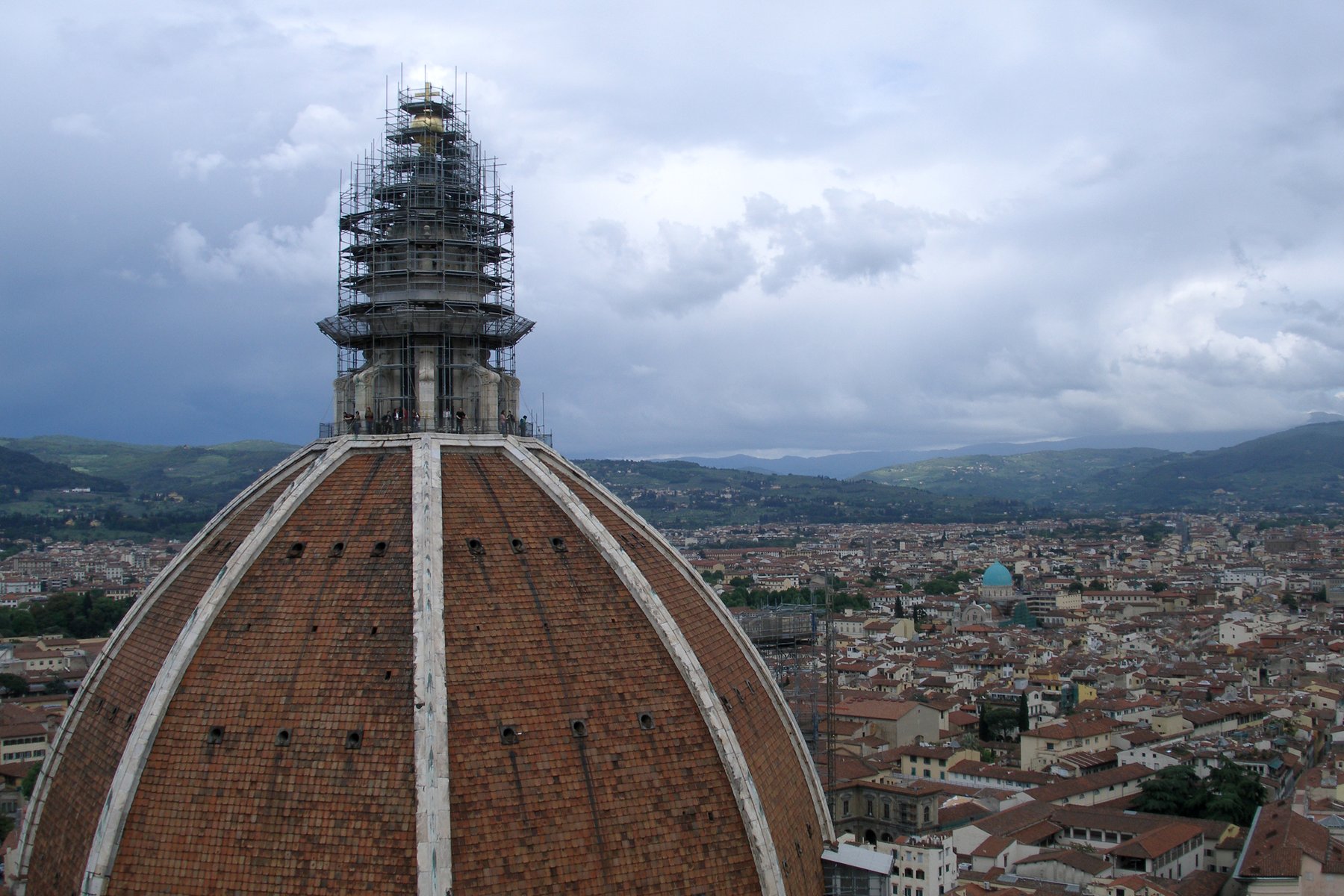
For about a hundred and twenty years, the largest cathedral in Italy had no roof. Construction had started in 1296, and the plan called for a dome over the crossing of the nave. The dome was supposed to span forty-five and a half meters. No dome that size had been built in Europe in a thousand years. The original architect, Arnolfo di Cambio, had died without explaining how he intended to close it. His successors continued building outward and upward, walls and tribunes, in the apparent hope that someone would eventually figure out the dome. By 1418, the walls were finished. The octagonal hole at the top was forty-five and a half meters across. Wind blew through it. Rain fell on the altar. The cathedral was the open-air center of the most ambitious city in Europe.
In 1418, the Opera del Duomo — the cathedral’s building authority — announced a public competition. Anyone with a plausible plan to close the dome could submit a model. The prize was the commission of a lifetime. Most of the submissions were nonsense. One proposed building a vast mountain of dirt inside the cathedral, baking the dome on top, and then digging the dirt out — coins to be mixed in with the dirt so the poor would carry it away one shovel at a time. Another proposed propping the dome on enormous wooden centering, scaffolding that would have required clear-cutting most of the forests of Tuscany.
The winning model was submitted by a forty-one-year-old goldsmith with a violent temper named Filippo Brunelleschi. He had no formal training as an architect. He had famously lost the competition for the Baptistery doors twenty years earlier to Lorenzo Ghiberti, after which he had quit Florence in a sulk and traveled to Rome to measure ruins. While Ghiberti spent two decades casting bronze relief panels, Brunelleschi spent two decades crawling around inside the Pantheon and the baths of Caracalla with a tape and a notebook. He came back to Florence in 1418 with a theory about how the Romans had built domes. He kept the theory to himself. His written proposal to the Opera said only that he could build the dome without internal scaffolding, that he would not reveal his method, and that anyone who copied him would have to deal with him personally.
He got the job. Mostly. The Opera, unable to evaluate his secrecy, also appointed Ghiberti as his co-architect, at equal pay. Brunelleschi treated this as the personal humiliation it was meant to be. The story of how he closed the dome is also the story of how he gradually maneuvered Ghiberti out of the project.
What Brunelleschi did not have
He did not have steel. He did not have rebar. He did not have modern cement. He did not, by his own choice, have internal wooden scaffolding — the standard way to build a vault, and the method everyone in 1418 assumed any dome would require. He did not have a working sketch of how the dome would be built; he had a method, but he refused to put it on paper. He did not have any predecessor of comparable scale to copy. The Pantheon, which he had measured in Rome, was a poured-concrete hemisphere on a heavy cylindrical drum. The Florence dome had to rise from an octagonal base ninety meters above the floor, and it had to be pointed — not hemispherical — to lean less heavily on the walls below.
What he did have was four million bricks, a quarry of Carrara marble, the entire civic budget of Florence, and a workshop of stonecutters who would do exactly what he told them.
The double shell
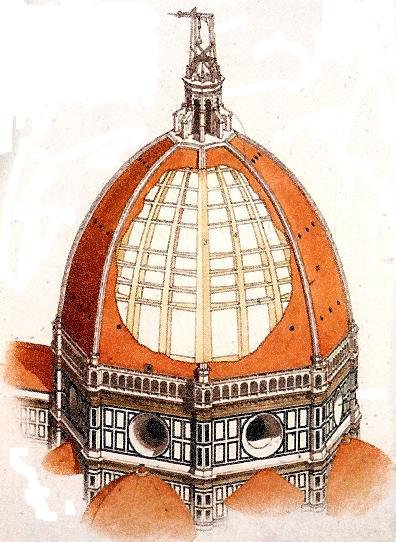
The first innovation was that the dome is not one shell but two. An inner dome, two meters thick, and an outer dome, half a meter thick, joined by eight major stone ribs and sixteen minor brick ribs. The space between the two domes is large enough to walk through. The reason for the doubling is mostly weight. A single solid shell at that span would have weighed enormously more than two thin shells with structural ribs between them. The doubling also gives the building the dome it appears to have from outside — tall, dramatic, pointed — without the weight that a real solid pointed dome would carry.
The eight major ribs are the visible white stone marble at the corners of the octagon. Walk around the cathedral outside and count them. They are not decoration. They are the structural skeleton. The brickwork between them, also visible from inside on the cupola climb, is the infill.
The herringbone
The second innovation was the herringbone. A standard brick wall lays courses of bricks flat, horizontal, with vertical mortar joints between them. A dome cannot use that pattern, because the bricks above the springing point have nothing to rest on while the mortar sets. The wet course slides off into the void below. This is why dome construction since the Romans had required wooden centering: the bricks need to lean against something while the mortar cures.
Brunelleschi laid his bricks in a spiral, with every fifth or sixth course set on edge in a vertical orientation. The vertical bricks broke up the horizontal courses into short segments. Each segment locked against the vertical brick at its end, transferring its weight onto the brick below before the mortar had set. The herringbone is, in essence, a self-supporting bond. The dome rose without scaffolding because each course was structurally complete the moment it was laid.
The pattern is also visible. Climb the dome — four hundred and sixty-three steps — and you walk between the two shells. The interior surfaces are bare brick. The herringbone is right there. You can put your hand on it. It is exactly what Brunelleschi laid down. The mortar around the bricks at chest height was mixed in 1430, applied with a trowel, and is still holding.
How he won the argument with Ghiberti
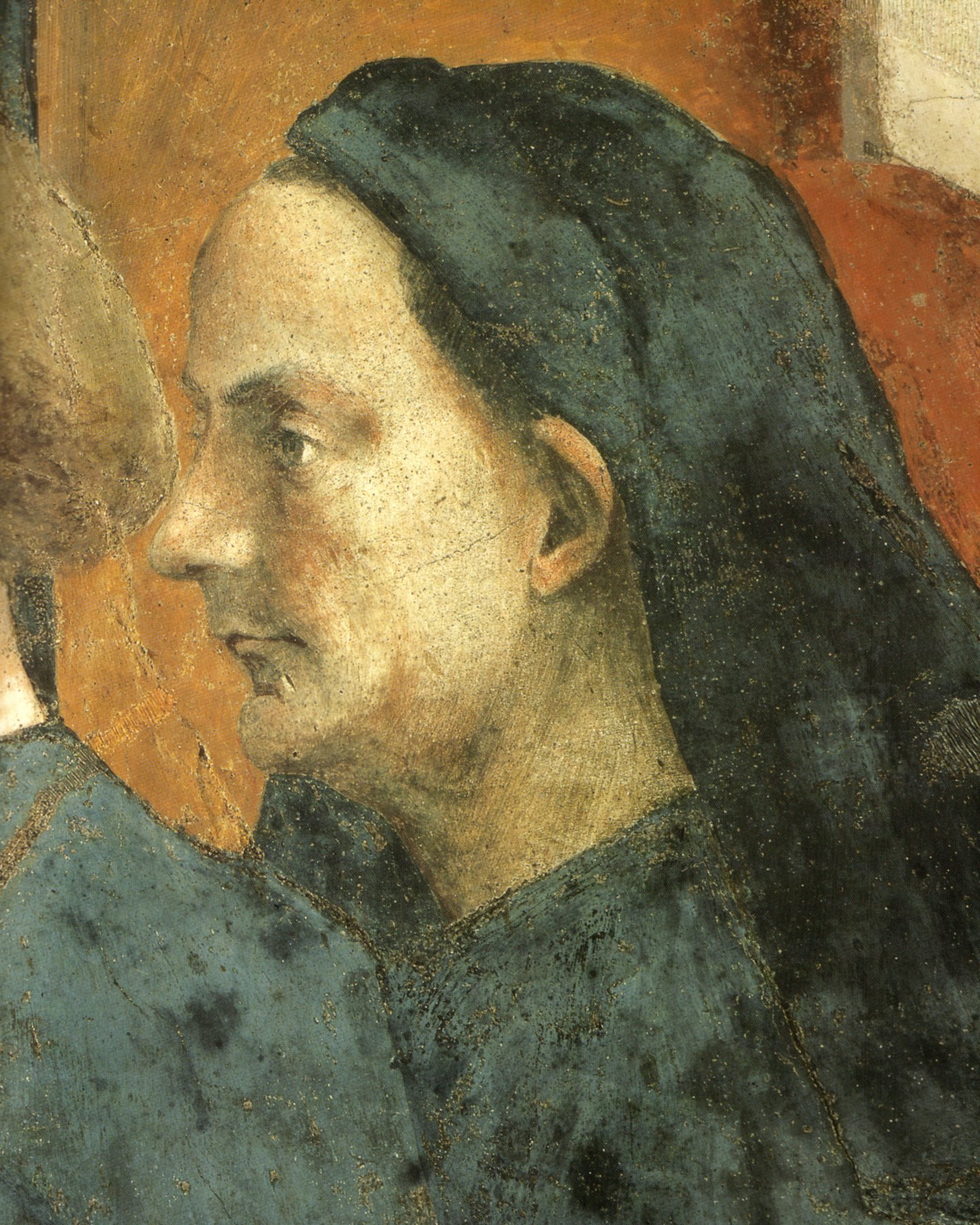
Brunelleschi could not work alongside Ghiberti. The story, repeated by Giorgio Vasari in the 1550s and probably embroidered along the way, is that Brunelleschi pretended to be sick in the middle of a critical phase of construction and refused to come to the worksite. Ghiberti had to take over. Within days, Ghiberti’s instructions to the masons were producing visible problems with the rib alignment. Brunelleschi returned, theatrically, just in time to fix everything. The point was made. From that day on, the Opera left Ghiberti’s name on the payroll but stopped consulting him about the dome.
Brunelleschi also invented or improved most of the machines used to build it. The ox-hoist that lifted stone from the floor of the cathedral to working height ninety meters above was his design. He patented it — the patent, granted by the Florentine government in 1421, is the first patent in modern history. He invented a reverse gear so the ox could keep walking in one direction while the load went up or down. He invented a counterweighted gripper that locked onto each stone block at the bottom and released it at the top without slipping. He paid the workers their wages on the dome itself, partly to save the time of having them come back down for lunch, and partly to keep them from drinking in the city. He installed a wine bar at the construction level. The workers ate and drank ninety meters above Florence for sixteen years.
The cap
The dome was structurally complete in 1436. Pope Eugene IV consecrated the cathedral on March 25 of that year. The lantern — the small marble tower on top that locks the structure together by adding compressive load at the apex — was started in 1446 from a model Brunelleschi designed but did not live to build. He died on April 15 of that year, at sixty-nine, almost as soon as the lantern was begun. He is buried in the crypt of the cathedral below his own dome. His tomb was lost for centuries and rediscovered in 1972 during a routine excavation. The slab is small and unmarked except for his name and a few lines in Latin describing him as the architect of the dome. It is just below the floor of the nave.
What is inside the dome
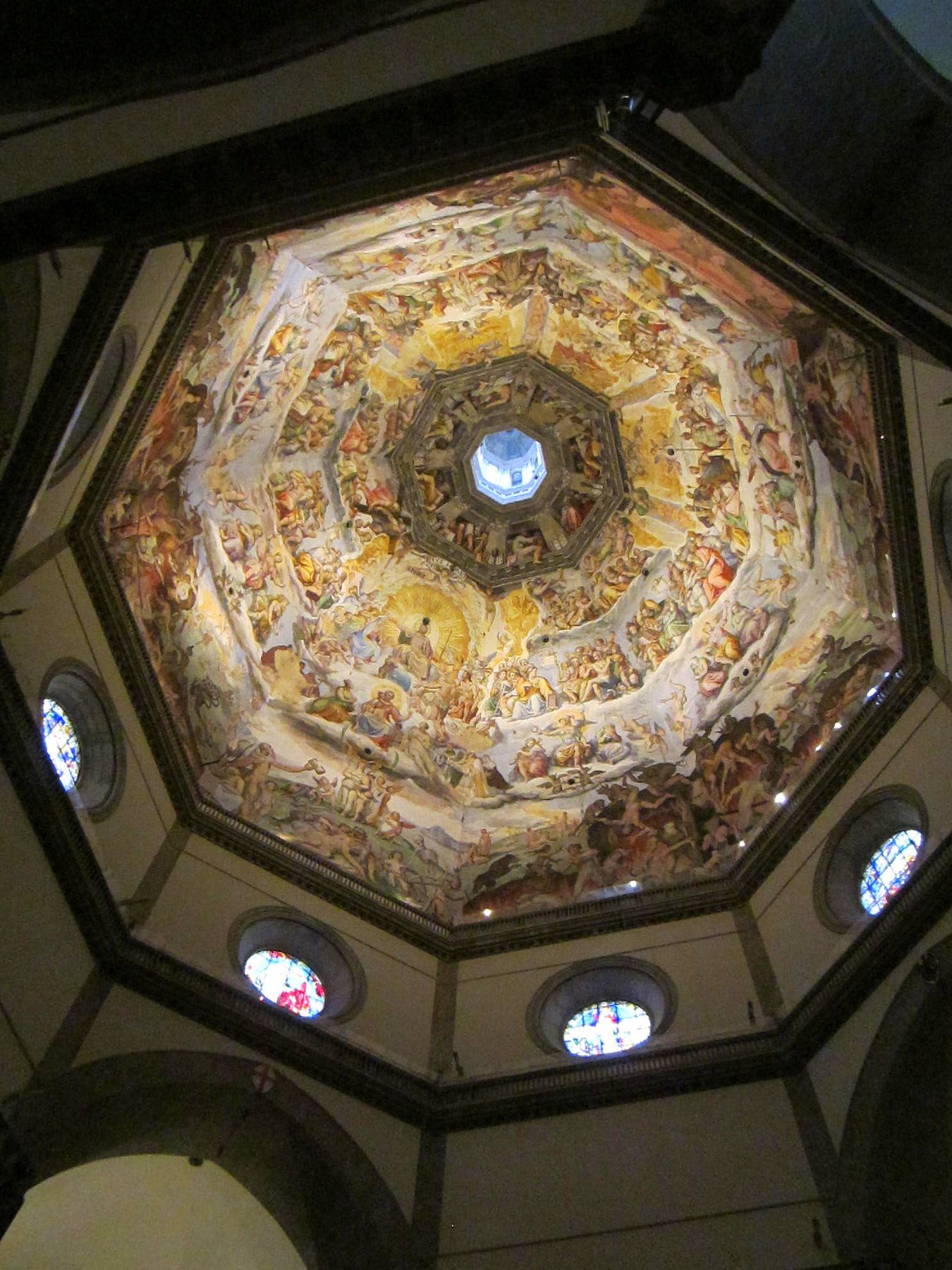
Brunelleschi died with the inside of the dome unfinished. He intended a coating of gold mosaic, in the Byzantine manner of Hagia Sophia, which would have made the inside of the dome a second sky of gold. The Opera spent a hundred and fifty years debating what to do and then, in 1568, gave the commission to paint the interior to Giorgio Vasari. The result is the great fresco of the Last Judgment that you see today. Vasari worked from 1572 to his death in 1574, leaving most of the lower registers unfinished. Federico Zuccari completed it in 1579. It is the largest fresco surface in the world, three thousand six hundred square meters. It is also, in many critical estimations, less than Vasari’s best work. The story it tells is theological rather than narrative; the figures are repetitive; the composition flattens at the equator of the dome rather than circulating. Brunelleschi would, almost certainly, have hated it. Chiaro reads the construction sequence from the inside of the dome — the springing course, the herringbone pattern, the ribs visible in the painted gores — while you crane your neck to look at the fresco, so the structure underneath the art comes back into view.
What to look for
Three things, in order of accessibility. First, from outside in any piazza of Florence, just stand and look at the silhouette. The dome rises above the city in pointed octagonal segments. It is the shape of a city deliberately announcing itself; every Florentine could see it from his front door and know which side of the city he was on. Brunelleschi planned that.
Second, climb the dome. The four hundred and sixty-three steps go up between the two shells, and the staircase passes through the herringbone brickwork. There is no other dome in the world where you can put your hand on the structure of the dome from inside while still standing on a usable stair. About halfway up, the inner curvature of the dome forces you to walk leaning inward, your shoulders tilted toward the axis of the building. This is what your body learns about the geometry that your eye has been missing.
Third, when you reach the top, walk outside onto the gallery around the lantern. The whole of Florence is below you, the Arno running through the middle. The roofs of the city are red tile because the dome is red tile, and four centuries of subsequent Florentine roofers matched the dome’s color. You are standing on the building’s most visible point, at the apex of an engineering argument that has been winning since 1436, and the city beneath you has been visually re-tuned to your altitude.
The Florence cathedral dome was the first great building of the Renaissance and the last great building of the Middle Ages, depending on how you read it. The herringbone is still there. The four million bricks are still there. The man with the temper who laid them out is in the crypt below your feet. He closed the biggest hole in Christendom by refusing to scaffold it from the inside, and the dome has stood, almost six hundred years now, without a single major structural repair.
Image credits
- Florence, Italy, Brunelleschi’s Dome of Florence Cathedral.jpg — Petar Milošević. Source, CC BY-SA.
- Filippo Brunelleschi, cutaway of the Dome of Florence Cathedral (Santa Maria del Fiore).JPG — Sailko. Source, CC BY.
- Masaccio, cappella brancacci, san pietro in cattedra. ritratto di filippo brunelleschi-184.jpg — Sailko. Source, CC BY.
- Firenze - Duomo, cupola affrescata.JPG — Sailko. Source, CC BY-SA.

.JPG)

