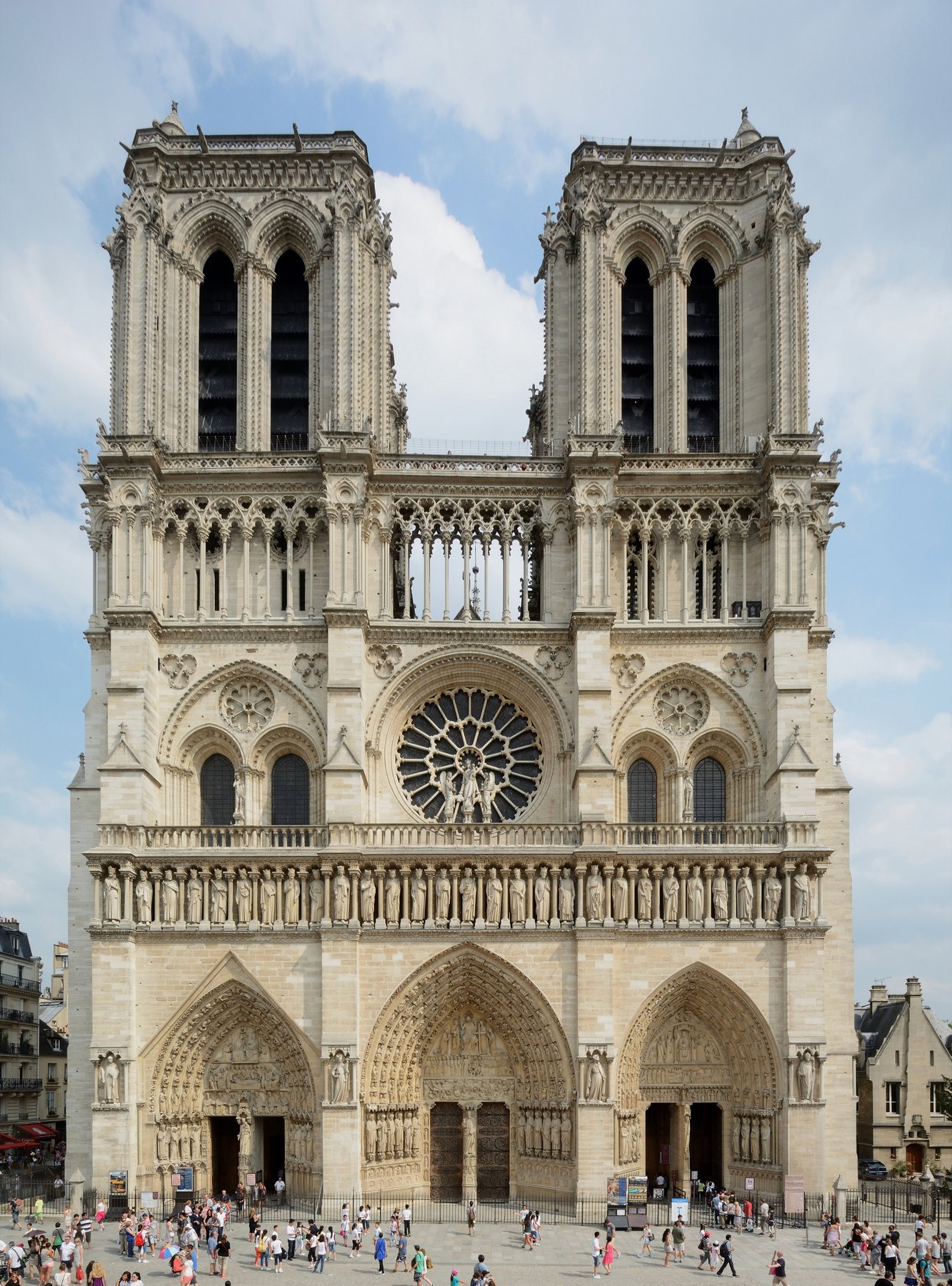
At 6:18 p.m. on Monday, April 15, 2019, the smoke alarm in Notre-Dame de Paris registered a high-temperature reading in the attic above the nave. The on-duty security agent dispatched to investigate went to the wrong attic. Half an hour later, the smoke detector at the correct location triggered. By that point, the great wooden roof structure of the cathedral, an oak forest of beams cut in the thirteenth century, was already on fire. Within ninety minutes, the central spire collapsed. The fire burned for fifteen hours.
What burned that night was eight hundred and fifty years old. The framework of beams that held up the roof, known to the cathedral workers as “la forêt” — the forest — had been made from about thirteen hundred oak trees felled between 1160 and 1170. Every beam was hand-shaped, with the marks of the medieval carpenter’s adze still on it when the fire took it. By the next morning, the forest was gone.
The cathedral reopened five years and seven months later, on December 7, 2024. What follows is the building, the fire, the rebuild, and what to look at when you walk in now.
What it was for
Construction on Notre-Dame de Paris began in 1163, on an island in the middle of the Seine, where the Romans had earlier built a temple to Jupiter and the Merovingian kings had later put up a smaller church. Bishop Maurice de Sully wanted a cathedral on a scale that would announce Paris as the new center of Christendom. The Île de la Cité was already the seat of the king. The cathedral was meant to put the seat of God next to it.
The technical problem was that the kind of cathedral Sully wanted — vaulted in stone, lit by huge windows, soaring to thirty meters at the keystone — could not stand by itself. Stone vaults push outward. Heavy walls at the base could hold the thrust, but heavy walls had no room for the windows. The solution, developed at Saint-Denis a decade earlier and refined at Notre-Dame, was to move the buttresses outside the building. The flying buttress is a quarter-arch of stone that braces the upper wall from a heavy pier set out in the churchyard. The thrust of the vault travels through the flying buttress, down the pier, and into the ground. The wall in between can be largely glass. The exterior of Notre-Dame, with its forest of buttresses around the apse and choir, is the engineering of the building made visible. The buttresses are not decoration. They are the building.
The spire that fell
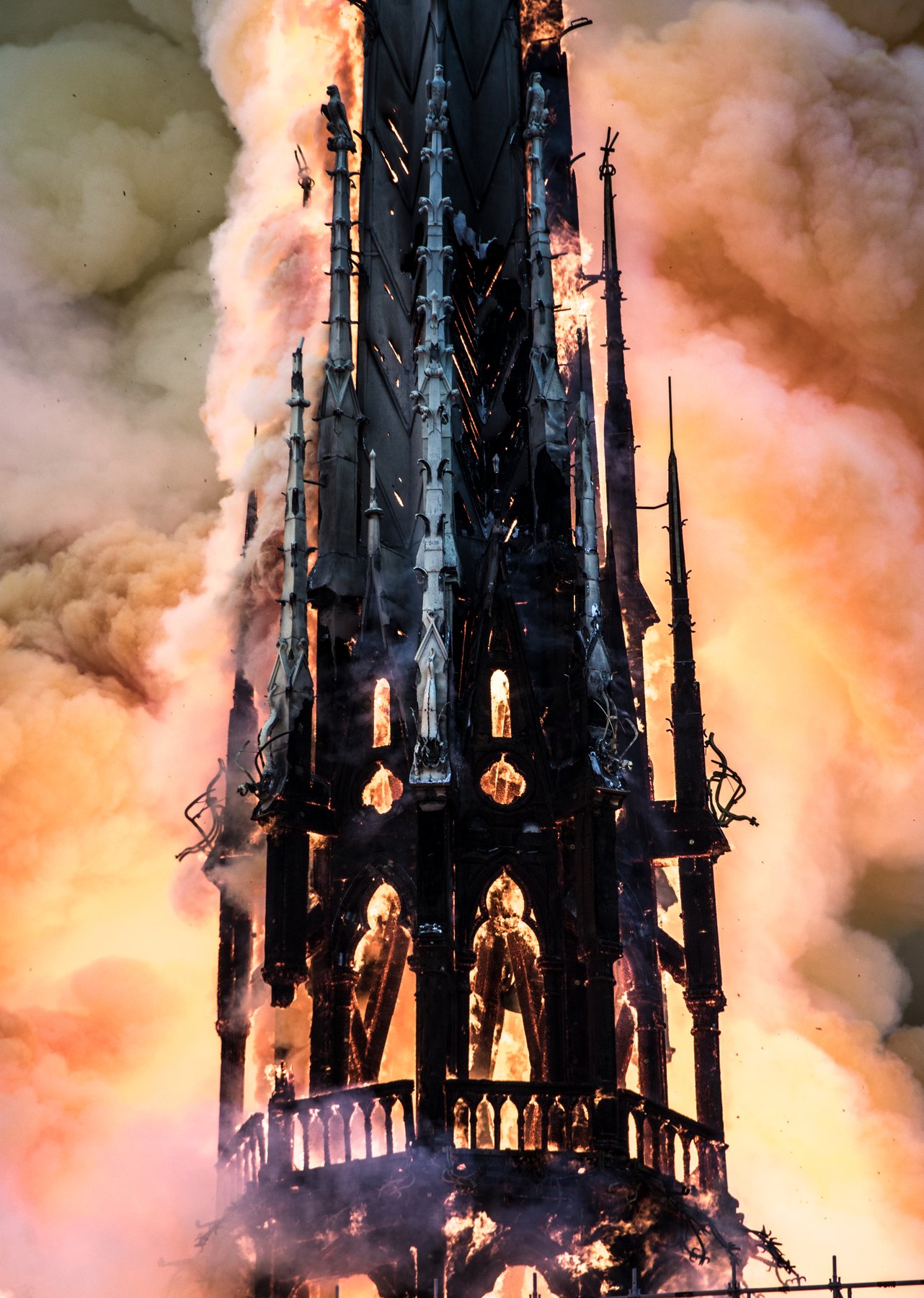
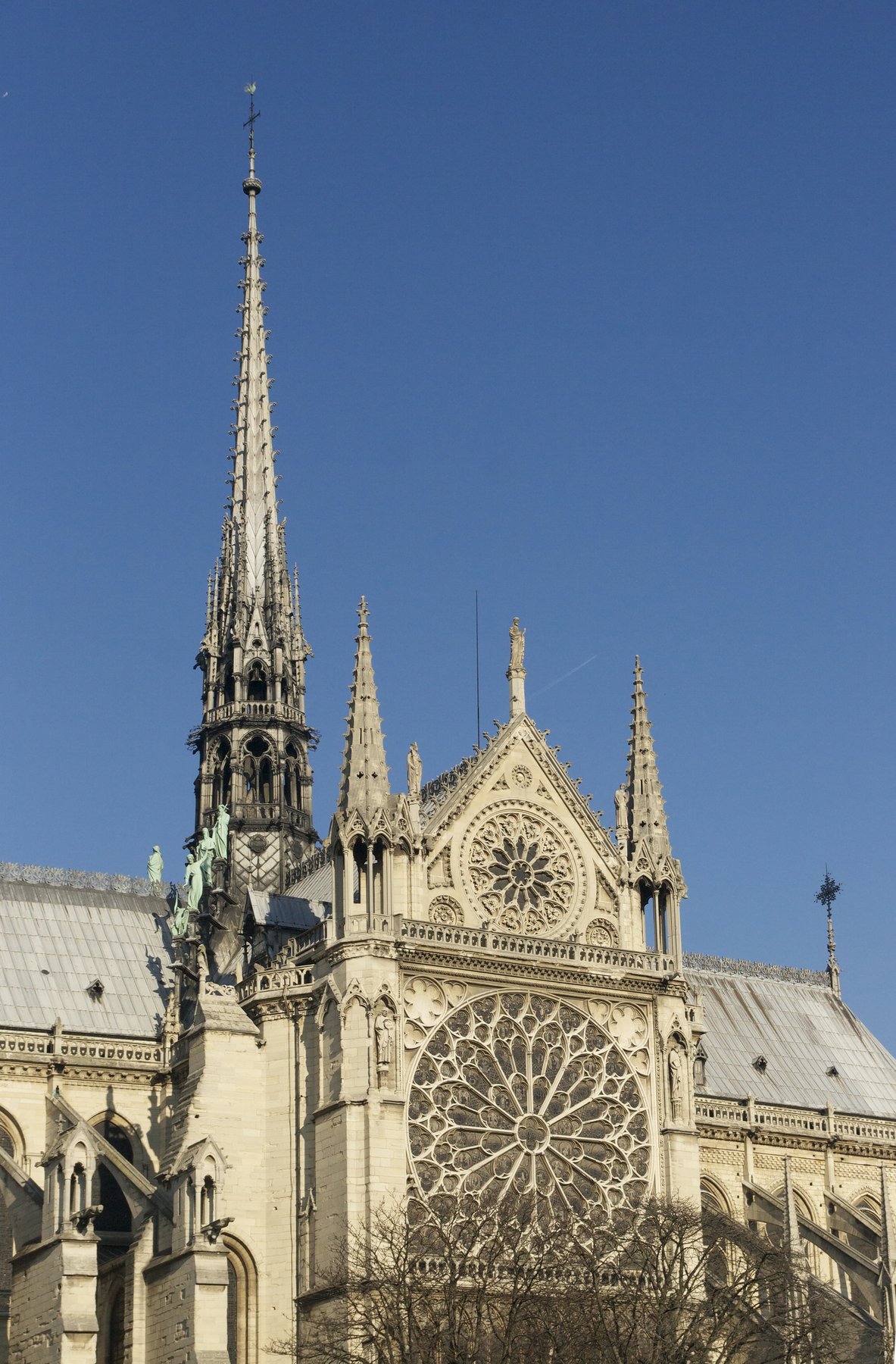
The spire that collapsed on the evening of the fire was not original. It was added between 1859 and 1864 by Eugène Viollet-le-Duc, the architect who restored the cathedral after a century of neglect during and after the French Revolution. The medieval spire had been removed in 1786 because it was rotting. For seventy-three years the crossing of Notre-Dame stood squared and roofless. Viollet-le-Duc designed his replacement at ninety-three meters in height, taller than the medieval original, in oak clad with two hundred and fifty tons of lead. He included statues of the twelve apostles at its base, looking out over Paris in four groups of three. He also added, at the foot of the apostle Thomas, a self-portrait. Thomas is conventionally the patron saint of architects. The face of Viollet-le-Duc looks up at the spire he had just designed.
Four days before the fire, on the morning of April 11, 2019, the twelve apostles and four evangelists were removed from the spire for cleaning and conservation. They were taken to a workshop in Périgueux. Eighty-two days later, they were the only large bronze figures still in existence from the spire. The lead-clad oak of the spire fell into the burning nave at about 7:50 p.m. on the fifteenth.
The decision after the fire was political. Should the spire be rebuilt as Viollet-le-Duc’s nineteenth-century design, or should a new contemporary spire be commissioned? The French government held a public competition. Architects from around the world submitted designs in glass, in titanium, in CLT timber. The competition was abandoned in July 2020. President Macron announced that the spire would be rebuilt identically to the one that had fallen. The new spire was raised by December 2023. It looks exactly like the one Viollet-le-Duc designed in 1859. The apostles came back from Périgueux. Thomas is at his post.
What the windows do
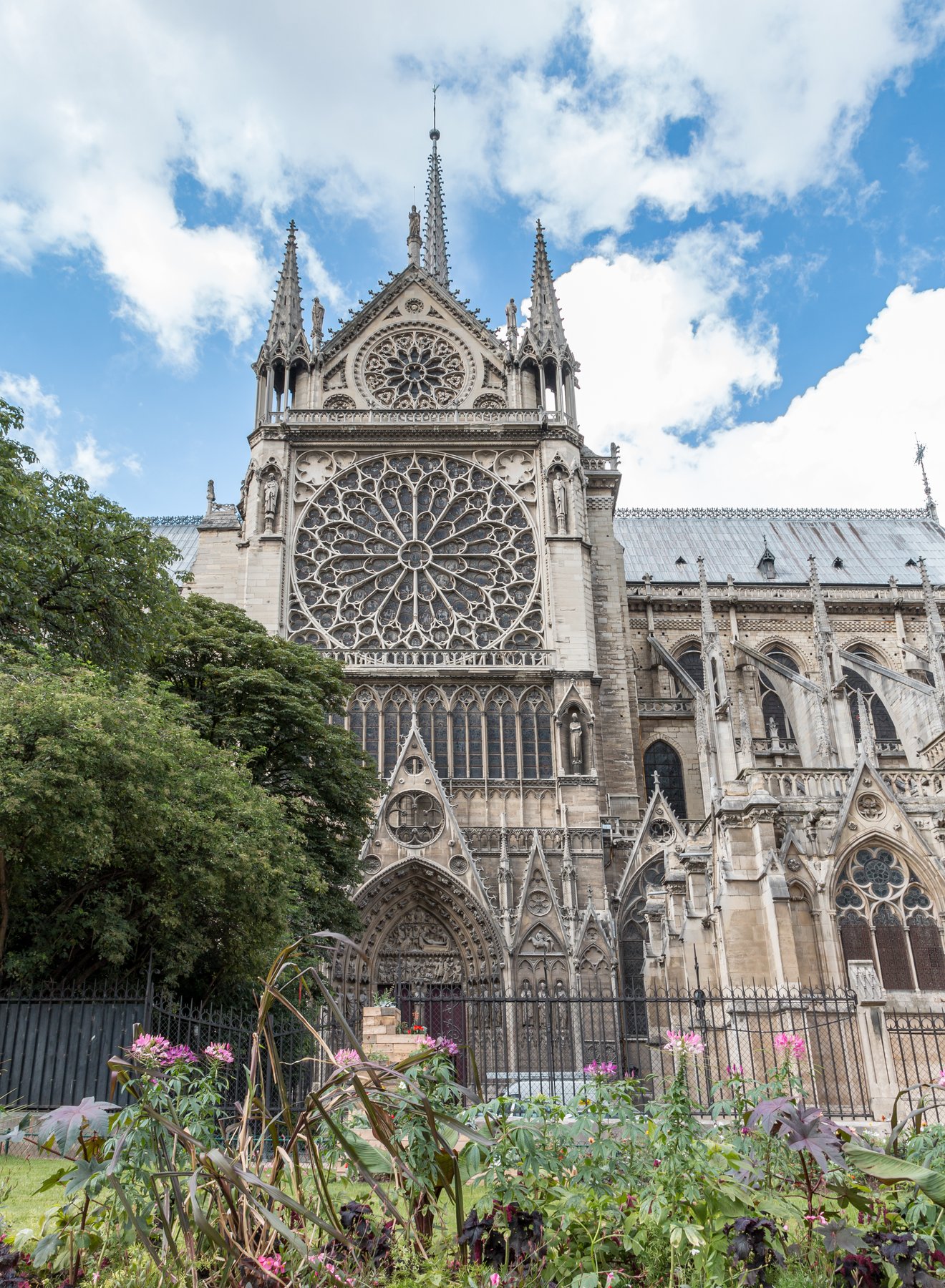
Notre-Dame has three rose windows. The west rose, above the main entrance, dates to the 1220s. The north rose, in the transept, was finished around 1250. The south rose, opposite it, was finished around 1260. The north and south rose windows are nearly thirteen meters across. About two-thirds of the medieval glass in the north rose is still original. The south rose has been heavily restored, most recently by Viollet-le-Duc.
The roses survived the fire intact. The lead caming that holds the glass softens at around three hundred and forty degrees Celsius, but the air temperature at the height of the rose windows during the fire stayed below that threshold; the heat went up through the roof, not sideways through the transepts. Conservators who entered the building the morning after the fire found the rose windows whole. The south rose had a few panels knocked loose by water pressure from the firehoses. None of the panels were lost.
A medieval stained glass window is a backlit theology. Each rose has a central figure — Christ in the north, the Virgin Mary in the south — surrounded by concentric rings of apostles, saints, prophets, and Old Testament scenes. The windows are read like wheels, from the hub outward, by viewers who could not read books. The cobalt blue of the deepest panels is a color the medievals called “Chartres blue,” after the cathedral that perfected it, and the recipe for the glass is partly lost. Modern attempts to match it produce a passable but slightly thinner color. The blue in Notre-Dame’s north rose is the original. Chiaro holds the figures of the apostles in the inner ring of the rose against the iconographic order they sit in — John at the upper right, Peter at the upper left, working clockwise — so the window reads as a sequence rather than as a static disc of light when you stand at the transept crossing.
What the fire took, and what it did not
What the fire took: the medieval roof timbers — the entire forest — and Viollet-le-Duc’s spire. The roof of the nave and the choir collapsed in flames into the vault below. The lead cladding of the roof melted and ran in molten rivulets that left blackened streaks down the exterior. The pipe organ, the largest in France with eight thousand pipes, was severely damaged by the heat and the water, though most of the pipes survived and were dismantled for cleaning. Several relics were lost or damaged. The cathedral’s three medieval clocks stopped at the times the fire passed each of them.
What the fire did not take: the stone walls. The vaulted stone ceiling held over almost the entire building, with two collapses where the spire and a section of the north transept came down. The flying buttresses held. The west facade with its three sculpted portals held. The bell towers held. The three rose windows held. The Crown of Thorns — a Christian relic Louis IX brought back from the Crusades in the thirteenth century, normally kept in the cathedral’s treasury — was carried out by the chaplain of the Paris fire brigade and laid on the pavement outside. So were many of the moveable objects and paintings. The chaplain, Father Jean-Marc Fournier, made multiple trips into the burning building. He had served as a chaplain to military units in Afghanistan. He later said the cathedral was the calmest assignment he had ever worked.
The rebuild
The rebuild took five years and seven months. The forest of medieval timbers in the roof was reconstructed using the original carpentry techniques — two thousand oak trees, mostly felled in publicly owned French forests, shaped by hand by traditional carpenters using axes and adzes. There are now videos of carpenters in Périgord and Burgundy raising the new forest with the same tools the original builders used. The new oak roof beams are the most labor-intensively crafted single object delivered in twenty-first century France. The visible stonework was cleaned of eight centuries of soot, leaving the interior much brighter than it had been before the fire. The pews are new. The lighting is new. The flagstones of the floor were lifted, the foundations beneath them excavated, and several previously unknown medieval and early-modern burials documented.
The cathedral reopened to the public on December 8, 2024. The first sunday mass after reopening was on the same date in 1864 that Viollet-le-Duc had completed his spire. The new spire glints in the same light. Eight hundred years of stone are still doing what they were built to do.
What to look for
Five things. First, from across the river, walk along the south bank to the Pont de l’Archevêché and look at the apse. The flying buttresses are best seen from this angle. They radiate out from the building like an open hand. They are the engineering of the cathedral made visible.
Second, walk in through the central portal of the west facade. Look up at the tympanum, the sculpted half-circle above the door. It shows the Last Judgment in three registers: the dead rising at the bottom, Christ judging in the middle, the saved going to heaven and the damned being shoved into the mouth of hell. The figures are medieval originals from the 1220s, with some heads replaced by Viollet-le-Duc’s nineteenth-century restorers. Look for the small differences in stone color: the older heads are darker, the replacements are paler.
Third, stand at the crossing where the nave and the transepts meet. Look up. The four ribs of the vault above you converge on a circular boss. This is where the original ceiling vault was holed by the falling spire. The new vault stone is brighter, slightly creamier, than the old. The seam is visible if you know where to look.
Fourth, at the transept crossing, swing your gaze left and right to the two rose windows. The north is the original medieval glass. The south is heavily restored. The blue tones differ slightly. The medieval blue is deeper and slightly more violet.
Fifth, walk out onto the parvis — the square in front of the cathedral. Find the bronze star set into the pavement just east of the central axis. This is point zero, the geographical center from which all road distances in France are officially measured. Every road sign in France that says “Paris 200 km” is measuring to that star. The cathedral is the literal center of France.
The fire is over. The forest is back. The Virgin and Christ are back in their roses. Notre-Dame still does what a cathedral is supposed to do, which is to be a hollow stone box pierced with colored glass, full of air and silence, in which a city can hold its breath for eight hundred years. The breath was almost lost on a Monday evening in 2019. It came back.


