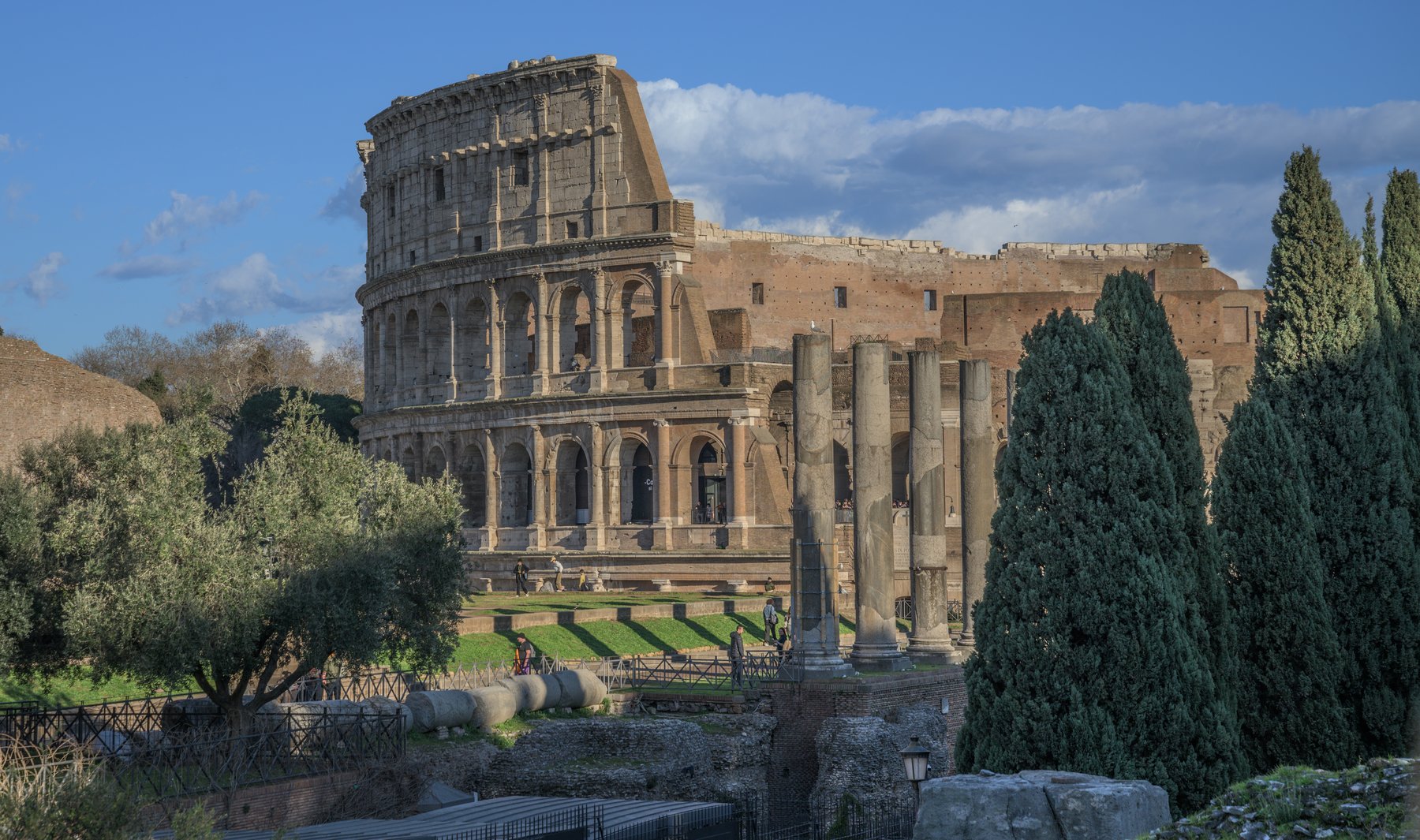
The opening games of the Colosseum, in the spring of the year 80, lasted one hundred days. The emperor Titus had ordered the inaugural program to celebrate the building’s completion. Surviving accounts say that nine thousand wild animals and several thousand fighters died in the arena over the course of those one hundred days. The floor was raked and re-sanded between bouts. A pulley system in the basement could change the sets between events in under five minutes. A retractable canvas awning, the velarium, was rigged across the top of the building by a hundred sailors from the imperial fleet to shade the seats. Free bread and wine were handed out from the entrances during the gaps. By the closing day, the Roman calendar had been re-aligned around the spectacle.
A stadium that could do this on day one had to be built unlike any stadium before it. The Colosseum is what happens when the most overengineered civilization on earth decides to build a public amusement park.
The basics
The official name is the Flavian Amphitheatre. The Flavian dynasty — Vespasian, then his sons Titus and Domitian — began construction around 72 AD on the drained bed of an artificial lake that Nero had built for his own pleasure palace. Vespasian was a soldier-emperor, fresh from a war in Judaea. He used the wealth and the captive labor of the Judaean campaign to pay for the project. The Arch of Titus, just up the slope from the Colosseum, shows the looted treasures of the Jerusalem temple being paraded through Rome. The seven-branched menorah from the temple is on that arch. Some of that loot built the building you walk into.
The Colosseum is an oval. The long axis is one hundred and eighty-eight meters; the short axis is one hundred and fifty-six. Three external storeys of arcaded arches, plus a closed fourth attic level, rise to about forty-eight meters. The fabric is travertine, the local Roman limestone from the quarries at Tibur, held together not with mortar but with iron clamps set in molten lead. The clamps were quarried out in the medieval period and the holes are still visible in the walls.
The capacity has been debated for two hundred years. The current consensus, based on the seat width and the surviving rows, is roughly fifty thousand spectators with the building full. The historian Edward Gibbon famously put it at seventy-five thousand, but he was estimating standing room. Either way, it was the largest building of its kind in the Roman world, and held its capacity record until the construction of the Maracana in 1950.
How the crowd got in and out
A modern stadium of fifty thousand people takes about an hour to empty after a major event. The Colosseum could do it in roughly fifteen minutes.
The Colosseum had eighty entrance arches at ground level. Seventy-six of them were numbered for ticket holders. Roman tickets were small pottery tokens, called tesserae, marked with a section, a row, and a seat. The ticket holder walked through the numbered arch that matched the first digit on his token, climbed a stone staircase, and emerged at his seat from a vaulted corridor called a vomitorium. The word does not mean what you think. It means “the place that ejects” — the architectural opening through which the crowd was poured into and out of the seating bowl. Modern stadiums still use the term. The original vomitoria of the Colosseum are still there, and you can still walk through them.
The result of having eighty independent exits arranged around the perimeter is that no spectator had to walk through another spectator’s section to leave the building. Distribute fifty thousand people across eighty channels and each channel handles fewer than six hundred and twenty-five. At a normal walking pace, that empties in fifteen minutes. No modern stadium architect has improved on this geometry.
The basement that was hidden
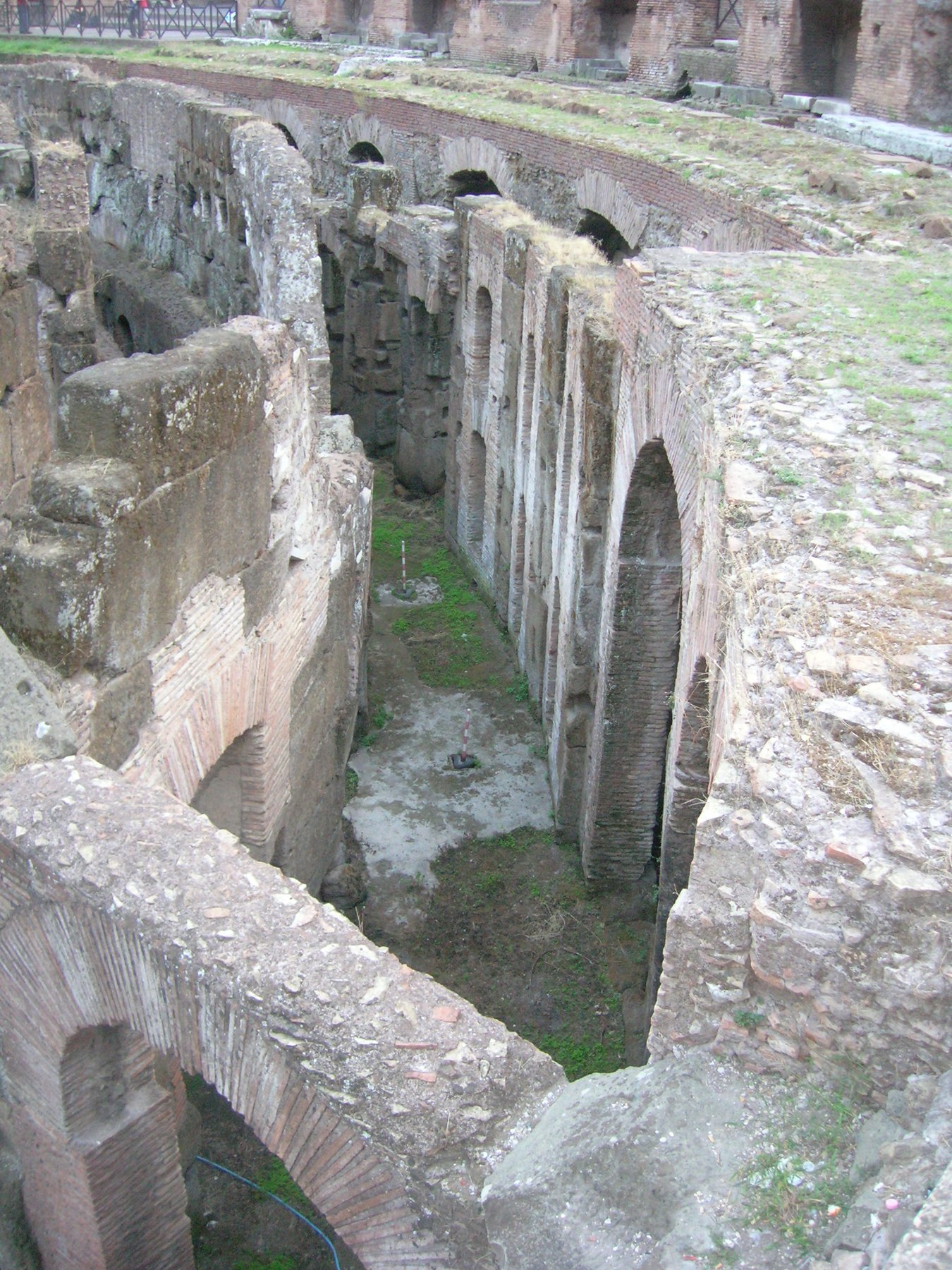
The arena floor was wooden, covered with sand, and supported on a network of brick walls and arches beneath. That network is the hypogeum. It is what you are looking at when you peer down into the open belly of the building today. The wooden floor was removed in late antiquity and never replaced.
The hypogeum was the backstage. Cells for gladiators and slaves, ramps for the wagons, holding rooms for the wild animals, and a system of thirty-two trapdoors and counterweighted elevators that lifted men and beasts directly up into the arena. A leopard could be uncaged from below, hoisted, and released through a panel at the level of the sand in under thirty seconds. The crowd above had no idea where it was coming from. Some accounts describe a set change in which a hunting scene in a fake forest was raised through the floor in minutes, complete with live trees, then taken down again for the next event.
The hypogeum also had a drain. The Colosseum could be flooded for staged naval battles, the naumachiae. The historian Cassius Dio describes one such battle staged for the inaugural games, with the arena filled to about three feet of water and crewed warships fighting until one side sank. The drainage system is engineered into the foundations, fed by the same aqueducts that ran the city’s fountains. After Domitian put in the permanent hypogeum, full flooding was no longer possible. The naval battles moved to a purpose-built artificial lake in Trastevere. But for the first decade of the building’s life, the floor of the Colosseum was both a stage and a lake.
What actually happened in there
The gladiator fights were the middle of the day. Mornings were for the venationes, the staged hunts of wild animals — lions, bears, leopards, hippopotamuses, rhinoceroses, elephants. Around midday, between the morning and afternoon programs, criminals condemned to death were executed in the arena, often by being thrown to animals or being forced to play roles in mythological reenactments that ended in their actual death. The afternoon was the gladiators.
Gladiators were a specialized profession. Some were slaves, some were prisoners of war, some were free volunteers from the urban poor who signed contracts called auctoramentum surrendering their legal status for a guaranteed wage and food. They lived in barracks, the largest of which, the Ludus Magnus, sat about a hundred meters east of the Colosseum and connected to it by an underground tunnel. They trained for years. Most fights did not end in death. A gladiator was an expensive investment, and the editor of the games — usually the emperor — was reluctant to lose property. The thumb-down gesture of modern legend is poorly attested. The historical signal for sparing a fighter was called missio, and was granted in the majority of recorded fights.
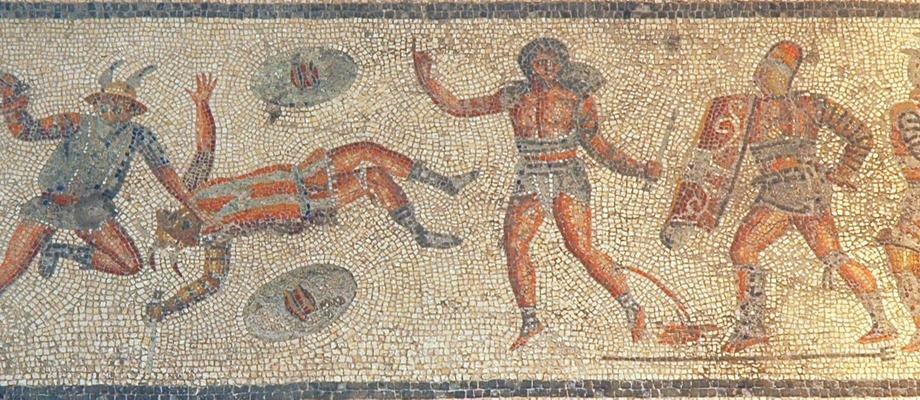
The Zliten mosaic, a Roman pavement found in Libya and now in the Bardo Museum, shows actual named fighters in standard combat pairings. It is one of the few visual sources that names individual gladiators. You can read their names above their heads. The mosaic was the floor of a triclinium, a dining room. A wealthy Roman in coastal Libya was eating dinner above pictures of his favorite arena fighters. Chiaro reads out the surviving fight contracts and the audience-side cues — which seat the emperor took, which signal the crowd would shout for missio, what the trumpets meant — while you are standing at the rail looking down into the hypogeum, so the layered theater of the place rebuilds itself around you.
What to look for
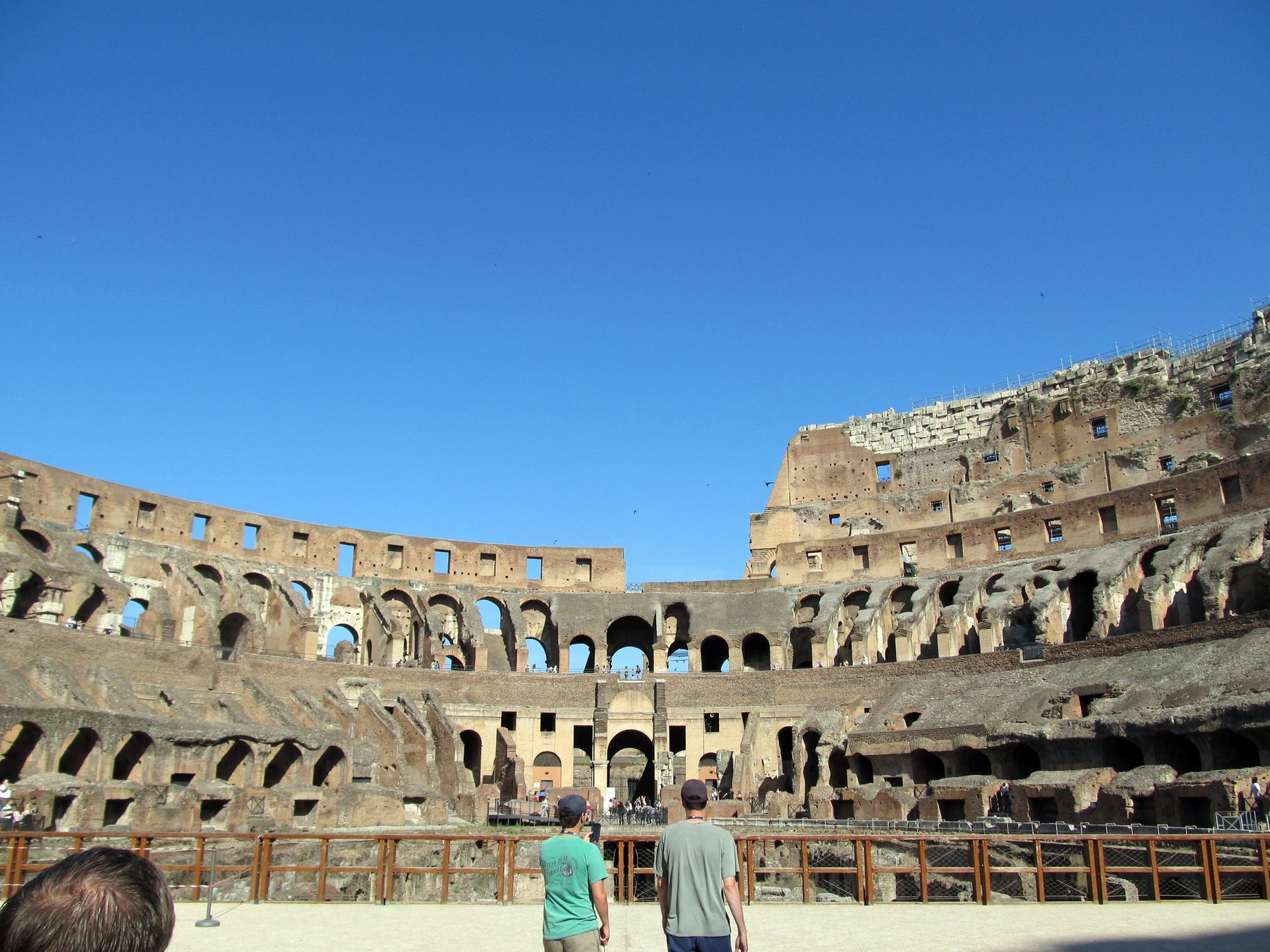
Four things to notice when you are inside. First, look up at the outer wall on the south side — the half that is still standing at full height. The three orders of column heads stacked on each story are Doric at the bottom, Ionic in the middle, Corinthian at the top. The orders get more ornate as they rise, an architectural commentary on social hierarchy: heavier and simpler at the bottom, lighter and more decorative at the top, just like the seats inside, where senators sat on the lowest tier and the urban poor and women sat at the top.
Second, find one of the holes where an iron clamp was once embedded. They are everywhere on the lower walls. They are also the reason the building looks pocked. The medieval Romans, for whom the Colosseum was a quarry, stole the metal first.
Third, walk through a vomitorium and look at the way the corridor opens. The masonry funnels you outward visually as you exit. A vomitorium was designed not just for crowd flow but for crowd psychology.
Fourth, look for the cross on the floor. A wooden cross stands today at one edge of the arena to commemorate the Christian martyrs who, according to medieval tradition, were killed there. The historical evidence is thin — no record of Christian executions specifically in the Colosseum survives from the period — but the cross is real.
The building has been a quarry, a fortress, a Christian shrine, and a tourist attraction. Two-thirds of the outer wall is gone. The wooden floor is gone. The marble seats are gone. What is still there is the geometry: eighty arches, fifteen-minute exit, oval inscribed in geometry that has dictated stadium design for two thousand years. The roar is gone too, but the building still amplifies sound. Stand in the center where the arena floor would have been, snap your fingers once, and listen. The clap that comes back is the closest you will get to the noise of a Roman afternoon.
Image credits
- Colosseum of Rome and Roman forum.jpg — Diliff. Source, CC BY-SA.
- Colosseum hypogeum.JPG — Jorge Royan. Source, CC BY-SA.
- Gladiators from the Zliten mosaic 2.JPG — Photographed at the Bardo Museum, public domain (mosaic ca. 200 AD). Source.
- Colosseum Interior 1 (15005911295).jpg — David Stanley. Source, CC BY.


.jpg)