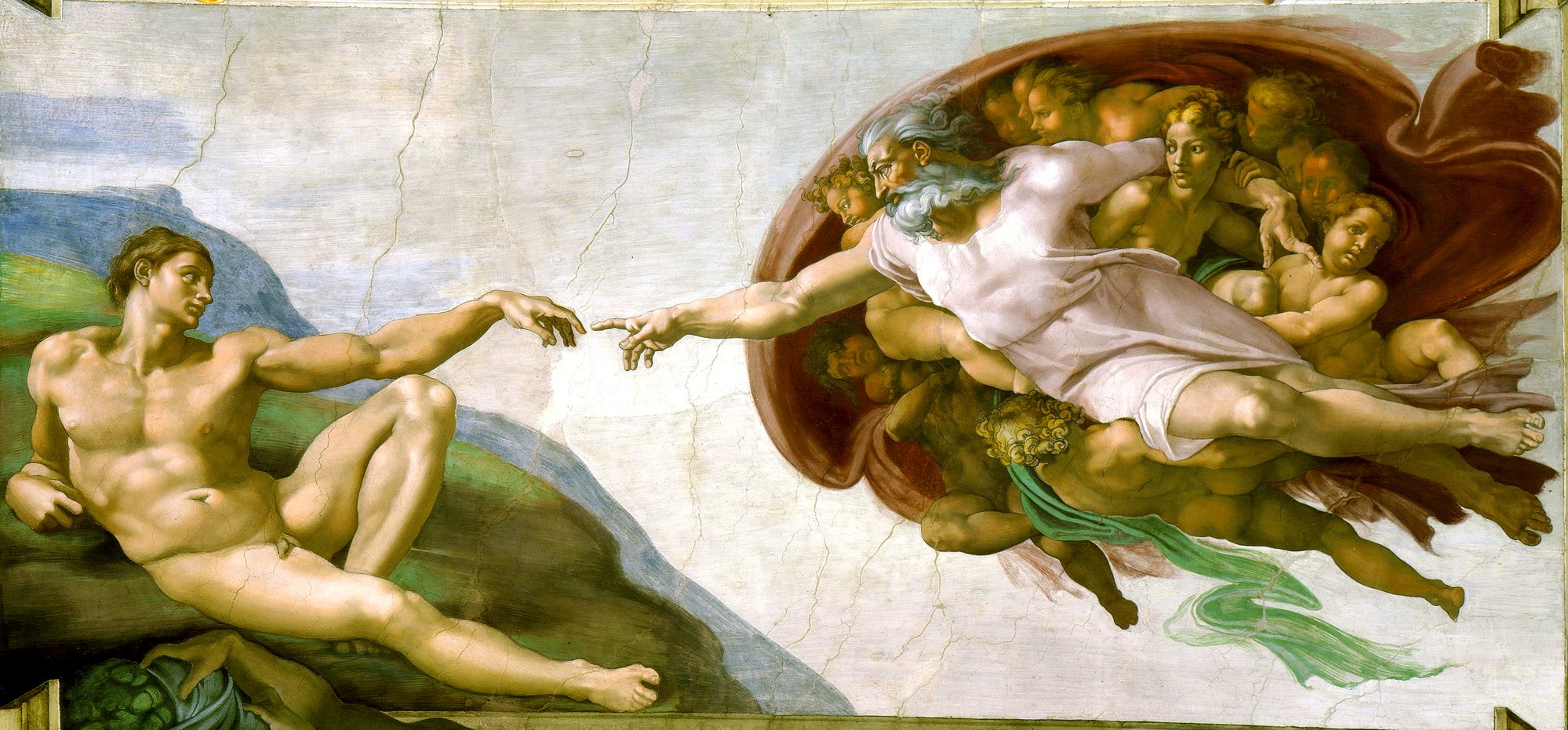
In October 1990, an obstetrician from Indianapolis named Frank Lynn Meshberger published a two-page paper in the Journal of the American Medical Association that did something a thousand art historians had failed to do for four hundred and seventy-eight years. He looked at the ceiling of the Sistine Chapel and noticed that the billowing red shape surrounding God in the Creation of Adam is a cross-section of the human brain.
Not a vague resemblance. Not a pious metaphor. An anatomically accurate diagram, with the sulci in the right places, the brainstem descending where the brainstem descends, and the pituitary stalk dropping down exactly where a neurosurgeon would expect to find it. Once you have seen it, the fresco stops being a religious scene and starts being an argument. The question is what the argument is about — and how a man who had been painting on his back for three and a half years smuggled a human brain into the middle of the Vatican without anyone noticing for nearly half a millennium.
The Creation of Adam hidden meaning a doctor spotted
Meshberger was not an art historian. He was a practicing OB-GYN who spent his days delivering babies in Indiana and his evenings reading about Michelangelo. The puzzle that consumed his off-hours had a simple origin: he kept looking at the panel and thinking the red drapery behind God did not look like drapery. It looked like something he had dissected in medical school.
So he traced it. He overlaid the outline of the cloak onto a textbook illustration of a sagittal cross-section of the brain, and the match was almost embarrassing. The frontal lobe sits where God’s shoulder pushes forward. The temporal lobe bulges under the angel whose knee tucks against God’s ribs. The brainstem runs down toward the green sash, which itself traces the vertebral artery. There is a little tuft in the lower middle of the cloak that matches the pituitary gland. The empty space behind God, the dark void where Michelangelo left the fresco almost bare, is the pons.
“I suggest that Michelangelo, a skilled anatomist,” Meshberger wrote, “concealed within his depiction of God the image of the brain, thereby making a statement about the nature of divinity.” The paper ran three columns, had one diagram, and changed how every serious visitor looks up in the Sistine Chapel. It was not received as heresy. It was received as the thing that had been there all along, hiding.
A sculptor told to paint
To understand why the Creation of Adam brain appears where it does, you have to understand that Michelangelo Buonarroti did not want to be on the scaffold in the first place. In 1508 he was thirty-three years old, already famous for the Pieta in St. Peter’s and the David in Florence, and he considered himself a sculptor. Paint was for other men. He had painted almost nothing, certainly nothing on the scale of a chapel ceiling, and when Pope Julius II summoned him to Rome and announced that he would be frescoing the vault of the Sistine, Michelangelo tried to get out of it.
He believed the commission was a trap engineered by his rival Donato Bramante, the architect of the new St. Peter’s, who wanted him to fail at a medium he did not know. He wrote to a friend that he was being set up. The Pope refused to hear it. Julius was a warrior pope, a man who had personally led armies into the field in full armor, and when he decided a thing was going to happen, it happened. Michelangelo climbed the scaffold in the spring of 1508 and started mixing pigment with plaster.
He painted for three and a half years. He painted lying on his back — that part is true, despite the myth that he stood. He painted with plaster dripping into his eyes and beard, with his neck bent so far backward that he wrote a sonnet complaining he had become a Syrian bow, a bent thing, his face a mosaic floor for the ceiling’s drippings. He fired his assistants in a rage one morning and painted most of it alone. He was paid in installments and paid late.
And when he was done, he had painted more than three hundred figures across nine central panels, running the length of the chapel from the altar to the door, telling the story of Genesis in reverse. You walk in at the end of the story — the drunkenness of Noah — and the fresco marches back in time toward the beginning. The Creation of Adam is the fourth panel from the altar end. It is not the most dramatic. The Separation of Light from Darkness has more fire. The Flood has more people. But the Creation of Adam is the one you have seen on a magnet, on a t-shirt, on an iPhone case.
Creation of Adam fingers that never touch
Two fingers, almost touching, with a gap of maybe an inch and a half between them. Meshberger is not the only writer to have noticed that the gap is the whole picture. If the fingers touched, the painting would be finished. Adam would be alive. The story would be over. The gap is the instant before. It is the moment Michelangelo chose to freeze, because the moment of almost is more interesting than the moment of arrival.
But look at the fingers themselves. God’s right index finger is taut, extended, reaching. Adam’s left is slack, limp, falling. The standard reading is that God gives life and Adam receives it. That is what the placards say, and that is what a hundred million tourists have been told. It is also, almost certainly, wrong.
Adam is already alive in the panel. His eyes are open. His body is muscled and formed. He is reclining like a young king on a hillside, looking at God with something that is not quite worship — more like recognition. If the picture were about the gift of biological life, Adam would be lifeless until the spark arrived. He is not lifeless. He is waiting.
What God is giving, if you read the composition the way Meshberger read the cloak, is something else. He is giving the thing that makes Adam human rather than animal. He is giving a mind.
Anatomy in the Sistine Chapel, hidden in a cloak
This is where the brain comes in. If the painting were about the gift of a soul, you would expect the soul to be somewhere visible — a dove, a beam of light, a flame. None of that is there. What is there is God, surrounded by angels, embedded inside an organ-shaped cloud of red cloth.
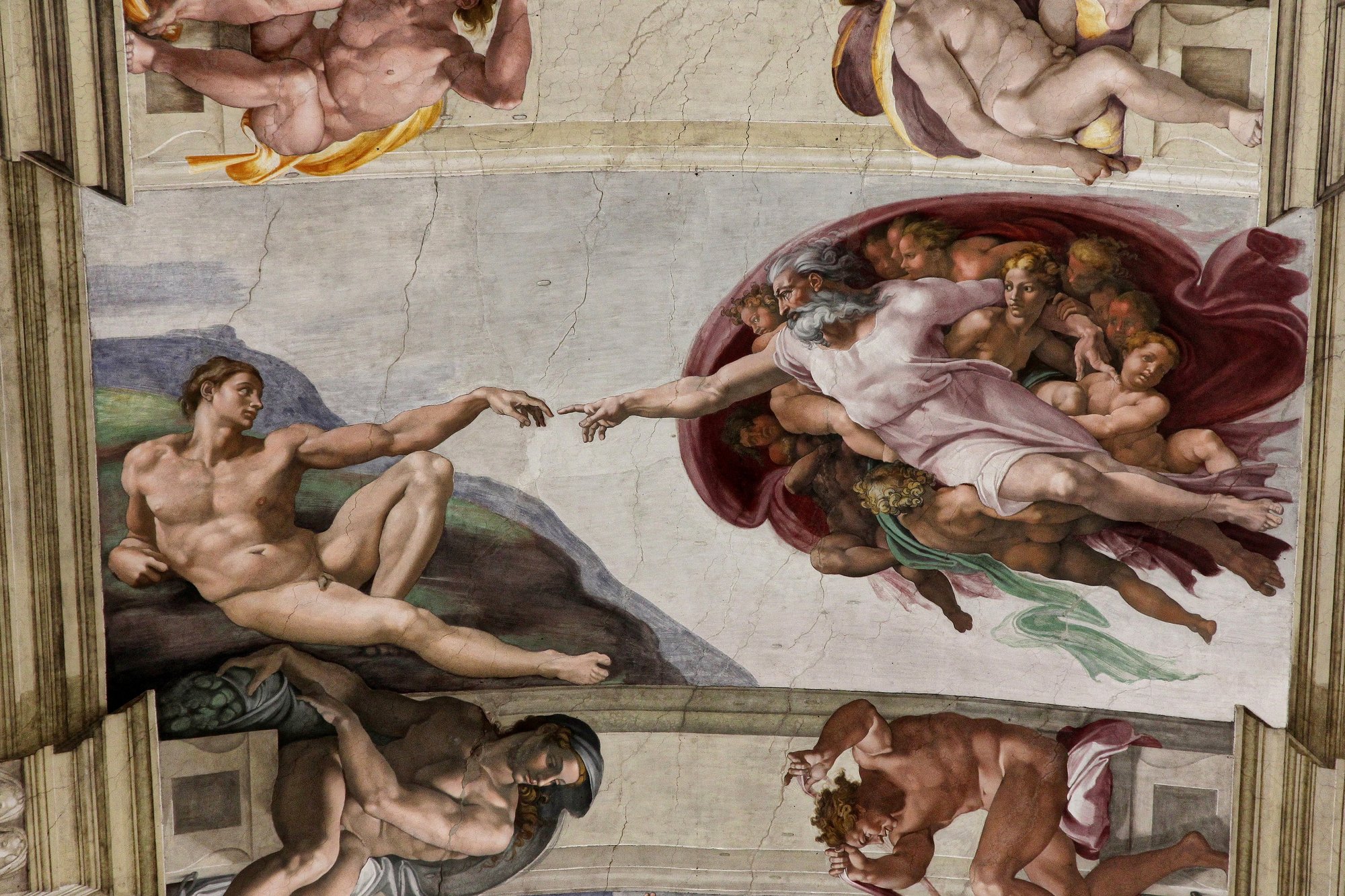
Meshberger walked through it structure by structure. The outer contour of the cloak traces the brain’s outer surface, including a very specific dip where the Sylvian fissure separates the frontal and temporal lobes. The angel directly below God, whose body curves under God’s right arm, occupies the position of the cerebellum. A second angel’s leg dangles where the brainstem descends. A foot extends where the spinal cord would. The optic chiasm, the pituitary, the hypothalamus — each has a corresponding feature in the drapery. The green scarf that floats out behind the cloak is the vertebral artery.
And there is a small detail in the lower middle, a little nubbin, that Meshberger identified as the pituitary gland, the master gland that governs the endocrine system. In the fresco, a child angel’s leg is positioned so its ankle and foot align precisely with the pituitary’s position in the diagram. It is the kind of thing you cannot explain by accident. Michelangelo put a child’s foot where the gland governing growth and reproduction would be, and he put it there in 1511, three hundred years before anyone in Europe would publish the modern anatomy of the pituitary.
The Sistine Chapel brain is not the only hidden piece of anatomy in the cycle either. In 2010 a pair of neuroanatomists from Johns Hopkins named Ian Suk and Rafael Tamargo published a follow-up paper identifying a brainstem inside another panel, the Separation of Light from Darkness. God’s neck in that panel, they argued, is rendered as a cross-section of the human brainstem, with the structures visible through a stretched membrane of skin. The argument in both papers is the same. Anatomy is not decorative. It is the subject.
Michelangelo the anatomist
How did a painter know what a brain looks like from the inside? Because he had cut one open.
By 1508, Michelangelo had been dissecting human corpses for nearly twenty years. He started as a teenager in Florence, working in the dead house of the Santo Spirito hospital, where the prior had granted him permission to cut up the bodies of patients who died without families to claim them. He carved a wooden crucifix as payment. The Michelangelo anatomy secret, if it was ever a secret, is that he saw more human interiors than any painter of his century.
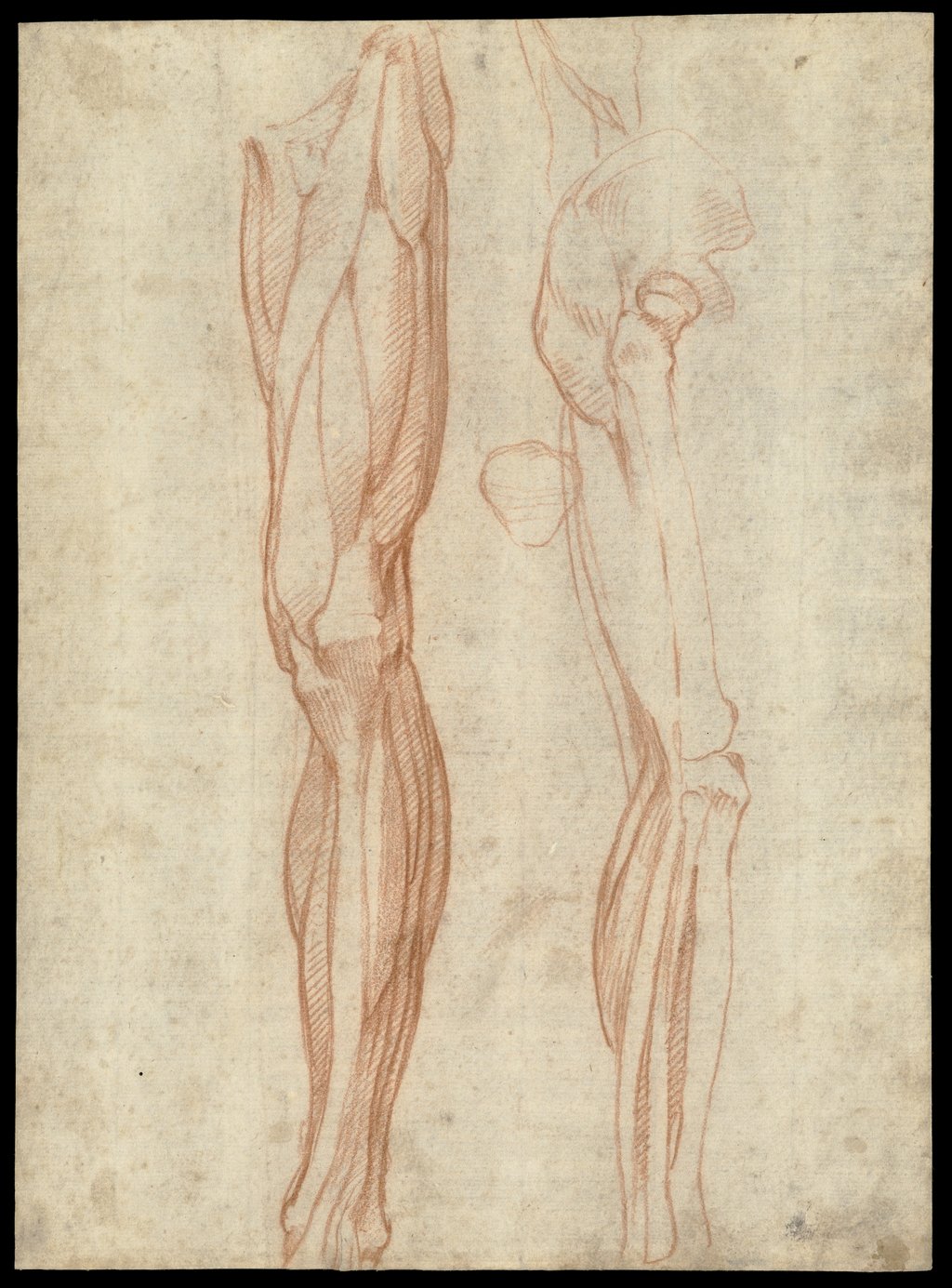
He drew what he saw. Dozens of his anatomical drawings survive, in red chalk and black chalk, muscles flayed and joints exposed, some of the drawings so detailed that twentieth-century surgeons have used them as teaching aids. He understood the arrangement of the abdominal muscles, the way the trapezius inserts into the shoulder blade, the curve of the spine under tension. He understood the brain. He had held a brain.
This matters because the standard defense of the standard reading — that the cloak is just a cloak, that Meshberger is pattern-matching — requires you to believe that a trained anatomist, given the freedom to design a scene about the creation of human consciousness, painted drapery that happens to match the organ of consciousness by coincidence. It is not impossible. It is simply improbable to the point of straining belief.
What Michelangelo could not say aloud
If Michelangelo did put a brain in the cloak on purpose, the question is why. And the best answer is the one Meshberger implied without spelling out: because he could not say it in words.
The theological climate of 1511 did not have room for the statement that God’s gift to humanity was consciousness rather than soul. The soul was a category the Church had settled. It was infused at conception. It was immaterial. It had nothing to do with the pink jelly inside the skull. To suggest that the divine spark was a matter of brain chemistry would have been, at best, a philosophical scandal. At worst, it would have been heresy, and heretics in Rome in 1511 had short life expectancies.
But Michelangelo was a Neoplatonist, raised in the court of Lorenzo de’ Medici, educated alongside Marsilio Ficino and Pico della Mirandola. The Neoplatonic idea that divinity expresses itself through the human capacity for reason was not fringe; it was the intellectual furniture of the Florentine humanist circle Michelangelo grew up in. He would have read Pico’s 900 Theses and the Oration on the Dignity of Man, which argued that what separates humanity from the beasts is the intellect, the power to reason, the mind.
You could not paint an argument like that on a chapel ceiling in 1511. You could, however, paint a brain. And you could do it in a way that a scholar looking at the ceiling would recognize, while a cardinal walking through would see only the drapery and the angels. It is the same strategy Galileo would later use with his telescope: say the controversial thing in a form that only the initiated can read.
This is the reading most historians who take Meshberger seriously now accept. The gift across the gap is not a generic life force. It is the capacity to know.
What is behind God in the Creation of Adam
Count the figures behind God. There are eleven of them, angels and children, huddled under his outstretched arm, pressed into the red cloak. Art historians have argued about who they are for centuries. The most common reading is that the woman looking out from under God’s left arm is Eve, pre-created, present in God’s mind before she arrives in the next panel. The child whose shoulder God’s left hand rests on is sometimes identified as Jesus, waiting for incarnation.
Meshberger’s reading changes this. If the cloak is a brain, the figures inside it are thoughts. They are what is in God’s head at the moment of creation. Eve and the coming Christ are not literal presences; they are ideas, the future, the plan. The woman looks out at Adam because she is the thought of Adam’s partner. The child under God’s hand is the thought of the child who will be needed to undo what Adam is about to get wrong.
This is why Michelangelo painted the scene as a moment of contemplation rather than a moment of action. God is not casting a spell. He is thinking. Adam is not being animated. He is being conceived.
Chiaro is useful in exactly the spot where this reading lands. Stand under the fourth panel from the altar, crane your neck, and find the pituitary nub near God’s left elbow while Meshberger’s paper is being described in your ear. The detail only works if you know where to look before you look, and the ceiling is too high and the room too crowded for anyone to walk you through it in real time.
The restoration that brought the colors back
For most of the twentieth century, nobody could have seen what Meshberger saw, because the ceiling was the color of a mud puddle. Four centuries of candle smoke, incense, oil lamps, and body heat from millions of visitors had coated the fresco in a layer of grime so thick that scholars had written entire books about Michelangelo’s “muted, somber palette.” They were describing dirt.
Between 1980 and 1994 a team of Vatican restorers led by Gianluigi Colalucci removed the grime with solvents and cotton pads, one centimeter at a time. What emerged underneath was not muted. It was the pink and green and acid yellow of a man who had learned fresco from a Florentine workshop that specialized in tempera and did not know that fresco was supposed to be somber. Michelangelo painted like a colorist. The restoration was not uncontroversial — a small but loud group of critics led by the American art historian James Beck argued that the cleaners had stripped a final protective glaze Michelangelo had added himself, flattening the modeling and brightening the contrasts past what Michelangelo intended.
Beck lost that argument over time. The weight of the evidence now suggests that what came off was in fact dirt, and that the colors Colalucci revealed are close to what Michelangelo painted. Meshberger’s paper, notably, was written right in the middle of the restoration. It is possible he saw the cloak more clearly than any viewer since the sixteenth century.
The finger, again, but this time from behind
Go back to the fingers. If you have followed the brain argument, a second detail resolves. Look at the position of God’s wrist relative to his arm. The forearm emerges from the cloak at exactly the spot where the motor cortex sits in a real human brain — the strip of tissue that controls voluntary movement in the arm, hand, and fingers. The neurologist’s name for this area is the precentral gyrus. In Meshberger’s overlay, God’s arm extends from the precentral gyrus and his finger reaches.
The hand of God, in other words, is coming out of the part of the brain that controls hands. This is the detail that, when it lands, stops the argument about whether the cloak resemblance is an accident. The arm exits the brain at the precise point a neuroanatomist would draw it exiting. It is not decoration. It is a diagram, and Michelangelo is showing you, with the subtlety of a man writing in a dead language, what he thinks the hand of God actually is.
What to look for when you see it
You will see the fresco twice in your life, at best. Once on a school trip, once on a honeymoon. Maybe a third time on a business trip to Rome that gets a free afternoon. The guard will hiss at you to be quiet, the ceiling will be fifty feet up, and you will have about nine minutes before the line behind you boils over.
Three things are worth finding in those nine minutes.
First, the gap between the fingers. Not the fingers — the gap. Notice that Adam’s finger is falling and God’s is reaching. The asymmetry is the point.
Second, the cloak. Look for the outer contour. Trace it with your eye. The frontal lobe where God’s shoulder is, the temporal lobe under the angel with her leg tucked back, the brainstem dropping toward the green sash. You will not be able to see the pituitary from fifty feet, but you can see the silhouette.
Third, Adam’s eyes. He is already looking at God. Ask yourself what you are seeing: a body being brought to life, or a mind being handed a thought.
The thing about seeing the ceiling is that it rewards the visitor who has done the reading beforehand. The person who walks in cold sees a ceiling. The person who walks in with Meshberger in their head sees an argument about what makes a human human, sneaked past the Inquisition by a sculptor who did not want to be there in the first place.
Six weeks after Michelangelo finished the vault in 1512, Pope Julius died. Michelangelo took it hard. He had fought with the Pope constantly, he had painted the ceiling under duress, and when it was done he was released from the commission and never had to finish the project Julius had really wanted, which was a giant tomb with forty marble figures. He went back to sculpture. He never painted on that scale again, except once, twenty-two years later, when a different pope made him paint the Last Judgment on the wall below. That painting has its own hidden bodies and its own anatomical jokes. But none of them has the quiet outrageousness of the brain in the ceiling.
The cloak is still there. It has been there for five hundred and fourteen years. Frank Meshberger went back to delivering babies. Michelangelo, somewhere, is presumably delighted that it took us that long.