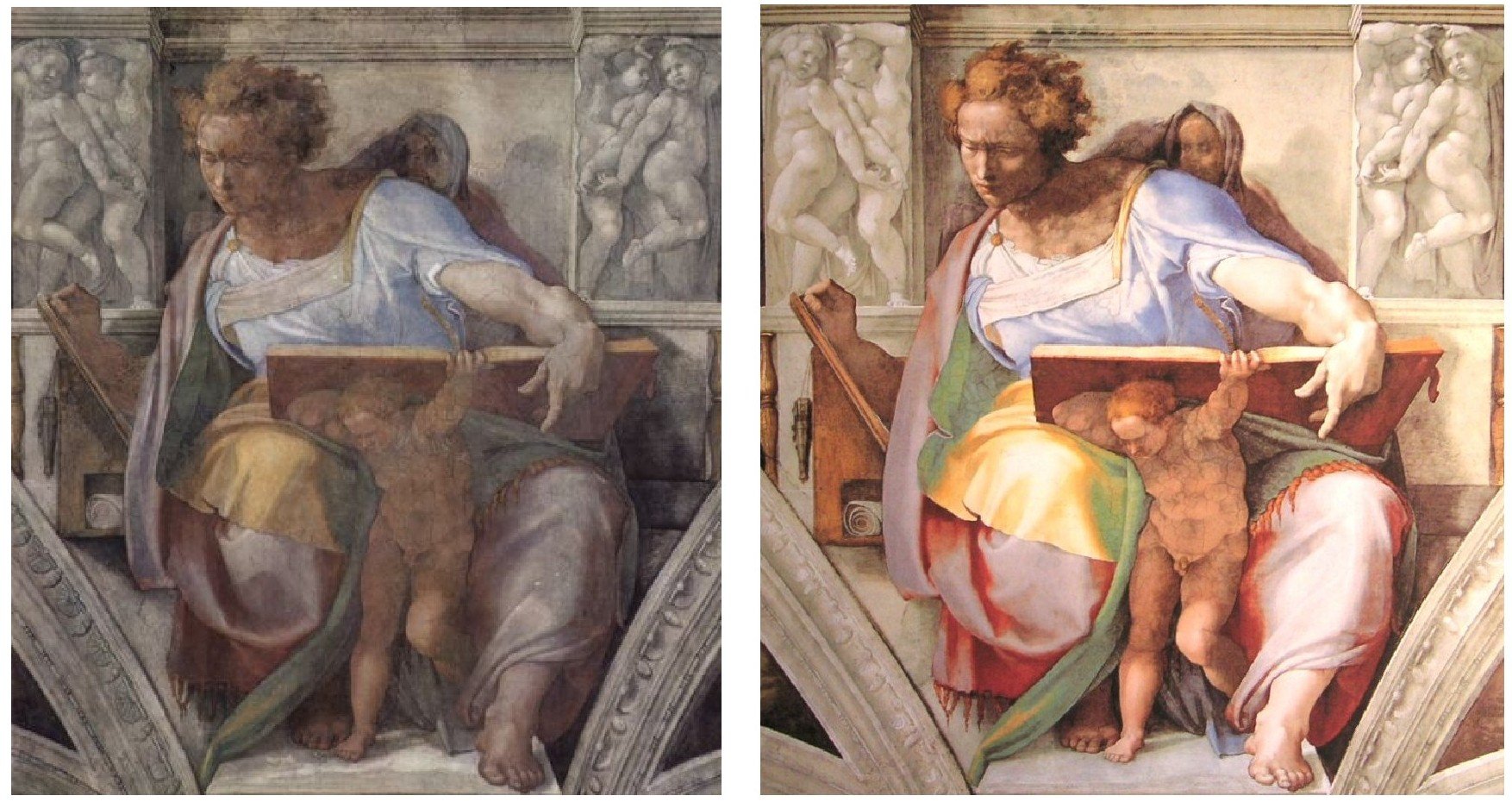
For four hundred and seventy years, the Sistine Chapel ceiling was brown. Sooty, muddy, dignified brown. Generations of art historians had written books about Michelangelo’s “restrained palette,” his “somber chromaticism,” the “Rembrandt-like gravity” of his figures lost in shadow. Goethe had sat under the ceiling and described its “brooding earth tones.” That was the Michelangelo everyone had.
Then in 1980 a team of Vatican restorers climbed the scaffolding with sponges and a solution called AB 57, and they started scrubbing. And over the next fourteen years, a different ceiling came out. The figures were pink. The skies were turquoise. The robes were the color of candied fruit. An American art history professor named James Beck looked up and said, out loud, in the pages of the New York Times, that the Vatican had just destroyed the greatest fresco cycle in the history of Western art. Nobody in the restoration community agreed with him. He spent the rest of his life saying it anyway.
The Sistine Chapel restoration controversy in one sentence
The argument is a fight about whether the brown on the ceiling was dirt or paint. If it was dirt, the cleaners were right to take it off. If any of it was the final shadow layer Michelangelo brushed on top of his own fresco — a technique called a secco, where pigment mixed with glue is applied dry, after the plaster cures — then the cleaners stripped the master’s own hand off the surface. The stakes are total. Either the ceiling we see today is closer to what Michelangelo painted than any viewer since 1512 has ever seen, or the Vatican spent fourteen years chemically destroying the last generation’s worth of Michelangelo’s own touch.
There is no middle answer. You cannot partially un-clean a fresco. Whatever the cleaners did, they did it forever.
Why the ceiling was brown
To understand why anyone wanted to touch the ceiling at all, stand in 1979 and look up. You see haze. You see figures that seem to emerge from a fog so thick that entire sections of the Genesis panels blur into each other. Connoisseurs call this the “patina of age.” The tourists call it dirty. The tourists are right.
By 1979 the Sistine Chapel had been holding conclaves, coronations, and daily masses for four hundred and sixty-seven years. Every one of those ceremonies burned candles. Tallow candles, beeswax candles, votive candles, Easter candles. The soot rose. It settled on the ceiling. It mixed with incense residue and oil-lamp exhaust and the exhalations of a million lungs, because the chapel has no real ventilation, and it coalesced into a film that the nineteenth and early twentieth centuries had already tried to address in a typical nineteenth-century way: by coating the whole thing in animal glue.
The glue had been applied in two main campaigns, once around 1625 and again around 1714. The idea was that the glue would brighten the darkened colors by giving them a layer of varnish-like gloss. In the short term, it worked. In the long term, it turned every previous candle cycle into a permanent record: the glue trapped the soot, then the next century’s candles added a new layer of soot on top of the glue, and then another layer of glue trapped that. By 1980 the ceiling had the optical density of a wet paper bag.
That is the ceiling everyone had been calling “somber” for centuries. It was not somber. It was filthy.
The Vatican cleaning fresco method that started it all
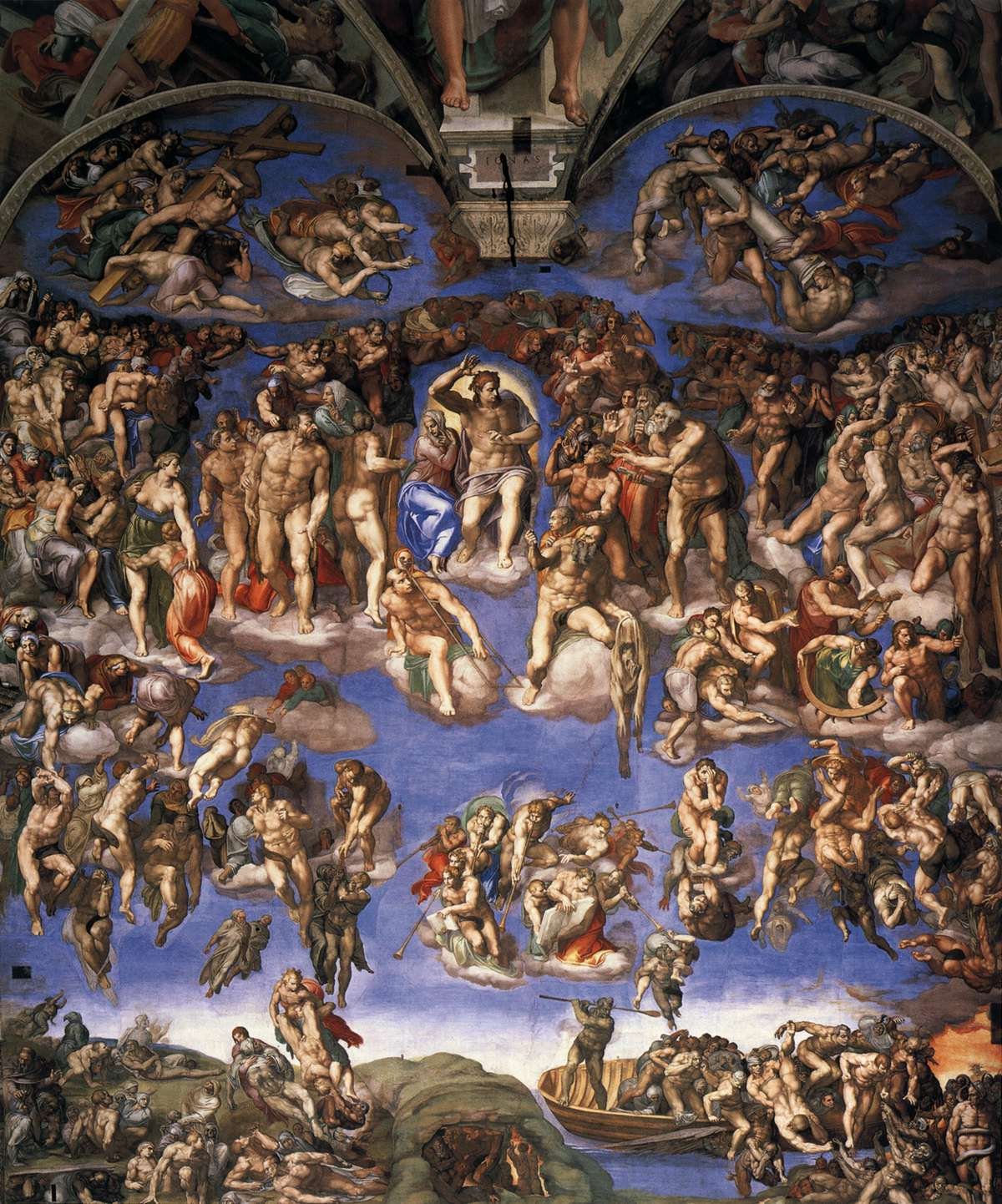
In 1964 the Vatican cleaned the Last Judgment on the chapel’s altar wall as a conservation test. The result shocked everyone, including the restorers. The wall had been so dark that Vasari’s drunken Christ and Charon’s boat of the damned were indistinguishable from the general murk. Cleaned, they were a riot of blue and orange and pink. Most critics shrugged and moved on. A small Italian restoration team led by Gianluigi Colalucci took notes.
In 1979, during a routine inspection of a lunette on the ceiling — the wall panels under the main vault, showing the ancestors of Christ — a conservator named Gianluigi Colalucci noticed that one corner of the Azor-Sadoch lunette was cracking. The crack was nothing. What Colalucci saw under the crack was everything. Pigment. Bright, clear, unmuddied pigment, the colors of a Florentine tempera from the fifteenth century. The ceiling was not brown. The layer on top of the ceiling was brown.
He went to his boss, the Director General of the Vatican Museums, Carlo Pietrangeli. Pietrangeli took it to Pope John Paul II. John Paul approved a full cleaning in 1980, with Japanese television company NTV agreeing to finance the operation in exchange for filming rights. The total cost, underwritten by NTV, ran to about three million dollars. The total duration was fourteen years. The total result, depending on who you ask, was either the restoration of the century or the disaster of the century.
The Sistine Chapel cleaning 1984 method
The tool was not glamorous. It was a solvent called AB 57, developed in the 1970s at Rome’s Istituto Centrale del Restauro. AB 57 is a gel of ammonium bicarbonate and sodium bicarbonate in a seaweed-based thickener, and it works by dissolving animal glue and the soot trapped in it, while leaving the underlying fresco pigments untouched. A restorer would apply the gel with a cotton pad, leave it for three minutes, and then peel it away with a second pad. Then a second three-minute application of the same gel. Then a deionized water rinse. Then nothing.
The technique was tested, in advance, on small areas. It was reviewed by international panels. It had been used successfully on other frescoes, including Masaccio’s Brancacci Chapel in Florence. Colalucci’s team worked square inch by square inch. They photographed every stage. They saved every cotton pad, storing the removed dirt in dated vials, in case anyone ever needed to know exactly what had come off the ceiling.
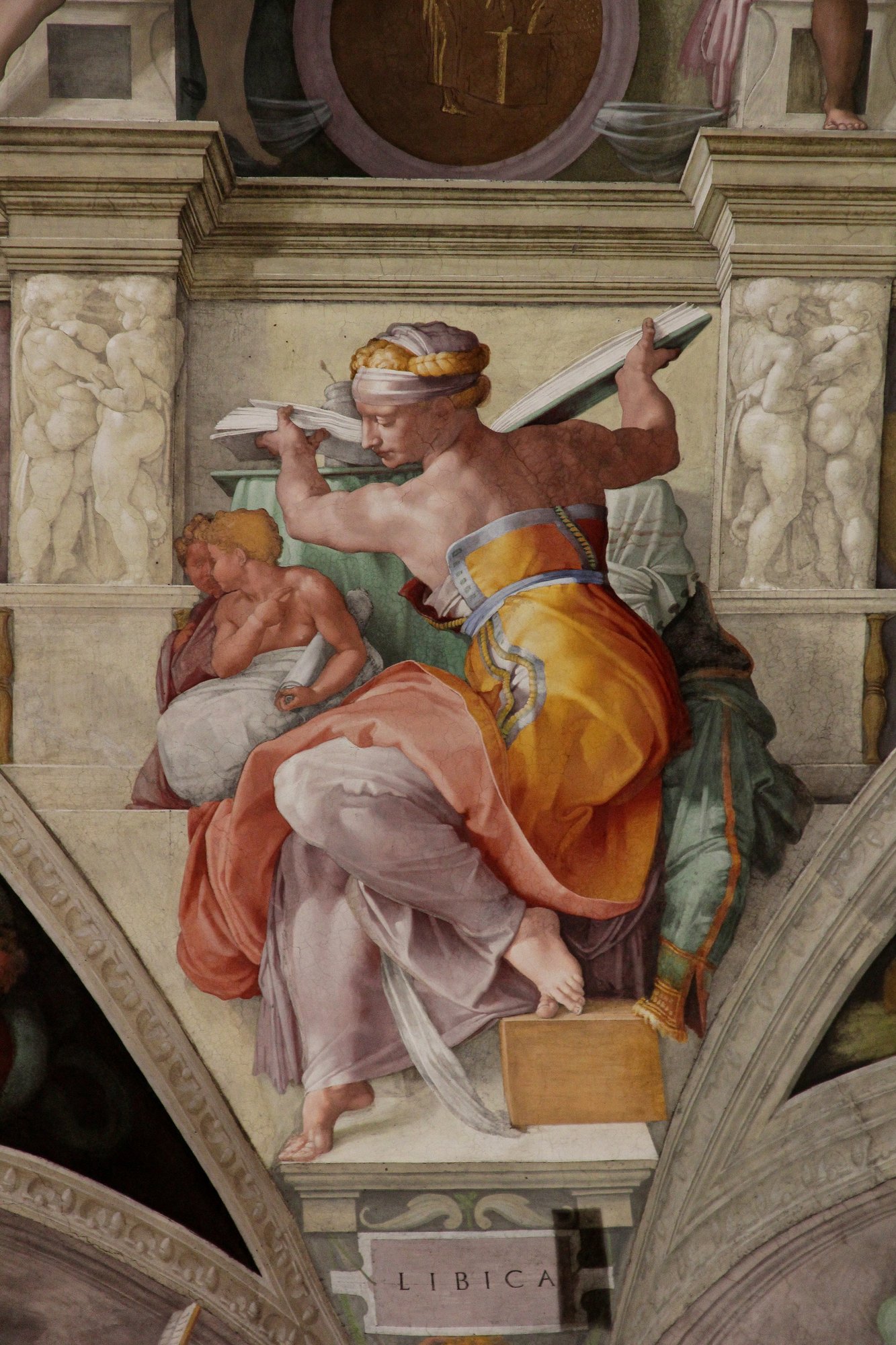
And what came off the ceiling was staggering. The Libyan Sibyl, that immense twisted figure reaching over her shoulder for her book, had been mud-brown in every photograph taken before 1980. She emerged from the cleaning in lime-green and coral-pink, her muscles modeled in a pink-salmon flesh tone, her book the color of fresh cream. The Delphic Sibyl was lilac and sage. Jonah’s turning pose — the central tour-de-force of the ceiling’s altar end — went from a mass of dark gesture to a bright blue and gold explosion that looks, now, almost like a Matisse cutout.
The before-and-after photographs are the most famous pairs in the history of conservation. They are also the evidence in the argument.
James Beck, restoration critic, sees something wrong
James Beck was the chair of the art history department at Columbia. He had spent his life writing about Italian Renaissance painting, including three books on Michelangelo. In 1990 he visited the scaffolding, was shown the cleaned sections of the ceiling, and left the chapel in a state of controlled fury.
What Beck saw was that the figures, after cleaning, had lost something he could only describe as “modeling.” The transitions from light to shadow on an arm, a neck, a rib, seemed to him flattened. The deep chiaroscuro that every previous generation had associated with Michelangelo was gone. In its place was a brighter, flatter, more frontal ceiling that looked, to Beck, nothing like the drawings and cartoons Michelangelo had left behind.
Beck’s argument was technical but the core of it is easy to follow. He believed Michelangelo had finished each panel of the ceiling in a two-stage process. Stage one: the main image, painted buon fresco, into wet plaster, in the traditional way. Stage two, after the plaster cured: a layer of darker pigment applied a secco — “on the dry” — in a glue medium, used to deepen the shadows and push back the recesses of each figure. That second layer, Beck argued, would have looked to restorers exactly like the glue-trapped soot they were being told to remove. And AB 57, the solvent, cannot tell the difference between nineteenth-century glue and sixteenth-century glue. Both are protein. Both dissolve.
If Beck was right, the cleaners were erasing Michelangelo’s finishing touches and telling themselves they were taking off varnish. Every square inch of the ceiling, in Beck’s reading, was losing its third dimension under the sponge.
Beck founded an organization called ArtWatch International to fight the restoration in the press. He wrote op-eds. He wrote a book called Art Restoration: The Culture, the Business, and the Scandal. He debated Colalucci on public television in Italy. He accused the Vatican of “the greatest art crime of the century.” The Vatican called him a crank. He was not a crank. He was, at worst, wrong, and it is still not entirely clear whether he was wrong.
The restorers’ defense
Colalucci and his team had an answer, and it was specific. They argued that Michelangelo, because of the sheer speed required by the scale of the commission, had not used a secco at all on the main vault. Michelangelo had learned fresco from the workshop of Domenico Ghirlandaio in Florence, where buon fresco purity was a religion. The idea of going back over cured plaster with glue-bound pigment was, to that school, cheating. You got it right in the wet plaster or you chipped out the section and started over.
The restorers pointed to Michelangelo’s own complaints in his letters. He had fired his initial team of Florentine assistants in 1508 because he was unhappy with their handling of mold on the first panel. He had stripped that section down to the plaster and redone it. This was not a man who tolerated a secco shortcuts. He worked alla prima, wet into wet, and the ceiling was a buon fresco from end to end. Anything on top was, by definition, not Michelangelo.
The physical evidence, Colalucci said, backed him up. Where the team found a secco retouches — and they did find some, particularly in the sky around God — they left them. The shadows in the cleaned ceiling are the shadows Michelangelo put there in 1511. The difference between the pre-cleaning ceiling and the post-cleaning ceiling, Colalucci argued, is exactly the difference between dirt and paint. One came off. The other did not.
Sistine Chapel before and after, what actually changed
A few things are undisputed. The colors are brighter. The transitions between color fields are sharper. Figures that had seemed to emerge from darkness now seem to float against light backgrounds. The ceiling no longer has what Beck called “the brown unity” of Michelangelo’s mature palette, and it is an open question whether that unity ever existed, or whether it was a hallucination produced by four hundred years of candle soot.
The chromatic shock is real, and it is worth naming. The green of Jonah’s mantle is the color of a lime popsicle. The pink in the Creation of Adam’s flesh tones is the pink of a department-store nightgown. The blue of the background sky is the blue of a Tiffany box. These are Michelangelo’s original colors, or very close to them, and their reappearance forced a complete reassessment of his place in the history of color.
The reassessment lands in a surprising place. Michelangelo, we now think, was a colorist — a serious, inventive, almost Fauvist colorist, more aligned with his Florentine training in tempera than with the Venetian oil painters who were about to change European painting. The restoration did not just clean the ceiling. It rewrote the art history textbook’s chapter on him.
Chiaro is useful for exactly this kind of reappraisal. Stand on the chapel floor after the morning rush clears, find the Libyan Sibyl above the altar end, and the chromatic argument — salmon flesh, lime robe, the sash a muddy lilac — is described in your ear while you look straight up at the thing. The ceiling is fifty feet away and the docent’s radio is across the room, so the only way to hear this argument in the room where it happened is to bring it with you.
Did the Vatican ruin Michelangelo
The short answer, which almost no serious conservator now disputes, is no. The weight of the physical and chemical evidence supports Colalucci’s reading. The material that came off the ceiling was animal glue and candle soot, laid down between 1512 and 1979. It was not Michelangelo’s finishing layer. The ceiling we see today is closer to what the chapel looked like on October 31, 1512, the day Michelangelo took down the scaffolding, than any ceiling any visitor has seen in five centuries.
The long answer is more interesting. Beck was wrong about the secco, but he was pointing at something real, which is that the cleaned ceiling does look different in ways that cannot be explained by the removal of dirt alone. Some of the difference is optical: bright colors, seen in a room with other bright colors, read as flatter than the same colors seen in a room where the rest of the palette is muted. Some of the difference is psychological: five centuries of museum-going have trained the Western eye to see “old master” and “sober” as synonyms, and when that training gets contradicted by pink salmon flesh, the eye rebels. And some of the difference is simply that we got used to Michelangelo in soot. We miss the soot.
Fresco restoration ethics after the Sistine
The conservation profession now uses the Sistine case as a touchstone. It is the reason every major fresco cleaning since 1994 has involved an explicit pre-cleaning study documenting whether any a secco layers exist. It is why conservators now leave “witness zones” — small uncleaned patches — on most restorations, so that future generations can see what the dirt was. The Sistine ceiling has no witness zones. When the cleaning ended in 1994, the whole ceiling was clean, and the argument about what used to be there became, forever, an argument about memory.
The Michelangelo restoration debate also changed the economics of conservation. NTV’s sponsorship, in exchange for exclusive filming rights, was the first major case of a private broadcaster underwriting a public-trust conservation project. Since then, Lavazza has underwritten work on the Cappella Paolina, and Fendi has paid to restore the Trevi Fountain. The Vatican defended the NTV arrangement on the grounds that the restoration could not otherwise have been afforded. Beck’s answer was that the Vatican could have afforded it fine, and that the real fee NTV paid was the right to call the Sistine cleaning a global television event whose scheduled endpoints mattered more than its technical pace. Neither side ever convinced the other.
What Michelangelo thought, if anyone had asked
Michelangelo wrote letters his whole life. We have hundreds of them, preserved in the archives of the Casa Buonarroti in Florence. He complained about Pope Julius. He complained about money. He wrote a sonnet comparing himself to a Syrian bow, bent and ruined by the ceiling. He did not say a word, in any letter that survives, about what he thought the ceiling should look like over time.
What we do know is that he returned to the chapel twenty-two years after the vault, in 1534, to paint the Last Judgment on the altar wall. And what we know about the Last Judgment is that he began it by chipping off the two lunettes he himself had painted in 1511 — Abraham and the Brazen Serpent — because they did not fit his new composition. He had no sentimentality about his own work. He believed, as all fresco painters do, that a painting is what is under the paint today, not what was there last year.
If someone had asked him in 1512 whether candle soot was part of the ceiling, he would have stared at them. It was not part of the ceiling. It had not accumulated yet. The ceiling was the thing he had painted onto the wet plaster, and the wet plaster was the thing that was now cured, and everything else was, by definition, not the ceiling.
The Colalucci team’s reading of the evidence is consistent with what Michelangelo himself would probably have said about it. The Beck reading is more sympathetic to the version of Michelangelo that generations of brown-tinted viewers had loved. Both readings are acts of reconstruction. The ceiling is what it is. Go look up.
What to look for when you see it
Three details reward the visitor who knows the controversy.
First, look for the contrast edges on Jonah, over the altar. Jonah’s body is the most muscular, twisted, anatomical figure on the ceiling, and the cleaning left his modeling intact enough to shut down the Beck argument on any honest viewing. The shadows are deep. The lights are bright. The transitions are Michelangelo’s transitions, and nobody has scrubbed them off.
Second, look at the lunette of Azor and Sadoch, the corner where Colalucci first noticed the bright pigment under the dirt. It is near the altar end on the right side as you face forward. The colors here were the first to see daylight in 1979. They are the colors the restoration promised.
Third, look at anything blue. The blue is the color that brown soot softens most completely. Before 1980 there was almost no blue visible on the Sistine ceiling. Now the whole ceiling is punctuated with blue — skies, robes, tunics, backgrounds. The difference that blue makes to the overall read of the room is the difference the restoration made. That is the thing being argued about. Either it belonged there or it did not. Your eye will have to decide.
Beck died in 2007 still arguing that the cleaning was a catastrophe. Colalucci died in 2021 still arguing that it was the greatest conservation achievement of the twentieth century. The two men met exactly once, in a television debate in 1991, and by all accounts neither changed a single word of his position. The ceiling has not changed its position either. It is fifty feet up, painted on curing plaster by a sculptor who thought he was being tricked by Bramante, and whichever side of the argument you land on, you are looking at the single most audacious painted surface ever produced in Europe. The rest is just lighting.
Image credits
- ‘LibyanSibyl Sistine Chapel ceiling’ by Michelangelo JBU34.jpg — Jörg Bittner Unna. Source, CC BY.
