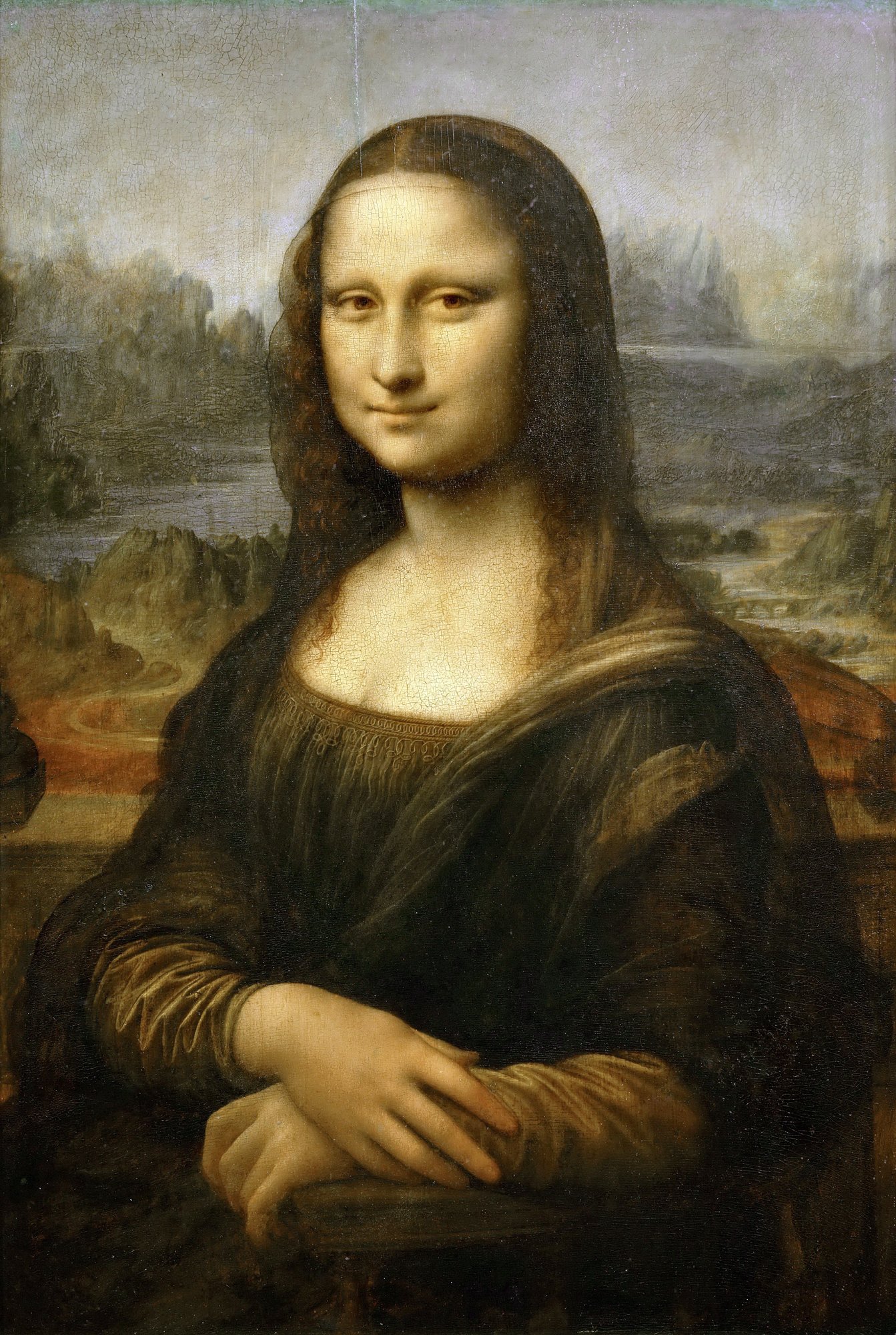
On the morning of August 21, 1911, a man in a white smock walked out of the Louvre with the Mona Lisa under his coat. Nobody noticed for 26 hours. Before that morning, Leonardo’s portrait was admired, visited, occasionally copied. After it, she was the most recognized image on earth.
So when people ask why is the Mona Lisa famous, the honest answer is that the question has a birthday. It was born on a Tuesday, the day the Louvre was closed for cleaning, when a quiet Italian handyman took the painting off a hook in the Salon Carré, wrapped it in a workman’s smock, and walked out a service door into a Paris summer. Everything we now think we know about the Mona Lisa — the crowds, the bulletproof glass, the selfie sticks, the postcards, the parodies — all of it downstream of that morning.
Why is the Mona Lisa famous? Start in 1911
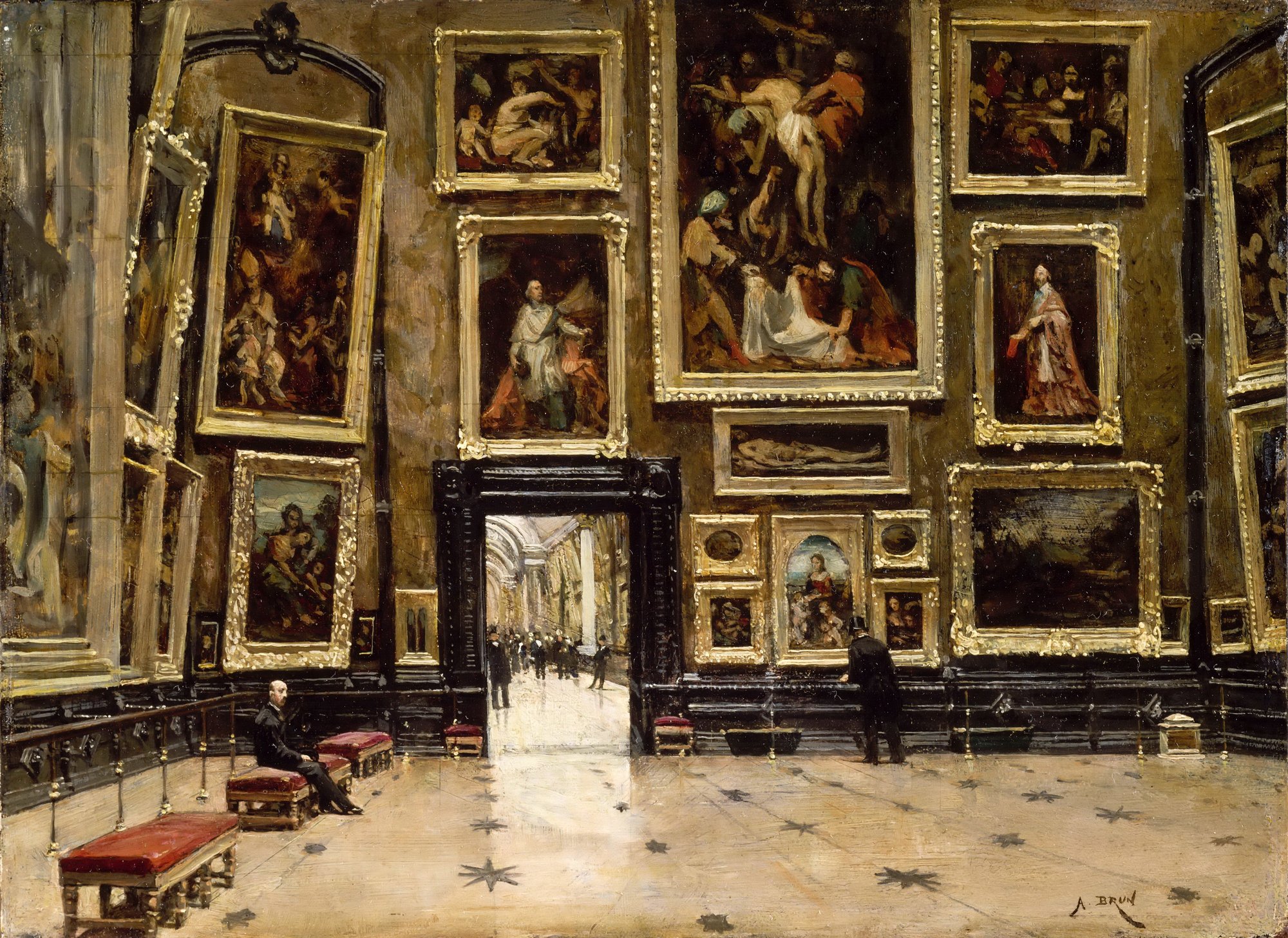
People Google why is the Mona Lisa so famous and get back essays about her smile, her eyebrows, her pose. The real answer is in a police report filed on a hot Tuesday afternoon: Mona Lisa stolen, painting missing, no suspect, no witnesses, no ransom. To understand why the Mona Lisa is famous today, start with how modestly she sat on the wall for four hundred years before that report was filed. The portrait had been in French royal collections since Leonardo sold it to Francis I around 1519. It had hung in Fontainebleau, at Versailles, in Napoleon’s bedroom at the Tuileries, and, from 1797 onward, in the Louvre. Critics admired it. Vasari wrote that the mouth seemed to breathe. Walter Pater called her an older-than-the-rocks figure in a purple essay that nineteenth-century students memorized. None of that made her the most famous painting in the world. She was one celebrated work among many — ranked, if she was ranked at all, behind Raphael’s Madonnas, behind any number of grand French history paintings, behind Veronese’s Wedding at Cana on the opposite wall.
Here is how ordinary she was: on the morning of the theft, one of the first people to walk into the Salon Carré was an amateur painter who had come to copy her. He saw the empty hooks on the wall, shrugged, and assumed she was being photographed by the museum’s documentation studio upstairs. He sat down to wait. A few hours later he asked a guard when she’d be back. The guard went to check. That was the moment, around noon, that the Louvre’s administration discovered the most famous painting in history — a painting that was not yet the most famous painting in history — was missing.
Twenty-six hours of nothing
The museum had been closed Monday. The theft happened early that morning. The painting was not reported missing until Tuesday around midday. That gap — the twenty-six hours in which the most guarded object in Paris sat in a cheap boarding house without anyone noticing she was gone — is the crack in the story where her fame rushed in.
Because now there was a mystery, and the mystery had a photograph. French newspapers printed the Mona Lisa on their front pages. So did papers in London, New York, Buenos Aires, Tokyo. For most readers in 1911, this was the first time they had ever seen the face. They had heard of the painting, possibly, in the way a literate person had heard of the Sistine Chapel or the Venus de Milo. Few of them could have picked her out of a lineup. Now her face was on the breakfast table, above a headline about a crime, in every capital that had a printing press. Within a week she was the most reproduced image in the world, and she had achieved this not through her own beauty but through her absence.
The Louvre closed for a week and then reopened with a bare wall where she had been. Visitors lined up to stare at the empty space. More people came to see nothing than had come to see her in the years before. They left flowers. They wrote poems. One Paris editor called it “a national humiliation” and pointed out that the painting had been stolen from a room guarded by a single sleepy watchman who had stepped out to smoke. Police questioned Guillaume Apollinaire and, through him, a young Spanish painter named Pablo Picasso, both of whom had once been tangentially connected to a previous minor Louvre theft of Iberian stone heads. Picasso arrived at the station shaking. He was released. The papers kept the story on the front page for months.
The handyman from Dumenza
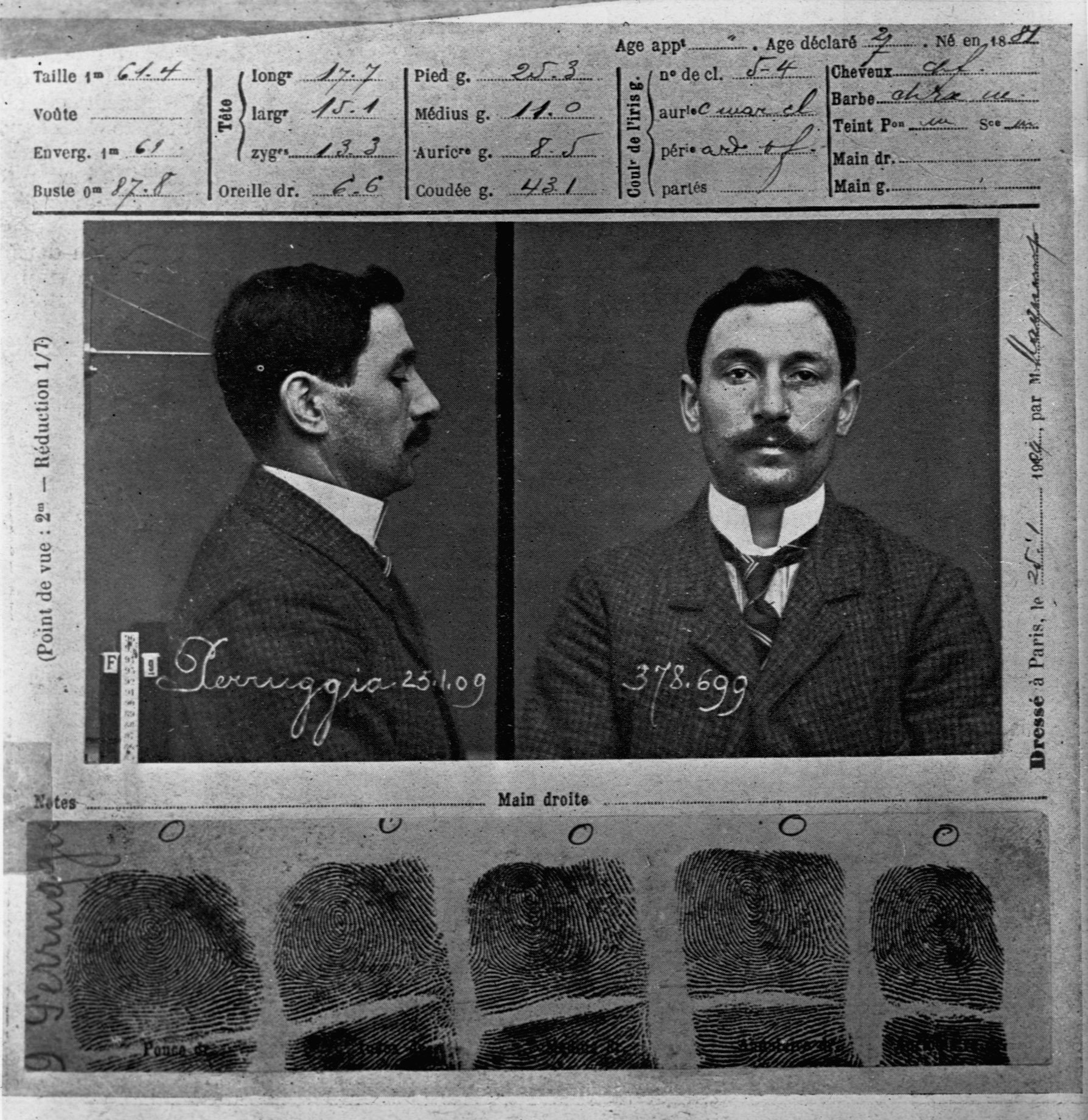
The thief was Vincenzo Peruggia, thirty years old, born in the hill village of Dumenza near the Italian-Swiss border. He had come to Paris looking for work, like hundreds of thousands of Italians in those years, and had found it as a glazier at the Louvre — one of the men hired to build protective glass cases for the museum’s paintings. He had actually helped install the glass in front of the Mona Lisa. He knew the room. He knew the screws. He knew the service stairs.
On the morning of August 21 he put on the white smock the museum gave its maintenance workers, walked into the Salon Carré while the galleries were closed to the public, lifted the painting off its four iron hooks, carried it into a service stairwell, and pried it out of its heavy gilt frame. He left the frame on the stairs — it was later found leaning against a wall, its glass intact, like a coat someone had hung up on the way out. Then he tucked the bare poplar panel under his smock, walked down the stairs, let himself out of a door near the courtyard, and went home.
The theft itself is not a story about an ingenious criminal. Peruggia was not a mastermind. He had no buyer. He had no plan beyond getting the painting home. For two years and four months he kept her in a false-bottomed trunk in a rented room on rue de l’Hôpital Saint-Louis, pulling her out occasionally to show friends and to check, with the anxious love of a man who was not sure he had done the right thing, that she was still there.
Why an Italian glazier would steal a Leonardo
Here is where the Mona Lisa story behind the painting stops being a whodunit and turns into something stranger — a story about nationalism, amateur history, and the kind of grievance that curdles into action.
Peruggia believed the Mona Lisa had been stolen from Italy by Napoleon. This is wrong. Leonardo himself brought the painting to France, carried over the Alps in the saddlebags of an old man dying slowly into French royal patronage. The painting had been in French hands since before there was a France in the modern sense. But Peruggia had grown up on a mythology, widely believed in early-twentieth-century Italy, that Napoleon’s armies had looted the country’s artistic patrimony and that Italy was owed restitution. The version of Mona Lisa history Peruggia carried in his head was wrong, but it was the one he had been taught, and he took it seriously enough to steal.
When the trial came, this was his defense: he had not committed a crime, he had performed a repatriation. The Italian courts gave him seven months. He served six and change. In Italy he was widely and openly treated as a folk hero — newspapers debated whether he deserved a medal, strangers sent him wine, a woman he had never met offered to marry him. He went back to Paris eventually, served in the Italian army in World War I, returned to house-painting, and died in obscurity in 1925, apparently never quite understanding what he had set in motion.
How fame actually gets made
Here is the part that is uncomfortable to admit, because we want art to become famous through its quality. The Mona Lisa is a magnificent painting. Leonardo’s sfumato — the soft smoky blur between shadow and light — is some of the most technically astonishing work in the history of European portraiture. Her ambiguous half-smile, the impossible landscape behind her, the hands that seem to have been painted by a different, calmer century than the face — all of it is as good as art gets. None of that is why she is the most famous painting in the world.
She is the most famous painting in the world because of something much dumber and much more human. For twenty-eight months, starting in the summer of 1911, the newspapers of every country with a press ran her photograph as a mystery. People learned her face the way they learn a missing child’s face. When she finally came home — Peruggia was caught in Florence in December 1913 after trying to sell the painting to the director of the Uffizi — the world had been looking at her for two years. Italy staged a victory tour before returning her to France. Crowds lined up in Florence, Rome, and Milan to see her. When she went back on the wall in the Louvre in January 1914, the crowds there were unlike anything the museum had seen. They have never really stopped.
The photograph did the work. The mystery did the work. The empty wall did the work. By the time she was hanging again, the fame was a thing in itself, self-sustaining, detached from the painting on the panel. Every subsequent act of fame — Duchamp’s mustache in 1919, Warhol’s prints, the bulletproof case, the million-visitor years — was built on top of the foundation the theft had poured. You cannot subtract 1911 from the story and get the same painting.
A small painting about a large idea
Stand in front of her today and you will be surprised by three things. She is smaller than you expected — about 30 by 21 inches, the size of a kitchen cabinet. She is darker than the reproductions suggest, because Leonardo’s varnish has yellowed over five centuries and nobody dares touch it. And she is farther away than you want her to be, behind a layer of bulletproof glass that turns her into a reflection of the crowd in front of her.
That last part is the real souvenir. People do not come to the Louvre to see the Mona Lisa anymore. They come to see each other seeing her — a kind of pilgrimage to a point on the map that everyone else has already visited. The modern version is a story about being one of the people who came. The painting is the excuse.
This does not diminish her. It is, if anything, the most Leonardo-ish outcome possible: a painting that ended up being about the act of looking, which is what Leonardo himself spent his entire career investigating. He would have been amused. He would also have been a little offended that it took a handyman from Dumenza to close the loop.
What to look for in front of her
Forget the smile for a moment. Everyone talks about the smile. Look instead at the landscape behind her — a world that does not exist, with a river that runs at two different heights on her left and right and no plausible geological way to connect them. Leonardo was painting a dream of a landscape, not a real one, and the dream is more revealing than the face. Look at her hands, which are arranged so calmly they seem almost borrowed from another body. Look at the veil so thin you can see her forehead through it, the transitions so soft you cannot find the edge where one color ends and another begins. This is the sfumato Walter Pater was trying to describe and giving up on. It is the reason she still stops people who have seen her a thousand times in postcards. Stand there with Chiaro in your ear and the sfumato gets explained in the ninety seconds the guard gives you, which is the only window the explanation actually fits into.
And then, having looked, remember that you are only looking because a man named Vincenzo Peruggia decided, one August morning, that she belonged to him. Two years in a rented room near the Gare de l’Est turned her from one great Renaissance portrait into the image the twentieth century could not put down.
She was always a great painting. The theft is what made her a famous one. That is the real backstory — the part the museum placards do not tell you because it is a little embarrassing for everyone involved, including us.