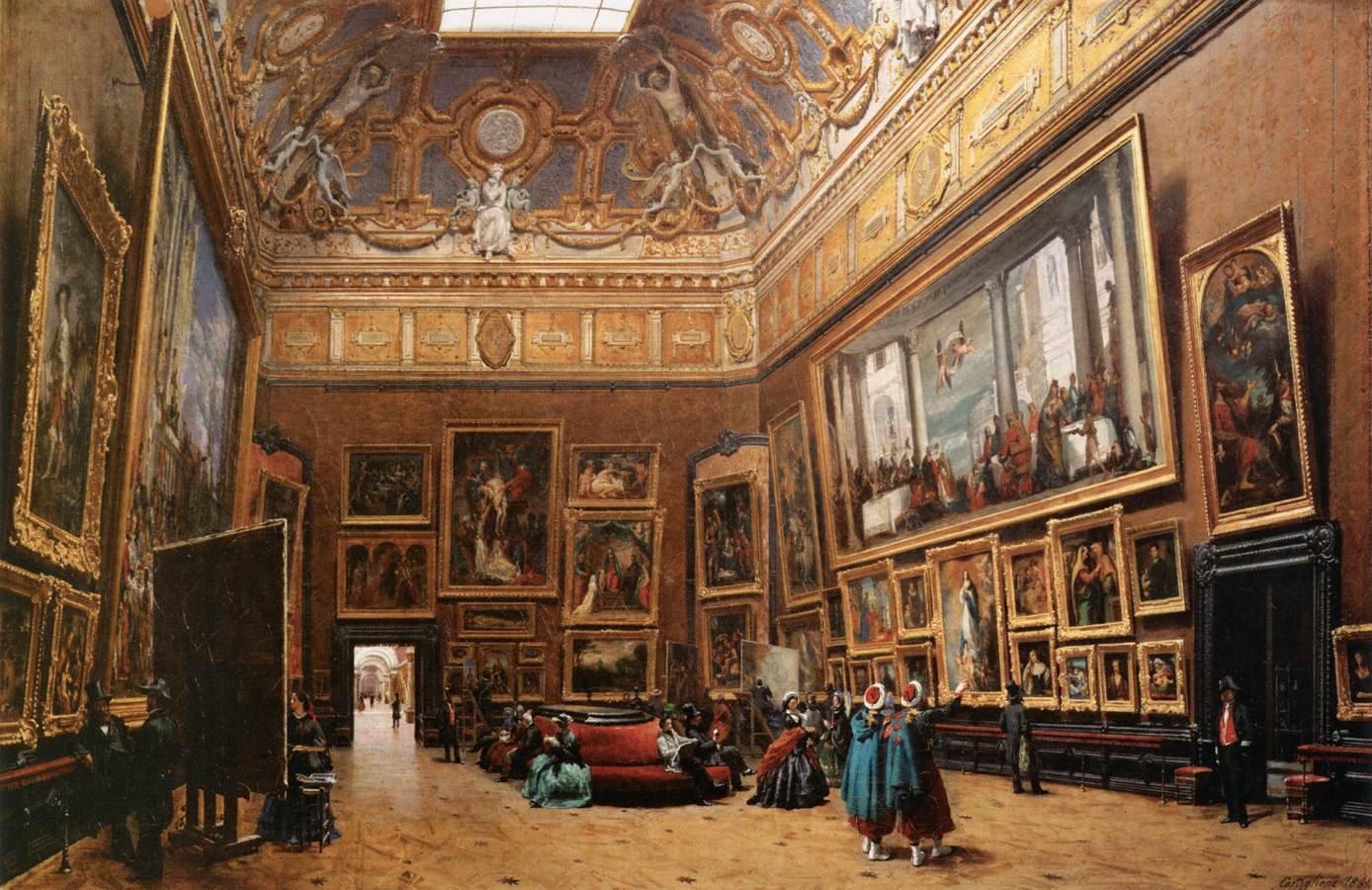
On the wall directly opposite the Mona Lisa hangs the largest painting in the Louvre. It is twenty-two feet high. It covers almost four hundred square feet of canvas. It has a hundred and thirty people in it, three dogs, a cat, and Jesus at a wedding in Venice. Nobody looks at it. They are all facing the other way, toward a portrait the size of a kitchen cabinet, pointing their phones at the back of each other’s heads.
This is the defining fact about the Louvre Museum paintings. You came to see the famous ones. You followed the arrows. You ended up in the one room where the map succeeds so well that it breaks itself. You are standing between the two grandest paintings in the building and seeing only one of them, because the other one does not have a line.
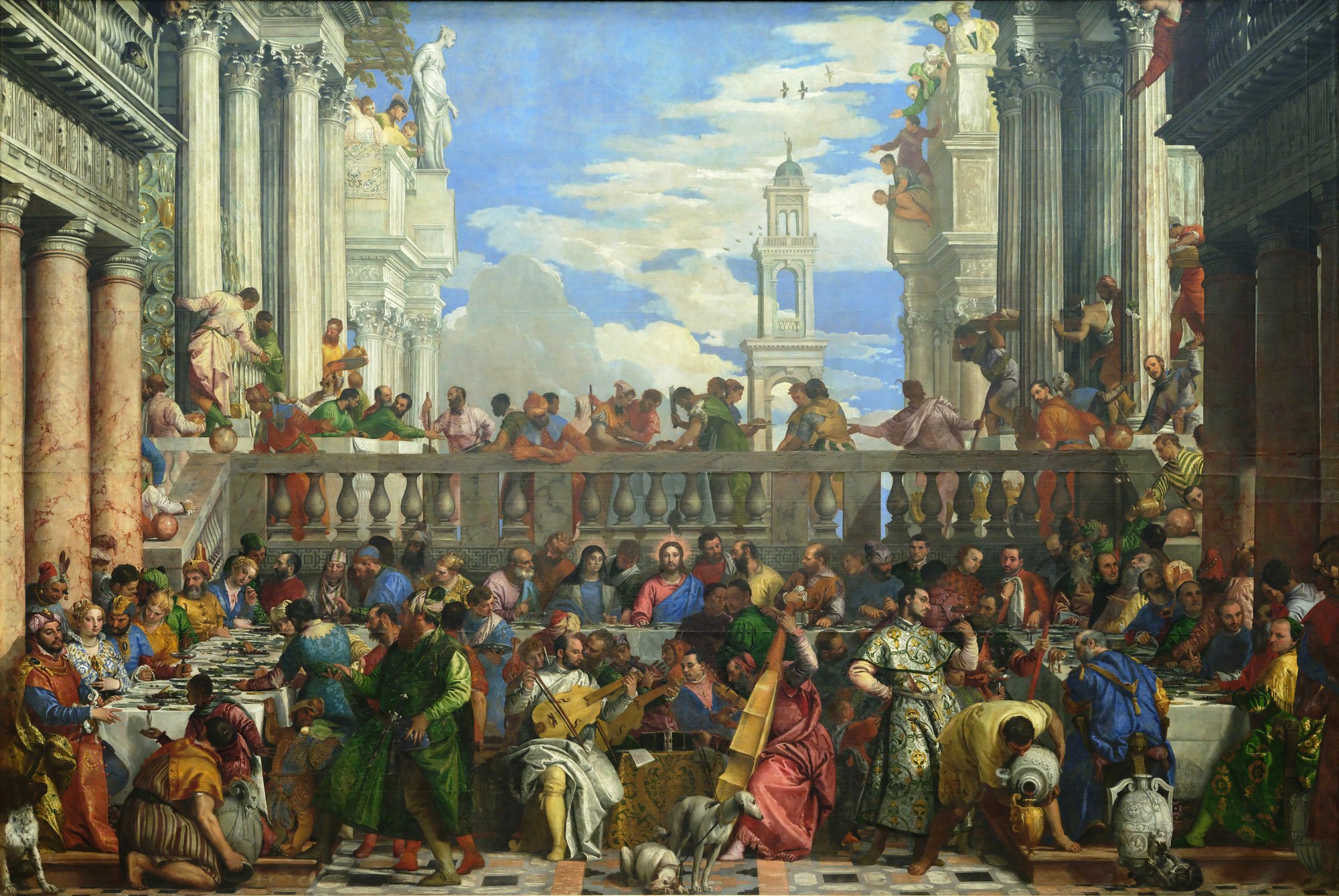
The painting behind you is Paolo Veronese’s Wedding at Cana, finished in 1563 for the refectory of the monastery of San Giorgio Maggiore in Venice. Napoleon’s soldiers cut it off the wall, rolled it up, and brought it to Paris in 1797. It has been hanging opposite the Mona Lisa for longer than most countries have been countries. And it exists, in the experience of nearly everyone who comes to the Louvre, only as a backdrop in other people’s photographs.
Why the Louvre museum paintings are arranged this way
The Louvre’s collection is organized roughly by geography and then by date. Italian paintings run north through the Grand Gallery — a quarter-mile corridor that used to be the physical connection between the royal palace and the Tuileries, so long that Napoleon held troop reviews inside it. French paintings fill the Richelieu and Sully wings. Northern European works — Dutch, Flemish, German — hang on the second floor of Richelieu. If you are looking at a painting, it generally got to that spot because of where the painter came from, not because of how important the painting is.
This is why the experience is so disorienting. The map treats a thirteenth-century Byzantine icon the same way it treats a Raphael Madonna, because both are Italian. A forgotten French history painting hangs in the same room as Delacroix’s Liberty Leading the People because both are nineteenth-century French. Greatness is not organized anywhere on the floor plan. You are supposed to bring your own taste, which is a very French way to design a museum and a very exhausting way to visit one.
The other thing worth knowing before you walk in: the Louvre’s collection stops around 1848. Anything after that went to the Musée d’Orsay when it opened in 1986. This is the correct answer to every confused tourist who Googles “Louvre museum Van Gogh” and shows up looking for him. He is not here. He is half a mile away, across the Seine, in a beautiful old train station — the Saint-Remy self portrait is on the fifth floor, behind the big clock. The Louvre has nothing of his, and it never did, and it never will. His entire short career happened forty years after the Louvre stopped collecting.
So when people ask about the famous paintings of the Louvre in Paris, they almost always mean a handful of works that happened to be made before the cutoff and happened to be bought or looted by French kings, emperors, and committees over the course of four centuries. It is a great collection. It is also a peculiar one.
The Grand Gallery is the spine of everything
Start at the entrance to the Louvre museum Grand Gallery, on the second floor of the Denon wing. Face north. You are standing in what Stendhal once called the most beautiful room in Europe, a claim that has aged well. The corridor goes on for almost a quarter of a mile. Everything famous in Italian painting is in it, or branches off it. Leonardo. Raphael. Titian. Caravaggio, who hangs near the beginning. Mantegna, whose crucifixion scene from the predella of the San Zeno altarpiece sits in a wall case like an absurdly detailed miniature.
The Grand Gallery is where you learn that the Louvre owns more Leonardo than any museum on earth. There are only about fifteen finished Leonardo paintings known to exist, and the Louvre has five of them. Five. The Virgin of the Rocks hangs in the Grand Gallery. So does La Belle Ferronnière, a portrait of a woman whose identity scholars have argued about for two centuries. Saint John the Baptist is there, pointing upward with a gesture so strange that people have spent lifetimes trying to decode it. The Virgin and Child with Saint Anne is there. And then, off in its own room, the Mona Lisa — which is in the Louvre not because it was looted but because Leonardo himself carried it over the Alps in 1516 and sold it to Francis I a few years later. He died in France. The painting stayed.
If you spent your entire visit to the Louvre in the Grand Gallery and its side rooms, looking only at Leonardo and the painters who followed him, you would still miss the rest of the building, but you would have seen more of the painter than you could see anywhere else. That alone is why any argument about the best paintings in the Louvre has to start here.
The French rooms are where the politics live
Leave the Grand Gallery and walk into the French wing and the whole temperature of the museum changes. The Italian rooms are about private devotion, private portraiture, quiet color. The French rooms are about spectacle. They are where the government is painting itself.
Jacques-Louis David’s Coronation of Napoleon fills an entire wall in a room on the first floor of Denon. It is thirty feet wide. Napoleon commissioned it directly, reviewed the sketches, and demanded changes. David painted the emperor placing the crown on his own head, then on Josephine’s, in a cathedral packed with the exact people Napoleon wanted to be seen crowning him. It is not a painting of a coronation. It is a painting of a press release about a coronation. The fact that it is also a masterpiece is almost incidental — David could paint, and he painted what he was told to, and what he was told to make is the best surviving image of how the Napoleonic state wanted to see itself.
In the same room, give or take a few steps, hangs Théodore Géricault’s Raft of the Medusa, which is the opposite painting. It is also huge. It is also full of bodies. But the bodies are starving, dying, stacked on a broken raft in the middle of the Atlantic because a French captain ran his ship aground and then abandoned the crew. Géricault painted it in 1819 as an accusation, using models from a morgue and cadavers in his studio to get the skin tones right. The painting almost did not hang here. The government considered it seditious. It hangs here anyway, a few rooms away from the king who made it politically dangerous, which is the best possible outcome for it.
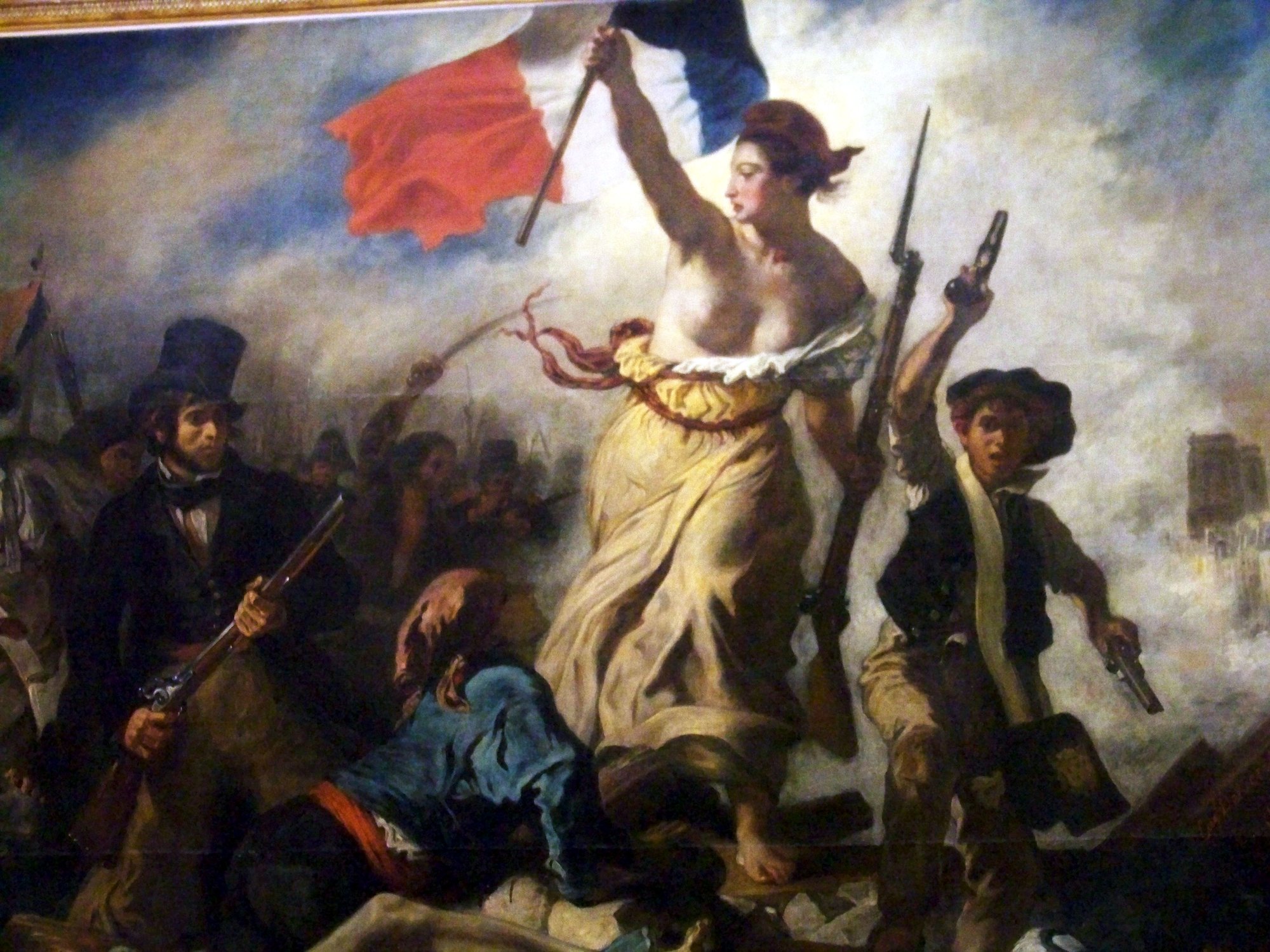
And then Delacroix’s Liberty Leading the People, a painting that has so completely escaped its museum that it is on French passports and used to be on banknotes. It shows a bare-chested allegorical figure leading a crowd over a barricade during the 1830 revolution, with a dead soldier at her feet and a kid in a top hat holding two pistols on her right. It is propaganda. It is also genuinely stirring, and every time it has been removed from the Louvre for cleaning, the news is treated as a minor national event.
These three paintings, side by side, are what people mean when they talk about the famous art of the Louvre without pointing at a specific one. They are the backbone of the French nineteenth-century collection, and they are all inside a thirty-second walk of each other.
The rooms nobody goes to
The second floor of Richelieu is where the crowds thin out. This is the Dutch and Flemish wing, and it contains some of the most quietly magnificent small paintings in Europe. Vermeer is here — not much of him, because not much of him exists anywhere, but two: The Lacemaker and The Astronomer, both small enough to cover with a placemat and both almost painful to look at because of how much Vermeer could do with a single source of light. Rembrandt is here by the roomful, including a self-portrait from 1660 in which he looks like a man who has survived most of his own life. Frans Hals. Hieronymus Bosch. A Rogier van der Weyden annunciation scene in which the angel’s robe is so precisely rendered that you can see the individual threads of the brocade.
When people ask for the top paintings in the Louvre and you want to tell them something they have not already heard, send them here. Tell them to look at the Vermeers for five minutes each without moving, with Chiaro running so they know what Vermeer’s single light source is actually doing while they stand there. Tell them to find the Rembrandt self-portrait and to stand at three different distances from it. Tell them that the entire Italian Renaissance is downstairs and they will have enough energy to see it later, because up here the rooms are quiet and the paintings are small and nothing is behind bulletproof glass.
The Wedding at Cana, again
Walk back to the Mona Lisa’s room one more time and, this time, turn around.
The painting behind you covers a wall the way a movie screen covers a wall. The composition is organized around a long U-shaped table packed with wedding guests, servants, musicians, and animals, in an architectural setting that looks more like a Venetian palazzo than a Galilean village. At the center of the table, almost lost in the crowd, Christ raises his hand to perform the miracle. Above him, on a balcony, butchers are cutting lamb. In the foreground, a servant is pouring water from one amphora into another and it is turning, mid-pour, into wine. The orchestra in the middle foreground is playing a group portrait — Veronese himself is in there, in white, holding a viola da gamba, along with Titian and Tintoretto, painted as if they were sitting in for the house band at the wedding of the century.
It is a lot of painting for one wall. It is the kind of picture you could stand in front of for an hour and still be finding new things. And because it hangs across from the single most-photographed object in the museum, it exists mostly as wallpaper. Which is, frankly, the single best piece of advice anyone can give you about seeing art in the Louvre: the painting everyone is looking at is rarely the only painting in the room, and sometimes it is not even the biggest one.
How to actually see them
If you are in the Louvre for a day, you will see maybe fifty paintings. If you are there for three hours, you will see twenty. If you are there for one hour with a crowd, you will see six, and you will remember three. Plan for this. Do not try to see everything. Pick one corridor and walk it slowly. Sit on a bench in the Grand Gallery and stay there for twenty minutes, watching the light change, and you will learn more about how these paintings were meant to be seen than you will from any audio guide.
These paintings are not a checklist. They are a reading list, and like any reading list, the point is not to get through it, it is to find the two or three that turn into something you carry with you afterward. The Mona Lisa may or may not be one of those for you. The Wedding at Cana might. The Vermeers probably will. A Géricault detail you did not expect will ambush you in a room you wandered into by accident, and that will be the painting you go home thinking about.
Who commissioned it. Who hated it when it was finished. What the painter was trying to say to the person across the table. That is the layer the gallery wall cannot carry, and it is the layer the paintings that do end up in your head always turn out to have had.
Image credits
- Detail from “Liberty Leading the People” at the Louvre (7181064608).jpg — Eugène Delacroix. Source, CC BY.
.jpg)