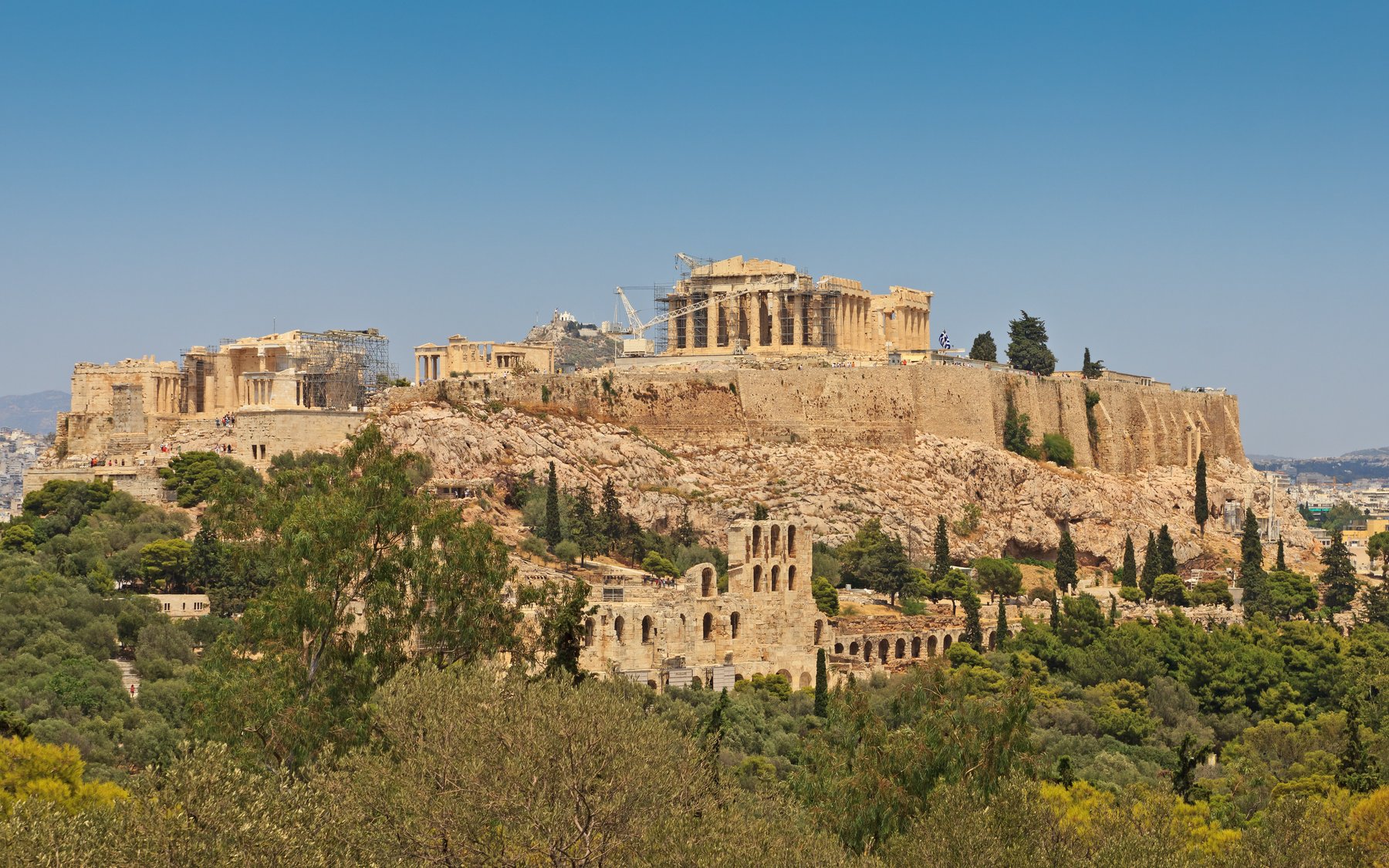
The Athenians began rebuilding the Acropolis in 447 BC. They finished, more or less, by 406. In that forty-one-year window, on a limestone rock about three hundred meters long and one hundred and fifty wide, they put up four buildings that the rest of European architecture has been copying ever since. The Parthenon. The Erechtheion. The Propylaea. The little Temple of Athena Nike. None of them had been planned together. None of them are aligned to a single grid. Each one was solving a different problem on the rock as it was found, and the architects — Iktinos, Kallikrates, Mnesikles — were working at the same time, sometimes against each other, on a budget that was the looted treasury of the Delian League.
What stands on the rock today is about half of what stood on it in 432 BC. Most of the smaller buildings are gone. The Parthenon lost its roof in a Venetian artillery strike in 1687, and most of its sculpture was sold to the British in 1801. But the four major buildings are still up there, in various states of restoration, and the climb to them is still the most concentrated piece of ancient architecture in the world.
If you are walking up the path on a hot afternoon, you can do the whole Acropolis in two unhurried hours. What follows is what the rock was for, what each of the four buildings is, and what to look at when you get there.
What it was for
The rock had been fortified since at least the thirteenth century BC. Mycenaean Greeks built a palace and a cyclopean wall around it. Later Athenians treated it as a sanctuary first and a fortress second. The Persian army sacked it in 480 BC, burning everything on top and dumping the wreckage off the north side. The pious citizens of Athens vowed not to rebuild for a generation, as a witness to the sacrilege. Pericles broke that vow in 447 BC, arguing that the Persian threat justified using the league’s defense fund on a new building program. The other members of the Delian League objected. Pericles won the vote. The Parthenon went up on the league’s money.
The Acropolis was not a citadel in the practical sense by the time of Pericles. It was a state-sponsored religious complex, dedicated mostly to Athena in her various aspects — Athena Parthenos, the virgin warrior; Athena Polias, protector of the city; Athena Nike, the bringer of victory. The buildings are arranged not on an axial plan but in a careful sequence of approaches, so that as you climb the path and pass through the Propylaea, the Parthenon swings into view at an oblique angle. The Athenians had no interest in symmetrical facades. They wanted you to walk around their buildings.
The Propylaea: the gate that argues with the rock
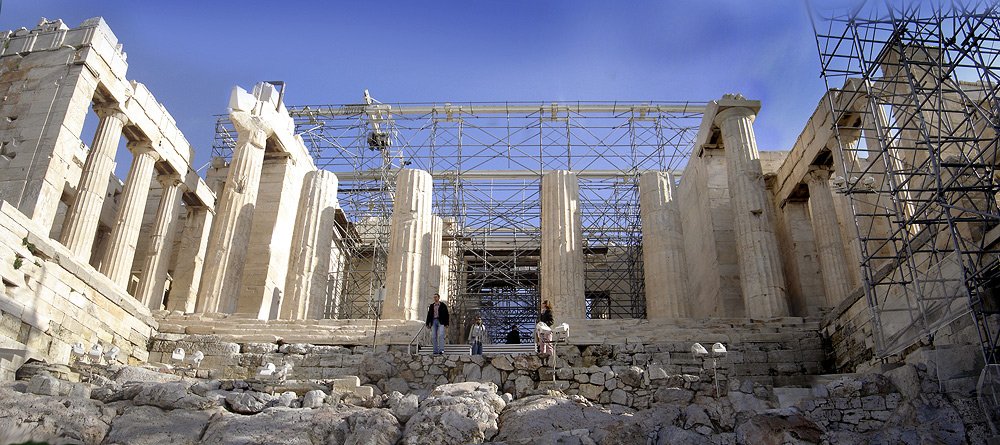
The Propylaea is the first thing you walk through. Mnesikles began it in 437 BC, finished the central block by 432, and never finished the side wings — the Peloponnesian War broke out and the money ran out. The unfinished state is still visible. Look at the wing on the left as you enter; the blocks of the upper course were quarried but never set, and the protective bosses that masons left on the stone to lift it into place were never chiseled off. The Propylaea is the only major Athenian temple with bosses still on its blocks. You are looking at a job left half-done in 432 BC.
The building has a problem the architect had to solve in real time. The path up the rock rises steeply. To put a colonnaded gate across it, Mnesikles needed to combine a sloping floor with a flat roof. He did it by using a sequence of Ionic columns inside the outer Doric facade, taller and slimmer than the Doric, that could span the height of the slope without dwarfing the entrance. The mixed Doric-and-Ionic order on the Propylaea is one of the earliest examples in Greek architecture. It became standard practice for the next three centuries because Mnesikles had already solved the problem here.
To the right of the Propylaea, perched on a small bastion at the southwest corner, is the Temple of Athena Nike, a tiny Ionic building finished around 420 BC. It is small enough to walk past. Do not walk past. Look up at its frieze. The fragments that survive show Athenian victories over Persians and Greeks both, the only Greek temple frieze that depicts historical — not mythological — combat. The Athenians were putting their own war victories on the same architectural register the gods normally occupied.
The Parthenon: what the camera flattens
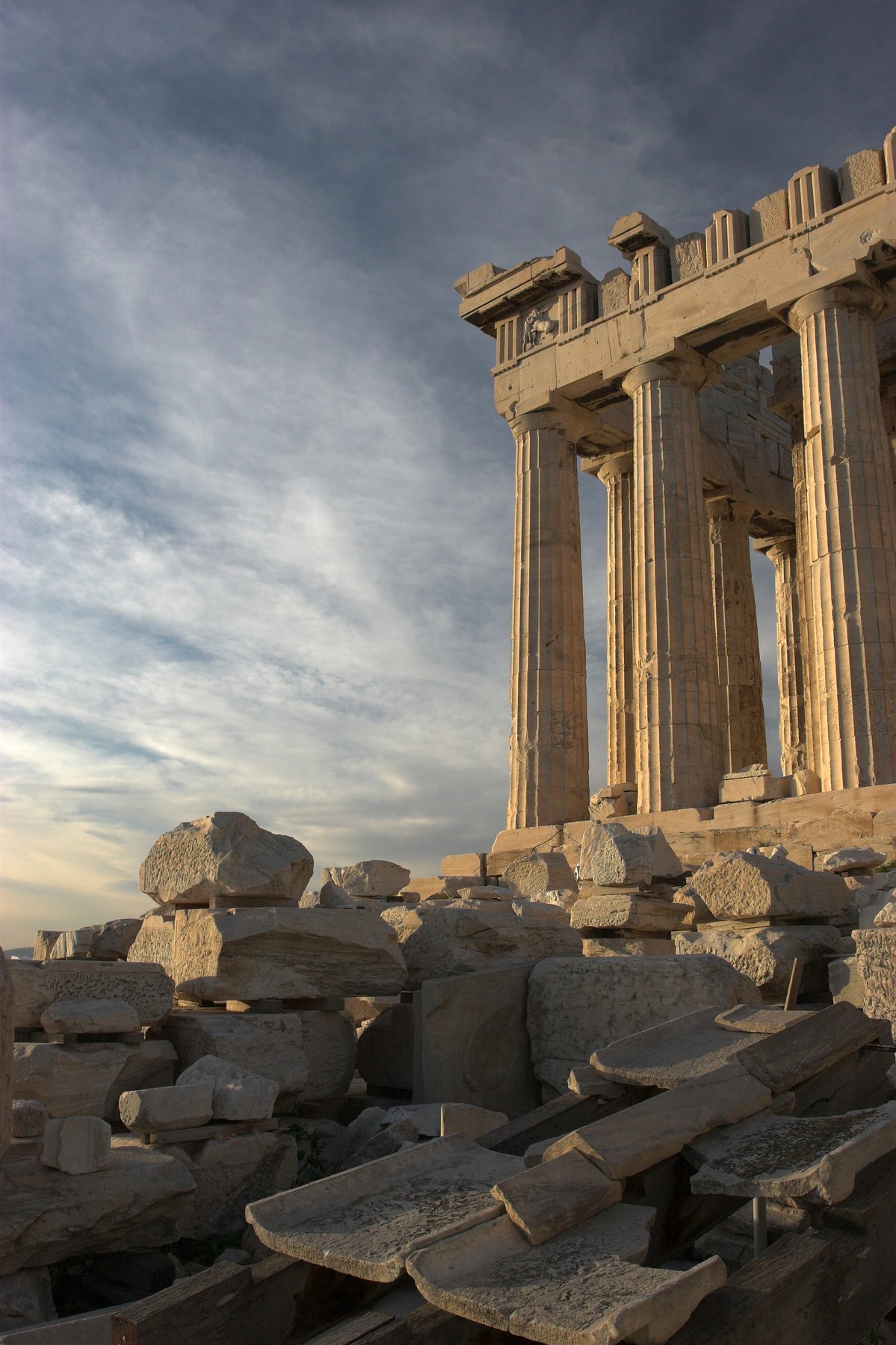
The Parthenon is the building everyone climbs the rock to see. It is also the building most people stop looking at after they have taken the photograph. Stand at the southwest corner instead, where the angle gives you both the long side and the short side at once, and the optical refinements of the building start to be visible.
The Parthenon has no straight lines. The architects Iktinos and Kallikrates, working with the sculptor Phidias as overall artistic director, built optical corrections into every element to compensate for the visual distortions a perfectly rectangular building would produce at this size. The stylobate — the platform the columns stand on — curves upward in the middle by about eleven centimeters on the long sides and seven on the short sides, so it does not look as if it is sagging. The columns lean inward by about seven centimeters at the top. The corner columns are slightly thicker than the others, so they do not look thin when silhouetted against bright sky. Each column has a subtle bulge in the middle, the entasis, so that the shaft does not appear concave under its load. If you sight along the top of the stylobate from the southwest corner, you can see the upward curve. The Parthenon is a building in which every line you think is straight is actually a precisely calculated curve.
Chiaro names each of these optical refinements as you stand at the corner and lays the geometry over what your eye is actually seeing, so the building reads as a piece of fifth-century engineering rather than a postcard. The sculptors and the architects did not separate their work; Phidias was overseeing both the marble figures of the frieze and the dimensions of the columns the frieze sat above. Nothing on this building is incidental.
The sculpture is mostly gone from the building itself. The pediments held two great mythological scenes — the birth of Athena on the east, the contest of Athena and Poseidon for the city on the west. Most of what survived the Venetian explosion in 1687 was removed by Lord Elgin’s agents between 1801 and 1812 and is now in the British Museum. What remains on the Parthenon today are the metope panels around the exterior and fragments of the inner frieze. The rest is in the Acropolis Museum at the foot of the south slope, where reproductions hang in the positions the originals once occupied, with the missing pieces marked in white plaster.
The Erechtheion: the temple that gave up on a single floor
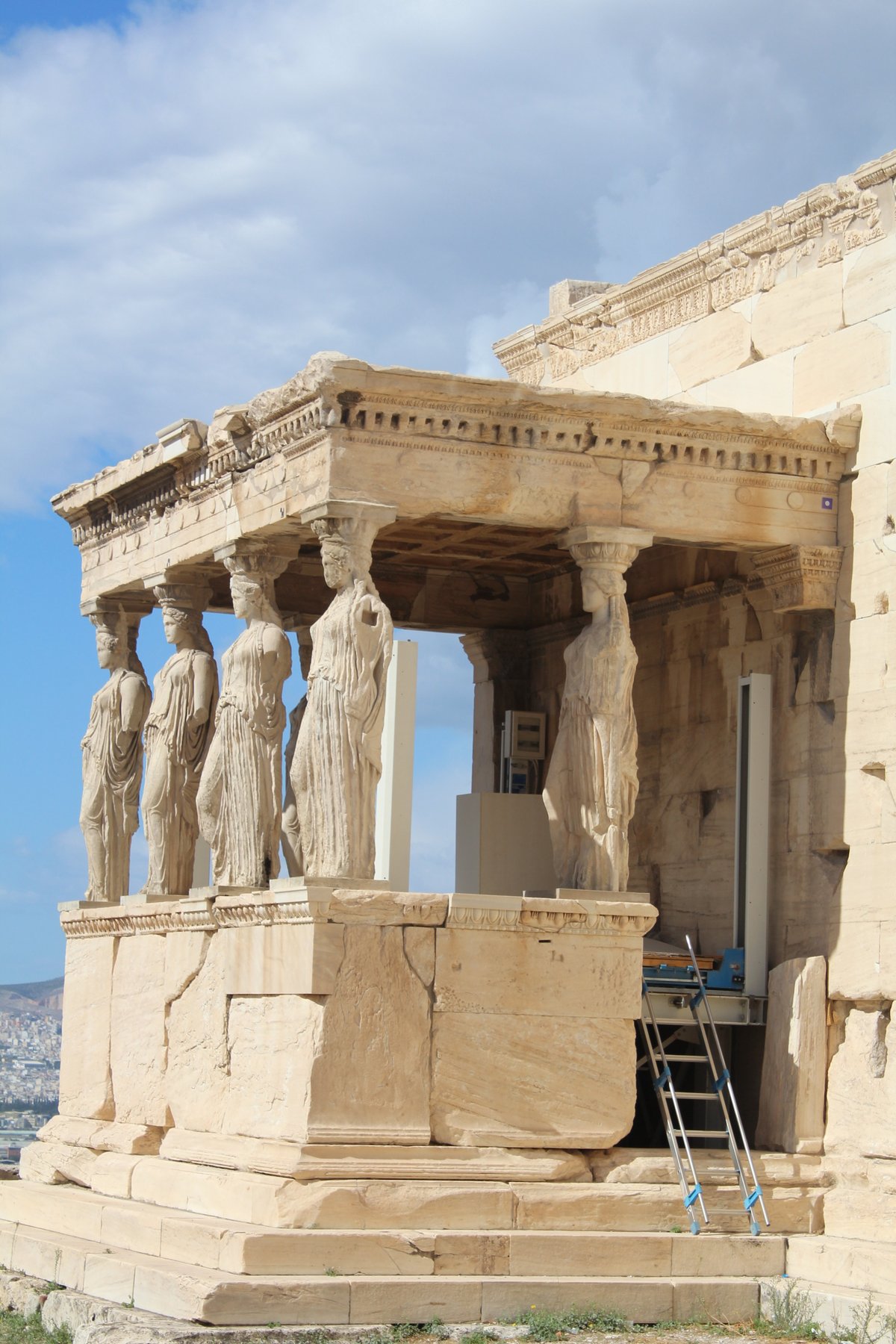
The Erechtheion is the small temple on the north side of the rock, opposite the Parthenon. It is the strangest building on the Acropolis. The architects who finished it in 406 BC had to fit a single building over three different existing sacred spots, each at a different elevation, including the place where Athena and Poseidon had supposedly held their contest and a tomb traditionally believed to belong to a legendary Athenian king named Erechtheus. They could not move the spots. So they built a temple with four different floor levels on a roughly L-shaped plan, with porches sticking out at angles, and a single roof that does not quite line up at any corner.
The famous element is the Porch of the Caryatids — six standing female figures, two meters tall, carrying the entablature of a small portico on their heads. The figures on the building today are casts. Five of the originals are inside the Acropolis Museum, in a glass case lit from above so the carving of the drapery reads from any angle. The sixth original is in the British Museum. Notice, when you look at the casts, that the three figures on the left stand with the weight on their right legs and the three on the right stand with the weight on their left legs, so the porch mirrors itself down the middle. The drapery follows the shifted weight. Each caryatid is a complete portrait statue functioning as architecture.
The trees of an old olive grove are visible just below the Erechtheion’s west porch. According to the founding myth of Athens, this is where the goddess produced the first olive tree as her gift to the city, beating Poseidon’s offer of a saltwater spring. The current olive tree is a much later replanting — it was set there in 1952. The persistence of the location for almost twenty-five hundred years is more interesting than the tree.
How to read the rock
The four buildings sit at angles to one another, but the path through the Propylaea was designed to direct your view in a specific sequence. Coming through the gate, you are looking at a colossal bronze statue of Athena Promachos that used to stand in front of you — gone now since the sixth century AD, but its base is still on the rock. As you walk around it to the right, the Parthenon comes into view at three-quarter angle, the way the Athenians wanted you to see it. The Erechtheion is to the left, smaller and asymmetrical, almost domestic next to the Parthenon’s grandeur. The two buildings together were the answer to a single religious problem: the Parthenon held the colossal gold-and-ivory cult statue of Athena Parthenos, the warrior virgin, made by Phidias; the Erechtheion held the much older wooden statue of Athena Polias, the city’s primary protector, the one that had been on the rock for hundreds of years. The Athenians needed both. They built one big building for the famous statue and one strange building for the sacred one.
What to look for
Five things to do on the rock. First, before you climb, look at the south slope from below. The Odeon of Herodes Atticus, a Roman amphitheater finished in 161 AD, is built directly into the cliff face. It is still used for summer performances. The acoustics are unchanged.
Second, at the Propylaea, look at the unfinished lifting bosses on the wall blocks of the left wing. They are pale, untouched, and proof that the building was abandoned mid-construction in 432 BC.
Third, at the Parthenon, walk around to the southwest corner and sight along the stylobate platform. The upward curve in the middle is visible. The Parthenon is doing optical work for you whether you notice or not.
Fourth, at the Erechtheion’s Porch of the Caryatids, count the figures. Five originals are in the museum below. The sixth is in London. The empty position in the Acropolis Museum cast is the one that left the rock in 1801.
Fifth, walk to the east edge of the summit, near the flagpole, and look down. You are looking straight at the National Garden, the Parliament building, the Olympic stadium, and the modern city of Athens stretching to the sea. The rock is what the city was built around. It has been the center of Athens for thirty-five hundred years. Everything below it is younger.
The Acropolis is small. The buildings are limestone and marble and time has eaten most of the decoration. What is still up there is the geometry: four buildings put up by one generation in one place, with optical refinements that have not been improved on since, and a path that swings the view of the Parthenon into your eye exactly the way Pericles wanted it to swing.
Image credits
- Attica 06-13 Athens 50 View from Philopappos - Acropolis Hill.jpg — A.Savin. Source, CC BY-SA.
- Parthenon from south.jpg — Mountain. Source, CC BY-SA.
- The Caryatid Porch of the Erechtheion, Athens.jpg — Thermos. Source, CC BY-SA.
- Propylaea-athens.jpg — Wikimedia Commons contributor. Source, CC BY-SA.


