The Vatican Museums are roughly seven kilometers of galleries arranged as a single one-way corridor that ends at the Sistine Chapel. On a busy day, twenty-five thousand people walk this corridor between nine in the morning and six in the evening. The pace is set by the crowd, not by you. From the moment you pass the metal detectors at the entrance on Viale Vaticano, the route is determined: you cannot easily go back, you cannot easily skip ahead, and you cannot meaningfully linger in any one room. The Sistine Chapel, which most people are here to see, is the last room in the sequence. Everything before it is arranged to feed you toward it.
This is the largest art collection in the world held under a single roof. The buildings were not designed as a museum — they are the private apartments, garden pavilions, and chapels of popes from the fifteenth century onward, retrofitted across four centuries to display the art the popes had been quietly accumulating. The result is that the corridor passes through some of the most painted and gilded interiors in Europe before you ever reach an artwork that is not also part of the wall.
What follows is the route as it actually works, and the four rooms that are worth slowing down for. If you read the corridor in the right order, the Sistine Chapel at the end stops feeling like a stand-alone famous ceiling and starts feeling like the climax of a sequence you have been walking through for an hour and a half.
What the route is
The standard public route, called the long route by the museums, begins after the entrance turnstiles, climbs Bramante’s spiral ramp into the Pio Clementino sculpture galleries — where the Laocoön and the Apollo Belvedere are, in two niches on the octagonal courtyard. From there you pass through the Egyptian collection, the Etruscan rooms, an enormous gallery of candelabra, a gallery of tapestries, a gallery of maps, and the four Raphael Rooms, before descending a staircase that puts you at the door of the Sistine Chapel.
The Sistine Chapel has two exits. The ordinary exit returns you up a corridor and out through the Pinacoteca gallery of paintings, which most visitors skip. The unofficial exit, on the right of the altar wall as you face it, opens directly into St. Peter’s Basilica via a corridor that is normally restricted to tour groups. If a museum guide is standing there, ask politely. Sometimes they let you through.
The choreography of the route is deliberate. The popes did not want pilgrims who had come to see St. Peter’s to enter the Sistine Chapel as a tourist destination. The chapel is liturgical space, a working chamber where the College of Cardinals still locks itself in to elect new popes. The route was set up to deliver visitors there in a state of accumulated awe, having already walked through enough beautiful things to have stopped reacting individually to them, so that the chapel ceiling is the thing that breaks through.
The Gallery of Maps
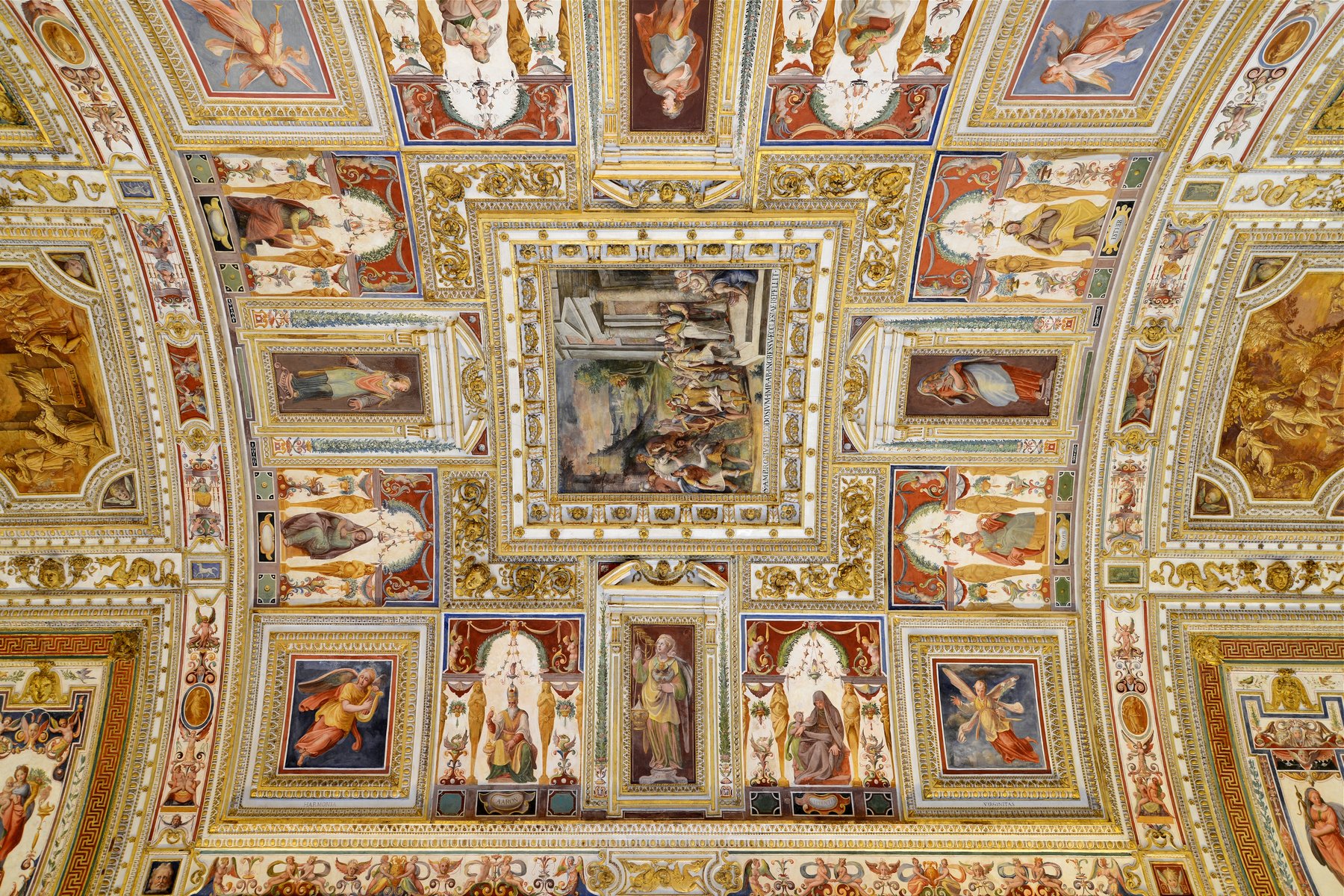
About two-thirds of the way along the route, you enter a corridor that is one hundred and twenty meters long, six meters wide, and frescoed continuously along both walls and the ceiling. This is the Galleria delle Carte Geografiche, the Gallery of Maps, commissioned by Pope Gregory XIII in 1580 and painted by a team led by the Dominican cartographer Egnazio Danti.
Forty large fresco maps cover the side walls — twenty on each side — and they show the whole of Italy and the Mediterranean as it was known in the early 1580s. The maps on the western wall depict the regions of Italy bounded by the Tyrrhenian Sea. The maps on the eastern wall show the regions bounded by the Adriatic. They are organized geographically, not alphabetically, so that walking down the gallery from south to north is a virtual journey up the spine of the Italian peninsula. The cartography is genuinely good for its date. The coastline of Sicily is recognizable. The Venetian lagoon is drawn in clear detail. The papal states are exaggerated slightly.
The ceiling above the maps is the part most people miss because everyone is looking at the walls. Look up. The ceiling is divided into octagonal panels showing miracles, saints, and historical events tied to the region depicted on the wall directly below. The Pope was projecting both his geographical and his spiritual authority over the peninsula at the same scale, on the same axis. This is the corridor where you should slow down. The crowd ahead of you is shuffling, and the ceiling will reward looking up for as long as you can hold the stop.
The Raphael Rooms
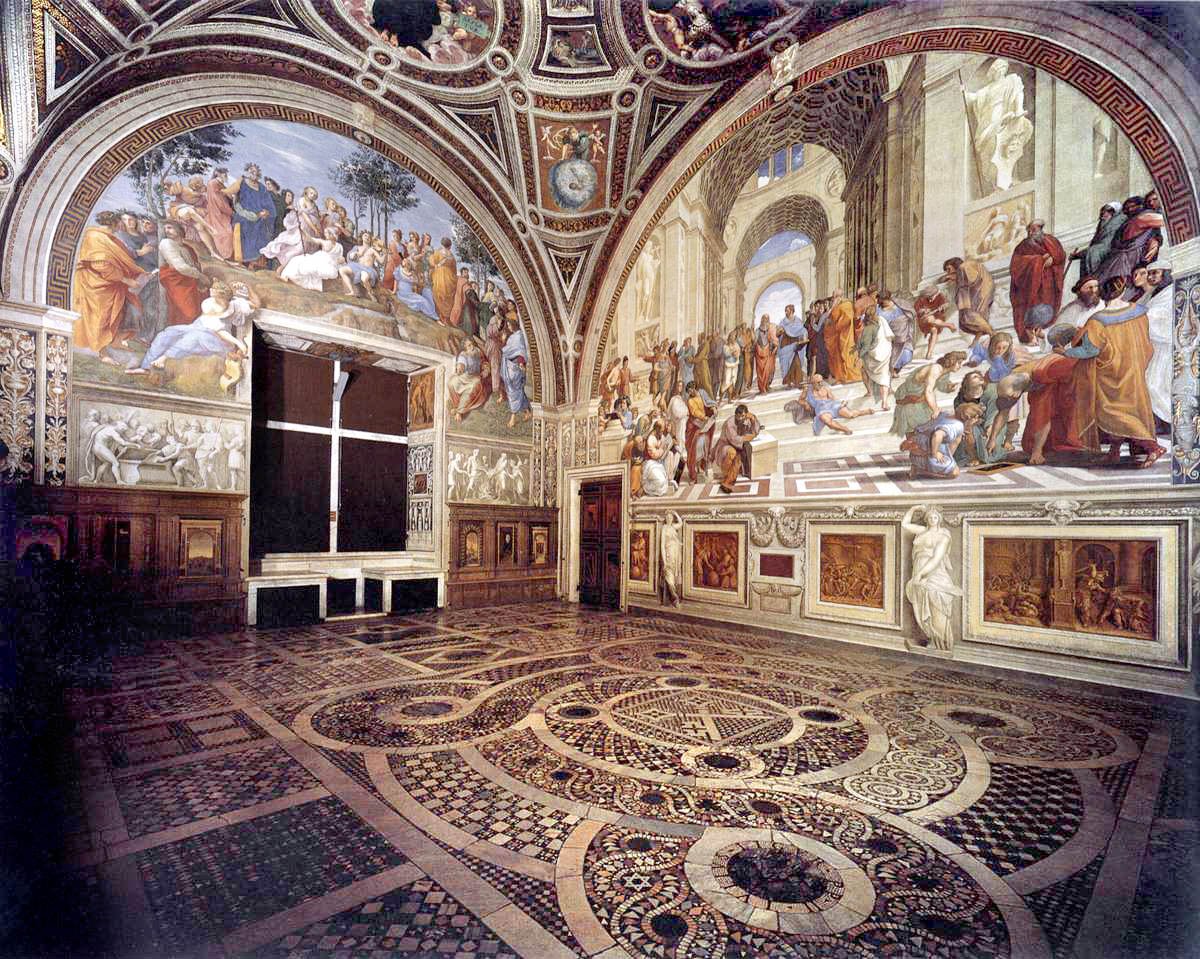
After the Gallery of Maps, the route enters the Raphael Rooms — the Stanze di Raffaello, a sequence of four chambers that Pope Julius II commissioned Raphael to fresco in 1508, when Raphael was twenty-five years old. The four rooms were the pope’s working apartment. The Stanza della Segnatura, the second of the four, was Julius’s private library and signing chamber, and it contains four of the most famous frescoes Raphael painted: the School of Athens on one wall, the Disputation of the Sacrament on the wall opposite, and two smaller compositions on the side walls.
The School of Athens is the one most visitors are looking for. Plato and Aristotle, in the center under the receding coffered arch, are the philosophical center of the composition; around them, Pythagoras with a book, Euclid with a compass, Diogenes lounging on the steps, Heraclitus in the foreground leaning on a block of marble, painted as a portrait of Michelangelo. Raphael was working in the room next door to Michelangelo’s Sistine Chapel ceiling at exactly the same time. He had seen Michelangelo’s preliminary cartoons. He included Michelangelo, dressed as a stonemason, brooding alone in the middle of a fresco about classical philosophy, partly as homage and partly as the artistic equivalent of a wink to a rival working three doors down. Michelangelo never mentions returning the compliment. He hated Raphael.
The four rooms were painted over a sixteen-year span. Raphael himself died in 1520 at the age of thirty-seven, with the final room only half finished, and his workshop assistants completed it. The hand-off is visible if you know what you are looking at — the figures in the Battle of Ostia on the wall of the last room are stiffer, the drapery less alive, the perspective slightly more mechanical. The pope kept commissioning frescoes for sixteen years from a single workshop because no other painter at that scale was available in Rome. The Vatican Museums hold the last and the most consolidated body of Raphael’s mature work anywhere on earth.
The Sistine Chapel
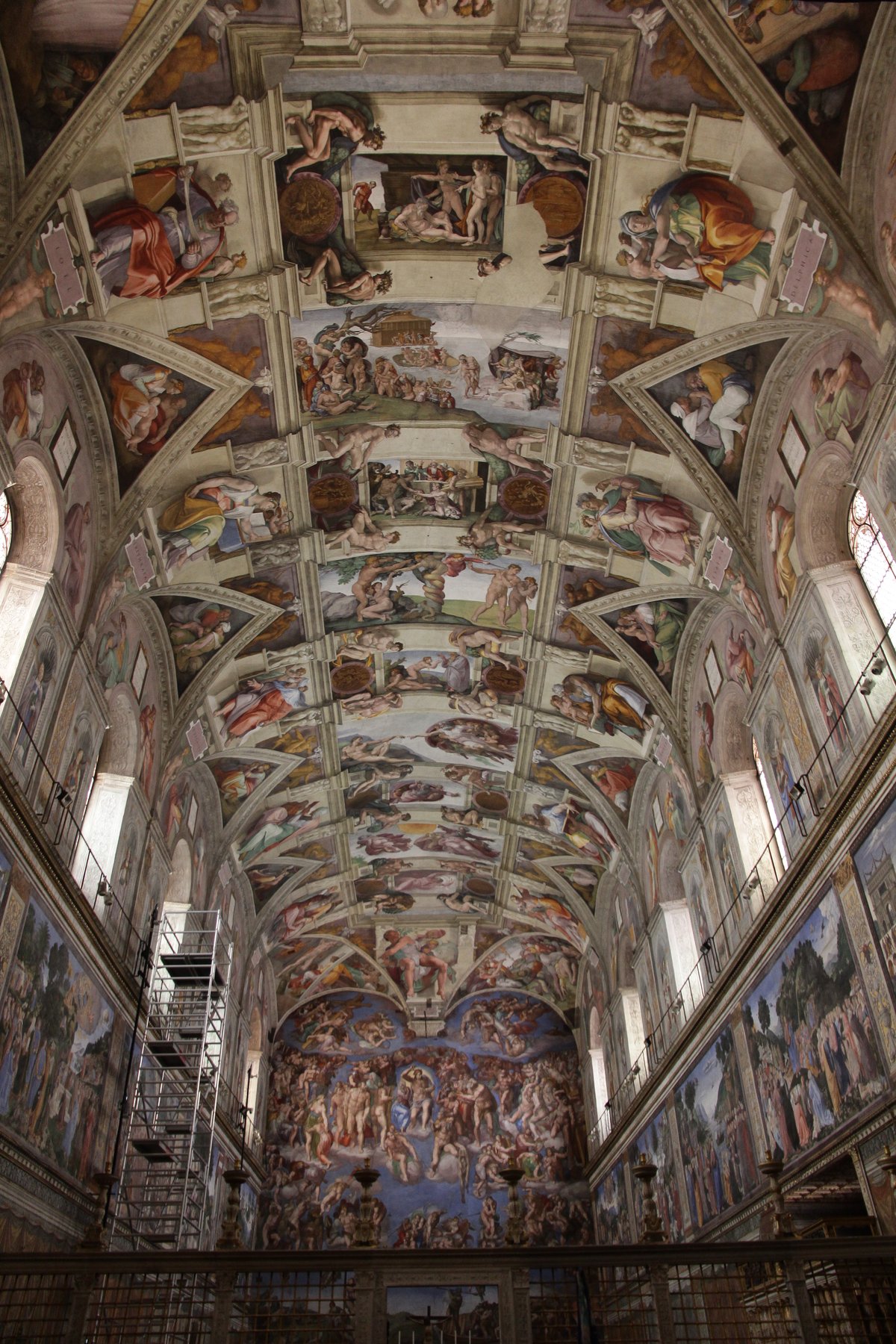
The Sistine Chapel is forty meters long, thirteen wide, and twenty-one high. The ceiling was painted by Michelangelo between 1508 and 1512, the altar wall by the same artist twenty-five years later in the Last Judgment of 1536 to 1541. The side walls were painted earlier, between 1481 and 1483, by a team that included Botticelli, Perugino, Ghirlandaio, and Cosimo Rosselli — frescoes that almost nobody looks at because the ceiling and the altar wall above the door are so dominant.
The ceiling is the project everyone knows. Michelangelo was a sculptor who had never executed a fresco at scale before Julius II forced him to take the commission. He famously hated the assignment, complained throughout, and finally produced one of the densest narrative cycles in Western painting: nine central panels of Genesis scenes, framed by twelve seated prophets and sibyls at the corners, with bronze-colored figures in the spandrels and twenty contorted nudes (the ignudi) holding garlands. The Creation of Adam, with God and Adam reaching toward each other in the center of the third panel from the altar end, is the single most reproduced image from the cycle. It is also slightly less central than most reproductions suggest — it is the fourth panel of nine, two panels in from the entrance wall, painted late in the program when Michelangelo had simplified his approach.
A guard at one end of the chapel calls out “silenzio” every few minutes. The chapel is consecrated space and is meant to be entered in silence. The rule is more honored in the breach now than it used to be, but the silenzio is real, and the guards do enforce it intermittently. Stand still in the middle of the chapel, look up, and you can see why the room was meant to be silent. The ceiling is loud enough on its own.
The Last Judgment on the altar wall is the more disturbing painting. Michelangelo was sixty-six when he painted it. The figures are heavier, more anguished, and physically muscular in a way the ceiling figures are not. Christ at the center is beardless and clean-shaven, his right arm raised in a gesture of damnation. Around him, the saved rise on the left, the damned descend on the right. Bartholomew, who was flayed alive, holds his own skin — and the face on the skin is a self-portrait of Michelangelo. The painting was controversial at its unveiling for the nudity of its figures, and a generation later, after Michelangelo’s death, the artist Daniele da Volterra was hired to paint loincloths over the most exposed bodies. The loincloths are still there. They are easy to spot once you know to look. Chiaro holds the chronology of these two ceilings — the youthful Michelangelo of 1508 and the elderly Michelangelo of 1536 — against each other while you stand in the chapel, so the same painter at two different ages is legible on the two surfaces of the same room.
What to look for
Five things to do on the route. First, in the Pio Clementino octagonal courtyard, find the Laocoön. It is the marble group from the second century BC showing the Trojan priest Laocoön and his two sons being attacked by serpents. It was unearthed in a Roman vineyard in 1506 and Michelangelo was one of the first artists to examine the discovery. Some of the strain and twist of the ceiling figures comes directly from his study of this piece.
Second, in the Gallery of Maps, look up at the ceiling. Most people only look at the maps. The painted octagonal panels overhead are the unrecognized half of the room.
Third, in the Stanza della Segnatura, find Michelangelo in the foreground of the School of Athens. He is the heavy figure leaning on the block of marble, in solitary brooding pose, dressed as a stonemason. Raphael painted him in after seeing the ceiling next door.
Fourth, in the Sistine Chapel, look at the altar wall and find Bartholomew holding his own flayed skin. The face on the skin is Michelangelo’s self-portrait, painted into the wall when the artist was in his sixties.
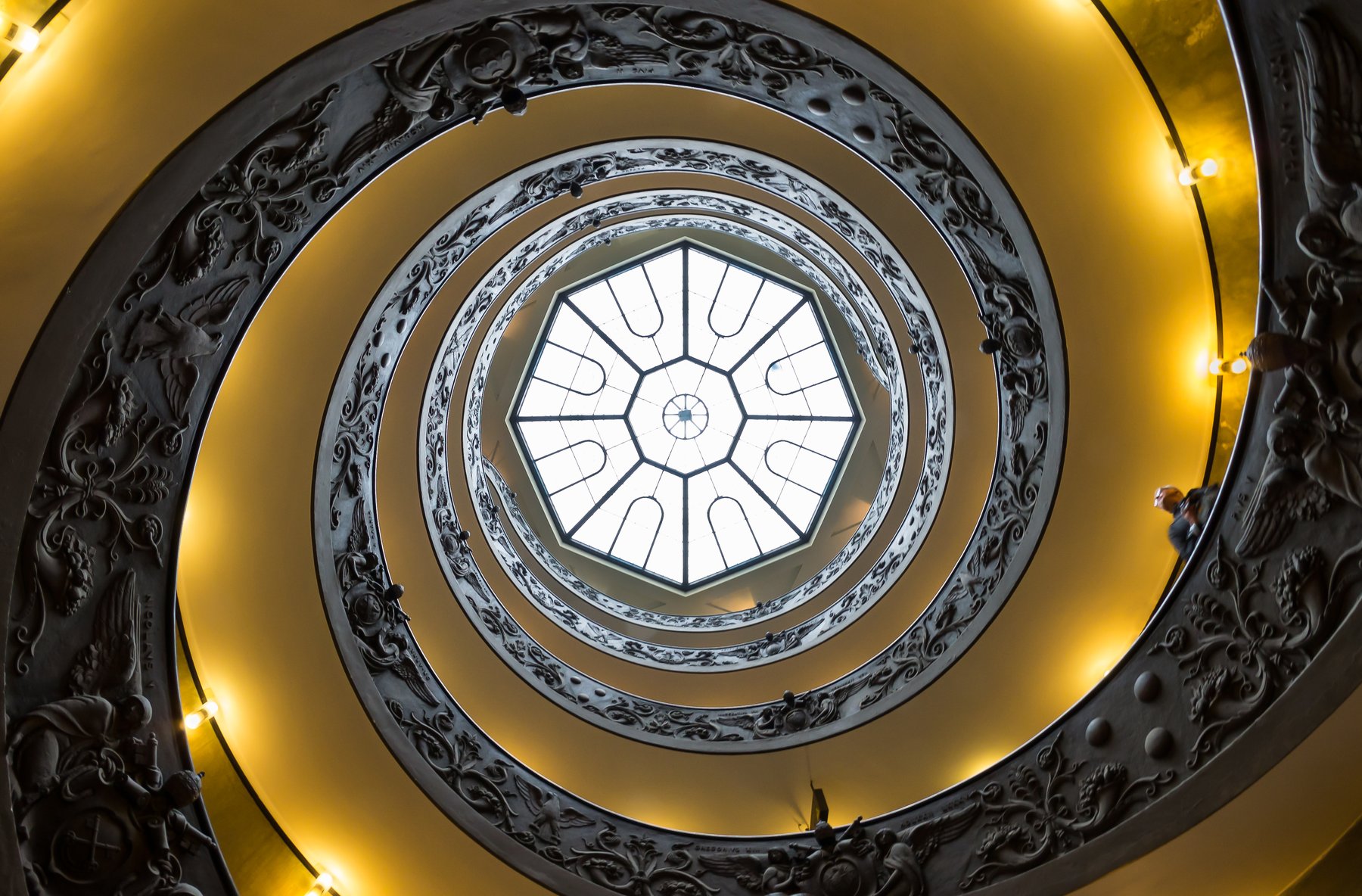
Fifth, on the way out, take the Momo spiral staircase if you exit through the official route. It is a double helix — one ascending, one descending — with two intertwined ramps so that visitors entering and leaving do not cross. Giuseppe Momo designed it in 1932 to replace the older Bramante stair, and it is the visual moment most photographs from the museums show. The bronze handrail spirals up under a stained-glass dome. Look down once before you leave.
The museums are not a museum the way the Louvre is a museum. They are the private rooms of popes, retrofitted for the public, with everything still in roughly the position the popes left it. The route is determined for you. The crowd is dense. But the corridor was built to deliver you, at the end of about ninety minutes of walking, to a forty-meter chapel under a ceiling that has been there for five hundred and fifteen years. That delivery is the whole point of the design.
Image credits
- Vatican Museums Spiral Staircase Looking Up 2012.jpg — Colin. Source, CC BY-SA.
- Galleria delle carte geografiche (Vatican Museums) September 2015-5.jpg — Carole Raddato. Source, CC BY-SA.
- Raffael Stanza della Segnatura.jpg — Raphael (1509-1511); photograph by Antoine Taveneaux. Source, CC BY-SA.
- ‘Sistine Chapel ceiling’ by Michelangelo JBU21.JPG — Michelangelo (1508-1512); photograph by Jean-Christophe Benoist. Source, CC BY.


