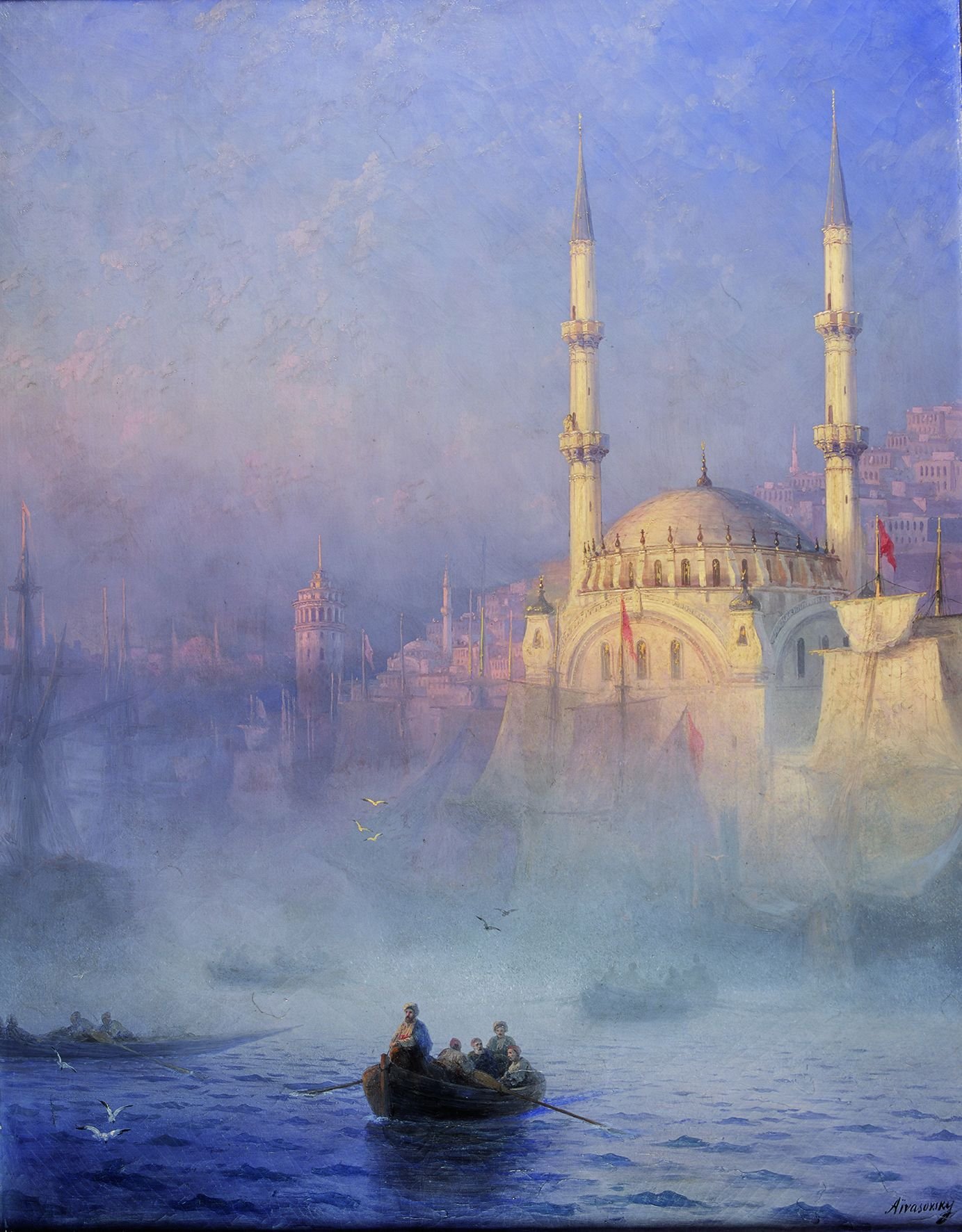
In 1845 a thirty-year-old Armenian painter from the Crimean port town of Feodosia sailed into the Bosphorus for the first time, on board the Russian Black Sea fleet’s flagship, and saw the dome of the Nusretiye mosque catch the morning sun off the Tophane quay. He stayed in Constantinople for six months. Over the next half-century he came back at least nine times. He painted the city around forty times. The 1884 canvas now sometimes called Constantinople, the Mosque of Tophane is one of the late ones — Ivan Aivazovsky was sixty-seven when he made it — and it is the painting most often used to teach what was strange about his entire career. He painted the same view, of the same mosque, on the same waterfront, more than half a dozen times over forty years, and every version looks like he just discovered the place yesterday. The Aivazovsky Constantinople paintings are a study in obsession that never stopped feeling like first sight.
The painter Russia would not stop ordering
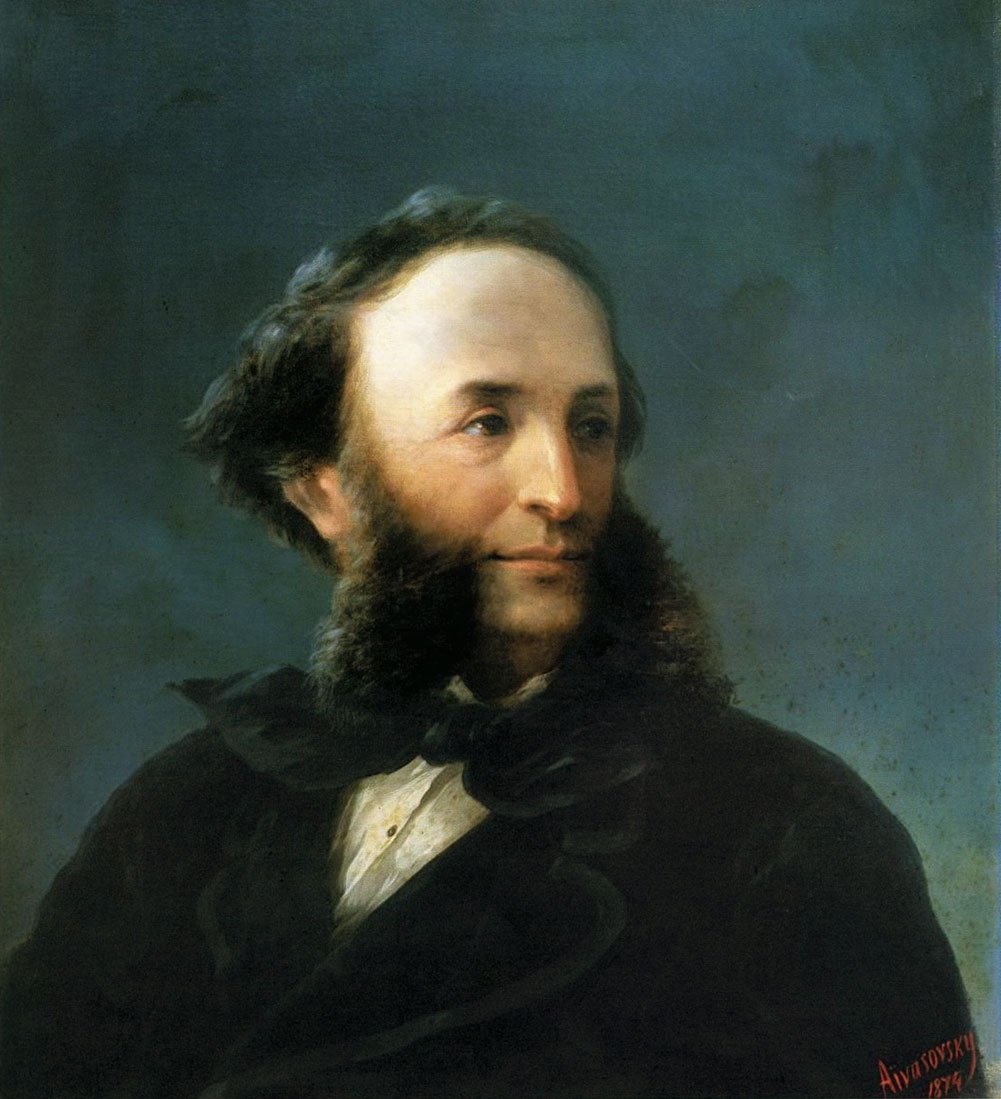
Aivazovsky was born Hovhannes Aivazian in 1817 in Feodosia, on the Crimean coast of the Russian Empire. His family was Armenian. He showed obvious talent young — the local mayor paid for his drawing lessons — and at thirteen he was admitted to the Imperial Academy of Arts in Saint Petersburg, the most prestigious art school in the Russian world. By twenty-three he was the official painter of the Russian Navy. This is not a title that translates well into a modern context. He was assigned to sail with the Black Sea fleet, witness real naval engagements, and paint them. Tsar Nicholas the First personally signed off on commissions. By the time Aivazovsky died in 1900 he had painted somewhere between five and six thousand finished oils. The number is not a guess. Aivazovsky kept extensive records. He worked fast and he worked steadily and he died with a brush in his hand — literally, in his Feodosia studio, in front of a canvas titled “Explosion of a Turkish Ship,” which he never finished.
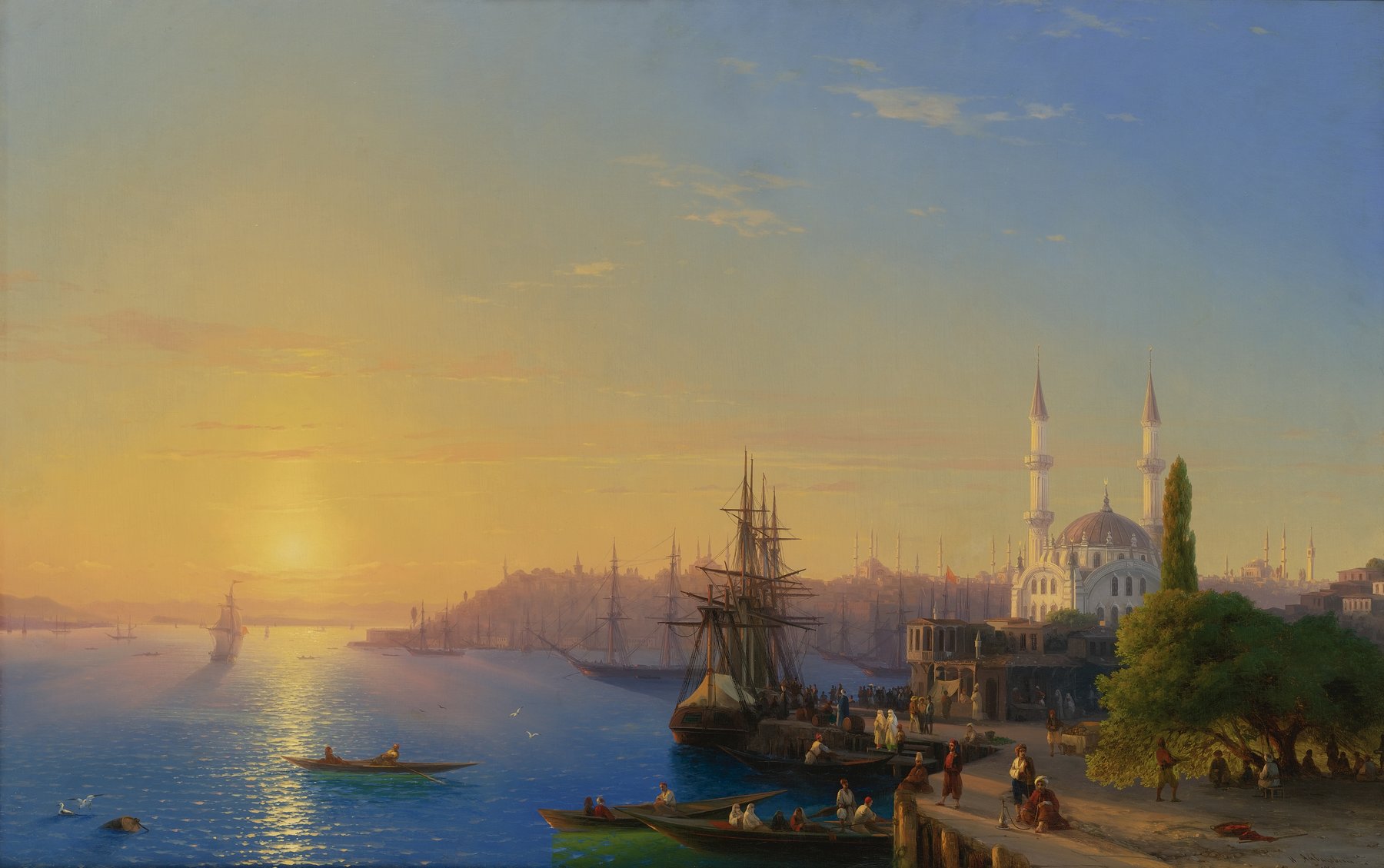
He had two subjects. The first was the sea, in every mood — moonlit calm, hurricane, battle, becalmed becalm, the foam of a wave breaking against a dying sailor on a spar. The second was Constantinople. He painted other cities sometimes — Venice, Naples, Saint Petersburg from the Neva, the Egyptian coast — but the city he returned to with the patience of a religious pilgrim was the Ottoman capital. He had Ottoman patrons, including Sultan Abdulmecid the First, who awarded him the Order of Mecidiye in 1856, and later Abdulhamid the Second, who hung Aivazovsky’s paintings in the Dolmabahce Palace. He was probably the only major nineteenth-century painter whose work was personally collected by both the Russian Tsar and the Ottoman Sultan, who at the time were essentially at war with each other. He kept his Russian commissions and he kept his Ottoman commissions. He painted Constantinople for both audiences.
Why he kept coming back
The view in the 1884 painting is taken from somewhere out in the water, looking south across the bay toward the European side. The big domed mosque in the center is the Nusretiye Camii, the “Mosque of Victory,” finished in 1826. It sat directly above the Tophane cannon foundry, which is why the area was called Tophane — “place of cannons” — and why the mosque is identified by that neighborhood rather than its own name in most of Aivazovsky’s titles. Beyond the mosque, on the higher ground, you can see the silhouette of the Genoese Galata Tower built in 1348. The minaret in the foreground belongs to the Kilic Ali Pasa mosque on the waterfront. To the right, dropping into the Bosphorus, are the wooden mansions of Beyoglu. In the foreground a caique — the long narrow Ottoman rowboat — carries six figures across pink-orange water. Two men in white turbans sit in the stern. A woman in pale clothing sits facing them. The water under the boat is doing something Aivazovsky paints better than anyone in the nineteenth century, which is being slightly translucent — you can see the wake under the surface as well as on it.
This is the trick that made his Constantinople paintings stay alive across dozens of versions. The Bosphorus, at certain hours, is genuinely strange. The water is full of suspended silt from the Danube and the Don, and at sunrise and sunset it does not reflect the sky cleanly the way an Italian lake does. It holds the light slightly inside itself, the way oiled silk does. Aivazovsky learned to paint that effect in the 1840s during his first long stay and he kept refining it for the rest of his life. By 1884 he was sixty-seven and he could do it in glazes so thin you can see his brush direction through the water. He did not work from oil sketches outdoors. He worked from memory, in the studio, on dry sized canvas, often finishing a major work in a single day. He claimed — and his assistants confirmed — that he could see the painting whole in his head before he started.
The mosque that did not match itself
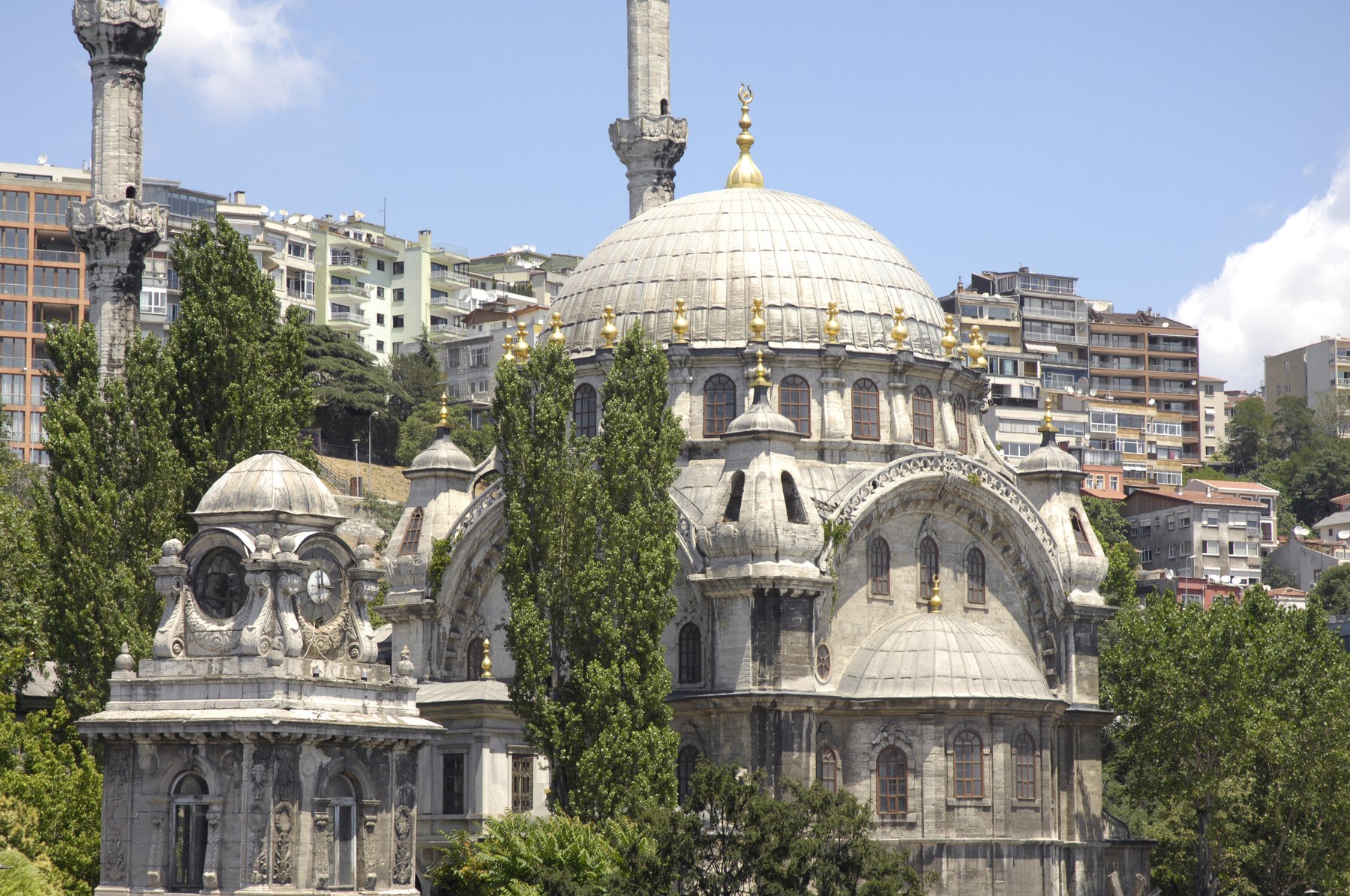
The Nusretiye Camii was a relatively new building when Aivazovsky first saw it. Sultan Mahmud the Second commissioned it in 1822, just one year after he abolished the Janissary corps in a violent purge that killed thousands of soldiers in Istanbul. The mosque was a victory monument — “Nusretiye” means “of victory” — but the victory it celebrated was a domestic one, the Sultan against his own army. The architect was Krikor Balyan, an Armenian, the founder of the Balyan dynasty that designed most of the great late-Ottoman buildings in Constantinople, including the Dolmabahce Palace. Krikor Balyan designed the mosque in the European Empire style, with corkscrew minarets, garlanded medallions, and a single high dome on slender drums, more like a Parisian opera house than a classical Ottoman mosque. The result is unmistakable on the skyline — which is why Aivazovsky, painting Constantinople, kept coming back to it. It was the most foreign-looking mosque in the city, and he was an Armenian painter from Crimea painting a Sultan’s commission about a building designed by an Armenian architect for a Sultan’s victory over his own army. The 1884 Tophane painting is a complicated picture even before you start looking at it.
Chiaro walks the eye from the caique in the foreground up through the minaret, across the dome, and onto the Galata Tower on the hill, in the order Aivazovsky built the picture, so you understand the recession of the city before you focus on the water.
What the painting does that photographs cannot
Stand close to the canvas at the museum that owns it and you will see the trick Aivazovsky used to make the water glow. He painted the sky and the underlying water at the same temperature — a high warm pink-orange — and then floated the actual sea surface on top of it in a series of thin gray-blue glazes. The eye reads the glow as coming from the water itself rather than from the sky reflected on it. Photographs of the painting flatten this completely. Reproductions look pretty. The original looks lit from underneath. He used the same technique in his more famous storm paintings, where it produces the opposite effect — the warm pink under a black wave reads as the dying glow of a sailor’s last conscious moment. Here it produces a city floating in pink water at the hour just after sunset. The sky is the cold part. The water is the warm part. Reverse what you expect to see and the painting clicks into place.
The figures in the caique are deliberately under-detailed. Aivazovsky was not a figure painter and he knew it. When he needed people in a marine scene he would sometimes ask other painters — including Ilya Repin — to add the figures for him. He painted the boat. Repin painted the people. There is no record of who painted the figures in the 1884 Tophane, but the indistinct touch is consistent with Aivazovsky working alone and on a deadline.
What to look for
Three things, when you find the painting. First, the dome. The Nusretiye is not a classical Ottoman dome on pendentives. It is shallower, on a drum, and Aivazovsky’s silhouette is precise enough that you can match it against a photograph of the building today. Second, the water under the caique. The wake is painted both on the surface as foam and through the surface as a curl of darker water beneath. The boat is not floating on the water; it is half-inside it. Third, the minaret on the far left, slightly cut off by the frame. It belongs to the Kilic Ali Pasa mosque, designed by Mimar Sinan in the 1580s. Aivazovsky was almost certainly painting the city as he had memorized it on his 1845 visit, which is why classical sixteenth-century landmarks and a modern 1820s mosque sit together as if they had always belonged to the same skyline.
The kicker
Aivazovsky painted Constantinople for the last time in 1899, the year before he died. He was eighty-two. The painting was a moonlight scene of the Bosphorus from almost the same angle as the 1884 Tophane. He had been painting the same view for fifty-four years. Nobody asked him to keep going. He kept going because the light off the water in Constantinople at the hour just after sunset is a thing he had decided to learn how to paint exactly, and he was not finished yet.
Image credits
- Hero: Ivan Aivazovsky, Constantinople, The Mosque of Tophane (1884) — via Wikimedia Commons, public domain.
- Inline 1: Ivan Aivazovsky, Self-Portrait (1874) — via Wikimedia Commons, public domain.
- Inline 2: Nusretiye Camii (Mosque of Victory), Tophane, Istanbul, photographed in the 2010s — via Wikimedia Commons, CC-BY-SA.
- Inline 3: Ivan Aivazovsky, View of Constantinople and the Bosphorus — via Wikimedia Commons, public domain.