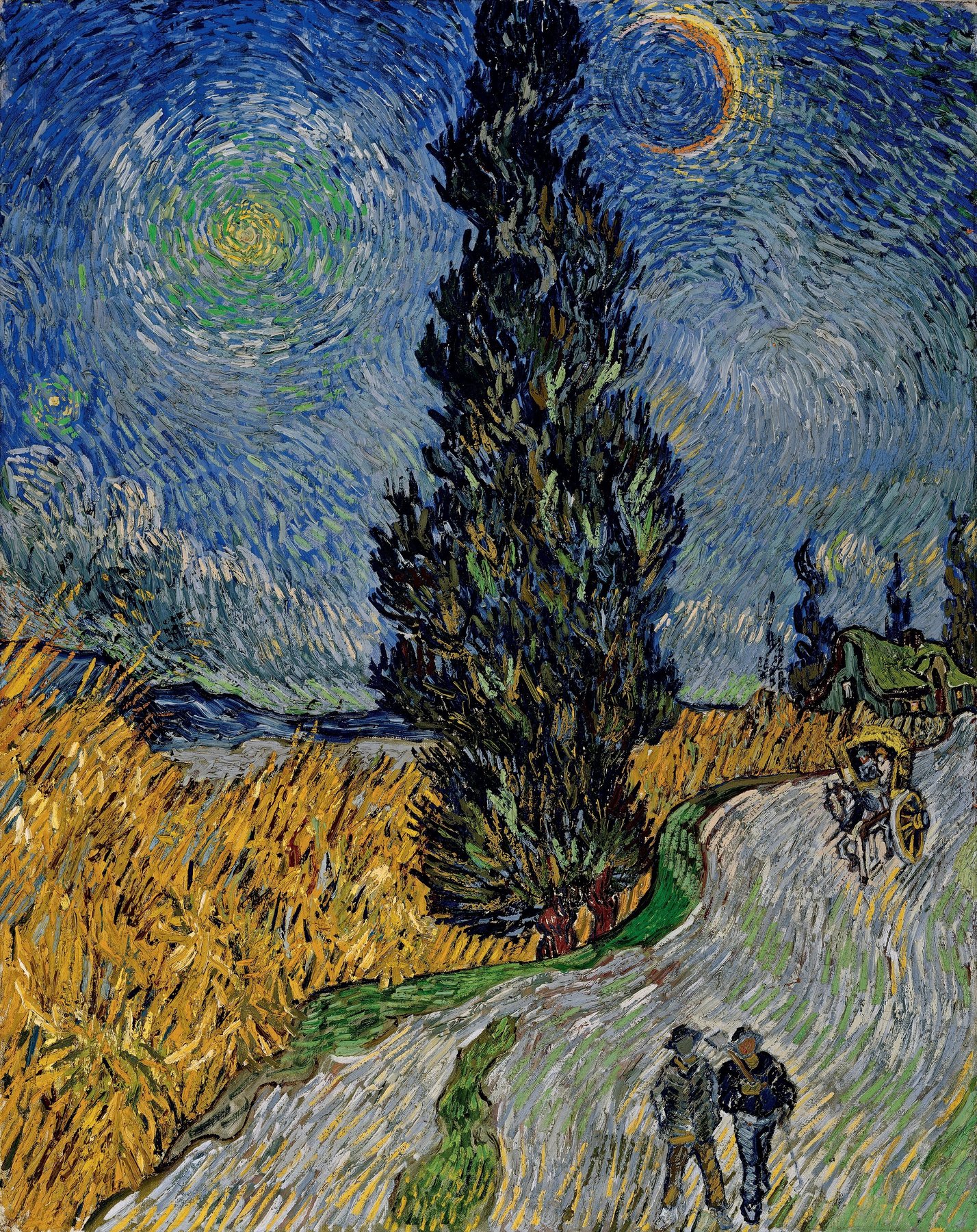
Sometime between the twelfth and fifteenth of May 1890, in the last week of his year-long stay at the Saint-Paul-de-Mausole asylum outside the town of Saint-Remy in Provence, Vincent van Gogh painted a road. The road was empty except for two figures walking south, a yellow stagecoach pulled by a brown horse coming up behind them, and a single huge cypress tree growing straight up out of the middle of the picture. On the left side of the sky, low and very bright, was the planet Venus, painted as a green-and-yellow halo about the size of a saucer. On the right, behind the cypress, was a thin orange crescent moon. He called the painting, in a letter to his brother Theo a week later, “a last attempt — a starry sky with a moon almost without radiance, the slender crescent emerging from the projected shadow of the earth — a star with exaggerated brilliance.” That letter is dated June 17, 1890. Six weeks later he was dead. Road with cypress and star is the last painting Vincent van Gogh made in Provence and the most direct picture he ever painted of the thing he had been trying to explain to Theo for two years — which is what cypresses meant.
The cypress problem
He had been obsessed with cypresses since the previous spring. Cypresses are the tall narrow black-green trees that grow in cemetery hedges and along farm roads in southern France, the ones that look like dark green flames stuck point-up in the soil. Van Gogh had painted his first proper cypress in June 1889, about three weeks after he checked into the asylum, in a picture called Wheat Field with Cypresses. He wrote to Theo about them obsessively. “The cypresses are always occupying my thoughts,” he wrote in a letter dated June 25, 1889. “It astonishes me that they have not yet been done as I see them. It is as beautiful in line and proportion as an Egyptian obelisk. And the green has a quality of such distinction. It is a splash of black in a sunny landscape, but it is one of the most interesting black notes, and the most difficult to hit off exactly, that I can imagine.”
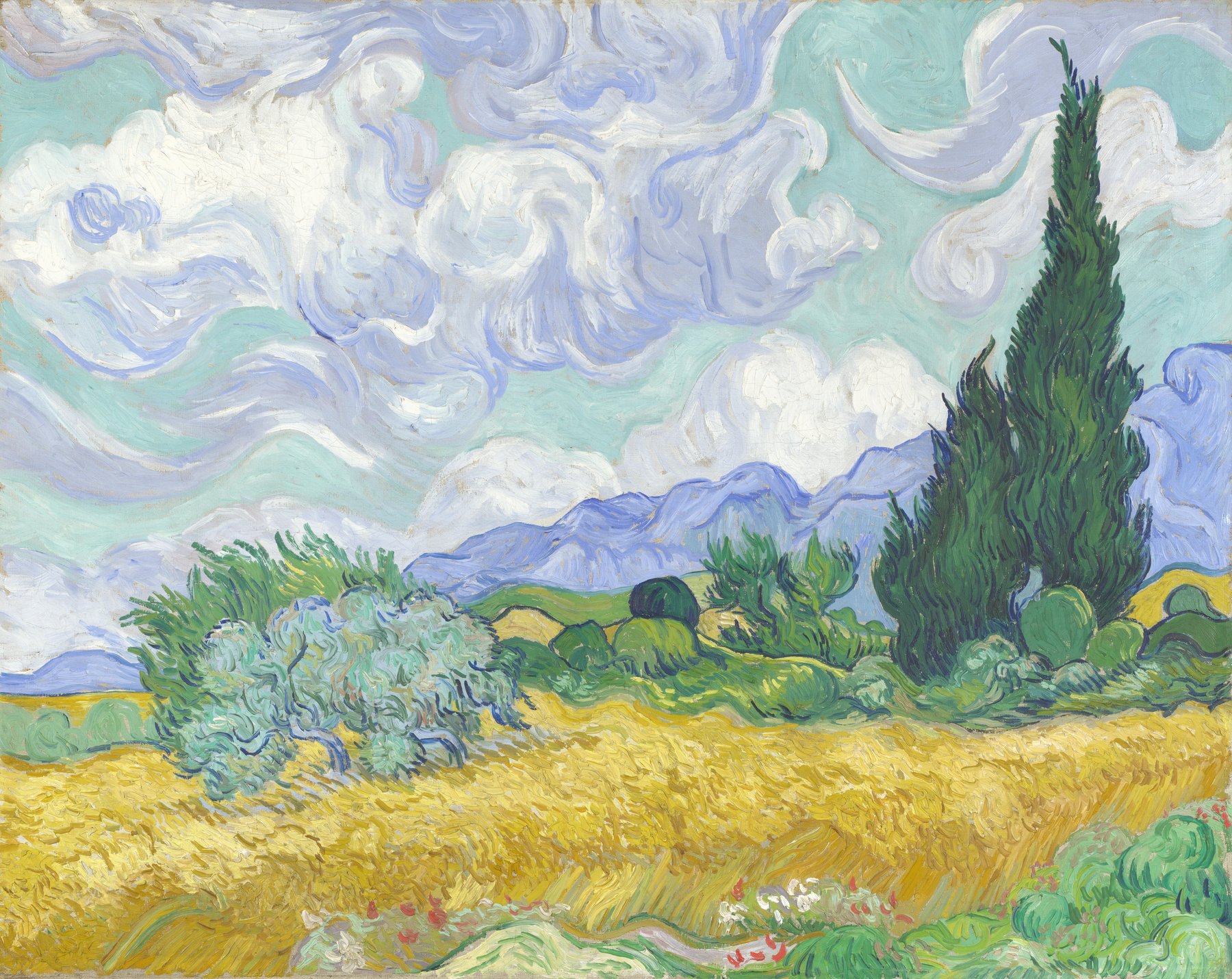
What was difficult, exactly, was that he saw a cypress as architecture rather than as a tree. He wanted to paint one the way an Egyptian sculptor would have carved an obelisk — as a vertical taller than anything else in the scene, holding the whole composition together by sheer presence. The Road with Cypress and Star is the picture in which he finally got the cypress to do this. The tree fills the canvas top to bottom. The road bends around it. The two stars are placed exactly where they have to go to make the cypress feel like the axis of the world. He had been working toward this for fourteen months. He finished the picture in three days. He never painted another cypress.
The road and the people on it
The two figures walking south on the road are deliberately small. One wears a dark jacket, the other a yellowish shirt. They are not portraits. They are people on a road. Behind them a yellow diligence — the French stagecoach — is rolling up, its driver and passengers indicated as smears of paint above the brown horse. Van Gogh painted the stagecoach as flat and the cypress as deep, which makes the cypress feel rooted and the coach feel passing. This is a picture about transit. The figures are walking. The coach is rolling. The cypress is staying. The stars are wheeling. He almost never painted scenes of travel — his pictures are usually of people stopped, sitting at tables, working at looms, posing in chairs. The last Provence painting is one of the rare ones in which everyone is going somewhere.
Where they are going is south, toward Saint-Remy, away from the painting’s viewpoint. The road itself is a real road. It is the route from the asylum at Saint-Paul-de-Mausole into the town of Saint-Remy, a walk of about two kilometers downhill. Van Gogh had walked this road dozens of times during his year at the asylum, escorted by an attendant on his good days and locked in his room on his bad ones. He had been hospitalized in May 1889 after the breakdown in Arles, the one that ended with him in front of Paul Gauguin holding a razor and then, hours later, slicing off his own left ear. The asylum was his place of safety and his place of constraint at the same time. The road in the painting is the road out.
What the stars are doing
This is the part the art historians have fought over for the longest. Van Gogh’s letter to Theo describes the painting in the order of its parts. First the moon — “a slender crescent emerging from the projected shadow of the earth.” That is the orange sliver to the right of the cypress. Then “a star with exaggerated brilliance” — the green-and-yellow halo on the left. In 2000 the astronomer Donald Olson, working with the historian Russell Doescher, used planetarium software to reconstruct the night sky over Saint-Remy in early May 1890. The bright object on the left of the painting was Venus. Venus was in its evening apparition that May, setting in the west about an hour after the sun. The crescent moon was waxing and would have been visible just south of the cypress on the evening of about May 13 or 14, 1890. Olson and Doescher’s reconstruction places Van Gogh sitting on the south-facing road at dusk on one of those evenings, looking west, with Venus on his left and the moon on his right. The cypress, in real life, would have been roughly where he painted it. The astronomical details are not symbolic. They are observed.
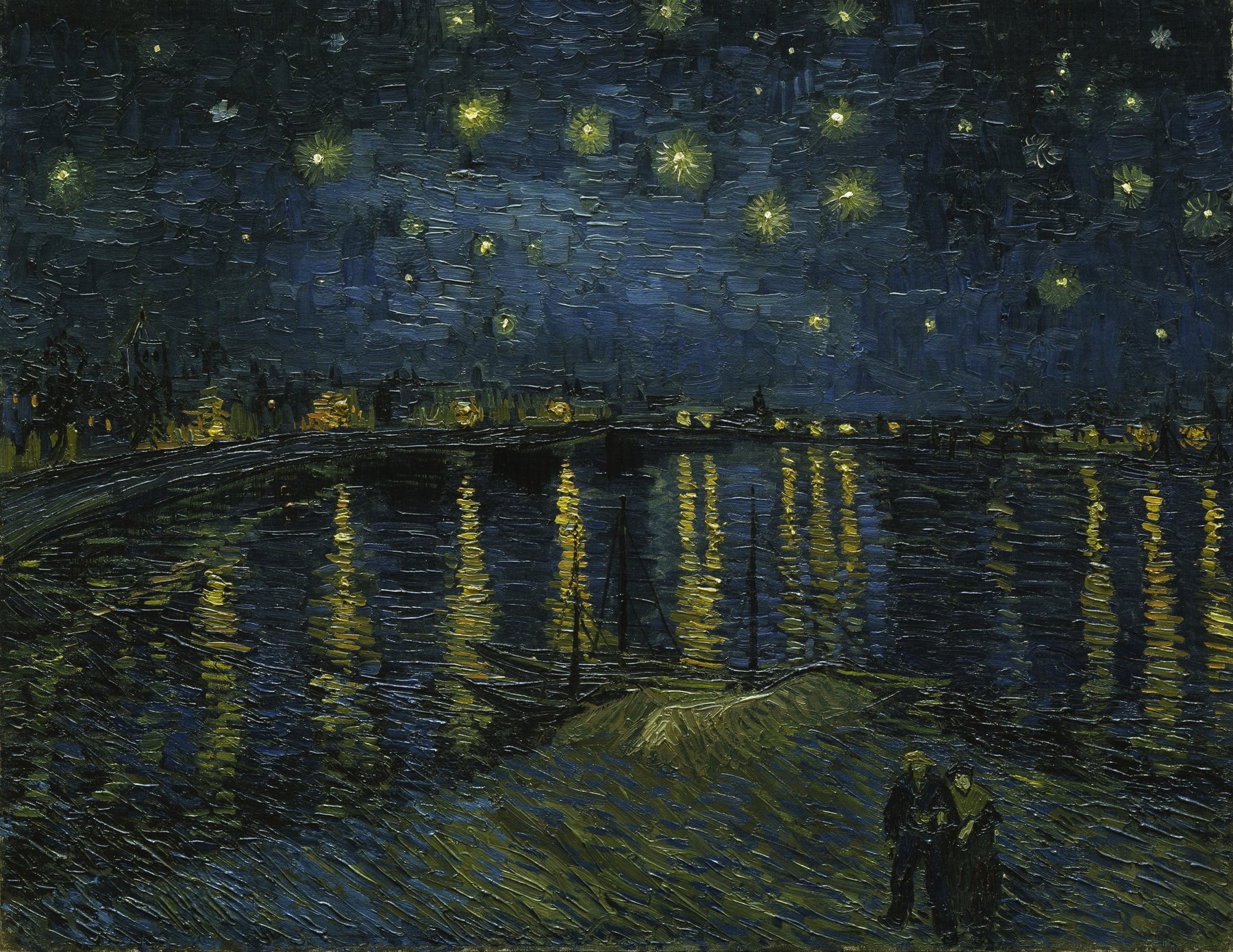
What he did with the observation is symbolic. The Venus halo is painted at about twenty times the apparent size of the actual planet. The moon is painted with a halo three times the radius of the moon itself. The sky between them is paint pulled into long curving brushstrokes — the same kind of strokes he had used in the more famous Starry Night the previous June, which is the picture you probably know best, the one with the swirling night sky over the village. Road with Cypress and Star is the smaller, calmer, end-of-the-stay version of Starry Night. The sky is still moving. Two large bright objects still anchor the composition. But the village underneath has been replaced by a road, and the road is going somewhere, and the cypress that in Starry Night is on the left edge has been brought to dead center and made the whole point of the picture.
Chiaro reads the June 17 letter to Theo over the cypress so you hear Van Gogh’s own description of the moon and the star — “exaggerated brilliance” — while you stand in front of the planet on the left of the canvas.
The last week
Van Gogh left the Saint-Remy asylum on May 16, 1890, three or four days after he finished the road picture. He took the train north to Paris and on May 21 arrived in Auvers-sur-Oise, the small village north of Paris where his brother Theo had arranged a room and a doctor, Paul Gachet, who specialized in melancholic patients. The road in the painting was, in a literal sense, the road out of Provence. He never went back. He worked steadily for seventy days in Auvers and produced about seventy paintings — one a day — and on July 27, 1890, he walked into a wheat field and shot himself in the chest with a small revolver. He died two days later in his rented room above the Auberge Ravoux, with Theo at his bedside.
Road with Cypress and Star traveled with the rest of his late work to Theo and, after Theo’s death six months later, to Theo’s widow Johanna Bonger, who spent the rest of her life building Vincent’s posthumous reputation. The painting was sold in 1903 to the Dutch collector Helene Kroller-Muller, who hung it in her private gallery and eventually built a museum to hold it. It has been at the Kroller-Muller Museum in Otterlo, in the Hoge Veluwe National Park in the Netherlands, since 1938. It has only rarely traveled. To see the road with cypress and star painting you have to go to a remote Dutch park.
What to look for
Three things, when you find it. First, the cypress itself. It is built out of about a dozen colors — not just dark green but blackish blue, olive, dark brown, a few stripes of orange on the trunk — pulled into vertical strokes that get more agitated toward the top. The tree is doing what flames do, on purpose. Second, the bend in the road. The road is painted in two stripes of dirty yellow and pinkish gray separated by a green grass strip, all pulled into curves by the same brush technique. Third, Venus. The halo on the left is not painted as a smudge or a blur. It is built out of concentric rings of green, then yellow, then white at the center, applied wet over a darkening sky. It is the part of the painting that, in person, has the most physical paint on it. The star is the place where Van Gogh ran out of restraint.
The kicker
He wrote to Theo about the painting six weeks after finishing it, from Auvers. By then he was in his final illness. “It does not constitute a return to the romantic or to religious ideas,” he wrote, “no. But by way of Eugene Delacroix, more than what might be apparent, by color and a more spontaneous drawing than illusory exactitude, one can express the pure nature of a countryside compared with the suburbs and cabarets of Paris.” He was defending the painting from the charge of being too symbolic, too pretty, too easy. The defense is itself a poem. The last picture he made in Provence was an obelisk and two lights and a road going south, and he was still arguing about it the month he died.
Image credits
- Hero: Vincent van Gogh, Road with Cypress and Star (c. May 12-15, 1890), Kroller-Muller Museum, Otterlo — via Wikimedia Commons, public domain.
- Inline 1: Vincent van Gogh, The Starry Night (June 1889), MoMA, New York — via Wikimedia Commons, public domain.
- Inline 2: Vincent van Gogh, Wheat Field with Cypresses (1889), National Gallery, London — via Wikimedia Commons, public domain.
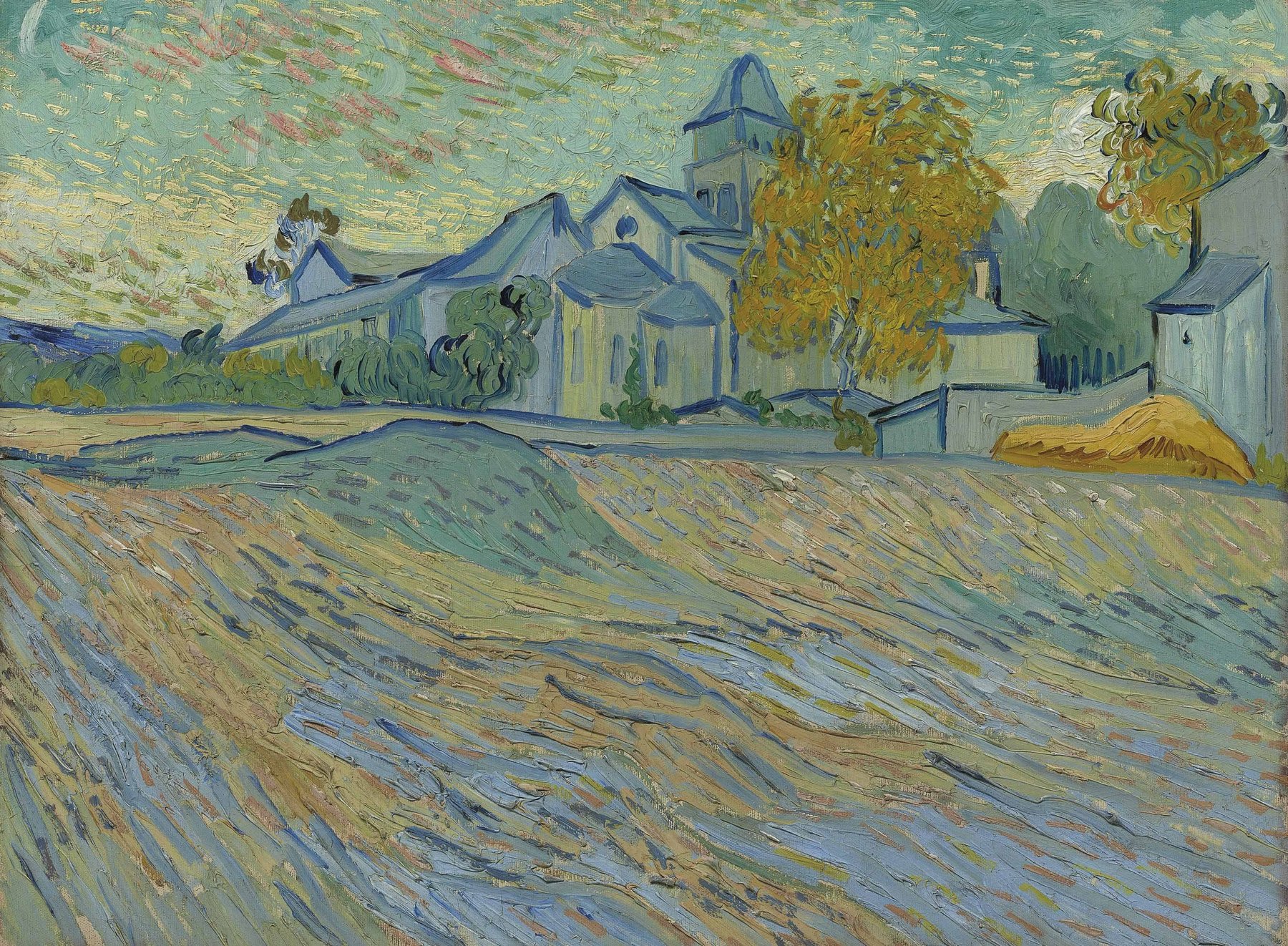
- Inline 3: Vincent van Gogh, View of the Asylum and Chapel of Saint-Remy (October 1889), private collection — via Wikimedia Commons, public domain.