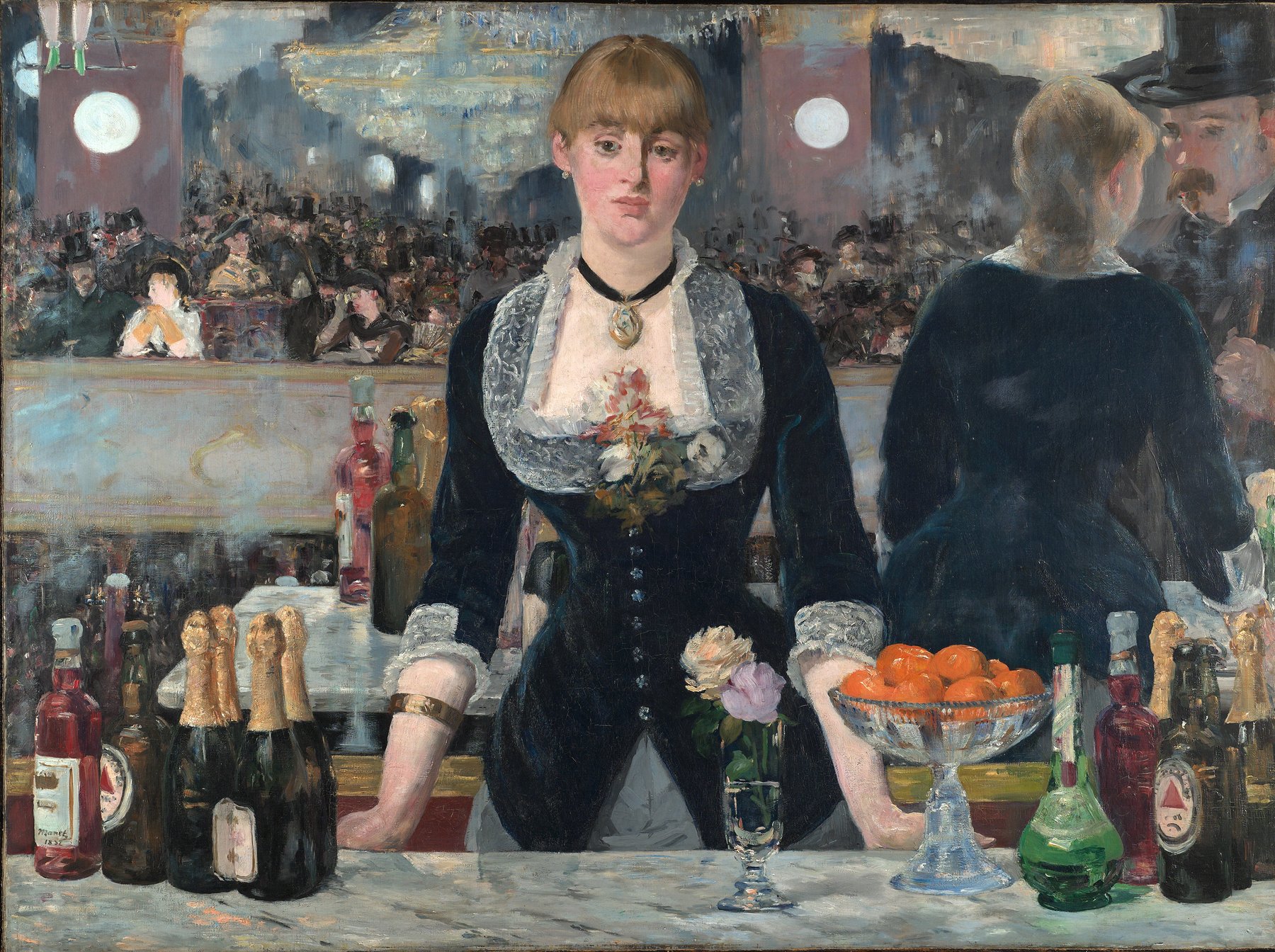
In the winter of 1881 Edouard Manet was dying. He had locomotor ataxia, a late-stage complication of syphilis, and he could barely walk to his studio on the rue d’Amsterdam in Paris. He was forty-nine years old. He had been refused by the official Salon, mocked by critics, and quietly outlasted by a generation of younger painters who were now calling themselves Impressionists and refusing his company. So he asked a young woman who worked at a music hall to come pose for him. Her name was Suzon. She was a real barmaid at the real Folies-Bergere on the rue Richer, eight blocks from the studio. He set up a marble counter in the studio, lined up the bottles she would have stood behind every night — the Bass ale with its red triangle, the champagne, the green creme de menthe, the mandarin liqueur in the round bottle — and put a mirror behind her. Then he painted the whole world of the Folies as a reflection. And he painted that reflection wrong on purpose. A bar at the Folies Bergere is the painting where Edouard Manet, the man who started modern painting, said one last thing about how looking at people actually works.
The painting that should not exist
He finished it in time for the Salon of 1882. It is two hundred ninety-six centimeters wide and ninety-six tall, which is huge for a bar scene. Suzon, the barmaid, stands behind the marble counter in a dark blue velvet jacket with a lace collar and a small bouquet of flowers at her chest. Her arms rest flat on the counter. Her face has the particular blankness of a person who has been on her feet for six hours and is being paid to keep being polite. Behind her is the mirror. In the mirror you can see the whole crushed glittering balcony of the Folies-Bergere — the chandeliers, the legs of a trapeze artist in green slippers in the upper left corner that everybody misses on first look, the crowd in top hats and feathered bonnets, the cigarette smoke. You can also see, in the upper right, the reflection of Suzon herself, talking to a customer in a top hat and a thick mustache.
Stand in front of it at the Courtauld Gallery in London, where it lives now, and the first thing you notice is that the reflection is in the wrong place. Suzon is dead center in the picture. Her reflection is far to the right, as if the mirror were tilted. The customer she is talking to in the mirror is standing directly in front of her — which would put him exactly where you, the viewer, are standing. He is not there. There is no one between Suzon and us. The mirror is not just slightly off. It is doing something a mirror cannot do.
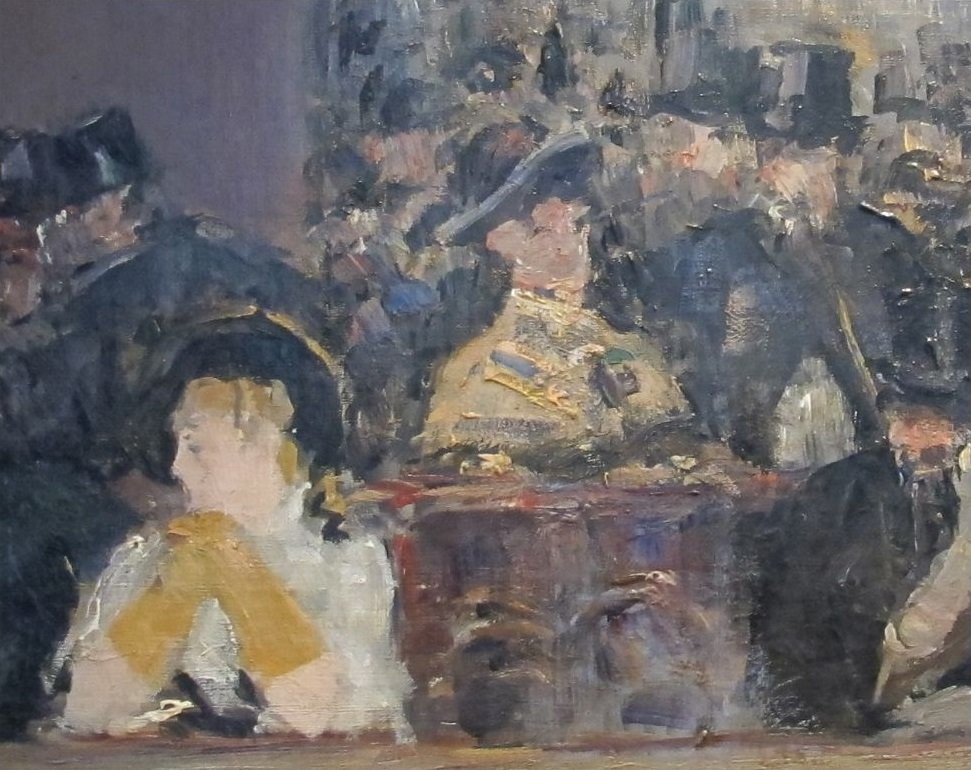
For a hundred and forty years art historians have been trying to figure out what Manet meant by this. The proposals run the full range. Maybe it is a mistake. (Manet, at this point in his career, made no mistakes that size.) Maybe it is two moments at once, like a film cut — the man approaches, then she turns to him, both states printed on the same canvas. Maybe the mirror is supposed to suggest the way memory and reflection fail to match, the way Suzon experiences her own night versus the way the customer sees her. Maybe the painting is asking who the customer is. There is one theory, advanced quietly by the critic T.J. Clark, that the customer is us. We are the man in the top hat. The painting catches the moment in which we, the bourgeois viewer at the Salon, became a buyer at the bar. Manet has folded the act of looking at the painting into the painting itself, and he has done it by breaking the mirror.
Suzon was real
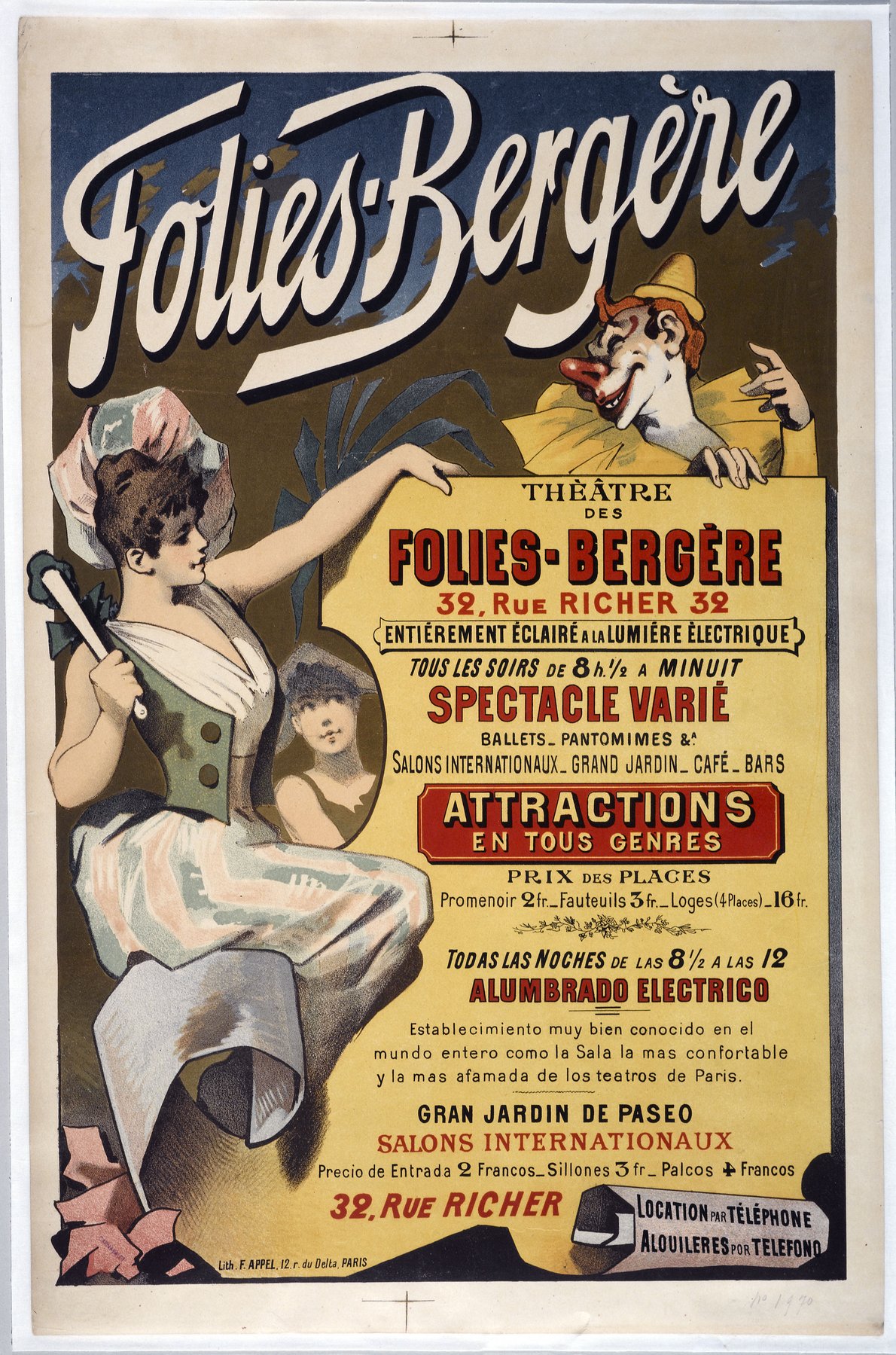
The barmaid’s name was Suzon. We know this because Manet wrote it on the back of a preparatory sketch. She worked at the Folies-Bergere from around 1880 to 1882. She was paid in tips on top of a modest wage, which means her income depended entirely on her ability to keep the customers cheerful. The Folies-Bergere at that point was about ten years old. It had opened in 1869 and had quickly become the most fashionable music hall in Paris — a place where the audience was as much the show as the stage. The crowd was middle class, well dressed, mostly male, and there to drink, watch operetta and acrobats, and arrange other transactions. The barmaids were part of the operation. Everyone understood what was for sale at the bar, even when only drinks were ordered. Suzon stood at the counter every night from eight until past midnight under the new electric lights — the Folies had electrified in 1881, the year Manet was painting — and what she sold most of, on paper, was Bass pale ale. The pyramid of bottles at her elbow is roughly accurate. The flowers at her chest are roughly accurate. The bowl of mandarin oranges is roughly accurate. The expression on her face is the one detail that the critics in 1882 could not stop describing. She is not selling anything. She is enduring.
That is what Manet got right that nobody else painting modern Paris ever quite managed. Degas painted dancers but he painted them as bodies in motion. Manet painted a working woman at the end of her shift and made her look exactly as tired as she actually was. The customers in the mirror are a blur of color. Suzon is the only thing in focus. The painting refuses to be a scene of the Folies-Bergere. It is a portrait of one person who happens to be standing at the Folies-Bergere.
What the mirror is actually doing
The mirror is doing two things and neither of them is realism. The first thing it does is compress time. The reflection on the right shows Suzon turned toward a male customer, leaning slightly forward, in conversation. The figure in the center shows her square to us, arms straight, looking nowhere. If you accept that these are the same moment, the mirror is impossible. If you accept that they are two different moments edited into the same frame, the mirror becomes a clock. The customer arrives. Suzon turns. The conversation begins. Manet has shown us the before and the during in one image. This is what painters had been trying to do since Giotto and what nobody had figured out how to do honestly until photography started teaching them that a single instant is a fiction.
The second thing the mirror does is implicate the viewer. In the reflection on the right, the man Suzon is talking to is standing slightly closer to her than would be natural — close enough to mean something. He is positioned exactly where you, looking at the painting, are standing. The viewer’s body is the customer’s body. The man in the top hat is not in the painting. He is us. This is the move that critics have been arguing about since 1882. If you take it seriously, the painting is not a scene of the Folies-Bergere; it is a transaction we have agreed to without noticing. Suzon is looking past us because she has to. She is selling us a beer. She is also selling us something the picture refuses to name.
There is a third reading that I am partial to and that does not get pushed hard enough. The mirror is not impossible. It is just behaving like memory. The reflection is what Suzon sees in her head while her body stands at the counter — the same scene, but rotated, half a beat off, with the customer she is dealing with right now placed inside it. Look at the painting and you are watching a woman think. The mirror is not behind her. It is inside her.
Chiaro starts the audio at the upper-left corner where the legs of the trapeze artist in green slippers swing into frame, then walks across the bottles one by one before arriving at Suzon’s face, so the painting unfolds in the order Manet built it rather than the order the eye grabs it.
The last painting
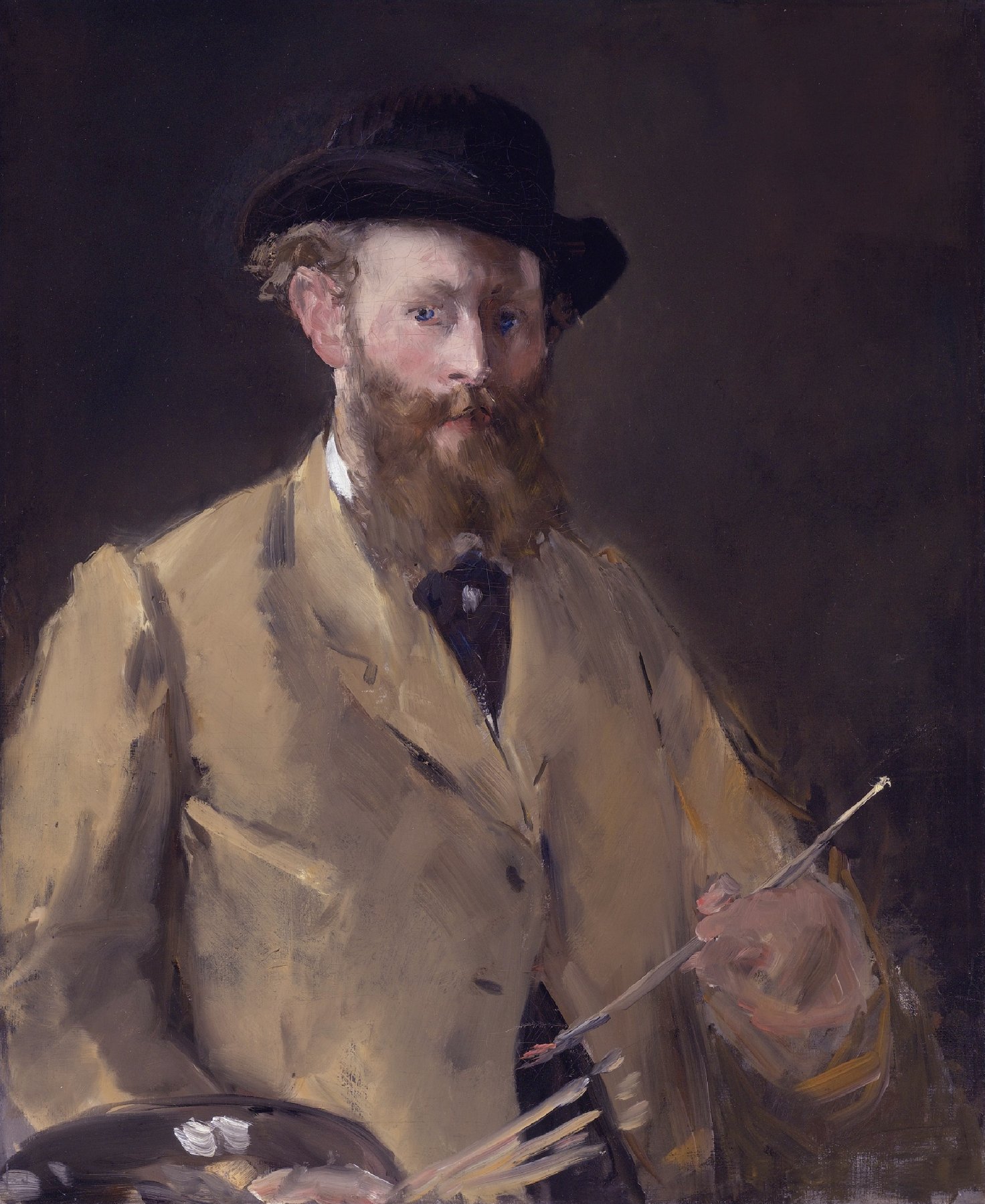
Manet exhibited a bar at the Folies Bergere at the Salon of 1882. The reviews were typical of his Salon reception — a mix of grudging admiration and complaint that the picture was unfinished, that the perspective was wrong, that the reflection did not match. (It does not match. That was the point.) Within a year he was dead. In April 1883 his left leg, gangrenous from the ataxia, was amputated. He died on April 30, 1883, eleven days later. He was fifty-one. He had been ill for six years. The bar at the Folies-Bergere was not literally his last painting — he made a few small flower studies after it, mostly because he could no longer stand at the easel for a large canvas — but it was his last statement. The man who had scandalized the Salon in 1863 with the Dejeuner sur l’herbe and again in 1865 with Olympia spent his dying months building a picture about reflection, distance, and what a customer at a Paris bar actually sees.
The painting went to a private collector after Manet’s death and then to another and then, in 1926, to the British industrialist Samuel Courtauld, who hung it in his London townhouse and eventually gave it to the gallery that bears his name. It has been there ever since. It has not traveled to Paris in living memory. To see the painting Edouard Manet made about the Folies-Bergere you have to leave Paris and go to London.
What to look for
Three things, in this order. First, the upper left corner, the two green slippers and the white-tighted legs of the trapeze artist. They are tiny. Most people miss them. They tell you that the scene in the mirror is a real place with real noise and movement, not just a backdrop. Second, the bottles. Count them. The Bass ale on the left is real. The pink roses in the small glass vase at her chest are slightly wilted. Manet built the still life on a marble shelf in his studio and treated it with the same seriousness he treated her face. Third, the man in the mirror. Find him in the upper right. Now stand directly in front of Suzon and notice that you are where he is supposed to be standing. The painting has been waiting to put you there for a hundred and forty years.
The kicker
Manet could barely walk by the time he finished it. He had to sit while he painted. He never went to the Folies-Bergere during the months he was making the picture; Suzon and the bottles came to the studio. The bar at the Folies-Bergere is not a scene he witnessed. It is a scene he reconstructed from memory and from the model in front of him, and the mirror behind her is the part he could not get to match. He left it broken because the truth of looking at a tired woman across a bar in 1882 was that nobody, including the man buying the beer, was seeing the same thing she was.
Image credits
- Hero: Edouard Manet, A Bar at the Folies-Bergere (1882), the Courtauld Gallery, London — via Wikimedia Commons, public domain.
- Inline 1: Detail of the upper-right reflection in A Bar at the Folies-Bergere — via Wikimedia Commons, public domain.
- Inline 2: Edouard Manet, Self-Portrait with Palette (1879) — via Wikimedia Commons, public domain.
- Inline 3: Folies-Bergere theatre poster, c. 1880, advertising the venue’s full electric lighting — via Wikimedia Commons, public domain.