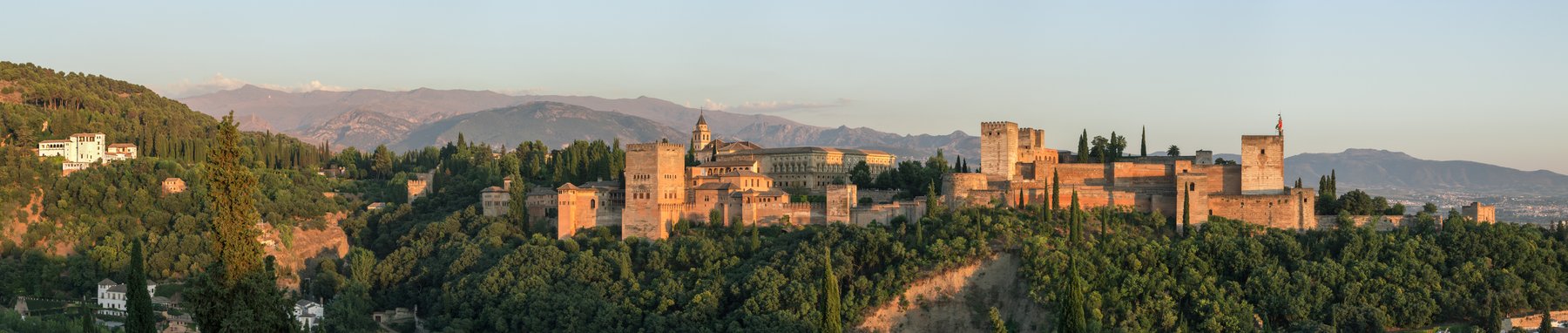
On January 2, 1492, the last Moorish sultan of Granada, Muhammad XII, known to history as Boabdil, walked down from the Alhambra and handed his keys to Ferdinand of Aragon and Isabella of Castile. The handover was negotiated, not stormed. Boabdil signed a treaty that guaranteed his subjects the right to keep their religion, their language, and their property. The treaty would be broken within ten years. But on the day of the surrender, the Catholic monarchs rode into the Alhambra with their banners and found the palace unburned, its fountains still running, its tilework intact. They moved in.
This is why the Alhambra survives. Every other major Islamic palace on the Iberian peninsula — the Aljaferia in Zaragoza, the alcázars of Seville and Cordoba, the palaces of Toledo — was either destroyed or so heavily remodeled that the original is barely legible. The Alhambra was kept because Ferdinand and Isabella, and after them Charles V, wanted to use it. They liked the gardens. They liked the cool inner courts in the August heat. They liked the message that they were not just defeating Islam in Spain, they were inheriting it.
What stands on the hill of La Sabika today is a 740-meter-long citadel built between 1238 and 1492, with one Renaissance palace bolted onto the side of it in the 1520s, and a separate summer estate, the Generalife, on the next ridge over. The visitor route walks through all three. What follows is what each part is, and what to look at when you get there.
What the place was for
The Alhambra is a city, not a palace. At its height under Sultan Yusuf I and Sultan Muhammad V in the mid-fourteenth century, it housed somewhere between two and three thousand people inside its walls: the royal household, the army garrison, a mosque, a mint, four bathhouses, a tannery, two cemeteries, and the workshops that produced the silk and ceramics the kingdom of Granada exported to the rest of Europe. The walls enclose roughly thirteen hectares. The fortifications — the red brick towers and curtain walls visible from the Albaicín neighborhood across the valley — are what gave the complex its name. Al-Hamra means “the red one” in Arabic. The walls are made from a local rammed earth and ferrous clay that turns rust-colored in late sun.
The kingdom of Granada was the last Muslim polity in Spain. By the early thirteenth century, the rest of al-Andalus had been reconquered by the Christian crowns of Castile and Aragon. The Nasrid emirs who founded the kingdom in 1238 — the dynasty that built nearly all of the Alhambra — accepted vassal status to Castile in exchange for being left alone, and they used the next two hundred and fifty years of paid tribute and careful diplomacy to build the most refined Islamic architecture surviving anywhere west of Damascus.
The Nasrid Palaces
The Nasrid Palaces are the heart of the visit. They sit at the center of the citadel and are accessed by a timed entry slip — the only part of the Alhambra with a time-stamped ticket, because too many people in the rooms at once cause condensation damage to the stucco. Bring your ticket. Be on time.
There are three palaces, built in sequence by three sultans across roughly fifty years in the mid-fourteenth century. The Mexuar, the oldest, was the public council chamber where the sultan dispensed justice. The Comares Palace, built under Yusuf I in the 1340s, was the official seat of the throne. The Palace of the Lions, built under Yusuf’s son Muhammad V around 1370, was the sultan’s private residence.
The Comares Palace centers on a long reflecting pool, the Patio of the Myrtles. At one end, a 45-meter tower called the Comares Tower contains the Hall of the Ambassadors, the largest single room in the palace and the place where the sultan formally received foreign delegations. The hall is roughly eleven meters on a side, with a domed wooden ceiling of inlaid cedar and poplar containing more than eight thousand individual carved panels arranged in seven concentric levels representing the seven heavens of Islamic cosmology. The room was deliberately calibrated, by the geometry of the dome and the position of the throne, so that an ambassador walking in would have the sultan silhouetted against a window of mountain light, with the ceiling reading as a sky overhead. The architecture was a piece of diplomatic theater.
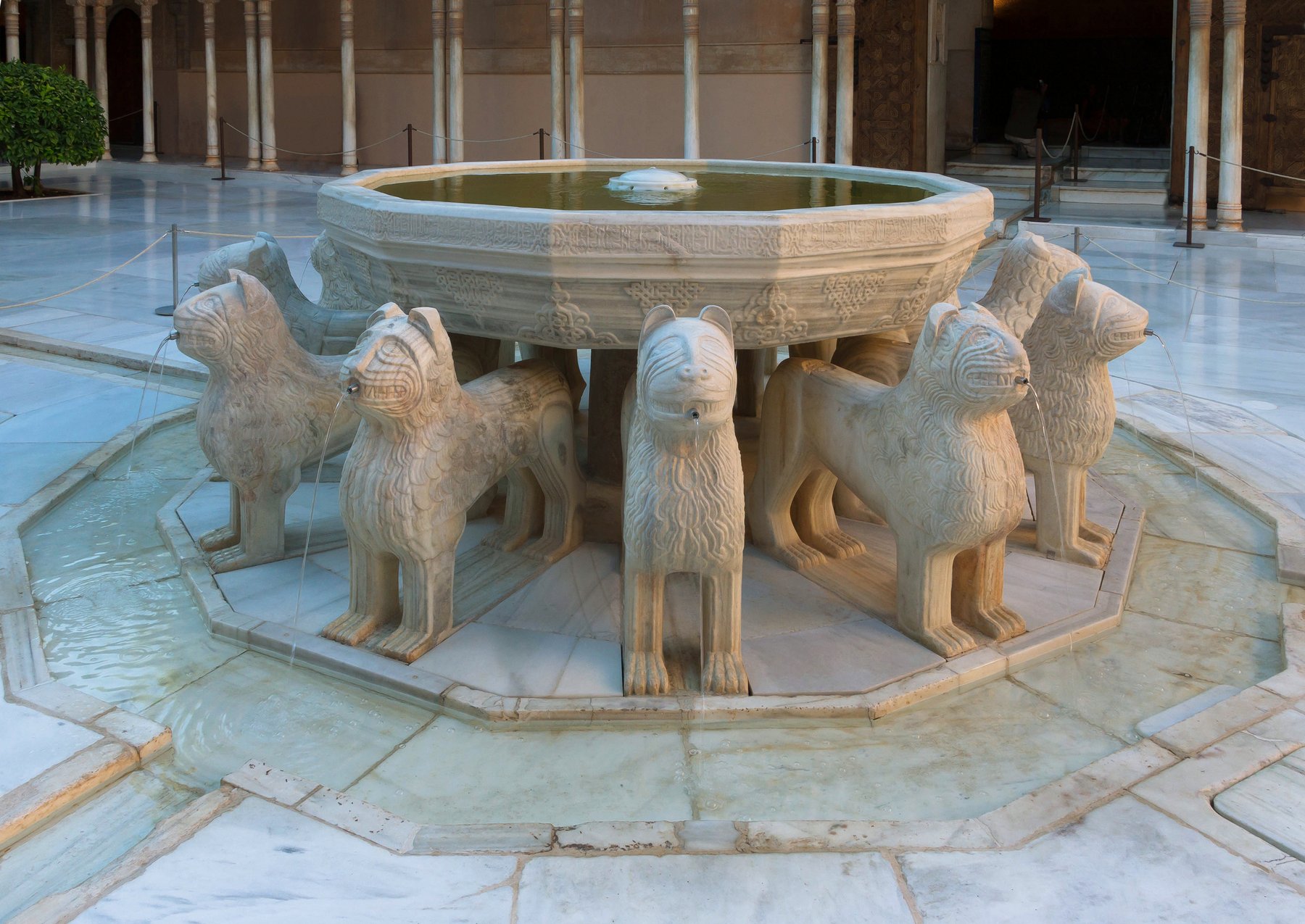
The Palace of the Lions is the more ornamented half. The central court is roughly twenty-eight meters by sixteen, with a fountain at the middle supported on the backs of twelve carved marble lions. The fountain has working hydraulics that date to the 1370s. Water enters from the four palace fountains on the cardinal axes and exits through the lions’ mouths in a calibrated cycle, with each lion releasing water at a different hour of the day. The pattern of release was tied to a clock mechanism that the Christian engineers in the 1490s reportedly took apart trying to understand it and could not reassemble. The hydraulic system today is a modern reconstruction that runs continuously.
The geometry of the ornament
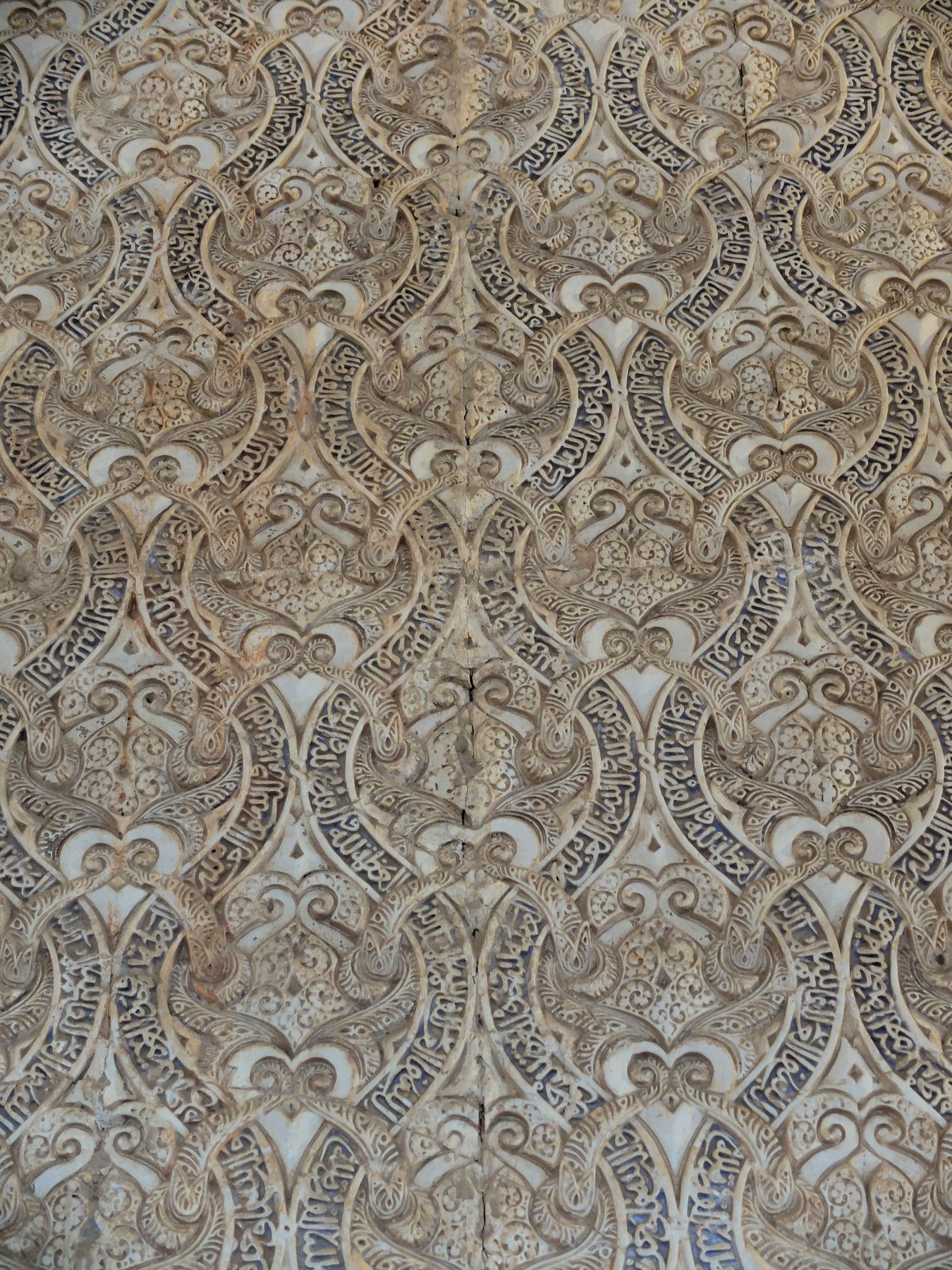
The walls of the Nasrid Palaces are covered, almost without exception, in three layers of ornament. At eye level and below, there is tilework — mostly square pieces in geometric patterns of interlocking stars, eight-pointed and sixteen-pointed and occasionally twenty-four-pointed. Above the tilework is carved stucco, originally painted in red, blue, gold, and green pigments that have largely faded. Above that, near the ceiling, is more stucco worked into honeycomb-like vaulted forms called muqarnas, which catch the light at angled facets and dissolve any sense that the ceiling is a single solid plane.
The patterns are not random. The geometry of the tilework includes all seventeen of the mathematically possible two-dimensional symmetry groups — the seventeen wallpaper groups, in the language of modern mathematics. The Spanish mathematician Marjorie Senechal and the Hungarian Edith Müller, working in the 1940s and 1970s respectively, demonstrated that the Alhambra is the only building in pre-modern world architecture to contain all seventeen. Islamic geometry was not decoration in the Western sense. It was a mathematical proof carried out in glazed clay and worked stucco, made visible on the walls of a room where the sultan slept.
The calligraphy above the tilework is mostly Quranic verses and short Arabic poems, with one phrase repeated through the building so many times that visitors come to recognize it: “wa la ghaliba illa Allah” — “there is no victor but God.” It was the motto of the Nasrid dynasty, adopted by the founder, and the family carved it into every wall. The Catholic monarchs left it in place when they took the building. Chiaro reads the geometric patterns of the muqarnas against the seventeen symmetry groups as you stand in the Hall of the Two Sisters, naming the tessellation by mathematical type rather than by aesthetic category, which is the only way the rooms read the way the Nasrid mathematicians intended them to read.
The Generalife
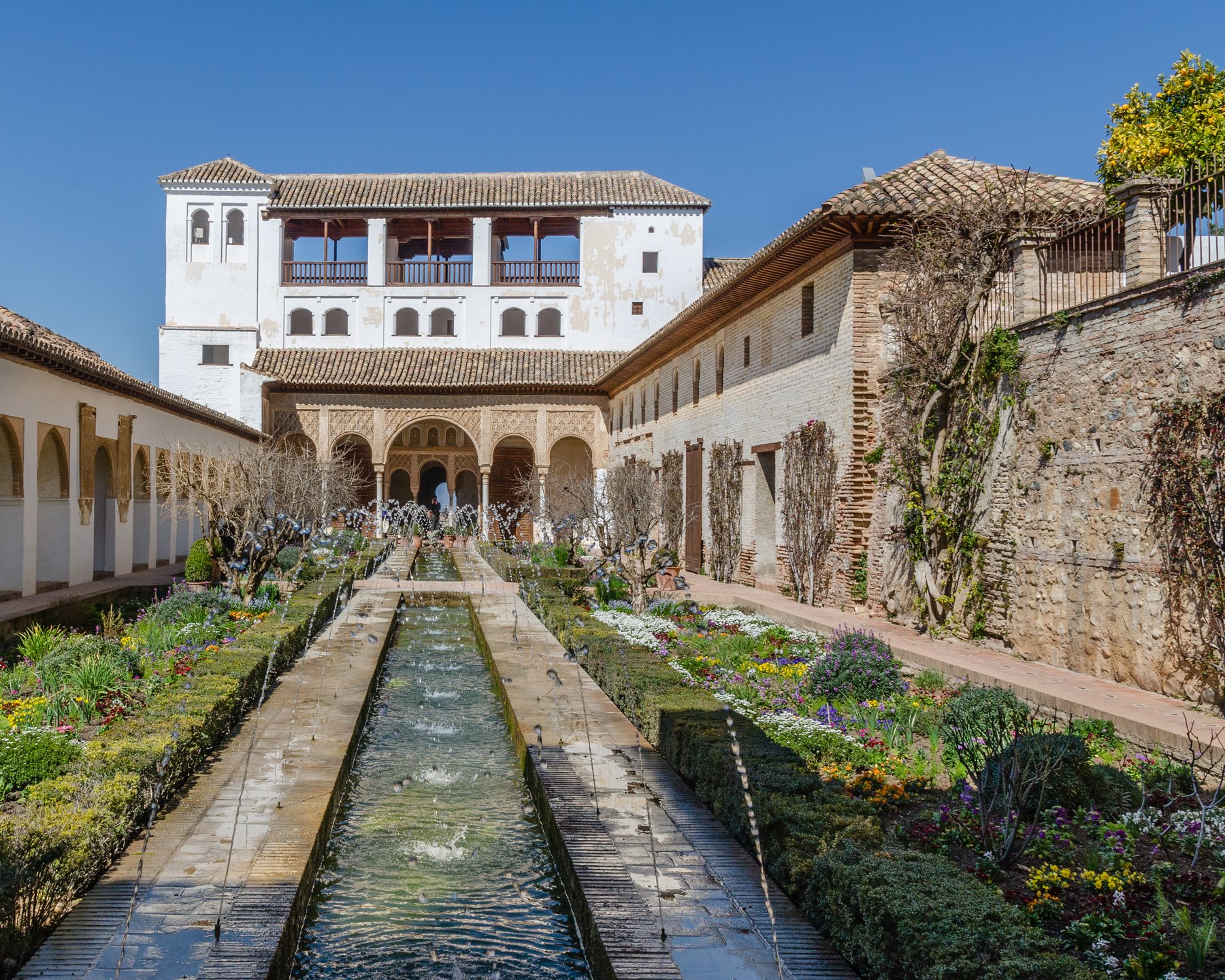
The Generalife sits on the next hill east of the main citadel, separated by a narrow ravine and connected by a single bridge. It was the summer residence of the Nasrid sultans, a place to retreat to during the hottest months when the main palaces became uncomfortable. The name comes from the Arabic Jannat al-‘Arif, “garden of the architect” or “garden of the master.”
What you walk through today is mostly fourteenth-century in plan but heavily replanted. The principal courtyard, the Patio de la Acequia, is a long rectangular pool bounded by parallel rows of jets of water that arc across its surface in a thin colonnade of spray. The medieval gardens were probably not arranged like this — the arcing jets are a sixteenth-century addition — but the underlying irrigation system, drawing water from the Sierra Nevada through a fourteen-kilometer-long aqueduct called the Acequia Real, is original. The Generalife works because water at high pressure runs down the mountain on a gradient that has been carefully maintained for seven hundred years. Every fountain, pool, and channel in the entire Alhambra complex is gravity-fed from this single mountain stream. There are no pumps. Cut the aqueduct at the source and every fountain in the Alhambra goes dry within a day.
The palace that does not belong
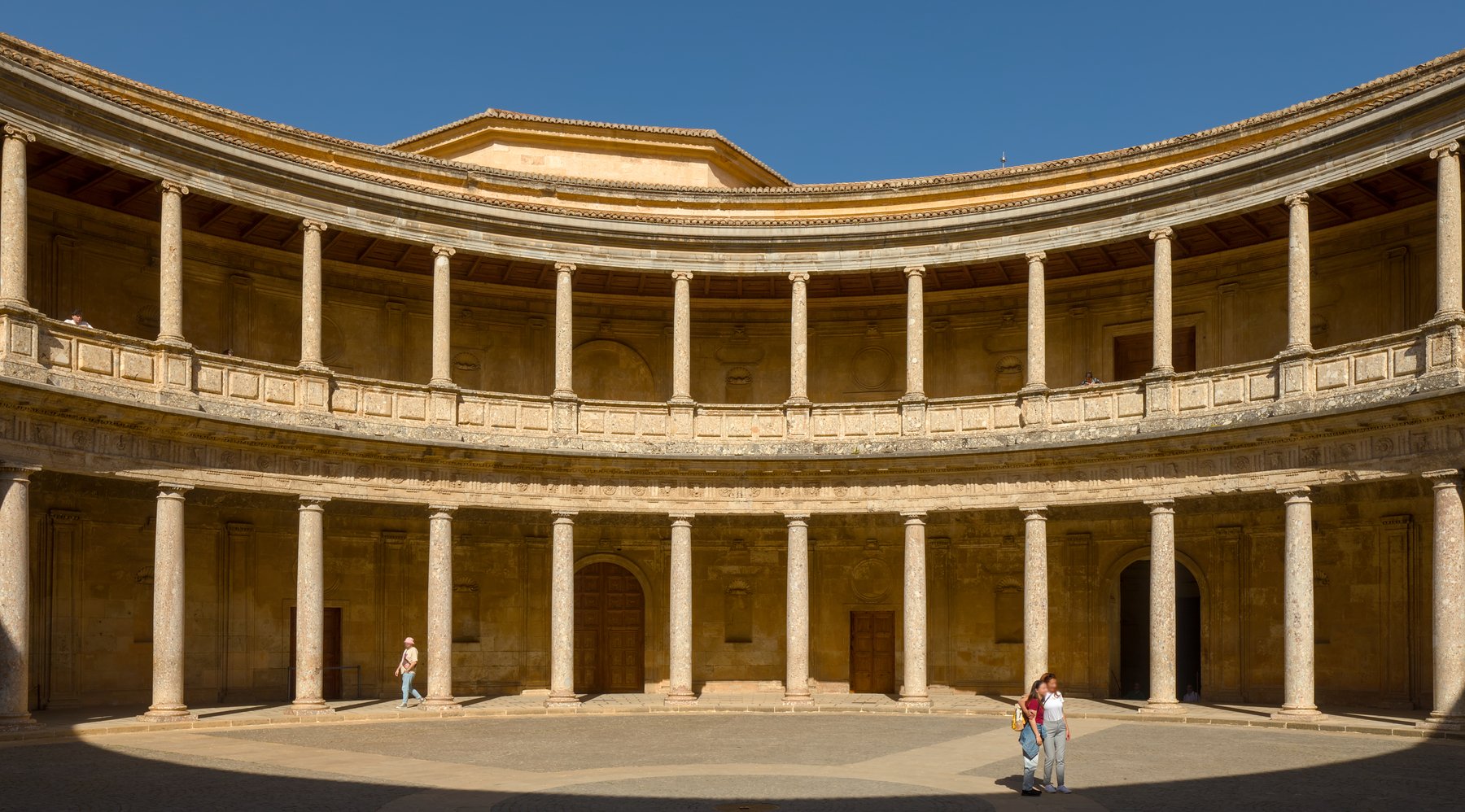
In 1526, Charles V — the grandson of Ferdinand and Isabella, and Holy Roman Emperor — spent his honeymoon in the Alhambra and decided he needed a palace there of his own. He hired Pedro Machuca, a Spanish painter who had trained in Italy in the workshop of Michelangelo, to design something in the Italian Renaissance style. The result is a square building of dressed stone, fifty-eight meters on a side, with a perfectly circular courtyard inside it. The contrast with the surrounding Moorish architecture is total. The Charles V palace is heavy where the Nasrid buildings are light. It is symmetrical where they are asymmetrical. It uses dressed stone where they use carved stucco. It punches a Renaissance argument into the middle of a Moorish citadel.
Construction began in 1533 and stopped, unfinished, in 1637. The building has never been roofed. The circular courtyard is open to the sky, with two storeys of Doric and Ionic columns running around it. When it rains, the courtyard floods. When there is sun, the inner ring catches it perfectly. It is, despite the architectural argument it makes with the Alhambra, one of the cleanest pieces of Spanish Renaissance design anywhere on the peninsula. Charles never lived in it. Most subsequent Spanish kings ignored it. It functions today as a public concert venue and as the home of the Museum of the Alhambra.
What to look for
Five things to do on the rock. First, time your Nasrid Palaces ticket for the late afternoon. The carved stucco was designed to be lit by oblique sun coming through the small high windows. In the middle of the day, the stucco reads flat. At four or five in the afternoon, the muqarnas vaults come to life as their facets shadow each other.
Second, in the Comares Hall, look up at the eight thousand panels of the cedar ceiling. The carpenters who assembled it left assembly marks on the backs of the panels. Restorations in the 1960s catalogued the marks. The ceiling is the largest medieval Islamic woodwork surviving anywhere.
Third, in the Court of the Lions, count the lions. There are twelve. The twelfth lion, on the south side, has a slightly different mane carving from the other eleven. Conservators believe it was replaced during the fifteenth century, possibly after Boabdil’s surrender, when one of the originals was damaged.
Fourth, walk to the Mirador de Lindaraja, the small balcony off the Hall of the Two Sisters. Look out over the small garden below. This is the view a Nasrid princess would have had from her apartments. The position of the window is calibrated so that the surrounding city does not enter the frame. You are looking only at greenery and sky, by deliberate architectural choice.
Fifth, walk down to the Torres Bermejas at the western end of the complex. From there, look back at the Alhambra and across the valley at the Albaicín, the old Moorish quarter on the opposite hill. This is the angle from which the founder of the dynasty would have first seen the rock he was about to build his palace on. The rock is still red in the late sun. The name still fits.
The Alhambra was kept because Ferdinand and Isabella decided to live in it. Charles V grafted his own Renaissance palace onto the side of it. The Catholic monarchy turned the mosque inside the citadel into a church. But the rooms, the tilework, the muqarnas, the lions, the gardens, and the aqueduct that feeds the water — all of these still work the way the Nasrid emirs designed them to work. Five hundred and thirty-three years after Boabdil walked out, the rock is still doing its job.
Image credits
- Alhambra evening panorama Mirador San Nicolas sRGB-1.jpg — Jebulon. Source, CC0.
- Fountain patio de los Leones Alhambra Granada Spain.jpg — Adam Jones. Source, CC BY-SA.
- Alhambra Comares Hall (R Prazeres) DSCF8420.jpg — Richard Mortel. Source, CC BY.
- Generalife Garden Alhambra 2014.jpg — Diego Delso. Source, CC BY-SA.
- Granada - Alhambra - Palacio de Carlos V.jpg — Jebulon. Source, CC0.


