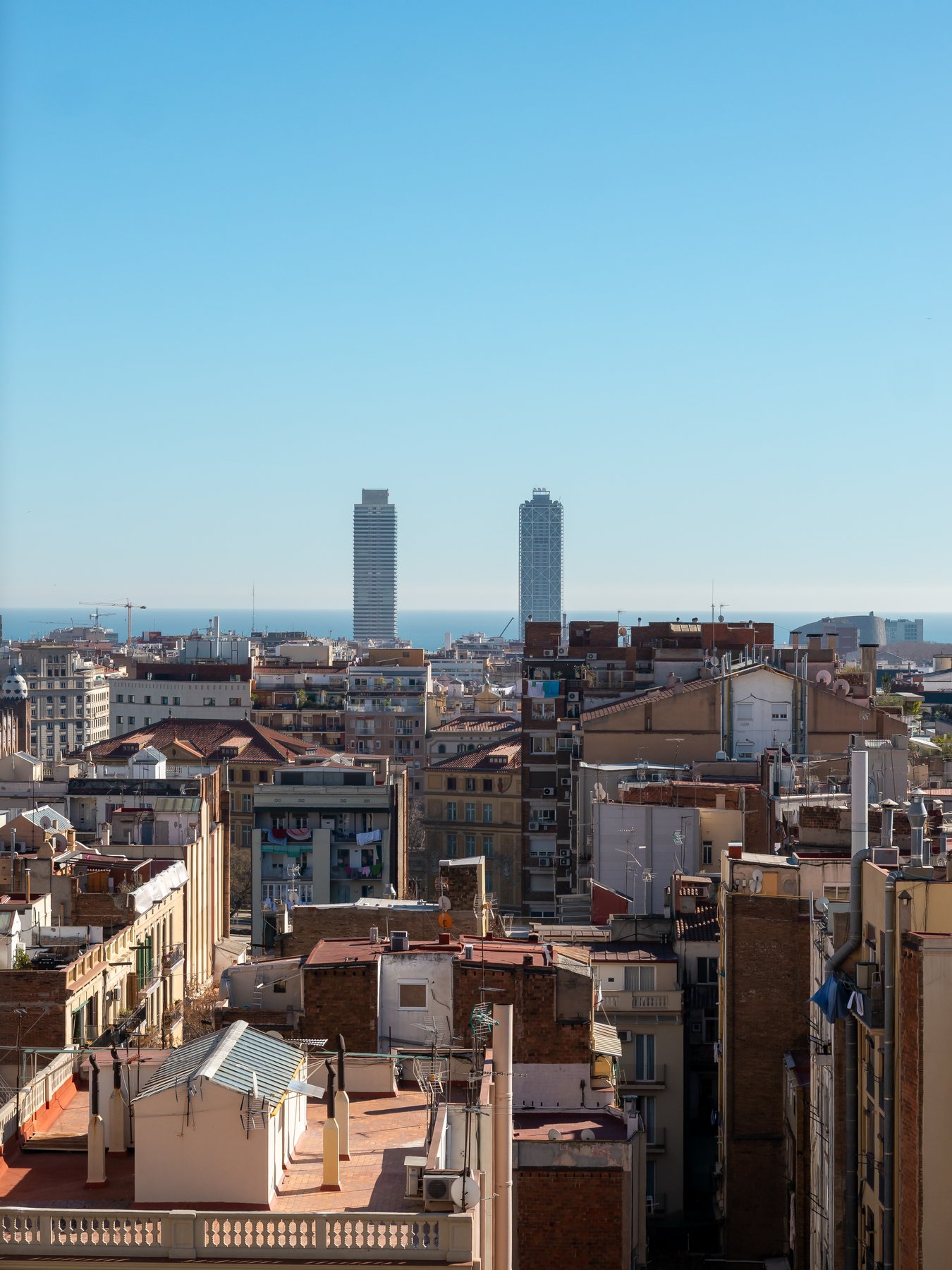
On the afternoon of June 7, 1926, an elderly man in a worn black suit was hit by a tram on the Gran Via de les Corts Catalanes in central Barcelona. He was carrying no identification. The taxi drivers refused to take him to a hospital, assuming he was a vagrant. He was eventually delivered to the Hospital de la Santa Creu, on a stretcher, where the chaplain who came to give him last rites recognized him from a recent newspaper photograph. The man was Antoni Gaudí, the most famous architect in Spain, on his way to evening confession. He died three days later. He was seventy-three years old. The basilica he had been working on for forty-three years was roughly one-quarter built.
Almost a hundred years later, in 2026, the Sagrada Familia is finally entering its last decade of construction. The central tower of Jesus Christ, the tallest of the eighteen planned spires, is being topped out at one hundred and seventy-two meters — by intent, exactly one meter shorter than the hill of Montjuïc, because Gaudí said no human work should rise higher than the work of God. The remaining facade, the Glory facade, will continue past the original 2026 anniversary completion target. The building has now been under construction for one hundred and forty-four years. It will probably be done by 2034 or so, though no one is committing.
What stands today is the longest single architectural project in modern European history, and the only major cathedral on the continent built entirely after the Industrial Revolution that uses no industrial structural metaphor. Gaudí designed it on the principle that nature, not classical geometry, was the proper template for sacred architecture. The columns inside lean and branch like trees. The vaults open like leaves. The towers are shaped like termite mounds and beehives. The Sagrada Familia is the largest natural-form structure ever attempted at this scale, and the engineering it requires has been delayed for a hundred years not because Gaudí was impractical but because the structural calculations he did by hand and by hanging-chain physical model could only be verified at scale after computers existed.
What it was for
The Sagrada Familia was not Gaudí’s project originally. It was commissioned in 1882 by a Catholic bookseller named Josep Maria Bocabella, who wanted a church dedicated to the Holy Family, to be paid for entirely by alms. Bocabella hired the architect Francisco de Paula del Villar, who broke ground on March 19, 1882. After a year of construction, Villar resigned over a dispute about column materials. Gaudí, then thirty-one years old and not yet famous, took over in 1883.
The original Villar plan was a conventional Neo-Gothic basilica, modeled on cathedrals like Cologne. Gaudí kept the cruciform floor plan but redesigned everything above ground level. He spent the next forty-three years on the project, the last twelve of which he was working on the basilica exclusively, having stopped accepting any other commissions. He lived in a small studio attached to the basilica’s crypt during his final years, sleeping on a cot and eating donated bread. He had become an ascetic by the end.
The basilica is funded entirely by alms and ticket sales. There is no government money, no diocesan budget, no Vatican subvention. Every spire, every facade, every column has been paid for by the slow accumulation of small donations and entrance fees. This is why the building took so long. Modern construction methods could have finished it in twenty years. The vow of alms-funding has stretched the timeline to a century and a half. Bocabella’s original principle has been honored.
The Nativity facade
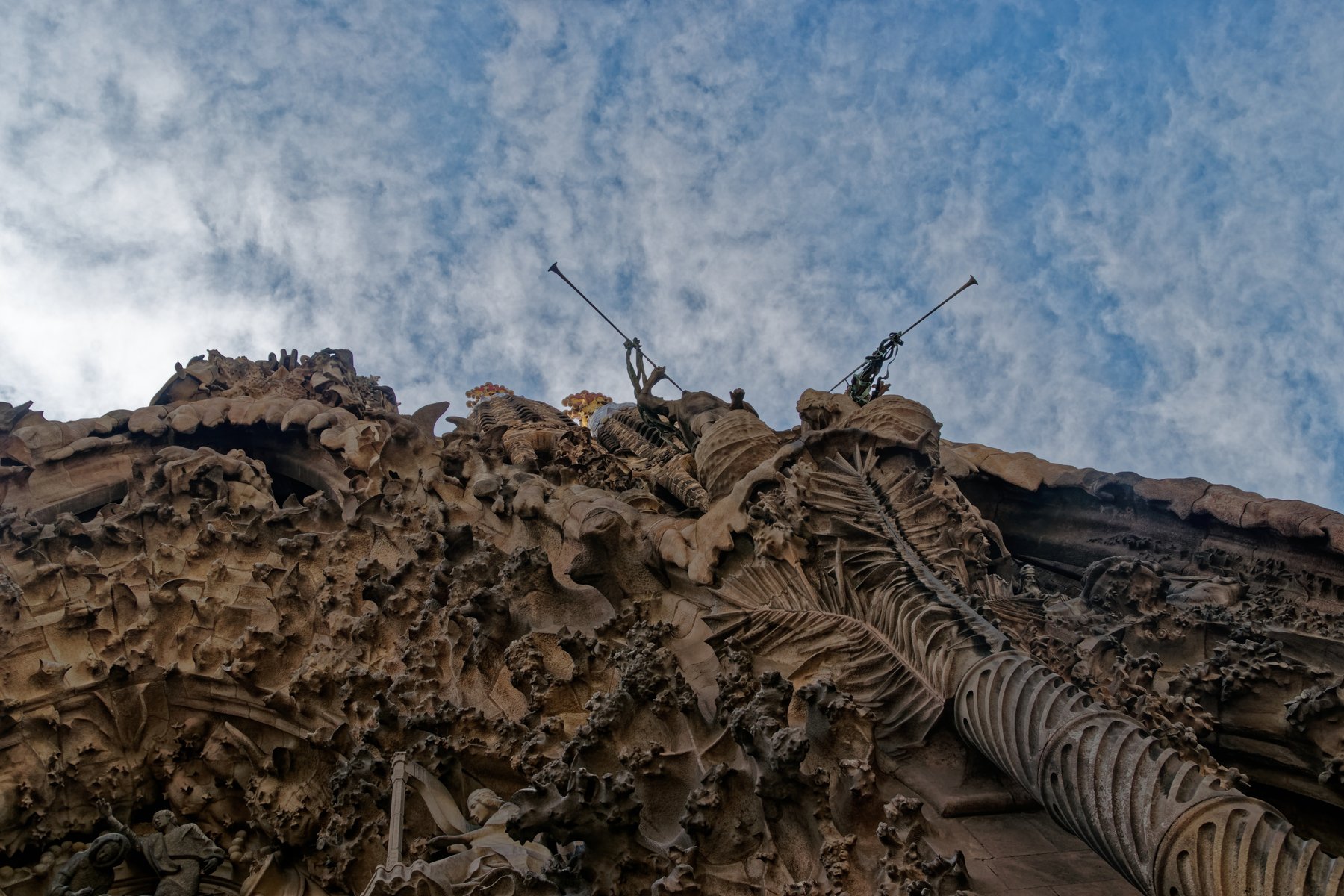
The east facade of the basilica is the only one Gaudí saw substantially completed in his lifetime. He worked on it from 1894 to 1926. The Nativity facade is the most ornamented surface in the building, and the most directly representational. Three portals — Hope, Faith, and Charity — frame scenes from the birth and infancy of Christ. The central tympanum shows the manger, with the holy family flanked by the ox, the ass, the shepherds, and the three kings. Above them, an angelic choir of musicians plays a stone orchestra of bassoons, harps, and trumpets carved at slightly larger than life scale.
What is unusual about the carving is that almost every figure is taken from a real-life model. Gaudí used neighborhood children for the shepherd boys, dock workers for the magi, and a vegetable seller from the local market for the Virgin Mary. He had life casts made of soldiers, donkeys, and chickens in plaster and brought them into the studio for the sculptors to copy. The chickens on the Nativity facade are recognizable as a specific Catalan breed. The donkey was a real donkey that worked at a nearby farm and was carried up the scaffolding for the carving.
The facade was nearly destroyed twice. During the Spanish Civil War in 1936, anti-clerical militants broke into the construction site, smashed Gaudí’s plaster models, and burned his archive of working drawings. The Nativity facade itself survived because it was already in stone and could not easily be destroyed. The plaster models, however, are mostly gone — and the rest of the basilica has had to be reconstructed from photographs, fragments of plaster, and the structural logic Gaudí had built into what was already standing. Every facade and tower built since 1936 has been an act of forensic reconstruction more than direct execution.
The Passion facade
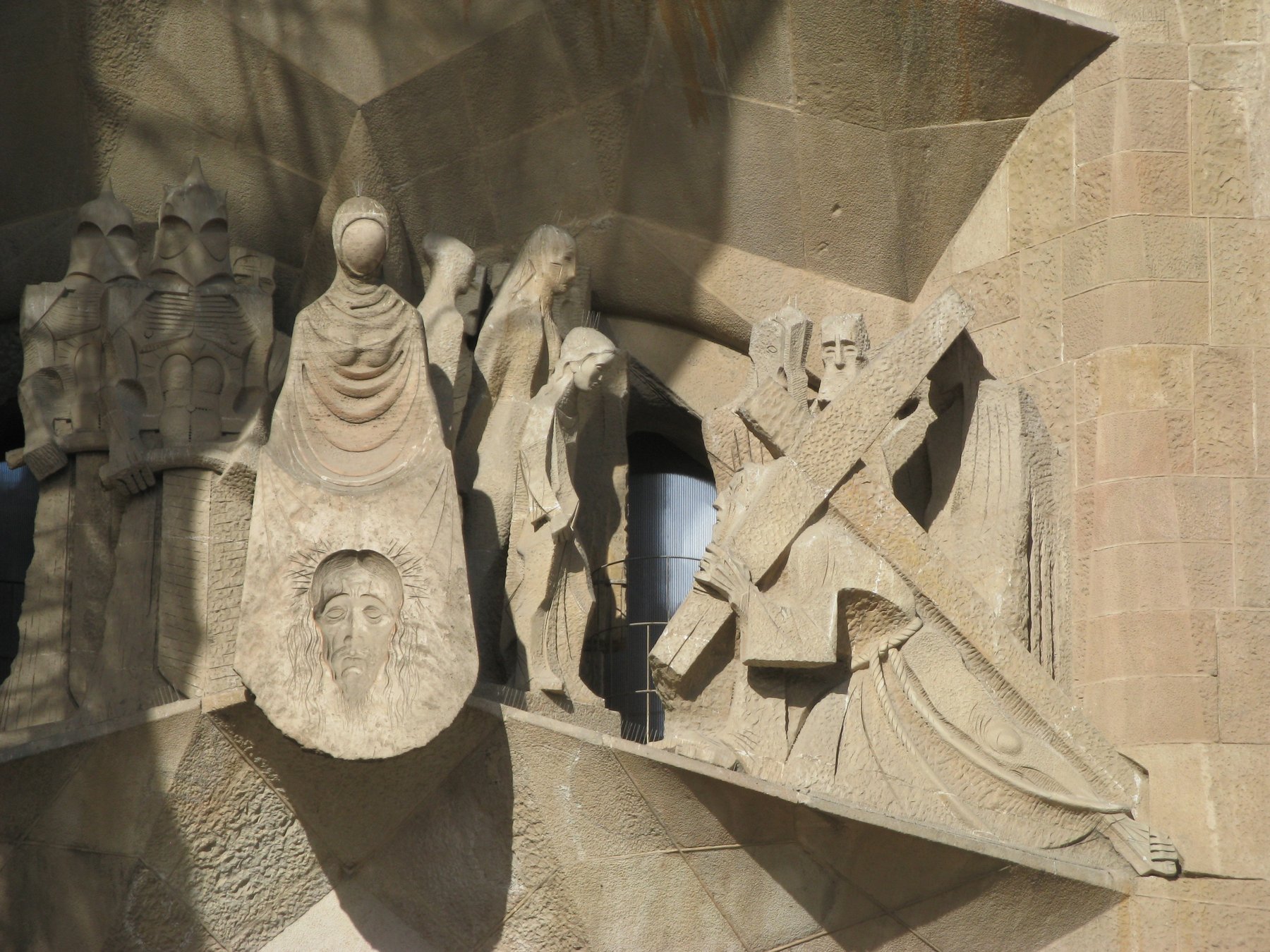
The west facade is the Passion facade, depicting the suffering and death of Christ. Construction began in 1954 and the main sculpture was finished in 2018 by the Catalan sculptor Josep Maria Subirachs, who worked on the facade for thirty-three years. Subirachs deliberately broke with Gaudí’s representational style. Where the Nativity facade is dense with naturalistic detail, the Passion facade is severe, angular, and almost expressionist. The figures of Christ, the disciples, and the Roman soldiers are blocky and stylized, with deep-cut features that read more like cubist sculpture than like Catalan Modernisme.
The choice was controversial. Some critics argued that Subirachs was betraying Gaudí’s vision; others argued that the contrast between birth and death required a contrast in style, and that Gaudí himself had sketched the Passion facade as more austere than the Nativity. Gaudí had written in his notebooks that the Passion facade should “frighten the viewer,” and Subirachs took the instruction literally.
The most striking element is the magic square on the wall of the Flagellation scene — a four-by-four grid of numbers carved into the stone in which every row, every column, every diagonal, and several other combinations sum to thirty-three, the age of Christ at his death. The square is mathematically unusual because it is not a true magic square in the classical sense — the numbers from one to sixteen are not all used, and some are duplicated — which makes it a deliberately broken puzzle, a piece of religious arithmetic that does not balance.
The forest inside
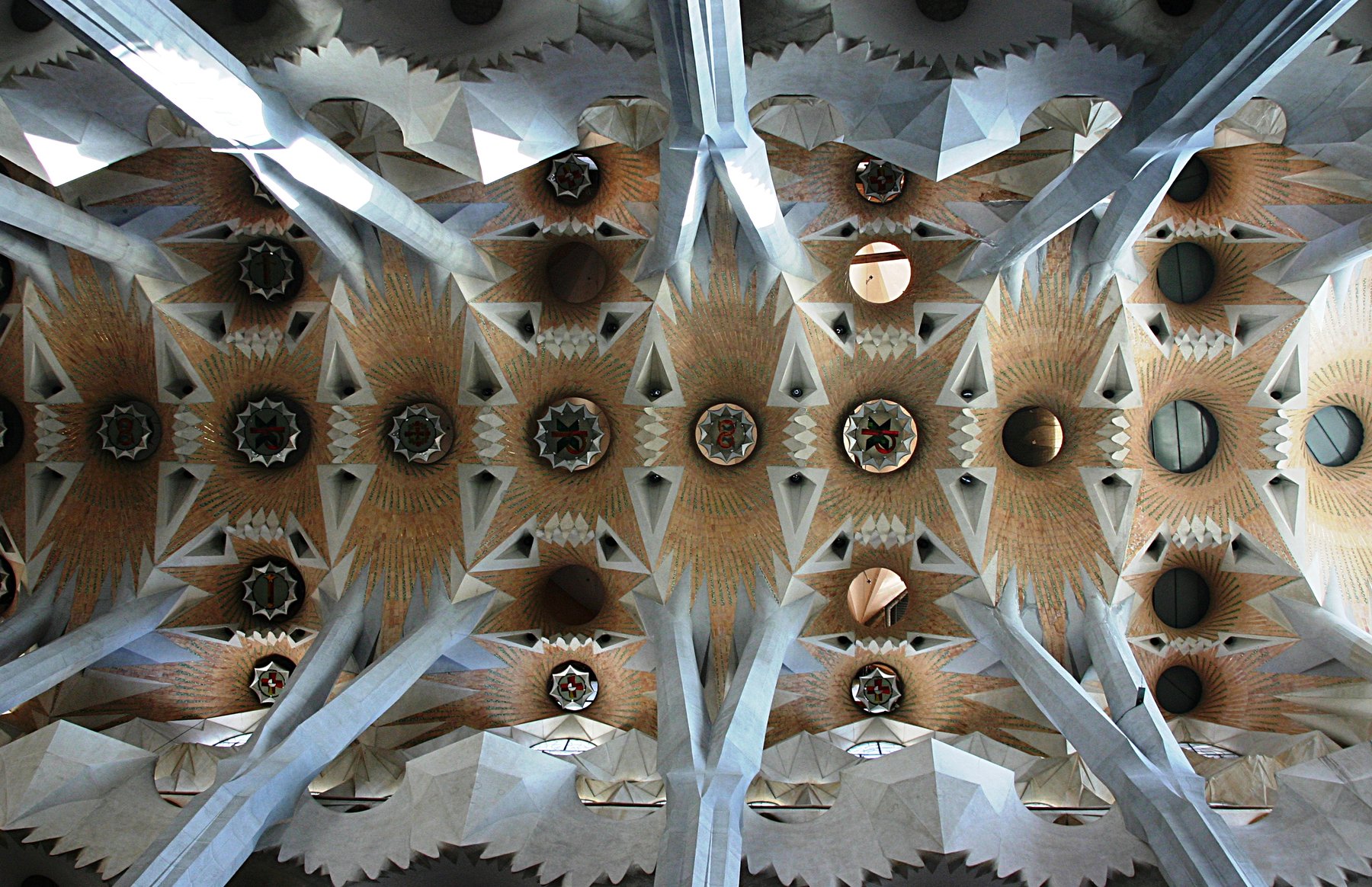
The interior of the basilica was finished in 2010 and consecrated by Pope Benedict XVI in November of that year. Walk in through the Nativity facade and look up. The ceiling is twenty-six meters above the floor of the side aisles, forty-five meters above the floor of the central nave, and sixty meters in the central crossing under the tower of Jesus Christ. The structural metaphor of the whole space is a forest. The columns lean outward at carefully calculated angles and branch near the top into secondary supports that meet the vault at multiple points. The light enters through stained glass arranged so that the eastern side — the morning side — is in cool blues and greens, and the western side — the evening side — is in warm reds and ambers. The light at noon is white. The light at sunset is red. The interior changes color through the day.
The structural calculations for this forest were done by Gaudí using inverted hanging-chain models. He would suspend small weights from chains in the shapes of his proposed columns and vaults, photograph the resulting catenary curves, flip the photograph upside down, and use the inverted shape as the structural form of the building. A catenary — the curve a chain takes under its own weight — is the geometrically optimal form for a load-bearing arch, because the entire load travels through the curve in pure compression with no bending stress. By using inverted catenaries as the basis for his vaults, Gaudí built a cathedral that does not need flying buttresses. The lateral thrust that medieval Gothic cathedrals dispose of through exterior buttressing is, in the Sagrada Familia, absorbed entirely by the lean of the columns. The interior of the building feels open and weightless because there is, in fact, no horizontal force pushing against the walls. The forest holds itself up. Chiaro walks you through one of these branching columns from base to capital while you stand under it, naming the catenary geometry and how the load is traveling down through the lean, so the engineering of the building reads in the same field of view as the surface.
What is still being built
Eight of the eighteen planned spires are now finished. The four towers of the Nativity facade and the four of the Passion facade have been up for decades. The four towers of the Glory facade — the south, main facade, which will be the official entrance once construction concludes — are still being built. The four central towers around the tower of Jesus Christ — representing the four evangelists Matthew, Mark, Luke, and John — are partially complete. The central tower itself, the spire of Jesus Christ, is being topped out in 2026 with a giant cross at its peak, becoming the tallest religious building in the world.
Construction continues seven days a week, in two shifts. About two hundred and forty workers are on site at any given time. The cost of the project is roughly twenty-five million euros a year, almost all funded by ticket sales. The Sagrada Familia is now the most visited monument in Spain, drawing about four and a half million visitors annually. The income from those tickets is the building’s only source of construction funding. The crowds you stand in inside the basilica are paying for the basilica around them.
What to look for
Five things to do on the visit. First, before you enter, walk around the entire exterior to compare the two completed facades. The Nativity facade on the east is dense, intricate, and representational. The Passion facade on the west is austere, geometric, and harsh. The same building shows two completely different sculptural philosophies. The shift is visible in the same field of view from the corner of the building.
Second, inside the central nave, stand directly under the central crossing — the spot below where the tower of Jesus Christ rises. Look straight up. The vault here is the highest point in the building, sixty meters above your head. The light entering at this height has been calibrated by Gaudí’s hanging-chain models to land on the floor at a specific angle at noon. At noon in mid-summer, the cross at the center of the floor is illuminated through a single window above.
Third, find the magic square on the Passion facade. It is on the wall just to the left of the central portal, near the Flagellation scene. Add up any row, column, or diagonal. You will get thirty-three.
Fourth, in the school built by Gaudí just behind the basilica — a tiny one-storey building used as a workers’ children’s school during construction — look at the roof. It is a thin concrete shell that warps in a sinusoidal curve to provide its own structural rigidity without internal columns. Le Corbusier, when he visited Barcelona in 1928, said the school roof was the single most important piece of modern architecture he had ever seen.
Fifth, take the elevator up the Passion facade tower. The view from the top is across the bay of Barcelona, and the sound that reaches you up there is the wind blowing through the stone tubes of the surrounding towers. Each tower is hollow and contains tuned bronze tubular bells designed by Gaudí to produce a specific tone when struck. The bells are not yet installed in most towers. Once they are, the building will ring as the wind passes through it.
The Sagrada Familia is the only major cathedral in Europe still under active construction. It is also the only one designed by a single architect from the ground up, in a single coherent structural and aesthetic system, with no major design committee or stylistic break. Gaudí died ninety-nine years before it will be finished, and the building is being completed by people who never met him, working from his drawings, his hanging-chain models, his sketches, and the parts of the basilica he had already built. The forest is still growing. Walk in, look up, and listen.
Image credits
- Sagrada Familia, Barcelona (P1170694).jpg — Bernard Gagnon. Source, CC BY-SA.
- Barcelona - La Sagrada Família - Nativity Façade IV.jpg — Massimo Catarinella. Source, CC BY-SA.
- Passion Facade of the Sagrada Familia sculpted by Josep Subirachs.jpg — Canaan. Source, CC BY-SA.
- Ceiling of the nave - Interior of Sagrada Família - Barcelona 2014.JPG — Cataleirxs. Source, CC BY-SA.


