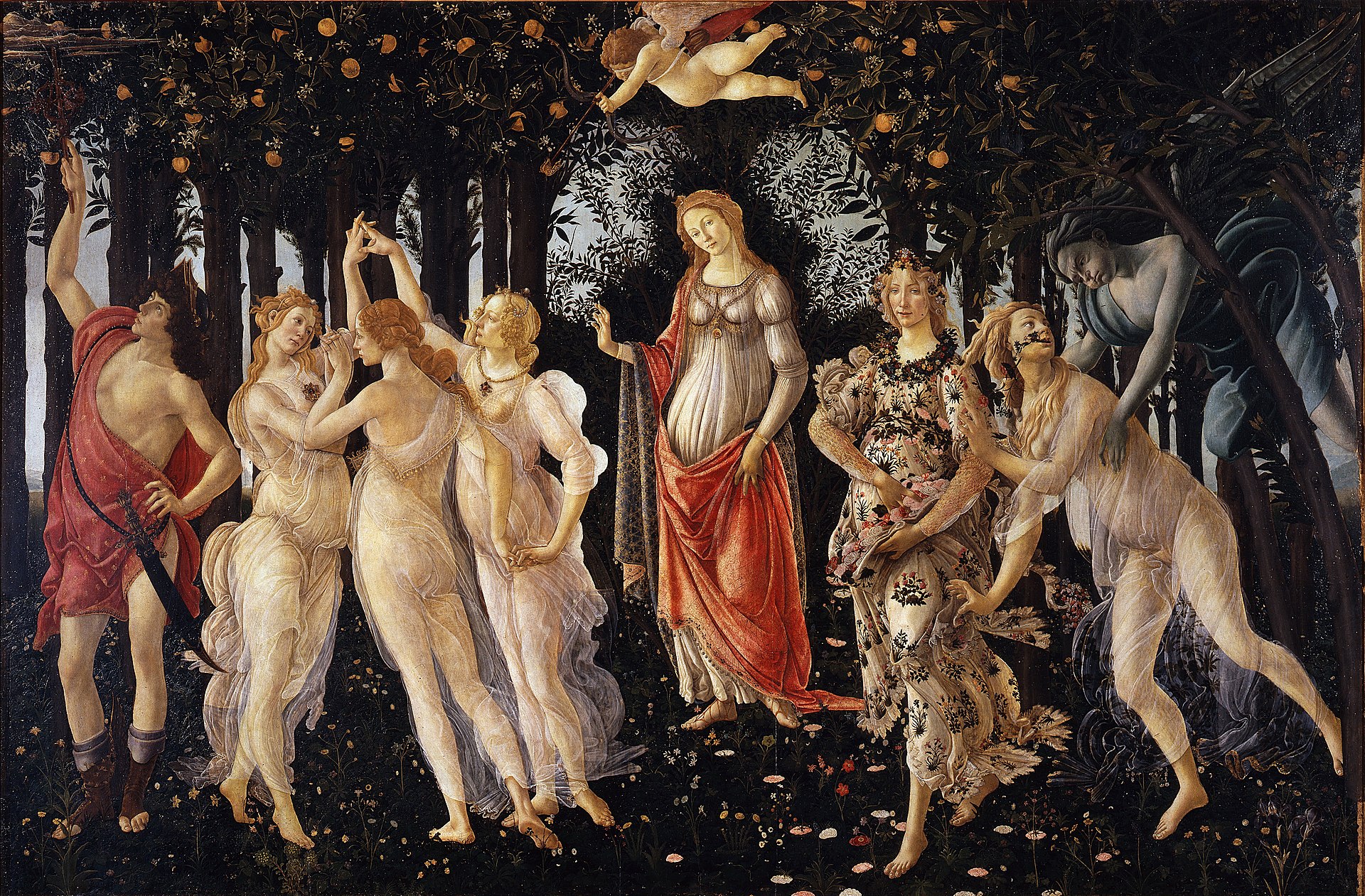
La Primavera has nine figures. Most paintings of the period have one or two, sometimes three. Primavera runs nine across the foreground, in a grove of orange trees, in a band that fills almost the entire canvas. Each figure is a quotation. Each is doing something specific. The painting is meant to be read right to left, against the natural left-to-right direction of Western reading, which is part of the reason most visitors stand in front of it confused.
This is the figure-by-figure decode. Each figure on the painting, what they are quoting, what they are doing, who they are. Read in the order Botticelli wants you to read them: from Zephyr seizing Chloris on the right, to Mercury parting the clouds on the far left.
For the longer essay on the painting as a whole — the patron, the season, the Neoplatonist context — see the companion piece. This is the figure-level companion to that essay.
How to read the painting
Start on the right. Move left. Each figure leads to the next. The painting is a single procession, in nine parts, of the arrival of spring.
The right-to-left reading is unusual. Most Renaissance paintings, if they have a narrative, read left to right. Primavera reverses it. The reason, on the dominant Neoplatonist reading, is that the painting is moving from the world of physical, animal love (Zephyr’s assault on Chloris) toward the world of philosophical, intellectual love (Mercury’s gesture upward toward the heavens). The eye reads from earth to sky, from body to soul.
There are nine figures plus a tenth element — Cupid, hovering above Venus — that some scholars count as a separate figure and others as a property of Venus’s group. We will do them as ten.
1. Zephyr (right edge)
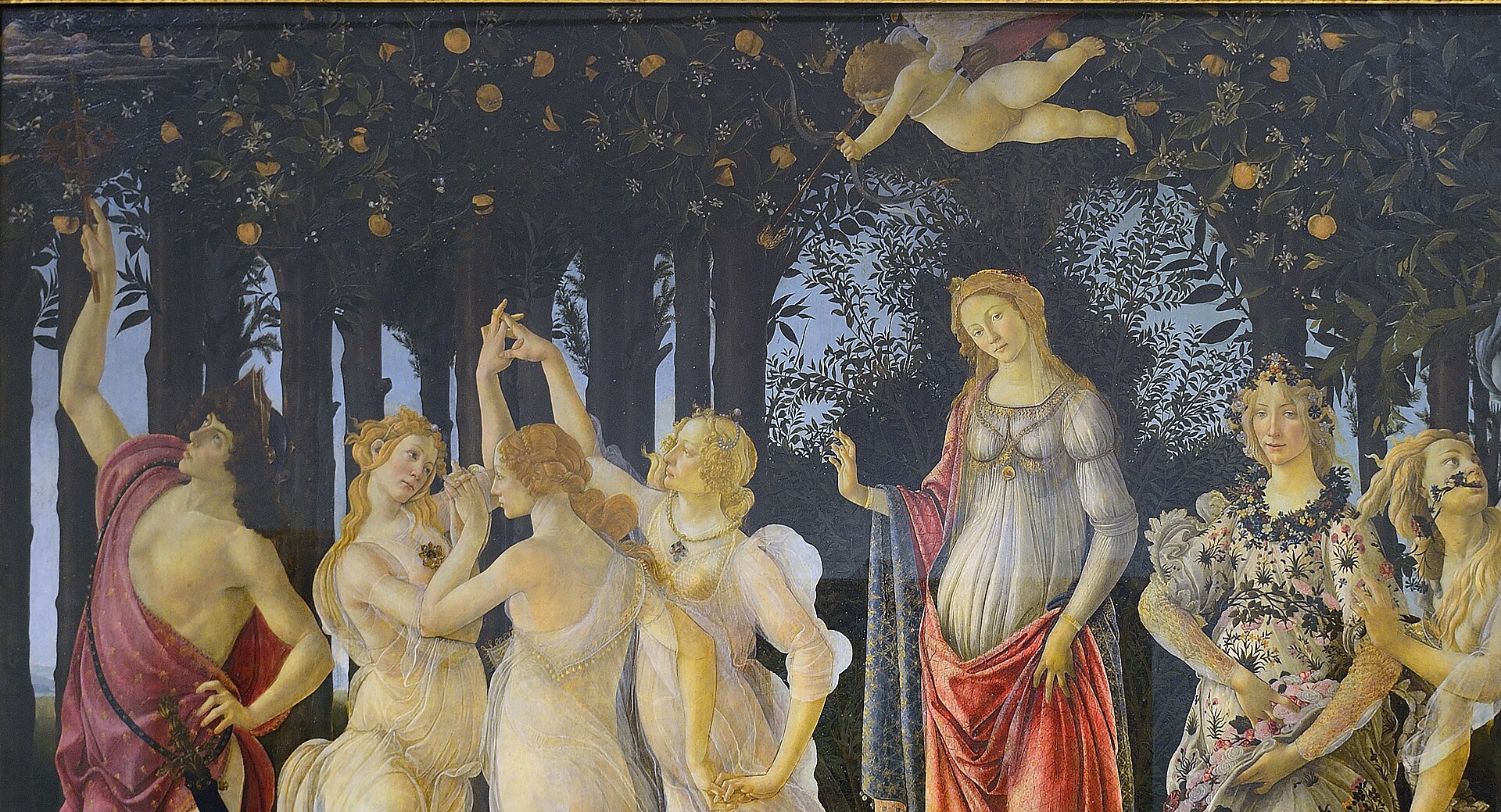
The figure on the far right of the canvas, in pale blue, half-emerging from the dark trees, with cheeks distended as if he is blowing wind, is Zephyr, the west wind. Zephyr is the personification of the warm spring wind that classical writers said brought the new season. Hesiod, Ovid, Lucretius — all of them describe Zephyrus as the wind of spring, the breath that thaws the world after winter.
Zephyr is the only figure in the painting that is not standing on the ground. He is mid-air, blown half into the grove by his own wind. His skin is blue-tinged, slightly otherworldly, marking him as a spirit rather than a mortal. His mouth is open. The breath is visible: streaks of white move from his lips into Chloris’s hair.
He is gripping the nymph immediately to his left. He is in the act of seizing her.
2. Chloris (just inside Zephyr)
The young nymph in the white dress, twisting away from Zephyr, with one arm raised to push him off and her face turned in surprise or alarm, is Chloris. She is a wood nymph in Greek mythology, daughter of nobody important, who happened to live in a grove that Zephyr decided to enter.
According to Ovid’s Fasti, Book V, Zephyr saw Chloris, was struck by her beauty, and pursued her. He caught her, raped her, and — in the same paragraph — married her, gave her dominion over flowers, and turned her into the goddess Flora. The transformation begins in the painting at this exact moment. Look at Chloris’s mouth. Vegetation is already coming out of it: tendrils, leaves, the first shoots of the flowers she will soon command. The ground around her feet is sprouting the first plants of the spring.
Botticelli has caught Chloris at the threshold between assault and apotheosis, between mortal nymph and goddess of flowers. The figure is a single movement: violence becoming creation.
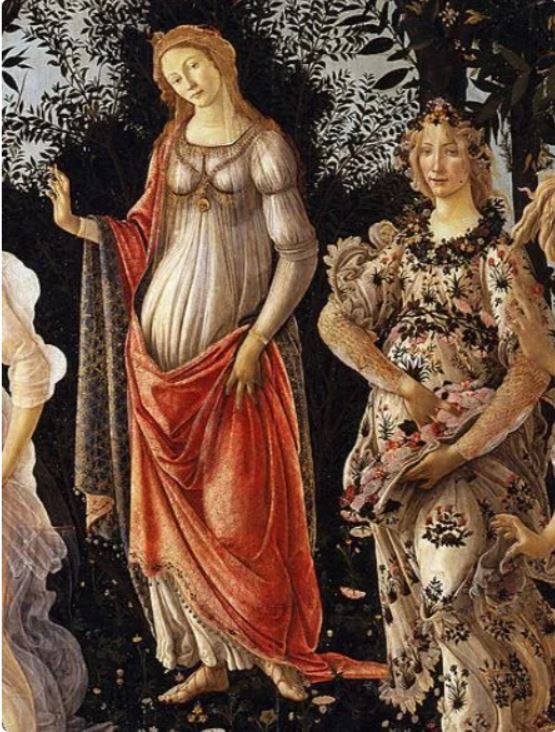
3. Flora (one step left of Chloris)
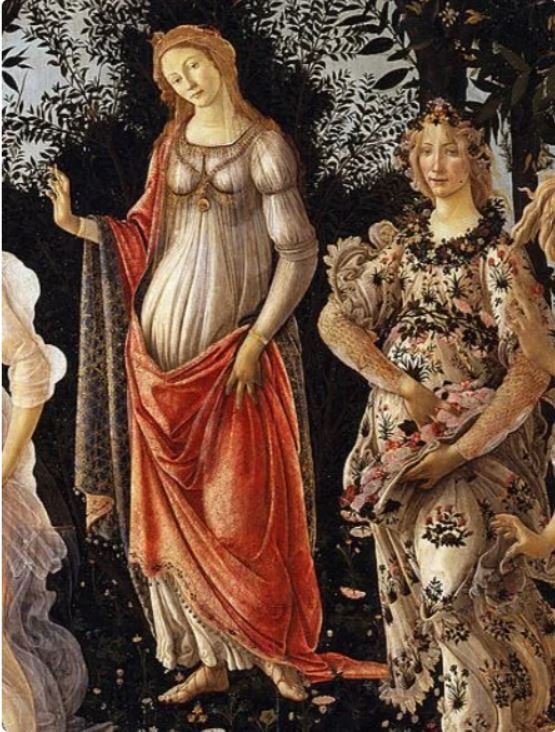
The figure immediately to Chloris’s left, dressed in a white gown stamped with cornflowers and roses, with a wreath in her hair and a gathered apron of fabric in front of her from which she is scattering flowers across the grove, is Flora, the goddess of flowering. Flora is, narratively, the same person as Chloris, one step in time later. Chloris on the right has just begun her transformation. Flora a step to the left has finished it.
This is one of the painting’s most subtle compositional choices. The same character is shown twice, simultaneously, in two states. The painting is doing in pictorial form what Ovid does in verse: a single sentence in which Chloris is seized, transformed, and renamed Flora.
Flora’s costume is one of the most beautiful in Renaissance painting. The cornflowers and roses on her dress are blue and red, the colors of late spring. The wreath in her hair is myrtle, sacred to Venus. The apron of flowers she is scattering contains daisies, marigolds, primroses, and at least a dozen other species. She is, in 1480s Florentine fashion terms, dressed as a bride — the white gown, the flowered apron, the wreath. Brides in Florence in this period really did dress this way for the wedding ceremony.
Flora is also looking out at the viewer, which makes her the second of three figures in the painting whose gaze meets ours. (The Three Graces are looking at each other; Venus and Mercury are looking past us; only Flora and the central Grace meet our eyes directly.)
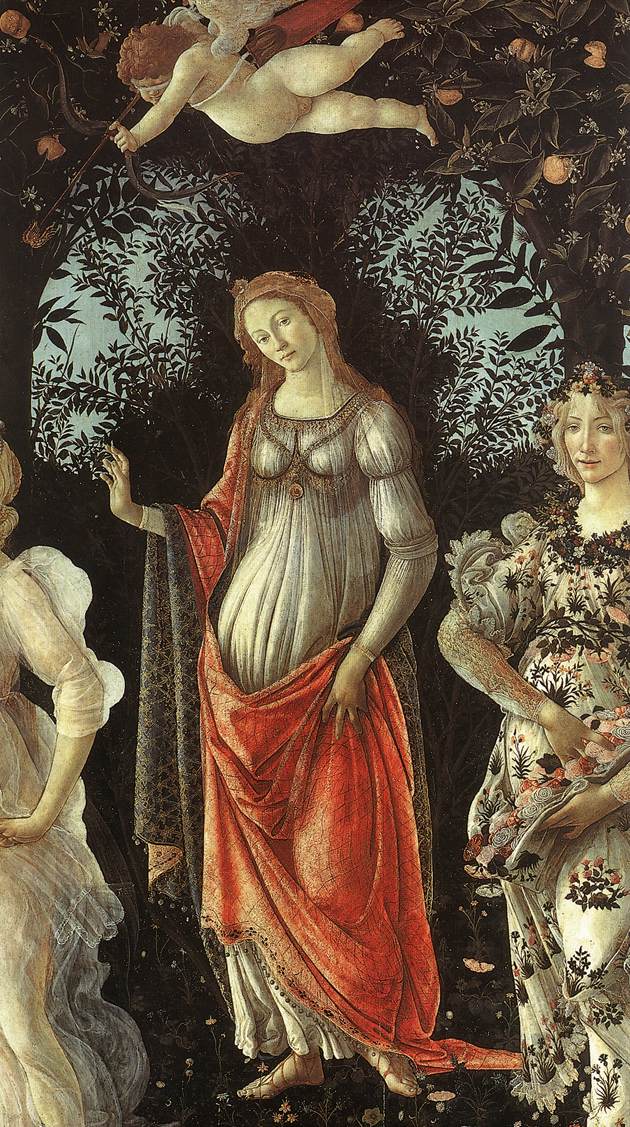
4. Venus (center)
The figure standing slightly back from the others, in the geometric center of the canvas, in a red cloak over a white underdress, with one hand raised in a gesture between welcome and benediction, is Venus. She is the ruling presence of the grove. The other figures are arranged around her like a court.
Venus, the Roman goddess of love (Aphrodite in Greek), was traditionally associated with the spring, with marriage, and with the principle of generation. In the Neoplatonist iconographic system that Marsilio Ficino had been teaching in Florence for fifteen years before Botticelli painted this, Venus had two aspects: the celestial Venus (Venus Caelestis), goddess of divine love, and the earthly Venus (Venus Vulgaris), goddess of physical love. Both were the same goddess seen from different angles.
The Venus in this painting is dressed not in the classical drapery you might expect for a goddess, but in the costume of a contemporary Florentine bride. The red mantle, the white underdress with red trim, the hairstyle — the trinzale with a single jewel at the forehead — are all the costume of a Florentine sposa in the 1480s. The painting was commissioned for the wedding of a young Medici cousin, Lorenzo di Pierfrancesco, and Venus is dressed as the bride.
Her gesture matters. Her right hand is raised, palm forward, in what art historians read as a gesture of welcome — adventus, the Roman gesture of receiving guests. She is welcoming Zephyr, Chloris, Flora, the Graces, Mercury, all of them, into her grove.
Venus’s belly is slightly rounded under the dress. Some scholars, following Charles Dempsey, have read this as a sign of pregnancy, which would tie the painting more specifically to the wedding-and-fertility iconography that fits the Medici-Appiani marriage of 1482. Others read it as the natural body shape of a Florentine bride in the painting’s idiom. The reading is disputed.
5. Cupid (above Venus)
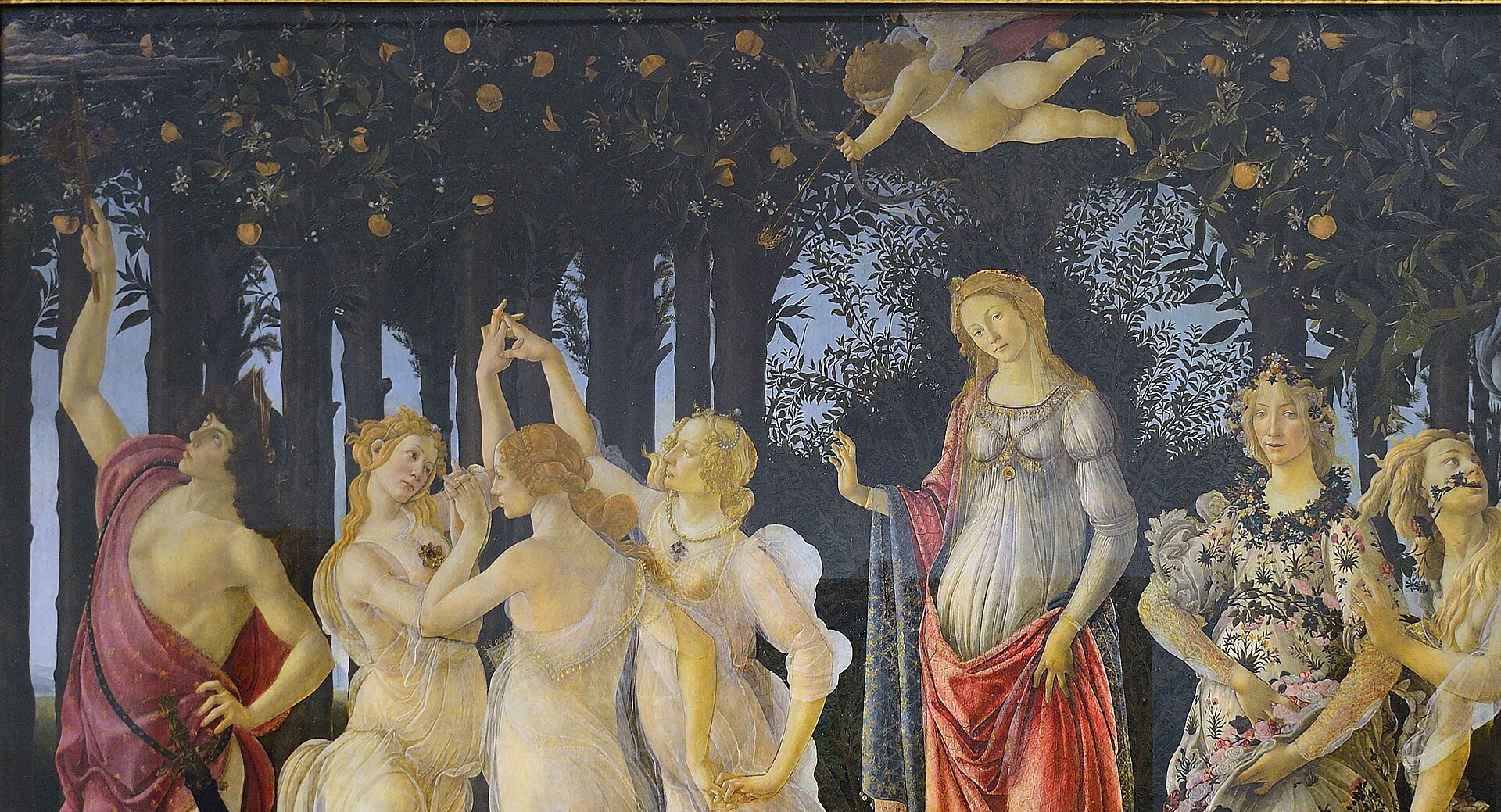
Just above Venus’s head, hovering in the canopy of the orange trees, is Cupid, her son. He is drawing his bow back. He is blindfolded. The arrow is pointed downward and slightly to the viewer’s right, aimed at the central figure of the Three Graces.
The blindfold is a quotation from Petrarch, who in his Trionfi (Triumphs) had described Cupid as blind, his arrows landing without regard for whom they hit. The Petrarch reference would have been instantly recognizable to any educated Florentine in 1482. Petrarch had been the most-read poet in the Italian language for a hundred years. The blindfolded Cupid is the painting saying: love is random, love is irrational, love is going to land where it lands.
Cupid’s flame-tipped arrow — you can see the small orange flame at the tip — is the arrow of erotic love. When it lands in the central Grace’s chest, it will set off the chain reaction that the three Graces are dancing.
6. The Three Graces (left of Venus)
The three young women in nearly transparent white gowns, hand in hand in a circle, dancing slowly in the orange grove, are the Three Graces. They are the Charites of Greek mythology, the Gratiae of Latin: in Hesiod’s Theogony they are the three daughters of Zeus and Eurynome, named Aglaia (Splendor), Euphrosyne (Mirth), and Thalia (Cheer). In Renaissance Neoplatonist iconography, however, they were given different names and a different reading: Pulchritudo (Beauty), Castitas (Chastity), and Voluptas (Pleasure).
The Three Graces in Primavera are, on the standard Neoplatonist reading, Pulchritudo on the left, Castitas in the center, and Voluptas on the right. They are arranged in a circular dance because, in Marsilio Ficino’s interpretation, the three are stages in a single cycle of erotic love: Beauty leads to Chastity (because Beauty inspires desire, which a chaste mind contains), Chastity leads to Pleasure (because contained desire eventually finds proper expression), Pleasure leads back to Beauty (because pleasure refines and renews the perception of beauty).
This is why Cupid’s arrow is aimed at the central Grace, Castitas. The arrow about to land in her chest is what will turn her — by the inexorable logic of love — into Pulchritudo’s sister Voluptas. The dance is the cycle, and Cupid is the random arrow that starts it.
The hand gesture is also significant. The Graces are not just holding hands. Their fingers are intertwined in a specific configuration — a chain of three crossed handholds — that ancient writers had described as the iconography of liberalitas, “generosity.” The three Graces in classical iconography stood for the three stages of generosity: giving, receiving, and returning. Botticelli’s pose preserves the classical reference while overlaying it with the Neoplatonist erotic reading.
The transparent gowns are deliberate. The Graces are clothed but you can see them. This is one of the painting’s small jokes: the goddesses of erotic love are technically modest, in long-sleeved white dresses, but the dresses are thin enough that the bodies show. Botticelli is having his iconography both ways.
7. Mercury (far left)
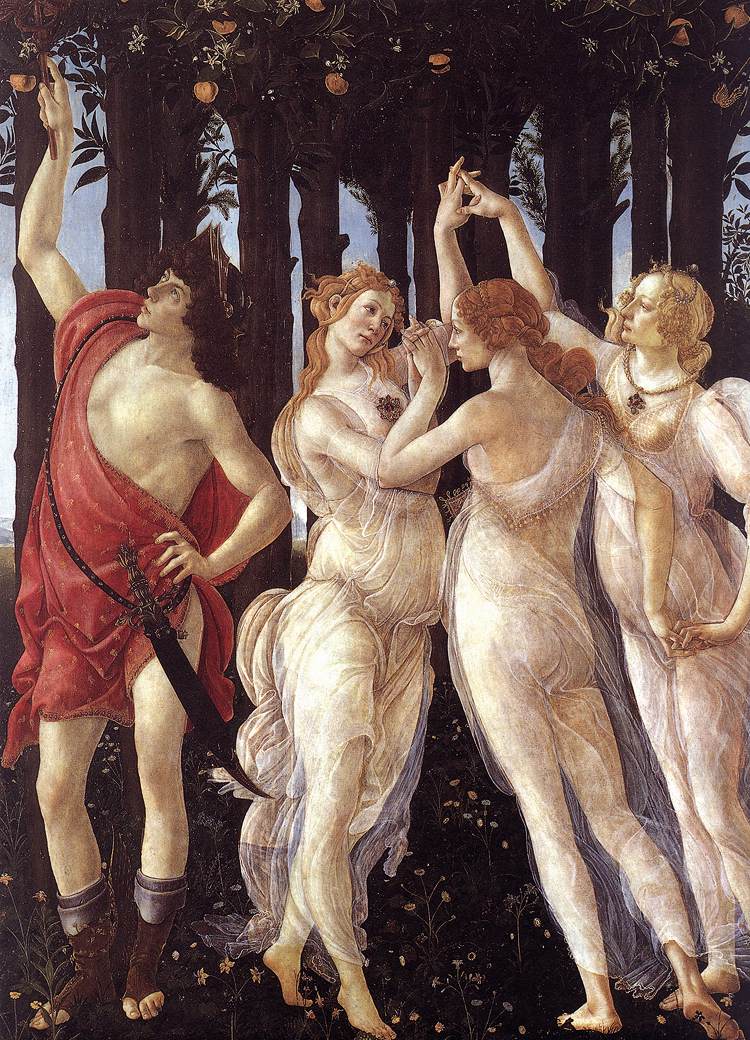
The figure on the far left of the painting, in a red cape, with golden boots, a small sword at his belt, and his caduceus (the staff with the two intertwined snakes) raised toward the trees, is Mercury, the messenger god. He is the only figure in the painting who is turned away from the central group. His back is angled toward the dance. He is looking up and to the side, at a small bank of dark clouds that has appeared above the orange canopy.
He is parting them. The caduceus, in his upraised right hand, is reaching toward the clouds, pushing them apart. This is a classical attribute. Mercury, in his role as psychopomp — the guide of souls — was traditionally the god who escorted the dead to the underworld and who, in some myths, also opened paths through clouds, mists, and barriers. Virgil describes him doing this in the Aeneid. Botticelli is illustrating the role.
In the Neoplatonist reading, Mercury is the boundary figure. The grove behind him, with its Graces and Venus and Flora, is the world of earthly love. Above him, beyond the clouds, is the world of celestial love — the soul’s ascent toward the divine. Mercury’s gesture is parting the boundary between the two. He is, in the iconographic argument the painting is making, leading the soul out of the body and toward the heavens.
This is also why Mercury is dressed as a contemporary Florentine. His costume — the red cape, the boots, the small sword at the hip — is the costume of a young Florentine nobleman. Some scholars have argued that the face is a portrait of one of the Medici, possibly Giuliano de’ Medici (the brother of Lorenzo il Magnifico, assassinated in 1478) or one of his cousins. The portrait identification is disputed. What is clear is that Mercury, like Venus, is dressed in modern dress, which would have collapsed the distance between mythology and the household for whom the painting was made.
8. The orange grove
The setting is not a forest, not a garden, but specifically a grove of orange trees. The fruit hanging in the canopy is golden. The leaves are dark green. The grove is closed at the back of the painting by a continuous band of foliage, with no horizon, no sky except for a small patch above Mercury where he is parting the clouds.
The orange trees are not random. The orange — mala medica in the Italian botanical name — was a heraldic emblem of the Medici family, a pun on their name. (The name “Medici” comes from “medico,” doctor; the orange, in Latin mala medica, was the “medical apple” or “Medici apple.” The pun was old by 1482 and the family had embraced it.) The grove is therefore a Medici grove. The painting is set, on the heraldic level, on Medici land.
This is the same kind of family-heraldry-as-setting move that Botticelli used in his Adoration of the Magi, where the Medici family is identified by the contemporary dress of the figures kneeling at the manger. The whole essay on the Adoration walks through that other family-portrait-as-painting.
9. The flowers
About 190 different flower species have been identified in Primavera by botanical scholars, beginning with the Tuscan botanist Mirella Levi d’Ancona in the 1980s. Most of them are flowers traditionally associated with Venus, with marriage, or with springtime in classical literature.
The roses are sacred to Venus. The daisies are flowers of Flora. The cornflowers are sometimes associated with Roman bridal customs. The narcissus is the flower of the Greek nymph Echo, who pined away for her unrequited love and was turned into the flower. The hyacinth is the flower of the youth Hyacinthus, who was loved by Apollo. Each species, in the Neoplatonist iconographic system Angelo Poliziano was working in, is a coded reference. Each could be unpacked into a small mythological story.
The flowers also have a calendar. The species visible in the painting bloom in the Tuscan calendar in roughly the same two-week window of late winter and early spring. By identifying the specific species, scholars have argued that Botticelli is depicting a single moment in early March, in or near Florence, in the year before the painting was finished.
10. The Three Graces seen up close
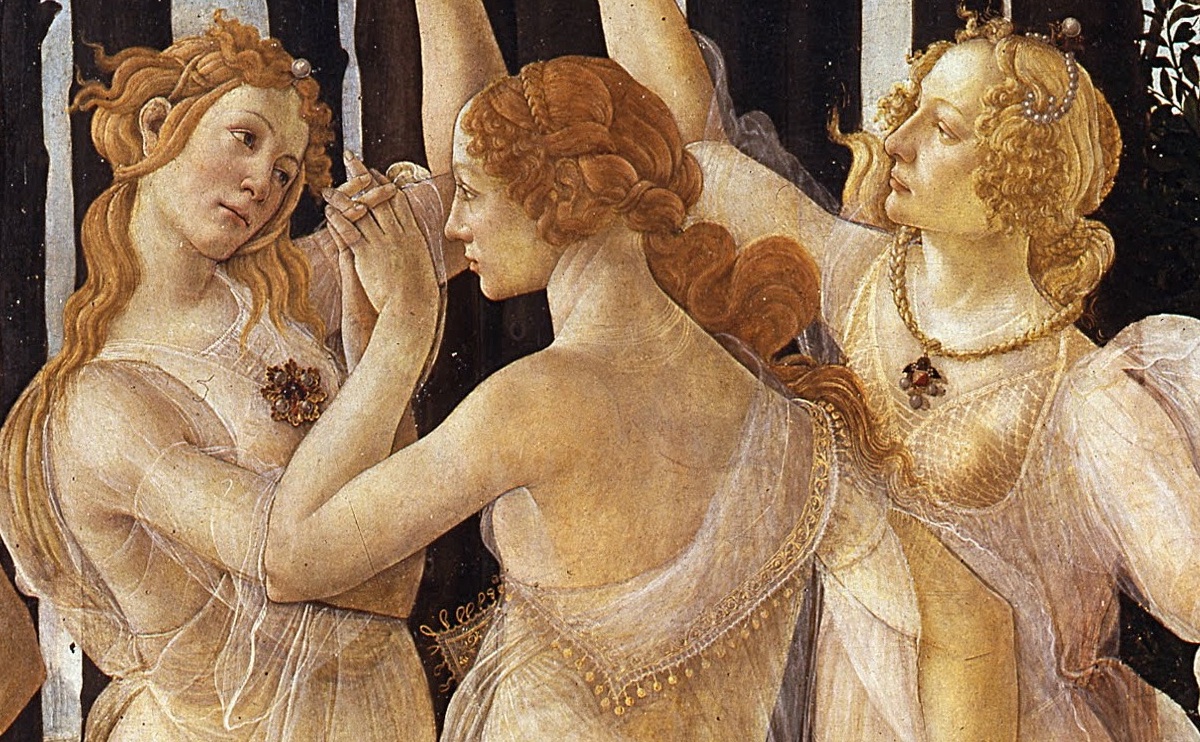
The Three Graces deserve a second look. From the front, they read as a unified circle. From a slightly oblique angle — the angle most viewers see them from in the gallery, since the painting is wide and you cannot stand directly in front of all parts of it at once — they are three distinct figures.
Each has a different hairstyle. Each has a different jewel. The central Grace, Castitas, is the most modestly dressed: her gown covers more, her hair is more tightly bound. The Grace on the right, Voluptas, is the most elaborately ornamented: pearls in her hair, a brooch at her shoulder. The Grace on the left, Pulchritudo, is the simplest. The hierarchy of dress matches the Neoplatonist hierarchy of the three: Beauty (simple), Chastity (modest), Pleasure (ornate).
The transparent fabric is, again, a deliberate choice. The fabric reads as nearly weightless. It reveals the bodies more than it conceals them. Botticelli is doing what he does throughout the painting: technically observing the modesty rules of his period, while making the bodies as sensual as the rules allow.
What the figures do together
Read right to left, the painting tells a single story. Zephyr arrives. Zephyr seizes Chloris. Chloris transforms into Flora. Flora scatters the first flowers across the grove. Venus presides over the new season from the center. Cupid, blindfolded, fires his arrow at the dance. The Three Graces dance the eternal cycle of erotic love. Mercury, at the boundary, parts the clouds and opens a path toward the divine.
The painting is a procession of spring, in nine figures, beginning in the chaos of the body’s appetites and ending in the contemplative ascent toward the heavens. It was painted for a young Medici cousin’s wedding chamber, where it hung for a generation, then moved to the Medici villa at Castello, where Vasari saw it in the 1550s, then to the Uffizi in the eighteenth century.
It has been there ever since. Room 10–14, on the long wall, opposite The Birth of Venus. The companion piece on the painting as a whole covers the patron, the season, and the broader interpretive history. The Birth of Venus essay covers the sister painting hanging in the same room.
Chiaro walks you through the figures right to left, the way the painting wants to be read — Zephyr seizing Chloris, Chloris transforming into Flora, Flora scattering, the Graces dancing, Mercury parting the clouds — as one continuous flow of spring moving across the canvas, so the painting reads as the procession it always was.
The kicker
Stand in front of La Primavera. Find the blue cheek on the right edge. Find the wood nymph just inside it, vegetation already coming out of her mouth. Move your eye left, slowly, against the way you read everything else — Flora scattering, Venus presiding, Cupid blindfolded, the Graces dancing, Mercury parting the cloud at the far edge. Six hundred years ago, in a young Medici cousin’s wedding room, somebody designed a painting that asked your eye to walk backward through the spring. It still does. Each of the nine figures is a quotation. Each is doing something specific. The whole thing fits in a glance, and unfolds in an hour.
Image credits
- Botticelli-primavera.jpg — Sandro Botticelli (c. 1445-1510). Source, Public Domain.
- Primavera 02.jpg — Sandro Botticelli (Mercury detail). Source, Public Domain.
- Primavera 03.jpg — Sandro Botticelli (Three Graces detail). Source, Public Domain.
- Primavera (Botticelli) (detail).jpg — Sandro Botticelli (Cupid and Venus detail). Source, Public Domain.
- Botticelli’s Primavera - detail (Flora and Venus).jpg — Sandro Botticelli. Source, Public Domain.
- Sandro Botticelli - Three Graces in Primavera (detail).jpg — Sandro Botticelli. Source, Public Domain.


_(detail).jpg)
.jpg)
.jpg)