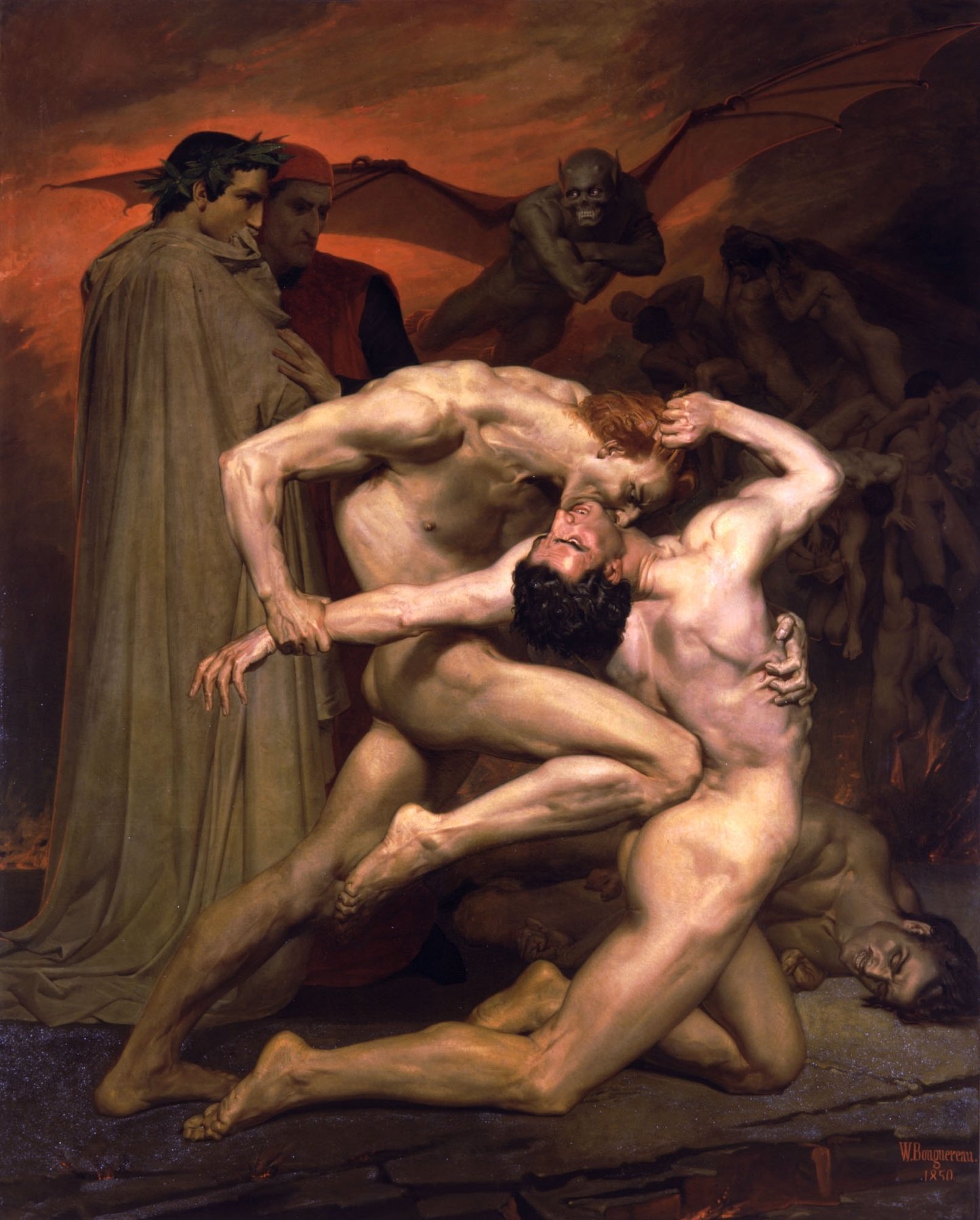
In the autumn of 1850, in a studio at the Villa Medici in Rome, a twenty-five-year-old painter from La Rochelle named William-Adolphe Bouguereau finished a canvas two and a quarter meters tall by a little more than two meters wide and titled it Dante et Virgile aux enfers. Dante and Virgil in Hell. The painting shows two damned souls in mid-fight in the eighth circle of hell, the circle Dante reserved for the falsifiers. One man, naked and muscular, has thrown his teeth into the side of the other man’s neck and is hanging from his bite while the bitten man arches backward with his hand pulling at the biter’s hair. Behind them, watching, are the figures of Dante in red robes and Virgil in dark blue, and behind those two, a winged demon hovers in the dark middle distance with a small smile on his face. The bouguereau dante and virgil painting is what hell looks like when two souls have eternity to keep doing this and nothing else.
The bite is the moment most reproductions miss. The biter is Gianni Schicchi, a thirteenth-century Florentine forger who pretended to be the dying Buoso Donati in order to dictate a fake will. The man being bitten is Capocchio of Siena, an alchemist Dante had known in life and who was burned at the stake in 1293 for counterfeiting gold. In the thirtieth canto of the Inferno, Dante watches the two souls run through the ditch of the falsifiers and watches Schicchi catch Capocchio and bite him in the neck, and the wound makes the wounded man bleed but does not kill him because the dead cannot die a second time. The wound stays open. The bite continues. This is the moment Bouguereau painted.
The brief from Paris
Bouguereau was at the Villa Medici on a Prix de Rome scholarship, which meant the French state paid for five years of study in Rome on the condition that he send a major painting back to Paris every year as proof he was working. The brief for his second-year envoi — second-year submissions — was an ambitious subject, classical or biblical, executed on a heroic scale, with at least three figures and a strong narrative moment. Bouguereau read the Inferno that winter, found Canto XXX, and chose the bite. The choice was not safe. The same year and the same award had been won three years earlier by Cabanel for his Fallen Angel, which the Salon jury had rejected. Subjects from the Christian tradition were out of fashion. Subjects with explicit violence were riskier still. But Bouguereau was twenty-five, ambitious, and had figured out that the way to a gold medal at the Salon was a painting that nobody could ignore, even from the back wall.
He worked on the canvas for about eight months, from January to September 1850, in a Villa Medici studio that overlooked the Pincian Hill and the dome of Saint Peter’s. He used local models, including a Roman dockworker for Schicchi’s back and a soldier on leave for the body of Capocchio. The two figures are built on a study of Hellenistic sculpture — the contorted central group is a deliberate echo of the Laocoon in the Vatican Museums, which Bouguereau drew dozens of times that year — and on Michelangelo’s Last Judgment, which Bouguereau also copied that winter. The smile on the demon’s face is the same small frozen smile of one of the damned in the lower right corner of the Sistine Chapel.
What hell looks like in academic paint
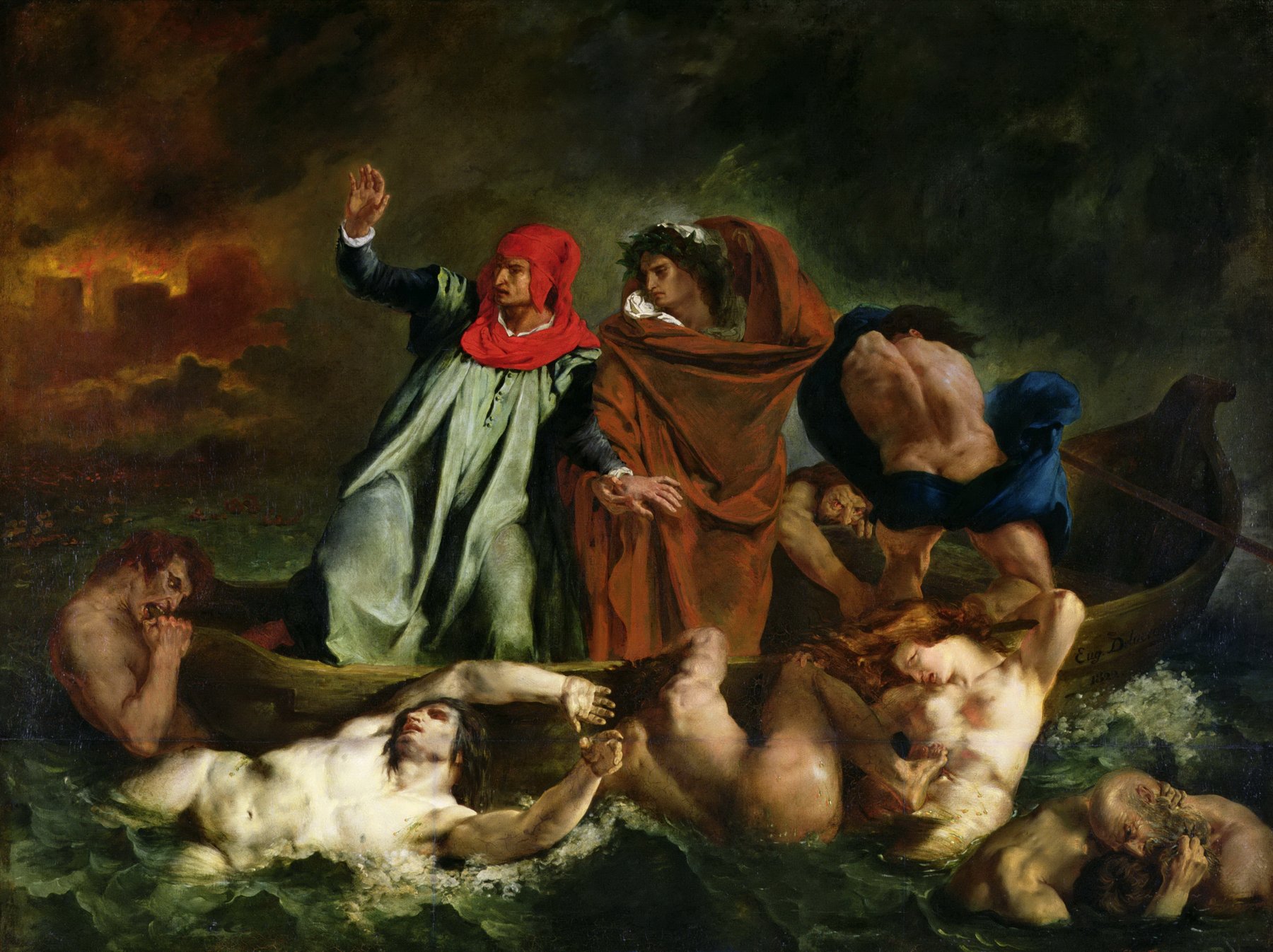
The Bouguereau Dante and Virgil in Hell painting was meant to compete on the same wall as Eugene Delacroix’s Barque of Dante, painted in 1822 and acquired by the Louvre in 1875. Delacroix’s painting is the romantic version of the Inferno — loose brushwork, dark waters, ghoulish figures clambering at the side of the boat, Dante and Virgil in fluttering robes leaning into the wind. Bouguereau’s painting is the academic answer. The figures are drawn with anatomical precision, the bodies have visible musculature down to the calves, the skin has the polished finish of the Salon style, and the dark middle ground is built up in glazes that go from raw umber to indigo and back. The two paintings are arguing about how to paint hell. Delacroix says hell is felt. Bouguereau says hell is seen.
The seeing is the cruelty. In Bouguereau’s painting you can count Capocchio’s teeth where his mouth is open. You can count the fingers of Schicchi’s hand twisting in the other man’s hair. The veins on Capocchio’s neck stand out where the biter’s grip pulls the skin tight. The blood is dark, almost black, painted in two thin lines that run from the bite down the chest. The bodies are too clean for what is happening to them, and the cleanness is the point. Bouguereau is saying that hell is what happens when violence becomes precise. When the body stops being able to die, the mechanics of cruelty stop being approximate. Every motion of the bite is exact.
The watching figures matter. Dante stands in his red robe with one hand at his chest, his face turned half away, his expression a mix of horror and the academic curiosity that Virgil his guide is supposed to teach him. Virgil is behind Dante, taller, calmer, his hand on Dante’s shoulder, his eyes on the bite. Virgil has seen this before. He has been in hell since the year 19 BC, when according to the poem he was assigned to the first circle as a virtuous pagan, and he has been showing visitors the lower circles for thirteen hundred years. The two of them are the only people in the picture who are not on fire emotionally. They are the camera. The biter and the bitten are the subject. The demon in the back is the editor.
What the Salon did with it
The painting was shipped from Rome to Paris in October 1850 and exhibited at the Salon of 1851 in the Palais des Champs-Elysees. The jury hung it on the upper register of the long gallery, in the position called “skied” — so high up the wall that no visitor could see the bottom half of the canvas at normal eye level. This was the standard punishment for a painting the jury found vulgar but could not reject outright because it had come through the Rome school’s protected channel. The reviews were mixed. Theophile Gautier wrote in La Presse that the painting had “the violence of a young man who has read too much Dante and too little of his contemporaries.” Charles Baudelaire, who reviewed the Salon for Le Constitutionnel, did not mention the painting at all — a silence that in 1851 was its own verdict.
The painting did not sell. The French state, which had paid for the canvas through the Rome scholarship and technically owned it, sent it to the storage of the Musee du Luxembourg, where contemporary art was kept until it was either elevated to the Louvre or quietly returned to the artist. It stayed in storage for a hundred and twenty-six years. In 1977 it was transferred to the new Musee d’Orsay, then under construction in the old Beaux-Arts railway station on the left bank of the Seine, and when the museum opened to the public in December 1986 the painting was hung in the central nave on the ground floor where the high arched ceiling could finally accommodate its height. It has been on view ever since.
The reason it came back
Bouguereau’s reputation collapsed after his death in 1905 and stayed collapsed for most of the twentieth century. The Impressionists and the Modernists treated him as the textbook example of academic complacency — everything they had been working to escape. The art critic Robert Hughes wrote in 1980 that Bouguereau’s work was “the eighty-percent solution to nineteenth-century French painting,” meaning that he had figured out what a Salon audience wanted in 1875 and gave it to them with the same finish for the next thirty years. The textbooks taught him as a foil. His paintings went into storage.
What rescued Bouguereau was the same thing that rescued Cabanel — the internet. High-resolution scans of the Orsay’s collection began circulating around 2008, and viewers who had no investment in the Modernist consensus could see the technical control of the paintings up close. Dante and Virgil in Hell became, alongside Cabanel’s Fallen Angel, one of the most-shared nineteenth-century paintings online. A short video of the painting filmed at the Orsay by a museum guide in 2013 got more than two million views on YouTube. The bite was the part of the painting people noticed first. The veins on the neck were the second. The demon’s smile was the third. The painting that had been hung on the back wall in 1851 because it was too violent for polite taste turned out to be exactly what a twenty-first-century internet audience wanted from a nineteenth-century painting — maximum drama, maximum precision, maximum visible cruelty.
The painter who came home from Rome
Bouguereau finished his Rome scholarship in 1854 and returned to Paris, where he won the Salon’s gold medal in 1859 and spent the next forty-six years as one of the most successful painters in France. He exhibited at every Salon from 1849 to his death, painted more than eight hundred canvases, made his fortune painting nymphs, peasant Madonnas, and small girls with bare feet in pastoral settings, and was elected to the Academy of Fine Arts in 1876. He taught at the Academie Julian, where he was the first major Beaux-Arts professor to admit women to his studio on the same terms as men — a small detail of his biography that has been ignored by most accounts of the period. The portrait painter Cecilia Beaux and the American painter Elizabeth Jane Gardner, who later became his second wife, both trained under him at Julian.
The dante and virgil in hell painting was the only major work Bouguereau ever made in this register — explicit violence, biblical-or-literary subject, dark palette. After 1851 he went lighter, softer, more saleable. The single dark painting from his early career sat in the Luxembourg storage for a hundred and twenty-six years while the painter who made it built a different reputation entirely on the strength of his blonde Madonnas. He died in La Rochelle in August 1905, age eighty, two months after the Salon des Independants in Paris had shown a room of Henri Matisse and Andre Derain that the critics called the “cage of wild beasts” — the show that gave Fauvism its name. The end of Bouguereau’s career and the beginning of the avant-garde happened in the same Paris summer.
What to look for
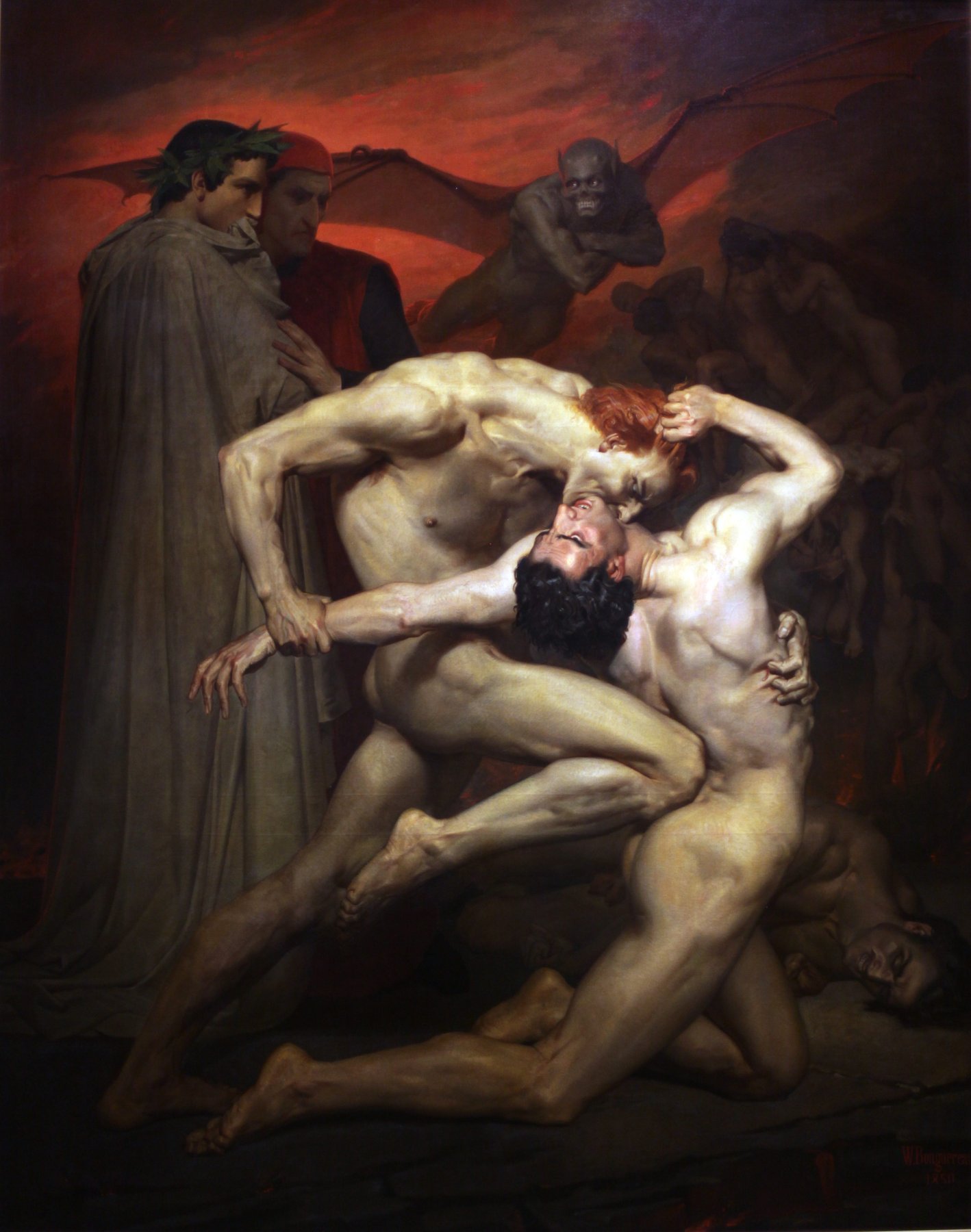
The painting hangs in the central sculpture nave on the ground floor of the Musee d’Orsay, on the long left-hand wall as you walk in from the entrance. The frame is dark gold and over six feet tall. Stand at the wall directly opposite — there is a bench — and the painting reads as a triangle: the two bodies form a leaning vertical mass on the left, Dante and Virgil form a smaller upright on the right, and the demon at the back closes the geometry. Walk closer and look at the central seam where the two heads meet. The biter’s mouth and the bitten man’s neck are painted with a separate, slower brush than the rest of the figures — you can see the difference in finish if the gallery lighting is on. Chiaro reads out Canto XXX of the Inferno in front of the painting at the right verse, so the bite of Gianni Schicchi gets named at the moment you are looking at it, and Dante and Virgil get explained while you can still see Dante’s right hand pulling at his red robe.
Step back and the bite goes out of focus. Step in and the demon’s small smile becomes the second thing in the painting that holds you. Bouguereau put that smile there because he understood that hell is not the violence. The violence is just the work. Hell is the demon enjoying watching the work. A young painter at Rome in 1850 had figured out the difference, and the painting was too precise about it for the Salon to hang at eye level, and the same precision was what brought it back a hundred and seventy years later.