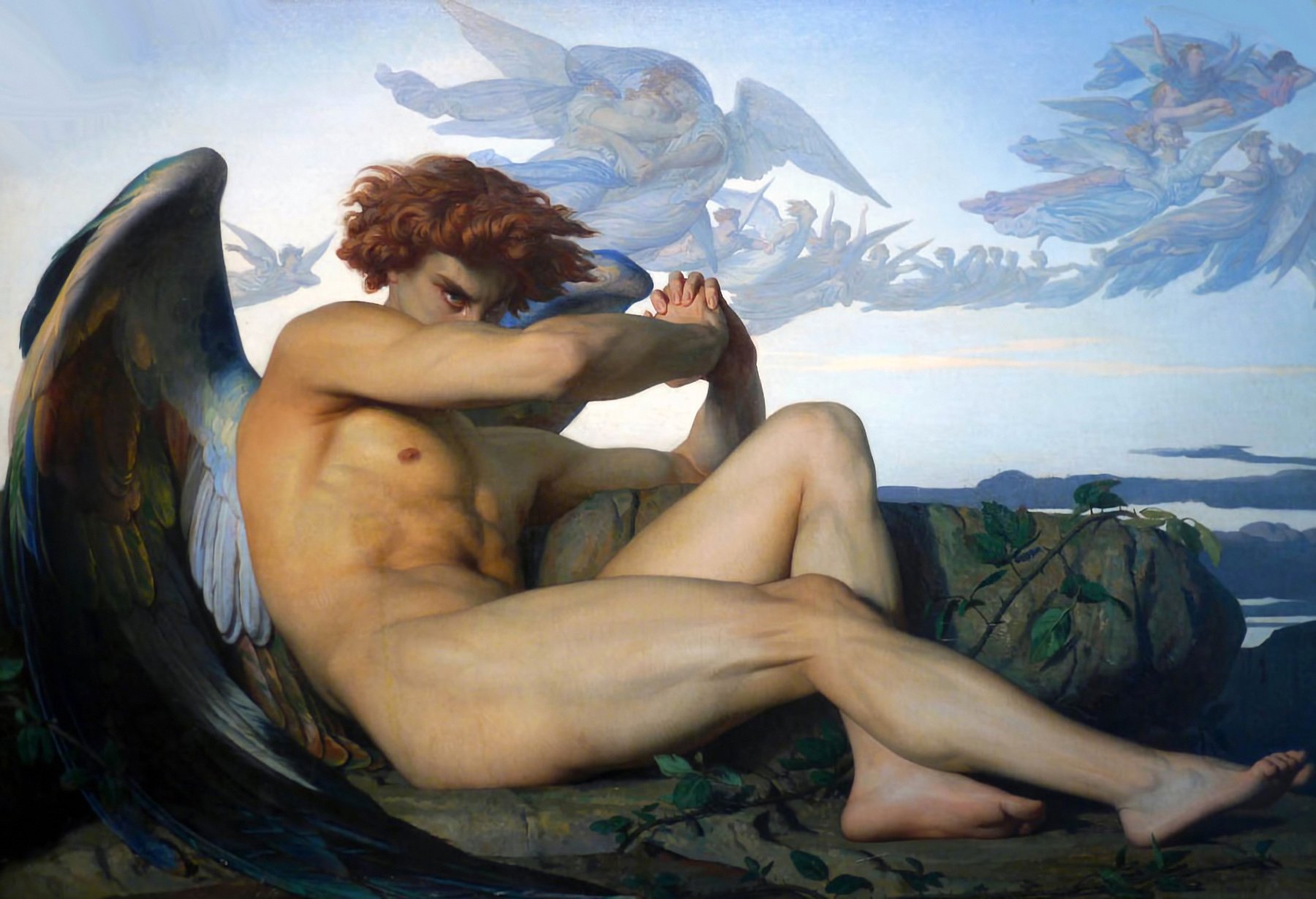
In the spring of 1847, in a Rome studio paid for by the French state, a twenty-three-year-old painter from Montpellier named Alexandre Cabanel finished a canvas he had been working on for a year and a half and signed it in the lower right corner: A. Cabanel, Rome, 1847. The canvas is a hundred and twenty-one centimeters tall by a hundred and ninety wide — a little under four feet by six. It shows a winged man, naked and adolescent, lying in a green meadow with one arm thrown over his face and one eye staring out at the viewer. The eye is red. The face is wet. Above him, painted thin as a watercolor wash, a procession of seraphim flies away into a yellow sky. The Cabanel Fallen Angel painting is what Lucifer looks like one hour after the war in heaven is over. He has not been thrown into hell yet. He is lying in the grass and he is crying.
He is also furious. This is the part most reproductions of The Fallen Angel painting miss. The single visible eye is glaring at you with a hatred so specific it feels like an accusation. The two tears running down the bridge of his nose are not sad tears. They are the tears of a person who has just lost a war and is going to lose forever. Cabanel painted them with two thin strokes of titanium white over a wet ground of umber and red lake, so that the tears catch a little more light than the rest of the face and pull your eye to them. The whole picture is built around the moment you notice the tears, and then notice that the eye behind them is not weeping. It is choosing to remember.
A scholarship boy who painted Lucifer
Cabanel was born in Montpellier in 1823, the son of a carpenter. He entered the Ecole des Beaux-Arts in Paris at seventeen on a municipal scholarship from his city, won the second-place Prix de Rome at twenty-two, and used that prize to spend five years at the Villa Medici, the French Academy in Rome, where ambitious painters of his generation were expected to soak in the work of Raphael and Michelangelo and come back to Paris ready to win the gold medal at the Salon. He chose for his second-year envoi — the painting Rome students sent home each year to prove they were working — the subject of the fallen Lucifer.
The choice was not safe. By 1847 the French academic system had moved away from Christian subjects toward classical mythology. The official preference was for Venus, Hercules, Pandora, Psyche, Theseus, anything Greek or Roman, anything you could justify as the study of the male or female nude in heroic action. A young academician’s Lucifer was a risk — biblical, theological, and worse, romantic. Cabanel sent the painting to Paris in May 1847, where it was reviewed by the Academy’s commission and then forwarded to the Salon jury. The jury rejected it. Officially the rejection was for “lack of finish in the secondary figures” — the angels in the upper register. The real objection was tone. Lucifer’s eye is too modern. It is the eye of a young man who has read Lord Byron and Victor Hugo and decided to make Lucifer look like the hero of a Romantic poem rather than the villain of a sermon.
What he was reading
The Romantic Lucifer was already a famous character by 1847. John Milton’s Paradise Lost, written in 1667, had given English literature a Satan who was eloquent, beautiful, and impossible to dismiss. The Romantics turned that figure into a hero. Byron’s Cain, published in 1821, had Lucifer as Cain’s mentor, a being who refused to bow to a creator he found unjust. Alfred de Vigny published Eloa, a long poem about a female angel who falls in love with Lucifer and is taken into hell by him, in 1824. Cabanel was nineteen when he read it. The figure in The Fallen Angel painting — young, beautiful, wronged, dangerous — comes directly from this literary tradition. Cabanel was not painting the Devil. He was painting the Romantic Lucifer, the most fashionable Lucifer of his generation, and the Salon jury knew exactly what he was doing.
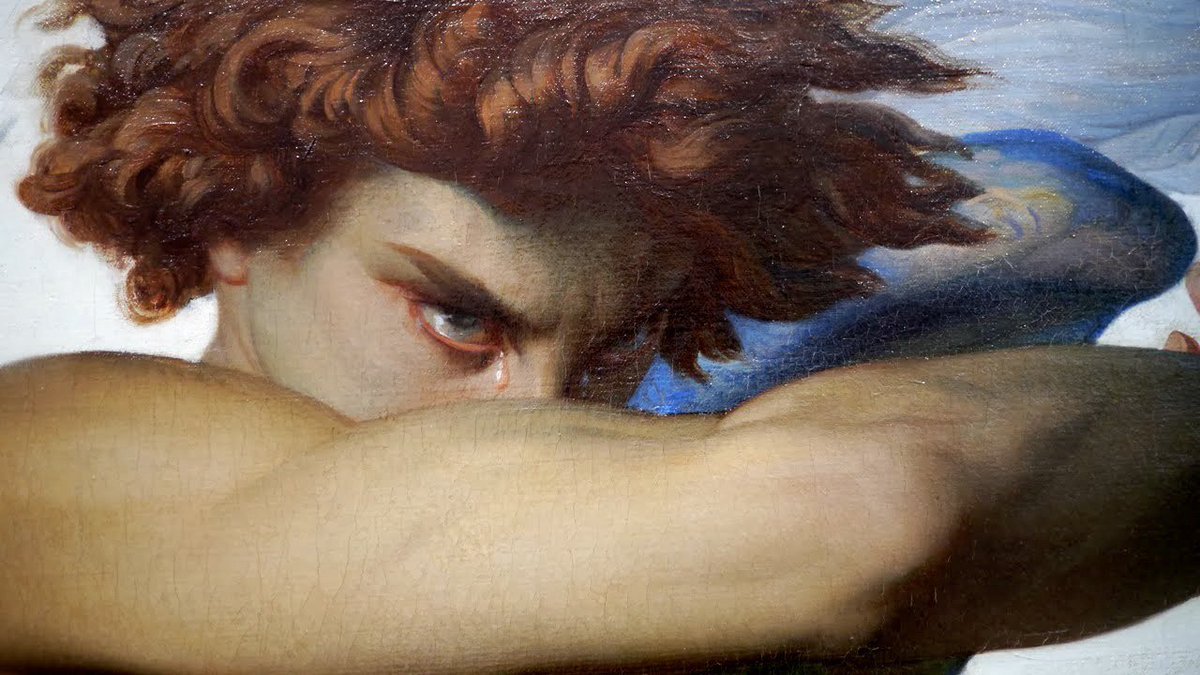
The pose is borrowed from antiquity. The crossed-arm gesture, with one bent arm covering the upper half of the face and the other resting on the thigh, is taken from a Hellenistic sleeping hermaphrodite known to every Rome student of the period from the marble copy in the Borghese collection. Cabanel has flipped it, sat it up, added wings, and made the half-hidden face the subject of the picture. The body is academic — carefully proportioned, anatomically correct, painted with the smooth glazed finish that the Ecole rewarded. The face is not. The face is a Romantic close-up smuggled into the middle of a Beaux-Arts exercise.
Where the painting went
Rejected by the Salon, the canvas went home with the painter. Cabanel returned to Paris in 1850, won the gold medal at the Salon of 1852 with a different mythological subject, and over the next thirty years became one of the most successful painters of the Second Empire — court favorite of Napoleon III, professor at the Ecole des Beaux-Arts, member of the jury that determined which paintings made it into the Salon and which did not. His Birth of Venus, exhibited at the 1863 Salon, was bought directly by the emperor for thirty thousand francs and now hangs in the Musee d’Orsay in Paris. He painted Napoleon III, Empress Eugenie, the Duchesse de Mouchy, the Princess Bibesco, half the financial aristocracy of Paris. He was, in his lifetime, the highest-paid portrait painter in France. He died in Paris in January 1889, age sixty-five, and was largely forgotten within twenty years.
The Fallen Angel never went to Paris. Cabanel kept it in his studio, then sent it home to Montpellier in 1860, where the city’s Musee Fabre acquired it as a gift in honor of his successful career. It has hung in the Musee Fabre for a hundred and sixty-five years. The museum is in a converted seventeenth-century mansion on Rue Montpellieret in the old center of Montpellier, three blocks from the cathedral. The room where The Fallen Angel hangs is on the second floor, painted dark red, lit by a single skylight aimed at the painting’s upper left. Stand at the far wall and the eye finds you before you find the painting.
The Tumblr resurrection
For most of the twentieth century Cabanel was the textbook example of everything the Impressionists and Modernists had overthrown. Art history books used him as a punching bag. The 1863 Salon, where Cabanel’s Birth of Venus won the medal and Edouard Manet’s Olympia was rejected as obscene, became the cleanest possible illustration of academic conservatism versus avant-garde courage. Cabanel was on the wrong side of the story. By 1950 his paintings were in storage at most French museums and his name appeared in surveys only as a foil. The Fallen Angel hung in Montpellier, unphotographed in any meaningful resolution, visited mostly by school groups.
The internet rescued him. Around 2011, a high-resolution photograph of The Fallen Angel began circulating on Tumblr, the image-sharing platform where teenage and twenty-something users posted favorite paintings to private blogs. The combination of the half-hidden face, the visible eye, the tears, the wings, and the resemblance of the figure to certain leading men in young-adult fantasy fiction made the painting a viral object. By 2013 it was reblogged hundreds of thousands of times. The hashtag aesthetic on Twitter and Instagram, which became the dominant visual style of online teen subculture in the mid-2010s, used the painting as a defining reference. The single tear and the single glaring eye became a shorthand for a particular kind of beautiful rage. Two generations of internet-raised art viewers know The Fallen Angel painting before they know any other Cabanel.
This is one of the wait-really moments of the painting’s history. The Salon jury rejected it in 1847 because the face was too modern. A hundred and seventy years later the face was modern enough to become the most-shared painting on a social network whose users mostly did not know who Cabanel was. The jury was right. The face is too modern. They just guessed wrong about which century would catch up to it.
The Birth of Venus is the other half of the story
To understand The Fallen Angel painting, look at what Cabanel painted sixteen years later. The 1863 Birth of Venus is a horizontal nude floating on a sea of sky-blue paint, surrounded by small chubby cupids, her eyes half-closed, her face turned slightly toward the viewer with a knowing half-smile. She is also adolescent. She is also looking out at you. She is the same emotional gesture as The Fallen Angel, inverted: where Lucifer’s hidden face is half-rage, Venus’s hidden expression is half-invitation. Both are figures painted to be looked at on the way to being something else. The 1863 painting made Cabanel rich. The 1847 painting made him interesting.
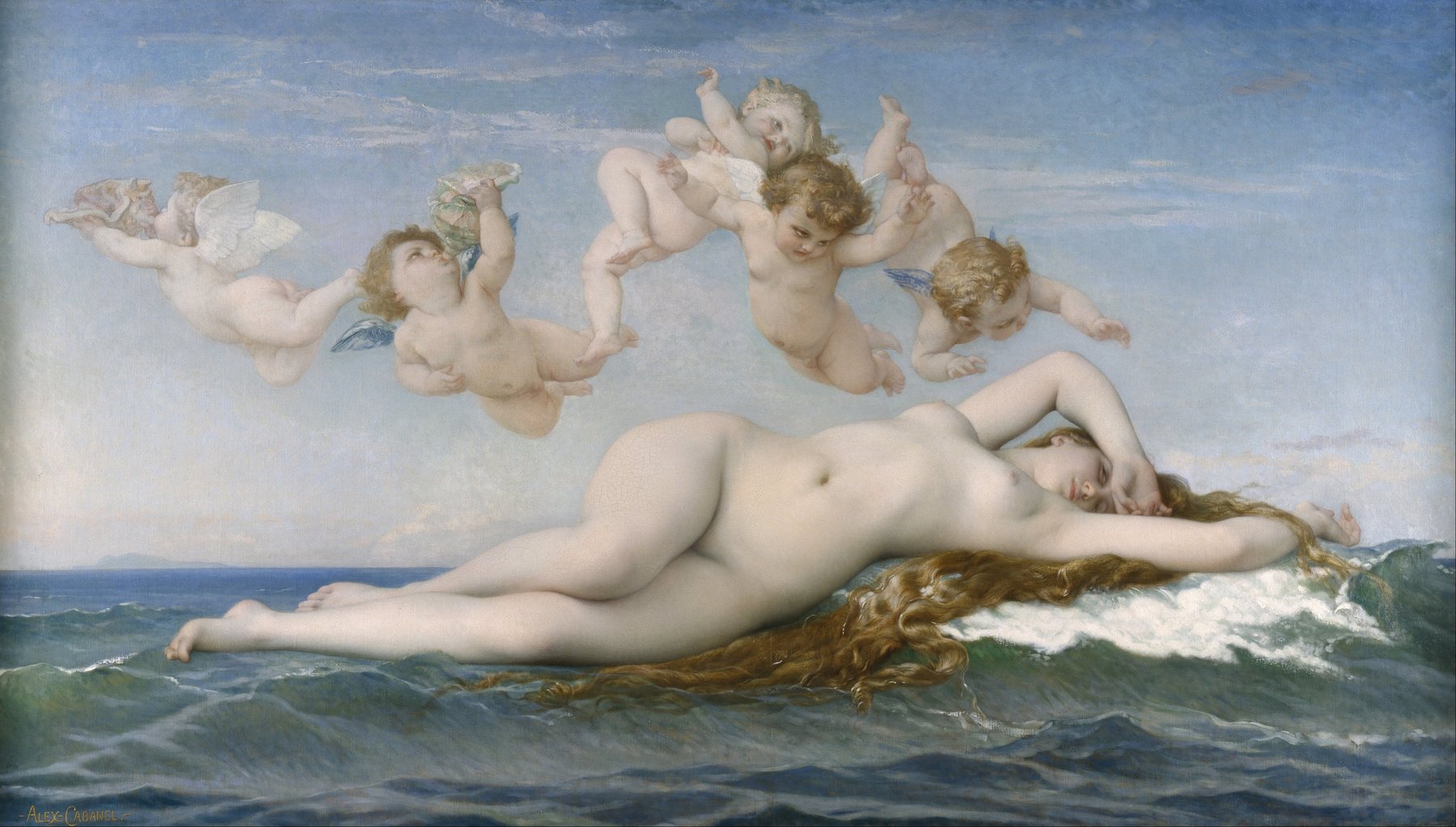
The technique is the same in both paintings. Cabanel built his figures on a smooth gessoed ground, sketched them in raw umber, modeled the volumes in monochrome, and then glazed thin colored layers over the dried underpaint to get the porcelain finish that academic painting valued. The skin has no visible brush. The transitions from light to shadow are continuous. The eye does not catch on any single mark. This is the technique he learned in Rome, finished on this canvas at twenty-three, and used for the rest of his career. The reason the tears in The Fallen Angel work is that they are the only mark in the picture you can see. Everything else is invisible labor. The tears are deliberate.
What to look for
Walk into the room at the Musee Fabre and you will see the painting from across a fifteen-foot gallery. The first thing you see is the eye. The second thing is the wings, which are sketched faster than the body — white and grey with quick strokes of charcoal-dark feather, intentionally less finished than the figure beneath them. The third thing is the bent right arm covering the upper face. The fourth is the small procession of departing angels in the upper left, painted thin as smoke. Walk closer. The tears are about an eighth of an inch wide and seven inches long. The wet eye behind them is the same kind of red Cabanel used in his court portraits to give a flush to the cheek of a woman who has just come in from cold weather. Lucifer is blushing. He is also crying. He is also glaring at you. Chiaro reads out Byron’s Cain and the Vigny poem and the Hellenistic sleeping marble Cabanel was thinking about while you stand at the right distance, so the references that explain the face are spoken at the moment the face itself is in front of you.
The painting is small enough to take in at one glance, finished enough to look academic from across the gallery, and modern enough up close to give you a small shock. The Salon jury saw the shock and turned the picture away. The Musee Fabre put it on a red wall and lit it from above and waited a century and a half for the world to want it back. Stand in front of it long enough and the eye holds you longer than it should. The wings sketch out faster than the body because the wings are leaving. The face is staying. Cabanel had figured out, at twenty-three, the one thing every painter trying to make a memorable portrait eventually learns, which is that you do not paint the moment of the fall. You paint the second before the fall becomes permanent, and you put one eye on the viewer, and you let the viewer decide what comes next.