In late July 1900, Gustav Klimt took a train from Vienna to the small village of Litzlberg on the southern shore of the Attersee, a long narrow alpine lake in the Salzkammergut region of Austria, about three hours east of Salzburg. He rented two rooms in a guesthouse called the Brauerei, set up a small portable easel, and spent six weeks painting trees. He came back to the same lake every summer for the next sixteen years. The Klimt forest paintings — about twenty of them survive — were almost all made on that lake, almost all in the same square format he had decided on in his thirties, and almost all of them painted standing within fifteen feet of the trunks he was painting. He never painted a forest from a vista. He never painted a forest with a path leading into it. He never put a figure in any of them. He painted the trunks at close range, head-on, with the canopy cut off above and the ground cut off below, and the result is the most peculiar body of landscape painting in early-twentieth-century European art.
The peculiarity is the format. Klimt’s forest paintings are almost all one hundred centimeters by one hundred centimeters — a perfect square, just a little under forty inches on a side. Landscape painting since the seventeenth century had been a horizontal art. The format is even called landscape. Klimt’s choice of the square broke the visual habit. A square canvas has no horizon. A square frame around a forest puts the viewer in the trees rather than looking at them. The horizon of a Klimt forest painting, if you can find it at all, is the small gap at the upper edge where the trunks finally meet the sky — a strip of pale green or blue maybe three inches tall in a hundred-centimeter picture. The rest is bark and leaf and undergrowth.
The summer house with the painter
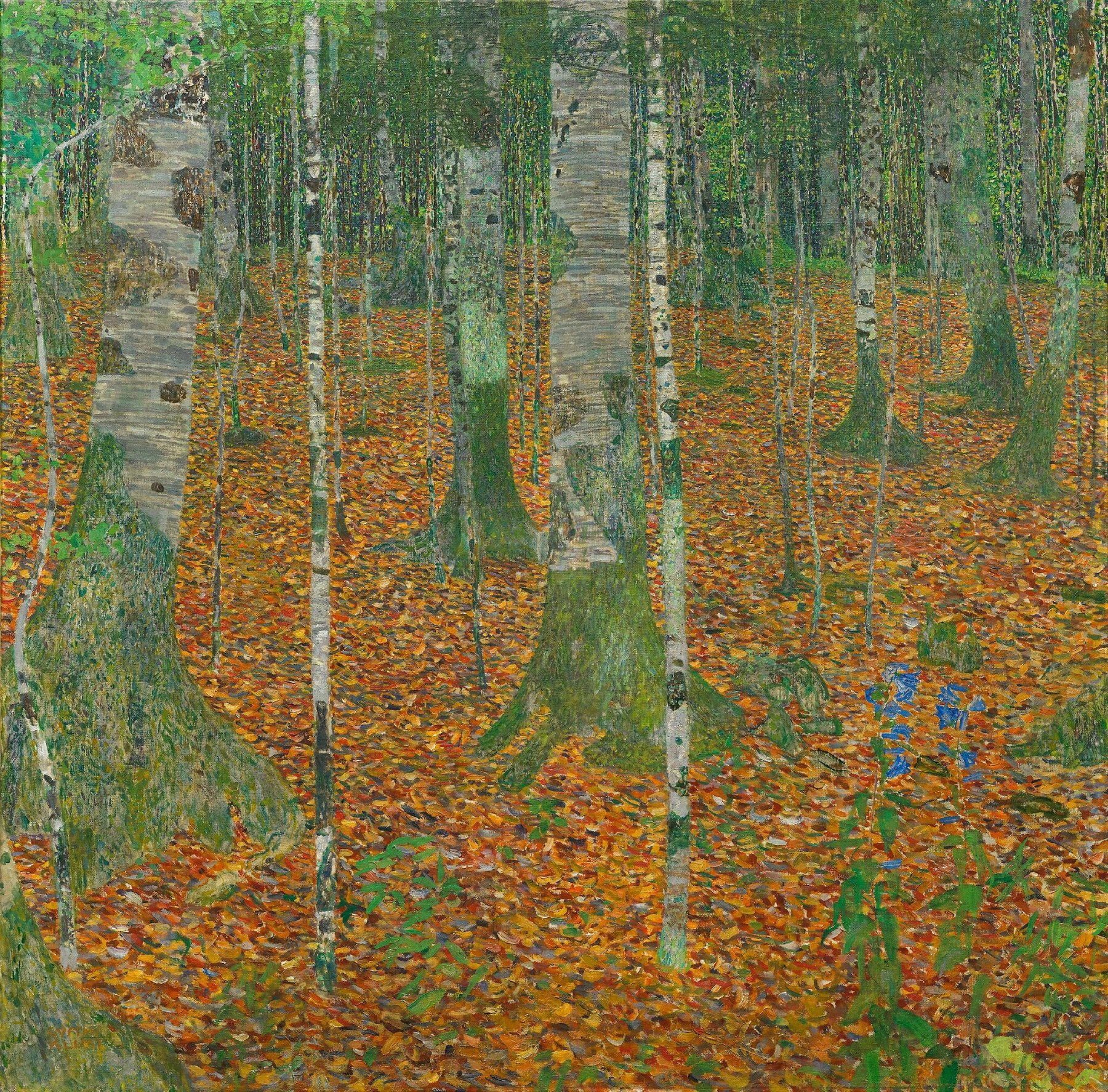
The Attersee summers had a routine. Klimt would arrive in mid-July with his lifelong companion Emilie Floge, the Viennese fashion designer whose family owned a couture house called the Casa Piccola, and they would settle into a routine of swimming, rowing, photography, and painting. Klimt was a powerful swimmer who began each day with a half-hour swim in the lake regardless of weather. He kept his hair in a closely-trimmed beard year-round and wore a long blue smock that Emilie had designed for him and which became his uniform. After breakfast he would carry his easel and a few canvases and a small folding stool to a particular grove of trees, set up, and work until the light changed in the late afternoon. He painted at distances of three to five meters from the trunks. The painting Birch Forest from 1903, which now hangs in the Paul G. Allen Collection in Seattle, was made at that distance — you can verify the closeness because the bark of each birch is rendered with brush marks no wider than two millimeters, the kind of detail you can only see standing very near.
The square format was his choice and the trees were his choice, but the village was Emilie’s. The Floge family had been summering at the Attersee since the 1890s. Emilie’s mother and sister Helene shared the house with the painter. The arrangement was not romantic in the conventional sense — Klimt had eight known illegitimate children by other women in Vienna and never married — but it was the closest thing to a partnership he had. Emilie made the dresses he painted his Vienna female portraits in; he painted her in 1902 in a famous full-length portrait that she did not particularly like. Their relationship lasted twenty-eight years, until Klimt’s death from a stroke at fifty-five in February 1918. The forest paintings were made on her family’s lake, on her family’s summer schedule, with her in the next room.
What he was painting away from
Klimt’s day job in Vienna was painting women. Between 1900 and 1916 — the same years as the Attersee summers — he made the Beethoven Frieze, the gold portrait of Adele Bloch-Bauer that became the Woman in Gold, the Three Ages of Woman, the Hope I and Hope II pregnancy paintings, the Danae, the Kiss, the Judith with the head of Holofernes, and the Water Snakes. Vienna at the turn of the twentieth century was a city more obsessed with the female image than any European capital since Renaissance Florence, and Klimt was its primary supplier. The portraits paid for the lake. They also exhausted him. The forest paintings are what he made when he wanted to be away from the salons of Vienna and the women who paid him to paint them. There are no figures because the figures stayed in Vienna.
The summer-house portraits and the forest paintings overlap in technique. The same gold leaf and silver-leaf experiments that Klimt was applying to Adele Bloch-Bauer’s gown in Vienna show up in the bark of the birches at the Attersee. The same mosaic-like dabs of color that built the kiss-gown in The Kiss build the underbrush in Birch Forest. He was using the same brush, the same vocabulary, on different subjects. The trees got the formal treatment that the women were getting in the city.
Beech Grove I is the painting where the format becomes the argument
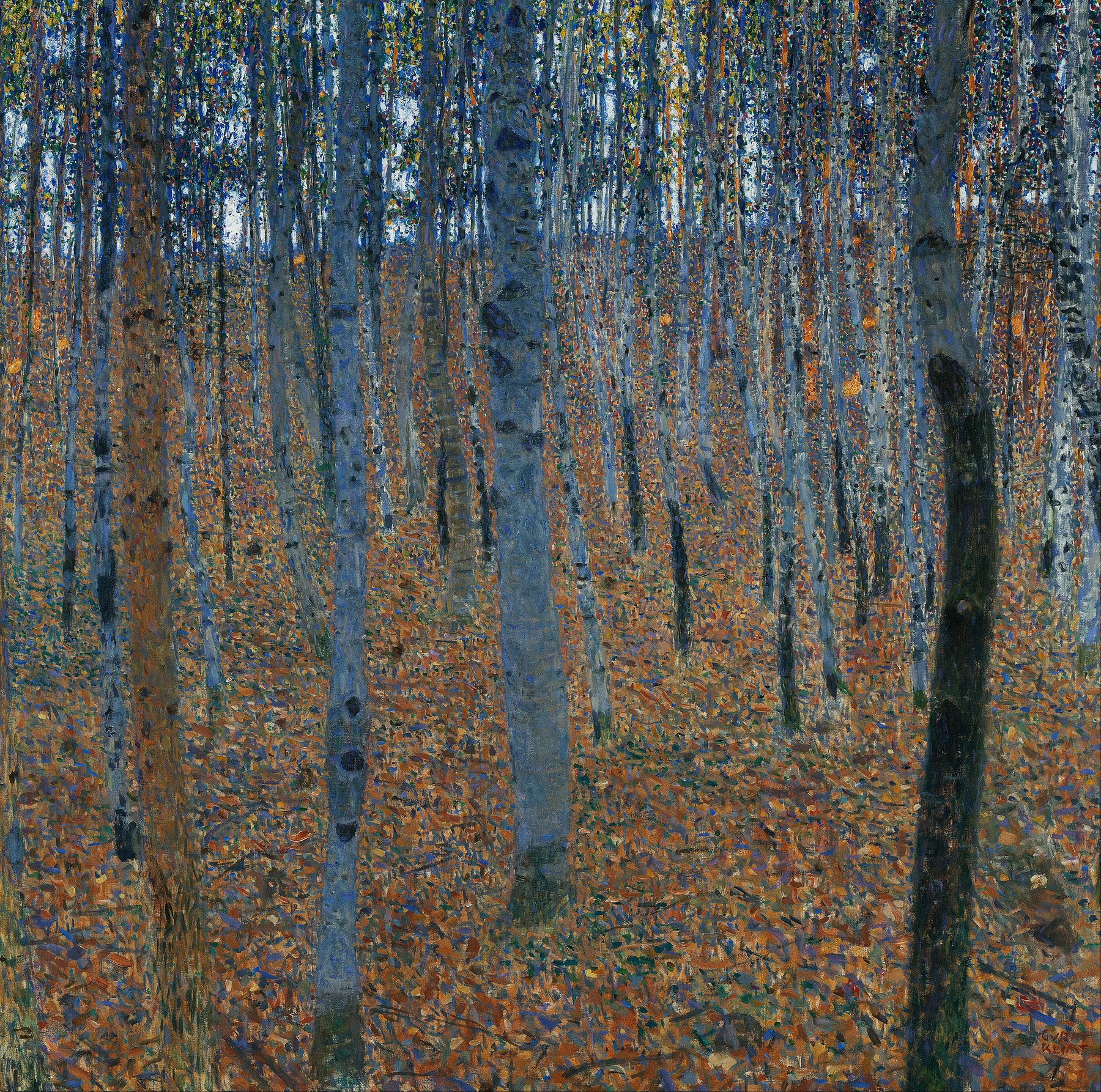
The earliest of the forest paintings is Beech Grove I, finished in late summer 1902. It is in the Galerie Neue Meister in Dresden — a hundred-by-hundred square showing the bases of about thirty beech trees in a forest near the village of Weissenbach. The trees are bare gray columns rising out of an orange-brown carpet of fallen leaves. The leaves are painted in tiny separate marks, like the tesserae of a mosaic, with no two leaves the same color but the whole carpet reading as a single ground. The trunks are perfectly vertical. The composition has no center because the trees do not converge on a vanishing point. They go straight up out of the bottom of the frame and disappear straight up out of the top. The painting is a wall of trunks.
What this does to the viewer is force the eye to read the painting up and down rather than left to right. The vertical organization of a forest — something obvious if you have ever stood in one — had not been the subject of European landscape painting before. Painters before Klimt put paths through their forests. They added travelers, woodcutters, lovers, deer. They turned the forest into a stage. Klimt’s beech grove is just the trees. The orange ground at the bottom is where the carpet of fallen leaves catches the autumn light, and the gradient that runs from the bottom of the canvas to the upper third — orange to ochre to the pale gray of the trunks — gives the painting a vertical movement that reads like looking up. There is no horizon. The painting is the experience of standing in a forest, head tilted slightly back, with no destination in mind.
Birch Forest is what happens at noon
The 1903 painting Birch Forest is the most reproduced of the group and the painting that, when collectors talk about a Klimt forest, they usually mean. Microsoft co-founder Paul Allen bought it in 2006 for about forty million dollars; it sold for a hundred and four million at auction in November 2022, two years after his death. The painting is white-trunked birches at midday in late summer, with the orange-brown carpet of fallen birch leaves at the base and a thin strip of dark green canopy at the top. The trunks are painted with vertical white strokes that have small dark dashes — the lenticels of birch bark — placed at irregular intervals down the height of each trunk. There are about thirty-two birches in the picture. They stand at slightly different distances from the painter. The painting is a study of how the eye registers depth in a forest with no horizon — the only depth cues are the relative size of the trunks and the way the carpet of leaves blurs slightly between the foreground and middle ground.
Pine Forest I is the forest in shadow
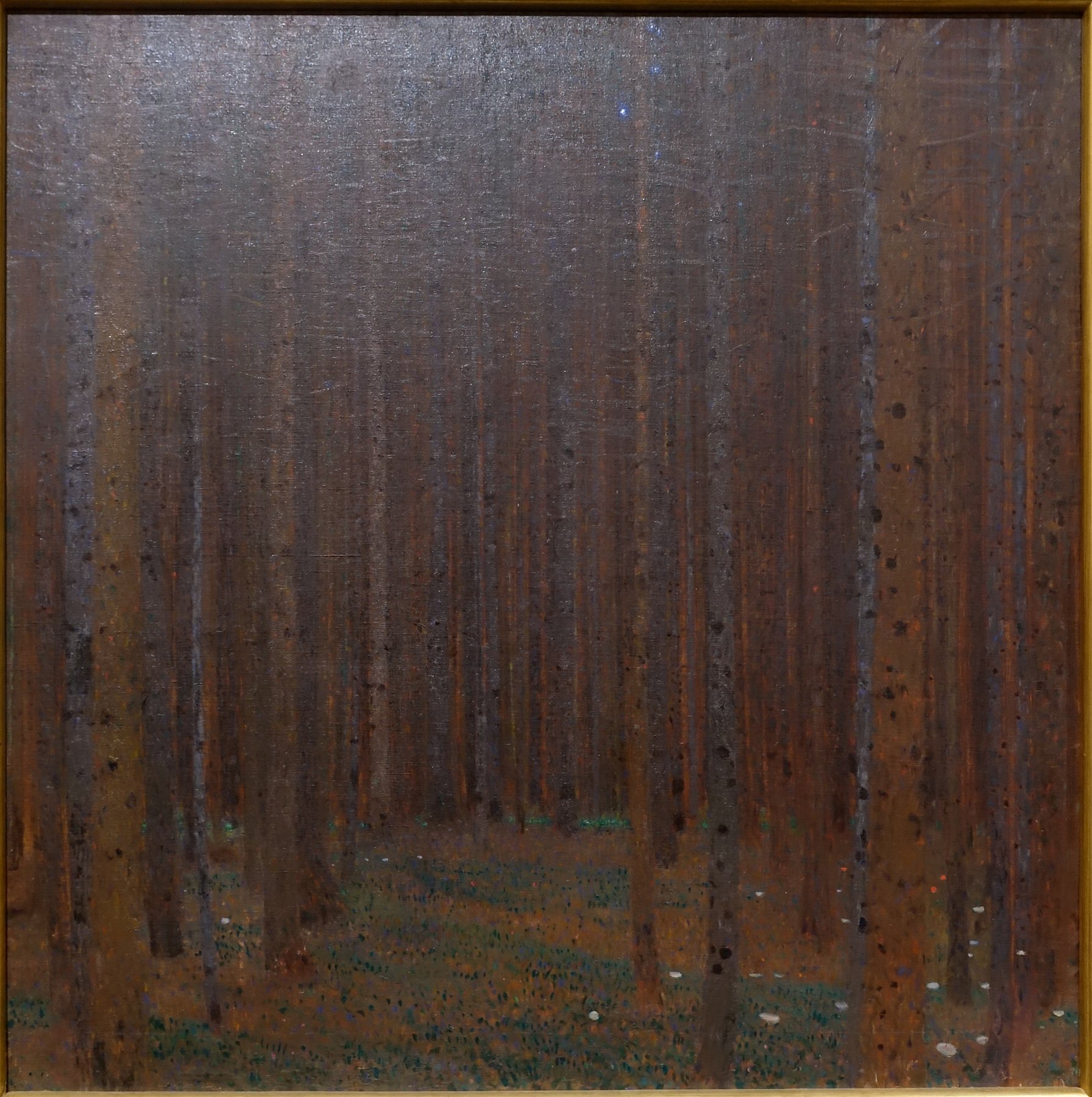
The 1901 Pine Forest I, in the Legion of Honor museum in San Francisco, is the dark twin of the birch painting. The trunks of the spruce trees are nearly black, the ground is a deep mossy green, the small patches of sky are pale gray. The painting was made in late afternoon in a stand of conifers above the village of Weissenbach. The format is the same square. The composition is the same wall of trunks. But the color key is two octaves lower. Klimt painted this picture, according to his letters to Emilie, on a day when the lake was overcast and the conifers absorbed all the available light. The painting is what happens when a Klimt forest has the sun taken out of it.
Forest Slope at Unterach is the last of them
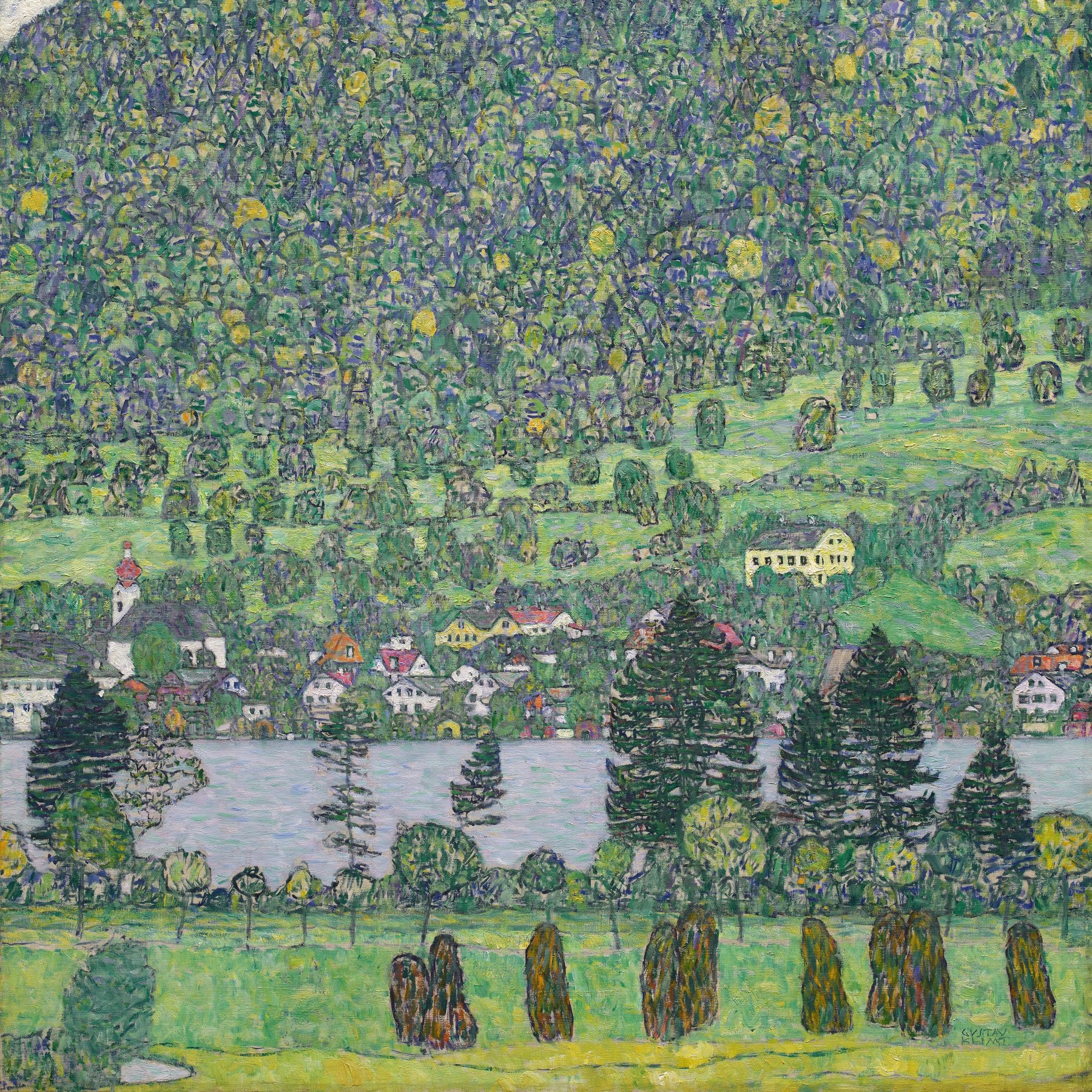
In the summer of 1916, two years before his death, Klimt painted Forest Slope at Unterach am Attersee. It is in the Klimt Foundation in Vienna. The format is the same hundred-centimeter square. The subject is a steep wooded slope above the village of Unterach, on the opposite shore of the Attersee from Litzlberg. The picture is half forest and half hillside, with the slope rising on a diagonal across the canvas and the trees climbing the hill in tight ranks. It is the only Klimt forest painting with a strong diagonal — the rest are vertical. The diagonal is what tells you something is changing.
Klimt had begun to use brighter, more dissonant colors in his late landscapes — patches of pink and lavender alongside the dark green and ochre that had dominated the earlier work. The slope is built up in mosaic marks of green, lavender, brick-red, and a yellow-white that suggests the spotty light of a forest seen against a strong morning sun. The painting was shown at the Vienna Secession exhibition of November 1916. It was the last forest painting Klimt finished. He had a stroke on January 11, 1918, in his Vienna studio, and died on February 6 in the General Hospital of Vienna, age fifty-five. The painting on the easel at the time of his stroke was The Bride, an unfinished portrait. The Attersee summers had ended in 1916. Vienna’s Belvedere Palace acquired many of the forest paintings after his death; others entered private collections. Chiaro reads the lake routine, the square-format choice, and the bark technique in front of whichever of the four forest paintings you are standing in — the Belvedere has two of them, the Allen, the Legion of Honor, and Dresden each have one — so the reasons the format breaks the landscape tradition get spoken at the moment a viewer is in front of the wall of trunks.
The wait-really
The wait-really moment of the Klimt forest paintings is the photographs. Klimt and Emilie Floge were both serious amateur photographers. The Floge family archive in Vienna includes a few hundred black-and-white plate photographs Klimt and Emilie took at the Attersee between 1900 and 1916, and many of them are pictures of the same trees Klimt was painting — birches, beeches, conifers, photographed at the same close-range angles. The photographs are framed in landscape format because that is how a Kodak hand camera of 1905 was built. The paintings are squares. Klimt was painting what the camera could not yet do — the elimination of the horizon, the vertical reading of a forest, the dabbed-mosaic registration of foliage — in a format that was a deliberate refusal of the camera’s rectangle. He had a camera in his hands and chose to paint what the camera could not. The square forest paintings are about photography exactly to the extent that they refuse to be photographs.
What to look for
The four major forest paintings — Birch Forest 1903, Beech Grove I 1902, Pine Forest I 1901, Forest Slope at Unterach 1916 — are scattered across museums in Vienna, Dresden, San Francisco, and the rotating loans of the Allen Collection. Wherever you find one, walk up to within three feet of the canvas and look at the bark. The marks are smaller than a fingernail. Each trunk is built of forty to a hundred separate touches of color. Then step back to about ten feet and the trunks turn back into trunks. The painting works at two distances and only at two distances. Klimt was painting the way a forest gives itself away to a person standing in it — close enough to see the lenticels on the birch bark, far enough to see the wall of vertical lines — and the square format keeps you at the right distance because there is no edge for the eye to escape to. The painting that should have been a wide horizontal vista is a vertical wall of trees, and the painter who in Vienna was famous for gold portraits of women in Viennese drawing rooms was, every summer, painting the bark of birches on a lake that the women never visited.