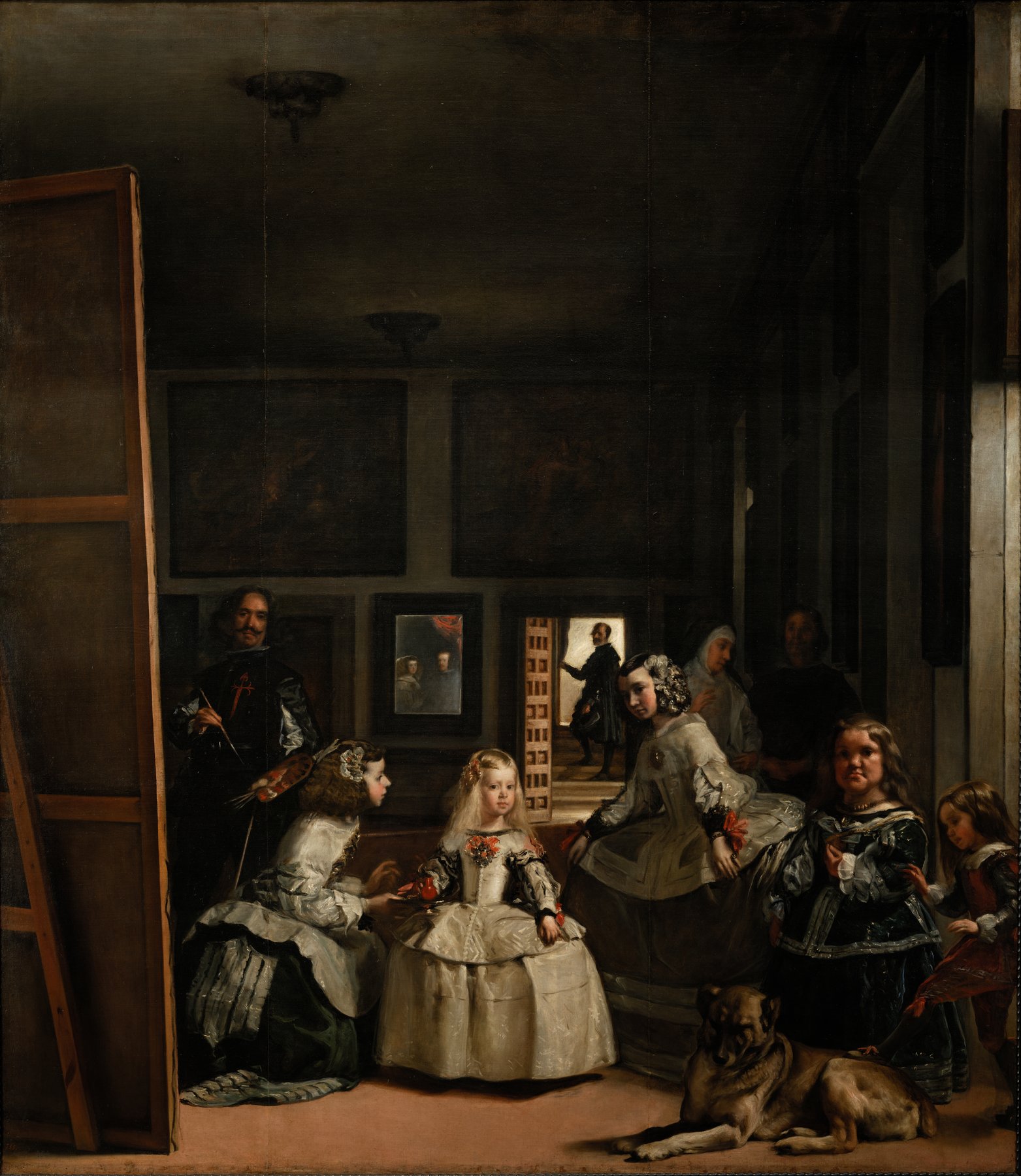
In the summer of 1656, in a converted reception room on the ground floor of the Alcazar palace in Madrid, Diego Velazquez painted himself painting his king and queen. The king and queen are not in the picture. They are reflected, faintly, in a small rectangular mirror on the back wall. The room contains Velazquez at his easel, the five-year-old Infanta Margarita Teresa in a wide silver-and-pink dress, two ladies-in-waiting whose Portuguese title gave the painting its name — meninas — a court dwarf named Maria Barbola, an Italian-born dwarf named Nicolas Pertusato nudging a large sleeping mastiff with his foot, a nun in widow’s habit beside an unnamed bodyguard, and at the back of the room, framed in a doorway, the queen’s chamberlain Jose Nieto pausing on a step with one hand on the curtain. What is Las Meninas about? It is about the moment a painter looked up from his canvas, saw the king and queen of Spain entering the room behind him, and decided to paint everyone in the room except them.
It is a picture three meters tall and two and three quarters meters wide — almost ten feet by nine — and in person it stops you because the floor of the painting is roughly continuous with the floor of the gallery. Stand at the right distance in Room 12 of the Prado and you are no longer looking at the scene. You are in it. The Infanta is at your eye level. Velazquez is looking past you at the mirror on the back wall, which is to say at the king and queen, which is to say at you. The whole painting is a question about who is standing where.
Two royal portraits and a working studio
To understand why Velazquez built this trick, you have to know what kind of room you are looking at. The space is the cuarto del Principe, the suite that had belonged to the king’s first son before the boy died in 1646. After the prince’s death the rooms were given to Velazquez as his studio, which was extraordinary for a court painter — studio space at the Alcazar was usually a closet off a corridor. Velazquez had been on the Spanish payroll since 1623, when at twenty-four he came up from Seville on the strength of a single black-background portrait of King Philip IV and never went home. By 1656 he was fifty-seven, gentleman of the bedchamber, chamberlain of the royal household, in line for the knighthood of Santiago that he would finally receive two years before his death.
The canvas in the painting — the huge stretched canvas Velazquez stands behind — is the same size as Las Meninas itself. We cannot see what he is painting on it. The back of the canvas is what faces us. But the mirror tells us what he sees. In the mirror, slightly blurred and small, are the heads and shoulders of King Philip IV and Queen Mariana of Austria, standing roughly where the viewer is standing. The hidden canvas, then, is their double portrait. Velazquez has painted the moment in the middle of painting a portrait we cannot see, with the sitters in the position we now occupy.
The reason this is not a parlor trick is what it does to the figures. The Infanta, her ladies, the dwarves, the dog, the chamberlain on the stair — they are not posing for us. They are the painter’s company, frozen in the small commotion of a royal child paying a visit to her father’s painter while he works. The lady on the left, Maria Agustina Sarmiento, is bending to offer Margarita a small red clay pot called a bucaro, full of perfumed water — the perfumed clay was eaten by ladies of the Spanish court to give their skin a pale matte tone, a habit doctors of the period kept warning against. The lady on the right, Isabel de Velasco, is dropping into a curtsy because the king and queen have just walked in. The chamberlain on the back stair has paused mid-step for the same reason. Everyone in the room except the painter is reacting to the entrance we are inhabiting.
The mirror argument
Art historians have argued for three hundred years about whether the mirror reflects the king and queen as they stand in our position, or reflects what is on the unseen canvas. The two readings give the painting different physics. If the mirror reflects the room, the royals are present and the picture is a snapshot. If the mirror reflects the canvas, the royals are not in the room at all and the whole composition is a meditation on representation itself — the Spanish art historian Jonathan Brown made the strongest version of that argument in his 1986 book on Velazquez. The technical evidence, including the angle of the mirror and the geometry of the wall behind Velazquez, mostly favors the first reading. The king and queen are standing where you are, the painter is looking at them, and the mirror catches them as you displace them.
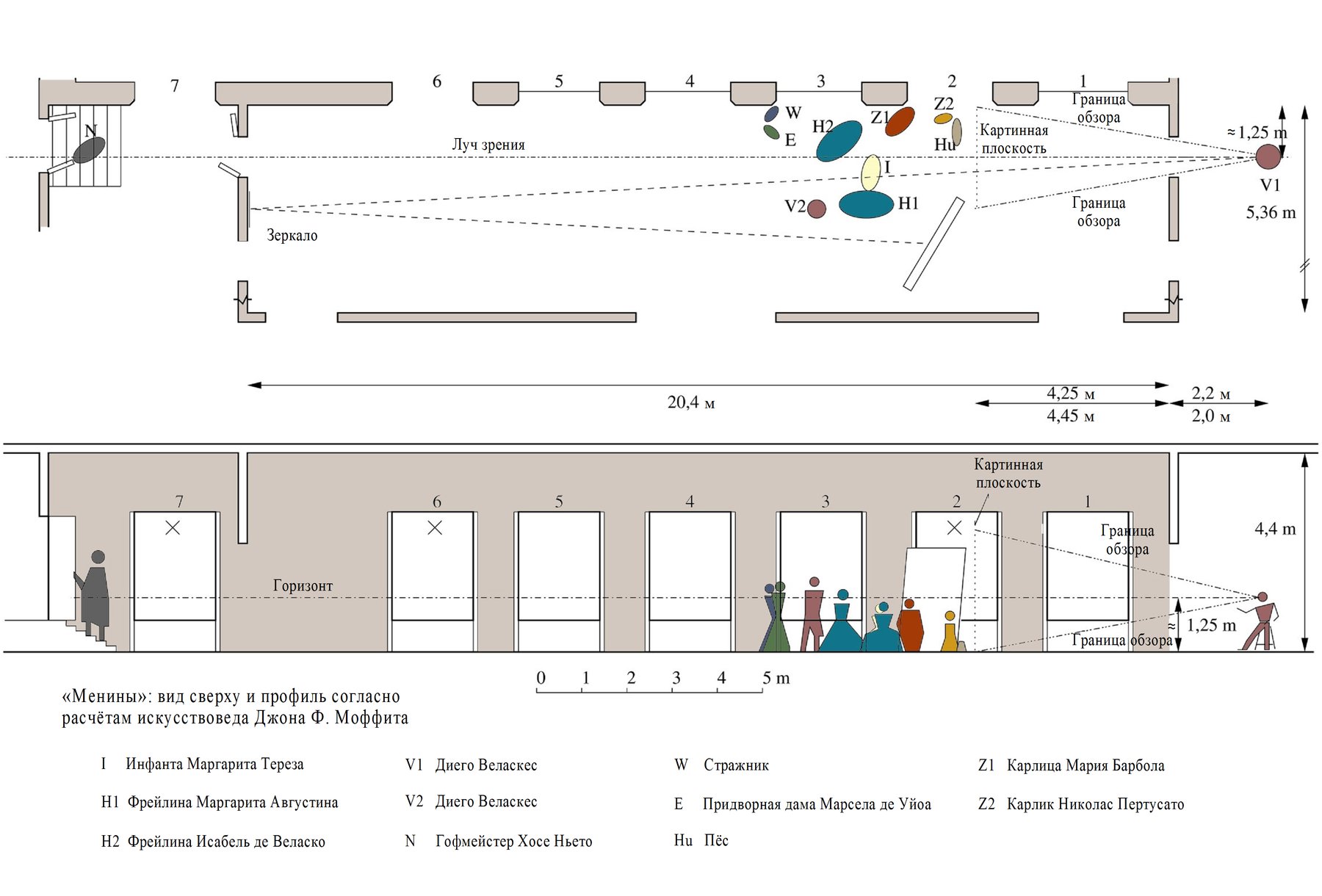
This is the wait-really moment of the picture. The most powerful man in Europe and his queen are reduced to a four-inch reflection in a back-wall mirror, and the painter — bound by court protocol to never look directly at them while painting them — has used the rules of his own profession to put himself in front and them behind. The hierarchy of the room as you read it left to right is: painter, princess, ladies, dwarves, dog, chamberlain, king. The king is the last figure you find. The Spanish poet and critic Antonio Palomino, who interviewed people who had known Velazquez and wrote the first biography of him in 1724, called the painting “the theology of painting.” That is roughly right. The argument is that the painter, looking, is doing something theological. He is making the visible.
The Infanta who held the room together
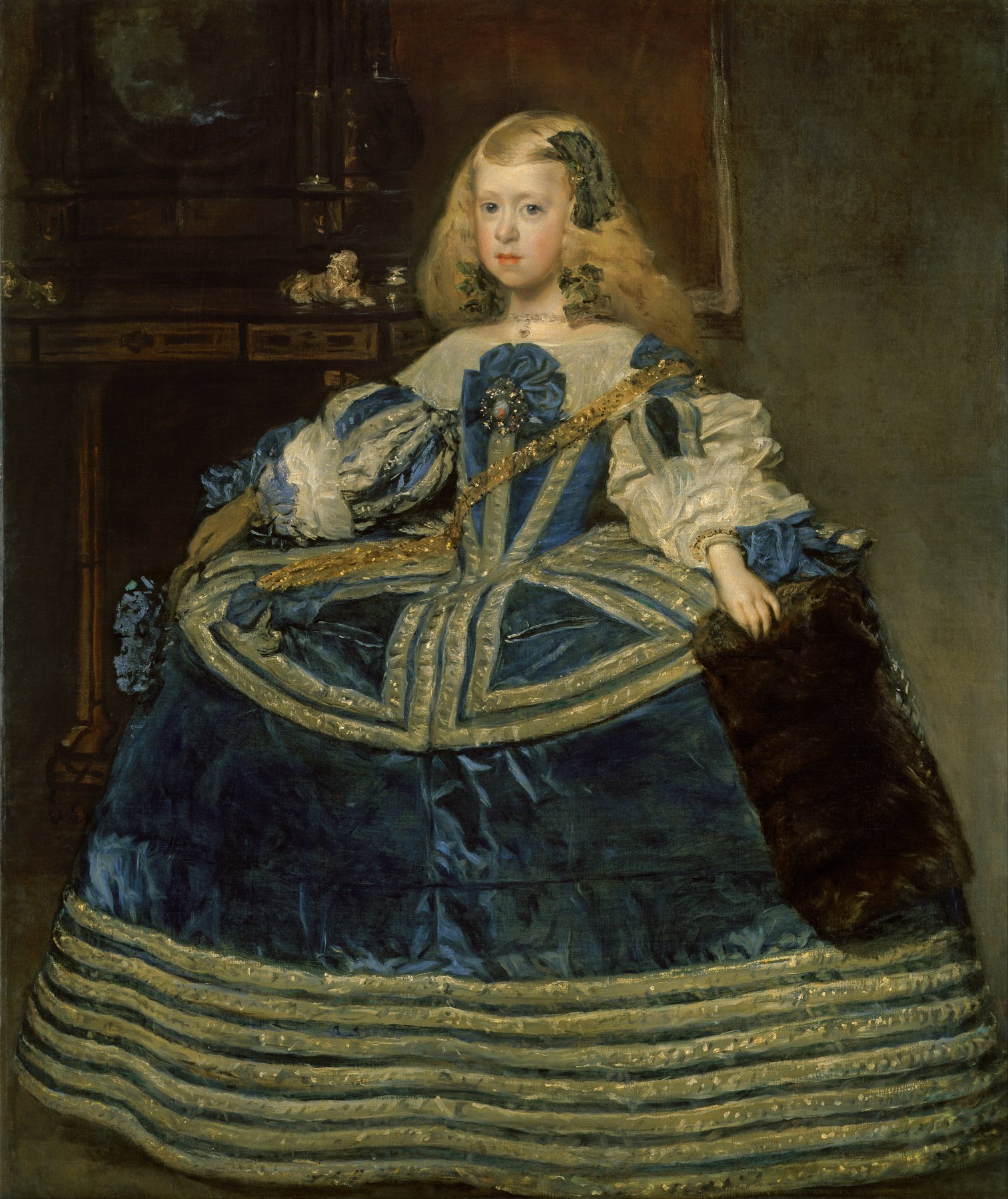
The child at the geometric center of the canvas is Margarita Teresa, born July 12, 1651, daughter of Philip IV and Mariana of Austria. She is five. Velazquez had been painting her since she was two, in a series of portraits sent every two years to her uncle and future husband Leopold I of Austria in Vienna, so that the Holy Roman Emperor could watch his bride grow. The blue-dress Margarita in Vienna’s Kunsthistorisches Museum, painted around 1659, is the most famous of those updates. In Las Meninas she is in a stiffer silver-and-pink guardainfante — the wide hooped overskirt that gave Spanish princesses their characteristic silhouette — with her blonde hair brushed flat on the sides and her face lit by a window we cannot see. She would marry Leopold in 1666 at fifteen and die six years later at twenty-one, after four pregnancies and one surviving daughter. The melancholy of Las Meninas is partly retrospective. We know how short the life of the little girl in the center was going to be.
The two dwarves in the painting are not decorative. Maria Barbola was a Habsburg court servant of dignified rank, retained as a companion for the Infanta, and Nicolas Pertusato was a small Italian boy of about ten who later grew to normal height and ended his career as the Austrian court’s master of household. Velazquez had painted dwarves separately — five of them survive as full portraits — in compositions that gave them the same gravity as he gave royal sitters. In Las Meninas, Barbola stares straight at the viewer with the calmest expression in the painting. She is the second person in the room paying attention to you. The first is the painter himself.
A detail that argues against any reading of Las Meninas as a stunt: the dog. The mastiff lying in the foreground is not a stuffed prop. It is breathing, asleep, painted with a precision of fur and weight that you cannot fake. Velazquez has weighted the floor of his picture with about eighty pounds of sleeping dog, and the dog is what tells you the painter is not joking. This is a real room with real people in it on a real afternoon in 1656.
What he was painting on himself
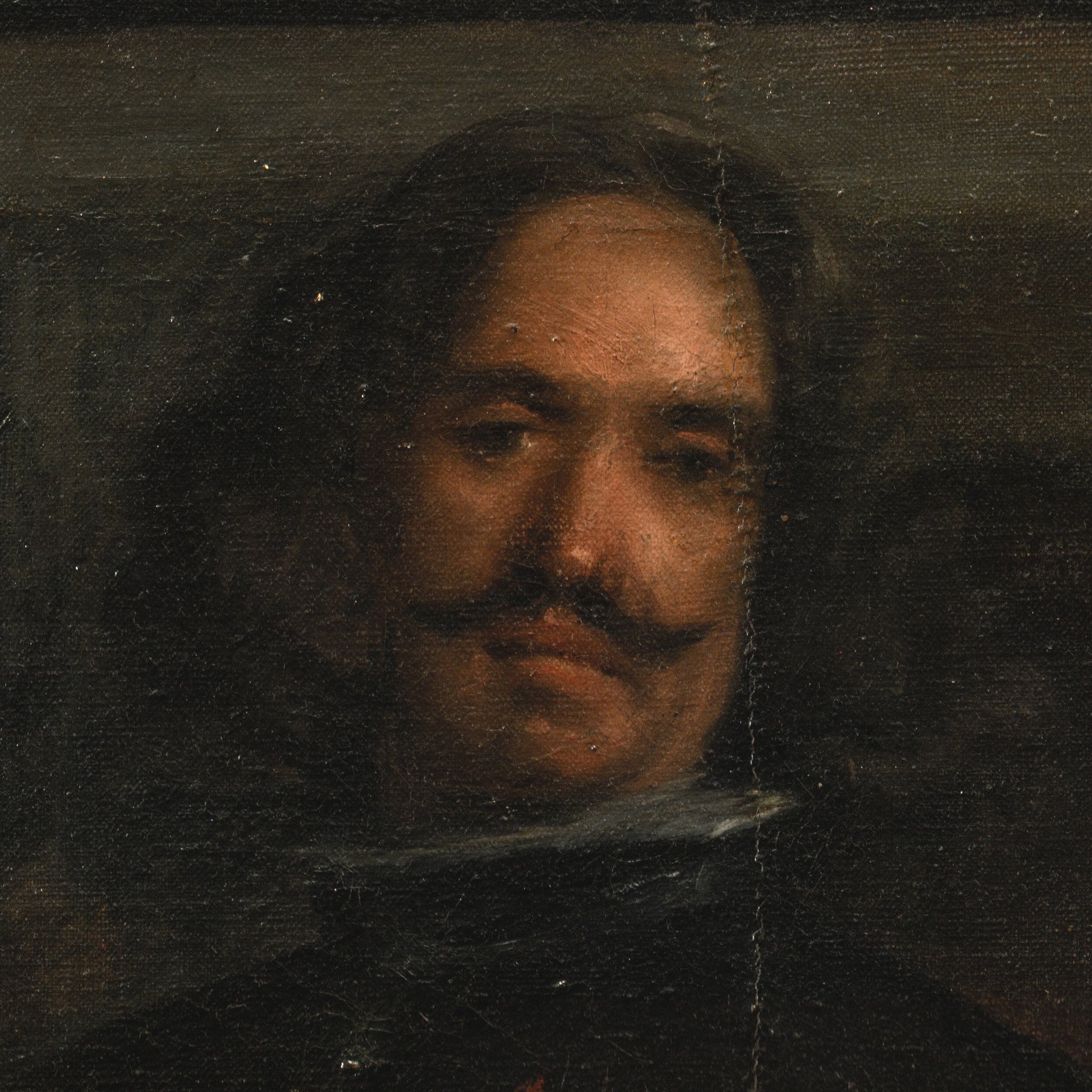
The red cross on Velazquez’s chest — the cross of the Order of Santiago — is the part of the painting most clearly added late. The king made Velazquez a Knight of Santiago in November 1659, three years after Las Meninas was finished, and the painter died in August 1660. The cross was added either by Velazquez in the last months of his life or, according to Palomino’s 1724 biography, by Philip IV himself after Velazquez’s death, with his own hand. X-rays at the Prado have confirmed that the cross was painted on top of the already-dry doublet, but they cannot tell whose hand held the brush. Either way, the cross is a posthumous correction. Velazquez wanted to be remembered as a knight, not just a painter, and the king completed the picture by raising him.
The story of how that cross got there is the story of Velazquez’s whole career. Spanish painters at court were technically craftsmen — they belonged to the same guild as the gilders who painted carriage wheels and the artisans who painted devotional images for parish chapels. Velazquez spent thirty years lobbying through the king’s court to be recognized as nobility, which meant being recognized as a gentleman who did not work with his hands for hire. To enter the Order of Santiago he had to prove four generations of noble blood on both sides, with no Jewish or Moorish ancestors, no convicted criminals, and no one in his family who had ever practiced a “vile trade” — which included painting for money. The investigators called one hundred and forty-eight witnesses and concluded that Velazquez had occasionally accepted commissions, which would have disqualified him. The king got him in anyway, by papal dispensation. The cross on his chest in Las Meninas is the answer to a court bureaucratic question that took him three decades to win.
The room you can still stand in
The room where Las Meninas was painted no longer exists. The old Alcazar burned to the ground on Christmas Eve 1734, in a fire that destroyed roughly five hundred paintings from the Spanish royal collection, including most of Velazquez’s portraits of the king. Las Meninas was saved by being thrown out a window. According to the inventory of damages, the canvas was found in the snow with a tear running from the lower right corner up to the Infanta’s right cheek, and a workshop in the royal court repaired it that winter. The repair is visible if you look at the right edge of the painting in raking light. Standing in front of Las Meninas at the Prado you are looking at a survivor.
The Prado moved into Juan de Villanueva’s neoclassical building in 1819, six years after Napoleon’s troops left Madrid, and Las Meninas has been there ever since. It hangs in Room 12 of the Villanueva building, in a gallery whose lighting and proportions were specifically chosen to match the original room. Chiaro reads out the mirror argument and the dog and the cross of Santiago in front of the painting itself, so that the proper-name details you need to see — the bucaro in Maria Sarmiento’s hand, the patch repair near the Infanta’s cheek, the chamberlain’s pause on the back step — get pointed out while you are standing in the only place they make sense.
Picasso’s fifty-eight versions
In August 1957, Pablo Picasso, then seventy-five, locked himself in a third-floor studio of his villa La Californie above Cannes and started painting Las Meninas. He painted it fifty-eight times. The series took him four months. He repainted the whole composition, the Infanta alone, the chamberlain in the doorway, the dog, the ladies, the painter at his easel. Some versions are grayscale, some are screaming oranges and acid yellows, some break the figures into the Cubist planes Picasso had not used seriously in thirty years. The whole series is at the Picasso Museum in Barcelona now — Picasso donated it as a unit in 1968, with a single condition: that they never be separated. He told his biographer Roland Penrose he was trying “to recompose Velazquez to my eye.” A nineteenth-century critic had told the young Picasso that copying the old masters was the only way to learn painting. Fifty years later he copied Velazquez. The Las Meninas Velazquez Picasso comparison is the easiest way to see that Picasso, late in life, knew exactly what Velazquez had done in 1656 and felt he had to answer it.
The answer is interesting because of what Picasso kept. In every one of the fifty-eight versions, the geometry of the room is the same. The mirror is on the back wall. The chamberlain stands in the doorway. The painter and the Infanta hold their positions. Picasso shuffled the people and the palette and the lighting, but he kept the architecture, because the architecture is the argument. You cannot remix Las Meninas without honoring the perspective lines that meet at the bend of the chamberlain’s elbow on the back stair, which is the vanishing point of the room and the eye of the whole composition.
What to look for
Stand at the far end of the gallery, about twenty feet back. The floor of the painting should look continuous with the floor under your shoes. Find the painter’s eyes. He is looking at you. Find the small mirror. The king and queen are looking at you. Now find the chamberlain on the back stair — he is paused in the curtain because he can also see you. There are three pairs of eyes in the room that see you, plus Maria Barbola the dwarf, who makes four. Most paintings have one or zero. Walk closer. The Infanta gets bigger. The mirror gets smaller. The dog stays the same weight. Look at Velazquez’s right hand on the brush. The brush is loaded but not yet on the canvas. He has not painted his picture yet. He is about to.
This is what the painter is doing in Las Meninas. He is showing you a moment that has not happened yet. The portrait of the king and queen, the one whose back is to you on the easel, will be made on this afternoon by this hand, and in three years he will be a knight of Santiago because of paintings like the one he is about to start. The painting we are looking at exists because the painting he is about to start needed a witness. Velazquez is the witness, and so are we.