Michelangelo Merisi da Caravaggio walked into the city in 1592 with no money, no commissions, and a sword he was not supposed to be carrying. He left in 1606 with a death sentence on his head for killing a man in a ball-game brawl near Campo Marzio. In between, he painted the pictures that broke Italian art in half. You can see almost every surviving Caravaggio in Rome in a single walking day.
Not in one museum. Not even all in museums. They are tucked inside working parish churches where you drop a coin in a light box to see the altarpiece, scattered across four galleries in different neighborhoods, and in one case hidden on a ceiling that has been closed to the public for most of the last decade.
This is the guide to how.
Why this city, and why now
Rome has more paintings by Caravaggio than any other city on earth. Not because he was born here — he was born in Milan, or a town outside it called Caravaggio that he later took as his name — but because Rome is where he figured out what he was doing. He was 20 when he arrived. He was 35 when he fled. The roughly 14 years in between are the story of a painter inventing the style that swallowed Europe for the next hundred years: a stage-lit, street-cast, violently specific realism that ran over the polished Mannerism it replaced like a truck.
The pictures are spread across two different classes of location, and this matters for your day. Six of the paintings are in churches, which are free to enter, funded by tourist coins in light boxes, and subject to Mass schedules. The rest are in museums, which are not free, sometimes require timed tickets booked days in advance, and close on Mondays. If you are in the city for less than 48 hours, do the churches in one morning and the Galleria Borghese on a different afternoon. The churches are all within a 15-minute walk of each other in the Centro Storico. The museums are not.
The French church, and the painting that made him
Start at San Luigi dei Francesi. It sits two blocks east of Piazza Navona, on a quiet corner between the Pantheon and the Senate building. The facade is plain travertine. The interior is dim. Walk straight down the left nave, past four chapels, until you see a small crowd holding up phones. Drop a euro in the slot and three paintings light up at once.
This is the Contarelli Chapel, and this is the moment Caravaggio became Caravaggio.
The commission came in 1599, through the intervention of Cardinal Francesco Maria del Monte, who had been housing Caravaggio in his Palazzo Madama apartments next door for four years. Matthieu Cointrel — an elderly French cardinal the Italians called Contarelli — had died in 1585 leaving detailed instructions and a large sum of money for three paintings on the life of his patron saint. For 14 years the chapel had sat empty while better-connected artists failed to deliver. Caravaggio got the job on a del Monte recommendation. He had never painted anything this large before. He was 28.
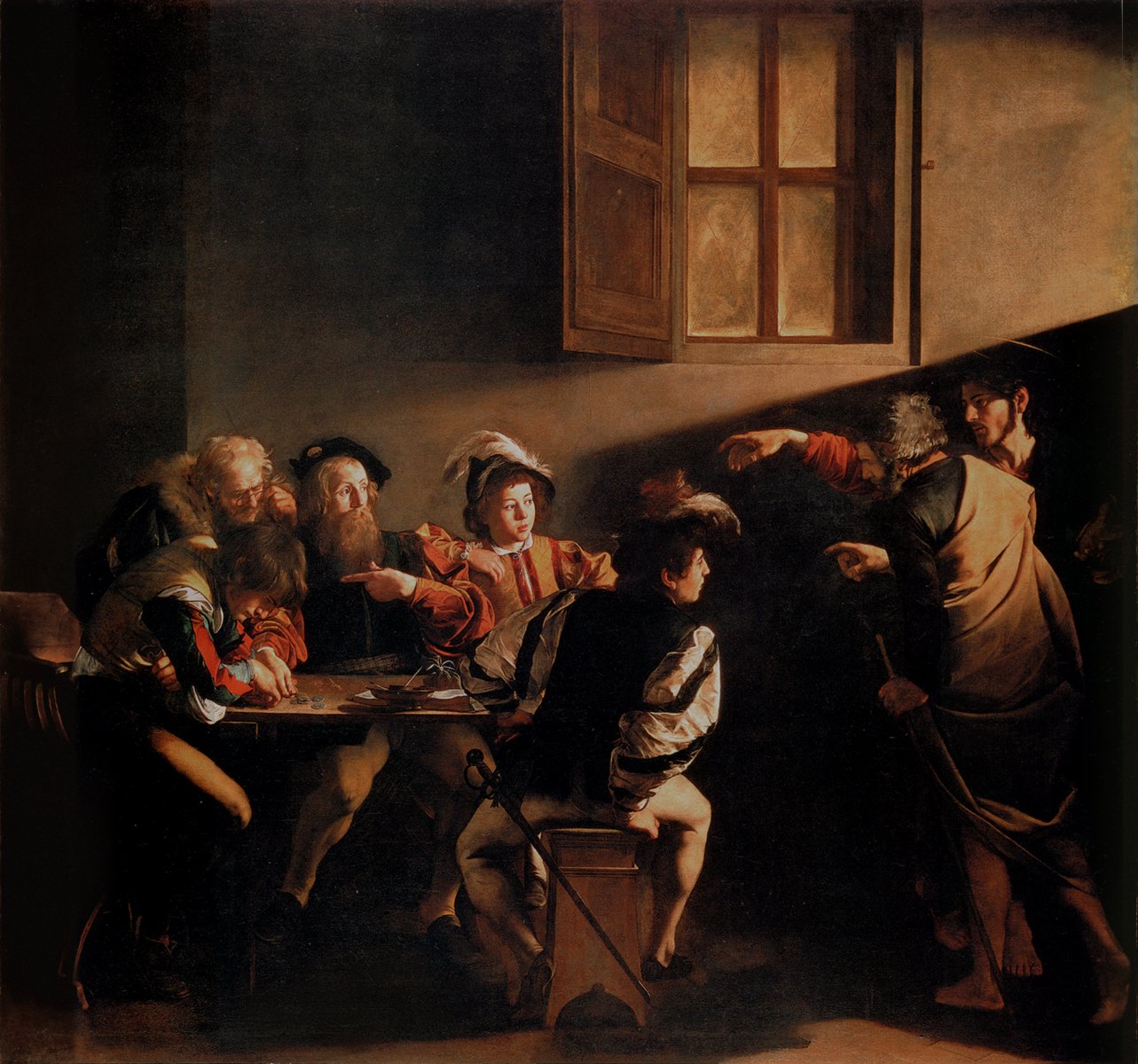
The three canvases read, from left to right: the calling, the inspiration, the martyrdom.
The Calling of Saint Matthew is the one you will remember. A beam of light slides in from the right, cutting across a table of tax collectors in contemporary Roman dress — plumed hats, slashed sleeves, a boy counting coins. Christ stands in shadow at the door, arm extended, finger pointed. Matthew looks up. The finger of Christ mirrors, almost exactly, the finger of God on the Sistine ceiling, reaching toward Adam. Caravaggio had studied Michelangelo. He knew what he was quoting. He also knew that putting a tax office and a messiah in the same wall-sized frame, with gambling money on the felt and no halos on anyone, was going to offend people.
It did. It also made him famous overnight.
The Martyrdom of Saint Matthew hangs opposite. This one was repainted twice. You can see the earlier compositions underneath with infrared imaging — the picture started as a crowded classical arrangement and ended as a single diagonal of violence: the killer’s exposed torso, Matthew on his back, an angel lowering a palm of martyrdom toward his hand. Caravaggio painted himself in the background, looking out. He wanted you to know he was there.
The Inspiration of Saint Matthew above the altar is a second version; the first, more earthly draft — in which the saint was a barefoot working man getting his hand guided by an angel like a child learning to write — was rejected by the priests as undignified and went to a private patron. That first version was destroyed in Berlin in 1945. What you see now is the tamer replacement, and it is still the strangest altarpiece in Rome: an angel twisting in mid-air, counting off points on his fingers like a tutor, while Matthew balances on one knee with his stool tipped backward. The stool is about to fall. It has been about to fall for 425 years.
That is the Caravaggio Rome French church, the one travelers come looking for. Now walk three blocks.
Santa Maria del Popolo, and two pictures that argue
Santa Maria del Popolo is at the north end of the Centro Storico, inside the old city gate where travelers used to enter Rome from the north. The church dates to the 1470s. The Cerasi Chapel, to the left of the main altar, was bought and decorated between 1600 and 1601 by Tiberio Cerasi, Pope Clement VIII’s treasurer-general. Cerasi hired two painters: Annibale Carracci for the altarpiece and Caravaggio for the two side walls.
Carracci’s central Assumption is a fine Bolognese ceiling in Baroque miniature. Nobody goes for it.
People go for the two Caravaggios that flank it, and the argument they have with each other.
On the left, the Crucifixion of Saint Peter. Three anonymous laborers, dressed in the coarse work clothes of sixteenth-century Rome, strain to hoist an upside-down cross. The apostle is old, heavy, thick-fingered, and looking at the nail in his left palm with an expression that is not quite horror and not quite anything else. The picture is almost entirely legs and feet and backs of heads. The soles of a workman’s feet are painted with more care than most Roman altars give the face of Christ.
On the right, the Conversion of Saint Paul. Saul of Tarsus is on his back on the ground, arms up toward a light that hits only him and the rear flank of his horse. The horse takes up two-thirds of the canvas. An old groom holds the reins, unbothered. There is no visible Christ, no choir of angels, no heavenly army. Just a man knocked off a horse by light, and a horse that has not noticed. Every student of art history has stood in front of this painting and tried to articulate why the horse is the point. Nobody has ever quite managed.
The first version of the Conversion, like the first version of the Inspiration of Saint Matthew, was rejected and went to a private collector. It still exists, in a private collection in Rome, and shows up in exhibitions every few years. What you see in the Cerasi Chapel is the second try. It is better.
Santa Maria del Popolo is free, open roughly 7:30 to noon and 4 to 7 most days, and closed during Mass. Bring a coin.
Sant’Agostino, and the saint with dirty feet
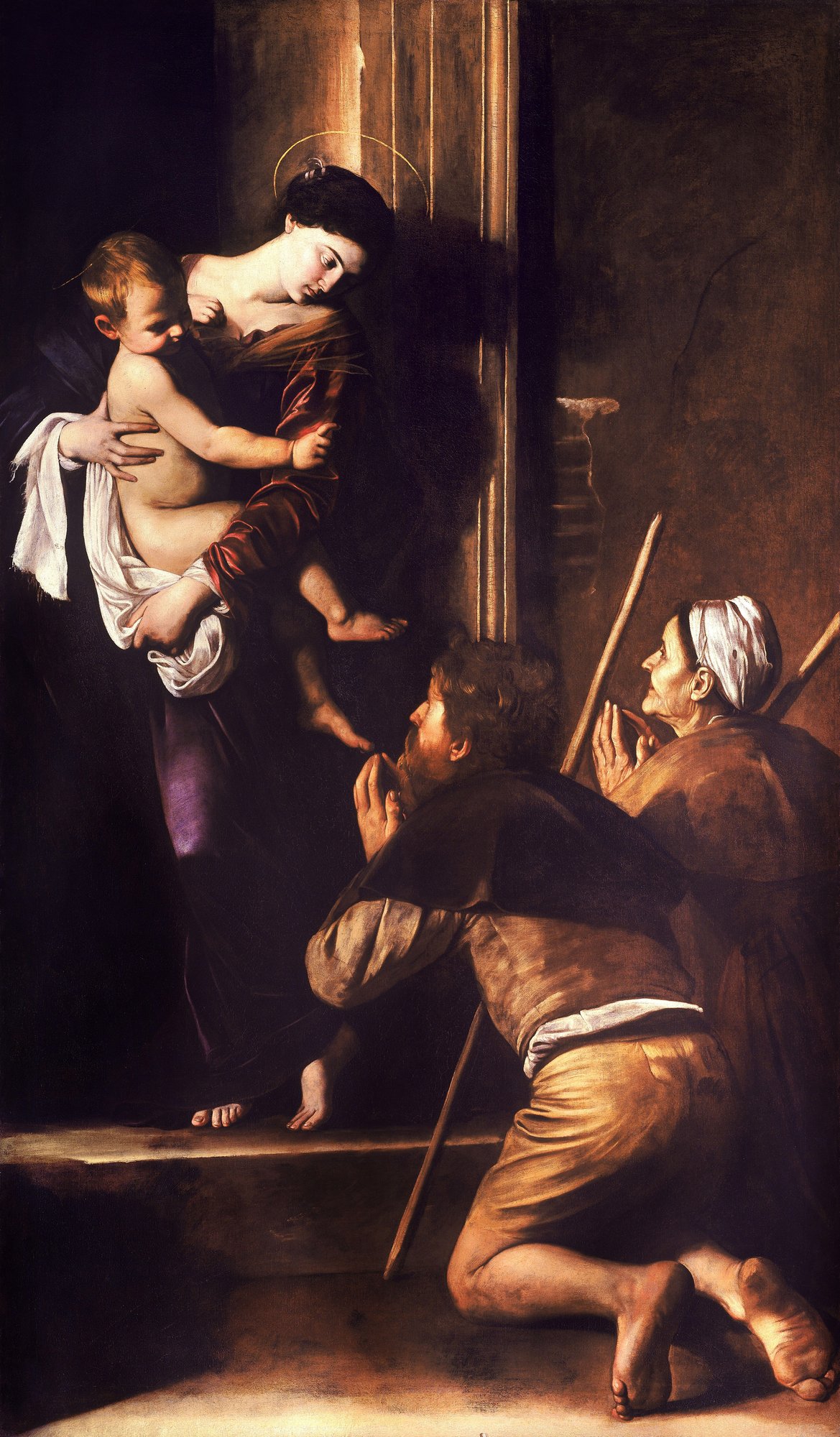
From Piazza del Popolo walk south about 12 minutes — down Via di Ripetta, past the Ara Pacis, across the river-looking stretch of Via dei Coronari with its antique dealers — to the small piazza of Sant’Agostino. The church sits behind a plain Renaissance facade. Inside and to the left, in the first chapel of the nave, is the Madonna di Loreto, sometimes called the Madonna dei Pellegrini. The date is 1604 or 1605. The painter was 34.
Two pilgrims — an old man with a walking stick and a woman in a headscarf — are kneeling at a threshold. The Virgin leans out of a doorway holding a child who is too big for her arms, a real toddler, heavy and squirming. The pilgrims have dirty feet. This is the scandal. Giovanni Baglione, a contemporary biographer who hated Caravaggio, wrote that the painting caused “extreme clamor” among the people because the saint had no jewels, the Virgin had bare feet like a peasant, and the pilgrims had mud on their heels. It is still the most tender Caravaggio anywhere in the city and the one most likely to catch you off guard, because the line for the light box is short and the chapel is quiet and the light from the window above falls on the painting at roughly the angle Caravaggio painted into it.
The model for the Virgin, according to gossip of the period, was a courtesan named Maddalena Antognetti — Lena — whom Caravaggio had fought with another man over. Two years after this painting was unveiled he killed that man near the tennis courts on Campo Marzio and ran.
The house, the tennis court, the alley
You are also three blocks from the Caravaggio house Rome guidebooks mention but rarely find. From Sant’Agostino, walk west along Via della Scrofa, cross the Corso Rinascimento, and cut into the narrow lanes behind Piazza Navona. You will find a short alley called Vicolo del Divino Amore. Number 19 is a small, unmarked building with a plaque bolted to the stone that almost nobody notices. This is where Caravaggio lived and kept his studio from around 1604 until the murder in 1606.
There is nothing to see inside. It is a private residence. The studio is gone; the walls he painted behind are replastered ten times over. But the alley is about the width of a horse cart, the light at eight in the morning falls exactly the way it falls in his pictures, and the tennis court on Via di Pallacorda — where he killed Ranuccio Tomassoni in May 1606 over a disputed point and possibly over Lena — is a three-minute walk east. He left Rome that same night. He never came back.
This is a good moment to stop and take coffee at one of the small bars on Via della Scrofa, because you are about to see the other Caravaggio that used to live a hundred yards from here: the one in the Doria Pamphilj.
Galleria Doria Pamphilj, and the painting that listens
Walk 10 minutes east to the Corso. Palazzo Doria Pamphilj takes up an entire block between the Corso and Via del Plebiscito. The entrance is an unremarkable door between two cafes. The ticket is about 16 dollars. The audio guide is free and narrated in part by the current Prince Doria himself, which is a strange and lovely detail.
The gallery is the private collection of a family that has been collecting for 400 years. The Caravaggios are in a small cabinet room off the main corridor. There are two.
Rest on the Flight into Egypt, painted around 1597, is the earliest large-scale composition Caravaggio ever finished. The Holy Family has stopped to rest on the road. Joseph holds a music book open for an angel with a violin. Mary is asleep, her cheek against the baby’s head. The angel is shown from the back, naked, with enormous wings and a piece of white drapery that falls exactly where it needs to. The music on the page is real; it has been identified as a motet by Noel Bauldeweyn on a Song of Songs text. The painting is quiet in the way a house is quiet after everyone has fallen asleep.
Penitent Magdalene, painted the same year, is the companion piece and was probably painted from the same model. A young woman sits on a low chair in a plain room. Her hair is damp; there is a small jar of ointment on the floor and a broken string of pearls. She is crying, but barely — a single tear at the corner of her eye. She is not looking at anything. Caravaggio painted the Magdalene the way a photographer would: no halo, no skull, no desert cave, just a woman in a Roman kitchen in the middle of an ordinary afternoon.
Chiaro identifies the motet in Joseph’s music book as you look at it, and the Bauldeweyn line runs in your ear while the angel plays the phrase that is actually there on the page.
Palazzo Barberini, and the severed head
For the next two, you need to cross town. Palazzo Barberini is up the hill toward the Quirinale, about a 15-minute taxi from the Corso or 25 minutes on foot through Via del Tritone and Piazza Barberini. The palazzo was built for the Barberini pope Urban VIII in the 1620s and now houses the Galleria Nazionale d’Arte Antica. The Caravaggios are in room 20 of the piano nobile.
Judith Beheading Holofernes, painted around 1599, is the single most unnerving painting in the building and arguably in the city. Judith, in a white blouse and pearl earrings, is sawing through the general’s neck with an expression of grim concentration. Holofernes is mid-scream, eyes wide, pinned to the sheets. Her servant Abra is at her shoulder with a sack, watching. The blood is extremely red. Scholars have identified the model for Judith as Fillide Melandroni, another courtesan in Caravaggio’s circle. She was about 18.
What makes the picture unforgettable is Judith’s face. It is not triumphant. It is not pious. It is the face of a young woman doing something physically unpleasant and having a moment of second thought about it, her brow creased, her body leaning back from the work her hands are doing. Every Judith painted before this one had been heroic. Caravaggio painted a beheading.
In the next room, Narcissus — attribution long contested, increasingly accepted as Caravaggio’s — hangs on its own wall. A boy on his stomach looks into a dark pool and sees his own face looking back. The composition is a closed circle of arms, knees, and reflection. There is no landscape. There is no story around the story. It is the first painting in Western art that is only about the moment a person sees themselves and does not look away.
Palazzo Barberini also holds, in the same room, the small panel Saint Francis in Meditation, an attribution accepted by some scholars and rejected by others, and not worth the argument.
Galleria Borghese, and the Villa Borghese Caravaggios
The Galleria Borghese is the endpoint. It sits inside the Villa Borghese park — Villa Borghese is the green, Galleria Borghese is the museum; they are different things, and tourists mix them up every day. The gallery requires a timed ticket, costs about 15 dollars plus a two-dollar booking fee, and lets you in for exactly two hours. You cannot extend. Book at least a week ahead, especially on weekends. The room you care about is room 8.
This is the densest single Caravaggio experience the city offers: six paintings in one room, most of them bought or confiscated by Cardinal Scipione Borghese, the collector-nephew of Pope Paul V and the sort of patron who got what he wanted by whatever means were available.
Boy with a Basket of Fruit, painted around 1593, is one of the very first pictures Caravaggio finished in Rome. The boy, long-haired, bare-shouldered, probably his friend and studio-mate Mario Minniti, holds a basket of peaches, figs, grapes, apples, and a pear. The fruit is more famous than the boy. A botanist named Jules Janick identified every piece of produce in the basket in 2010 and noted how many of them are visibly past ripeness — blemished, split, starting to rot. Caravaggio was interested in decay from the beginning.
Young Sick Bacchus, around 1593-94, hangs beside it. Art historians have long read this as a self-portrait made while the painter was recovering from malaria in the Hospital of Santa Maria della Consolazione. The skin has a grayish cast. The lips are pale. He is holding a bunch of grapes and wearing a vine crown like an actor playing a god while actually running a fever. He is 22 years old in the picture.
Madonna and Child with Saint Anne, the so-called Madonna dei Palafrenieri, was painted in 1605 for the confraternity of papal grooms and hung in their altar at St. Peter’s for exactly one month before being taken down. The reason was a combination of theological objections and a scandal over the Virgin’s dress, which was a red gown with a bodice cut in the Roman fashion of the moment. Cardinal Scipione bought it for almost nothing and took it home.
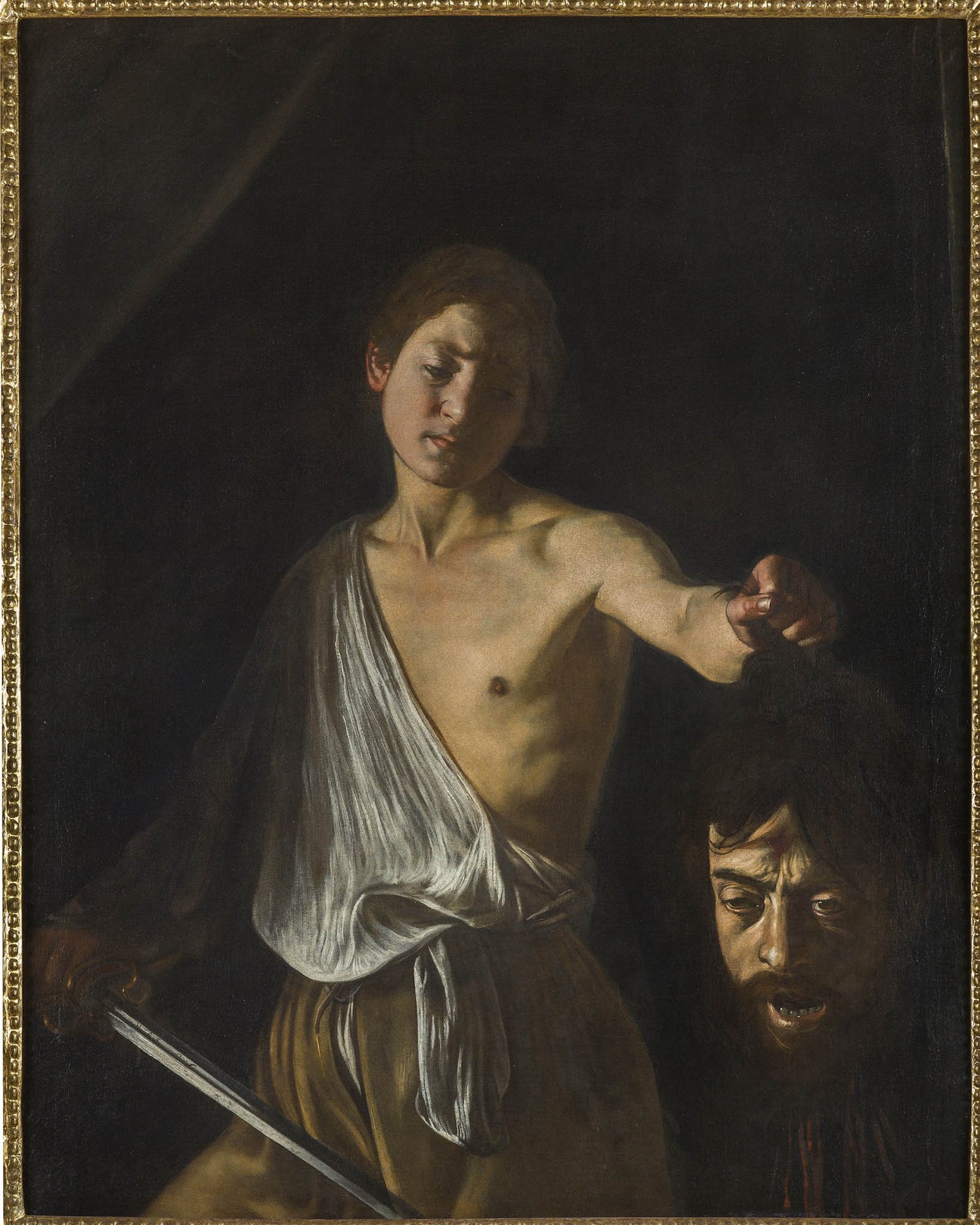
David with the Head of Goliath, painted around 1610 near the end of Caravaggio’s life, is the one that stops you. A young David in a white shirt holds up the severed head of the giant. The head is a self-portrait. The painter signed his name in the blood on David’s sword: H[umilitas] O[ccidit] S[uperbiam] — “humility kills pride,” a motto that doubles as an explanation and a plea. Caravaggio was traveling in the south of Italy trying to secure a papal pardon for the 1606 killing. He sent the painting to Scipione Borghese, whose uncle the pope could grant that pardon. It is a man painting himself as a trophy and mailing it to the one person who could save his life.
The pardon came through. Caravaggio died of a fever, or malaria, or possibly lead poisoning, on a beach in Porto Ercole in July 1610, before he could get back to Rome to hear about it.
Saint Jerome Writing, painted around 1605-06, completes the room. An old man in a red cloak, bent over a manuscript, his quill resting on the page. A human skull sits on his books as a bookmark. The light is ordinary lamplight. There is no miracle happening. This is a picture of a scholar at work, rendered with the respect Caravaggio rarely showed anything but shoulders and shadows.
That last fact — six Caravaggios in one small room, four of them among his best — is what makes the Galleria Borghese ticket worth the booking hassle. You will see caravaggio villa borghese rome and caravaggio roma galleria borghese show up in every search you run; that is what those queries are about.
The Caravaggio fresco Rome people search for
One more stop, and it is the one that almost nobody actually gets to see.
When people search for “caravaggio fresco rome” they are usually looking for something that does not exist. Caravaggio never painted a true fresco. He painted on canvas, sometimes on wood, and exactly once on a plaster ceiling — and that one was done in oil, not true buon fresco technique. The picture is a small oval titled Jupiter, Neptune and Pluto, painted around 1597-98 on the ceiling of a tiny alchemy room in the Casino Ludovisi — also called the Casino dell’Aurora — on the grounds of the old Villa Ludovisi. That house and its gardens are private, still owned by the Boncompagni Ludovisi family, and the building has been closed to the public for most of the past decade following an inheritance dispute. When it does open, usually by private appointment, entry can run to 700 euros a person. The ceiling is about three feet across. The three gods lean down around their astrological beasts — eagle, sea horse, Cerberus — with the forearm foreshortening that Caravaggio would later use for the angels in San Luigi dei Francesi.
It is the only thing on a Roman ceiling by him, and very few visitors will ever lay eyes on it. Include it on your list anyway; it is the answer to the question, and the question gets asked.
The walking day to see Caravaggio in Rome
For a church-first day that sees five paintings before lunch:
Start at 9 a.m. at San Luigi dei Francesi. Allow 30 minutes for the Contarelli Chapel. Bring three one-euro coins for the light box because the first one always runs out halfway through the Inspiration.
Walk 10 minutes north to Santa Maria del Popolo. The Cerasi Chapel is on the left of the altar. 20 minutes.
Walk 12 minutes south to Sant’Agostino. Madonna di Loreto is in the first chapel on the left. 15 minutes.
Detour two blocks to Vicolo del Divino Amore, stand in the alley, look up. Five minutes. Have coffee on Via della Scrofa.
Walk 10 minutes east to Galleria Doria Pamphilj. Two Caravaggios, plus a superb early Titian and a Velazquez that is not a Caravaggio but is arguably the best portrait in Rome. One hour.
Lunch. After lunch, Palazzo Barberini for the Judith, the Narcissus, and the argued-over Saint Francis. 90 minutes.
On a different afternoon, with a ticket booked in advance: Galleria Borghese. Two hours, room 8, six paintings.
What to notice when you stand there
Caravaggio’s light is not sunlight. It is theatrical — a single hard source, usually from the upper left, that falls only on the people who matter to the story and leaves everyone else underwater. Stand back from any of the paintings about 12 feet and you will see faces emerging from a black field like actors stepping from the wings. Step up close and you will notice the skin textures: pores, stubble, the exact color of a forearm that has been outside. Look at the fingernails. Caravaggio painted fingernails with more precision than most painters give eyes.
Look, too, for the objects he put in the foreground: fruit with bruises, a basket tipping off the edge of a table, a sword at the exact height of a child’s head, a stool about to fall. He liked unstable things. He liked the moment just before something tips.
If you are the kind of traveler who writes a Caravaggio Rome review afterward, it should note that the experience is not museum-like. It is church-like, in the original sense: you are kneeling at an altar, dropping a coin, and a painted scene lights up in the dark for two minutes. Then it goes out.
That is the pacing he designed for. It still works.
After Rome
He painted for four more years after leaving the city: in Naples, in Malta, in Sicily. The late pictures get darker. More empty space, more black, less rhetoric. He was running the whole time. The pardon reached him too late. He was 38 when he died. The burial record was lost; his bones were identified in 2010 in an ossuary at Porto Ercole by a team that matched them against a descendant’s DNA, with a ten-percent probability margin they cheerfully admitted was the best anyone was going to do.
But everything he did that broke the rules of Italian painting and then rewrote them, he did here. On these seven walls. In a city that still holds them.
Drop a coin in the box. Watch the light come on.