Almost every building in ancient Rome is a ruin. The Forum is a field of broken columns. The Baths of Caracalla are roofless walls. The imperial palaces on the Palatine are outlines in the grass. The Colosseum is a shell missing most of its marble skin. You walk through the ancient city and you walk through wreckage.
Except for one building.
The Pantheon still has its roof. It still has its bronze doors. It still has the single beam of light that was designed to fall through its ceiling at noon. The floor you walk on is the floor Hadrian’s engineers laid down around 126 AD. The dome above your head is the dome they cast. The Pantheon history is, among other things, the story of how a pagan temple on the Campus Martius managed to survive nineteen hundred years of fire, flood, earthquake, invasion, and papal looting, while every comparable Roman monument got quarried for building stone.
The short answer is that it got lucky, and then it got a pope.
The first Pantheon, and the problem with it
The story begins in 27 BC, when Marcus Agrippa — Augustus’s son-in-law, his general at the Battle of Actium, and the builder of most of the public infrastructure of early imperial Rome — put up a temple in the Campus Martius. The district was then a floodplain just outside the old city walls where aristocrats built their gardens and generals held their triumphs. Agrippa’s building was rectangular, fronted by a columned porch, and dedicated, according to the later writer Cassius Dio, either to all the gods or to the personal gods of the Julian family. The name “Pantheon” is Greek. It means something close to “to every god.”
Nobody alive has seen that first Pantheon. It burned down in 80 AD, in the enormous fire that also took out most of the Campus Martius. The emperor Domitian rebuilt it. His version burned down too, struck by lightning around 110 AD. By the time Hadrian came to the throne in 117, the site had been a fire scar for most of a decade.
Everything the modern visitor sees is Hadrian’s rebuild. Dendrochronology on the original wooden roof trusses and brick stamps baked into the walls date the construction to roughly 114-128 AD. What is remarkable, and what has confused tourists for nineteen centuries, is that Hadrian refused to put his own name on it. He left Agrippa’s dedication, in foot-tall bronze letters, across the pediment: M·AGRIPPA·L·F·COS·TERTIVM·FECIT. Marcus Agrippa, son of Lucius, consul for the third time, made this.
This was not false modesty. Hadrian did the same thing at several other sites. The convention seems to have been that if you rebuilt a temple on the same footprint, you kept the founder’s name as an act of religious continuity. It is one of the reasons that nearly every visitor today thinks Agrippa built the Pantheon, and one of the reasons it took modern archaeologists reading brick stamps to figure out what actually happened.
What Hadrian actually built
The building Hadrian’s team put up was not a rebuild in any normal sense. It was a new kind of building disguised with a conventional porch.
From the front, approaching from what is now Piazza della Rotonda, the Pantheon reads as a standard Roman temple. Sixteen granite columns, each thirty-nine feet tall and weighing around sixty tons, quarried in Egypt and shipped across the Mediterranean. A triangular pediment. A shallow portico. This was the familiar grammar of civic religion. Agrippa’s original had looked something like this too.
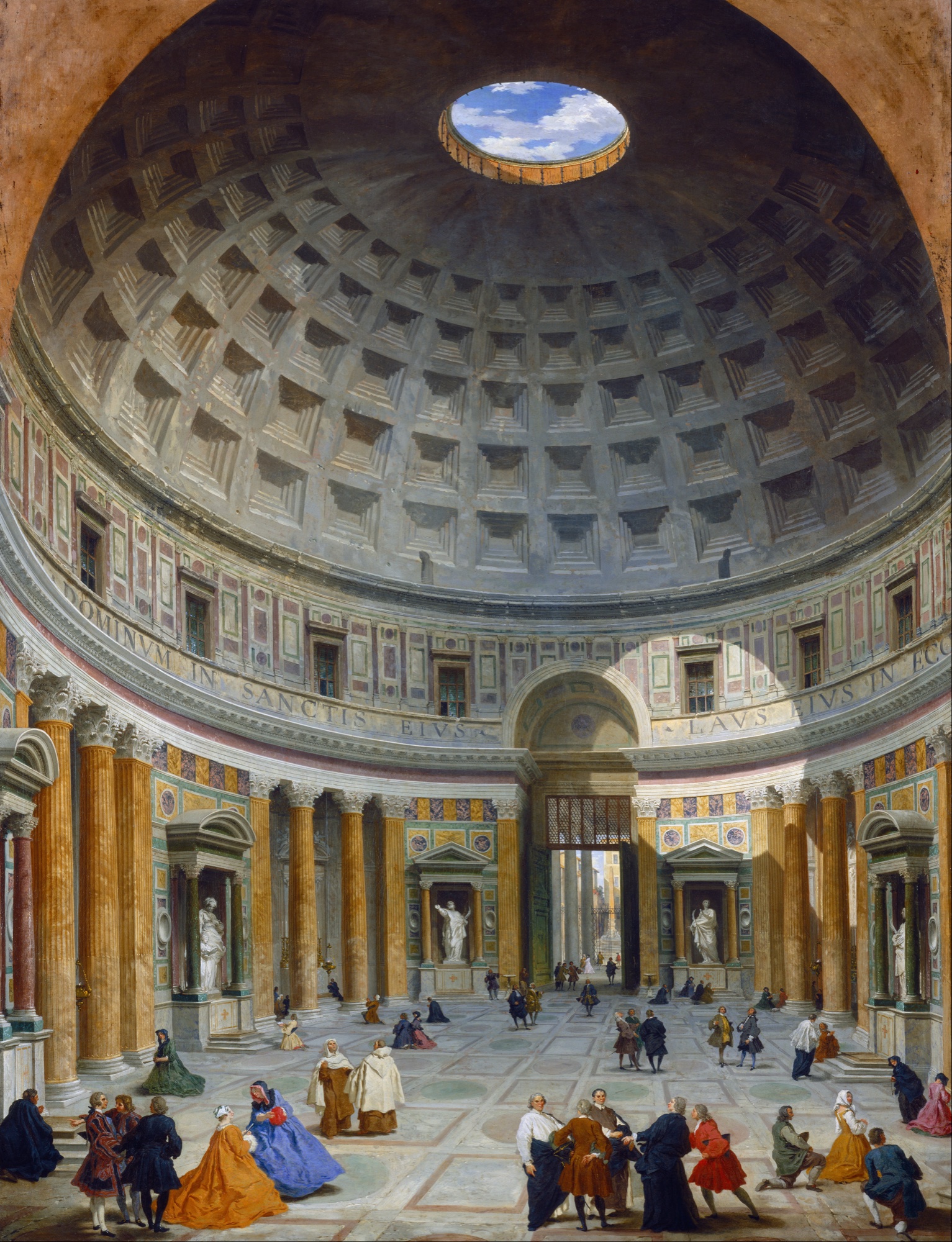
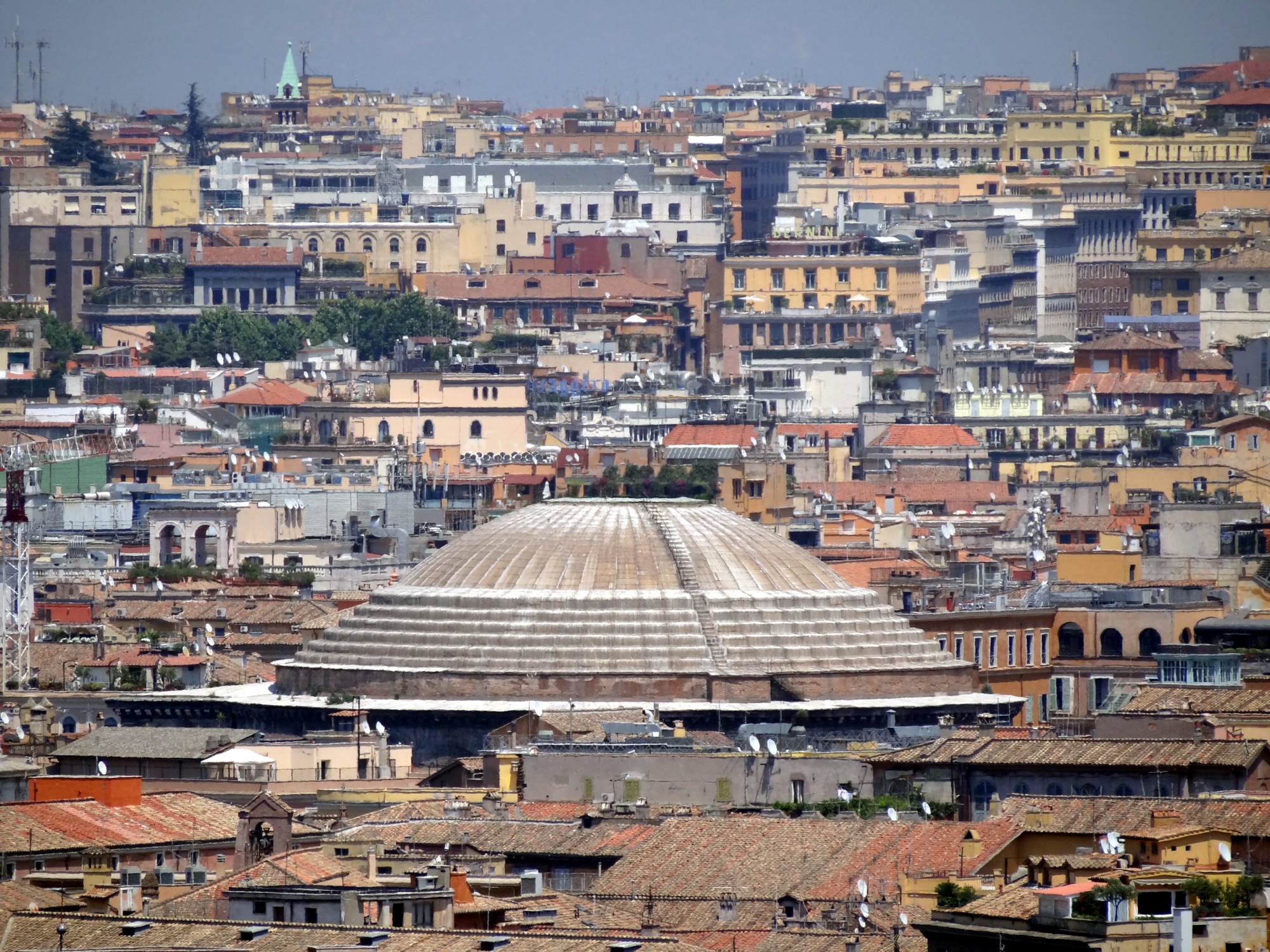
Behind the porch, though, is something with no real precedent: a cylindrical rotunda capped by a hemispherical concrete dome 43.3 meters wide. For context, it would be thirteen centuries before any builder in Europe came close to matching that span. The Pantheon’s dome is still, two thousand years later, the largest unreinforced concrete dome in the world. The oculus in the center, nine meters across, has never been glazed. When it rains, the rain falls into the building. The floor is canted and drains out through small slotted holes you can still see in the marble.
The effect, when you walk in, is nothing like the porch promised. The porch is a temple. The interior is a planetarium.
From temple to church
The Pantheon stayed in use as a pagan temple through the collapse of the Western Empire. When Theodosius banned pagan worship in 380, the building was officially closed. For a little over two centuries, it sat empty. This was the dangerous period. An unused Roman building was a building whose marble could be carried off, whose bronze could be melted, whose stone blocks could be repurposed for churches and fortresses. Most of ancient Rome vanished in exactly this way between the fifth and eighth centuries.
The Pantheon got saved in 609 AD, by a transaction between the Byzantine emperor Phocas and Pope Boniface IV. Phocas, who was trying to shore up support in the West, handed the building over to the papacy. Boniface consecrated it that year as a Christian church dedicated to Santa Maria ad Martyres — Saint Mary and the Martyrs — after a procession in which, according to the chronicler Paul the Deacon, twenty-eight wagon-loads of martyrs’ bones were carried in from the Roman catacombs and buried beneath the floor.
This is the hinge of the whole story. The moment the Pantheon became the Basilica di Santa Maria ad Martyres, it stopped being a target for demolition and started being a protected asset. Popes maintained it. Masses were said in it. It passed, nearly intact, through the centuries when the Colosseum was being quarried for travertine to build palaces and the Forum was being used as a cow pasture.
The feast day of the dedication, November 1, eventually migrated into the general Christian calendar as All Saints’ Day. There is a direct, if thin, line from Agrippa’s “temple to every god” to the modern November holiday for every saint. The name survived. The religion changed.
The medieval Pantheon
The building did not escape all damage.
Sometime in the early Middle Ages — probably the seventh or eighth century — a bell tower was added to the porch. It stayed there for nine hundred years. Sometime in the thirteenth century, a second bell tower replaced it. Gianlorenzo Bernini later added two small towers flanking the porch in the 1620s, the so-called “asses’ ears” that were so universally hated that they were finally demolished in 1883. You can see seventeenth- and eighteenth-century engravings of the Pantheon with the Bernini towers sticking up like goat horns over the pediment.
The original bronze that once covered the porch roof was stripped in 1625 by Pope Urban VIII, a Barberini, who wanted the metal for two projects: the bronze baldacchino over the tomb of St. Peter in the new basilica, and cannon for the Castel Sant’Angelo fortress. The pasquinade that made the rounds in Rome at the time has stuck: “Quod non fecerunt barbari, fecerunt Barberini.” What the barbarians did not do, the Barberini did. The Romans never quite forgave him.
The original bronze doors on the front of the Pantheon, though — those are the ones Agrippa and Hadrian’s engineers hung. The same doors. Seven meters tall, cast solid, probably the oldest working doors in Europe. They swing on the same hinges. When they close at night, they close against the same door-frame Hadrian built.
Raphael, Renaissance burial ground
By the Renaissance, the Pantheon had been a church for nearly a thousand years, and it had become, among architects, the single most studied building in Europe. Brunelleschi measured it before designing the dome of Florence Cathedral. Michelangelo, reportedly, called it the work of angels rather than men. Bramante walked the floor before starting the new St. Peter’s. Every young architect from Bernini to Piranesi to Christopher Wren drew it. The building taught an entire European architectural tradition how to think about interior volume.
It also became, by a kind of quiet accumulation, the Westminster Abbey of Italian art.
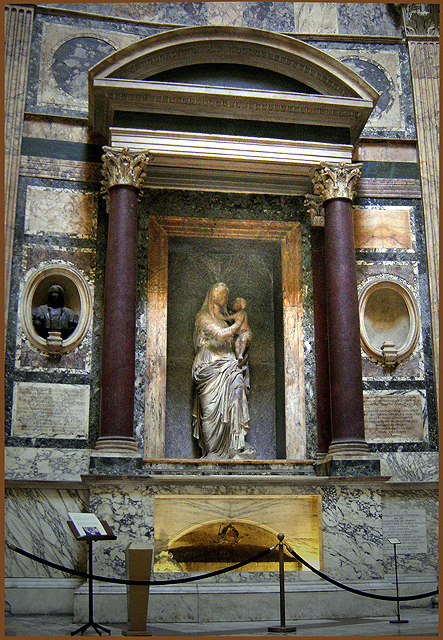
Raphael was buried there in 1520. He had left instructions: he wanted to be interred in the rotunda, near a particular altar. His friend Pietro Bembo wrote the Latin epitaph that is still on the wall above the tomb. The most frequently translated line says roughly: “Here lies Raphael, by whom Nature herself feared to be outdone while he lived, and when he died, feared to die herself.” Raphael was thirty-seven. The sculptor Lorenzetto, working to his friend’s design, carved the small Madonna del Sasso that stands in the niche above the grave. There is a longer story about why Raphael chose to be buried here and what that burial meant — for the building, and for the status of painters in the sixteenth century.
After Raphael, the burial list kept growing. Annibale Carracci, the Bolognese painter whose frescoes in the Palazzo Farnese set the template for the Italian Baroque, was laid near Raphael in 1609. A dozen other artists and architects were interred in the chapels along the walls through the seventeenth and eighteenth centuries. Two Italian kings — Vittorio Emanuele II and Umberto I — and the queen of Italy are buried there in tombs that date from after the Risorgimento, when a newly unified Italy used the Pantheon to claim a direct line back to Rome.
The Pantheon, still working
The building is still a church. Mass is celebrated in it. On Sundays and holidays you will often find a service in progress when you walk in, and visitors are asked to move to the back. The feast of Santa Maria ad Martyres is still observed on November 1. During Pentecost, red rose petals are dropped through the oculus by firefighters from the roof above, a tradition revived in modern times to echo medieval descriptions of the same gesture.
The Pantheon also remains, somewhat stubbornly, a tourist monument with no modern glazing. When it rains in Rome, it rains inside the Pantheon. The floor has a barely visible slope — about thirty centimeters, drifting toward the center — and twenty-two small drainage holes set into the marble that carry the water out. On bright days at noon, the shaft of sunlight from the oculus tracks across the interior in a predictable arc, reaching the top of the entrance door at around forty minutes past the hour at spring equinox. Recent research by the architectural historian Robert Hannah and others has argued, convincingly, that the building was designed as a kind of calendar, a solar meridian that marked certain imperial anniversaries by the position of the beam.
There are not many places where you can put your hand on a wall that has been held up continuously, without reconstruction, without ruin, for nineteen hundred years. Chiaro notices the slope of the floor as you walk toward the center of the rotunda, and tells you what that thirty-centimeter tilt is for while you feel it underfoot.
What to look for
Three things worth your attention, other than the dome.
The first is the bronze doors. Stand to one side and look at the hinge pins. They are as old as the building. The door is so balanced that a single person can swing it, though it weighs around eight tons.
The second is the floor. The original marble is still there in many panels. Look for the rosettes of red porphyry and yellow giallo antico, the two hardest, most valuable marbles of the ancient world. Hadrian was importing them from Egypt and Numidia at colossal expense. The pattern is a mix of circles and squares that plays, very deliberately, with the circle of the dome and the square of the portico plan.
The third is the oculus itself. Walk underneath it, look up, and hold your gaze. In rain, the water falls into the rotunda as a silver column. In bright sun, the beam hits the wall hard enough to cast shadows off the coffers. The opening has not changed shape since 126 AD. The sky you see through it is the same sky that watched Hadrian’s architect finish the dome.
Every comparable Roman building is a ruin. This one is still working.