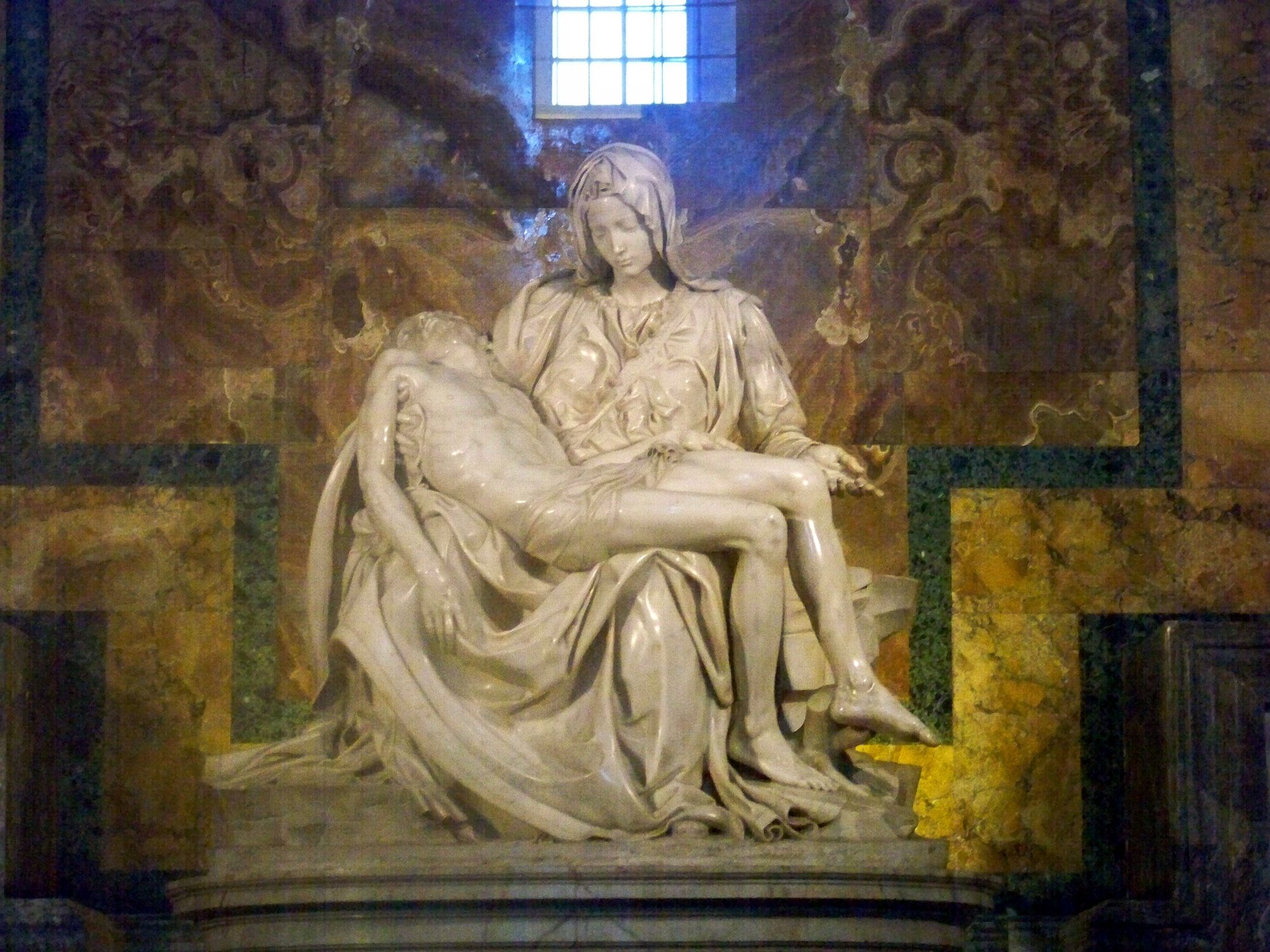
Here is why Michelangelo signed the Pietà. In the spring of 1499, two men in pilgrims’ cloaks stood in the north transept of old St. Peter’s, looking at a brand-new marble sculpture. A young mother, barely older than a girl, held her grown son across her lap. The son was dead. His muscles were slack. His right arm hung down, fingers loose, almost brushing her knee. The mother’s face was bent over him with a grief so quiet it looked like sleep.
The pilgrims admired the piece. One of them turned to the other and said the name of the sculptor who had made it. The name he said was Cristoforo Solari.
A third man, standing a few feet away, heard him. The third man was Michelangelo Buonarroti. He was twenty-four years old. He had spent a year and a half on that marble. He had just delivered it to the church for the tomb of a French cardinal. And he was watching strangers attribute his work to a mediocre sculptor from Milan.
That night, or perhaps the next, he went back to the chapel with a candle, a chisel, and a mallet. He climbed up onto the sculpture. On the sash running diagonally across the Virgin’s chest, he carved ten Latin letters: MICHAEL.A[N]GELVS.BONAROTVS.FLORENT[INVS].FACIEBA[T]. “Michelangelo Buonarroti, a Florentine, was making this.”
Then he climbed down. That was the only time in his life he ever signed a piece of his own sculpture. He lived another sixty-one years and never did it again.
Why Michelangelo signed the Pieta, and regretted it
The story comes from Giorgio Vasari, who wrote his Lives of the Artists in 1550 and updated the Michelangelo chapter after the sculptor’s death in 1564. Vasari knew Michelangelo. He had watched him work. He had interviewed people who had been in Rome in 1499 when the Pieta was installed. When Vasari recounts the episode, he is not guessing.
The Cristoforo Solari rivalry, he says, was the trigger. Solari was a Lombard sculptor who had a decent reputation in Milan but no presence in Rome. Somehow, standing in front of the Pieta, a group of visitors had convinced themselves that the young mother was an arm from that other workshop. Michelangelo heard it and could not let it pass.
But here is the part that matters. Michelangelo was ashamed of what he had done. Vasari is careful to note that the signature was carved in a moment of overheard insult, not as a routine act of self-promotion. After he calmed down, he decided that the proper posture for a sculptor was not to carve his name into the work at all. That was boastful. That was peasant behavior. A great sculpture should speak for itself.
So he made a private vow. No signature ever again. And he kept it.
The David in Florence, seventeen feet of marble, is not signed. The Moses in San Pietro in Vincoli is not signed. The Medici tombs, with their sublime Dawn and Dusk and Day and Night, are not signed. The Dying Slave and the Rebellious Slave in the Louvre are not signed. The ceiling of the Sistine Chapel is not signed. The Last Judgement is not signed. The final Rondanini Pieta, which he was still working on six days before his death at eighty-eight, is not signed.
The only Michelangelo signature Vatican visitors can see, the only one he ever carved, is on a sash that runs across a twenty-year-old marble Virgin. It is the signature of a man correcting a misunderstanding. It is also, he decided later, a signature he should not have carved.
The Pietà inscription sash, where to find it
If you walk into St. Peter’s today, the Pieta is in the first chapel on your right as you enter. It is behind thick bulletproof glass, installed after a Hungarian-Australian geologist named Laszlo Toth attacked the sculpture with a hammer in 1972, knocking off the Virgin’s nose and part of her left arm. The restoration took ten months.
The Pieta st peters basilica visitors see today is therefore behind several feet of glass, and the light in the chapel is always low. Finding the inscription is difficult without a guide.
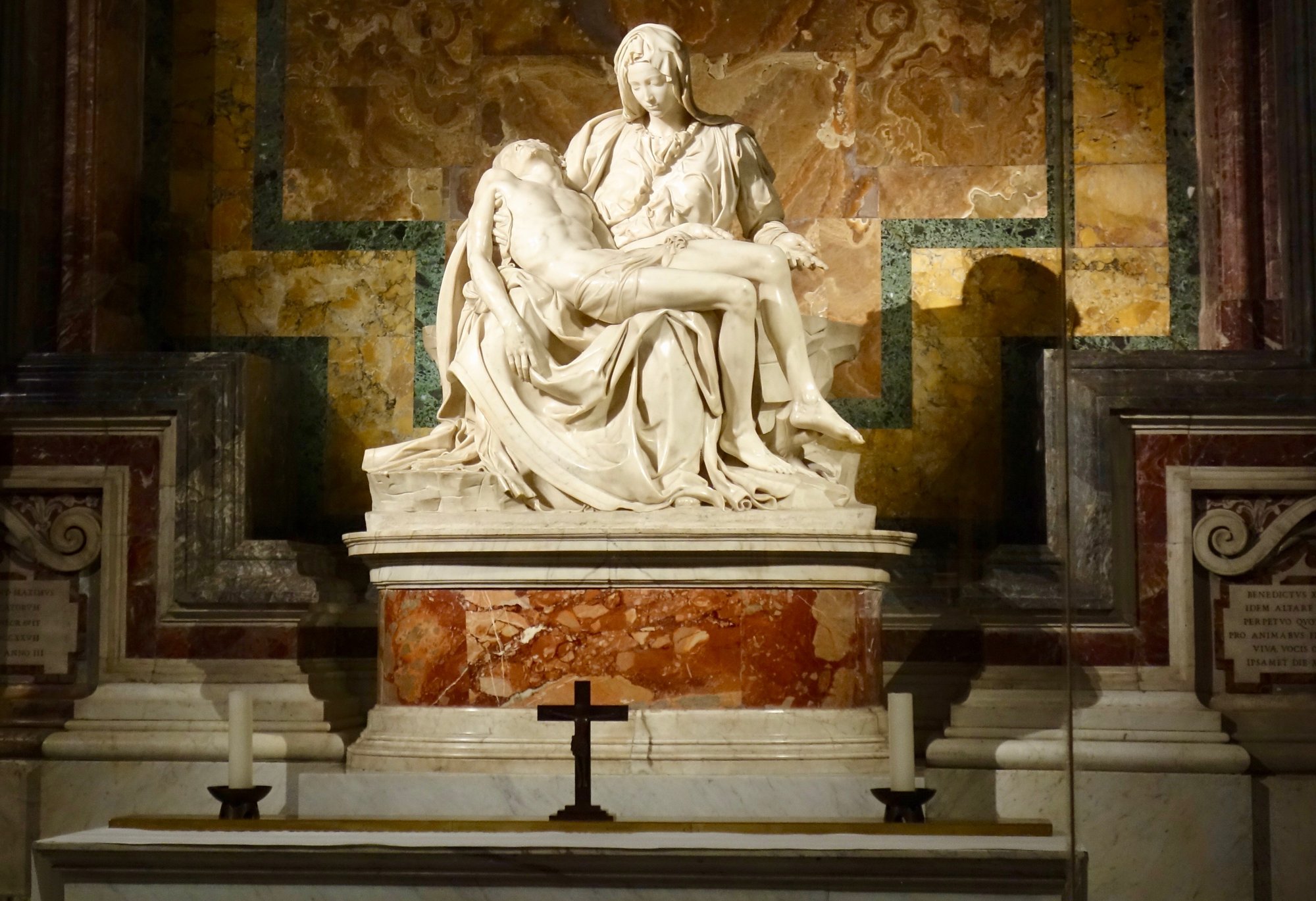
Look at the Virgin. Look at her chest, where a sash runs from her left shoulder diagonally down to her right hip. The sash holds her robe closed. On that sash, in roman capitals, Michelangelo carved his name.
The letters are small. They are not elegant. They are scratched in, not laid in. Michelangelo was a Florentine who had studied classical inscriptions his whole life and could have signed the piece in a beautiful humanist hand if he had planned to. He did not plan to. He did it at night, in a hurry, in anger. The letters look like it.
The Pietà inscription sash is the only signature on the sculpture and the only thing on it that was not part of the original design. Everything else was carved over months of planning. The letters were carved in one session, probably in a few hours, in the dark.
The only work Michelangelo signed, in his own words
In 1549, fifty years after the event, the Florentine art writer Benedetto Varchi wrote to Michelangelo in Rome and asked him to confirm the story. Michelangelo was seventy-four. He had been the most famous living artist in Europe for forty years. He answered Varchi’s letter in writing, and the letter survives.
He confirmed the episode. He confirmed the overheard attribution to Solari. He confirmed that he had carved the signature that night in anger. And he confirmed that he had regretted it afterward and resolved never to sign another work.
The only work Michelangelo signed is therefore the only one whose signing we can date, and it is the only one whose signing we have the artist’s own explanation for. Every other piece of his work is attributed by style, by documents, by contemporaneous accounts, by the signature of contracts preserved in Roman and Florentine archives. The signature itself, the letters on the sash, is unique in his career.
This is something worth sitting with. Michelangelo lived to eighty-eight. He produced more documented work than any sculptor of his generation. And across that entire body, from the fifteen-year-old apprentice pieces in Lorenzo de’ Medici’s garden to the final unfinished Pieta he was hammering at in the week he died, there is exactly one carved signature. On one sculpture. Carved in haste. After a single misunderstanding. By a twenty-four-year-old who then decided, for the rest of his life, that he had been too loud.
Pieta marble inscription meaning in the Latin
The Latin of the inscription tells you something too. MICHAEL.ANGELVS.BONAROTVS.FLORENTINVS.FACIEBAT. The choice of verb is the interesting piece. FACIEBAT is the imperfect tense. It translates as “was making,” not “made.”
This was a formula Roman sculptors used. Pliny the Elder wrote that the great Greek sculptors signed their works with the imperfect tense specifically to communicate modesty, as if to say: I did not finish this, it is only a work I was in the middle of, someone else could always have done it better. FECIT — “made” — was the bold finished statement. FACIEBAT was the humble unfinished one.
The Pietà marble inscription meaning, then, is not just a name but a Roman-inflected claim to modesty even in the act of signing. Michelangelo was saying, in the same breath: I made this, and I was not really done. The modesty was performative. He knew the Latin. He was asserting himself inside a tradition of sculptors’ humility that he had read about in Pliny.
But the modesty did not save him from his own later judgment. Looking back, he decided that even FACIEBAT had been too much. The only proper signature was no signature. The work spoke for itself.
Virgin Mary Michelangelo sculpture, why she is young
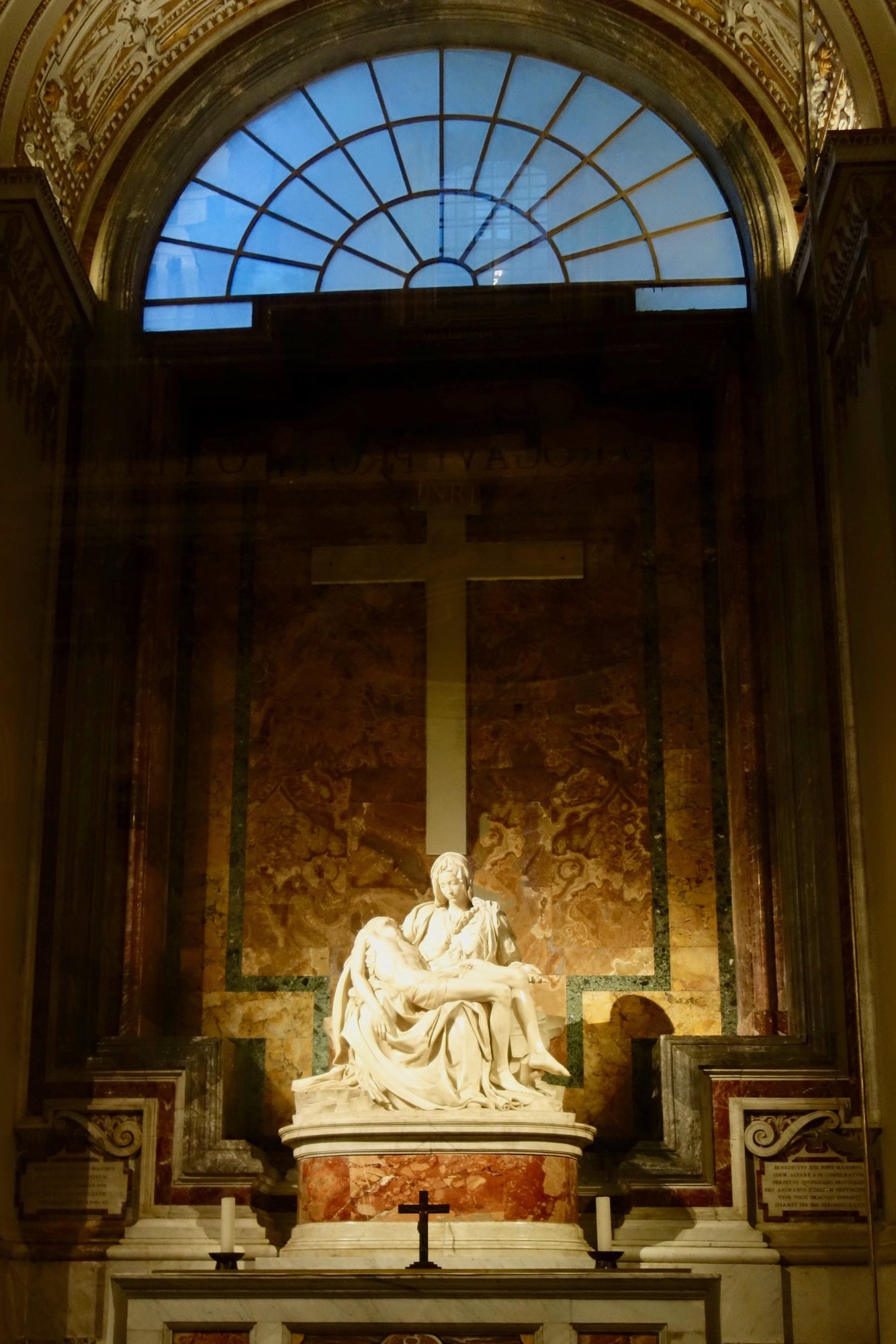
Another thing people notice in St. Peter’s: the Virgin Mary in the Pieta is younger than her son. She is serene, smooth-faced, perhaps eighteen years old, and she is holding a man of about thirty-three. It looks wrong. Every other Pieta in Renaissance art shows a grieving middle-aged woman. Michelangelo made her a girl.
When visitors complained about this in the early sixteenth century, he answered. Ascanio Condivi, his biographer and apprentice, transcribed the explanation. Chaste women, Michelangelo said, keep their youth longer than women who are not chaste. Mary was the most chaste woman who had ever lived. Therefore she would have remained young forever. The Virgin Mary Michelangelo sculpture is a theological argument in stone: purity preserves the flesh.
This is a strange answer, and it is not universally accepted. Some art historians think the real reason is compositional. If you make the mother the same age as the son, she cannot support his body in her lap without looking strained. Michelangelo had to carve a woman strong enough and youthful enough to hold a dead man across her knees, or the sculpture would have tipped over into grotesque. The youth is a structural solution as much as a theological one.
Whatever the reason, the Pietà young Mary symbolism is one of the first things visitors notice, and it is the first reason the sculpture keeps looking fresh instead of familiar. Every Pietà you have ever seen in a museum has a weeping older woman. This one does not.
The night Michelangelo climbed the sculpture
Think about the physical act. The Pieta is about six feet tall. The Virgin’s sash runs across her chest at roughly shoulder level on the sculpture itself, so about five feet off the ground. To carve letters across it, Michelangelo needed to climb the marble, or to drag a step up to it, or both. He needed a light. He needed to work quietly enough that nobody in the basilica at night would catch him defacing the chapel.
He carved ten letters. It would have taken at least an hour of careful tapping with a small chisel. He was lit by a candle. The rest of the basilica was dark. This was during the last weeks of 1499 or the first weeks of 1500, which means it was cold. He was twenty-four years old, famous in Florence but still a nobody in Rome, and he was standing on a sculpture he had just finished, scratching his name into stone he had polished for months.
Chiaro reads the Condivi and Vasari accounts of the overheard misattribution while you are standing in front of the glass, so the candle-lit night-carving sits in your ear at the same angle your eye is looking down at the sash. The ten Latin letters stop being decoration and start being a confession.
When he came back in the morning — or when the light came up and he saw what he had done — he did not ask to have it removed. He was too proud for that. But he was also ashamed enough of the vanity that he promised himself it would never happen again. And it never did.
What to look for when you visit
The Pieta is in the first chapel on the right as you enter St. Peter’s. The sculpture is behind glass. The crowd is often thick. There is a guard. The light is low.
Do three things.
First, find the face of the Virgin. She is looking down. Her eyes are closed or nearly closed. Her expression is not grief. It is a kind of downward attention, as if she is listening to something the dead body is telling her. Most visitors see grief. Grief is not the right word. The word is attention.
Second, find the son. His body falls across her lap in a long diagonal. The right arm hangs. The head falls back. The muscles are perfectly relaxed. Michelangelo had been allowed to dissect bodies at the Santo Spirito hospital in Florence as a teenager, and the anatomy here is the most accurate in any Pieta ever carved. You are looking at a dead body by a sculptor who had watched dead bodies.
Third, find the sash. Follow it from the Virgin’s left shoulder down and across to her right hip. In the middle, in small incised roman capitals, is the name. It is hard to see through the glass. A guard will sometimes point to it if you ask. Once you have located it, the whole sculpture changes.
That ten-letter inscription is the pulse of the piece. It is the one place where Michelangelo forgot himself and claimed the work out loud. Everywhere else he left the marble to speak. Here, for ten letters, he spoke for it.
The kicker
He was twenty-four when he carved those letters. He was eighty-eight when he died. For sixty-four years he never signed another sculpture, never inscribed his name on a fresco, never carved his initials in a corner. The Pieta was the last piece he failed to let go of. And because of that one failure, it is the only piece we can look at and know, from his own hand, that he knew he had made it.
.jpg)
.jpg)
.jpg)