In June 1883 a forty-three-year-old painter from Paris signed a lease on a pink stucco farmhouse in a small village in Normandy called Giverny, sixty miles down the Seine from the city. He had eight children and two stepchildren and almost no money. The garden was about an acre. He spent the next forty-three years turning it into a private greenhouse-laboratory of color, planting irises in stripes, weeping willows along a small pond he had dug himself, banks of poppies, climbing roses, hollyhocks, and the imported Egyptian and Japanese water lilies that would eventually fill more than two hundred and fifty of his paintings. By the time Claude Monet died in 1926 he had painted more flowers than any other major artist in European history. And he was not even alone in this. Impressionism flower paintings, as a category, run from Monet’s late lily ponds back through Renoir’s bouquets, Manet’s peonies, and Fantin-Latour’s roses to a single technical conviction the whole group shared: that flowers, painted fast in changing light, were a near-perfect subject for the new way of working they were inventing.
This is a guide to the eight impressionism flowers paintings that matter most. Some are wall-sized lily panels. Some are tabletop bouquets. They span fifty years and four different painters. Together they make the case for why impressionism flower paintings ended up being one of the central genres of the entire movement, and why the impressionism garden painting tradition that came out of it is still the most-reproduced category of nineteenth-century art on bedroom walls in 2026.
Why flowers worked for the new painting
Before the names, a quick technical point because it answers the question implicit in the impressionism nature paintings category. Why did the Impressionists paint so many flowers?
Three reasons, all practical. Flowers do not pose. You cannot pay them by the hour, you cannot ask them to hold still, and they will visibly change in front of you as the light moves and as the cut stems wilt. This forces a working speed close to what Monet was already trying to achieve outdoors. Second, flowers are a near-perfect subject for the new chemical-pigment tubes the industrial revolution had just put on the market. Cobalt blue, cadmium yellow, ultramarine, viridian, alizarin crimson, chrome green — the entire bright palette of post-1860 painting was being marketed in part on the argument that you could now paint a tulip the color the tulip actually was. Third, flowers are an indoor subject that follows the open-air rules. You can paint them on a kitchen table in February in the same loose, fast register you would use for a haystack in July. They let an Impressionist work indoors without abandoning the program.
Almost every painter on the impressionism famous artists list painted flowers. The eight examples below are the ones to know.
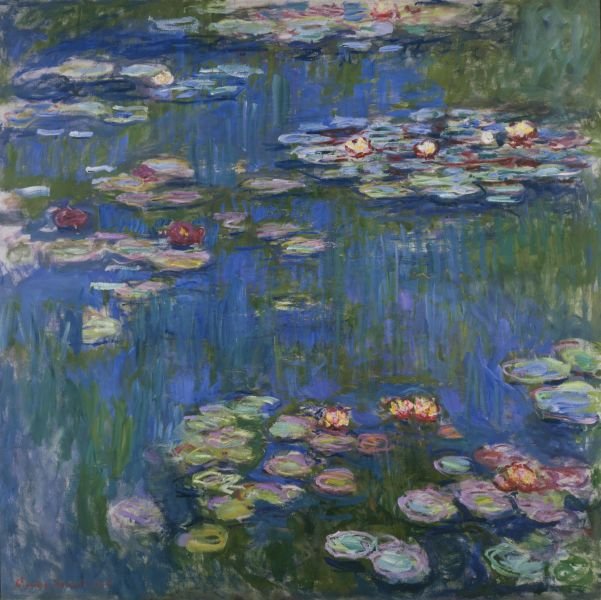
1. Monet, Water Lilies (Nymphéas), 1916
The single defining work of the entire impressionism oil painting tradition of flowers. Monet bought the Giverny property in 1890, having rented it for seven years, then bought the adjoining strip of marshland in 1893 and spent two years and a small fortune diverting a tributary of the Epte river to fill the pond. He planted the first water lilies in 1894. He started painting them in 1897. Over the next thirty years he made around two hundred and fifty canvases of the same pond.
The version above is one of the wall-sized later ones, painted in 1916 when Monet was seventy-six. It shows the surface of the pond with no shore visible, no horizon line, and no fixed viewpoint. The lily pads float across a depth of reflected sky and willow leaves. You cannot tell, looking at the painting, whether you are looking down at the pond or up through it. Monet had spent twenty years figuring out how to paint that ambiguity and the late canvases like this one are the most extreme version of it.
The biggest collection of Nymphéas in the world hangs at the Musée de l’Orangerie in Paris, where Monet himself designed the two oval rooms in the 1920s to hold his eight largest panels, each about six feet tall and fourteen feet wide on average. The Marmottan owns a smaller late group. The Met owns three. The Art Institute of Chicago owns one. Standing in front of any of them is the closest most visitors will ever get to understanding why the impressionism painting style ended up being more about the act of looking than about the thing looked at.
2. Monet, Iris Garden at Giverny, around 1900
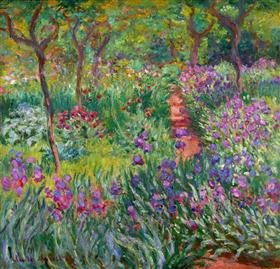
Monet’s irises are sometimes overshadowed by the lilies, which is unfair. He planted a sixty-meter band of bearded irises along the central path of the upper garden, the so-called Grande Allée, every spring from the early 1890s on. The irises bloomed for about three weeks in late May and early June. He treated each spring as a single working campaign. The painting above, dated to around 1900, shows the path receding through irises that come up to the canvas’s eye line. The greens and the violets and the blue-purples sit on top of each other in vertical strokes that are almost too fast to read individually.
This is one of the great impressionism landscape painting examples, and one of the cleanest demonstrations of how Monet thought about a flower bed not as decorative subject matter but as an organized field of color contrast. The orange-yellow path runs straight up the middle. The complementary blue-violet of the irises is on either side. The structure of the painting is almost mathematical. The execution is anything but.
3. Renoir, Bouquet of Flowers, 1878
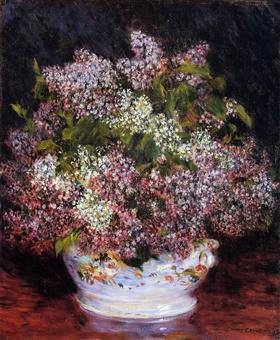
Renoir painted bouquets all his life, but the late 1870s ones are the strongest. The version above is from 1878, painted in his small Montmartre studio in the same months he was working on the Moulin de la Galette dance painting. It shows about thirty cut flowers in a clear glass vase on a draped table, against a blue-gray wall. The composition is loose. The brushwork on the petals is so fast it almost feels improvised.
Renoir was the painter in the group most committed to making flowers feel alive. He once wrote that he learned more about painting figure flesh from working on flower studies than from any other practice. The pinks of a peony petal, he said, were the same pinks as the inside of an arm. The trick was to paint them with the same speed and the same loose touch. You can see this argument working in the bouquet above. The flowers are not posed. They are spilling out of the vase. They look like they were brought in from outside half an hour earlier and are about to start dropping petals.
4. Manet, Peonies, around 1864-65
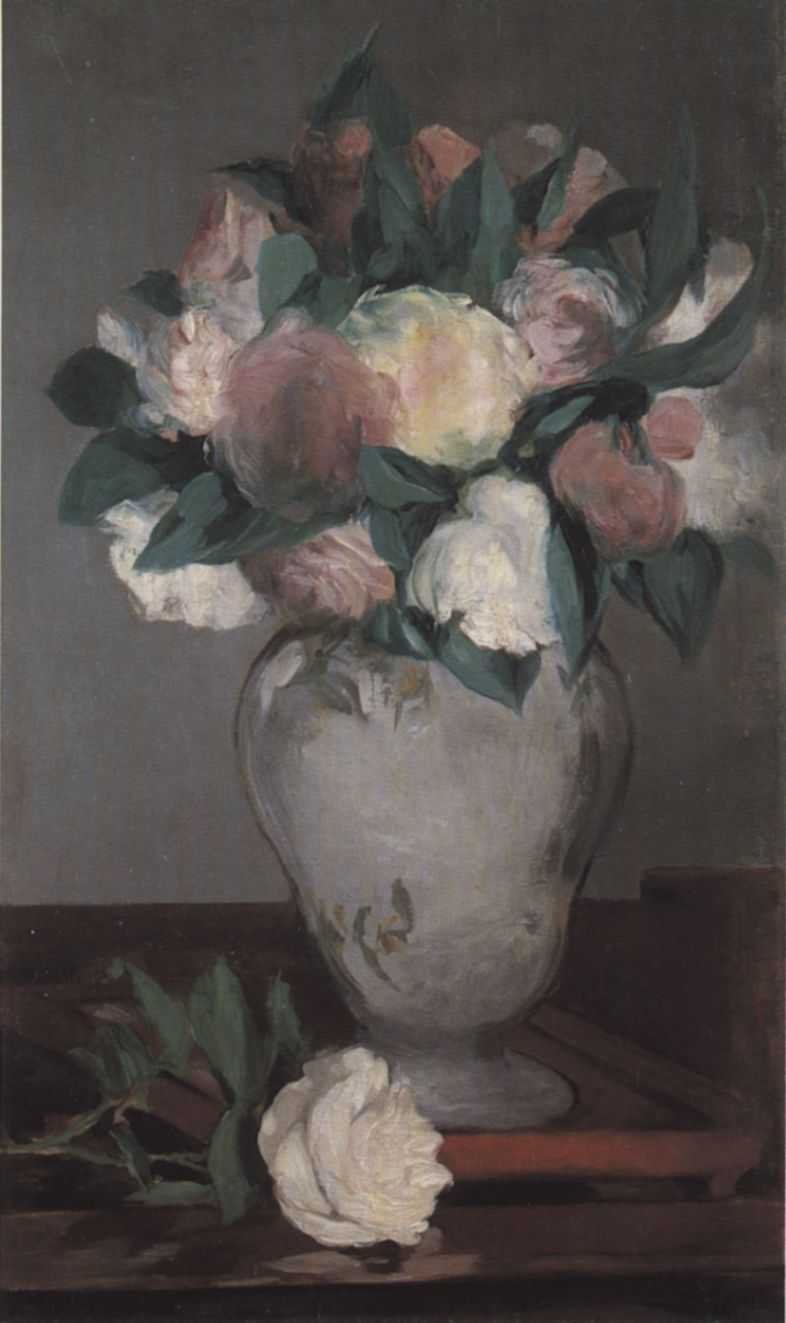
Édouard Manet, who never showed at any of the eight Impressionist group exhibitions but is universally credited as the painter who opened the door, painted peonies obsessively in the 1860s. He grew them in his garden at Gennevilliers, downstream from Paris, and brought cuttings into his studio. The Orsay owns six of his peony still lifes from the 1864-65 period. The version above, oil on wood, shows a vase of pink and white peonies on a black lacquered Japanese tray.
These are not garden paintings. They are interior pieces, painted in a Paris studio with controlled north light. But the brushwork is already loose. The petals are summary. The black tray and the dark backdrop set the flowers up to read as the only living thing in the picture. Manet was the painter who established peonies as a serious modern subject. Every Impressionist who came after him — Renoir, Caillebotte, Fantin-Latour, even Cézanne in his way — was working in the genre Manet had defined in this small group of canvases just before Olympia made him notorious.
5. Fantin-Latour, Still Life of White Roses, 1870s
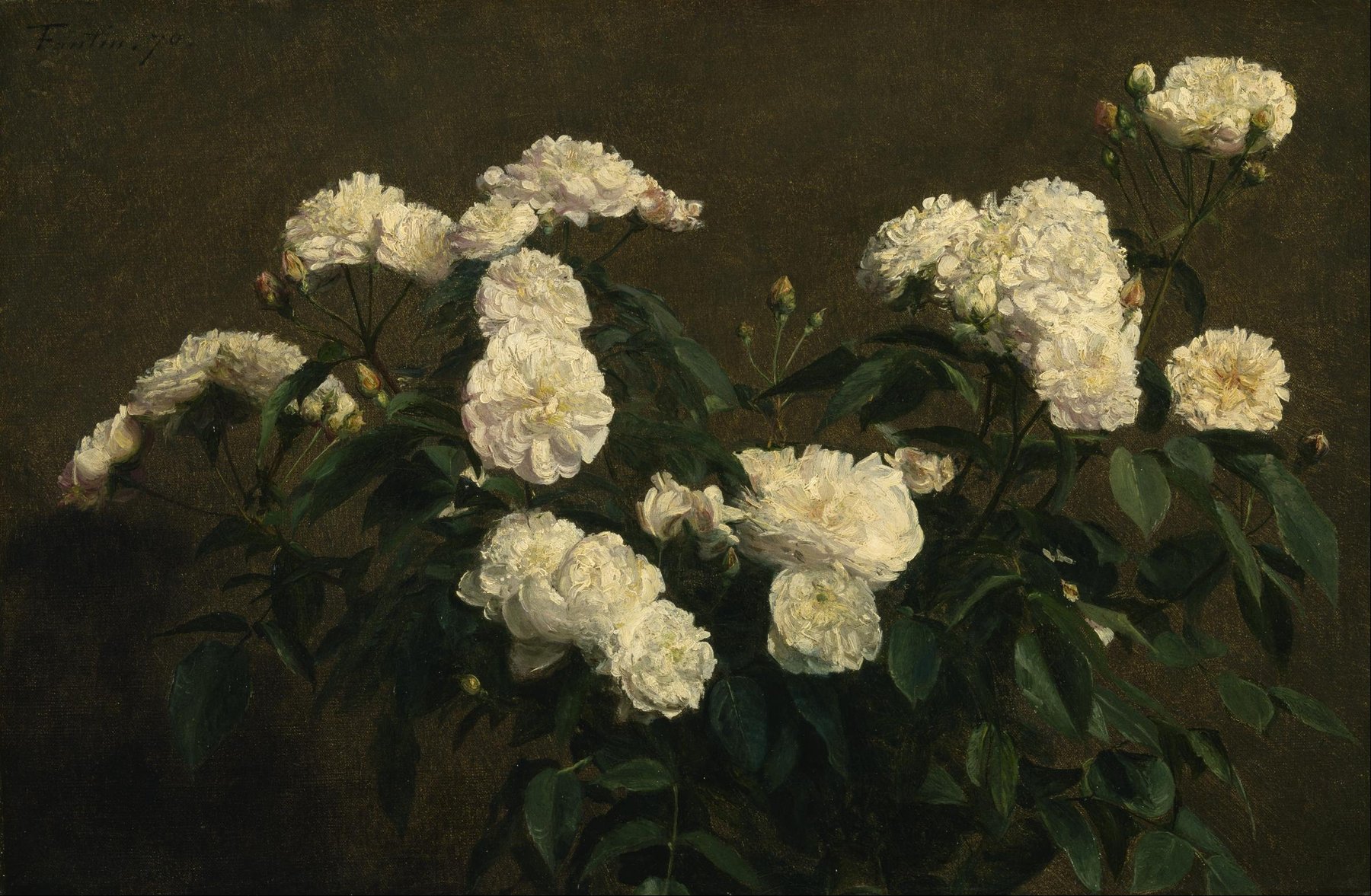
Henri Fantin-Latour is the awkward case. He was a close friend of Manet’s, painted with the Impressionist circle, exhibited his group portraits of them, and is on every long list of impressionism key artists. But his own flower paintings are the most polished, smoothly worked, and old-fashioned of the entire generation. He painted around eight hundred flower still lifes in his lifetime, mostly roses. He sold them all, mostly to British collectors. They are the financial reason he was able to also make the more experimental group portraits and figure studies he is now better known for.
The white roses above are a representative example. The petals are individually rendered. The leaves are shaded toward the back. The vase is given full perspective and a clear light source. There is almost nothing of the loose Impressionist brushwork in the flowers themselves. And yet Fantin-Latour was, in conversation and in his choice of friends, a card-carrying member of the avant-garde. He included himself in his Homage to Delacroix group portrait of 1864 alongside Manet, Whistler, and Baudelaire.
The Fantin-Latour roses are the proof that impressionism flowers, as a category, was not technically uniform. There was a conservative wing of the same generation working alongside the loose-brushwork radicals, and the most successful flower painter of the entire 1870s and 1880s in commercial terms was the conservative.
6. Monet, Water Lilies and Japanese Bridge, around 1899
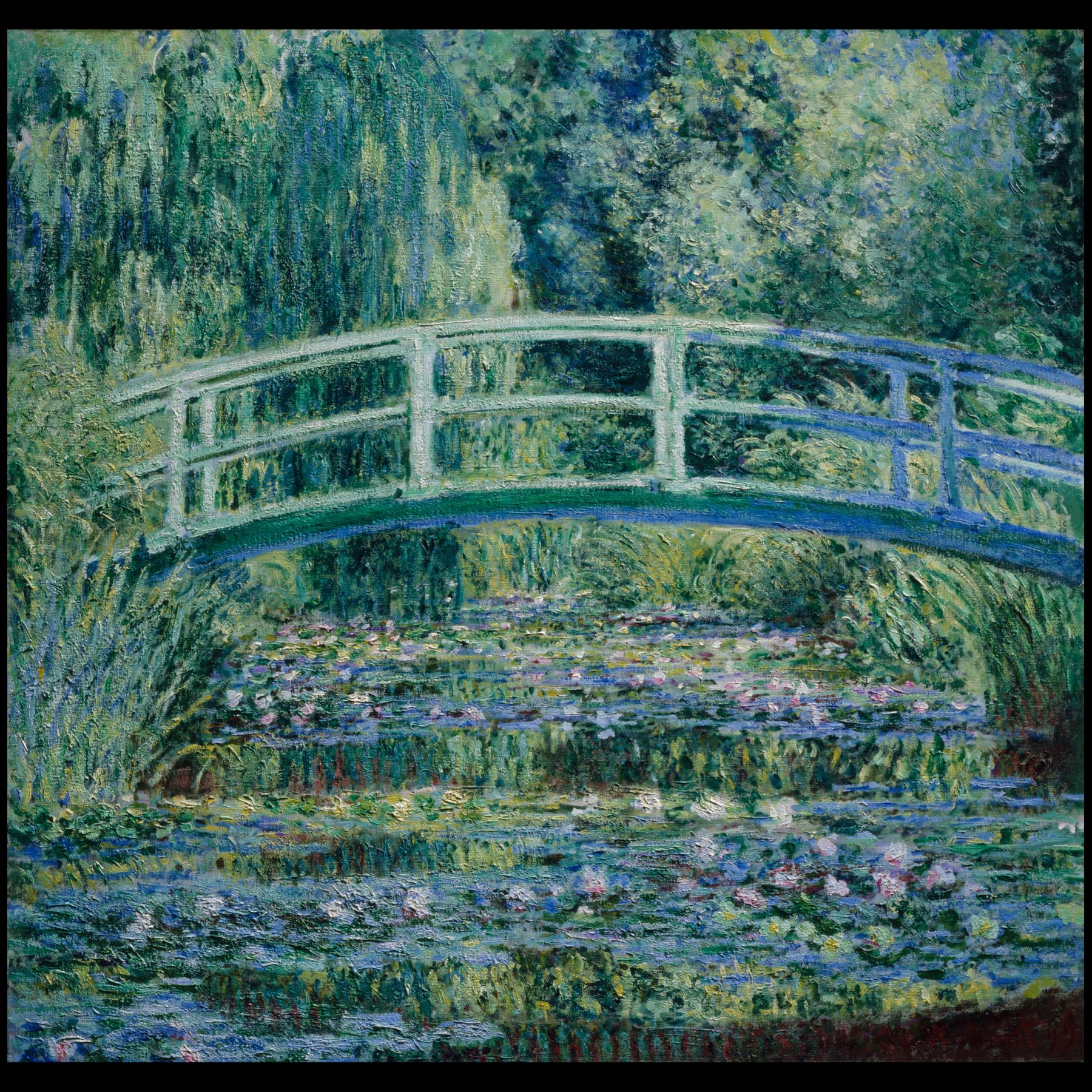
The lily-pond series did not start with the wall-sized panels at the Orangerie. It started with a smaller, tighter format that included the Japanese-style wooden footbridge Monet had built across the pond in 1895. The version above, from around 1899, is one of around eighteen canvases he made of the bridge between 1899 and 1900. The composition is more conventional than the late lilies. There is a clear horizon. The bridge spans the pond from edge to edge. The lilies are arranged in front of and behind the bridge.
This is the entry-point work for understanding the trajectory. The early pond paintings include structure. The middle period removes the bridge and the shore. The late panels remove almost everything except the floating pads and the reflected sky. Standing in front of the version with the bridge is like reading the first chapter of a long novel where the writer has not yet figured out what to leave out. The looseness comes later. First, the structure had to be set.
7. Caillebotte, Yellow Roses in a Vase, 1882
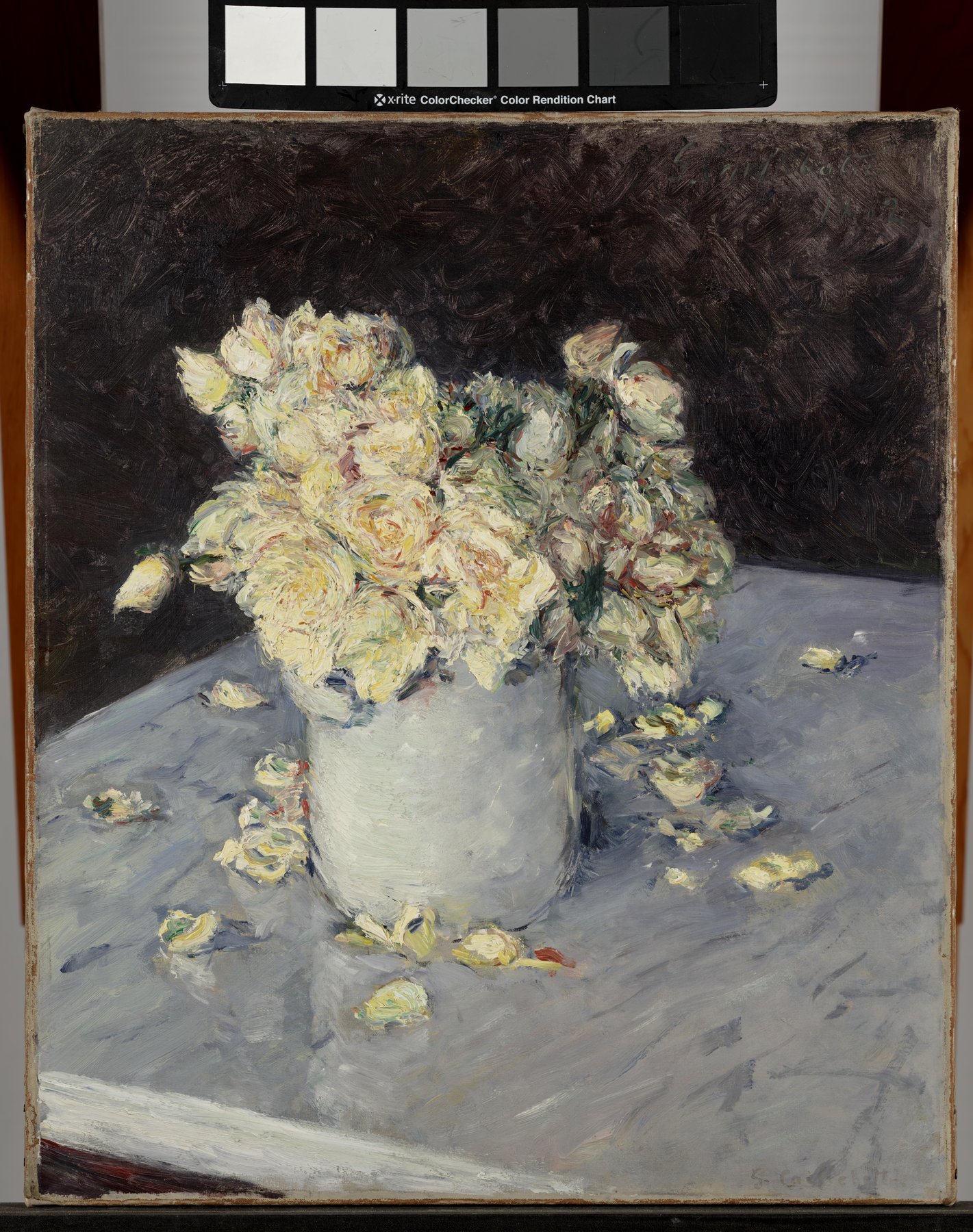
Gustave Caillebotte, who is best known for his nine-foot-wide painting of Paris in the rain and for being the silent collector who kept the early Impressionists solvent, was also a serious painter of flowers. He grew them at his property at Petit-Gennevilliers on the Seine, just downstream from Paris, where he spent the last twelve years of his life. He painted them in tighter, almost photorealistic compositions that read very differently from the bouquets of his friends.
The yellow roses above, from 1882, show six cut blooms in a clear glass vase against a near-monochrome cream-colored backdrop. The vase is rendered with engineering precision. The roses themselves are loose-brushwork Impressionist. The painting works because the precise vase makes the loose flowers look more alive than they would in a uniformly loose composition. Caillebotte had been trained as a naval engineer in his twenties and the engineer’s eye is visible in almost every painting he made.
8. Monet, The Artist’s Garden at Giverny, 1900
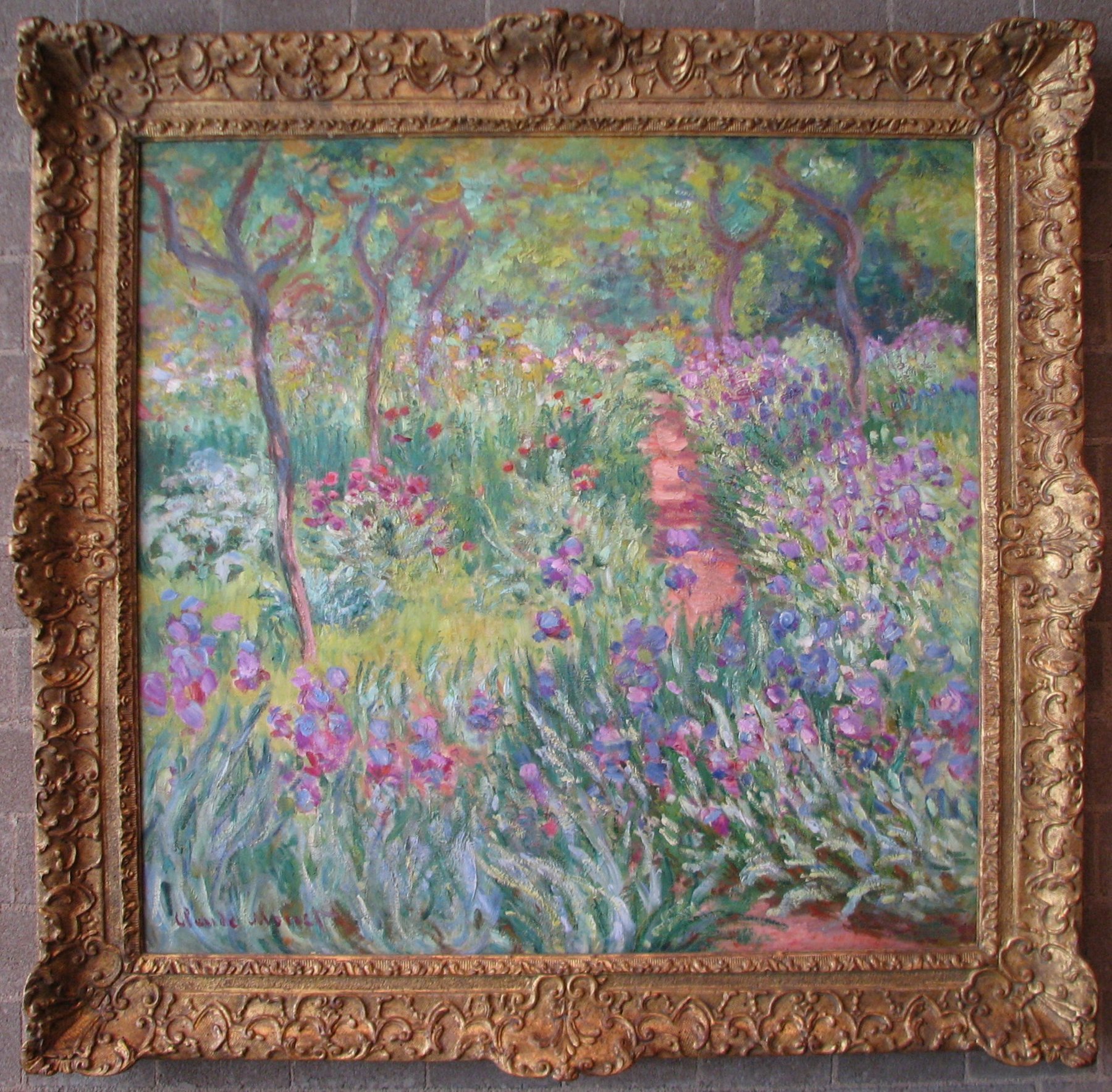
The last of the eight is another Giverny garden painting, this one from 1900, and one of the most-reproduced pictures in the impressionism garden painting tradition. The view runs down the central path of the upper garden in mid-May, looking toward the pink-stucco house at the far end. Irises in stripes of yellow, white, blue, and dark purple line the path on both sides. The light is the soft late-morning light Monet liked best for the upper garden, before the sun was high enough to flatten the blue-violets out of the irises.
This is the painting that taught most of the twentieth century what an Impressionist garden looked like. It is the source image for thousands of bedroom-wall reproductions, kitchen-towel patterns, and museum gift-shop magnets. The reason the impressionism nature paintings industry exists, in commercial terms, is largely this one canvas and the dozen close variants Monet made between 1898 and 1902.
What to look for in any Impressionist flower painting
A short checklist for the next time you stand in front of one.
First, look at the brushwork on the petals before you look at anything else. The looser the brushwork, the more recently the painter believed in the Impressionist program. A petal painted in three or four strokes is more “Impressionist” than a petal painted with the kind of finish Fantin-Latour brought to his roses. Both are valid. The technical difference is visible in seconds.
Second, look at the background. Impressionist flower paintings tend to be set against a deliberately flat or near-flat backdrop. The Manet peonies are against black. The Renoir bouquet is against blue-gray. The Caillebotte roses are against cream. The trick is to push the colors of the flowers forward by giving them nothing to compete with behind them. Compare to the Salon flower painting tradition of the same period, which used elaborate fabric or curtain backdrops, and the modernity of the Impressionist approach is immediate.
Third, look at how the light is rendered. In a real Impressionist flower painting the light source is almost always implied rather than shown. There is no clear shadow. There is no obvious lit-from-the-left rendering. The flowers seem to be glowing from inside. This is the same trick the open-air landscapes use. The light is everywhere. The painting is the light.
Chiaro reads out Monet’s 1909 letter to the dealer Paul Durand-Ruel describing the lily pond as “an obsession that has gone on for too long” while you stand in front of one of the late Nymphéas at the Orangerie and look at six feet of floating pads.
The kicker
A painter buys a small farmhouse in Normandy in 1883 because his rent is overdue in Paris. He plants a garden. The garden takes over his work. By the time he dies in 1926, the lily pond he dug himself has produced two hundred and fifty paintings, and the genre of impressionism flower paintings has become the single most reproduced category of nineteenth-century art in the world. All from a one-acre property in a village of two hundred people, sixty miles down the Seine from Paris.
Image credits
- Monet Water Lilies 1916.jpg — Claude Monet (1840-1926). Source, Public Domain.
- Monet - the-iris-garden-at-giverny-1900.jpg — Claude Monet (1840-1926). Source, Public Domain.
- Renoir - bouquet-of-flowers-1878.jpg — Pierre-Auguste Renoir (1841-1919). Source, Public Domain.
- Édouard Manet - Vase de pivoines sur un plateau laqué.jpg — Édouard Manet (1832-1883). Source, Public Domain.
- Henri Fantin-Latour - Still Life of White Roses - Google Art Project.jpg — Henri Fantin-Latour (1836-1904). Source, Public Domain.
- Claude Monet - Water Lilies and Japanese Bridge - Google Art Project.jpg — Claude Monet (1840-1926). Source, Public Domain.
- Gustave Caillebotte - Yellow Roses in a Vase.jpg — Gustave Caillebotte (1848-1894). Source, Public Domain.
- Claude Monet The Artist’s Garden at Giverny.jpg — Claude Monet (1840-1926). Source, Public Domain.


