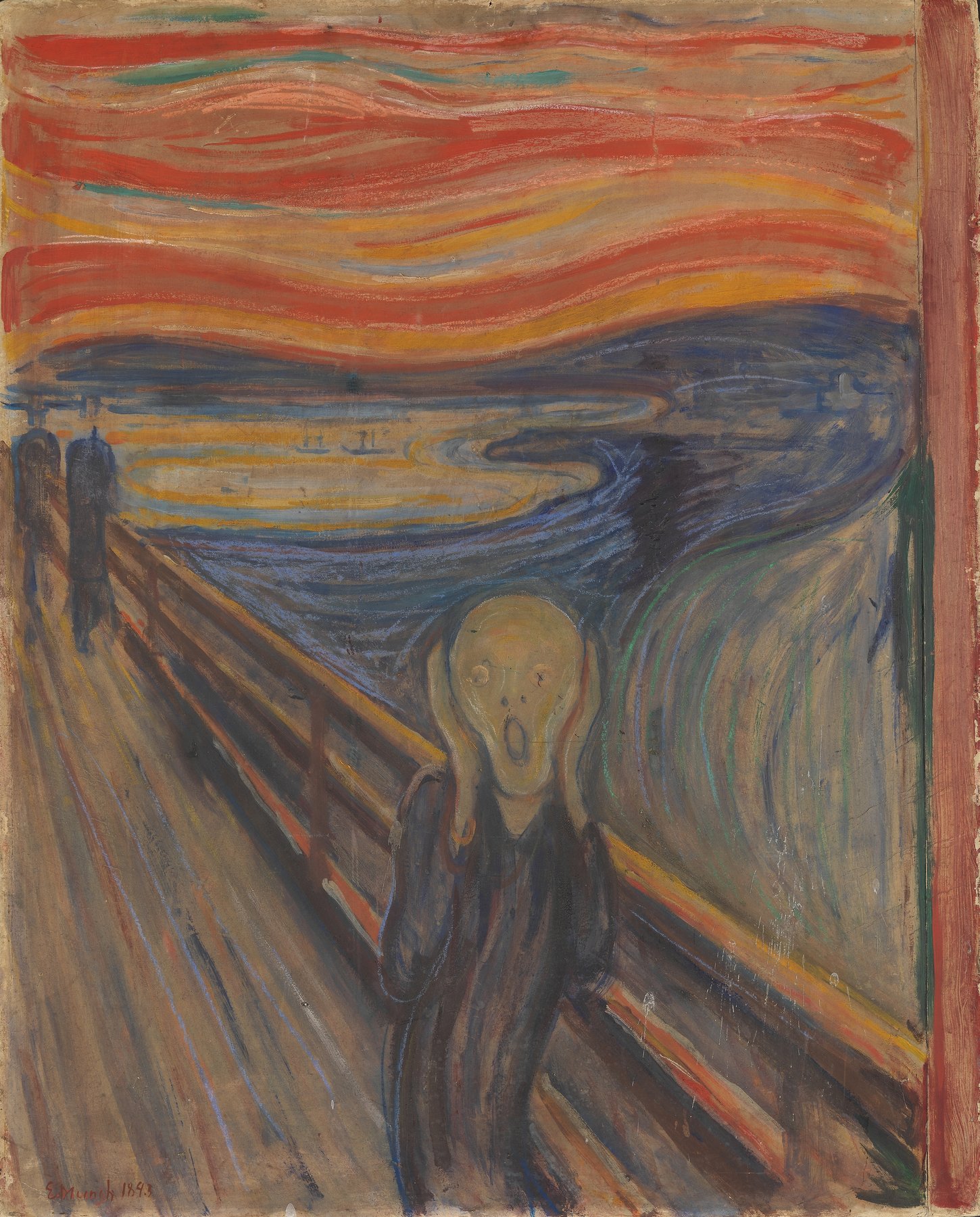
Two paintings, twenty years apart. The first is small, painted in Le Havre on a misty November morning in 1872. It shows a working harbor with an orange sun coming up over the water and three black rowboats heading out for the day. The painter was Claude Monet, the title was Impression, soleil levant, and a satirical critic looking at it in 1874 thought he was throwing an insult when he called the painters who made things like it “Impressionists.” The second is also small, painted in Oslo on an evening walk in January 1893 by a Norwegian artist named Edvard Munch. It shows a humanoid figure on a fjord-side bridge with its hands to its face, mouth open, the sky behind it bleeding orange and red and the water bleeding the same colors back. The painter wrote in his diary that the sky had felt like “an infinite scream passing through nature.” It is now called The Scream, and it is the picture most people in 2026 will picture if you ask them to picture an Expressionist painting. The impressionism vs expressionism question, in other words, comes down to two paintings, both with the orange sky on fire over a body of water, made twenty years apart, in two different countries, asking two completely different questions about what painting is for.
This is the difference between impressionism and post impressionism, and between Impressionism and Expressionism, and between Impressionism and almost everything that came after it. Three movements, all visually similar enough to confuse, all emerging from a roughly fifty-year window between 1870 and 1920 in France and Germany. The chart most websites give you to sort them out is wrong on the most important point. Here is the chart that actually works.
The one-question test
The impressionism vs expressionism art question reduces to one question, and the chart everybody uses misses it. The standard chart says Impressionism is “outdoor” and Expressionism is “indoor.” Or it says Impressionism is “happy” and Expressionism is “sad.” Both of those are misleading. Degas painted indoors and Kirchner painted street scenes, so the location chart fails. Munch’s later landscapes are joyful and Pissarro’s late Boulevard scenes are bleak, so the mood chart fails too.
The actual difference is this. Impressionism is painting what your eyes see. Expressionism is painting what your nerves feel.
That is the whole test. Hold any painting from either movement up against the question and the answer falls out cleanly. Monet’s Sunrise is a painting of a particular morning at a particular harbor with the orange sun coming up at a particular angle. The painter is trying to record his physical optical experience of looking at it. Munch’s Scream is a painting of a feeling that has nothing to do with how the fjord actually looked that evening. The sky was not actually red. The figure on the bridge does not actually have an oval head with no facial features. The painter is trying to record his nervous system’s response to a moment of dread.
Impressionism trusts the eye. Expressionism distrusts the eye. That is the whole difference. Everything else — technique, color, subject, period, country — comes out of that one disagreement.
When and where each one happened
Two short timelines, because the dates matter for how the movements relate to each other.
Impressionism: Paris, roughly 1860 to 1886. The first Impressionist exhibition was held in April 1874 in a borrowed photographer’s loft on the Boulevard des Capucines. The eighth and last group exhibition was held in 1886. By that point most of the original painters had moved on to other registers or had simply absorbed the techniques into a working method that did not need a label. The painters were a small group of about fifteen friends, most of them in Paris, all of them painting in roughly the same direction by 1880. Claude Monet was the most committed. Pierre-Auguste Renoir was the most popular. Edgar Degas was the most technically ambitious. Camille Pissarro was the only one who showed at every single one of the eight group exhibitions.
Expressionism: Germany and northern Europe, roughly 1905 to 1925. The two main Expressionist groups both formed in Germany in the early twentieth century. Die Brücke, “The Bridge,” was founded in Dresden in 1905 by four architecture students including Ernst Ludwig Kirchner. Der Blaue Reiter, “The Blue Rider,” was founded in Munich in 1911 by Wassily Kandinsky and Franz Marc. Edvard Munch in Norway and Oskar Kokoschka in Vienna are usually filed as Expressionists too, though they preceded both German groups and were never members. The whole movement was effectively shut down by the Nazis in 1937, when the Entartete Kunst exhibition labeled almost every Expressionist painter as a “degenerate” and ordered their work removed from German museums.
So Impressionism is roughly a generation older. It happened mostly in France. It was over by 1890. Expressionism is roughly a generation younger. It happened mostly in Germany. It was over by 1937, by force.
What an Impressionist painting actually does
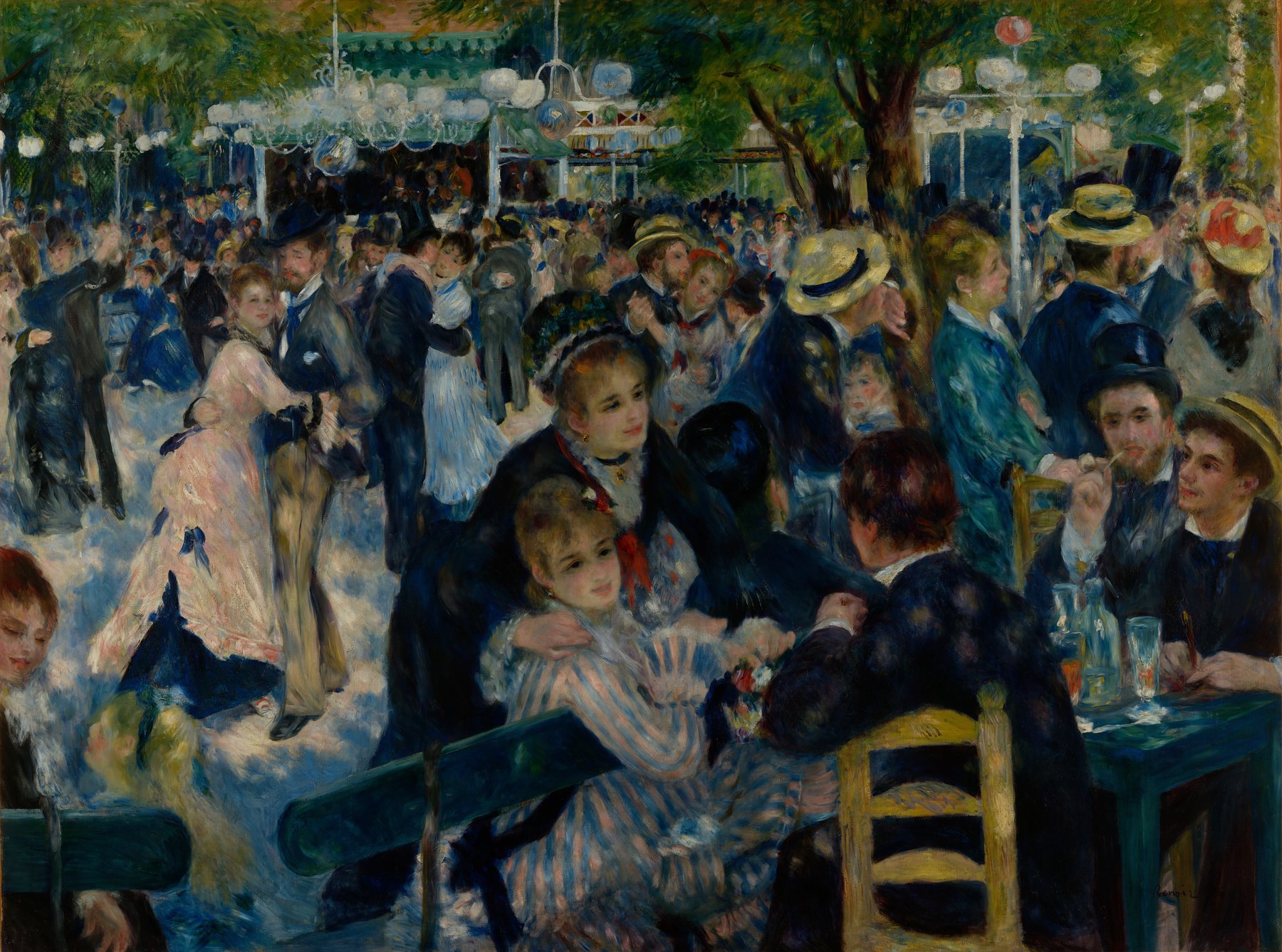
Stand in front of Renoir’s Bal du moulin de la Galette at the Musée d’Orsay and look at how the dappled afternoon light falls through the leaves onto the dancers. The painting is making a specific optical claim. On a Sunday afternoon in 1876 at an open-air dance hall in Montmartre, with the sun coming through the trees from the upper left, this is approximately what you would have seen if you had been there. The faces are not perfectly drawn. The clothes are not finished. But the light is observably real, and the dancers are observably people, and the whole painting trusts that recording these visual observations honestly is enough.
This is the Impressionist program. Look at the world. Paint it the way it actually looks at the moment you are looking at it. Do not idealize. Do not symbolize. Do not invent. The light through the leaves is genuinely the most important thing in the painting, and the painter is making no attempt to charge it with meaning beyond its own physical truth.
The technical signatures that follow from this commitment are predictable. Loose brushwork, because if you are working fast in changing light you cannot afford a polished surface. Bright color, because the new chemical pigments let you actually paint the colors in front of you instead of mixing them down to a brown academic palette. Outdoor subjects, because that is where the light experiments work. Modern subjects — trains, suburbs, dance halls, weekend rowers, ballet rehearsals, the new Paris boulevards — because those are the subjects that exist in your visible present. Cropped, off-center compositions taken from photography and Japanese prints, because that is what your actual visual experience looks like before a Salon painter cleans it up.
The Impressionist project is a project of trusting your eyes.
What an Expressionist painting actually does
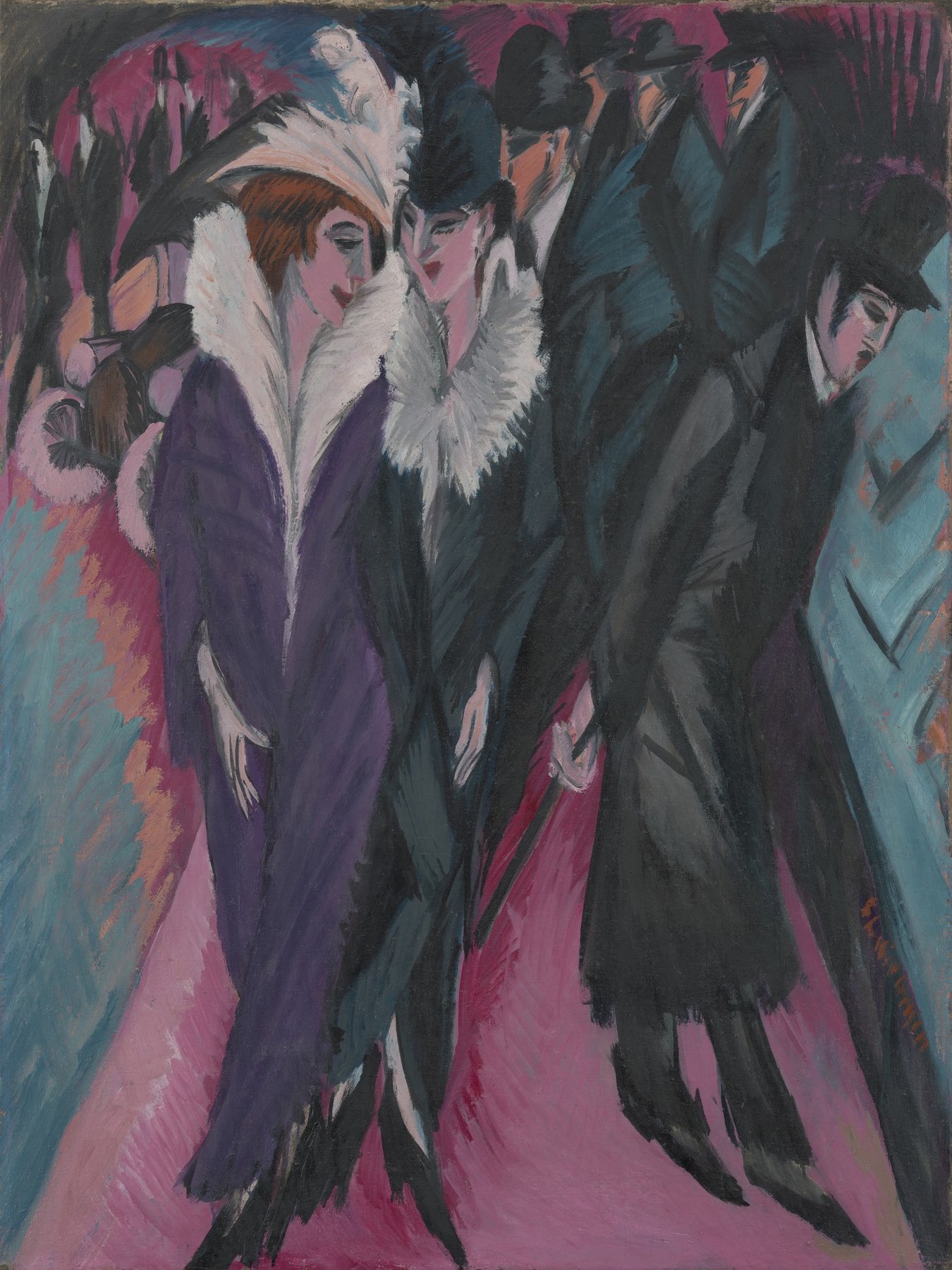
Now look at Kirchner’s Street, Berlin from 1913, hanging at MoMA in New York. It shows a Berlin sidewalk at night with two prostitutes in the foreground, a few hatted men around them, and a crowd of pedestrians compressed into the background. The figures are distorted. The faces are masklike. The colors are wrong — pink and acid green and dirty turquoise, none of them matching any actual Berlin sidewalk. The composition is tilted vertically as if the whole street is being seen through a fish-eye lens by someone who is panicking.
Kirchner is not lying about Berlin. He is painting what the experience of being on a Berlin sidewalk in 1913 felt like for him. The anxiety of urban modernity. The transactional quality of the encounters. The way prewar Berlin felt teetering on the edge of something terrible. The painting is not a record of a place. It is a record of a feeling about a place. The distortions and the wrong colors are not failures of observation. They are the whole point.
This is the Expressionist program. Do not look at the world. Look at how the world makes you feel. Then paint that. Distort whatever needs to be distorted to make the feeling visible. Use the wrong color if the right color does not carry the right charge. Bend the perspective. Make the eyes too big. Stretch the mouth. The painter’s nervous system is the subject. The world in the painting is just a metaphor for what the nervous system is doing.
The technical signatures of Expressionism are also predictable, and they are mostly inversions of the Impressionist ones. Heavy outline rather than dissolved edges. Aggressive non-natural color rather than observational color. Distorted figures rather than honestly proportioned ones. Symbolic rather than incidental subject matter. The painter is announcing the meaning rather than letting the visible world supply it.
Wait — so what is post-Impressionism?
This is where the impressionism vs post impressionism question comes in, and it is the question most casual chart-makers get wrong.
Post-Impressionism is the bridge. It is the term art historians coined in the 1910s, retrospectively, to describe a generation of painters who started inside Impressionism in the 1880s and 1890s but who pushed past its limits in different directions. Cézanne went toward structure and the formal analysis of how a painting holds together. Vincent van Gogh went toward emotional intensity and saturated color. Paul Gauguin went toward symbolism and non-Western color systems. Georges Seurat went toward scientific dot-patterns — pointillism, also called Neo-Impressionism. None of them are doing what Monet was doing. None of them are doing what Munch is doing. They are between the two.
The difference between impressionism and post impressionism, in one sentence, is this. Impressionism trusts the eye. Post-Impressionism still uses the loose-brushwork, bright-color toolkit Impressionism developed but starts using it to express something other than pure optical truth — structure, in Cézanne’s case, or emotion, in Van Gogh’s case. Post-Impressionism is not a coherent movement. It is the term we use for the four or five great painters who came out of Impressionism but who were already moving toward the Expressionist position before Expressionism existed as a label.
Van Gogh in particular is the painter who most directly anticipated Expressionism. The thick swirling brushwork in his late Saint-Rémy paintings is doing something that is closer to Munch than to Monet. The German Expressionists in the 1900s and 1910s read his letters to his brother Theo as a kind of founding document. They saw what they were trying to do already done in Van Gogh’s Starry Night, ten or fifteen years earlier.
The clean answer to is neo impressionism and post impressionism the same: no. Neo-Impressionism is the more specific term for Seurat’s pointillist approach, sometimes called divisionism, which uses small dots of pure color that the eye blends at distance. Post-Impressionism is the broader umbrella term that includes Neo-Impressionism, Cézanne’s structural project, Van Gogh’s emotional project, and Gauguin’s symbolist project. All four of those branches grew out of Impressionism in the 1880s. Two of them (Van Gogh’s and to a lesser extent Gauguin’s) fed directly into Expressionism in the 1900s.
The other comparison everyone runs into
While we are sorting out labels, the impressionism vs realism question deserves a paragraph because it is the other one that comes up.
Realism, in painting, is the movement that preceded Impressionism in France in the 1840s, 1850s, and 1860s. Gustave Courbet was the leading figure. Jean-François Millet, Honoré Daumier, and Jean-Baptiste-Camille Corot are usually filed there too. The Realist program was to paint ordinary modern life — peasants, workers, urban poor — with seriousness and without idealization. The technical execution was still relatively polished, but the subject matter was a deliberate refusal of the Salon’s preference for mythology and history. Realism was politically left and visually conservative.
Impressionism inherited Realism’s commitment to modern subjects — the train station, the suburb, the boulevard, the dance hall — but rejected its polished surface. Where Courbet would have rendered a peasant’s hands with full Old Master shading, Monet would render a haystack as three or four loose patches of complementary color. The how is different. The why is similar. Realism is the immediate ancestor of Impressionism, and the line between the two is fuzzy.
How is impressionism different from realism? It changed the brushwork, kept the subjects, added the open-air working method, and embraced color contrast. Realism and Impressionism are continuous. Realism and Expressionism are not.
Two paintings, side by side
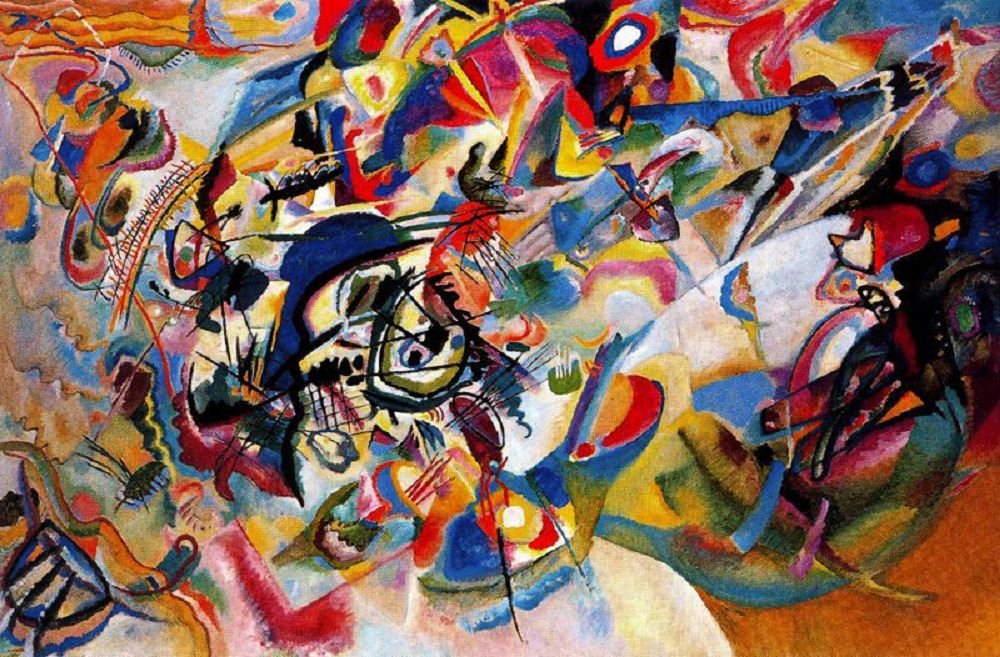
Here is the side-by-side test. Imagine Monet’s Impression, soleil levant on a wall, and Kandinsky’s Composition VII on the wall next to it. Both painted in the same forty-year window. Both about color and rhythm. Both deliberately turning their backs on academic finish.
The Monet, painted in 1872, is recognizably a harbor at Le Havre on a particular November morning. You can locate the sun, the boats, the smokestacks, the water. The rendering is loose but the subject is real and observable. The painter is asking his eye to do the work and is trusting his eye’s report.
The Kandinsky, painted in 1913, is recognizably nothing in particular. The colored shapes do not represent objects. The composition does not refer to a real place. Kandinsky himself was a synesthete who heard music when he saw color and his Compositions are essentially attempts to paint the experience of music. There is no observable subject. There is only the painter’s interior experience, made visible.
That is the impressionism vs expressionism gap in one wall. Monet trusts the world to be the subject. Kandinsky has decided the world is not the subject and that the painter’s interior life is. The painters in between — Van Gogh, Munch, Kirchner, Marc — are working out the implications.
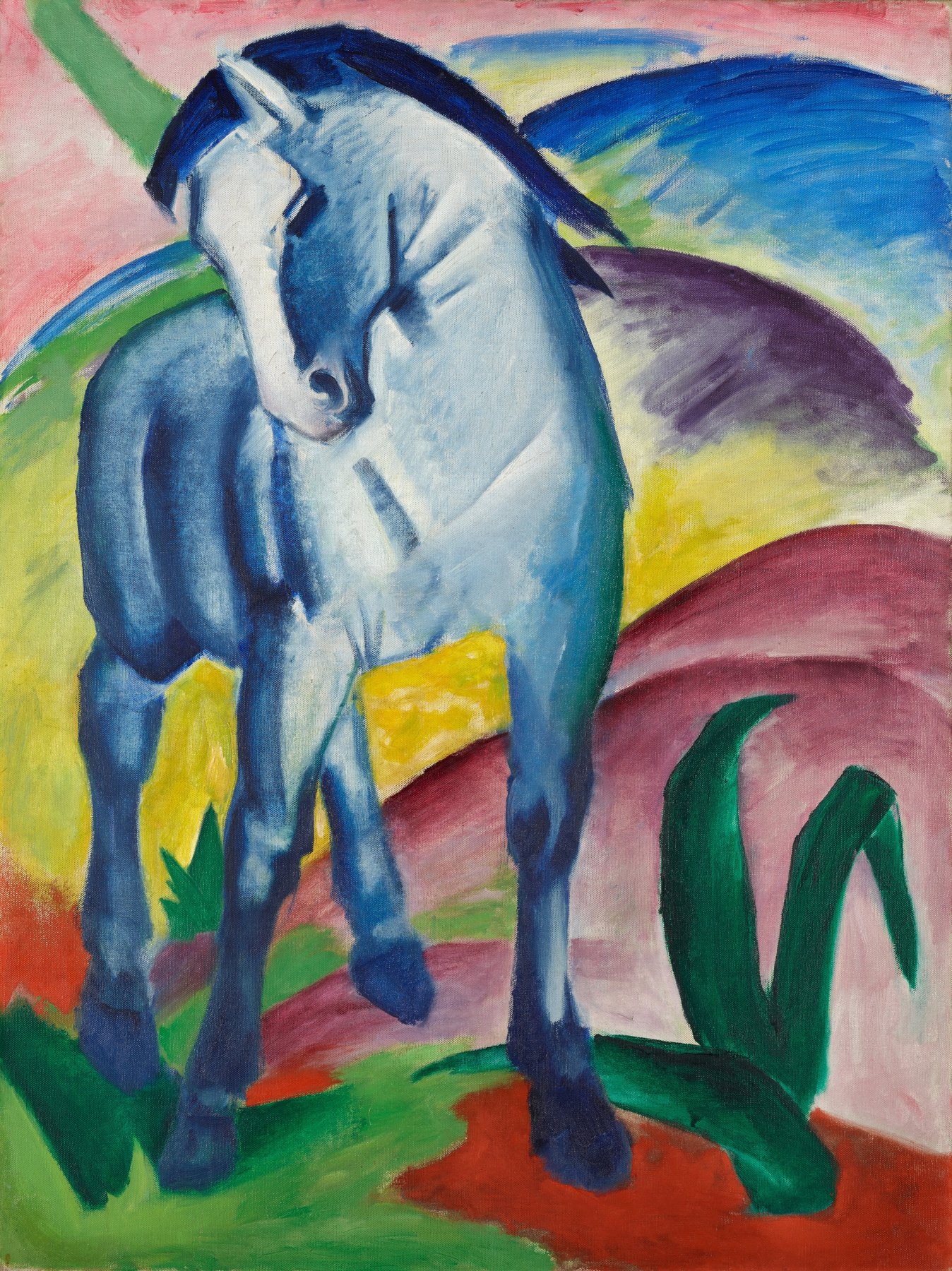
Franz Marc’s Blue Horse I, painted in 1911, makes the same argument in three feet of canvas. The horse is blue. There are no blue horses. The blue is not an observation, it is a feeling — about innocence, about animal interiority, about the spiritual seriousness Marc thought lived inside an animal that humans had dulled to the point of invisibility. The painting was one of the founding works of Der Blaue Reiter, the Munich-based Expressionist group Marc and Kandinsky started in 1911. They named the group after the blue horse and rider that recur in both painters’ early Expressionist work. The animal is the subject. The blue is the painter telling you what the animal means.
A short cheat sheet
Because the question how does impressionism differ from expressionism comes up so often, here is the comparison reduced to one line per dimension.
- Period: Impressionism c. 1860-1886, mostly France. Expressionism c. 1905-1925, mostly Germany.
- Core question: Impressionism asks “what does the world look like?” Expressionism asks “what does the world feel like?”
- Color logic: Impressionism uses observed color. Expressionism uses symbolic or emotional color.
- Drawing: Impressionism dissolves outlines. Expressionism reinstates them.
- Subject: Impressionism takes incidental modern life as subject. Expressionism takes interior emotional life as subject.
- Distortion: Impressionism distorts only as much as the eye does (cropping, off-center composition). Expressionism distorts deliberately to charge the image.
- Brushwork: Both are loose. Impressionist looseness records observation; Expressionist looseness records feeling.
- Politics: Impressionism is mostly apolitical. Expressionism is often explicitly political and was officially banned by the Nazis as “degenerate.”
- Direct ancestor: Impressionism comes out of French Realism. Expressionism comes out of post-Impressionist Van Gogh, Gauguin, and Munch.
What to look for the next time you stand in front of one
Three quick things.
First, look at the color. If it could plausibly be the color of the actual scene, you are probably looking at Impressionism. If the sky is acid green or the face is pink against teal, you are probably looking at Expressionism.
Second, look at the line. If the edges of objects are dissolved into the surrounding atmosphere, Impressionism. If the edges are heavily outlined or carved out with hard strokes, Expressionism.
Third, look at the figure. Are the proportions roughly what proportions usually are? Impressionism. Or are the eyes too big, the head misshapen, the body bent? Expressionism. Chiaro reads out Munch’s January 1893 diary entry about the “infinite scream passing through nature” while you stand in front of one of the Scream lithographs and look at the sky bleeding red.
Most of the impressionism vs expressionism confusion in casual writing comes from looking at the brushwork alone. Both movements use loose brushwork. The brushwork is not the difference. The difference is what the brushwork is recording.
The kicker
A misty Le Havre harbor in November 1872. A figure on an Oslo bridge in January 1893. Twenty years between them, two different countries, two different generations. Both have an orange sky on fire over the water. The first painter is trying to tell you what the morning looked like. The second painter is trying to tell you what the evening felt like. That is the entire impressionism vs expressionism question, in two paintings, both small, both with the same color in the sky.
Image credits
- Edvard Munch, 1893, The Scream.jpg — Edvard Munch (1863-1944). Source, Public Domain.
- Auguste Renoir - Dance at Le Moulin de la Galette - Google Art Project.jpg — Pierre-Auguste Renoir (1841-1919). Source, Public Domain.
- Ernst Ludwig Kirchner, 1913, Street, Berlin.jpg — Ernst Ludwig Kirchner (1880-1938). Source, Public Domain.
- Vassily Kandinsky, 1913 - Composition 7.jpg — Wassily Kandinsky (1866-1944). Source, Public Domain.
- Marc, Franz - Blue Horse I - Google Art Project.jpg — Franz Marc (1880-1916). Source, Public Domain.


