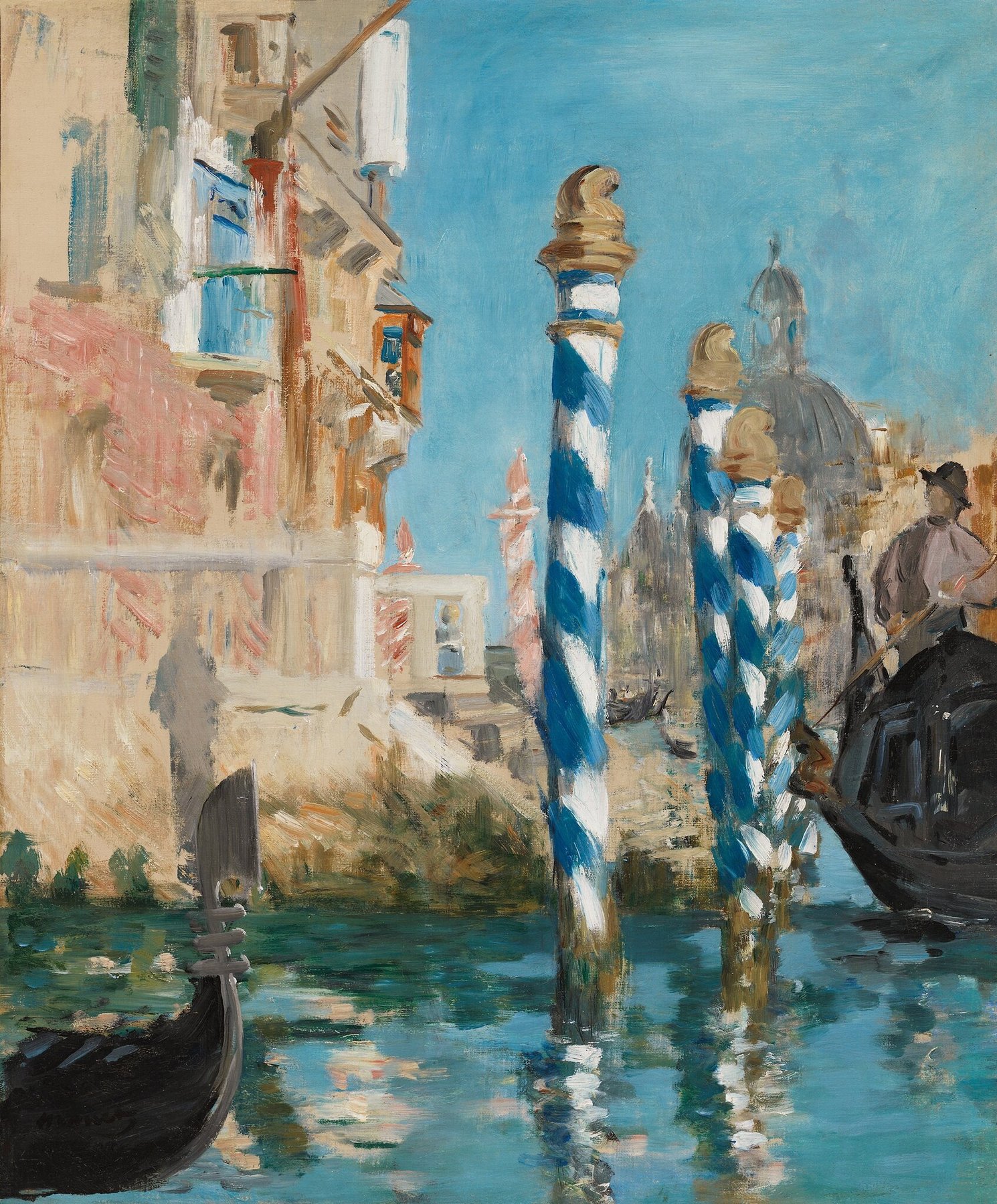
In the early autumn of 1874, Edouard Manet boarded a train at the Gare de Lyon in Paris with his brother-in-law, the painter James Tissot, and crossed the Alps for the only trip to Venice he ever took in his life. He was forty-two. He had spent the summer at Argenteuil on the Seine painting next to Claude Monet and Pierre-Auguste Renoir, who had just held the first Impressionist exhibition together six months earlier. Manet had refused to exhibit with them — he believed in the Salon and wanted to win the Salon’s gold medal — but he had been watching what they were doing with broken color and the small detached touches of paint that registered light. He took a train to Venice to try it himself, in a different city, away from his Paris studio. He stayed for about four weeks. He came back to Paris with two oil paintings of the Grand Canal. They are the only Manet venice paintings he ever made.
Both pictures are dominated by a single visual device that Manet must have noticed within an hour of arriving: the striped mooring posts. The pali in the Grand Canal — the wooden posts driven into the lagoon bed for tying up gondolas — are painted with diagonal bands of color according to the heraldry of the family whose palace sits on the canal behind them. Blue and white for one palazzo, red and white for the next, dark green and ochre for a third. The posts stand in clusters of three or four in front of each palace, the colors marking the territory of each family along the water. Manet seized on this. In both his Venice paintings the posts are the structural device. They are vertical, brightly colored, and they read against the soft horizontal of the canal in a way that solves a painting problem he had been working on for ten years — how to anchor a loose-brushwork composition with a few sharp graphic accents.
The Tissot connection
The reason Manet was in Venice at all in September 1874 was Tissot. James Tissot was a French painter who had fled Paris during the Commune of 1871 — he had been politically compromised, painting portraits of Communard officers in his Paris studio — and had relocated to London, where he had spent three years making a small fortune painting English society women in striped silk dresses on yachts and lawns and decks. By 1874 Tissot was rich, well-connected, and looking for a vacation. He invited Manet, who had been his classmate at the Ecole des Beaux-Arts in the 1850s and who, like Tissot, had spent the previous winter exhausted by a difficult Salon submission. The two of them met in Paris in early September, took the train south, and went to Venice together.
They stayed at the Hotel Europa on the Grand Canal, between the Salute church and the mouth of the canal at the lagoon, which gave Manet a working window onto the water. He worked outdoors, at the edge of the canal, on small canvases he could carry under his arm. He did not paint the famous tourist views — no San Marco, no Doge’s Palace, no Rialto Bridge. He picked two stretches of the canal in front of unfamous palaces and painted the posts.
What he was doing technically
The Manet grand canal Venice painting that everyone calls View in Venice — the larger of the two, now in the Paul G. Allen Collection — shows the canal in front of the Palazzo da Mula, near the church of the Salute. The water is a single broken blue, painted with horizontal touches that catch the choppy lagoon light. The palazzo on the far side is built up in three flat horizontal bands of color — the red-brown of the brickwork at the base, the cream-white of the upper stories, and the deep red of the tiled roofline — with no architectural detail to speak of. The windows are dark slashes. The posts in the foreground are blue and white. A single gondola moves across the middle distance with a black-cloaked gondolier in the stern, painted with two quick strokes.
The technique is what Manet had learned from watching Monet at Argenteuil in the summer of 1874. The brush is loaded with separate dabs of color rather than blended on the palette. The water is built out of dozens of small touches of blue, blue-green, and cream, each one approximating a wave or a reflection or a patch of shadow. The painting is finished but not polished. The whole canvas is about ninety centimeters wide — a little under three feet — and would have fit in a steamer trunk. The painter Berthe Morisot, who was Manet’s sister-in-law and the most attentive observer of his career, wrote to her sister Edma after seeing the painting back in Paris that it was “Edouard at the moment he is starting to admit the others were right” — the others meaning Monet and Renoir.
Blue Venice is the bolder picture
The second Venice painting, smaller and looser, is called Blue Venice (Le Grand Canal a Venise). It is at the Shelburne Museum in Shelburne, Vermont, in the collection of Electra Havemeyer Webb, the American sugar heiress who bought it from a Paris dealer in 1925 for her private museum. The painting shows a different stretch of the canal — the bend just past the Accademia, looking back toward the Salute — with a small white motorboat-less gondola in the foreground and three striped posts marking the foreground plane. The blue is more saturated than in the larger picture, the water more agitated, the palace facades on the right side built up in even fewer marks. Blue Venice Manet painted, according to the painter’s later account to his friend Antonin Proust, in three afternoons in the same week as the larger painting. It is rougher. It is also, in the opinion of most twentieth-century critics, the better picture.
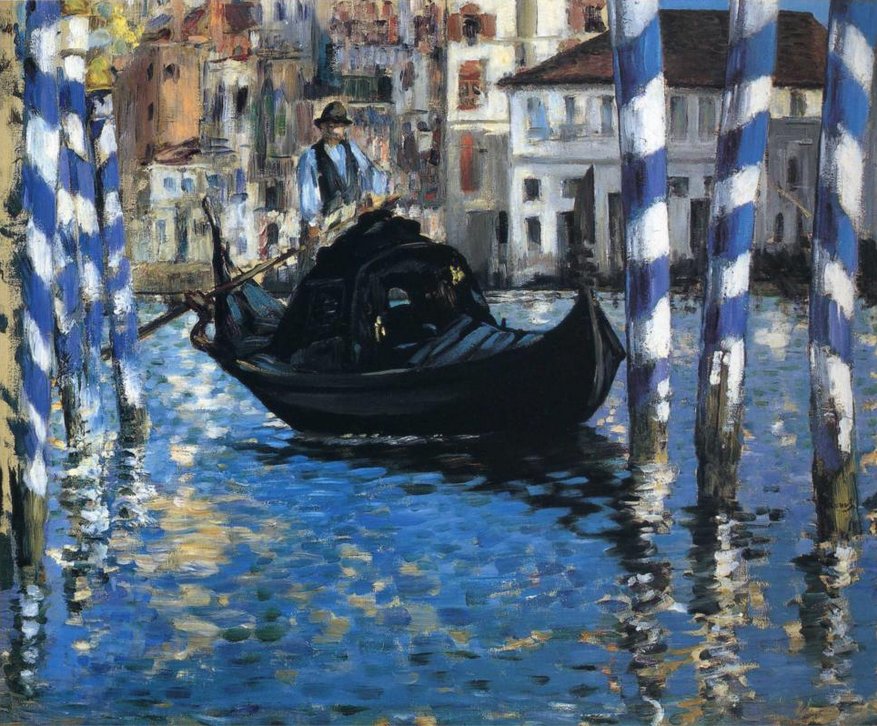
The thing that makes Blue Venice the better picture is the striped posts. Manet painted the three foreground posts in the lower right corner of the canvas with confident vertical strokes of cobalt blue alternating with strokes of titanium white, each stripe about an inch tall in the painting. The posts are slightly tilted, the way real mooring posts always are after a few winters in the lagoon. They give the canvas a foreground that the rest of the painting — the loose water, the loose facades, the small gondola in the middle distance — can lean against. Painters had been struggling with the problem of how to compose a Venice picture for two hundred years, since Canaletto’s eighteenth-century vedute. Canaletto had solved it with architectural precision — every column on the Doge’s Palace counted, every figure in a gondola sized to its distance from the viewer. Manet solved it with two striped posts. The economy is the trick.
The other painters in the city
Manet was not the only foreign painter in Venice in the autumn of 1874. James McNeill Whistler had arrived a few weeks earlier and would stay for fourteen months, producing the Venice etchings and the small pastels of nocturnes on the lagoon that became some of the best work of his career. Whistler was painting fog and twilight — the soft middle hours when the city went gray. Manet was painting noon. The two painters knew each other — they had both shown at the Salon des Refuses in 1863, the alternative exhibition where Manet’s Dejeuner sur l’herbe and Whistler’s Symphony in White had both been jeered at — and they may or may not have met in Venice that autumn. The records are unclear. The two of them were working in the same city on the same canal in the same six weeks and produced almost opposite pictures.
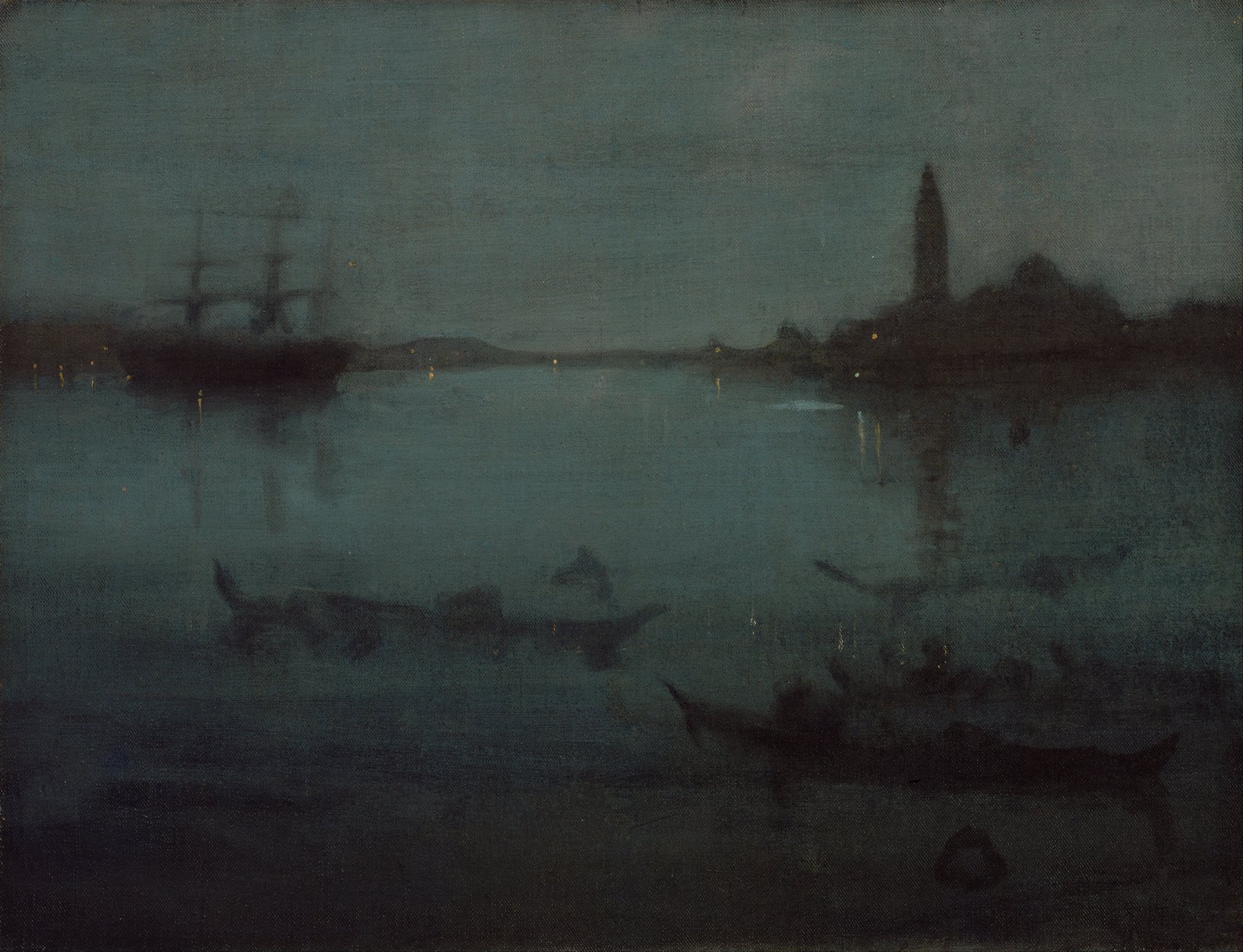
The contrast is the wait-really moment of the Venice trip. Manet had built his Paris reputation on flat color and the refusal of atmospheric depth. He had painted the bartender at the Folies-Bergere head-on, the picnic on the grass head-on, the rest at home head-on. He went to Venice — the city of mist and reflection, the city that had made painters atmospheric for three hundred years — and he refused to be atmospheric. He painted the canal as if it were a flat-color theatre flat, with three striped posts in the foreground holding up the composition. Whistler, who had built his career on the soft tonal harmonies of his Nocturnes, went to Venice and painted it as a poem of fog. Each painter brought to Venice exactly what Venice was supposed to soften out of him. Neither one budged.
The trip did not change him
Manet went back to Paris in mid-October 1874 and never went south again. He spent the next nine years until his death in April 1883 painting Parisians in Parisian settings — the bar at the Folies, the railway station at Saint-Lazare, the picnic at Argenteuil, the asparagus, the lemon, the portrait of Madame Manet on a blue couch. The Venice paintings sat in his studio. The larger one sold during his lifetime to a dealer named Durand-Ruel. The smaller one — the Blue Venice — sold to a Parisian collector named Henri Vever in the 1880s and then changed hands four times before Electra Havemeyer Webb bought it in 1925. Both paintings are now in American collections, and neither has ever been exhibited in Venice.
The reason the Venice trip did not change him is that Manet was finishing rather than starting. He was forty-two. He had four years of declining health ahead of him — the syphilis he had contracted as a young man was beginning to affect his legs — and he had already made the paintings that would secure his reputation. Olympia and Dejeuner had been painted in 1863, when he was thirty-one. The Bar at the Folies-Bergere, his last major canvas, was painted in 1882. The Venice paintings are bracketed by the two big careers, the early and the late, and they belong to neither. They are vacation work. They are also among the freshest pictures he ever made, because they were vacation work. He was painting without the pressure of the Salon, without the politics of the Impressionist exhibitions, without his own reputation to defend. He stood on the edge of the Grand Canal and painted what was in front of him.
What to look for
The two Venice paintings rotate between private collections and special exhibitions. The Paul G. Allen Collection, which holds the larger View in Venice, has lent the painting to the Frick in New York, the National Gallery in Washington, and the Museo Correr in Venice itself for special shows. The Blue Venice at the Shelburne Museum hangs year-round in a small dark room on the second floor of the Electra Havemeyer Webb building, with three pieces of furniture from the Havemeyer Paris house arranged in front of it. Wherever you find one of the paintings, look at the foreground posts. They are the painting’s structural argument. Count the stripes. There are usually four bands of color per post, alternating, with the colors corresponding to the heraldry of a Venetian family the painter probably did not know by name. The water is built out of separate touches. The gondolas are two strokes each. Chiaro reads the September 1874 trip, the Whistler counter-current, and the Berthe Morisot letter at the moment you are standing in front of either painting, so the four weeks Manet spent on the Grand Canal get told at the right distance from the striped posts.
The peculiar thing about a one-time Venice painter is that the city does not get diluted by repetition. Monet painted Venice in 1908 and went back twice in his head, painting the Doge’s Palace from memory at Giverny for the next four years. Whistler made fifty Venice etchings. John Singer Sargent did Venice his entire life. Manet did Venice once. The Venice paintings are not a series. They are not a phase. They are two canvases made in one autumn by a painter who had four years to live and who looked at the city’s most painted view and put three striped posts in the foreground and called it done. The economy is what makes them last.