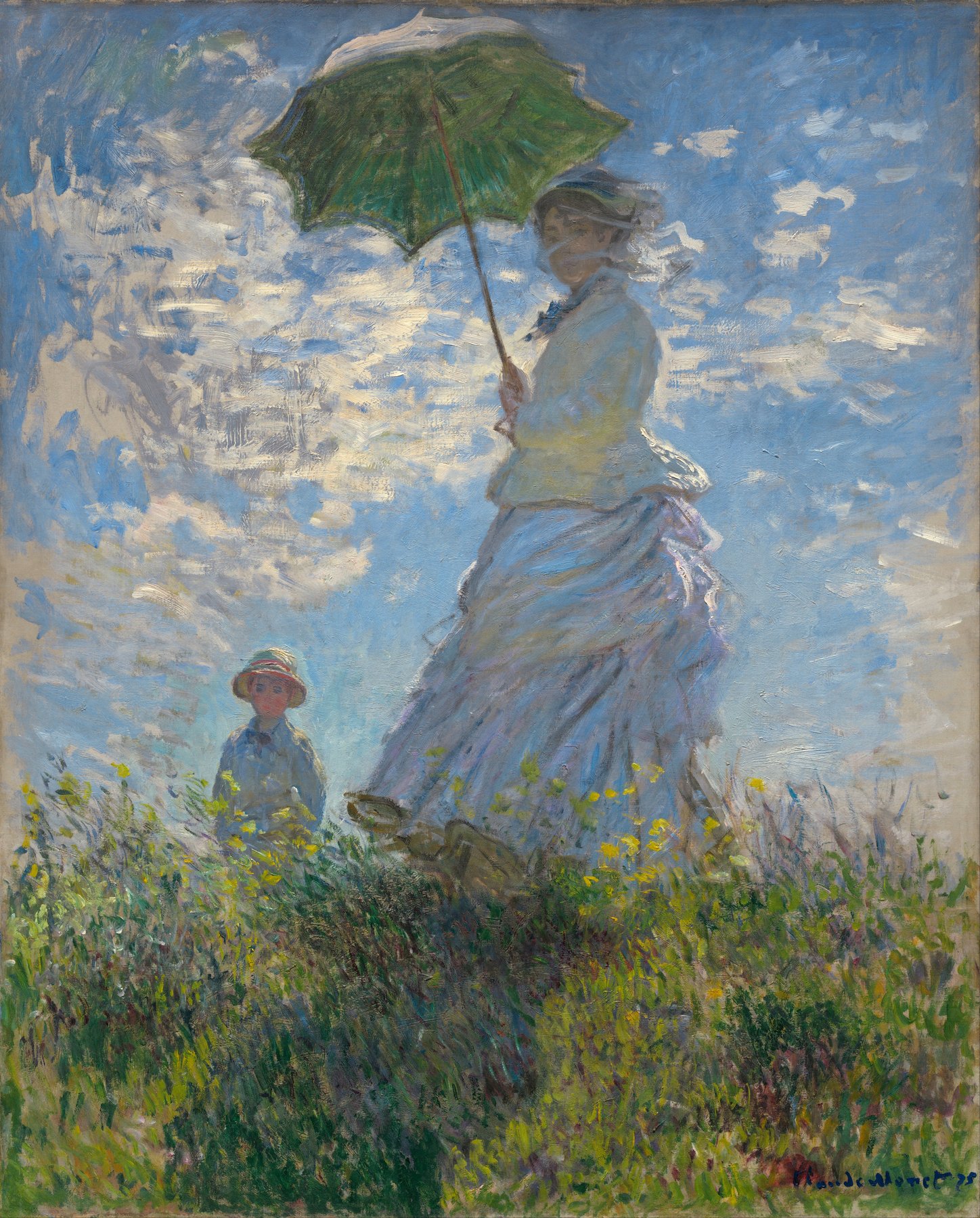
In the summer of 1875, in the small commuter town of Argenteuil on the Seine just outside Paris, Claude Monet asked his wife Camille and their seven-year-old son Jean to walk up the small hill behind their rented house and stand in the field at the top while he set up an easel below. He worked very fast. The picture is one hundred centimeters tall by eighty wide. The brushwork is loose to the point of looking unfinished. The figure of Camille is built out of about three hundred separate strokes laid down in roughly four hours, give or take. She is wearing a long white dress and a navy belt, holding a green parasol over her head and turning slightly back toward the painter, her face shaded under the parasol, her dress pulled and pressed against her left leg by the wind. The boy is small and almost cut off at the lower edge of the field, half-hidden in the grass. The Monet woman with a parasol painting in its first version was finished in 1875. Camille Doncieux Monet died of pelvic cancer four years later, on September 5, 1879, at thirty-two years old. Eleven years after the first painting Monet painted the same composition twice more, in 1886, from memory, without Camille in it, and never painted his late wife again. Those three pictures, taken together, are one of the most direct things any nineteenth-century painter ever did about loss.
The day in 1875
Monet was thirty-four. Camille was twenty-eight. They had been married for five years — they had married in June 1870, three years after Jean was born, after Monet’s family had refused to recognize the relationship because Camille was a working-class model and not a suitable wife for the son of a Le Havre grocer. By 1875 they were renting a comfortable house in Argenteuil with a small garden, financed largely by the patient and increasingly desperate generosity of Monet’s friend and patron, the painter and collector Gustave Caillebotte. The Impressionists had held their first group exhibition the previous April. The reviews had been bad. Monet was selling almost nothing.
The picture he made of Camille that summer afternoon is informally called La Promenade — “the walk.” Its full Monet-given title at the National Gallery in Washington is Woman with a Parasol — Madame Monet and Her Son. He showed it at the second Impressionist exhibition in April 1876. The critic Albert Wolff, writing in Le Figaro, called the entire show “five or six lunatics, one of them a woman, who have come together to exhibit their works.” Camille is the second painting in the catalogue. The first thing you notice about it in person is the angle. You are looking up at her. Monet has set the horizon line at her hip level, which means he was painting from below the slope — crouched or seated — and Camille is standing above him, slightly back-lit, the sun behind her shoulder, her body throwing a long pale-violet shadow down the grass toward the painter. The whole composition is about a man looking up at his wife on a windy day.
The wind is the part of the painting that most people miss. Look at the dress. The white skirt is pulled hard against her left leg. The dark blue ribbon at her waist is blown out to the side. The shawl, or veil, attached to her hat is streaming behind her head. The grass below her bends in the same direction as the dress. The clouds in the sky are torn into long horizontal smears that match the angle of the grass. The whole picture is an instrument for recording one direction of wind, which is from her right toward her left, and a single moment of light, which is mid-afternoon with the sun roughly behind her. Monet was painting what the photographers of the same decade could not yet record, which was weather. The reason the brushwork is loose is that it had to be. He had four hours of light and one direction of wind and a wife who could not pose forever.
Camille
She was born Camille-Leonie Doncieux in 1847. She met Monet in Paris around 1865 when he was looking for a model for a large studio painting of a picnic, his answer to Manet’s then-recent Dejeuner sur l’herbe. She posed for him in the Camille (Woman in a Green Dress) painting that he showed at the Salon of 1866, which is the picture that established his name. She moved in with him. She gave birth to Jean in August 1867, while Monet was visiting his family in Le Havre under pressure to leave her. She posed for him at least thirty-two more times over the next twelve years — as a woman in a garden, as a woman reading on a sofa, as a woman in red on a Japanese-style robe, as a young mother, as a figure walking on a cliff, as a passenger in a railway carriage. By the late 1870s she was sick. The cancer was diagnosed in 1878. She gave birth to their second son Michel in March 1878 already very ill and never recovered. She died in September 1879 in their house at Vetheuil, fifty kilometers downstream from Argenteuil, with Monet at the bedside. He painted her in death — a quiet, awful canvas now in the Musee d’Orsay, where her face is wrapped in a violet-blue light and her body is a smear — and he wrote later that he had caught himself, while she lay dying, “studying the play of colors on her dead face. Reflexes of yellow, of grey.” He felt monstrous for it. He kept painting.
The 1886 echoes
Eleven years passed. Monet was forty-six. He had moved to Giverny with his second household — his patroness Alice Hoschede and their combined children — in 1883. He was successful now. His dealer Paul Durand-Ruel was selling his paintings in New York. He had stopped painting figures almost entirely. In the summer of 1886, while staying at the country house in Giverny, he picked up the parasol composition again. He painted two new canvases of the same size and the same upward angle and the same wind-blown skirt. The model was Suzanne Hoschede, Alice’s eighteen-year-old daughter, his future stepdaughter. He titled both pictures “Essai de figure en plein air” — “study of a figure outdoors.” In the first, Suzanne faces left, looking back over her shoulder, in white dress and green-lined parasol. In the second, painted right after the first, she faces right. The composition in both is almost identical to the 1875 picture of Camille. The angle, the wind, the parasol, the grass at the woman’s feet, the long pale shadow falling toward the painter — everything is the same. The face is different. The face in the 1886 pictures is deliberately blank. He scumbled it over with the same colors as the parasol shade.
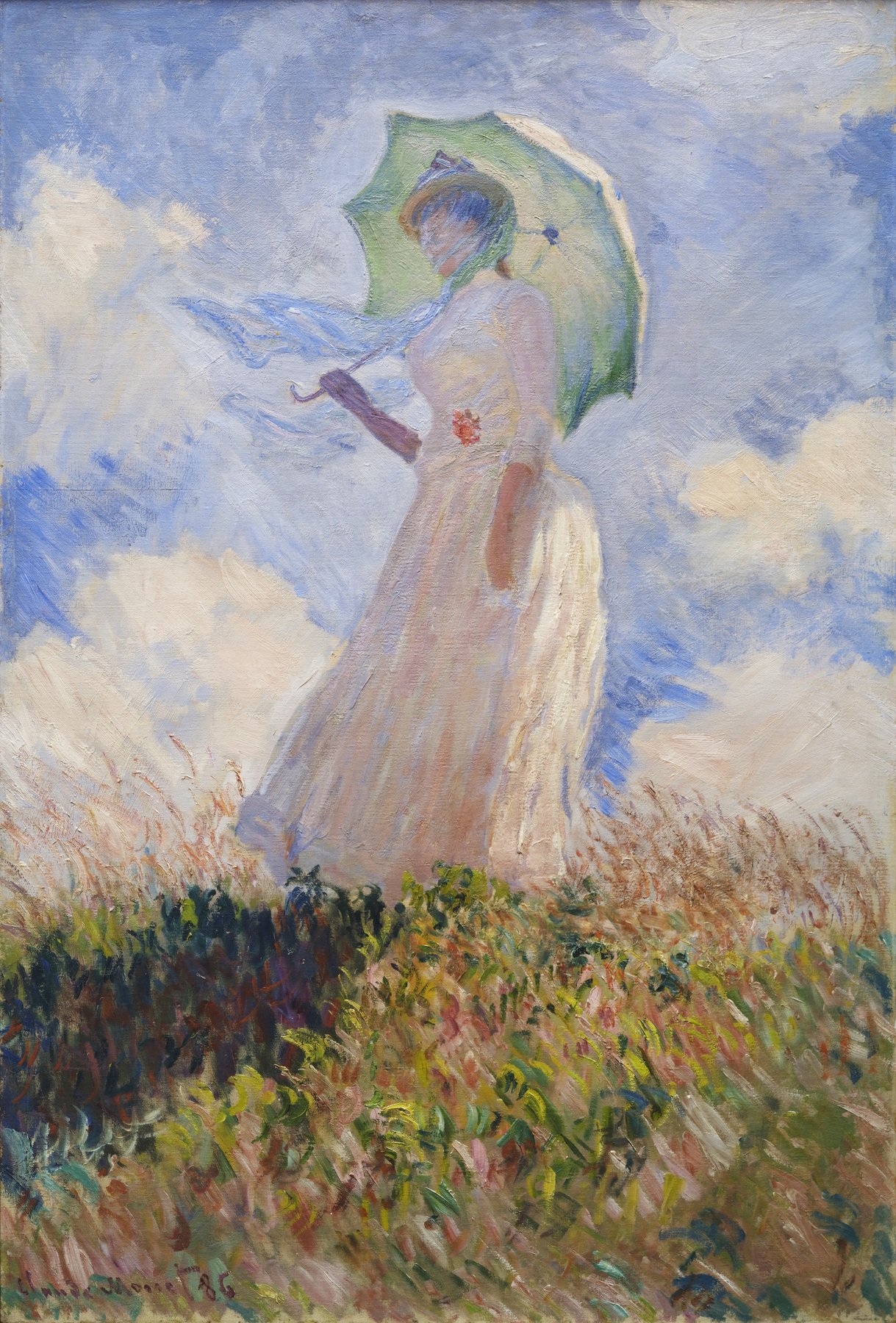
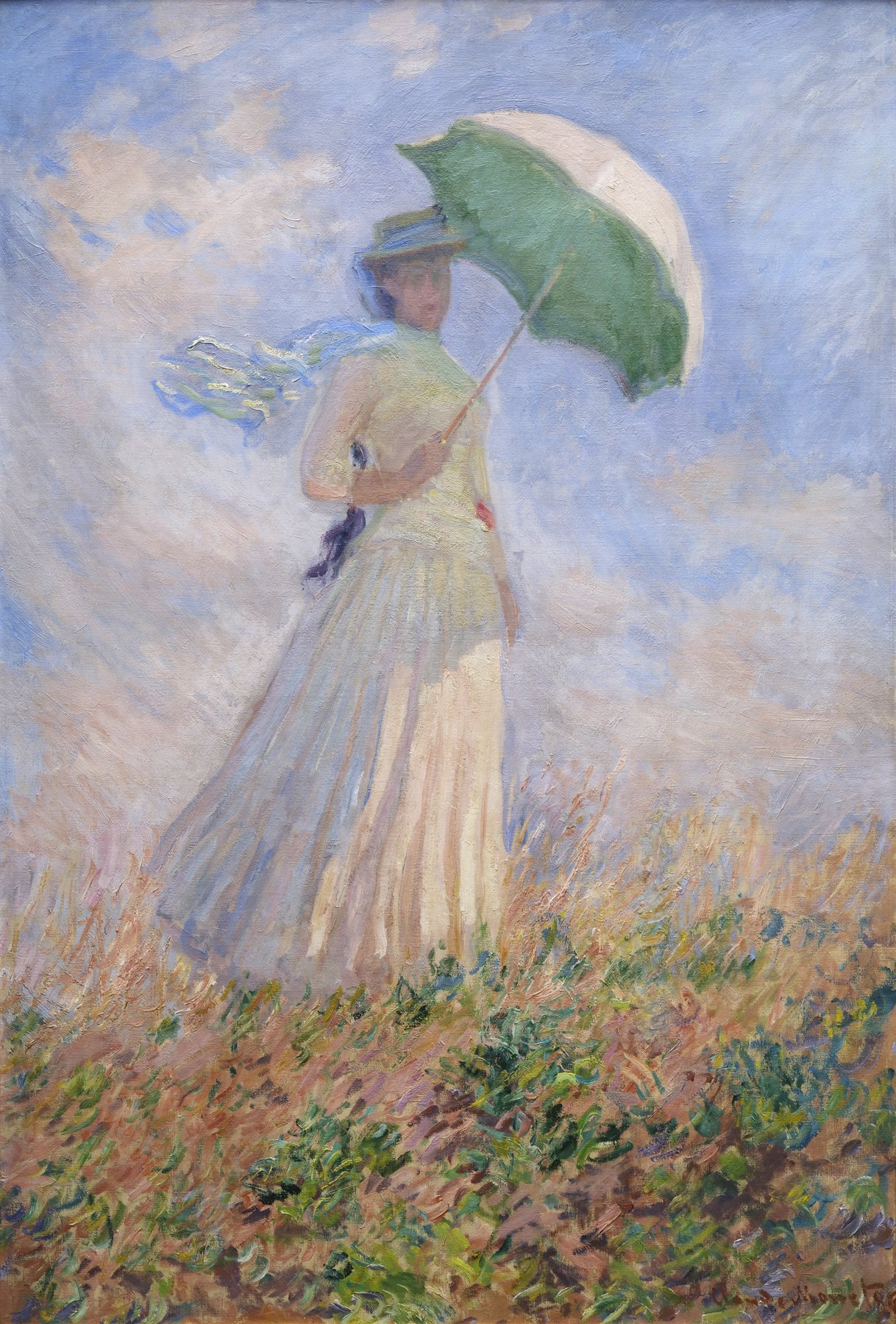
The art historian Paul Hayes Tucker, whose 1995 book Claude Monet: Life and Art is still the standard biography, put it as plainly as anyone has. “The 1886 paintings are not portraits of Suzanne. They are paintings of the 1875 painting of Camille, with Suzanne standing in for her body.” Tucker’s case is that Monet was, eleven years after his wife’s death and seven years after he started his second household, painting the same picture again to figure out how to keep painting it without her in it. The blanked-out face is the give. Suzanne’s features are erased because Camille’s are no longer recoverable. He could remember the wind and the dress and the angle. He could not remember the face.
Chiaro places the three canvases side by side in your ear — the 1875 hero, then the 1886 left-turning Suzanne, then the 1886 right-turning Suzanne — and reads the relevant passage from the September 5, 1879 letter Monet wrote about Camille’s death while you look at the hero’s blue-violet shadow.
What the National Gallery says about the painting
The hero painting has been at the National Gallery of Art in Washington since 1983, when it was given by Paul Mellon and his wife Bunny. They had bought it in 1972 from the Durand-Ruel gallery in New York for around a million dollars, which at the time was a respectable but not extraordinary price for a major Monet. (A late water lily had sold the year before for a multiple of that.) The Mellons hung it in their house at Oak Springs in Virginia for eleven years and then gave it to the museum on Mellon’s seventy-sixth birthday. It hangs now in the West Building, in the East Garden Court, on a wall by itself. It is the most popular painting in the museum on Sundays. The National Gallery does not own either of the 1886 versions. Those are at the Musee d’Orsay in Paris, where they hang in the same gallery on the fifth floor, two meters apart, the left-facing and the right-facing.
What to look for
Three things, when you find the 1875 picture. First, the angle. Stand directly in front of the canvas and notice that Camille’s hip is at your eye level. The horizon is unusually low. You are seeing her as Monet saw her, which was from a few steps down the slope. Second, the shadow. Her shadow falls down the grass toward you. It is painted in pale violet and yellow. It is not a black silhouette. It is the color of grass with the sun taken out of it. Third, Jean. The boy in the lower left is almost an afterthought, his face barely articulated. He is the figure that proves the picture is a family painting and not just a study. The composition does not need him. Monet put him in because the painting is about the three of them on a hillside.
If you can get to the Orsay, look at the two 1886 pictures in the same trip. The face of the woman in those is the question the painting is asking. The face of Camille, in the 1875 picture, is the answer. Monet stopped painting that answer in 1879. He spent the rest of his life painting around it.
The kicker
Monet kept the 1875 painting in his own house at Giverny until 1890, fifteen years after he made it and eleven years after Camille died. He sold it that year to the American collector James Sutton, who shipped it to New York. He sold it because his second wife Alice told him to. Alice, who had been waiting since 1879 to be made his real wife, did not want her predecessor on the wall.
Image credits
- Hero: Claude Monet, Woman with a Parasol - Madame Monet and Her Son (1875), National Gallery of Art, Washington — via Wikimedia Commons, public domain.
- Inline 1: Claude Monet, Study of a Figure Outdoors (Woman with a Parasol facing left), 1886, Musee d’Orsay, Paris — via Wikimedia Commons, public domain.
- Inline 2: Claude Monet, Study of a Figure Outdoors (Woman with a Parasol facing right), 1886, Musee d’Orsay, Paris — via Wikimedia Commons, public domain.
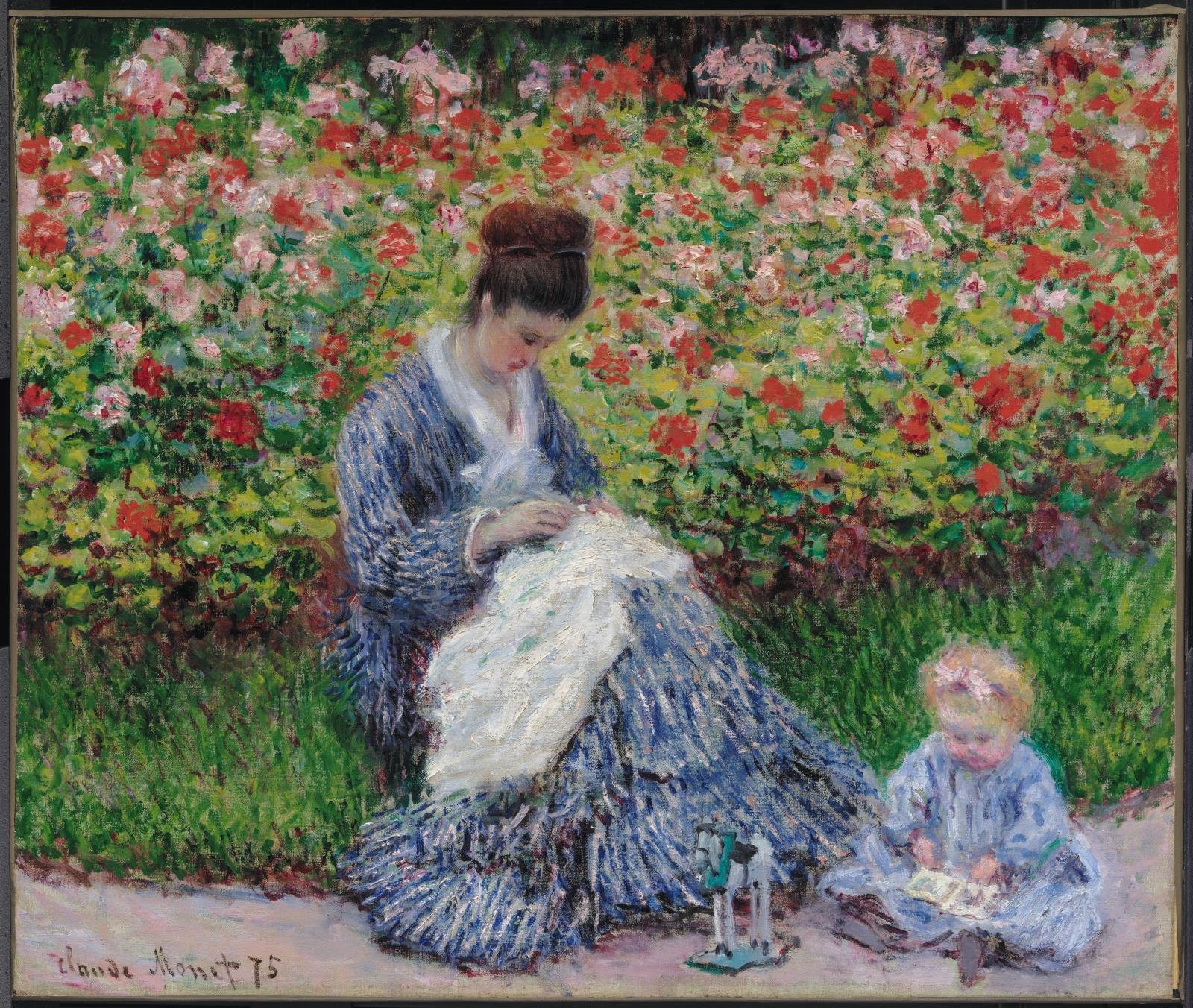
- Inline 3: Claude Monet, Camille Monet and a Child in the Artist’s Garden in Argenteuil (1875), Museum of Fine Arts, Boston — via Wikimedia Commons, public domain.