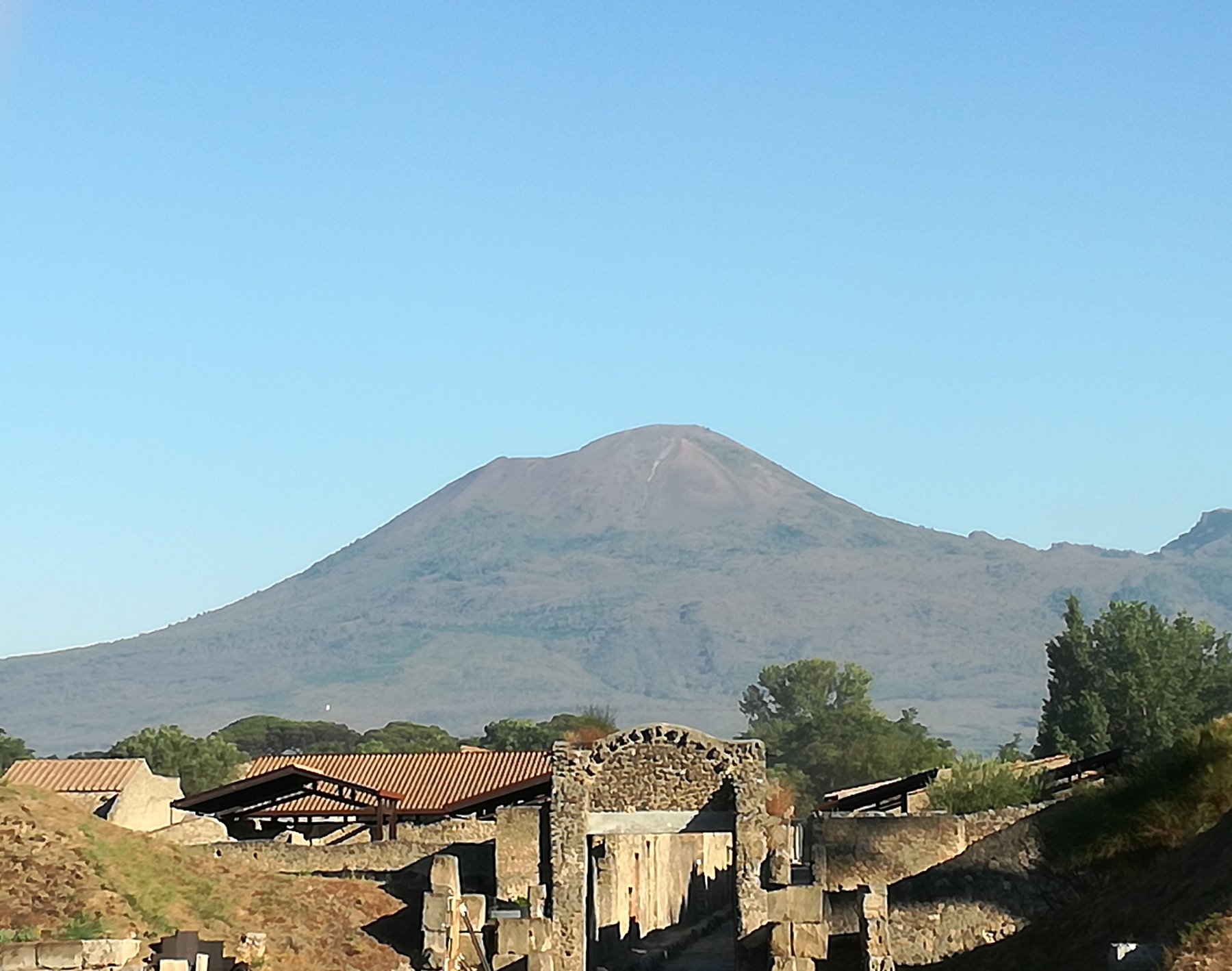
On the afternoon of October 24, 79 AD, a baker in Pompeii slid eighty-one loaves of bread into a brick oven and closed the iron door. The bread is still there. It is carbonized, black, hard as ceramic, and the loaves still bear the eight-wedge cuts the baker pressed into the dough with the side of his hand. The oven and the bread are in a glass case in the Naples archaeological museum. Nobody opened that door for one thousand six hundred and seventy years.
This is what Pompeii is. The volcano did not just destroy a Roman city. It catalogued it. Vesuvius dropped roughly seven meters of pumice and ash on a working town in the space of a single afternoon, sealed the lid down with a final wave of superheated gas in the small hours of the next morning, and then walked away for sixteen centuries. When the first treasure hunters cut into the deposit in 1748, what came out was not ruins. It was a town with the lights still on.
The afternoon that buried it
Pompeii sits at the foot of Mount Vesuvius on the Bay of Naples, about a four-hour ride south of Rome by horse in the first century. In the year 79, it was a prosperous, mid-sized provincial city of roughly twelve thousand people. The forum had been damaged in a heavy earthquake seventeen years earlier and was still being repaired. Construction scaffolding was up all over town. Life was normal in the way life is normal in any town where the slow rebuild has become the new normal.
What the residents did not know is that the earthquakes of the previous decades had been the volcano clearing its throat. The mountain above them had not erupted in living memory. Strabo, writing a generation earlier, had identified Vesuvius as a former volcano based on the look of its rocks, but no Roman expected it to wake. The traditional date of the eruption is August 24, but recent re-readings of charred organic remains, autumn fruit preserved in storage jars, and the heavy wool clothes on the bodies suggest October 24 is closer to the truth.
In the early afternoon, the mountain opened. A column of pumice and ash rose roughly twenty miles straight up before it began to fall. Pliny the Younger, watching from across the bay at Misenum, described it in a letter to Tacitus as a column shaped like an umbrella pine, branching at the top. His uncle, Pliny the Elder, sailed toward the eruption to rescue people and died on the beach at Stabiae, probably of asphyxiation. Pliny the Younger’s letter, written about thirty years later from memory, is the only first-person account of the event. It is also the document from which modern volcanology took the term “Plinian eruption.”
The pumice that fell on Pompeii in the first six hours was the size of marbles, then golf balls. Roofs began to collapse under the weight. People who tried to leave on the open road were pelted hard enough to knock them unconscious. Most of those who stayed indoors suffocated when the ash filled the rooms or were crushed when the timbers gave way. Around one in the morning, the column itself collapsed and began producing a series of pyroclastic surges — dense, ground-hugging clouds of ash and gas moving at about three hundred miles an hour at temperatures of about five hundred degrees Fahrenheit. The fourth surge reached Pompeii. Anyone still alive in the city died in seconds.
The casts
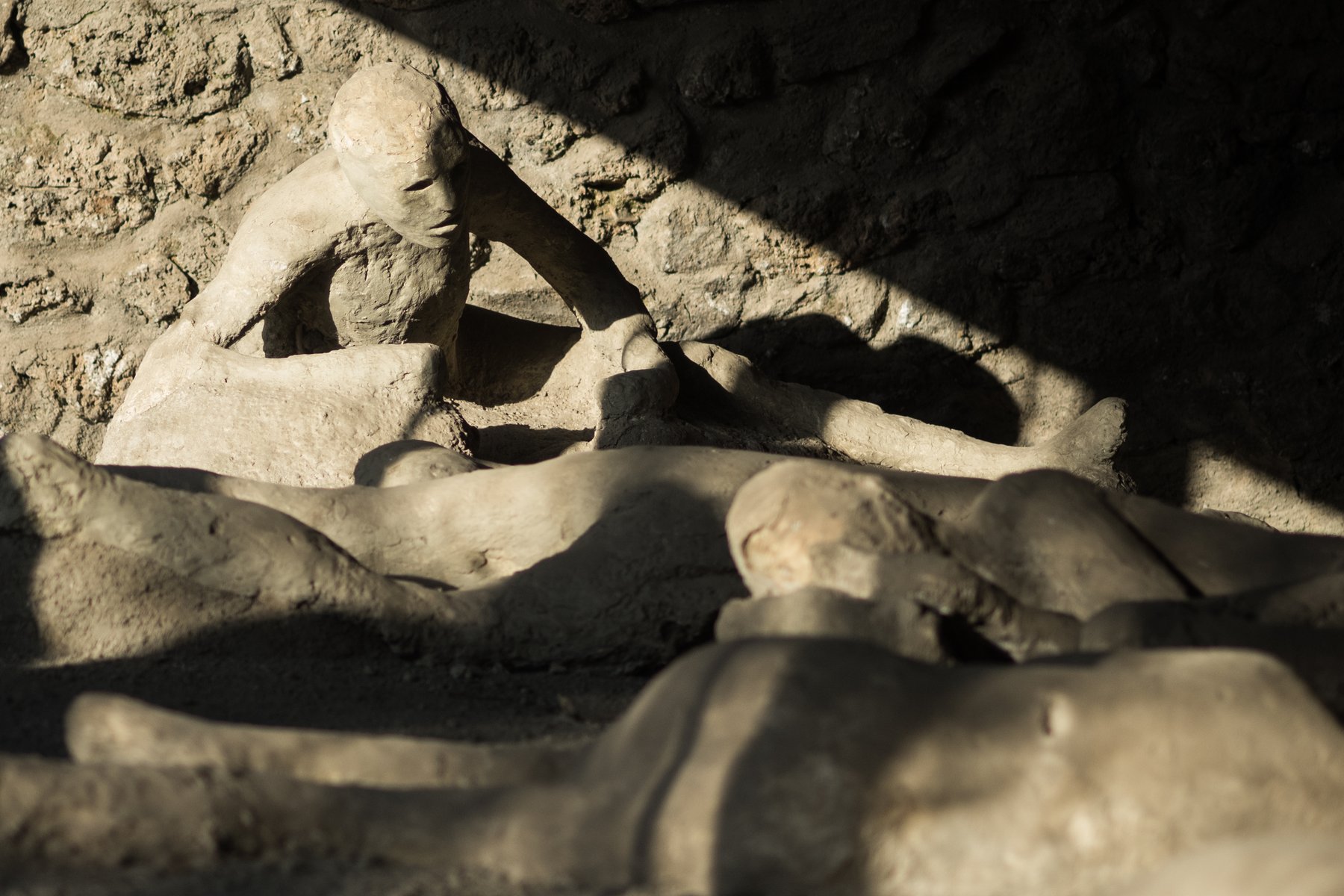
In the 1860s an archaeologist named Giuseppe Fiorelli noticed that his workmen kept hitting hollow voids in the ash. He had them stop digging when the next void was reached and instead pour liquid plaster into the cavity. They left the plaster to set, then chipped the ash away. What came out was a person.
The ash, falling on the bodies of the dying, had hardened into a mold around them. Skin and clothes had decayed in the centuries since, leaving a perfect negative space inside the rock. Fiorelli was casting that negative space. The result is the most disturbing archive in archaeology. You can see facial expressions. You can see the texture of tunics. You can see a dog twisted in agony against a chain, a pregnant woman curled around her belly, a family of four found together in a corner of a back room, a man sitting with his head in his hands. The Pompeii bodies are not skeletons. They are the shape of human beings at the instant of their last breath.
Roughly thirteen hundred such casts have been made. Recent estimates put the death toll across the wider Vesuvius region at around two thousand confirmed, with many more unrecovered. The bodies cluster at the city gates and along the streets where people tried to flee. They also cluster in the upper floors of houses, where families had gone to wait the storm out.
What you walk through
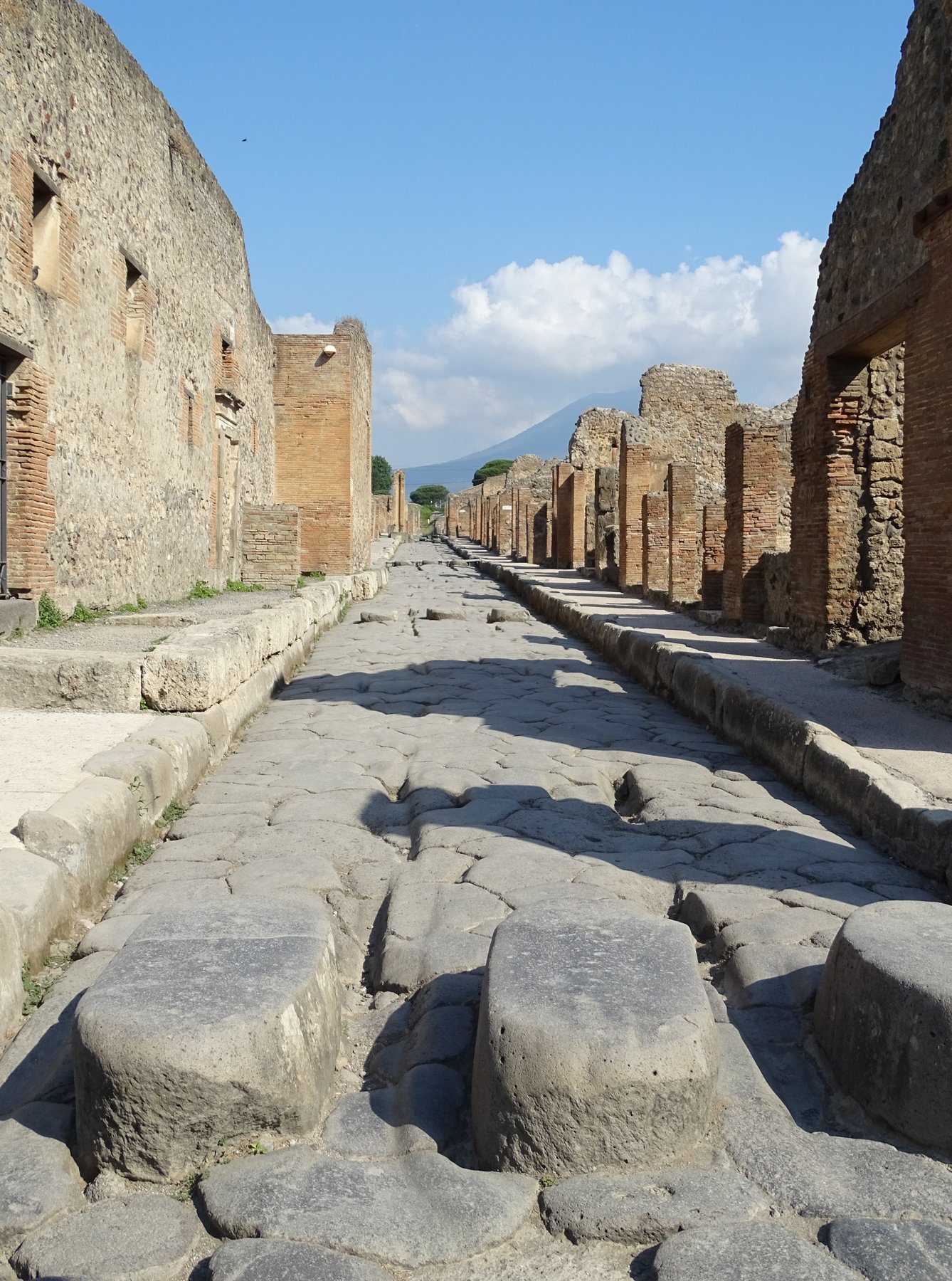
The streets are basalt slabs cut by the wheels of carts into ruts you can still drop a finger into. Stepping stones cross the road at every intersection, three or four blocks of stone set into the pavement at a height that lets a pedestrian walk over without stepping in the runoff and lets the axles of a cart pass between them. The width of the gap between stepping stones is the standard Roman cart axle width. Every cart in Italy was built to that gauge for centuries because of these stones.
Inside the houses, the floors are still mosaic. The walls are still painted. The pigments in the frescoes are still vivid because they were sealed in an oxygen-free ash bath within hours of being made. The reds are still red. The yellows are still yellow. There is a fresco in the brothel showing the menu of services, painted directly above each room’s door for clients who didn’t speak Latin. There is a wine bar on the Via dell’Abbondanza where the marble counter still has a circular stain ring where someone, on the last morning, set down a wet cup. The cup is gone. The ring is not.
The painted rooms
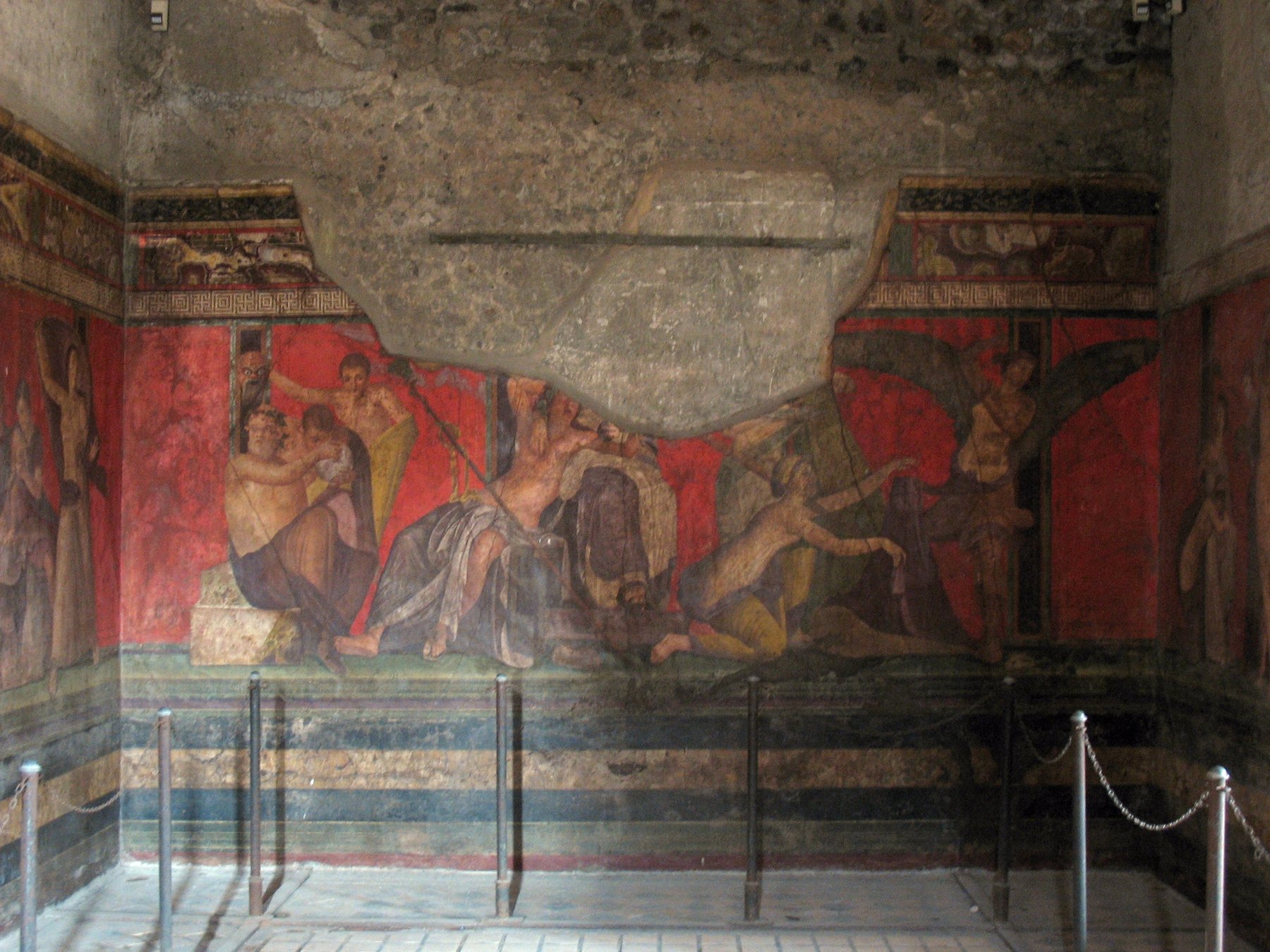
The Villa of the Mysteries sits just outside the city wall, an upper-class country house that was empty on the day of the eruption. Its main reception room is painted with the largest surviving Roman fresco cycle in the world. Twenty-eight nearly life-size figures on a saturated cinnabar-red ground, in a continuous frieze around the room, enacting what is generally read as a Dionysian initiation — a ritual that a bride may have undergone before her wedding. Nobody is sure. The figures move from a child reading sacred text, to a woman uncovering a winnowing basket with what looks like a phallus inside, to a winged woman swinging a whip, to a bride being initiated.
The fresco is two thousand years old and looks like it was painted last year. You can see the brushstrokes. You can see the order in which the colors were laid down. The figure of the bride at the climax of the cycle has cheeks flushed with rouge that is still pink. The cinnabar wall was pigment ground from mercury sulfide, which the Romans called minium and imported from the mines at Almadén in Spain. It was an expensive room. Chiaro reads the figures in order around the room while you stand at the right doorway, in the order a Roman would have entered, so the narrative of the frieze unfolds clockwise the way it was meant to.
What to look for
Three things to notice. First, look down. The basalt stepping stones at every crossing are the keys to the city’s circulation. Stand on the stones in the middle of a junction and you can see how a Roman could cross any intersection without ever touching the wet road. Second, look at the wall frescoes in the small rooms, not just the famous ones. The ordinary middle-class houses are painted as carefully as the grand villas, often with garden scenes on interior walls of rooms that had no windows. The Romans painted views into their own walls. Third, look back at the mountain. Vesuvius is still active. It last erupted in 1944. It will erupt again. The volcanology institute in Naples publishes a daily seismic reading. The city below it, larger now than it has ever been, lives with the same lid the Romans did, and has the same plan if it lifts again.
The streets are quiet now. The bread is in the museum. The cart-ruts are still there. A volcanic afternoon two thousand years ago put the lights out, and turned a working town into the most complete picture we will ever have of a Roman city not as monument but as everyday life mid-sentence.
Image credits
- Vesuvio dietro al parco archeologico di pompei.jpg — ElfQrin. Source, CC BY-SA.
- Body of Vesuvius eruption victim preserved in ash coating in Pompeii, 2016.jpg — Paul Vlaar. Source, CC BY-SA.
- Pompeii Via dell’ Abbondanza 01.jpg — Carlo Raso. Source, Public Domain.
- Roman fresco Villa dei Misteri Pompeii 011.jpg — WolfgangRieger. Source, Public Domain.


