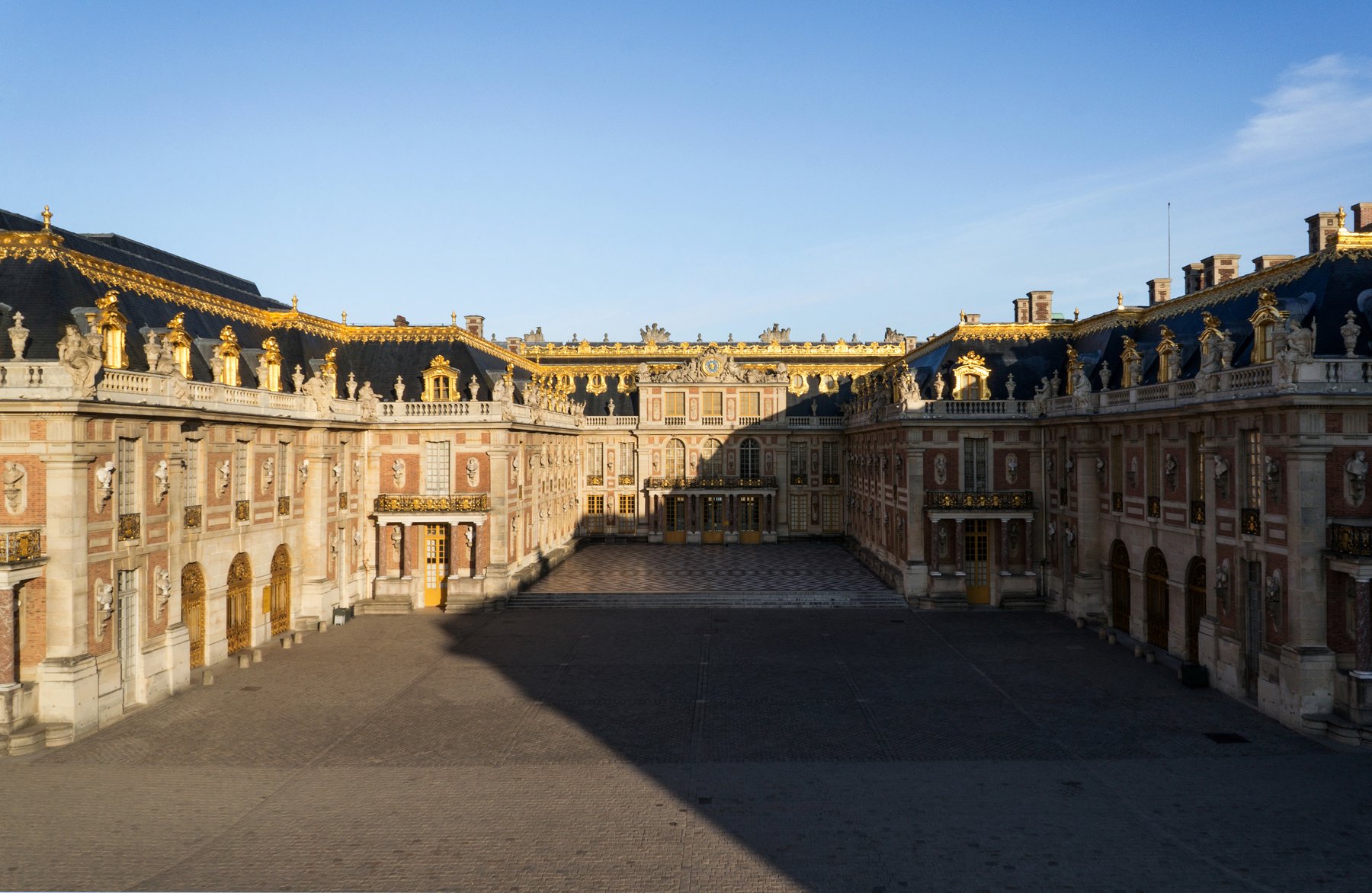
On May 6, 1682, Louis XIV moved his entire court from Paris to Versailles. The complex was not yet finished. The Hall of Mirrors was three years from completion. The two enormous wings flanking the central palace were under active construction. The chapel that the king intended as the spiritual climax of the whole ensemble would not be consecrated for another twenty-eight years. But the king was forty-three years old and impatient. He moved into the partially built palace with his queen, his official mistress, his three legitimized bastards, the Dauphin, and roughly three thousand courtiers. The capital of France migrated with him. For the next one hundred and seven years, until October 1789 when a revolutionary mob marched out from Paris and forced Louis XVI back to the city, Versailles was the seat of the French government.
The reason for the move was not luxury. Louis XIV had spent his childhood living through the Fronde, the civil war of 1648 to 1653, during which the high nobility of France had rebelled against royal authority, besieged the queen mother in the Louvre, and twice forced the royal family to flee Paris under cover of darkness. The king never forgot. The move to Versailles was not a retirement to the country. It was a political program. By compelling the nobility to live with him, sleep with him in the building, attend his rising, his dressing, his dining, his bathing, and his retiring, the king turned the French aristocracy into a captive audience that could be watched, ranked, and managed every hour of every day. Court life at Versailles was a continuous theater in which the king was the central character and the choreography was the politics of attendance.
What you walk through today is the partially restored survivor of that program. The Revolution stripped most of the furniture in 1789. Napoleon used the palace as a backdrop. The French Republic turned it into a national museum in 1837. The Treaty of Versailles was signed in the Hall of Mirrors in 1919. The German occupation left it alone. What follows is the building, the gardens, and what to read in them.
What it was for
Louis XIII — the father of the Sun King — had built a small brick-and-stone hunting lodge at Versailles in 1623. It was a modest two-storey building set among marshy ground, suitable for the king to retire to for a few days when he wanted to hunt deer in the surrounding forests. The site was not chosen for its beauty. It was chosen because the land was cheap and the king’s father wanted a private place far from Paris.
Louis XIV inherited the hunting lodge in 1643 at the age of four. He visited it for the first time in 1651. He fell in love with the place but did not want to demolish his father’s modest building, so he chose instead to wrap a much larger palace around it. The construction began in 1661 under the architect Louis Le Vau, with the gardener André Le Nôtre laying out the grounds and the painter Charles Le Brun directing the interior decoration. The three men worked together for twenty years on the first phase. After Le Vau’s death in 1670, Jules Hardouin-Mansart took over as chief architect and added the two long wings, the chapel, the Orangerie, and the Hall of Mirrors. By the time the king moved in fully in 1682, Versailles was already the largest royal palace in Europe and had cost the equivalent of about half a year of French state revenue.
The cost is the key. Versailles bankrupted the French monarchy slowly across the eighteenth century, and the bankruptcy contributed directly to the Revolution. When the Estates-General was convened in 1789, it was convened at Versailles, and the first acts of revolutionary defiance happened on the palace grounds. The building was both the symbol of the regime that fell and the place that broke it.
The Hall of Mirrors
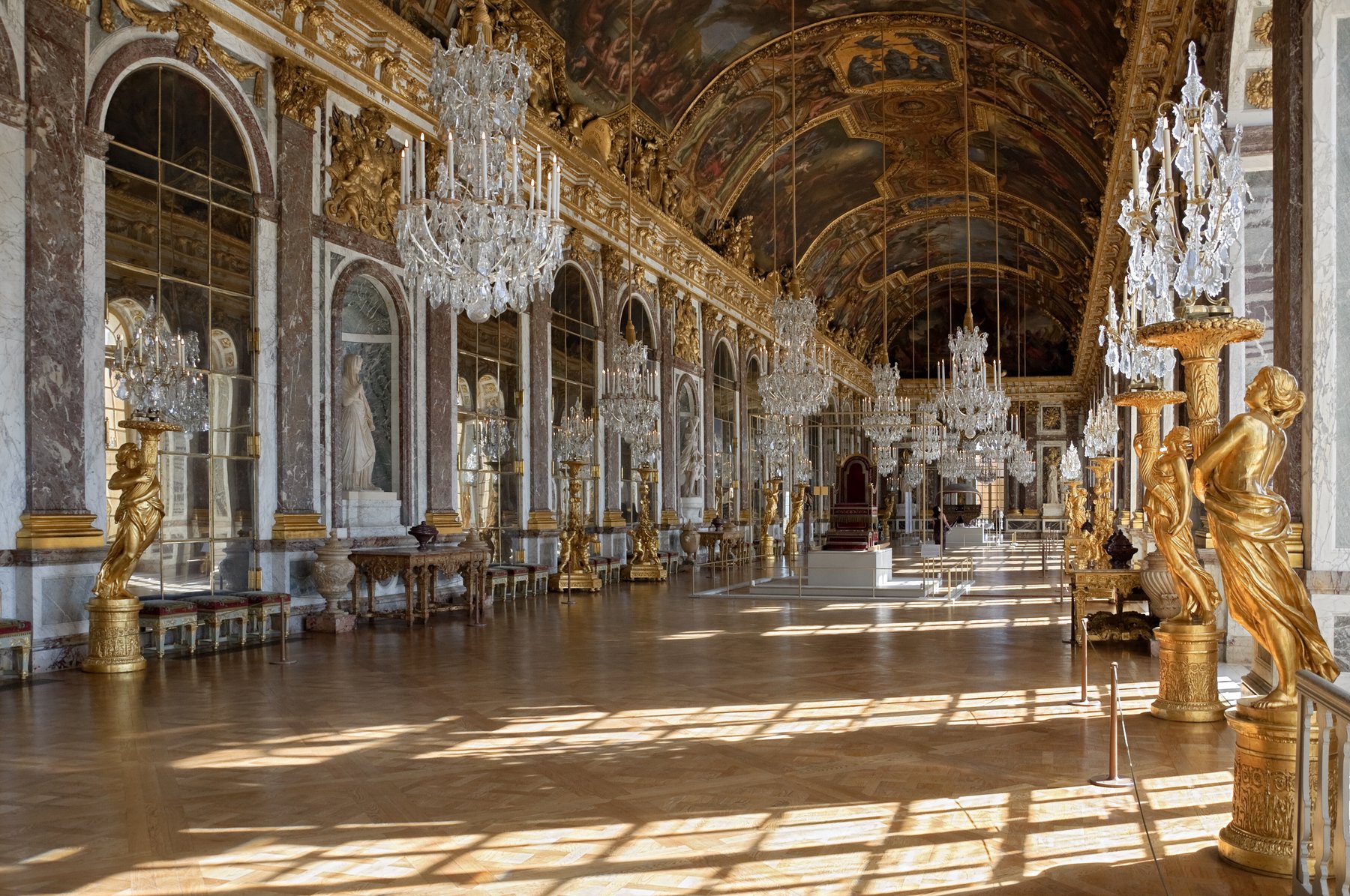
The Galerie des Glaces — the Hall of Mirrors — is the most famous room in the palace and the only one almost every visitor will recognize on entry. It is seventy-three meters long, ten and a half meters wide, and twelve and a half meters tall. Along one long side, seventeen tall windows open onto the gardens. Along the other long side, seventeen arched panels mirror the windows in glass. The hall was designed by Mansart and decorated by Le Brun, completed in 1684, and intended specifically as the political theater of the palace.
The mirrors were the technical achievement. In the 1680s, the production of large flat mirror glass was a Venetian monopoly. Venice forbade its glassmakers from working abroad on pain of death. Louis XIV’s finance minister Colbert recruited Venetian glassmakers covertly, smuggled them out of Venice, and set them up in a state-run factory in Paris. Venice sent assassins. Some of the smuggled glassmakers were poisoned. Others were ransomed back. But the factory survived, and by 1684 it had produced the three hundred and fifty-seven mirror panels of the Galerie des Glaces, each individually crowned, in a glass technology that no other country in Europe could match. The hall was a piece of industrial espionage made architecture.
The political function of the hall was to broadcast wealth at the scale of the building. When you walked the length of the Galerie des Glaces in 1685, you were walking past a luxury good that none of the other monarchies of Europe could afford or replicate. The mirror was the iPhone of the seventeenth century. Louis XIV had three hundred and fifty-seven of them, in a single room, lit by hundreds of candles whose light bounced off the mirrors and through the windows back into the gardens. The whole effect was meant to communicate one thing: French industrial and decorative monopoly under royal direction.
The ceiling above is a continuous painted barrel vault by Charles Le Brun, depicting thirty episodes from the personal history of Louis XIV between 1661 and 1678. The king is the protagonist of every scene — crossing the Rhine, receiving the surrender of Maastricht, being crowned by Victory, conquering the Triple Alliance. Le Brun did the planning. The execution was by a team of about forty painters and gilders working under his direction over five years.
The gardens
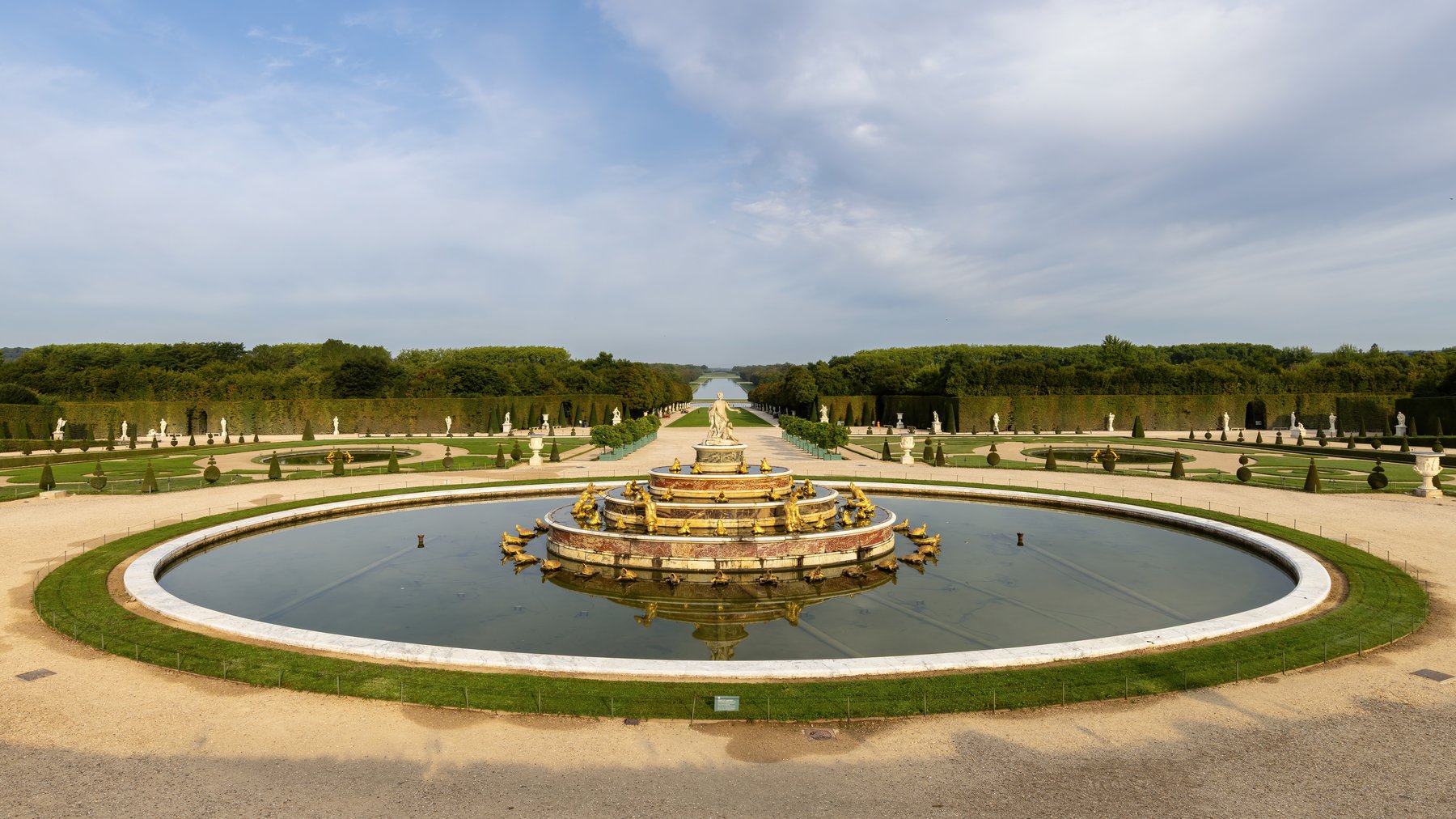
Walk out of the Hall of Mirrors through any of the seventeen windows — in reality, through the central doors that lead onto the terrace — and you are standing at the head of one of the largest formal gardens ever laid out. André Le Nôtre began the design in 1661 and worked on it for the rest of his life. The plan extends west from the palace for about three kilometers, ending at the Grand Canal, which is one and a half kilometers long and one hundred and twenty meters wide. The entire ground was originally marshland. Le Nôtre’s first task was to drain it, terrace it, and import enough topsoil from the surrounding region to build the underlying earthworks. Tens of thousands of laborers and soldiers worked on the gardens for decades. The casualty rates from malaria in the marsh phase were so high that the building site at Versailles is, in French historical writing, sometimes referred to as the second front of Louis XIV’s long wars.
The gardens are organized on a strict east-west axis aligned with the palace’s central salons. The main axis is broken at intervals by fountains — the Latona Fountain just below the terrace, the Apollo Fountain at the head of the Grand Canal — and bisected by transverse alleys leading to subsidiary garden rooms called bosquets. The bosquets are smaller enclosed spaces, each themed differently: the Ballroom Bosquet has a sunken amphitheater, the Bosquet of the Three Fountains has cascading water, the Apollo Baths have a grotto. Le Nôtre designed the gardens as a system of rooms rather than as a single open landscape. You walk through them as you walk through a building, with each space opening onto the next.
The fountains run on a gravity-fed water system that Louis XIV built for the gardens at extraordinary cost. The water comes from the Eure river, sixty kilometers away, brought to Versailles by a partially completed aqueduct, the Machine de Marly, and an ingenious series of pumps that lifted the water two hundred meters up to the palace’s elevation. The total system used more pumped horsepower than any industrial installation in seventeenth-century Europe. Even so, there was never enough water to run all the fountains simultaneously. The gardeners developed a relay system: a fountainier would walk ahead of the king as he toured the gardens, turning on each fountain just before he came around the corner and turning it off behind him. The visitor in the eighteenth century would have seen a parade of fountains running at every place the king stood. The other fountains, when the king was not present, were dry. Chiaro holds the fountainier’s relay schedule against the route the king walked, so the way the water followed the monarch through the bosquets becomes legible while you are standing at the same balustrade he stood at.
Louis XIV himself
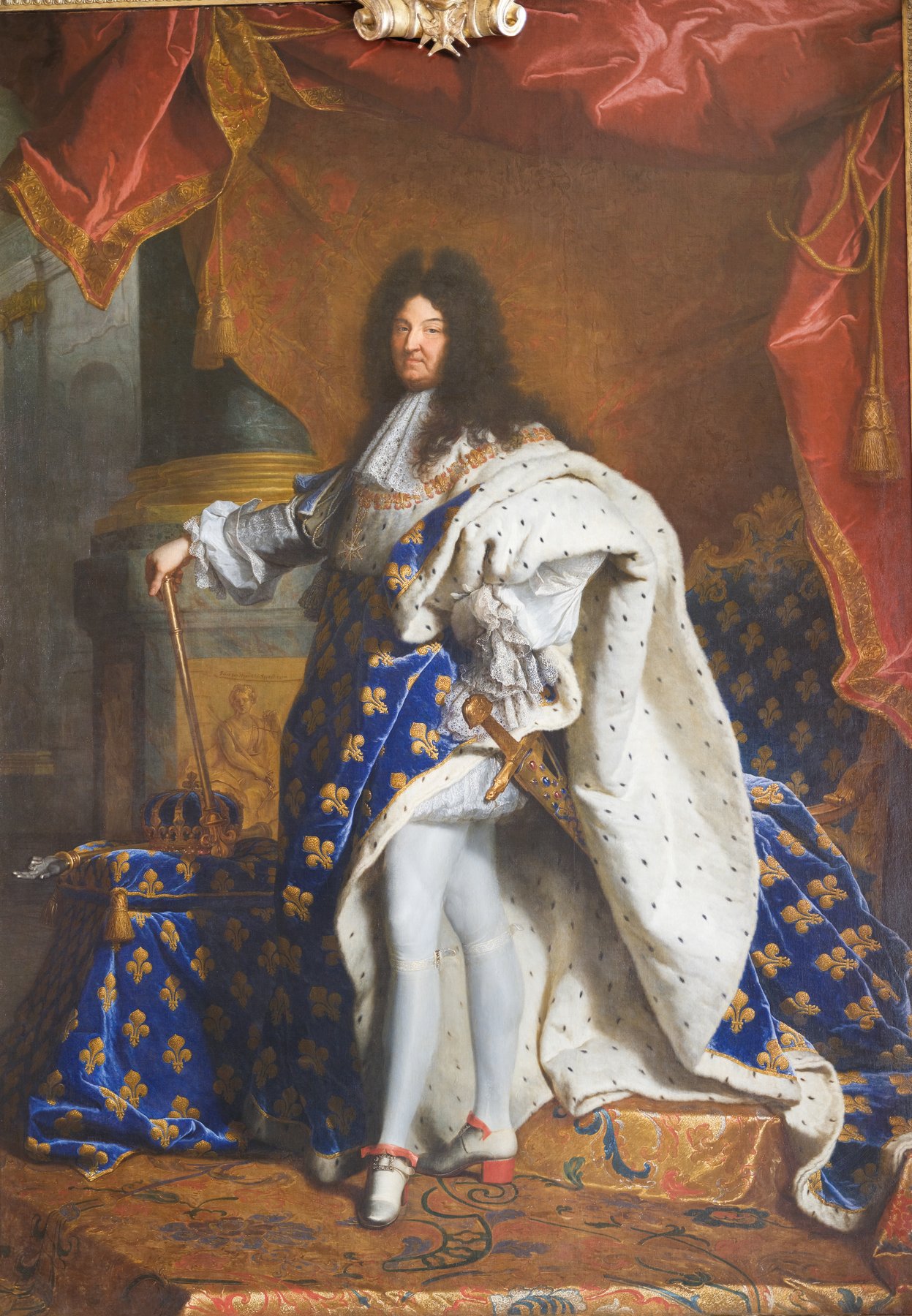
The official state portrait of Louis XIV was painted by Hyacinthe Rigaud in 1701, when the king was sixty-three. It hangs today in the Louvre, but a contemporary copy hangs at Versailles and the original was painted for display at the palace. It is the image by which the king is now universally remembered: full ermine robes, the Sword of Charlemagne at his hip, white silk stockings, red-heeled shoes, an enormous wig of black curls cascading to his waist, and the king’s calves displayed prominently in a dancer’s pose.
The wig and the shoes are the part that matters. Louis XIV was below average height for the period — about one hundred and sixty-three centimeters — and self-conscious about it. The high red heels and the tall wig together added roughly fifteen centimeters to his apparent stature. The red heel itself became a court convention: only members of the royal household and a few specifically authorized courtiers were allowed to wear them. To wear red heels at Versailles in 1701 was to broadcast your access to the king. To not wear them was to be excluded from his inner circle. The court used clothing the way a modern company uses badge access: the deeper you got into the building, the more specific the dress code became.
The pose itself — the king leaning slightly to the side, one leg forward, calf displayed — is borrowed from classical dance. Louis XIV had been a serious ballet dancer in his youth. He performed publicly in court ballets between 1651 and 1670, including the role of the rising sun in the Ballet de la Nuit of 1653, which is where his epithet, the Sun King, comes from. The dance training shows in every portrait. He understood that being looked at was a performance and he framed himself accordingly.
What to look for
Five things to do at the palace. First, in the Hall of Mirrors, count the mirror panels along the wall. There are seventeen large arched groupings, each made of about twenty-one individual panels of mirror glass. Three hundred and fifty-seven panels in total. Each one was an export-grade luxury item in 1684.
Second, on the floor of the Hall of Mirrors near the center, stop and look up at the painted ceiling. The figure of Louis XIV is in nearly every panel. Each panel is a different victory. The most prominent shows him crossing the Rhine in 1672, which was a low-stakes military maneuver that the king’s painters subsequently turned into one of the central narratives of his reign.
Third, in the King’s Bedchamber — two rooms down from the Hall of Mirrors — find the balustrade that separates the king’s bed from the rest of the room. Members of the court would attend the king’s lever, the formal rising ceremony, by standing behind this balustrade in carefully assigned ranks. Position determined status. To be in the front row was to be a duke. To be in the back row was to be a marquis. To not be invited was to be no one.
Fourth, walk down to the Latona Fountain, the first fountain on the central axis below the palace terrace. The fountain shows the goddess Latona protecting her children from a group of Lycian peasants who are being turned, mid-transformation, into frogs and lizards. The myth is from Ovid. The political allegory is the Fronde: Louis XIV, mocked in his childhood by rebellious nobles, casting them out and turning them into ridiculous creatures. The fountain is a piece of personal political vengeance executed in stone and bronze.
Fifth, take the small road around the western side of the palace, past the Petit Trianon, and find the Hameau de la Reine — Marie Antoinette’s hamlet. It is a deliberately rustic mock village of thatched cottages, a working dairy, a mill, and a small farm that the queen had built between 1783 and 1787, where she retreated from the formal life of the main palace to play at being a peasant. The hamlet is the architectural opposite of everything Versailles was built to be. Six years after it was finished, she was beheaded in Paris. The hamlet is still there, and it still has cows.
The palace is a piece of seventeenth-century political theater preserved in stone and water. The mirrors are still mirrors. The fountains still run on the same gravity system. The gardens are still on the original Le Nôtre axis. The king is gone and so is the court he assembled, but the architecture is still doing its work. Walk in through the gates, cross the marble courtyard, climb the Queen’s Staircase, pass through the Salon of Hercules, and you are still walking the route Louis XIV designed for you. You are still attending the king’s lever. The king is no longer in his bed. The room is still waiting for the next monarch to climb in.
Image credits
- Vue aérienne du domaine de Versailles le 20 août 2014.jpg — ToucanWings. Source, CC BY-SA.
- Chateau Versailles Galerie des Glaces.jpg — Myrabella. Source, CC BY-SA.
- Panoramic view of the Park of Versailles with Latona Fountain.jpg — Tognopop. Source, CC BY-SA.
- Hyacinthe Rigaud, Portrait de Louis XIV en grand manteau royal, 1701-1702.jpg — Hyacinthe Rigaud (1701-1702); Louvre Museum, public domain. Source.


