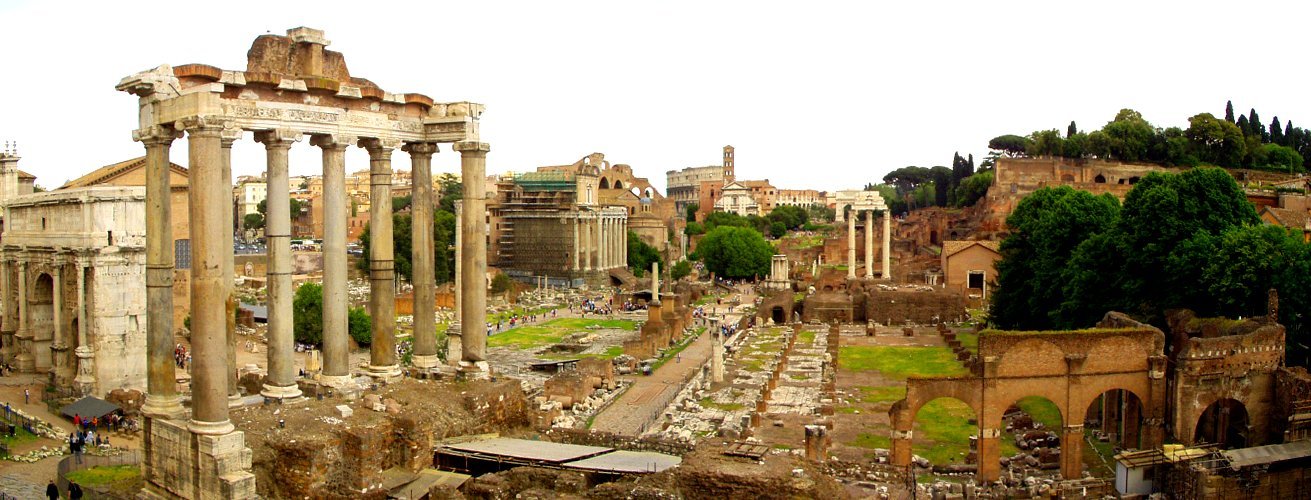
In the early ninth century AD, the Roman Forum was already a cattle pasture. By the thirteenth century it had a name to match: the Campo Vaccino, the cow field. The classical structures were still standing, partially, but they were no longer being maintained. Drifting silt from the Tiber floods had buried the original pavement under five or six meters of dirt. Trees grew where the senate had met. Goats grazed inside the Temple of Vesta. By the time the painter Giovanni Paolo Panini was sketching the Campo Vaccino in the 1740s, the forum was a meadow with column stumps and the occasional arch sticking out of it. Tourists went there to picnic.
The forum was first systematically excavated between 1803 and the 1930s, under archaeologists working for the Papal States, the unified Italian government, and then for Mussolini, who wanted the imperial past visible as propaganda for the regime. The dirt was hauled out. The buildings were partially re-erected. Some of the columns were stood back up using their original drums. The pavement of the Sacred Way, the main road of the forum, was uncovered for the first time in twelve hundred years.
What you walk through today is the result of those excavations: a deeply scooped-out depression between the Capitoline and Palatine Hills, lined with the foundations and partial elevations of about thirty separate ancient structures, each from a different century, jumbled together because the city kept rebuilding on top of itself. There is no single moment the forum represents. It is eight hundred years of urban Roman civic life compressed into about three city blocks. If you read the ruins in the right sequence, the place rebuilds itself.
What follows is the forum from west to east, the Palatine afterward, and what to look at along the way.
What it was for
The valley between the Capitoline and Palatine Hills was originally a marsh. The earliest Romans of the seventh and sixth centuries BC drained it by building the Cloaca Maxima, a sewer that still runs under the modern forum and still empties into the Tiber. The cleared ground became the city’s main public square. Around it grew up the institutions that ran the Roman Republic and, later, the Empire: the Senate House, the law courts, the major temples, the speakers’ platforms, the imperial palaces. The forum was where Romans came to vote, prosecute lawsuits, conduct business, perform sacrifices, attend funerals, hear emperors speak, and watch generals process in triumph. It was the political, commercial, and religious center of the city for more than a thousand years.
It is also, geographically, very small. The classical forum was approximately one hundred and thirty meters long and fifty wide, smaller than a soccer pitch. The density of activity inside that space was extraordinary. Every important political event between the founding of the Republic in 509 BC and the fall of the Western Empire in 476 AD happened somewhere within the boundaries of the forum or its immediate extensions. A walking tour at a slow pace, reading the ruins in order, can be done in about ninety minutes.
The west end: temples of state
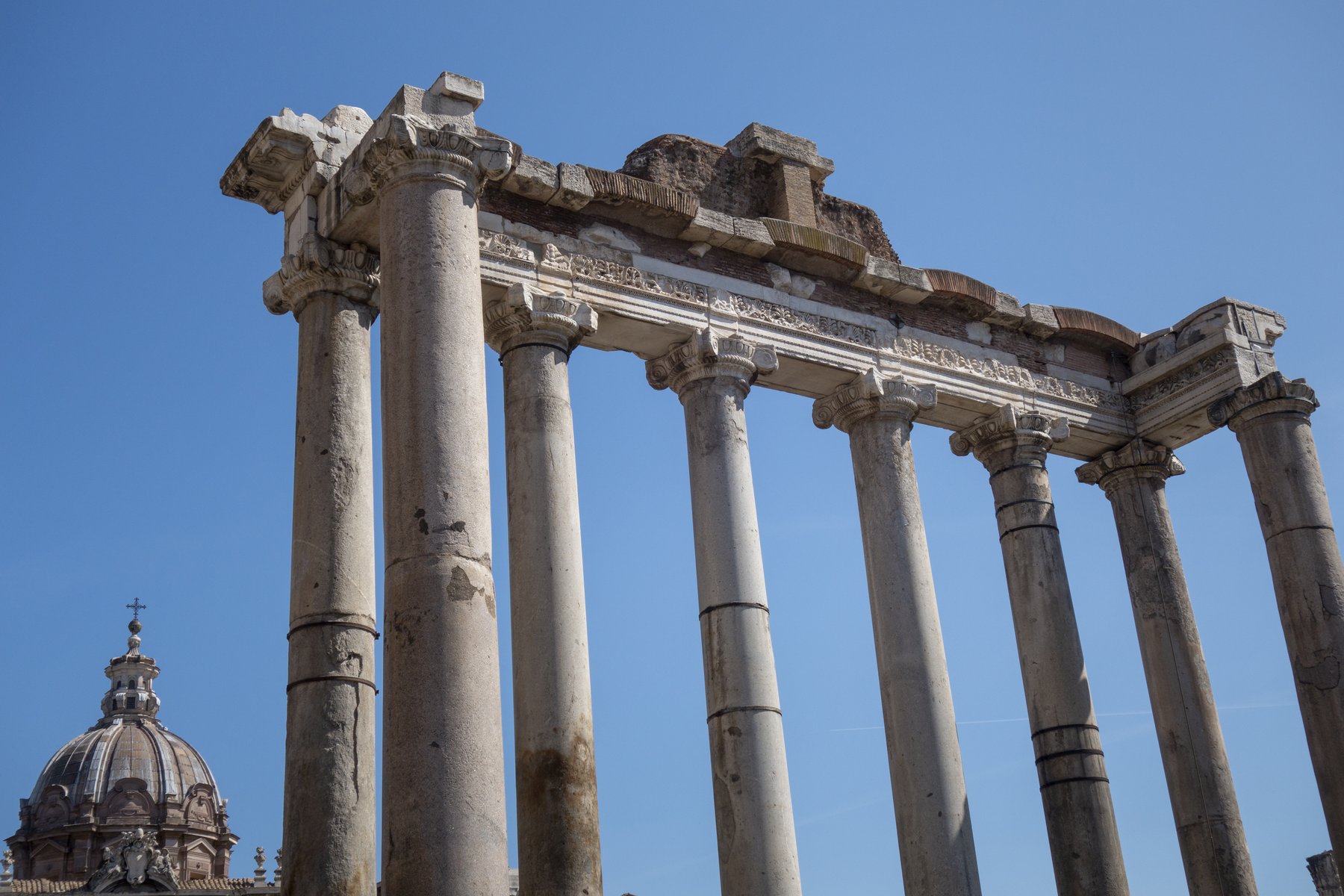
Enter the forum from the western, Capitoline end. The first structure you see is the Temple of Saturn — eight remaining columns of Egyptian granite, with parts of the entablature still attached at the top. The temple was first built in 497 BC and was rebuilt three times. What is standing today is the fourth-century AD restoration. The temple housed the Roman state treasury, the aerarium, in a vault below the floor. It was also the focus of the annual Saturnalia festival in December, the week-long winter holiday during which slaves and masters reversed roles and the city did effectively no business. The Christian celebration of Christmas, fixed to December 25, was deliberately placed on the last day of Saturnalia by Pope Julius I in the fourth century.
Directly next to the Temple of Saturn is the Portico of the Dii Consentes, a small colonnade rebuilt in the late fourth century AD that originally housed twelve gilded bronze statues of the major gods of the Roman pantheon. This was one of the last functional pagan temples in the city. The Christian emperor Theodosius shut it down in 391 AD as part of his ban on pagan worship.
A few meters east is the Rostra, the platform from which Roman orators addressed the citizens of the city. It was originally decorated with the bronze rams — the rostra — of captured warships from the Battle of Antium in 338 BC, which gave the platform its name. Julius Caesar’s funeral oration by Mark Antony, the one Shakespeare reconstructed as “Friends, Romans, countrymen, lend me your ears,” was delivered from this platform on the day after Caesar’s assassination in 44 BC. The actual Latin oration has not survived. What was said was reconstructed by Roman historians a century later, then by Plutarch a century after that, then by Shakespeare another fifteen hundred years later. The platform is still there. The exact spot can be walked across in eight steps.
The arch and the column
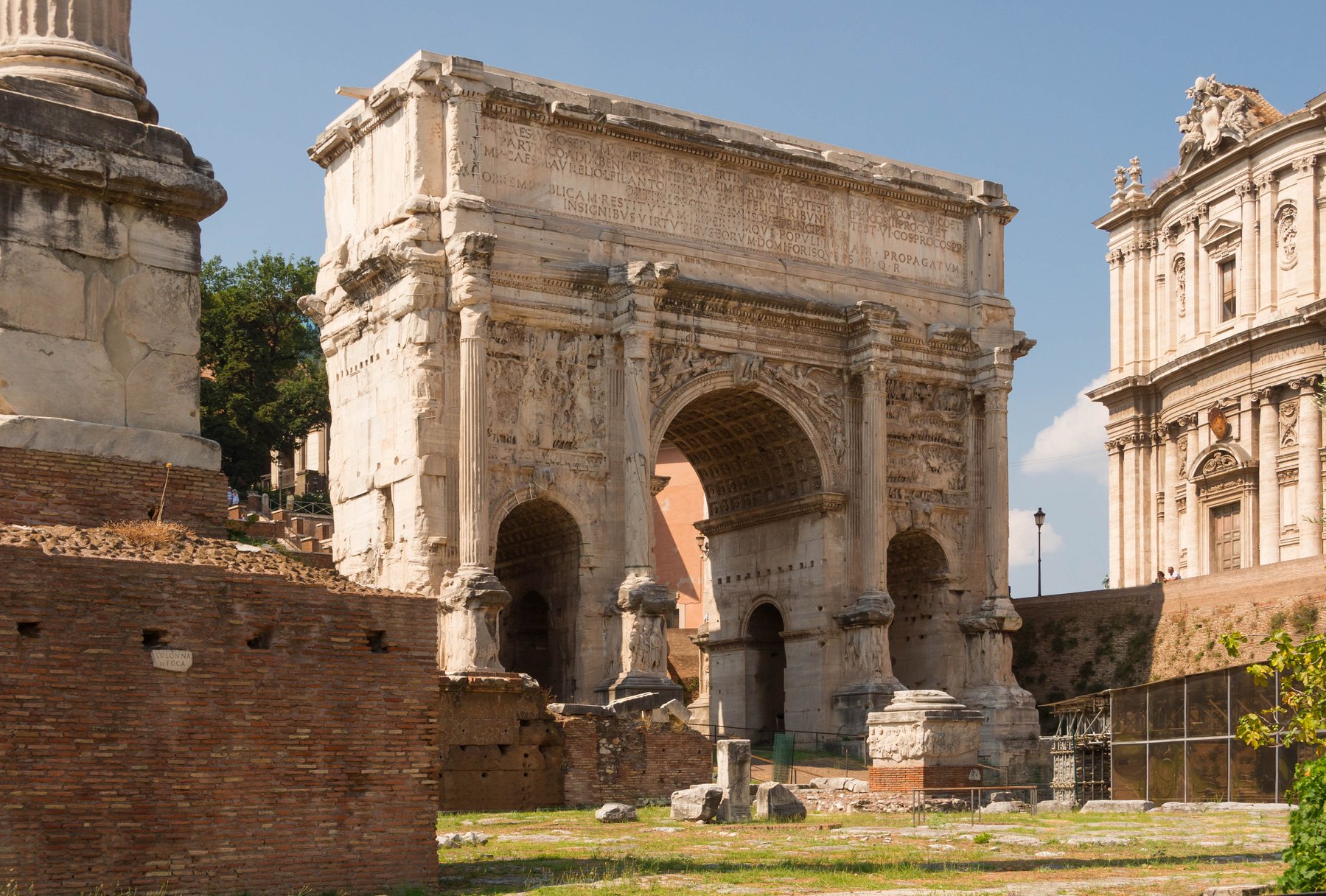
The triumphal arch at the western end of the forum is the Arch of Septimius Severus, completed in 203 AD. It is twenty-three meters wide and twenty-five tall, with three openings and four large relief panels on the upper level showing the emperor’s victorious campaigns against the Parthians in modern-day Iraq. The Latin inscription across the top dedicates the arch to Septimius Severus and his two sons, Caracalla and Geta. After Septimius died in 211 AD, Caracalla had Geta murdered and ordered the damnatio memoriae — the erasure of the name — against his brother. Look closely at the inscription. The fourth line, originally reading “and for Geta, most noble Caesar,” has been chiseled out and replaced with a phrase praising Septimius and Caracalla alone. The chisel marks are still visible on the bronze letters that no longer fit the holes where they were originally mounted.
A few meters east of the arch is the Column of Phocas, a fifteen-meter-tall fluted Corinthian column with a Latin inscription dedicating it, in 608 AD, to the Byzantine emperor Phocas. It is the last imperial monument erected in the Roman Forum. The pedestal was second-hand, repurposed from an earlier statue. The column itself was probably also second-hand, robbed from a different building. By the time Phocas was being honored, the forum was already in steep decline and no major new construction had been undertaken in it for nearly a century. After Phocas, the forum stopped being a place where Romans built things. The column is the punctuation mark on twelve hundred years of public construction.
The east end: courts, temples, and the senate
Continue east along the Sacred Way. On your left is the Curia Julia, the senate house, originally built by Julius Caesar to replace the older Curia Hostilia that had burned down in 52 BC. The current building is the third-century AD reconstruction by the emperor Diocletian, preserved because it was converted into a church in the seventh century. The interior is largely intact, including most of the original marble floor. You can walk into it. The senators sat on three tiers of marble benches running along the long walls, with the presiding magistrate at the apse end. The acoustics are extraordinary. Stand in the middle of the room and speak normally; you will be perfectly audible at the apse. The building was designed for oratory and it still works.
Further east is the round Temple of Vesta, where the Vestal Virgins kept the sacred eternal flame of the city burning continuously. The original temple was built in the seventh century BC, but the surviving foundations and three columns are from the AD 191 reconstruction by Julia Domna, wife of Septimius Severus. Adjacent to the temple is the House of the Vestals, a large courtyard residence where the six Vestals lived during their thirty-year service. Statues of senior Vestals line the long sides of the courtyard.
The Temple of Antoninus and Faustina, with its grand portico facing the Sacred Way, was built in 141 AD by the emperor Antoninus Pius for his deceased wife. It is the most complete building in the forum because it was converted into the church of San Lorenzo in Miranda in the seventh century and has been continuously roofed ever since. The columns of the original porch are still standing at their original height because the medieval Christians built the church inside the temple rather than tearing it down.
Chiaro holds the chronology of all of these buildings against each other while you walk — the Temple of Saturn next to the Temple of Vespasian next to the Curia Julia next to the Column of Phocas — so that the eight hundred years of construction layered into a hundred-and-thirty-meter strip become legible in the order the Romans actually built them, rather than as a single undifferentiated pile of stone.
The Palatine Hill
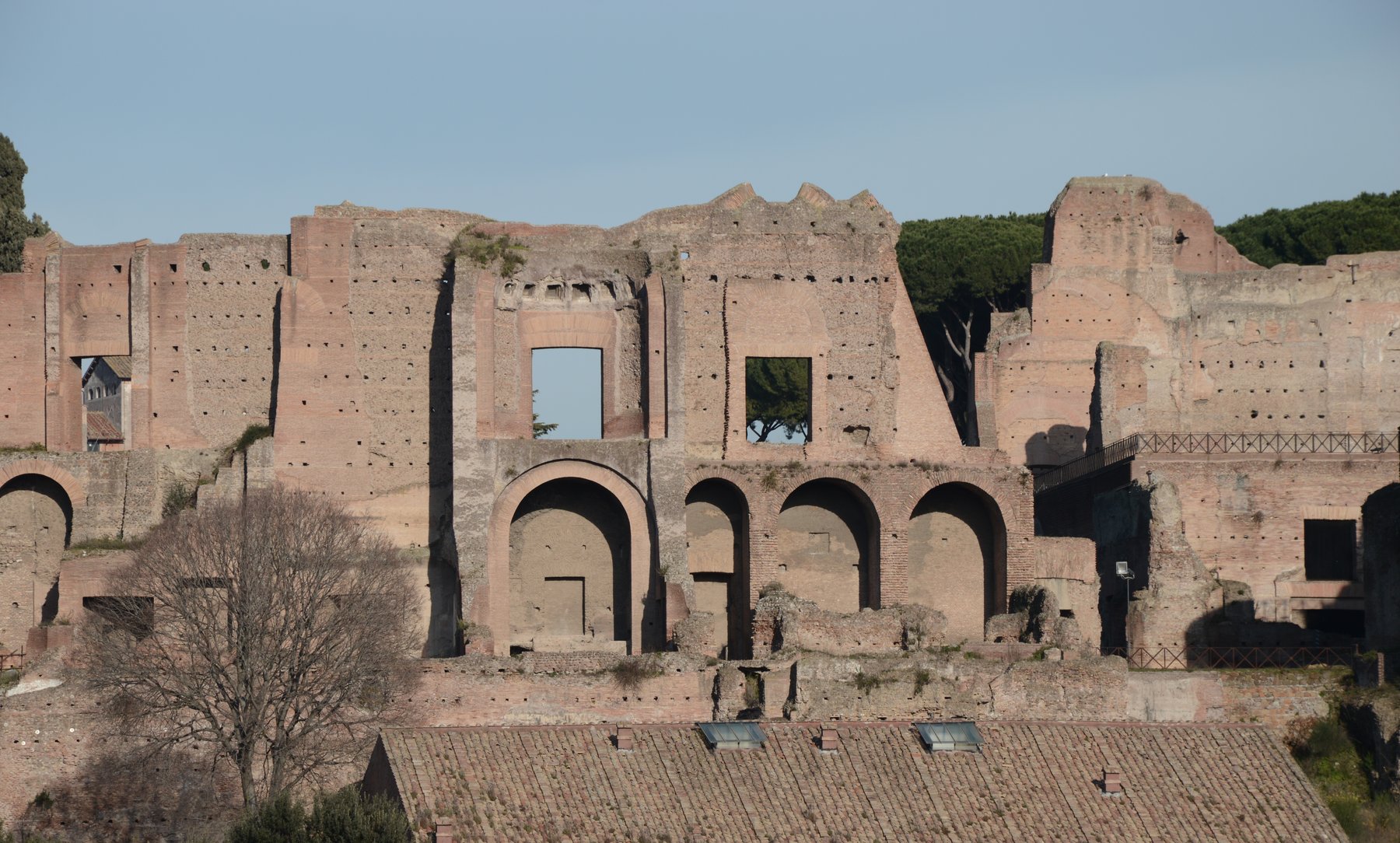
Climb the path up the south side of the forum and you are on the Palatine Hill. This is the central of the seven hills of Rome and the one where the city, according to its founding legend, was actually founded. The cave of the she-wolf — the Lupercal, where Romulus and Remus were supposedly suckled — was located somewhere on the southwestern slope of this hill. Archaeologists found and tentatively identified the cave in 2007, fifteen meters under the foundations of the imperial palaces. The cave is small and the identification is contested, but the topographic logic is right: the legend would have placed it where they found it.
The Palatine is where the emperors lived. From Augustus onward, the imperial residence was on this hill, and the word palace in nearly every European language descends from the name of this hill. Palatium in Latin became palais in French, palazzo in Italian, palace in English. The hill is the etymological origin of the concept.
The dominant ruins today are from the Domus Flavia and Domus Augustana, the public and private wings of the palace complex built by the emperor Domitian in 92 AD. The complex was the working seat of imperial government for almost three centuries. The audience hall of the Domus Flavia was approximately thirty by forty meters, with eight massive columns of green Numidian marble and a semicircular apse where the emperor sat to receive embassies. The throne room dwarfs anything in the forum below. The hill was where decisions were made; the forum was where decisions were announced.
The famous Stadium of Domitian, a private exercise track shaped like a circus, is just east of the palace. It is one hundred and sixty meters long and fifty wide, with a curved end and a small viewing pavilion. It was probably used for athletic exercises, horse training, and processions rather than chariot racing — the actual chariot stadium, the Circus Maximus, was a separate enormous complex in the valley below.
The hill’s southwest corner offers the famous view down into the Circus Maximus and across to the Aventine. Walk to the edge of the Domus Augustana and look down. The Circus Maximus could hold two hundred and fifty thousand spectators — five times the capacity of the Colosseum. The chariots ran the length of a track six hundred and twenty-one meters long. The track is still there, an open green strip of grass between the Palatine and the Aventine. Nothing of the original seating remains. The circus is now a public park.
What to look for
Five things to do as you walk. First, at the Arch of Septimius Severus, find the chiseled-out fourth line of the dedicatory inscription. It is the damnatio memoriae of Geta, visible to anyone who knows where to look, a piece of fratricidal politics carved into bronze and then carved out again two thousand years ago.
Second, inside the Curia Julia, walk to the apse end and turn around to face the door. Speak in a normal voice. The room will return your voice clearly. The senate house was acoustically engineered.
Third, at the round Temple of Vesta, look at the three surviving columns of the rebuilt third-century structure. The original eighth-century BC temple stood on the same circular foundation. Continuity of religious site over thirteen hundred years is what the Roman state ran on. The Vestal flame was reportedly never extinguished from the founding of the temple until Theodosius shut down the cult in 391 AD.
Fourth, on the Palatine, find the small Casa di Livia near the western end of the imperial complex. The house has frescoed walls in deep red and black with mythological scenes — the abduction of Io, Mercury and Argus — in nearly intact condition. The house traditionally belongs to Livia, wife of Augustus, and the frescoes are from the late first century BC. You are looking at the wall paintings of a Roman empress, on the wall they were painted on, in the room she lived in.
Fifth, walk to the southwestern edge of the Palatine and look down at the Circus Maximus and across to the Aventine. The view is what the emperor looked out over from his private dining rooms. The chariot races are gone. The crowd is gone. The track is still there.
The forum and the Palatine together are the oldest continuously identified piece of urban space in Europe. Other cities have older buildings; nowhere else has eight centuries of public construction layered into a single visible strip with the order still legible. The Romans rebuilt their own city on top of itself, and the archaeologists peeled the city back, and what is left is the chronological cross-section of an empire. Walk through it in the order the Romans built it, and the field of stones organizes itself into a story.
Image credits
- Forum Romanum panorama 2.jpg — Carla Tavares. Source, CC BY-SA.
- Roman Forum Temple of Saturn.jpg — Adrian Pingstone. Source, public domain.
- Arch of Septimius Severus Forum Romanum Rome.jpg — Wikimedia Commons contributor. Source, CC BY-SA.
- Ruins of the Domus Augustana on Palatine Hill.jpg — Wikimedia Commons contributor. Source, CC BY-SA.


