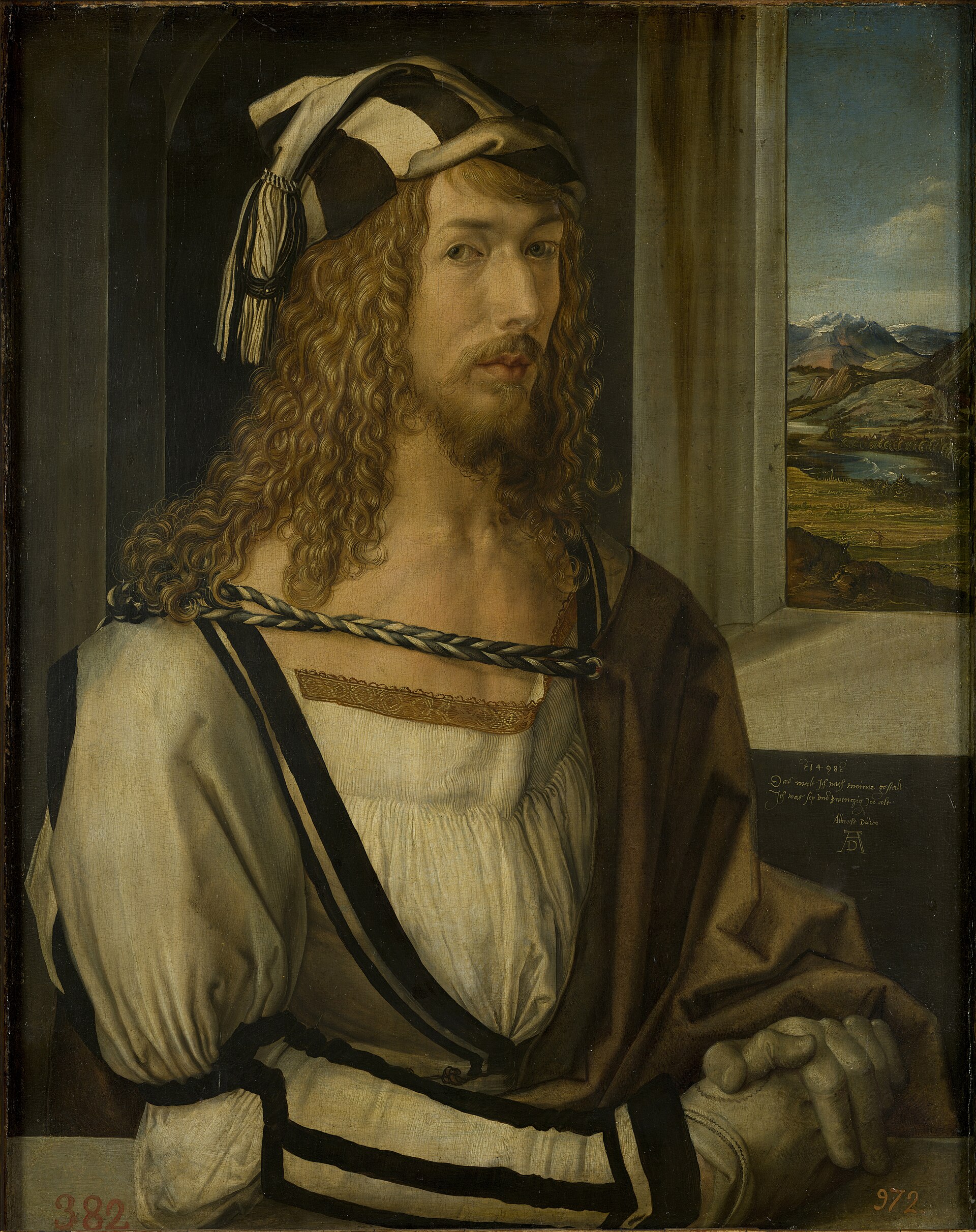
In 1498 a twenty-six-year-old painter from Nuremberg sat down and painted himself in clothes he could not afford to wear in public. He gave himself a banded white-and-black cap, a striped doublet with gold-trimmed slashes, a cloak draped over one shoulder, fine kid gloves on his folded hands, and curled blond hair falling past his collarbone in carefully separated ringlets. Behind him, through an open window, a green plain runs back to a lake and a wall of snow-capped Alps. On the wall to the left of his head he wrote, in German, the date and a sentence: “I painted this from my own appearance. I was twenty-six years old. Albrecht Durer.” Then he added his monogram, the famous AD with the small D nested under the wide A, a logo before logos existed.
This is the second of Durer’s three painted self-portraits, it hangs in Room 55B of the Prado in Madrid, and it is one of the strangest objects in the history of art, because in 1498 painters did not do this. A German painter was a craftsman, a member of a guild, paid by the job to decorate altarpieces and grind pigments. He did not present himself to the viewer dressed like a Venetian gentleman, hands idle in expensive gloves, with his own name on the wall like a man who expects to be remembered. Durer is the man who decided the painter was somebody. The 1498 self-portrait is the argument he made for it, painted on a single panel of limewood fifty-two centimeters tall.
What he is wearing, and why it matters
Start with the gloves, because the gloves are the whole point. Durer’s hands rest on a ledge at the bottom of the picture, folded, sheathed in pale kidskin. These are not working hands. A craftsman’s hands in 1498 were stained with linseed oil and lead white and the metal salts of his pigments. By covering his hands in gentleman’s gloves, Durer is saying the thing his whole career was about: I am not a manual laborer. I am an artist, which is to say a person who thinks. The Italian humanists he had just met on his first trip south of the Alps were arguing exactly this, that painting was a liberal art like poetry and geometry, not a mechanical trade like carpentry. Durer came home from Italy convinced, and he spent the rest of his life proving it, starting with this picture.
The clothes carry the same message. The slashed sleeves with their gold borders, the tasseled cord across the chest, the elegant striped cap, are Italian high fashion, or a German painter’s idea of it. Durer had crossed the Alps to Venice around 1494 and seen how artists lived there, in the workshops of men like Giovanni Bellini, treated as honored figures rather than tradesmen. The flat plain, the lake, the snow-capped mountains through the window are usually read as a memory of that Alpine crossing, the journey from Nuremberg to Venice and back compressed into a strip of landscape over his shoulder. He is not just dressed Italian. He is telling you where the new ideas came from.
The inscription, and the German who could write
The line on the wall reads, in the original: “Das malt ich nach meiner gestalt / Ich war sex und zwenzig Jor alt / 1498.” Painted from my own appearance, twenty-six years old. The detail that gives the whole thing away is that Durer rhymed it. The first two lines are a rhyming couplet, gestalt and alt, the kind of thing a literate man writes for pleasure. Durer was unusually literate for a painter. He kept a diary, wrote letters that survive, published treatises on geometry and on the proportions of the human body, and corresponded with humanist scholars as an equal. The inscription is not a label. It is a writer signing his work, and the signature insists you notice both the date and the age, because the age is the surprising part. Twenty-six, and already this sure of himself.
The monogram below the inscription is the other half of the brand. Durer designed the interlocked AD as a personal mark and used it on everything, his paintings, his woodcuts, his engravings. His prints sold all over Europe, and the monogram was so recognizable that other printmakers forged it to move their own work, which led Durer to one of the first artist’s copyright disputes in history, when he took a Venetian engraver named Marcantonio Raimondi to court for copying his Life of the Virgin woodcuts complete with the AD mark. The Venetian senate let Raimondi keep copying the images but ordered him to drop the monogram. The face on the Prado panel and the letters under it are the same act, a man making himself into a name that travels.
Not the famous one, and that is the point
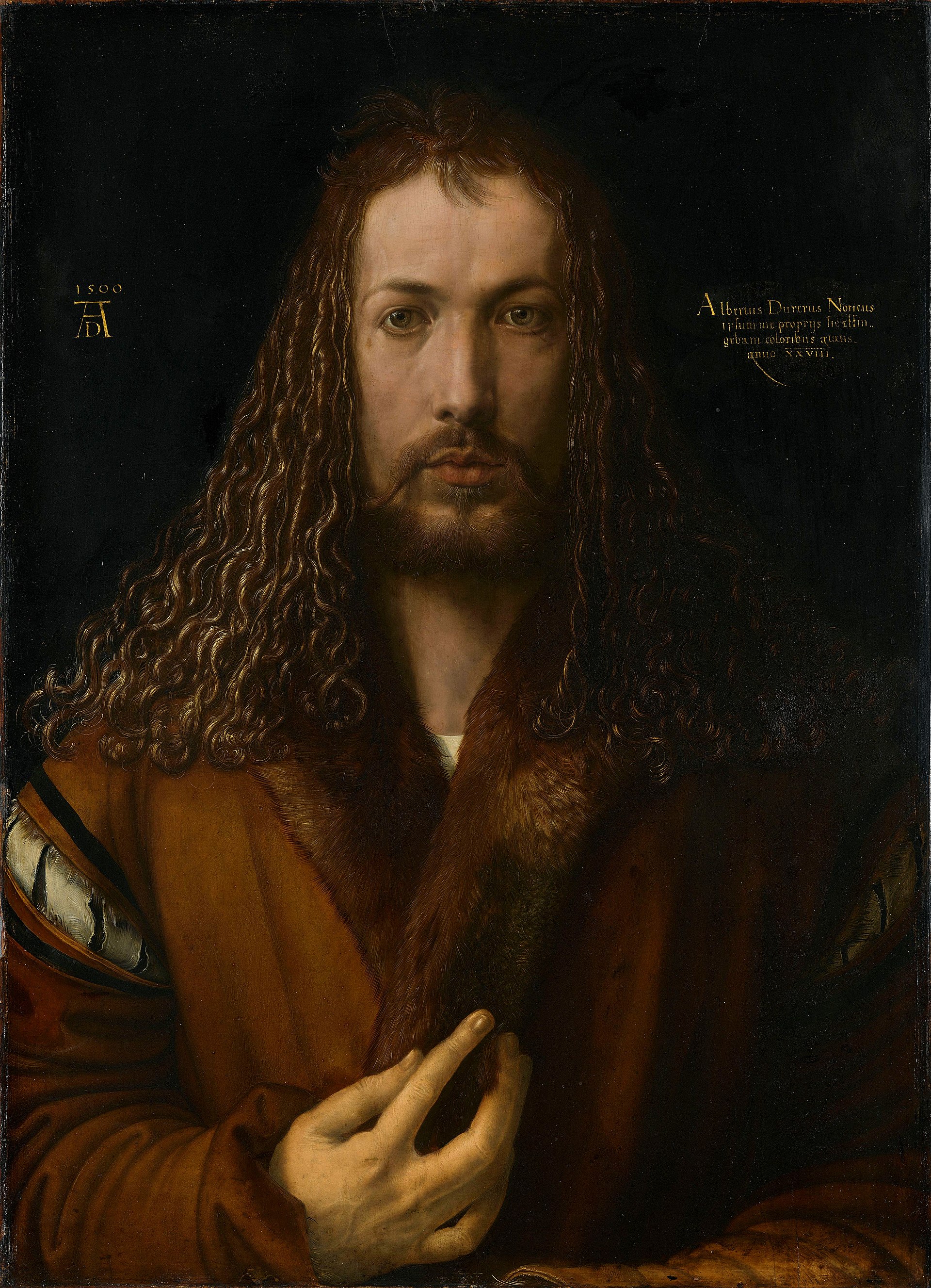
If you have seen a Durer self-portrait in your mind, you are probably picturing the wrong one. The image that gets reproduced most is the 1500 self-portrait in Munich, the rigidly frontal, brown-robed, long-haired head that deliberately echoes the conventional face of Christ, hand raised to the fur of his own collar. That painting is in the Alte Pinakothek in Munich, not the Prado, and it is a different and more theological project, the artist arranging himself in the pose reserved for the divine to argue that the act of creation is god-like. The Prado picture, painted two years earlier, is the worldly version of the same ambition. Where the Munich head is timeless and saintly, the Madrid portrait is a real young man in fashionable clothes on a specific afternoon, dated and located and proud. Travelers regularly arrive at the Prado expecting the Christ-face and find instead this dandy at the window. They are looking at the first move in a two-painting argument, and this is the move where Durer is still a person rather than a symbol.
How it got to Spain
A German self-portrait painted in Nuremberg is a peculiar thing to find hanging in Madrid, and the path it took explains a lot about the Prado itself. The painting belonged to the city of Nuremberg, which in 1636 gave it as a diplomatic gift to Thomas Howard, the Earl of Arundel, an English collector traveling through on an embassy for King Charles I of England. From Arundel’s collection it eventually passed, through the upheavals of the English Civil War and the dispersal of Charles I’s pictures, into the Spanish royal collection. By the eighteenth century it hung in the royal palaces in and around Madrid, and when the Prado opened in 1819 to display the kings of Spain’s accumulated art, the Durer came with it. The Spanish Habsburgs and Bourbons were among the great collectors of European painting, and the Prado is essentially their private collection made public, which is why a German artist’s most personal picture ended up between Italian and Flemish masters in a museum in Spain. If you want the full story of how that collection became a public building, the Prado visiting guide walks through it.
The face itself
Look past the clothes and the window and the inscription and at the actual face, because Durer was too good to let the costume do all the work. The expression is cool, slightly sidelong, neither smiling nor severe. The eyes are not quite meeting yours, they are aimed just past the viewer, the look of a man examining himself in a mirror, which is exactly what he was doing. Every painted self-portrait before photography was made from a mirror, which means the painter is always looking slightly off-axis, into the glass rather than at us, and Durer renders that displacement precisely. The hair is the showpiece, each ringlet drawn as a separate sculpted curl with a highlight running along it, an absurd amount of labor lavished on the one part of a man that signals vanity. He wanted you to know he could paint hair like a Flemish master and that he was the kind of man who had hair worth painting.
This is the German Renaissance compressed into one panel: northern precision, every thread and curl rendered with engraver’s exactness, married to Italian ambition, the new idea that the artist is a gentleman and a thinker and a name. Durer is the hinge between those two worlds. He learned the meticulous craft of the north in his father’s goldsmith workshop and the painter Michael Wolgemut’s studio, and he learned the swagger of the south on the road to Venice, and the 1498 self-portrait is the first picture in which he fuses them. Chiaro reads out the inscription, the gloves, and the Alpine window in front of the panel itself, so that the small proper-name details you would otherwise walk past get pointed out while you are standing where they make sense.
The other Durer in the same museum
The Prado does not own only the self-portrait. A few rooms away hang Durer’s Adam and Eve, a pair of life-size painted panels from 1507, made after a second Italian trip, in which Durer applied everything he had learned about the classical nude to two pale, idealized figures standing against black backgrounds. They are the German answer to the Italian obsession with perfect anatomy, and they show the same man a decade later, no longer arguing that he belongs but simply painting at the highest level in Europe.
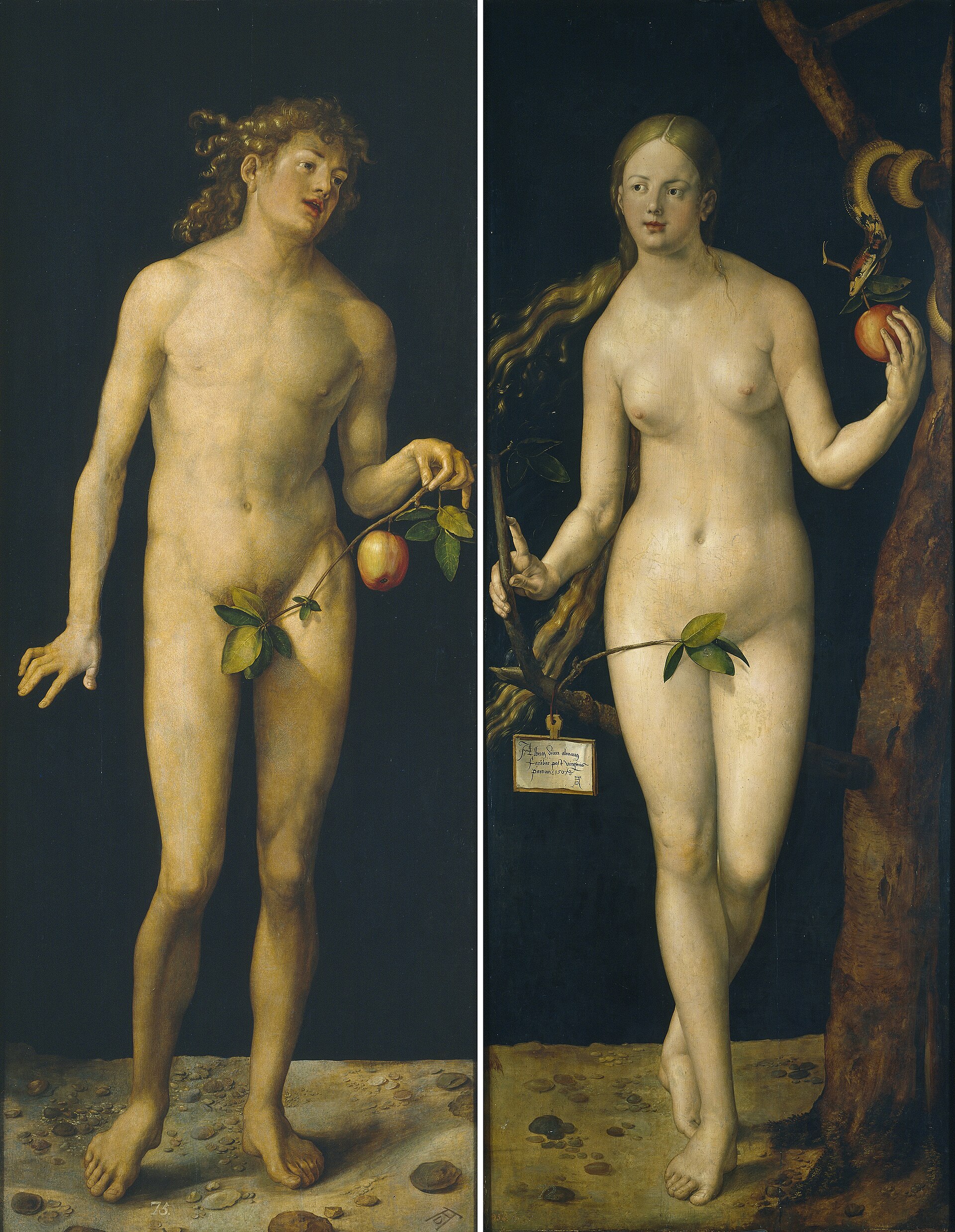
The two works bracket Durer’s transformation. In 1498 he is a young man insisting, through gloves and silk and a rhyming couplet, that a painter deserves to be looked at. By 1507 he no longer has to insist, because the Adam and Eve simply are looked at, by everyone, as the standard against which northern painting measures itself. Seeing both in one building is the closest thing the Prado offers to watching an artist win an argument he started with his own face.
What to look for
Stand close enough to read the inscription on the wall, then step back and find the gloves. Those two details, the writing and the idle covered hands, are the entire thesis: a man who can write, whose hands do not labor, who expects to be remembered by name. Then look at the window. The plain, the lake, the mountains are the road to Italy, the source of every idea in the picture. Last, look at the hair, and count how many separate curls Durer bothered to paint. The answer is more than any reasonable person would, which is the answer to who this man thought he was. He was twenty-six, he had crossed the Alps and come back changed, and he had decided that the painter was a person worth the most careful portrait he could make, even if the only sitter he could fully command was himself.
If you want to see how a later painter pushed the self-portrait even further inside the same museum, the Prado’s own Las Meninas puts Velazquez into his own picture of the royal family a century and a half on, and the highlights tour in what to see at the Prado places Durer’s panel among the works most worth your time.