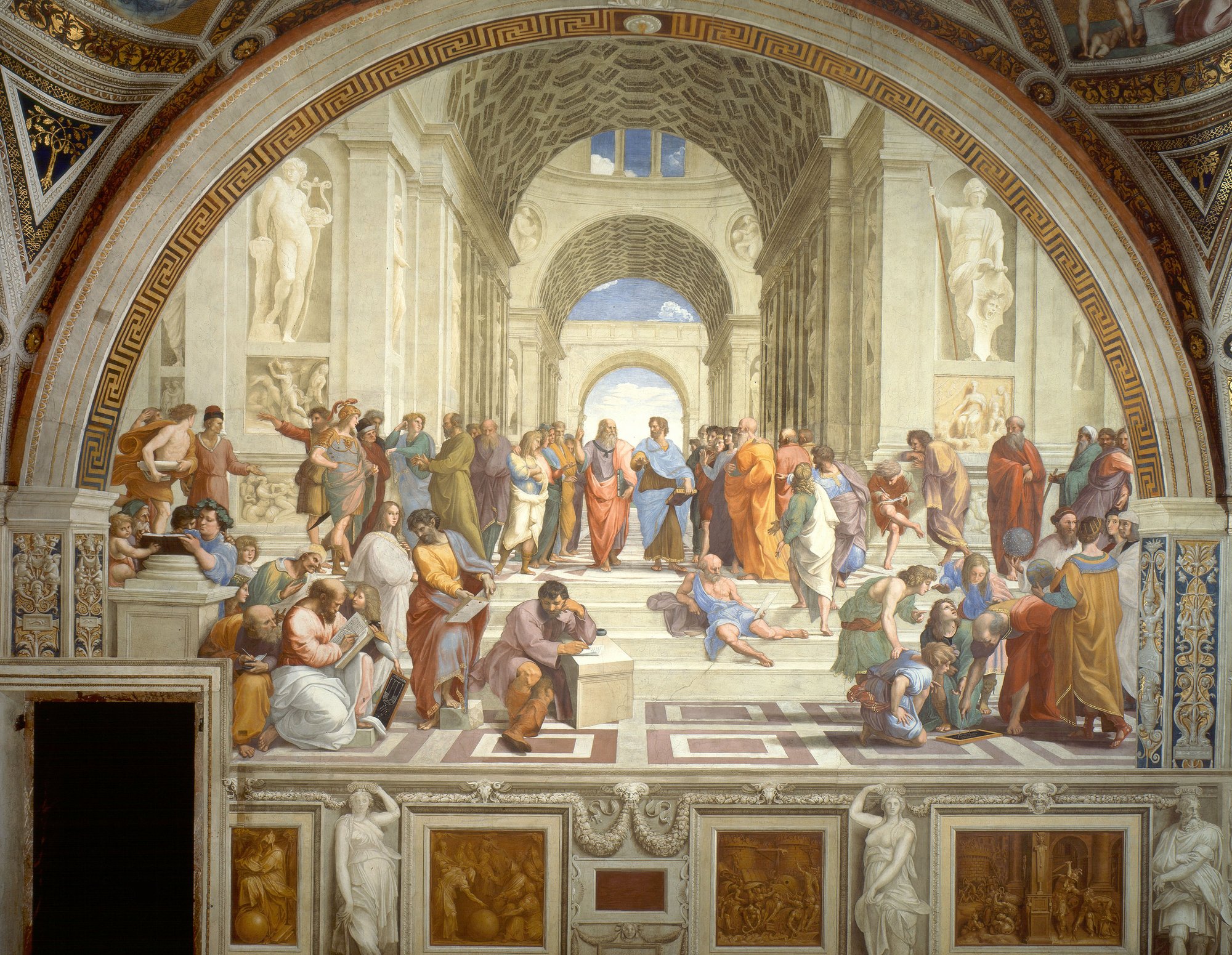
In the summer of 1509, Raphael Sanzio was twenty-six years old, living in Rome on a salary from Pope Julius II, and walking past Michelangelo in the hallway of the Vatican almost every day. Michelangelo was painting the Sistine ceiling, two hundred yards away, in a state of grim hostility. Raphael was painting a room called the Stanza della Segnatura, Julius’s private library, on the floor above. On the long wall facing the window, he laid out a painted colonnade in the style of Bramante’s new Saint Peter’s and filled it with fifty-eight philosophers.
He did not give the philosophers the faces of philosophers. He gave them the faces of his contemporaries. Plato is Leonardo da Vinci. Heraclitus, brooding alone on the steps, is Michelangelo, painted from memory after Raphael snuck into the locked Sistine Chapel one afternoon. Euclid, kneeling with a compass, is the architect Donato Bramante. And in the far right corner, looking directly at the viewer from under a soft black cap, is a young man with a long thin neck and dark eyes. That is Raphael himself. He signed his painting by standing in it.
School of Athens figures identified, from the center out
To walk through the crowd you start in the middle. Two figures at the top of the steps dominate the composition. They are Plato on the left, in red and purple, and Aristotle on the right, in blue and brown. Plato holds his dialogue Timaeus and points up at the sky. Aristotle holds his Nicomachean Ethics and gestures flat, palm down, at the earth. That single gesture contains the painting’s argument. Plato’s philosophy is about ideas, which live above the world. Aristotle’s is about substances, which live in it. The whole Renaissance quarrel between the two of them is packaged into one hand at shoulder height.
Plato’s face is Leonardo’s. You can verify this by standing in front of the fresco and then walking across the same palace to Raphael’s other frescoes, where Leonardo appears in conventional portrait form. Same silver beard, same long bony nose, same slightly hooded eyes. Leonardo was fifty-seven in 1509, living in Milan, and he was the most famous living painter in Italy. Raphael, who had studied Leonardo’s cartoon of the Battle of Anghiari in Florence five years earlier, was paying tribute to the man every Italian painter considered the master.
Aristotle is a composite. No single model has ever been convincingly identified. He is younger than Plato, more muscular, more present. He looks like a senator.
Plato and Aristotle painting a family quarrel
The relationship between Plato and Aristotle was not abstract for Raphael. The Stanza della Segnatura is Pope Julius’s library, and the ceiling frescoes above it show the four faculties: theology, philosophy, poetry, and jurisprudence. Each wall matches a faculty. The Disputation of the Sacrament is theology. Mount Parnassus is poetry. The Cardinal and Theological Virtues is jurisprudence. Philosophy is this wall — the one now called The School of Athens, a title that did not exist until the seventeenth century.
Julius, a humanist as well as a warrior pope, believed the four faculties harmonized. The Christian theology on the opposite wall and the pagan philosophy on this one were meant to face each other across the room in a state of argument that was also a state of reconciliation. Raphael’s job was to paint that argument as a crowd.
So the crowd is organized. Around Plato cluster the idealists, the mystics, the mathematicians who believed numbers were the structure of reality. Around Aristotle stand the naturalists, the observers, the people who got their knowledge by looking at things. Every pose, every gesture, every knot of conversation in the painting is positioned within that gravitational field.
Who is in School of Athens, figure by figure
Start left and move clockwise.
Socrates is in olive green, in profile, holding up his left hand as if counting off propositions on his fingers. He is arguing. His audience, the man with a helmet who looks like he arrived at a philosophy lecture by accident, is Alcibiades, the young Athenian general who became Socrates’s most famous pupil. The helmet is a visual joke: Alcibiades did in fact show up at symposia in military kit, drunk, and tried to seduce his teacher, who did in fact turn him down.
In front of Socrates, sprawled on the steps like he fell there, is Diogenes the Cynic. He is alone. He is reading. He does not care about the crowd. Diogenes famously lived in a barrel, told Alexander the Great to get out of his sunlight, and held a lamp up in the agora looking for an honest man. Raphael gave him the middle of the painting and then walled him off from every other figure. Nobody is talking to him. That is accurate.
Lower left, kneeling over an open book, is Pythagoras, surrounded by a small crowd of students. A young man in white writing on a slate holds the book so Pythagoras can see it. The slate contains the Greek letters for the harmonic ratios — the mathematical proof that music is numbers. A second student behind Pythagoras holds a scroll showing the tetractys, the triangular arrangement of ten points that was the sacred symbol of the Pythagorean school.
Behind Pythagoras, peering over his shoulder with a white turban, is the Arab philosopher Averroes. He is the only non-Greek identified by costume. Raphael included him because he was the most important medieval commentator on Aristotle, and Aristotle’s presence in the painting is sponsored, in a sense, by Averroes’s translations.
To the left of Pythagoras, in white, with a laurel wreath, is a beautiful young man whose identity is one of the painting’s puzzles. Some scholars say he is Francesco Maria della Rovere, the Duke of Urbino, painted as a courtesy to the Della Rovere family Julius came from. Others say he is Hypatia of Alexandria, the female mathematician and Neoplatonist. If the second reading is right, Raphael painted a woman into a fresco about philosophy without telling anyone he had done it, and did it by giving her the haircut of a man.
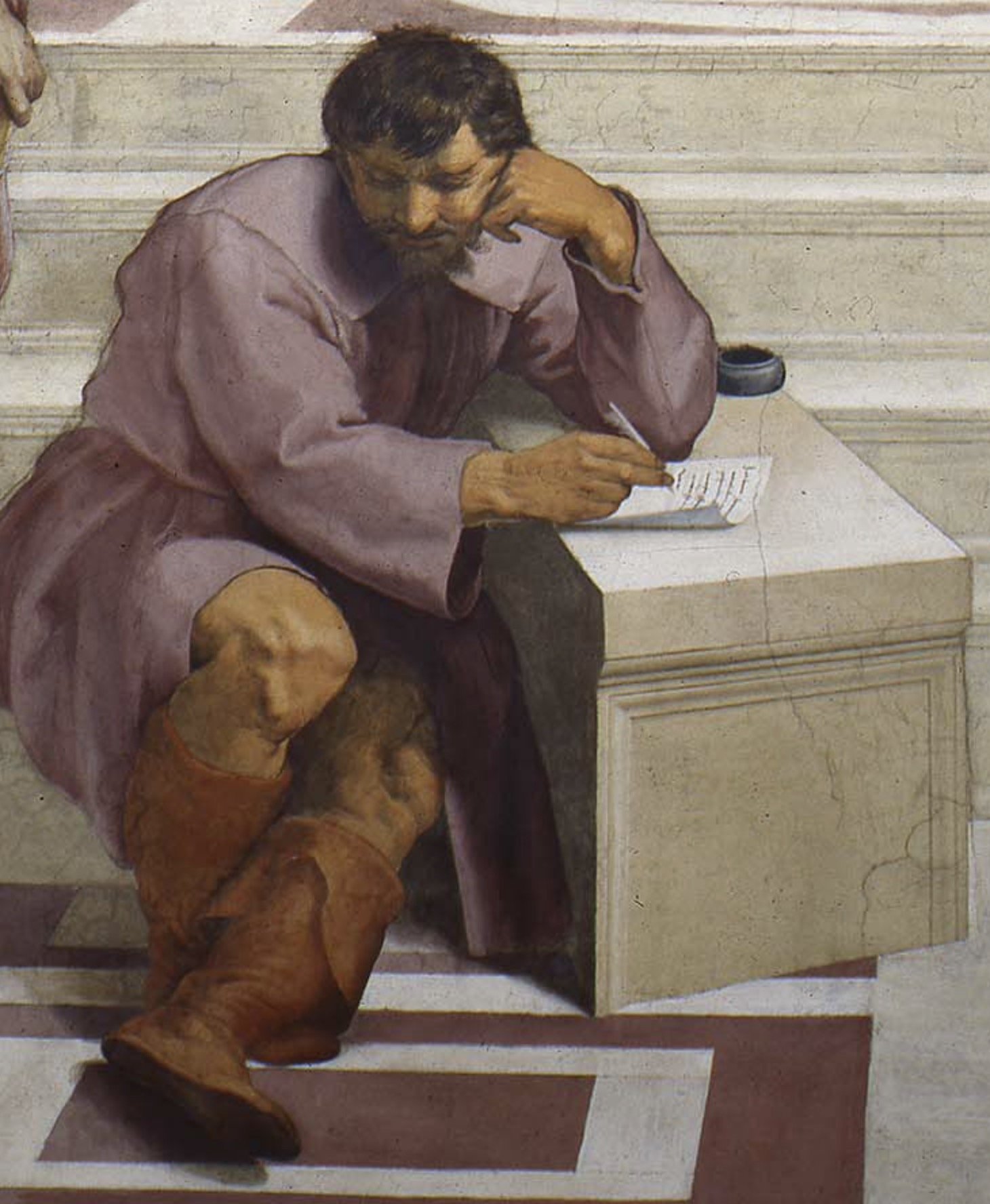
In the center foreground, in a white tunic, propped against a block of marble with his head on his hand, is the painting’s most famous addition. This is the figure who was not in Raphael’s original cartoon. It was added late, after the rest of the fresco was already painted, on a second patch of plaster slapped onto the existing wall. The figure is Heraclitus. And the face is Michelangelo’s.
Heraclitus Michelangelo portrait, painted in secret
Here is the story. In late 1510, about a year into Raphael’s work on the Segnatura, the Sistine scaffolding came down briefly for an unveiling. Michelangelo, who jealously guarded access to his work in progress, had refused to let anyone in during the painting. Raphael, Bramante, and a few others slipped in to see the half-finished ceiling.
Raphael walked out changed. The ceiling was more muscular, more violent, more monumental than anything he had painted. He went back to the Stanza della Segnatura, looked at The School of Athens, which was mostly done, and decided something was missing. He ordered the masons to chisel out a patch of plaster in the center foreground and replaster it. When the new surface was ready, he painted Heraclitus onto it.
Heraclitus, the Greek philosopher known as “the weeping philosopher,” was famous for the doctrine that everything flows and nothing remains, and for a temperament the ancients described as dark, solitary, and contemptuous of other people. Raphael gave him Michelangelo’s body, Michelangelo’s brooding posture, and Michelangelo’s face. He even gave him Michelangelo’s clothes: a rough stonecutter’s tunic and leather boots, not the toga everyone else wears. It is a portrait made in memory after the Sistine visit, inserted into the painting as a tribute and also as a joke. The man is brooding alone because he is Michelangelo, who actually was brooding alone, down the hall, at that exact moment.
If you look carefully at Heraclitus’s left leg, you can see a faint seam in the plaster where the patch meets the surrounding surface. Five hundred years later, the evidence of the late edit is still visible to anyone who bothers to look.
Euclid School of Athens, kneeling with a compass
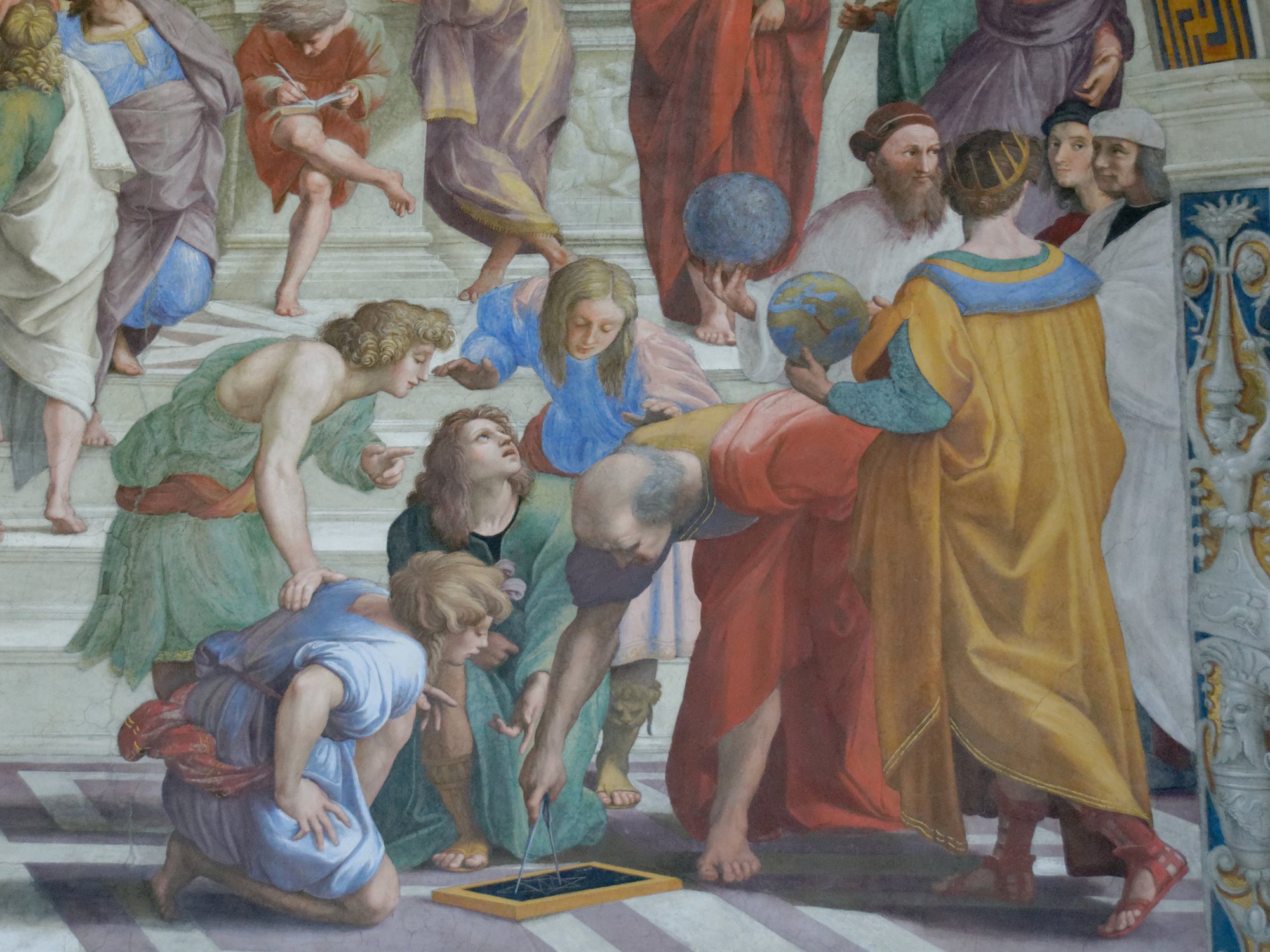
Move across to the right foreground. A bald man bends over a slate with a compass in his hand, drawing a geometric figure. Four young students are gathered around him, one of them leaning in so close his nose almost touches the slate. This is Euclid, the third-century B.C. geometer whose Elements was the textbook every European learned mathematics from for two thousand years.
Euclid’s face is the face of the architect Donato Bramante. Bramante was fifteen years older than Raphael and also from Urbino, the small court city where Raphael had grown up. He had designed the new St. Peter’s, the colonnade that Raphael used as the architectural frame of the whole fresco. Giving Euclid Bramante’s face was Raphael’s acknowledgment that the painting’s architecture, literally and figuratively, was Bramante’s work. Bramante had also, incidentally, been the man who suggested to the Pope that Raphael be given this commission instead of a rival candidate. The portrait was a paycheck.
On the ground next to Euclid, on his slate, is a small signature: the letters R.U.S.M. They stand for Raphael Urbinas Sua Manu — “Raphael of Urbino, by his own hand.” It is the painter’s only formal signature on the fresco. That R.U.S.M. is on the only slate that does not contain Greek mathematics. You have to look down, not up, to see it.
Next to Euclid stand three more named figures. Zoroaster holds a celestial globe. Ptolemy, the Egyptian astronomer, holds a terrestrial globe — the ancient view of the cosmos, with Earth at the center. The two of them face each other, globes in hand, as if arguing about what to put in the middle of the universe. Behind Ptolemy, looking over his shoulder, wearing a soft black beret, is a young man with dark hair. That is Raphael.
Philosophers in Raphael painting, the ones you can’t name
Not every face is identified. The young man next to Plato, the one in the gold cloak, is probably Xenophon, the historian and student of Socrates, but scholars have argued for other readings. The bearded man in a blue cloak to the right of the central steps could be Plotinus, the Neoplatonist, or could be a pure invention. The three men conversing in the middle distance to the left, with their heads together, are not identified at all, and were probably meant to be types rather than individuals.
Raphael built in the ambiguity on purpose. The painting was commissioned as a portrait of philosophy, not as a specific taxonomy of named philosophers. The crowd that cannot all be named is itself the point: there were more philosophers than any one room can hold. You are looking at a sample.
Chiaro works for the Segnatura because this is a room where the key to the whole painting is a list of names, and the list is not on the wall. Stand in front of the fresco, look at Heraclitus on his marble block, and the story of the late 1510 chisel — the patch of plaster, the Sistine break-in, the Michelangelo face — runs in your ear at the exact moment you are looking at the seam.
Raphael Vatican fresco, the program above the crowd
Look up. The ceiling of the Stanza della Segnatura is not a decorative flourish. It is the philosophical program of the four walls announced from above. In the center is an octagon containing a grotesque medallion of God the Father over the word FIAT LUX. Around the octagon are four tondi, one for each wall’s faculty.
The tondo above the philosophy wall — the one above The School of Athens — shows a female personification of Philosophy seated on a throne, holding two books labeled Moralis and Naturalis. Moral philosophy and natural philosophy. That is the divide the wall below elaborates. The right side of the fresco is Aristotle’s natural philosophy: observation, measurement, physical things. The left is Plato’s moral philosophy: ideas, forms, the realm above. The ceiling tells you what to look for. The wall tells you who.
Raphael did not paint the ceiling tondi himself. They were executed by his assistants following his designs. But the program came out of his head — out of long conversations, presumably, with Julius’s theologian adviser and with Bramante. The Stanza della Segnatura as a whole is one of the most carefully argued painted rooms in Europe. Four walls, four faculties, four harmonies. It was a philosophy of organization as much as a philosophy of philosophy.
Diogenes Raphael fresco, the man who wouldn’t join
Go back to Diogenes. He is still there, alone, on the steps. His placement is the painting’s cruelest joke. He is the one philosopher everyone in the Renaissance had heard of and nobody wanted to be. He mocked Alexander. He spat on marble. He lived in a barrel and declared himself a citizen of the world, rejecting every school, including his own. Raphael gave him the central diagonal of the painting and then isolated him from every single other figure in it.
The isolation is also a formal decision. Diogenes’s recumbent body cuts the crowd into two symmetrical halves, the Platonists on the left and the Aristotelians on the right. He is the pivot. He is the figure the painting is composed around, even though nobody in the painting acknowledges him. That is exactly how Diogenes himself would have liked it.
If you want to see the key to Raphael’s compositional method, find Diogenes first and work outward. Every other figure is placed in relation to him.
Pythagoras Raphael painting and the music of the spheres
The slate at Pythagoras’s feet is one of the painting’s most carefully researched details. On it Raphael painted the Pythagorean harmonic ratios: diapason, diapente, diatessaron — the octave, the fifth, and the fourth — each expressed as a ratio of small integers. This was not invented; Raphael copied it from a treatise. The treatise was by his contemporary Franchino Gaffurio, a music theorist whose diagrams of the harmonic ratios had been circulating in Rome for twenty years.
The detail is there because Pythagoras was the first Greek to argue that music and mathematics were the same thing: that the pitch of a vibrating string is a function of its length, which is a function of number, which is therefore the underlying language of reality. That idea, the music of the spheres, is the foundation of everything Plato said above Pythagoras’s head.
So the composition works vertically too. Pythagoras on the ground, ratios in hand. Plato overhead, pointing up at the heaven the ratios describe. Aristotle pointing down at the physical world where those ratios manifest. Heraclitus on the marble block, not agreeing with any of it. The argument happens on three levels simultaneously.
What to look for when you see it
Go to the Stanza della Segnatura early. The Vatican Museums send visitors through the rooms in a processional order ending at the Sistine, so by the time most people reach the Segnatura they are already planning the next room. Stop. The Segnatura is better than the Sistine. It is less crowded. You can actually see the figures.
Three details reward ten minutes in front of the wall.
First, the seam. The patch of plaster for Heraclitus is faintly visible in raking light. Stand at the right-hand side of the fresco and look at the central foreground. The rectangle of slightly different plaster shows up if you know to look.
Second, the signature. The letters R.U.S.M. on the collar of Euclid’s tunic. You have to get close. The guard will not stop you.
Third, the self-portrait. The young man looking out from behind Ptolemy. He is the only figure in the entire painting whose eyes meet yours. He painted that in deliberately. He wanted you to know who did this.
Raphael was dead eleven years later, in 1520, at thirty-seven. He was buried in the Pantheon, at his own request. His epitaph, written by the humanist Pietro Bembo, reads: “Here lies Raphael, by whom the mother of all things feared to be outdone while he lived, and when he died, feared she herself would die.” It is the kind of line Bembo only wrote for painters who deserved it. Walk out of the Stanza, across Saint Peter’s square, past the Pantheon, and stand in front of the plain grey slab that marks the grave. The man under it is looking out at you from the corner of the Segnatura fresco, in a black cap, from behind Ptolemy, still twenty-six, still holding his gaze.