Stand in the Salle des Etats on any given Tuesday at eleven in the morning. Thirty thousand people will pass through this room today. Every one of them is facing the same direction: south, toward the bulletproof glass box that holds Leonardo’s Mona Lisa. Phones up, elbows out, patient shuffle.
Now turn around.
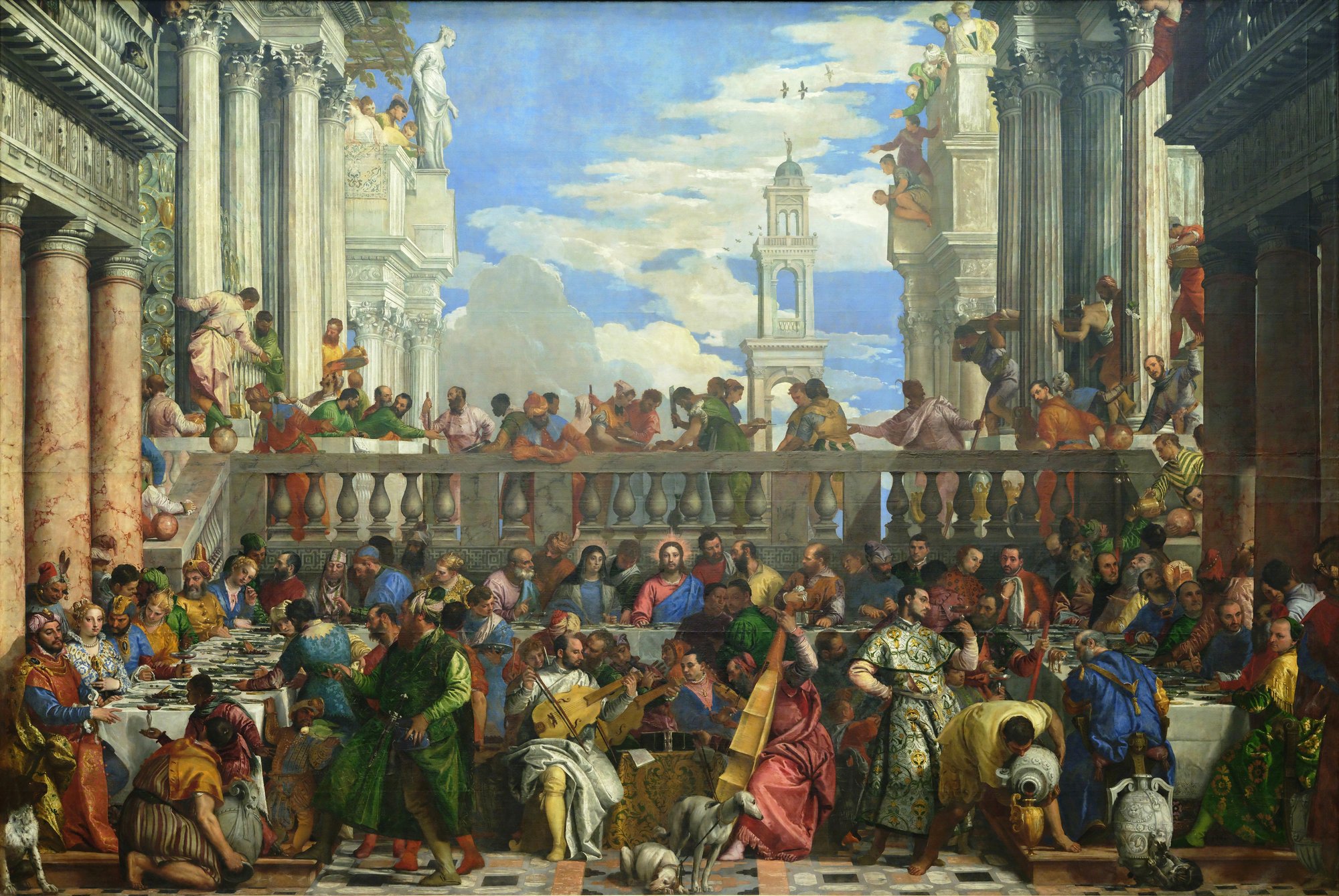
The back wall is a painted room six and three quarter meters tall and almost ten meters wide. One hundred and thirty people in Venetian silk are eating dinner in it. There is a dog under the table and a parrot on somebody’s wrist. Four musicians in the foreground are playing a bass viol, a violone, a cornetto, and a viola. Jesus is in the middle. He has just turned a jar of water into wine. That is Paolo Veronese’s Wedding at Cana, and at any given moment in the Salle des Etats roughly nine out of ten people are standing with their backs to it.
That is not an accident of crowd flow. It is the defining fact of the room. The Mona Lisa is seventy-seven centimeters tall. Veronese’s canvas is sixty-seven square meters. The ratio of surface area is roughly two hundred to one. The smaller work is behind bulletproof glass and a bronze rail twelve feet deep. The bigger one is right there. You can walk up and read the label.
The Wedding at Cana painting by the numbers
Let’s get the numbers on the table, because the numbers are the whole setup.
The canvas is six point seven seven meters tall. Nine point nine four meters wide. Sixty seven point twenty nine square meters of painted surface. With its lining and modern stretcher it weighs somewhere around one point three metric tons. For scale: Jacques-Louis David’s Coronation of Napoleon, which hangs two rooms over and is itself a monster, is about six by ten meters. Veronese’s is bigger. It is the biggest painting in the Louvre, full stop, and it has been the biggest since 1798.
Paolo Caliari, called Veronese because he was born in Verona around 1528, was one of three men who ran the Venetian painting scene in the sixteenth century. Titian was the old master and the court painter to emperors. Tintoretto was the velocity man, working fast and cheap on huge surfaces. Veronese was the color and the architecture guy. He painted feast scenes. The Benedictines of San Giorgio Maggiore, a monastery on its own small island in the Venetian lagoon, commissioned him in June of 1562 for a work to cover the entire back wall of their new refectory. The wall had been designed by Andrea Palladio. Veronese was twenty six years old.
He signed the contract for three hundred twenty four ducats plus a barrel of wine plus room and board while he painted it. It took him fifteen months. He delivered the finished canvas on September 8, 1563.
Dinner in Palladio’s refectory
Here is the thing to hold in your head. The work was never meant to be a museum object. It was a wall. The monks of San Giorgio Maggiore walked into the refectory twice a day, sat down on long benches, and ate their bread and fish in silence while staring at a wedding feast that was almost the exact dimensions of their actual room. Palladio’s real pillars on their side of the wall kept going, in paint, on the other side. The painted balustrade lined up with the real floor. If you were a novice, eighteen years old, hungry, it must have felt like the Venetian nobility in the picture were about to hand you a plate.
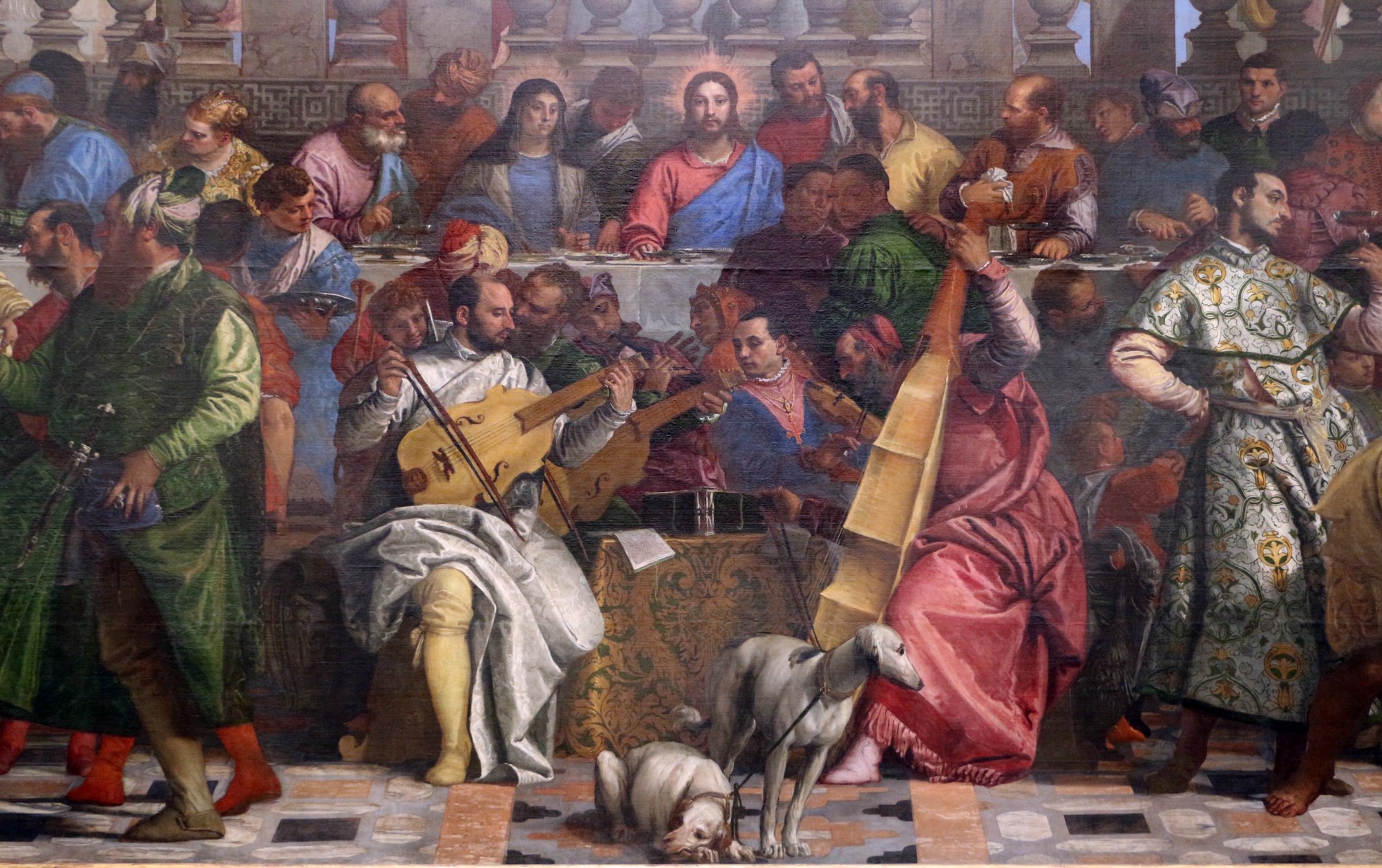
Veronese painted himself into the scene. Him and three of his friends. They are the four musicians in the foreground, the ones in the white silk jackets playing a consort of stringed and wind instruments at the moment the water becomes wine. The traditional identification, which the Louvre still hedges on its own label, is that Veronese is the viola da gamba player on the left, Titian is the double bass on the right, Jacopo Bassano is holding the cornetto, and Tintoretto is behind them playing the viola. Four of the greatest painters of the Venetian cinquecento playing a quartet at a wedding in Galilee that is also a Venetian society dinner that is also a miracle. If that is not a commit-to-an-opinion move, nothing is.
One hundred and thirty guests
The scene is the Gospel of John, chapter two. Jesus, his mother, and his disciples go to a wedding in the town of Cana. The wine runs out. Mary tells Jesus. Jesus tells the servants to fill the stone water jars. They pour wine. This is his first public miracle. The whole account is eleven verses long.
Veronese gives it around one hundred and thirty figures. Venetian patricians in silk. Turkish ambassadors in turbans. African servants carrying plates. A dwarf on the left holding a parrot. A dog under the table. A cat pawing at a jug in the foreground. A man at the right picking his teeth with a toothpick. Jesus is dead center, small in the frame, quiet, holding a red cloak. Mary is beside him. The bride and groom are pushed almost off the edge of the canvas on the far left, which is theologically aggressive. Veronese is saying, without quite saying it, that this wedding is not about the couple. It is about the guest who just changed the chemistry of the drinks.
Above the table, in the upper third, you can see the sky and Palladio-style Renaissance architecture of a Venetian palazzo. The butchers up on the balcony are carving a lamb. This is not accidental either. The lamb is the Passion sign, stuck in the background of the first miracle, three years before the event it points to.
If you want a one-line guide to the Wedding at Cana self portrait group, here it is: they are the best dressed people in the room and they are the only ones actually working.
Napoleon cuts it down
On September 11, 1797, French soldiers operating under the orders of General Napoleon Bonaparte walked into the refectory of San Giorgio Maggiore and took it off the wall.
They could not, of course, carry it out intact. It was the size of a wall. So they sawed the canvas into sections right through the paint, rolled the sections, crated them, and shipped them to Paris. This was part of the looting campaign that the French armies in Italy ran from 1796 to 1798 under the terms of the Treaty of Tolentino, a treaty the French had dictated at gunpoint to Pope Pius VI a few months earlier. The treaty gave France a legal cover to take more than five hundred paintings and sculptures out of Italy. This one was the single biggest item on the list.
The rolled canvases arrived in Paris in 1798. Conservators stitched the work back together and remounted it on new stretchers. It was installed in the Musee Napoleon, which is what the Louvre was called while Napoleon was running France, and it has been there ever since. If you have ever wondered how the Wedding at Cana Louvre story goes, that is it. The painting did not come to Paris. It was cut down and shipped to Paris.
The Le Brun swap Venice still resents
In 1815, Napoleon lost at Waterloo. The Treaty of Paris required France to return the art it had looted during the previous two decades. Antonio Canova, the great neoclassical sculptor, was sent from Rome as the papal envoy in charge of getting the Vatican’s paintings back. He was, to everyone’s surprise, largely successful. Most of Napoleon’s Italian loot went home.
Venice asked for the Veronese back.
France said no.
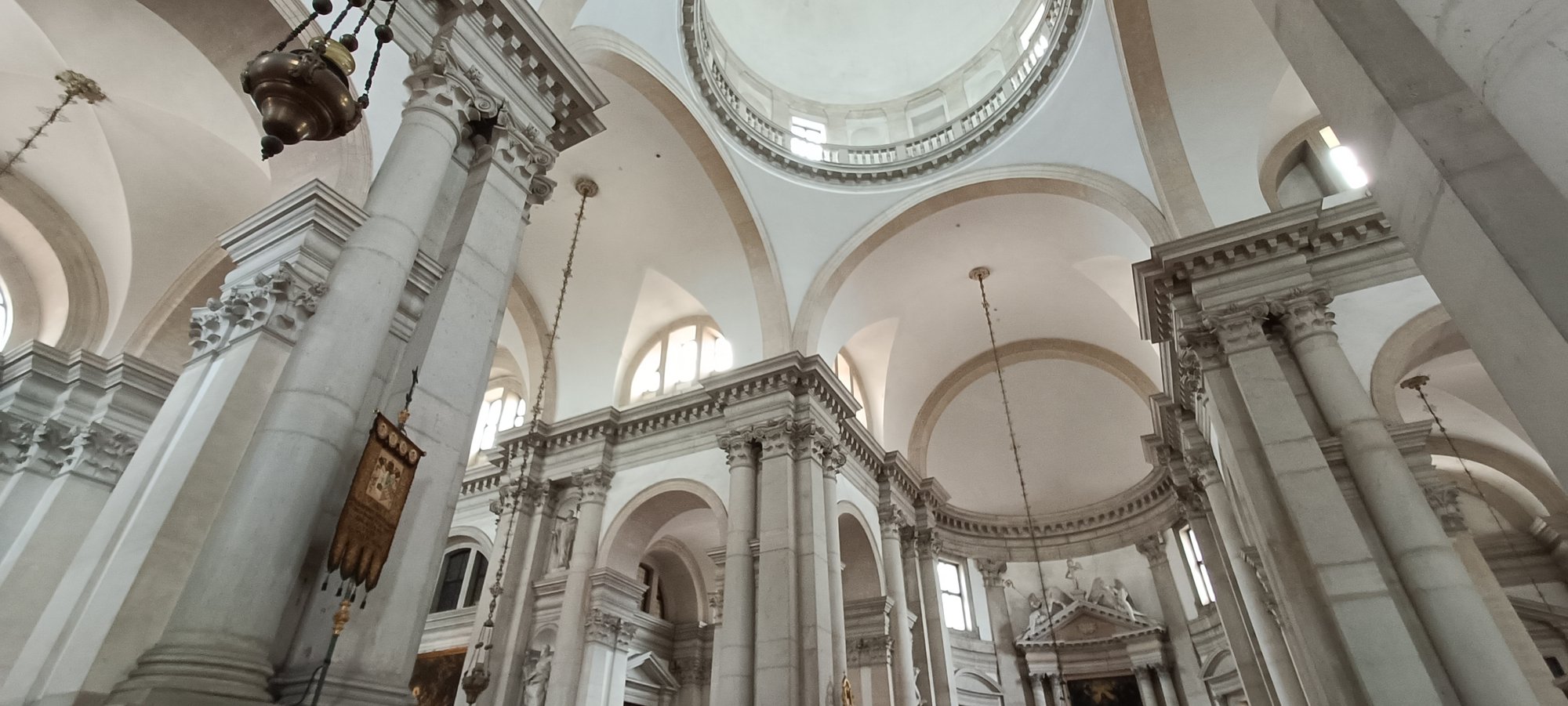
The official French position was that the canvas was now too fragile to move. It had been sawed apart, rolled, shipped, stitched, and remounted once already. Taking it off the Louvre wall and putting it on a cart to Venice would, the argument went, destroy it. As a consolation gift France sent Venice a different work: Charles Le Brun’s Feast in the House of Simon the Pharisee, a late seventeenth century French painting showing a different New Testament banquet. That substitute is what hangs today on the refectory wall in San Giorgio Maggiore where the Veronese used to hang. Most visitors never notice the swap. Venetians have never stopped noticing. As recently as the twenty first century, Italian cultural ministers have floated the idea of asking again, and the answer from Paris is always the same: too fragile to move.
Here is the trick of the fragility argument. In 2007 the Italian studio Factum Arte, working under a commission from the Fondazione Giorgio Cini, produced a full-scale digital facsimile and installed it back in the Palladio refectory. It took thirty people fifteen months. The facsimile is in the refectory right now. You can visit it. You can sit in the room it was painted for, with the Palladio pillars lined up with the painted ones the way Veronese intended, and eat the view the monks ate for two hundred and thirty years.
It is not the original. The original is in Paris.
The liberties of poets and madmen
Ten years after he finished this canvas, Veronese was in trouble with the Inquisition.
The incident was not about Cana itself. It was about another refectory painting, a Last Supper he had finished for the Dominicans at Santi Giovanni e Paolo. In that work he had included German soldiers, jesters, dwarfs, a man with a bloody nose, and a dog in the foreground. The Inquisitors wanted to know who had authorized the indecorous detail. On July 18, 1573, Veronese was called before the tribunal.
The transcript survives. It is one of the great records of an artist defending his own work against a religious censor, and the core exchange goes like this. The Inquisitor asks why Veronese put Germans, dwarfs, and buffoons into a scene of the Last Supper. Veronese answers, on the record: “We painters take the same liberties poets and madmen take.” He adds that he included the figures as ornament, in the empty parts of the canvas, as painters have always done.
The Inquisition ordered him to fix it. Veronese did not repaint. Instead he changed the title. “The Last Supper” became “The Feast in the House of Levi,” the story of Jesus eating at a tax collector’s house, which is a scene where it is theologically fine to have Germans and jesters at the table. Retitle and done. That canvas is in the Accademia in Venice now.
The reason the Inquisition story belongs in the story of the first painting and not just in its own Feast in the House of Levi entry is this: the principle Veronese argued in front of the tribunal in 1573 is exactly the principle he had already painted ten years earlier on the wall of the Benedictine refectory in San Giorgio Maggiore. A religious miracle dressed in sixteenth century Venetian silk, packed with dogs and parrots and working musicians. The Inquisition hauled him in for the Santi Giovanni work. They could have hauled him in for Cana and the argument would have been identical.
The day they tore it
The second scar after the 1797 cutdown is the one the Louvre admitted to in 1992.
In 1989 the canvas went into a long scheduled conservation campaign. The conservators wanted to clean two centuries of varnish off it, consolidate areas of flaking paint, and restretch the lining. The work was to be done in the Salle des Etats itself, behind scaffolding. On the night of June 8, 1992, during a handling operation, part of the support frame holding the painting failed. It dropped and tore. The Louvre disclosed the damage. The restoration, which was supposed to finish that year, had to be extended. Restorers patched the tear and reinforced the lining. The canvas went back up.
You will not find the 1992 tear in most English-language summaries of the Cana story or its meaning. It is easy to miss. The Louvre itself does not lead with it on the room label. But it is part of what you are looking at when you stand in front of it now. The canvas was cut apart by soldiers in 1797 and dropped by its own support frame in 1992. It has been repaired twice.
Finding Room 711
The Wedding at Cana dimensions do not fit in a normal gallery, so the Louvre gave it a specific home. It lives in the Salle des Etats, officially Room 711, in the Denon Wing on the first floor. This is also where the Mona Lisa lives. If you have ever asked where is the Wedding at Cana located, the answer is simple: in the same room as the most photographed painting in the world, on the opposite wall.
Getting to it is the easiest navigation problem in the museum. Follow the signs for the Mona Lisa. That is it. Every hallway from every entrance eventually funnels into the Salle des Etats. Once you are in the room, the Mona Lisa is the wall with the roped crowd. The Veronese is the wall behind the crowd.
A practical note on salle des etats wedding at cana viewing. The morning rush, between nine thirty and eleven, is when the Mona Lisa line is densest and the far wall is emptiest. You can get within a meter of the Veronese and look up the middle of the canvas at Jesus and Mary without anyone in your way. The crowd is three meters behind you, all facing the other direction. The Louvre guards will not stop you standing there as long as you do not touch the rail. You will have one of the largest oil paintings ever made essentially to yourself, in the most visited art room on Earth, at rush hour — and the room labels will not tell you about the four musicians, the 1797 saw lines, or the 1992 tear. Chiaro walks through all three.
Turn around
If you remember one thing about this canvas, let it be the geometry. The largest work in the building has been in Paris since 1798. It was taken from a Venetian monastery by French soldiers with saws. France has refused to return it for two hundred twenty nine years. It hangs, today, on the wall directly opposite the Mona Lisa. Around thirty thousand people stand in front of it every day and almost none of them know they are standing in front of it. They are looking the wrong way.
The wall in Venice is still empty of it. The wall in Paris is covered in it. And in the most visited room in the most visited museum on earth, the biggest painting on the biggest wall is the one thing nobody is looking at. Do the one thing nobody else in the Salle des Etats is doing. Turn around.

