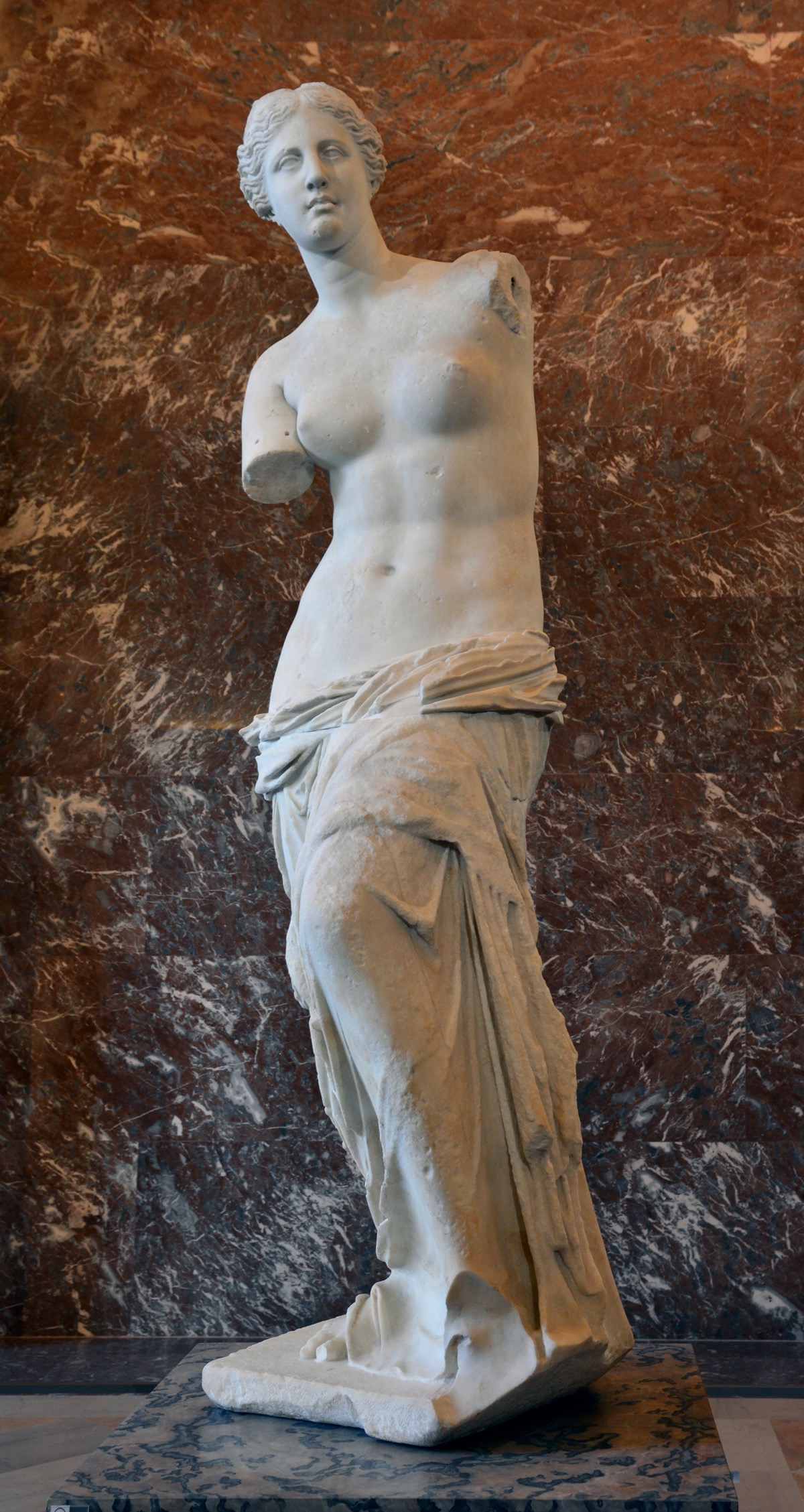
On the morning of April 8, 1820, a farmer named Yorgos Kentrotas was prying stones out of a wall on the island of Milos. He was quarrying for building material. He pulled one block, then another, and then the third block wasn’t a block at all. It was a niche. Inside the niche, broken into two large pieces and a scatter of smaller ones, was a marble statue of a half-nude woman about six and a half feet tall. She was missing both arms. She had no nose on the first look and then she had a nose again when they rolled the upper body out into the light. She had a plinth, a small inscribed base that fit under her left foot. Yorgos propped the pieces against the wall and went to find someone in town who could tell him what to do.
The person he found was Olivier Voutier, a twenty-three-year-old French naval ensign who had been wandering the island looking for antiquities to draw. Voutier sprinted to the site, saw the torso, saw the plinth, understood instantly what he was looking at, and started a chain of events that would end two hundred years later with a queue of tourists photographing her in a ground-floor gallery of the Louvre, none of them ever told that the last thing France did before shipping her home was lose the only object that would have proven who made her and when.
What the Louvre Museum Venus de Milo actually is
She is a late Hellenistic marble from somewhere between 150 and 100 BCE, carved by a sculptor whose full name is lost to a chipped plinth but whose first name was Alexandros, and whose hometown was Antioch on the Maeander. She is Aphrodite, goddess of love, or possibly Amphitrite, goddess of the sea, which was the local protector of Milos. She probably held an apple in her raised left hand — the Apple of Discord from the Judgment of Paris, which would make the statue a Melian civic joke, since “Milos” and the Greek word for apple, “melon,” are the same word. Nobody knows for sure because the arms are gone.
She is not Classical. That matters, because for the first hundred and fifty years she was in Paris, almost every French art historian, guidebook, and plaster cast label insisted she was. Classical meant fourth century BCE, meant Praxiteles, meant the serene high point of Greek sculpture, meant she belonged on the same tier as the Venus de’ Medici in Florence and the Apollo Belvedere in Rome. Hellenistic meant three hundred years later, past the peak, a copyist age. The difference was prestige, and France in 1821 badly needed the prestigious version.
The scuffle on the beach
Voutier’s first move was to go find the French vice-consul on Milos, Louis Brest, who bought the pieces from Yorgos and sent word to the French ambassador in Constantinople, the Marquis de Rivière. Rivière dispatched a young diplomatic secretary named Marcellus to retrieve her. Marcellus got there a week too late. The local Ottoman governor had heard about the statue, decided she belonged to the Sublime Porte, and had already authorized a Greek merchant named Oikonomos to ship her to a dragoman in Constantinople.
What happened next is where the folklore starts and the documents get vague. By the time Marcellus arrived in the bay of Milos on the French naval schooner Estafette, the statue was loaded onto a caique in the harbor, about to sail for Constantinople. There was an argument on the beach between the French and the dragoman’s agents. There was pulling, pushing, and the crates were eventually dragged off the caique and onto the Estafette by force. Marcellus paid compensation to the Ottoman side afterward, and the governor received a beating from the Porte for having tried to steal French property that France had purchased first, which is a sentence that could only be written about 1820.
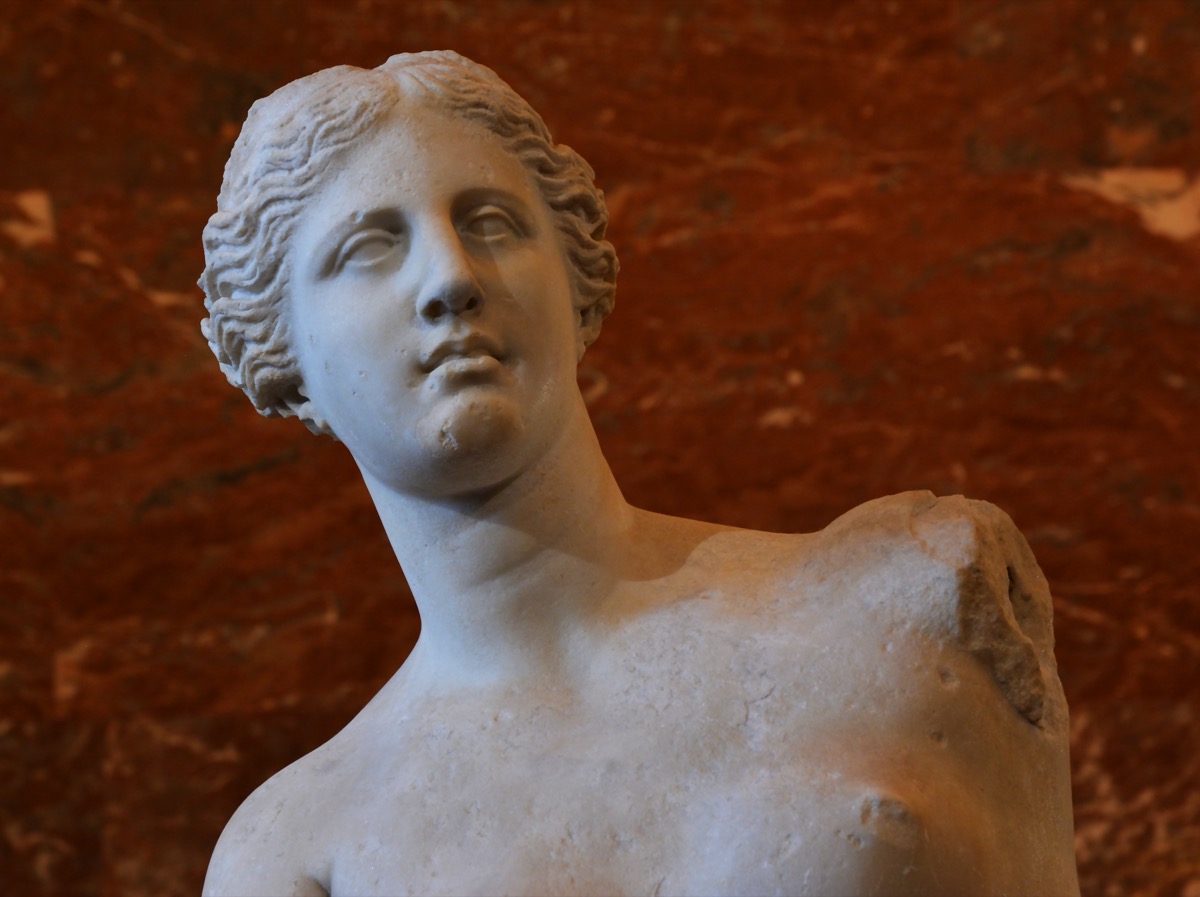
The story most Louvre visitors get told, if they ask a guide, is that during the scuffle on the beach the arms were snapped off the statue. One arm went one way, one the other, and both were lost in the shingle. It is a good story. It is almost certainly not true. The earliest written accounts of the discovery — Voutier’s own sketches from the day of the find, and a letter Louis Brest wrote to Paris that April — show the statue already armless when she came out of the wall. She was buried armless. The scuffle broke other things, maybe fingers and folds of drapery, but the arms were gone a thousand years before anyone named Yorgos started prying stones.
So why does the beach story survive? Because something else was lost during the voyage home, and the armless Venus became a useful place to hang the blame.
The plinth that disappeared
When the statue was first pulled out of the niche, the pieces included a small fragment of the plinth she had stood on. It had been carved separately and then dowelled to her feet. On one face of the plinth was a carved Greek inscription, which Voutier saw, which Marcellus saw, which Louis Brest reported on in writing to the Marquis de Rivière, and which several French scholars in Paris examined in 1821 after the statue arrived in the Louvre. The inscription read, translated:
Alexandros, son of Menides, citizen of Antioch on the Maeander, made this.
Antioch on the Maeander was a Hellenistic Greek city in what is now western Turkey, founded by Seleucid kings in the third century BCE. The form of the lettering, the mention of the city, and the style of the statue all dated her to the late second or early first century BCE. Late Hellenistic. Not Classical. Three hundred years and a whole category of prestige removed from the date the French wanted her to be.
In 1821, just as the statue was being cleaned and prepared for presentation to King Louis XVIII, the plinth went missing. Accounts vary. In some versions it was “misplaced” in a storeroom at the Louvre. In others it was “damaged in transit” and quietly discarded. In one version, noted by the nineteenth-century French archaeologist Salomon Reinach, the plinth was deliberately separated from the statue and suppressed, because the Marquis de Quatremère de Quincy, the permanent secretary of the Academy of Fine Arts and the most influential art historian in France, had declared in writing that the statue was a Classical work, and the inscription contradicted him.
Quatremère de Quincy knew the inscription existed. He had read the reports. He ruled, in a formal paper to the Academy in 1821, that the inscription was a later Roman-era addition, that Alexandros was probably a repair man, not the sculptor, and that the true date of the Venus de Milo was the fourth century BCE — the age of Praxiteles. The plinth, conveniently, was no longer available for anyone to re-examine. It has never been seen since.
Why France needed her to be Classical
The cover-up had a specific political cause. Six years before Yorgos Kentrotas started digging, France had been forced to give back the Venus de’ Medici. The Medici Venus, a first-century BCE Roman copy of a Greek original, had been the glory of Napoleon’s looted collection — taken from the Uffizi in 1803, displayed in the Louvre as the apex of all ancient sculpture, and then, after Waterloo, returned to Florence in 1815 under Allied pressure. Paris was humiliated. The main gallery of classical antiquities was a hole. The Apollo Belvedere had also gone back to the Vatican. France had the Winged Victory of Samothrace still on a boat, years away. The Louvre, the great republican museum, was suddenly missing its top exhibit.
Then a peasant on Milos walked into his field and hit a niche. The statue arrived in Paris in February 1821, a gift from the Marquis de Rivière to the king. Louis XVIII was bedridden with gout and could not attend the unveiling. He sent his compliments from his chamber. The court historians needed her to replace the Medici Venus. The court historians got what they needed. She was immediately presented as a Classical original, fourth century BCE, quite possibly by Praxiteles, and the only surviving Greek Venus of that quality in existence. The inscription suggesting otherwise ceased to be on file.
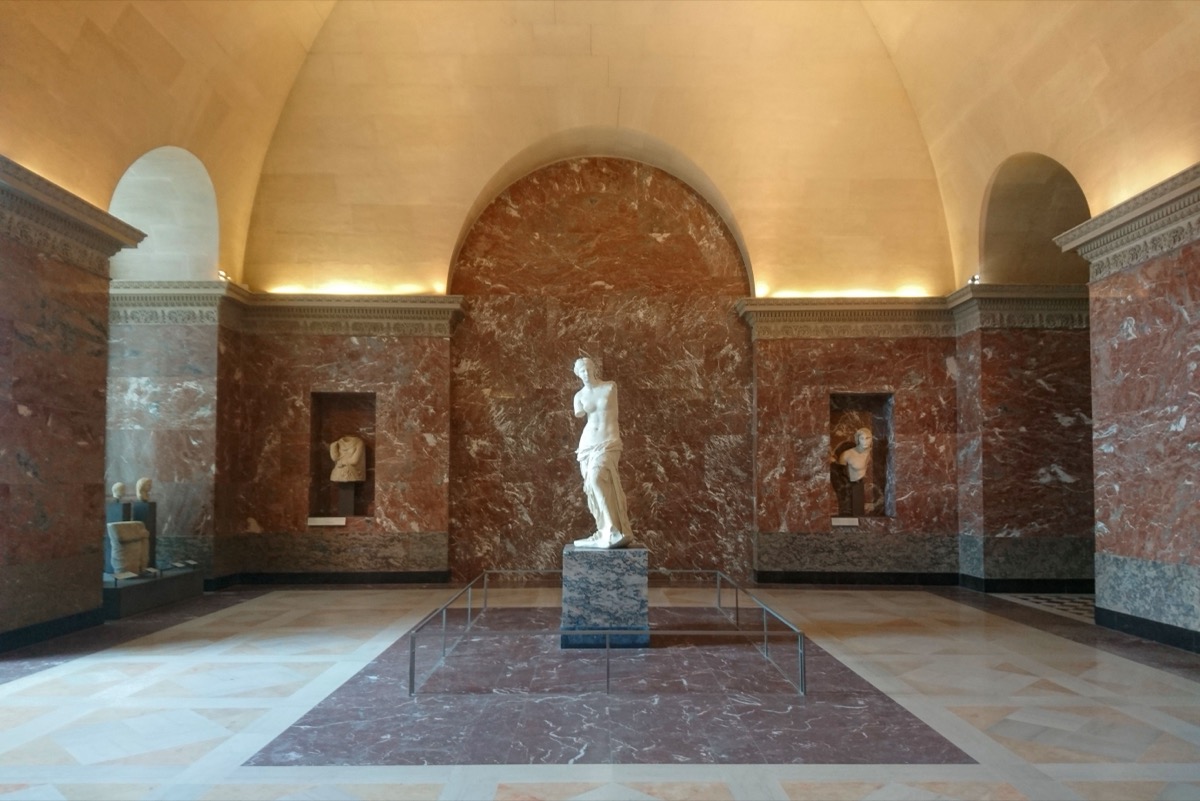
It took the rest of the nineteenth century and several German and French archaeologists to put the correct date back. Adolf Furtwängler, the great German classicist, published the demonstration in the 1890s. Salomon Reinach confirmed it in the 1900s. By 1920 the Louvre’s catalog reluctantly listed her as Hellenistic. By 2000 the wall label in the room acknowledged the Alexandros inscription. But the room itself — the Salle de la Venus de Milo, on the ground floor of the Denon wing — was built in the 1820s on the assumption that she was Classical, and the architecture still announces her that way. The niches around the room are for objects that were supposed to be peers of hers. They are all Roman copies from later centuries. She is still the only real Greek marble in the room.
Where in Louvre is Venus de Milo
She is on the ground floor of the Denon wing, in a long vaulted gallery that opens off the Galerie des Antiques. If you are coming from the Pyramid, you walk down toward Egyptian antiquities and then bear right into the Greek, Etruscan, and Roman rooms. The Salle de la Venus de Milo is near the end of that axis, on your left, signposted. She stands on a stone plinth — not the one from Milos, which is gone, but a replacement — at the far end of a symmetric room lined with lesser Roman Venuses and a cold marble floor. The lighting is natural when you can get it, supplemented by overhead spots that were installed in a 2010 refurbishment. The room is usually less crowded than you expect, because most of the Mona Lisa pilgrims never come downstairs.
Stand close. Look at her left foot. There is a small rectangular cut-out in the top of the plinth where the original inscribed base once dowelled in. That cut-out is the trace of the hidden history. It is the only remaining evidence on the statue itself that the inscription ever existed. Most visitors do not know to look for it, and the Louvre’s current wall text does not mention it — Chiaro does, in the order the 1821 cover-up actually unfolded.
Then walk around her once slowly. The drapery falling from her hips is carved with an undercut that the Hellenistic sculptors had perfected and Classical-era carvers never attempted. The folds are deep. The marble behind them is cut away to almost nothing. You can see it from the side. It is the late-Hellenistic style the French spent a century denying.
A note on the arms
The question everyone wants answered is what she was holding. The short answer is that we do not know, but we can reason. Her shoulders and torso are positioned the way a figure holds something forward and slightly to the left. Traces on her left shoulder suggest she bore weight there. Hellenistic Venuses from the same period and region are frequently shown holding either an apple — the Apple of Discord — or the shield of Ares reflecting her own face, a conceit from the Roman poet Ovid. The apple version is the more popular guess because of the Milos-apple pun. The shield version is the more scholarly. Neither can be proven without the arms, and the arms will almost certainly never be found. Yorgos Kentrotas dug into a wall, not a tomb. Whatever she originally held was broken off her long before the Ottomans controlled Milos, long before France existed, probably while she was still a civic statue in the public square of an ancient Greek town.
What to look for when you see her
Look for the cut-out in the plinth where the inscription used to fit. Look at the undercut drapery from the side. Look for the small chip above her right hip where one of the seams between the upper and lower blocks of marble was clumsily restored with cement in 1821. Look at the way the torso twists on the hips — contrapposto carried one step past Classical restraint into something looser and more theatrical. Those are the tells. She is a late Hellenistic original, and every one of them is a fingerprint the French could not erase.


