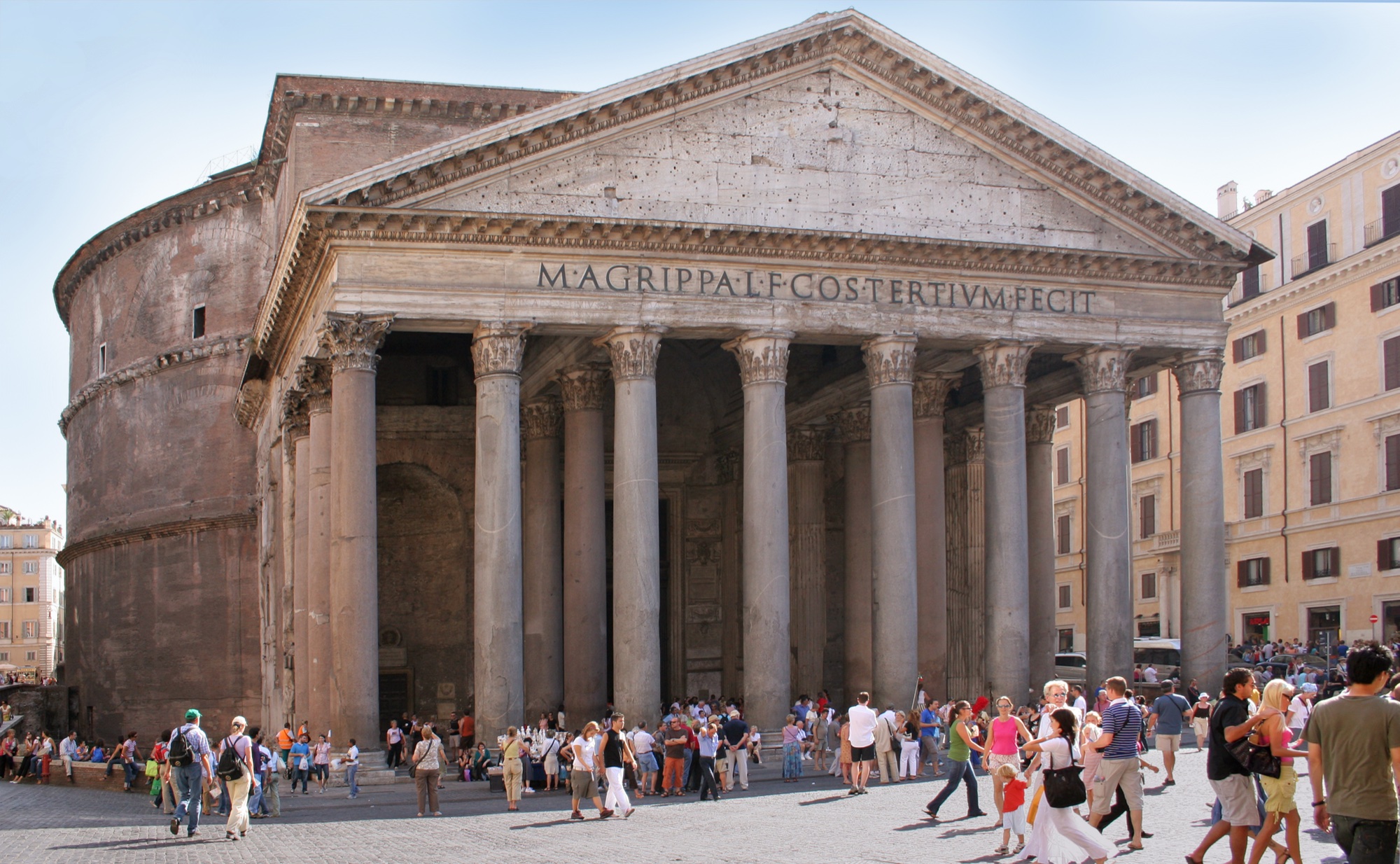
In foot-tall bronze letters across the front of the Pantheon, one sentence has been staring back at visitors for nineteen hundred years.
M·AGRIPPA·L·F·COS·TERTIVM·FECIT.
Marcus Agrippa, son of Lucius, consul for the third time, made this. It sounds definitive. It is almost totally misleading. When people ask who built the Pantheon, the answer on the pediment is wrong. The name belongs to a man who died more than a century before the building you are looking at was finished. The actual builder left no signature. The actual designer is someone whose name appears nowhere on the stones.
Three men are in this story. One gets the credit. One does the work. One probably draws the thing and then is arguably executed for knowing too much. Here is how they fit together.
Agrippa and the first Pantheon
Marcus Vipsanius Agrippa was the most important public builder of early imperial Rome. He was Augustus’s closest friend, his son-in-law, and the general who commanded the fleet at the Battle of Actium in 31 BC. After the war, Augustus put him in charge of improving the city. Agrippa paved streets, dredged sewers, restored temples, built the first thermal bath complex in Rome, and laid out the great monumental zone of the Campus Martius.
In 27 BC, he finished a temple there that he called the Pantheon. The Greek name meant roughly “to every god,” though Cassius Dio, writing two centuries later, reports a tradition that it was dedicated specifically to the Julian family’s tutelary gods rather than to the whole Roman pantheon. The exact dedication does not survive. Neither does the building itself.
Archaeologists excavating under the modern Pantheon in the 1890s found the foundations of a rectangular temple on a north-south axis, facing south, roughly the same width as the current rotunda but differently shaped and oriented. That is Agrippa’s building. It was a standard Roman temple: columned porch, closed cella, probably one of several similar temples that Agrippa put up across the Campus Martius between about 30 and 25 BC.
The reason the modern visitor can be confused about this is that the later Hadrianic rebuild kept the old name, the old dedicatory inscription, and roughly the old orientation of the porch. This was deliberate. Roman religious practice treated a rebuilt temple as a continuation of the original vow. You did not renumber a temple when you replaced its roof. So even though the building was completely new, it was legally, liturgically, and epigraphically the same Pantheon.
Agrippa’s original burned down on his watch’s schedule. It went up in the great fire of 80 AD, eleven years after his death. The emperor Domitian rebuilt the temple. The rebuild survived about thirty years and then was struck by lightning and burned again, around 110 AD. For most of the next decade, the site was a scorched patch of masonry in the middle of Rome.
Hadrian and the rebuild that kept the old name
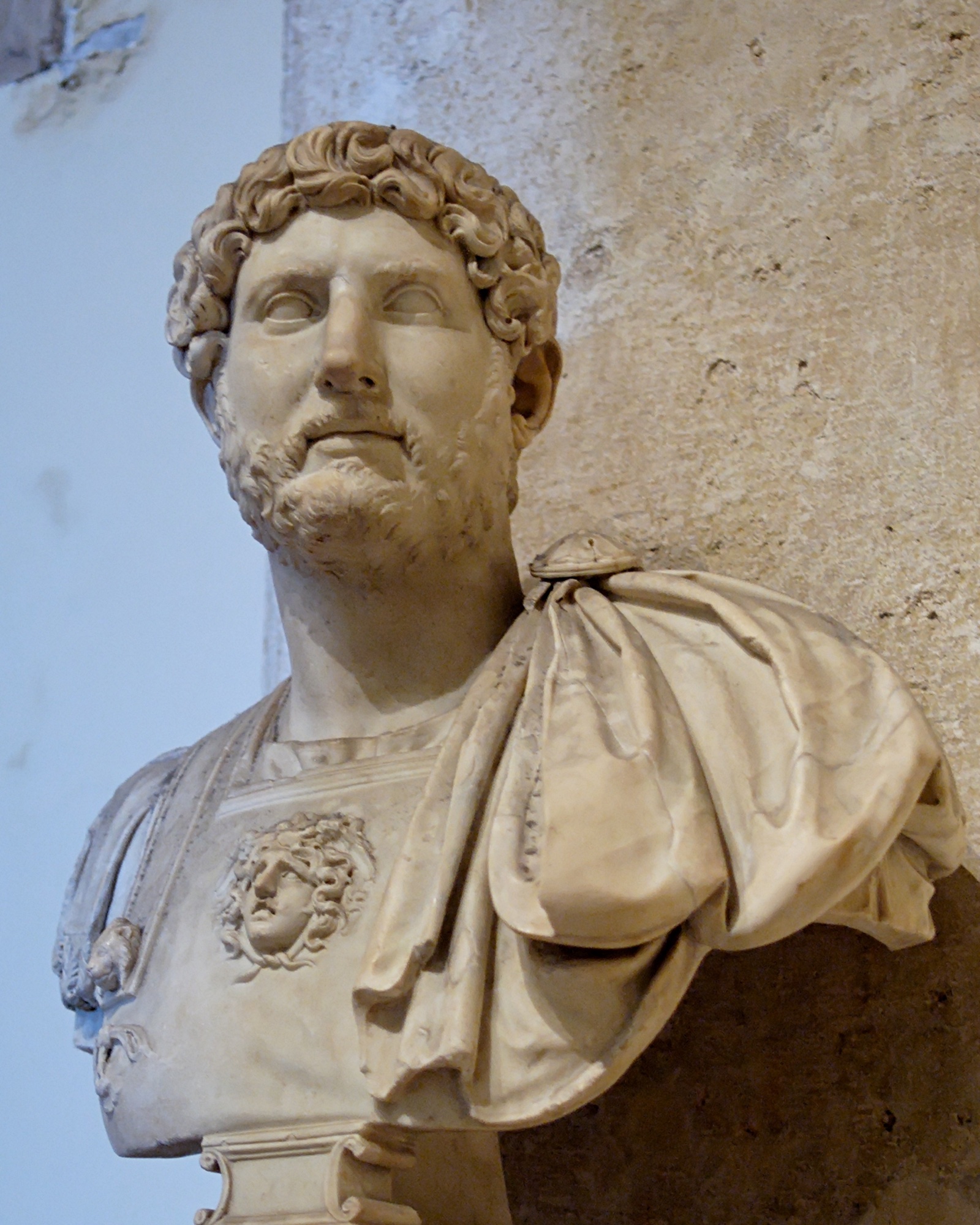
Hadrian became emperor in 117 AD. He was the first Roman emperor to grow a beard. He was also the first emperor who really thought of himself as an architect. He spent his reign traveling — Britain, Egypt, Greece, Anatolia — and at every major site he visited he either commissioned or personally modified a building. He signed his own designs. He argued with his architects. He fired, and according to one story probably had murdered, the most famous of them.
Hadrian’s Pantheon was begun within a few years of his accession. Brick stamps pressed into the clay of the building’s walls before firing are the key dating evidence. These stamps name the imperial brickyards and the year of the consuls under whose authority they were produced. Lise Hetland, working in the early 2000s, showed that the great majority of Pantheon brick stamps date between 114 and 119 AD, with a smaller group going up to about 126 or 128. The building was probably begun under Trajan and dedicated under Hadrian.
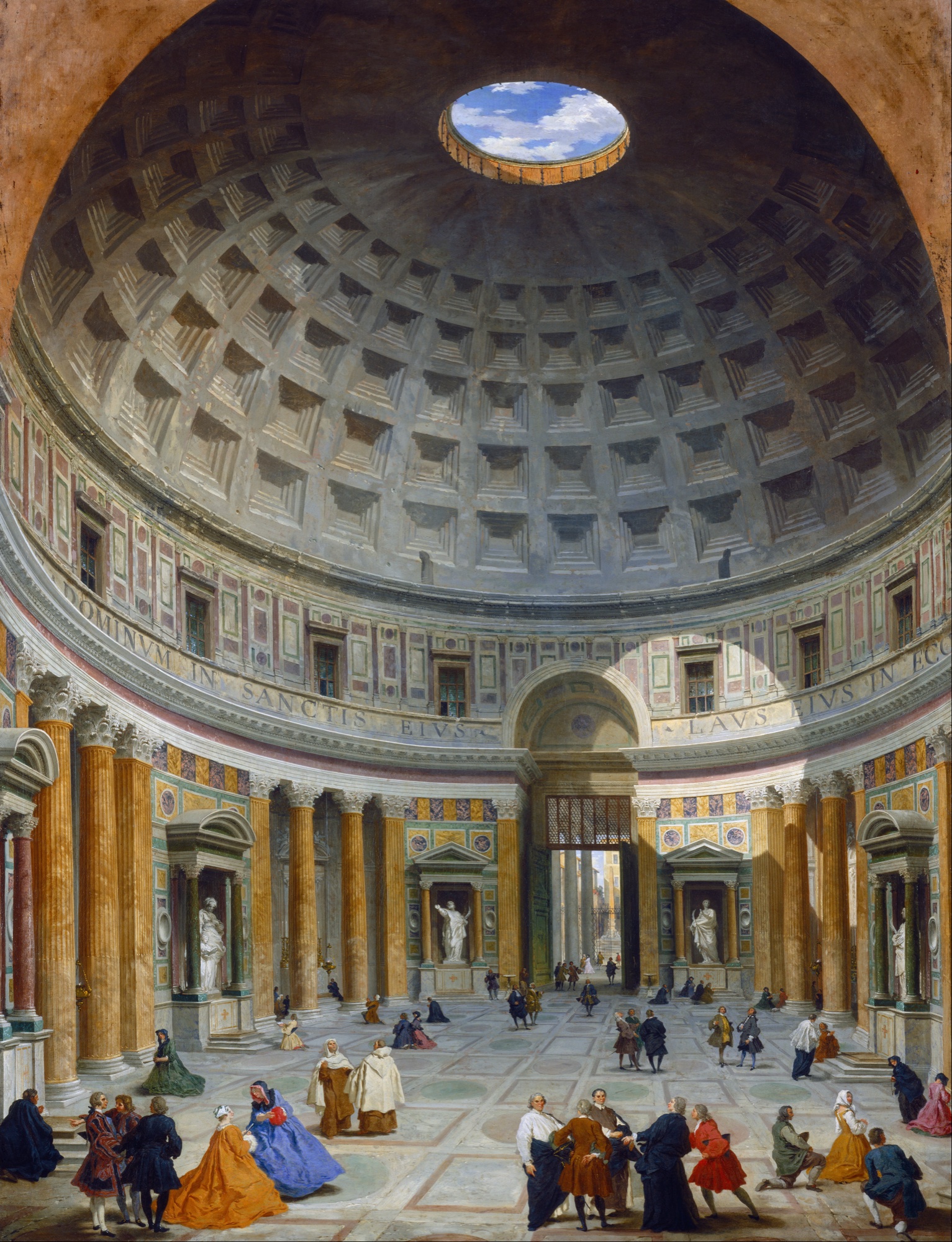
The part most visitors find surprising is how complete the rebuild was. This was not a renovation. Hadrian’s team tore down what remained of Domitian’s temple and started from the foundations. They reoriented the building to face north. They replaced the rectangular cella with a massive cylindrical rotunda capped by the hemispherical dome visitors still walk under. They added the monumental pronaos — the porch with the sixteen Egyptian granite columns that you see from Piazza della Rotonda. Each column is around thirty-nine feet tall, a single shaft of gray or rose granite quarried at Mons Claudianus in the Egyptian Eastern Desert, floated down the Nile, rafted across the Mediterranean, and dragged up the Tiber by ox teams. The columns alone represent a logistical feat comparable to the dome itself.
Hadrian then did something unusual. When the building was finished, he refused to put his own name on it. He kept Agrippa’s inscription across the pediment in bronze letters. He did the same thing at several other restoration projects around Rome. Cassius Dio, writing later, thought it was admirable modesty. More recent historians have read it as political craft — a way of connecting the new imperial program to the old Augustan one, of placing Hadrian in a line of builders rather than claiming singular authorship. Either way, the effect is what Rome still sees today. Agrippa, who had been dead for a hundred and thirty years, got his name on a building he did not construct and could not have imagined.
Apollodorus of Damascus, probable designer
The actual design of the Pantheon’s rotunda is one of the hardest engineering problems any Roman architect ever solved, and it bears almost no resemblance to anything built in Rome before it. Somebody had to draw it. The ancient sources do not identify that person by name, but there is one very plausible candidate: Apollodorus of Damascus, the Syrian-born architect who had been the chief engineer of Hadrian’s predecessor Trajan.
Apollodorus had built the Forum of Trajan, the enormous multi-story Markets of Trajan, the basilica inside the forum, and the stone bridge across the Danube for Trajan’s Dacian campaign. He was, by the 110s, the most accomplished practical architect in the empire. Hadrian inherited him as part of the imperial staff. The timing fits: the early Pantheon brick stamps date from Trajan’s reign, when Apollodorus would still have been running major imperial projects.
There is also a strange story about how the relationship ended. Cassius Dio, writing roughly a century later, reports that Apollodorus had once publicly mocked one of Hadrian’s own architectural sketches — a plan for a temple of Venus and Rome — telling the future emperor that his columns were too short and his statues would not fit inside their niches. When Hadrian came to power, Dio says, he banished Apollodorus from Rome. Later he had him executed on trumped-up charges. The story is not quite contemporary and may not be accurate. But it is the only story about Apollodorus’s fate we have, and it is plausible.
This is where it gets interesting. If Apollodorus designed the Pantheon rotunda under Trajan, and if the building he envisioned was largely complete or near complete by the time Hadrian began reigning, then Hadrian would have inherited both the design and its author. And then the author who had once mocked the emperor’s drafting was, by the story, killed. The Pantheon would be, on this reading, Apollodorus’s posthumous masterpiece, claimed by an emperor who had taken it over and then taken the credit — and then, again, not even the credit, since Hadrian gave the credit to Agrippa. It is one of the stranger attribution chains in the history of Western architecture.
No Pantheon inscription names Apollodorus. But the engineering vocabulary of the dome — the graduated concrete gradient, the coffered relief, the 43.3-meter hemisphere geometry — fits precisely the kind of systematic, calculation-heavy approach his other buildings demonstrate. The Markets of Trajan, in particular, show the same willingness to treat concrete as a structural material in shapes no other tradition had attempted. It is possible the Pantheon is what happens when a Syrian engineer with a gift for volumes designs a temple for the vainest emperor Rome ever produced, and then the whole project gets labeled under a century-old dead man’s name because it seems prudent.
The inscription problem
Let us return to the pediment. The inscription reads M·AGRIPPA·L·F·COS·TERTIVM·FECIT. Agrippa was consul for the third time in 27 BC, which dates his dedication to that year. The bronze letters attached to the stone are reproductions; the originals went missing in the Middle Ages, but we know what they said because the holes for the letter anchors are still visible and match perfectly with documented transcriptions.
Below Agrippa’s bronze inscription, slightly less prominent, is a second line that most visitors never notice. It reads, in Latin, IMP·CAES·L·SEPTIMIVS·SEVERUS·PIVS·PERTINAX·ARABICVS·ADIABENICVS·PARTHICVS·MAXIMVS·PONTIF·MAX·TRIB·POT·X·IMP·XI·COS·III·P·P·PROCOS·ET·IMP·CAES·M·AVRELIVS·ANTONINVS·PIVS·FELIX·AVG·TRIB·POT·V·COS·PROCOS·PANTHEVM·VETVSTATE·CORRVPTVM·CVM·OMNI·CVLTV·RESTITVERVNT.
Translated: “The Emperor Caesar Septimius Severus Pius Pertinax, victor in Arabia, Adiabene, and Parthia, in the tenth year of his tribunician power, etc., together with the Emperor Marcus Aurelius Antoninus Pius, in the fifth year of his tribunician power, restored the Pantheon, corrupted by age, with all due reverence.”
That inscription is from 202 AD. Septimius Severus and his son Caracalla did minor restoration work on the building around that year. Their inscription is an add-on to Agrippa’s. So the front of the Pantheon, strictly speaking, now credits three parties: Agrippa, Severus, and Caracalla. Nothing on the pediment names Hadrian, who built almost everything you see. Nothing names Apollodorus, who probably designed the dome. The pediment is a lie by omission, but it is the kind of lie Romans preferred. They liked their buildings to claim continuity. They did not mind if the names were wrong.
What this tells you when you stand outside
There is a specific pleasure in standing in Piazza della Rotonda and reading the inscription against what you know. The bronze letters are the names of a general who died before Christ was born. The pediment is Trajan’s or Hadrian’s work. The dome behind it is the product of an engineering tradition that was refined in Trajan’s forum a decade earlier, probably under Apollodorus of Damascus. The whole facade is a layered argument about continuity in Roman public memory, in which no single name ever tells the truth about who actually held the chisel.
Chiaro reads the inscription back in Latin as you look at it and then tells you which parts of the building each name is actually responsible for, so that the one-line answer — that Agrippa built it — unfolds into the three-name answer while you are still looking up at the pediment.
The short version
If you want a one-sentence answer: Marcus Agrippa built the first Pantheon in 27 BC, the emperor Hadrian rebuilt it entirely between about 114 and 126 AD, and Apollodorus of Damascus probably designed the rotunda. You should picture Agrippa as the founder, Hadrian as the builder, and Apollodorus as the quiet draftsman behind the curve.
The building we walk into today is Hadrian’s. The name it wears is Agrippa’s. The dome was almost certainly drawn by somebody Hadrian later had exiled. Nineteen hundred years on, the pediment still gives the credit to a man who never saw the roof. There is no better example of Roman public memory. They were very good at remembering the wrong things for the right reasons.