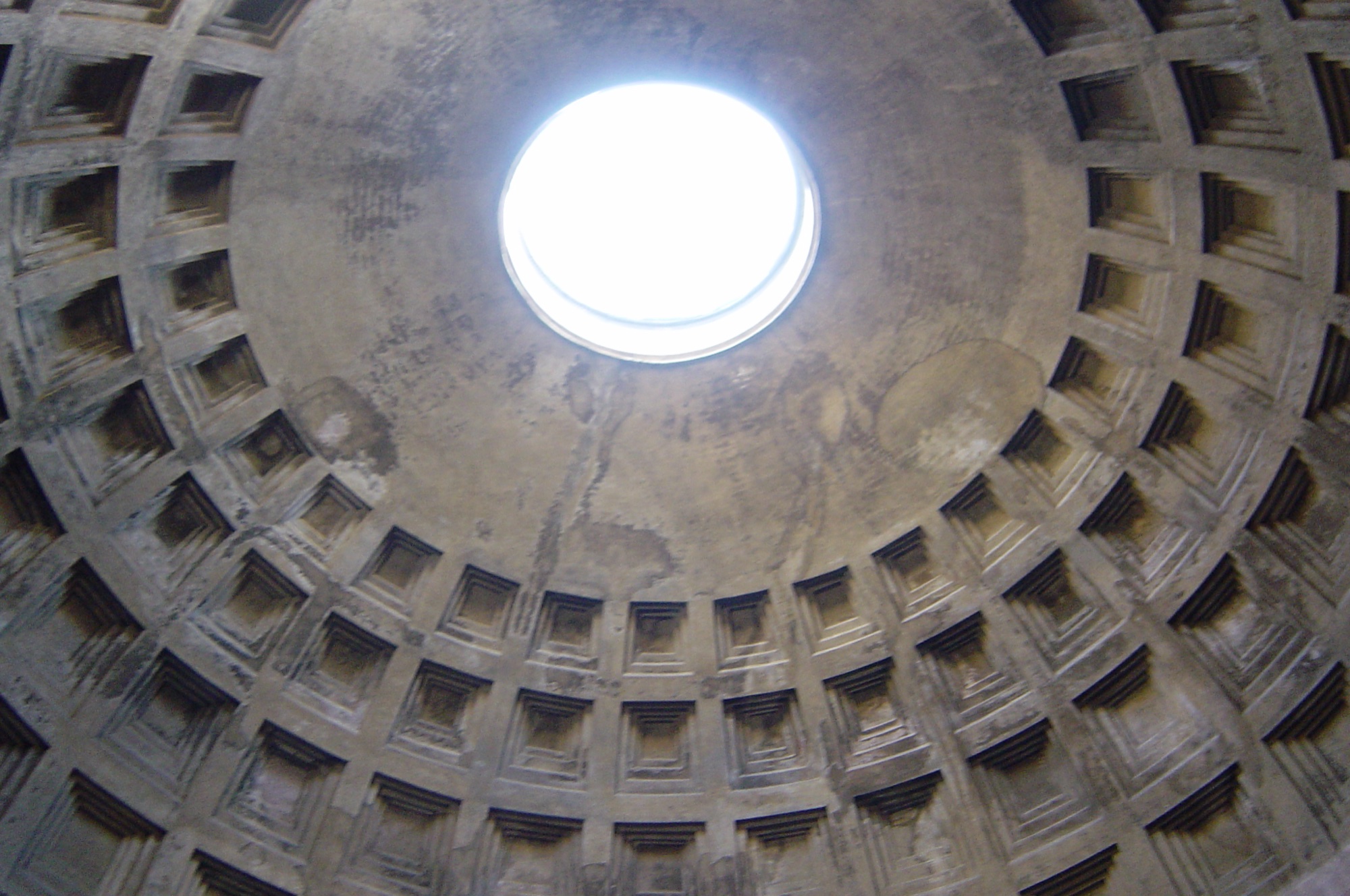
Stand directly under the oculus of the Pantheon on a clear afternoon and look up. A shaft of white sunlight drops straight onto you, sharp-edged, bright enough to cast a shadow on your shoes. Around the beam, five concentric rings of coffers march upward toward the hole. Above the hole is sky.
The Pantheon dome is the oldest concrete structure on earth that has never needed a major repair, and it is still the largest unreinforced concrete dome ever built. Every stadium dome in the modern world is held up by steel rebar somewhere in its belly. This one is not. It is held up by the rules of geometry and a set of quiet engineering tricks the Romans worked out and then, for reasons no one fully understands, mostly forgot.
It is forty-three point three meters across. It is forty-three point three meters tall from the floor to the oculus. If you dropped a perfect sphere into the interior of the rotunda, it would fit exactly. This is not a coincidence. The diameter of the room is the diameter of the sphere that defines its geometry. The Romans were very, very explicit about this kind of thing.
Here is how they got the dome up, how it stays up, and what to look at when you are looking at it.
What the dome is made of
The first thing to understand is that the Pantheon dome is not made of stone. It is not made of brick. It is made of Roman concrete, called opus caementicium, which is a mix of lime mortar and aggregate — broken rubble of various densities — that was poured in place inside wooden formwork and left to cure.
This sounds modern. It was not. Roman concrete and modern Portland cement are chemically different. The Romans used slaked lime mixed with volcanic ash — pozzolana, quarried mostly from the hills around the Bay of Naples — and an aggregate of stone or tile. The resulting set, done right, is actually tougher than modern cement because over centuries the pozzolanic lime keeps reacting with seawater and mineral-rich groundwater to grow new crystals inside the matrix. A 2017 study in the journal American Mineralogist showed Roman marine concrete self-healing micro-cracks through this process for two thousand years. The Pantheon is inland, so the chemistry there is slightly different, but the basic principle holds. The dome has been getting harder.
The genius of Hadrian’s engineers was not just in the material but in how they varied it. Down at the base of the dome, where the loads are highest, the aggregate is travertine — dense, heavy Italian limestone. Move up a few meters and the aggregate becomes tufa, a softer volcanic rock. Higher still and it is terracotta rubble, probably broken roof tiles. At the top, just below the oculus, the aggregate is pumice, the foamy volcanic stone so light it floats. This gradient is not decorative. It is structural. The dome gets progressively lighter as it rises, which reduces the lateral thrust it exerts on the walls below. The Romans knew, by trial and error, that the real enemy of a wide dome is not the downward weight; it is the sideways push at the springing point. They built a dome that weighs less where it matters most.
The walls supporting the dome are also thicker than any modern engineer would make them. At the base, the rotunda wall is six meters thick, carved out in a hidden pattern of niches and cavities that lightens its own load without compromising strength. The layered attribution chain for who designed this is complicated, but the most plausible candidate is Apollodorus of Damascus, Trajan’s Syrian engineer, who had pioneered the same techniques a decade earlier in the Markets of Trajan.
The coffers
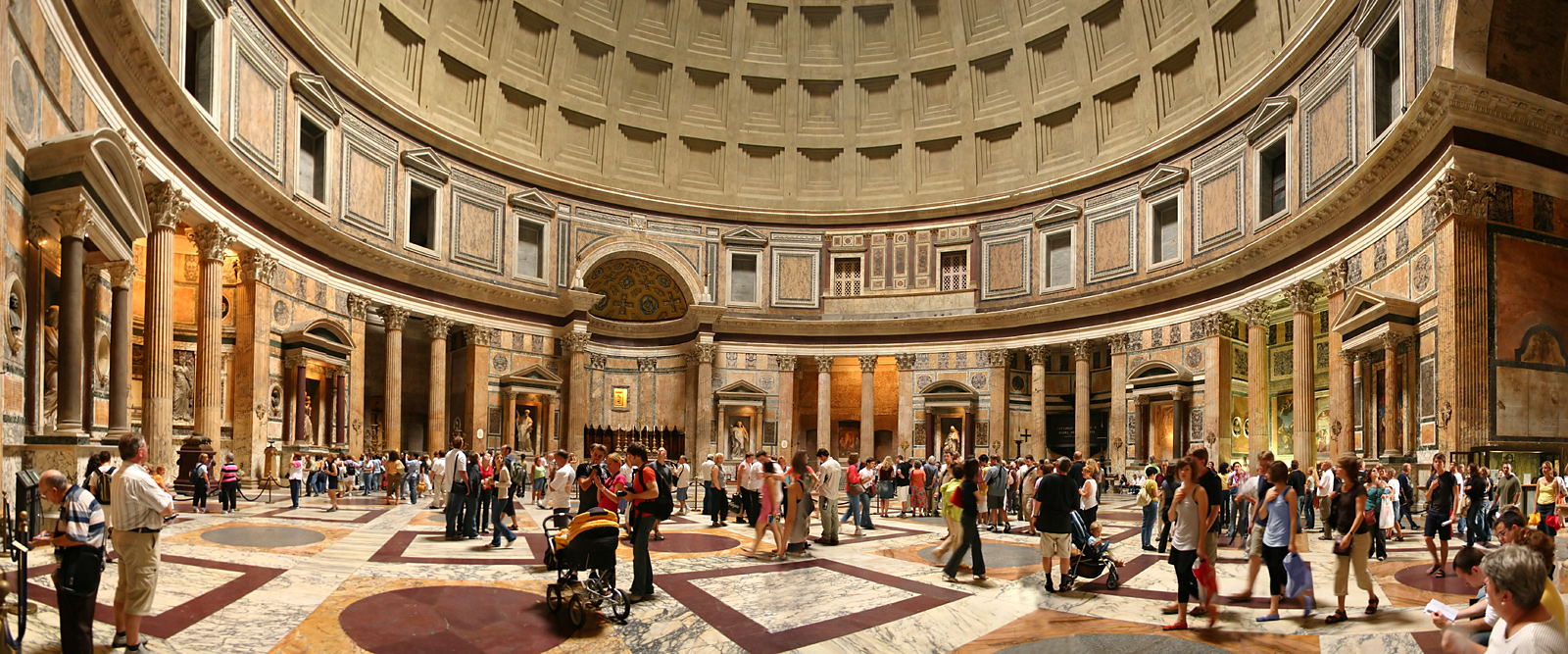
Look up at the dome and the first thing that catches the eye is the grid of square recessed panels that covers its inner surface. These are the coffers. There are 140 of them — 28 coffers per ring, five rings — and they are not just ornamental.
Each coffer is a saving of mass. Removing a square of concrete from the inside of the dome reduces the dome’s total weight without weakening it, because the compression lines in a hemispherical shell run along the surface, not through its thickness. Hollow out the middle of a coffer and you have subtracted load from the structure while leaving the load path intact. Do it 140 times and you have removed a very large amount of concrete.
The coffers also shrink as they rise. The bottom ring is the deepest and widest. Each successive ring is slightly smaller. This is an optical correction of a kind Greek temple-builders had been doing for centuries. Because the coffers further up are farther from the viewer, making them smaller in absolute terms makes them appear the same size from the floor. The dome reads, to a standing viewer, as an evenly-gridded hemisphere. Photographed with a wide-angle lens, the same dome looks like it has coffers of wildly different sizes. Your eye has been patched by the architect.
Each coffer was originally bronze-gilded, or bore a bronze rosette at its center. Small holes in the concrete where the bronze was anchored are still visible. The bronze was stripped in stages during the medieval and early modern periods. What you see now is the bare, slightly rough surface of the original cast concrete.
The oculus
At the top, in the exact middle, is the oculus. It is a circular opening nine meters across, unglazed, open to the sky. The opening is framed by a ring of bronze — the original ring, still in place. Water falls into the rotunda whenever it rains. In a heavy rain, the column of water you can see from the floor is thirty meters tall and unbroken. The floor has been deliberately canted to drain the water through twenty-two small holes in the marble, mostly concealed in the pattern, that carry runoff out through the foundations.
The oculus is the only source of natural light inside the Pantheon. The building has no windows. A single beam of sun moves across the interior over the course of the day, and across the course of the year the beam traces a figure-eight path up the walls and across the dome. Recent studies by the architectural historian Robert Hannah, among others, have argued that the oculus was designed as a solar meridian, with the beam hitting specific points on specific imperial anniversaries: the grille above the entrance door at noon on April 21, for instance, which was the traditional founding date of Rome. The building may have functioned, in other words, as a one-room calendar whose moving light marked the ritual dates of the Roman state.
The opening is also structural. A dome under compression needs to close into a single point at the top. An oculus, counterintuitively, accomplishes this by creating a compression ring — a loop of concrete that tightens around the opening and concentrates the downward forces onto a narrow band. It is the same principle a modern suspension bridge uses at its cable anchors. Remove the oculus and you would have to cast a much heavier closing cap on top of the dome, which would add load without adding strength. Leaving the hole is engineering.
The 43.3-meter sphere
The geometry of the rotunda hides a single elegant fact. The inside diameter of the dome is 43.3 meters. The height from the floor to the top of the oculus is also 43.3 meters. If you drew a perfect sphere of 43.3 meters and lowered it into the building, it would touch the floor at a single point in the center, touch the walls at the springing of the dome, and kiss the oculus at the top. The sphere fits. It is the sphere the architect drew first.
This is a kind of visual philosophy. The Pantheon is, in plan, a circle inscribed in a larger square. In section, it is a sphere enclosed by a cylinder. The geometry of the building is a demonstration of the axiom that a perfect form contains the universe in microcosm. The architect of the Pantheon was making an argument about cosmology through proportion.
There is a famous Renaissance drawing, much reproduced, that shows the 43.3-meter sphere inscribed inside a cross-section of the rotunda, with the oculus open at the top and a small human figure standing at the bottom. Chiaro runs that diagram in your ear as you stand on the center of the floor, tracing the arc of the sphere from your feet up the wall and across the dome to the oculus, so the geometry registers before the dimensions do.
Why it has not fallen
The Pantheon dome has survived, in working order, for nineteen hundred years. No other dome in the world has done anything like that. The Hagia Sophia’s dome, built four centuries later, has partially collapsed twice. The dome of Brunelleschi’s Florence Cathedral is bigger, but it was built in 1436 and has required constant monitoring and crack repair. St. Peter’s dome is the work of Michelangelo, completed in 1590, and has also needed repeated intervention. Modern stadium domes are generally designed for a hundred-year lifespan.
The Pantheon is on year 1900 and counting. Why?
Three reasons, in rough order of importance. First, the graded aggregate. Making the top of the dome lighter than the bottom is a trick that modern engineers have only recently begun re-exploring in concrete shell structures. The Romans did it by eye, but they did it consistently across the entire rise of the dome. Second, the thickness of the supporting walls. Six meters of pozzolanic concrete is overbuilt by any modern standard, but overbuilding is cheap insurance when you do not have rebar. Third, the oculus. An open dome under compression loads stays in compression. A closed dome on a building this wide starts to develop tension cracks as its geometry settles. Cracks in a compressive-only structure are catastrophic; in a tensile-reinforced structure, they are routine. The Romans could not reinforce. They cheated by never letting the dome enter tension in the first place.
The dome does have cracks. They were first mapped in the 1930s. They are all meridional — running from the springing upward toward the oculus, like the lines of latitude on a globe — and they are structural. Meridional cracking in a masonry or concrete dome is actually expected behavior. It allows the dome to settle into its own geometry without pulling the supporting walls apart. Modern structural analysis has shown that the Pantheon has basically been a system of independent radial arches for most of its life, with the oculus ring holding the tops together. This is not a failure. It is how the design actually works once the dome has fully cured and settled.
What to look for
Four things to notice when you are standing under it.
First, walk directly beneath the center of the oculus and look up. Hold your gaze for at least ten seconds. The sense of depth changes. The dome moves away from you. The illusion is strongest in direct overhead sunlight.
Second, watch the beam, not the hole. The shaft of light from the oculus lands somewhere on the wall or the floor, and it moves visibly — faster than you expect — across the surface as the earth turns. In half an hour, the beam will have crossed almost a full coffer.
Third, notice the slight dish in the floor. The twenty-two drainage holes in the marble are arranged in the pattern, but only visible up close. Stand on one and feel the groove.
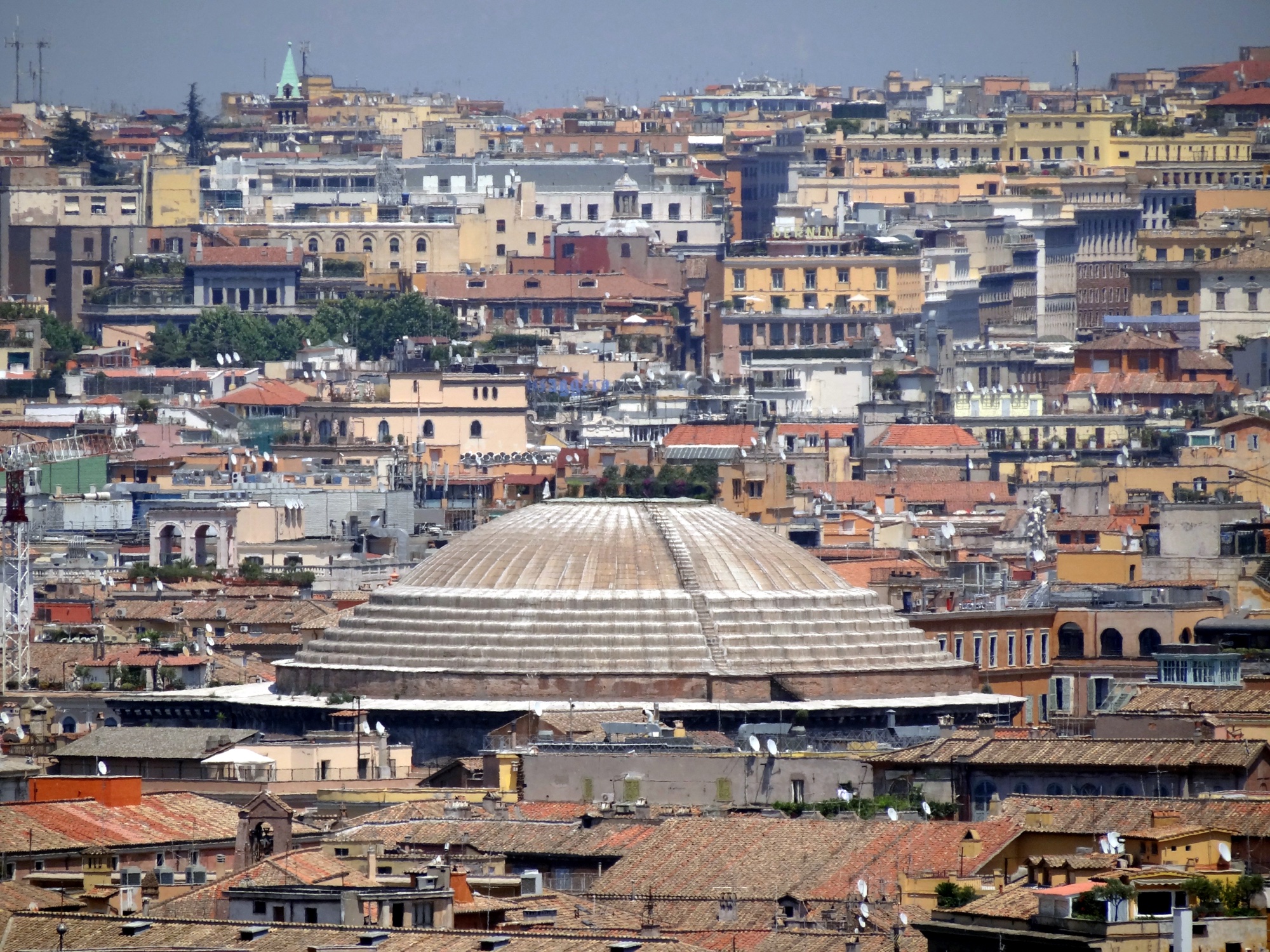
Fourth, from outside, walk up the Janiculum hill in the afternoon and look back across the rooftops. The dome rises above the city with no visible buttressing, no flying arches, no external drama. It looks, from that angle, like a shallow bubble pressed into the skyline. That is what a building looks like when its engineering is doing all of its work on the inside.
The Pantheon dome is the single most influential dome in Western architecture. Every great subsequent dome — Hagia Sophia, Florence, St. Peter’s, the Capitol in Washington — was built in explicit response to it. None has beaten its span without steel. How this particular building managed to survive the collapse of antiquity at all is a longer story. But standing under it, in the one beam of light, you are standing inside an engineering argument that has been winning without maintenance since 126 AD.
It is still a church. It is still a calendar. It is still a concrete hemisphere that a sphere slides into like a key. Nineteen centuries. No rebar. No collapse. Just a hole in the top for the sky.