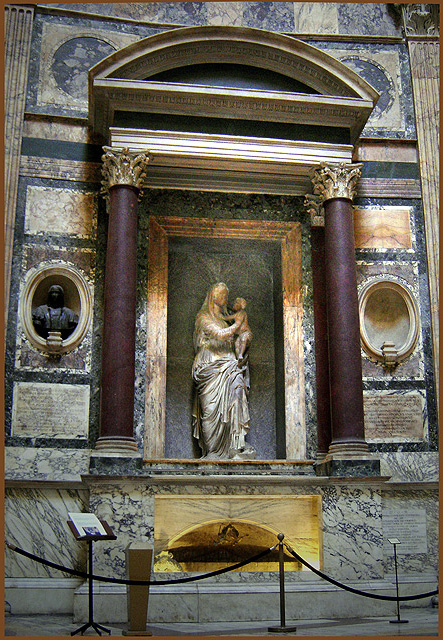
Walk into the Pantheon, turn left, and about two chapels down the curve of the rotunda you will find, behind an iron grille, a plain stone sarcophagus set into the wall. Above it in a small niche stands a Madonna carved by a friend of the dead man. Cut into the wall over the niche is a single line of Latin.
This is the tomb of Raphael. He was thirty-seven years old when they buried him here on April 7, 1520. Raphael’s famous work — the frescoes in the Vatican, the altarpieces, the portraits of popes and bankers — had by then made him the most admired painter in Europe. He had asked, in his will, to be buried inside the Pantheon, a pagan temple turned basilica, in a spot he had picked himself. Rome granted the request almost immediately.
It was an extraordinary thing. Painters, in 1520, did not get buried with emperors and saints. Most of them got plain parish graves. The Pantheon was the address of the Italian state, even before there was an Italian state. You needed to be a king, a pope, or an apostle to sleep in there. Raphael got in because of what he had made. So the real question about the tomb is: what did he paint that earned him the room?
This article answers that. Every painting discussed below is a step in the argument that ended, in 1520, with a sarcophagus under the oculus.
How the Pantheon became a Christian church
A quick bit of context. The Pantheon, by Raphael’s day, had already been a Christian church for about nine hundred years. Agrippa’s original temple from 27 BC had been rebuilt by Hadrian around 126 AD, and then consecrated as the Basilica di Santa Maria ad Martyres by Pope Boniface IV in 609 AD. This is the reason it still had a roof in 1520 when half of ancient Rome was lying in pieces. There is a longer piece on how the Pantheon survived intact from Agrippa through the Renaissance; the short version is that becoming a church saved it.
It was also, by the early sixteenth century, a kind of Florentine-Roman clubhouse for artists. The sculptor Giovanni da Udine and the painter Baldassare Peruzzi both had ties to the building. So did the architect Bramante, Raphael’s fellow townsman from Urbino, who probably introduced him to the idea that the rotunda was not only a church but a plausible place for a painter to want to rest. The Pantheon was where the Renaissance had gone to study how the ancients did architecture. Choosing to be buried there was, among other things, a statement about which tradition you thought you belonged to.
The School of Athens: the picture that made his name
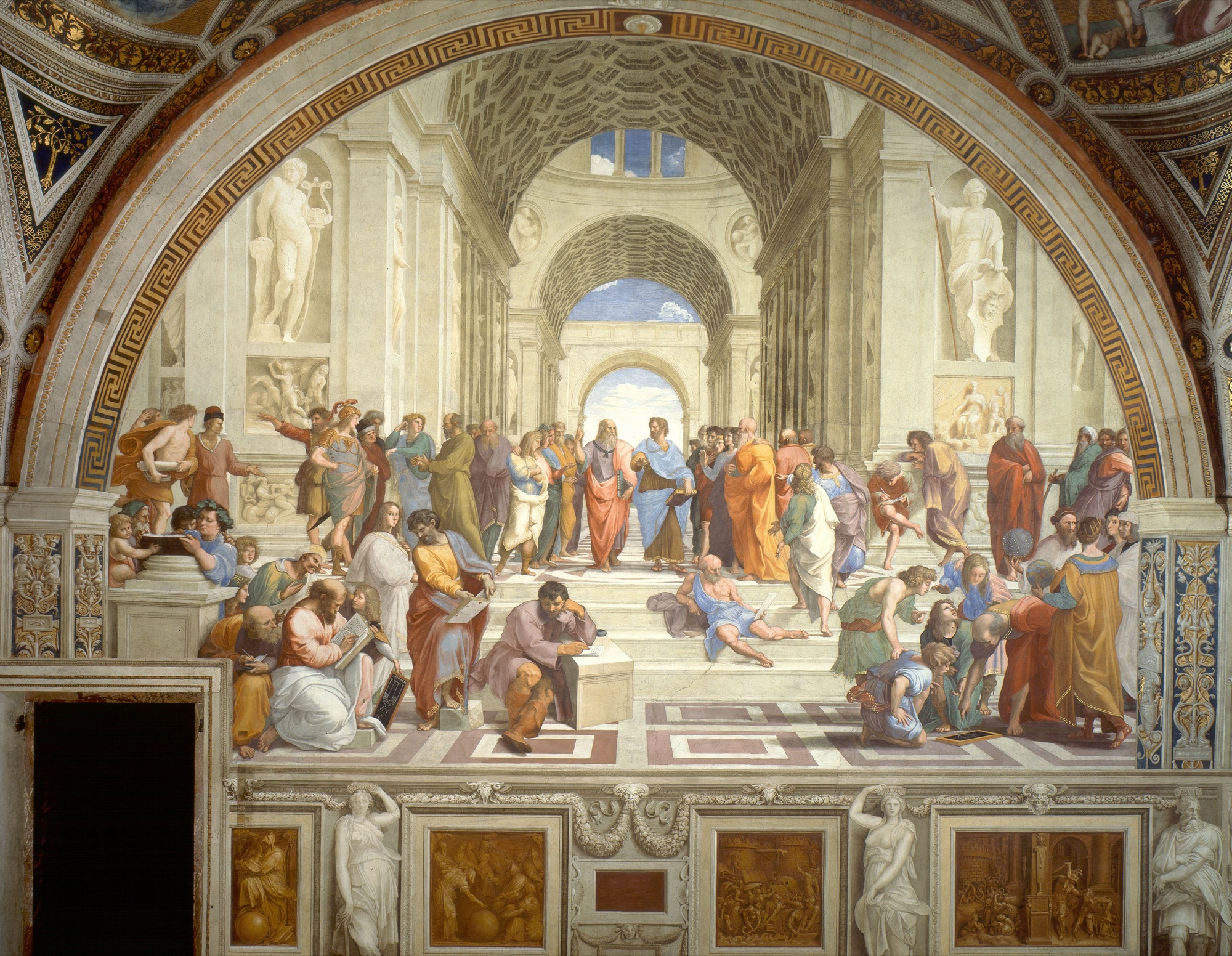
In 1508, Raphael was twenty-five and almost nobody in Rome knew his name. Julius II was hiring painters to decorate his new apartments in the Vatican. Bramante put in a word for the young painter from Urbino. Julius gave Raphael a single room, the Stanza della Segnatura, as a trial.
The fresco on the east wall of that room is The School of Athens. It is, depending on how you count, either Raphael’s most famous work or tied for it with the Sistine Madonna. Plato and Aristotle stand at the center of a vast coffered barrel vault, surrounded by fifty or so philosophers, mathematicians, and astronomers. Plato points up. Aristotle gestures across. The composition is so organized that it looks spontaneous. It was not spontaneous.
Raphael worked the room for about three years, between 1509 and 1511. By the time Julius saw the finished fresco, he had seen enough. He fired every other painter he had hired for the papal apartments and turned the whole floor over to Raphael alone. There is a longer reading of the figures in The School of Athens, including the self-portrait Raphael tucked into the right-hand side of the crowd, wearing a black beret and staring out at the viewer. What matters here is the effect. That single wall changed the terms on which an ambitious painter could operate in Rome.
Before the Stanza della Segnatura, Raphael was a promising provincial. After it, he was the most sought-after painter in the city. Every important commission in Rome ran through his studio for the next decade. The tomb in the Pantheon starts in this room, on this wall.
The Transfiguration: the unfinished last work
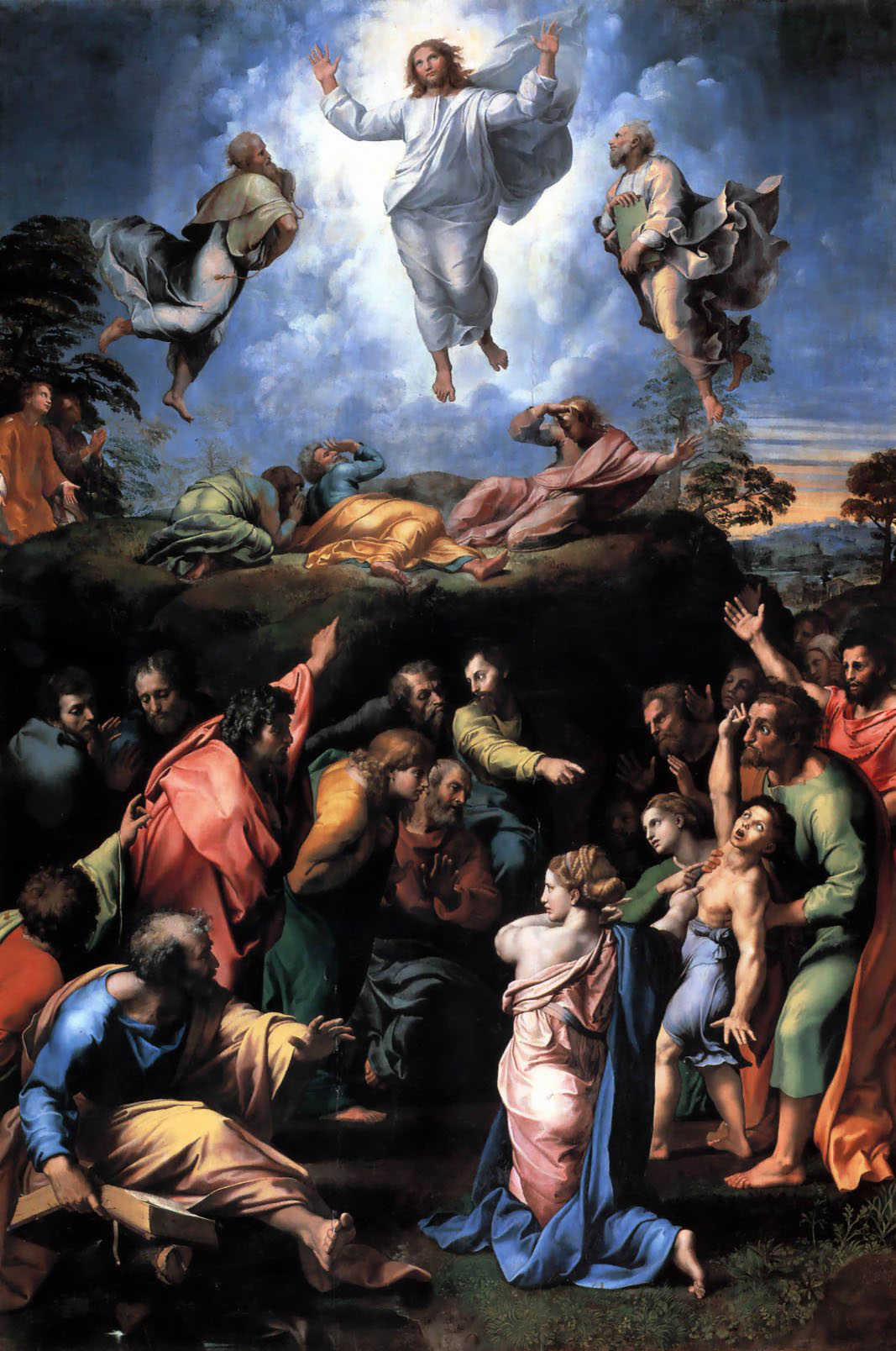
Raphael’s last painting was The Transfiguration. Cardinal Giulio de’ Medici, the future Pope Clement VII, had commissioned it in 1516 as an altarpiece for the cathedral of Narbonne in France. Raphael worked on it for four years. The picture has two registers: Christ rising in light on Mount Tabor in the upper half, and below him a chaotic crowd trying to heal a possessed boy while the apostles argue. It is, even by Raphael’s standards, a radical piece of design. The apostles gesture upward at a thing they cannot see. The boy’s eyes roll back. The dark of the lower register presses up against the light of the upper one.
Raphael was still painting the lower figures when he died. The standard story is that he caught a fever after a night of, in Vasari’s discreet phrase, excessive activity, collapsed, and was dead within fifteen days. He was thirty-seven. His workshop finished the Transfiguration under the supervision of Giulio Romano, his lead pupil. When it was displayed, the crowd gasped.
Here is the part that connects directly to the tomb: when Raphael’s funeral procession moved from his studio on Via dei Coronari to the Pantheon, his assistants carried the Transfiguration at the head of the cortege. The painting leaned against the wall at the Pantheon during the funeral Mass. Then it was taken to San Pietro in Montorio on the Janiculum, and eventually to the Vatican Pinacoteca, where it hangs today. Contemporaries described the image of the living painter’s last face, on the floor, in the same room as his last painting, propped up and still drying. That scene is why the Transfiguration is not only Raphael’s famous work in general; it is the specific picture that followed him into his burial.
The Sistine Madonna and the painter as court favorite
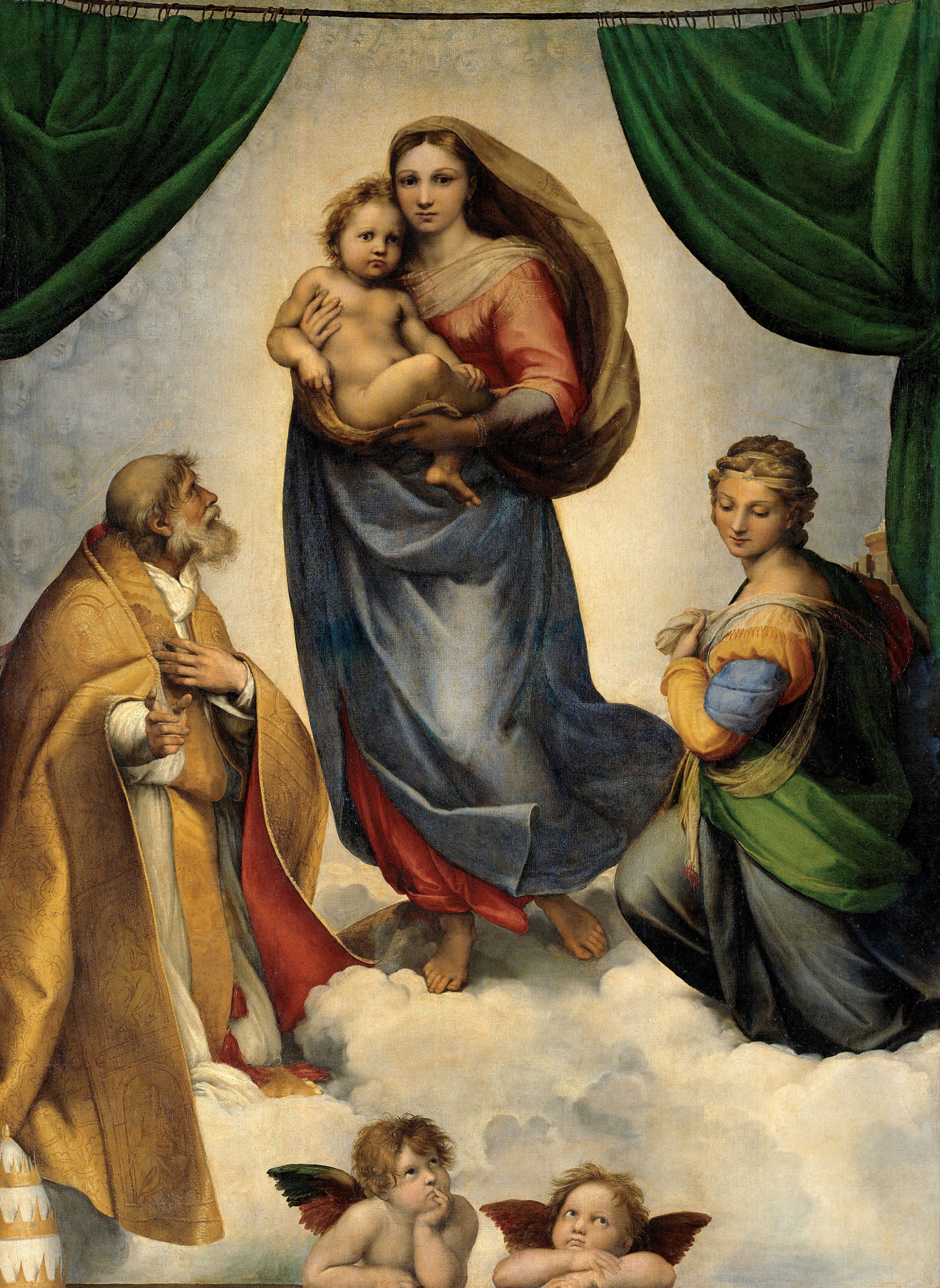
While Raphael was working on the Vatican rooms, Julius II also commissioned him to paint an altarpiece for the new church of San Sisto in Piacenza, a small city in Emilia. The commission commemorated the papal states’ victory over the French at Ravenna in 1512. The resulting canvas, the Sistine Madonna, is most famous in the Anglophone world for the two bored cherubs resting their elbows on the frame at the bottom edge, endlessly reproduced on postcards and posters. In German museums it is treated with a reverence more like that afforded to religious icons than paintings. It hangs in its own room in the Gemäldegalerie Alter Meister in Dresden. Dostoyevsky came to stare at it. So did Goethe.
The painting is an argument about weight. The Virgin stands on clouds, not ground. Saint Sixtus kneels in front of her, his papal tiara set aside. Saint Barbara looks down toward the cherubs. Above them the background is not sky but dozens of barely-visible angel faces, a kind of wallpaper of watching. Raphael’s design has the whole composition held together by diagonals — the Virgin’s gaze running down one line, Sixtus’s outstretched hand running along another, the two figures acting as weights on either side of the Madonna’s mass.
It was also, in its period, an enormous political and commercial success. Raphael had become, by about 1513, the painter you hired if you wanted not only quality but reputation. He ran a studio of around fifty assistants. He was appointed architect of St. Peter’s after Bramante’s death. He was the papal commissioner of antiquities, charged with surveying every remaining piece of ancient Rome before it was looted for construction material. He was, in our terms, a CEO who happened to also be the best painter in Europe. The tomb in the Pantheon reflects that double role. He was buried not only as an artist but as an officer of the Church.
Why the Pantheon
Raphael could have been buried in any number of Roman churches. Painters of his standing in the sixteenth century were often laid in Santa Maria del Popolo, or San Luigi dei Francesi, or the Florentine church of San Lorenzo in Damaso. Each of those would have been a perfectly honorable address.
The Pantheon was different. It was not a parish church or a commission church. It was understood, in 1520, to be the finest surviving building of the ancient world. Bramante had been measuring it for twenty years. Raphael had been doing the same — his survey of ancient Rome, addressed to Leo X, opens with a long, technical appreciation of the rotunda. To be buried there was to make a specific claim about one’s work. It was to say that the achievement of a modern painter could stand in the company of the builders of the empire.
This is why the choice matters. Raphael was asking to be placed in the single building that sixteenth-century Rome used as its shorthand for classical perfection. Chiaro notices this when you walk into the niche: the line of sight from the tomb runs up the curve of the rotunda, across the coffers, and out through the oculus, and the audio draws that arc for you while you stand there, so the geometry of why he picked this spot registers before you read the epitaph.
The epitaph by Pietro Bembo
Cut into the wall above the niche is a hexameter in Latin, composed by the humanist Pietro Bembo, a close friend of Raphael’s and future cardinal.
ILLE HIC EST RAPHAEL, TIMUIT QUO SOSPITE VINCI RERUM MAGNA PARENS ET MORIENTE MORI
Which is usually translated, loosely, as: Here lies that Raphael, by whom Nature herself feared to be outdone while he lived, and when he died, feared to die with him.
It is a showy line. It is the kind of thing one humanist writes to eulogize another humanist. It is also a theological argument. Raphael had made images so persuasive that the natural world itself, on this reading, had been alarmed by the competition. Coming from a cardinal, that is not a small compliment. It is a claim that a painter, through his famous work, had done something that rivaled God’s first act of creation.
This is the claim the Pantheon burial was meant to support. That a painter, born in 1483 in a small court town on the Adriatic, had produced pictures that belonged in the same conversation as the building Hadrian put up in 126 AD.
What to look for at the tomb
Three details.
First, the sarcophagus itself is plain. No effigy, no portrait, no flourish. Raphael had seen too many decorated Renaissance tombs in Florence and Rome to want one. The plainness is deliberate.
Second, the Madonna del Sasso in the niche above the tomb is by Lorenzetto, a sculptor who was Raphael’s friend and collaborator. It was carved to Raphael’s own design. The Virgin leans slightly forward, as if over the grave she now permanently watches.
Third, the epitaph is in the wrong meter for a tomb. Bembo wrote it as a literary hexameter, not a funeral couplet. That was a small, careful choice. It puts the whole epitaph in the register of classical praise-poetry, not mourning. Raphael, in other words, did not get a Christian burial verse. He got an ancient Roman one.
He is still there, five centuries later. The light from the oculus reaches the tomb at certain angles, certain times of year. Every generation of tourists forms a quiet crowd in front of the grille and reads Bembo’s line. The painter who wanted to be buried with the ancients managed to stay with them.