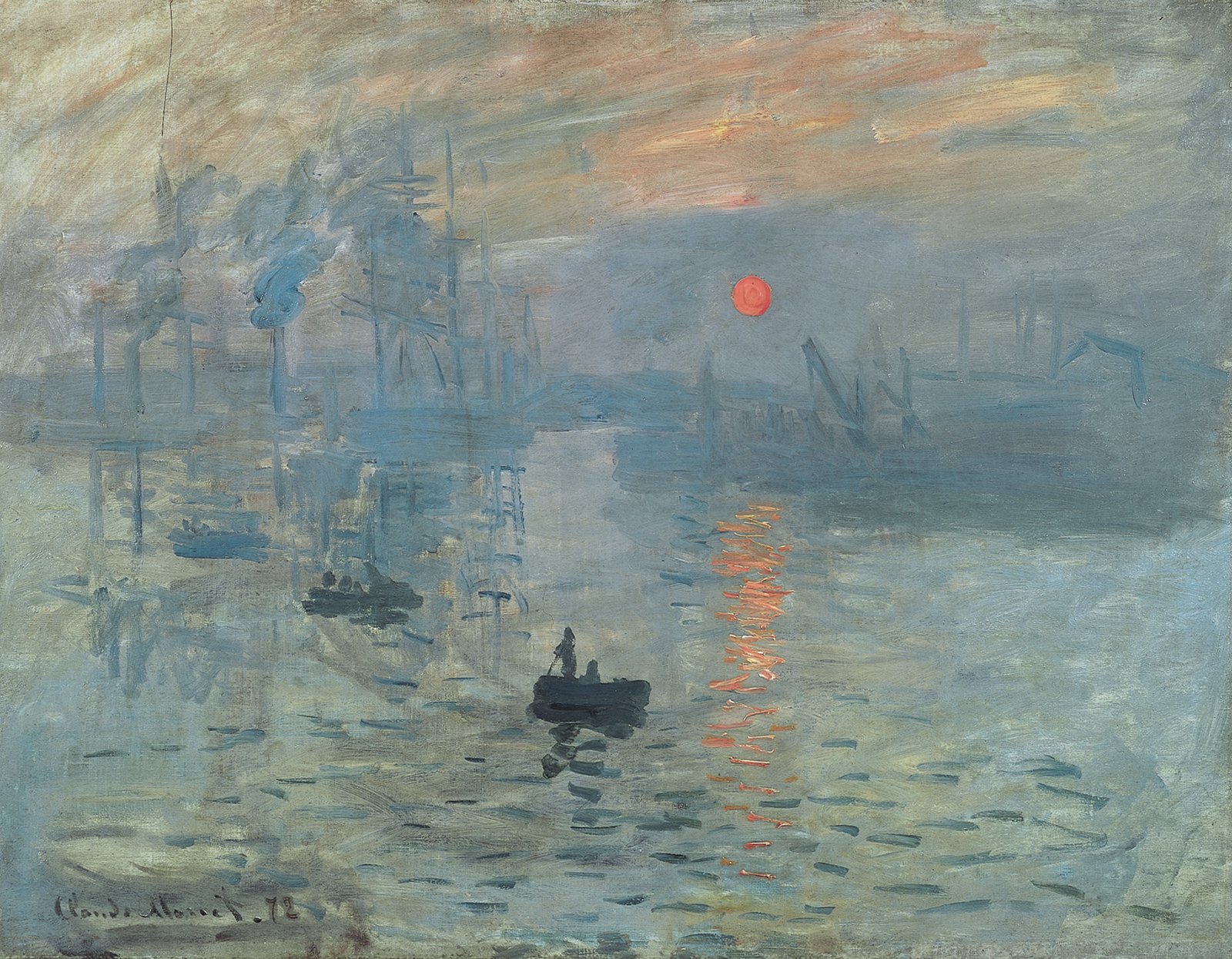
On April 15, 1874, in a borrowed photographer’s studio at 35 Boulevard des Capucines in Paris, a thirty-three-year-old painter from Le Havre hung a small canvas on a temporary wall. The painting was forty-eight by sixty-three centimeters. It showed an orange disc rising over a working harbor on a gray-blue morning, three little black boats sketched into the foreground, smokestacks and cranes faded into the mist behind. He had finished it almost two years earlier and put it aside. Now he needed a title for the catalogue. He looked at it on the wall, hesitated, and told the printer to call it Impression, soleil levant. Impression, sunrise. He thought the word “impression” let him off the hook for finishing it properly. He could not have known that he had just named an entire movement, and that the impressionism sunrise problem — what is this painting actually showing, and why did everybody hate it — would still be argued about a hundred and fifty years later.
This is the painting that gave Impressionism its name. Not a Renoir, not a Degas, not a Monet water lily. A small, fast, almost-not-finished view of the harbor at Le Havre painted from a hotel window on a winter morning in 1872. It hangs today on the third floor of the Musée Marmottan Monet, a small townhouse-sized museum on the western edge of the sixteenth arrondissement that owns ninety-four other Monets and is the closest thing the world has to a Monet shrine. Most visitors to Paris never make it that far west. They go to the Orangerie for the Nymphéas, they go to the Orsay for the Cézannes and the Van Goghs, and the painting that lent its name to all of it ends up being the one a serious visitor has to take a bus or a metro twenty minutes past the Trocadéro to actually see.
The morning Monet looked out the window
Here is what we know about how the painting was made. Claude Monet was thirty-one years old in November 1872, recently returned from London where he had ridden out the Franco-Prussian War, freshly remarried, and broke. He went home to Le Havre to visit his family and stayed at the Hôtel de l’Amirauté, a working-class hotel on the south side of the inner harbor. The window of his room opened onto the Bassin du Commerce, the busiest of Le Havre’s three harbor basins, with the sun rising directly across the water at that time of year.
He painted the view in roughly one sitting. The canvas is thinly worked, in places almost watercolor-thin, with the pencil grid he used to sketch in the boats still visible at the bottom edge if you get close. The orange sun is a single dollop of vermilion. The reflection in the water is six or seven horizontal flicks of the same red. The sky is gray-blue smeared horizontally with a flat brush. The boats are black silhouettes added wet-on-wet. He signed it lower right and dated it 72.
What we do not know with total certainty is the day. For decades the painting was assumed to date from 1873, the year before the exhibition. Then in 2014, the Marmottan published an analysis by an American astrophysicist named Donald Olson, who used tide tables, weather records, and the position of the rising sun across the harbor to calculate that the painting must have been made on the morning of November 13, 1872, between 7:30 and 8:00 a.m., looking northeast across the basin. The smoke from the steam tug in the middle distance is going the right direction for the wind that day. The tide is at the height the harbor records say it should have been. Even the way the sun’s reflection breaks on the water matches a very specific weather front that passed through the Channel that night.
The painting that named Impressionism, in other words, was painted on a Wednesday morning before breakfast.
The exhibition the Salon refused to host
To understand why this painting matters, you need to understand the room it was hung in. By 1874 a group of about thirty painters who could not get into the official Paris Salon had started talking about putting on their own show. The official Salon was the only meaningful place in France to sell paintings, and it was juried by the Académie des Beaux-Arts, which had a particular and conservative idea of what finished painting looked like. Tight brushwork. Smooth surfaces. Historical or mythological subjects. Polished. The painters Monet ran with — Renoir, Pissarro, Sisley, Degas, Berthe Morisot, Cézanne, a few others — had been rejected from the Salon repeatedly through the late 1860s. Some of them had shown briefly at the Salon des Refusés in 1863, the alternate exhibition Napoleon III had set up to display the rejects, but that had been a one-off humiliation more than a launching pad.
In December 1873, the group incorporated themselves as the Société Anonyme des Artistes Peintres, Sculpteurs, Graveurs, etc. The deliberately bureaucratic name was a joke about the Salon’s pomposity. They rented Nadar’s old photography studio, a glass-roofed loft on the Boulevard des Capucines two blocks from the Opéra. They opened on April 15, 1874, two weeks before the Salon. They charged one franc admission, fifty centimes for the catalogue.
Thirty painters showed one hundred and sixty-five works. Monet sent twelve, including five oils and seven pastels. The fifth oil was the small Le Havre harbor study he had been carrying around for almost two years.
The joke that named the movement
The exhibition was not popular. Visitors averaged around 175 a day for the four weeks the show ran. Reviews were mixed but mostly hostile. The painting that drew the most ridicule was Monet’s harbor view. It was visibly unfinished by Salon standards. The brushwork was not just loose, it was almost contemptuously fast. There was no draftsmanship visible, no anatomy, no architecture, no subject in the conventional sense. It was a window onto a working morning. Critics found it provoking.
On April 25, 1874, ten days into the exhibition, a satirical magazine called Le Charivari ran a review by a critic named Louis Leroy. Leroy structured the review as a fictional dialogue between himself and an academic painter friend named Joseph Vincent. Vincent walks through the show getting more and more agitated. He stops in front of Monet’s canvas and reads the title. “Impression… I knew it. I said to myself, since I’m so impressed, there must be some impression in there… and what freedom, what audacity in the execution. Wallpaper in its embryonic state is more finished than this seascape.” The headline Leroy gave the piece was “L’Exposition des Impressionnistes.” The Exhibition of the Impressionists.
It was meant as an insult. The painters were not “impressionists.” They were people who painted “impressions” — meaning sketches, meaning unfinished, meaning trivial. The word was supposed to land like calling a serious novelist a writer of “rough drafts.”
The painters kept the name.
What is actually in the painting
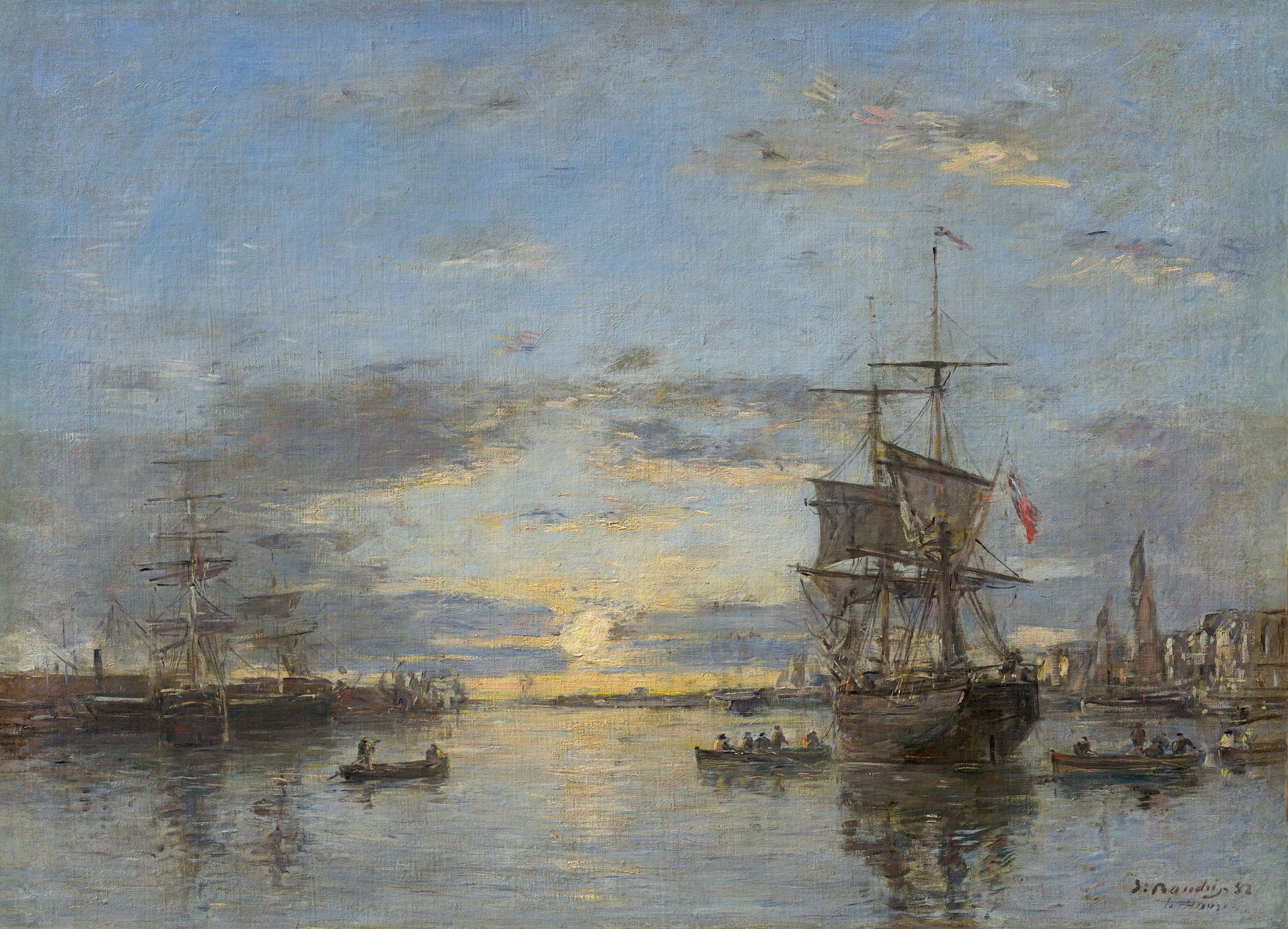
Stand in front of the canvas at the Marmottan and try to read it as a description of a place rather than as a piece of art history. You are looking at the inner harbor of Le Havre, the working basin where coal steamers and fishing boats unloaded, looking northeast from a window on the Quai de Southampton. The orange sun is coming up over the eastern jetty. The middle distance is full of the rigging of larger ships, ten or twelve of them, masts and yardarms reduced to gray-blue scribbles. To the right, faded into the mist, are the smokestacks of the industrial waterfront — iron works, sugar refineries, the Saint-Nicolas dry docks. The black silhouettes in the foreground are two small rowboats with two figures each, almost certainly fishermen heading out for the morning.
The water is doing the most work in the painting. Monet rendered it with a series of horizontal strokes that get smaller and choppier as your eye moves toward the boats. The orange reflection breaks into about seven distinct flicks. There are two zones of slightly disturbed water around the rowboats, painted with a slightly thicker brush. The whole thing creates a kind of optical churn that makes the static image feel like it is moving in real time.
The sun is the single most important element. Compare it side by side to the sky around it on a brightness scale and the orange disc is almost exactly the same value as the gray-blue clouds. In other words, the sun does not look brighter than the sky, it looks the same brightness but a different color. This is the trick of the painting. Reproductions cannot show it, because they boost the orange. In person, the sun seems to glow because of color contrast, not luminance. The art historian Margaret Livingstone published a paper in 2003 arguing that this is the same trick the human visual system uses to detect motion in low light, which is why the painting feels like it is happening rather than depicting.
Chiaro reads out Monet’s letter to his patron Paul Durand-Ruel from December 1872, the one where he describes “the impression of a sunrise” he was trying to catch, while you stand in front of the painting and look at the orange dollop and the seven flicks of red.
The sunset the painting almost was
Here is one of the small mysteries of art history. There is a strong argument, made by the curator Marianne Mathieu of the Marmottan in 2014, that Impression, soleil levant is not actually a sunrise. It might be a sunset.
The argument is technical but worth the minute it takes. Le Havre’s inner harbor opens to the southwest. If you are standing at the Hôtel de l’Amirauté window and facing the basin, the sun in November rises in the southeast, behind your right shoulder. It does not rise across the water. It rises behind you. The sun in the painting is rising directly in front of you. So either Monet rotated the scene for compositional reasons, which painters routinely do, or he was painting a sunset, which would have been visible across the water from that exact window in November.
The wind direction supports sunset. The smoke from the tug is blowing left to right. November wind in Le Havre is overwhelmingly southwesterly, which would push smoke from a tug heading inbound to the right. That direction is consistent with both a morning and an evening. But the orange of the sun in the painting is on the left side of the canvas, which in late afternoon would be the western horizon, where the November sun sets. Olson’s astrophysics paper cuts the other way and argues for sunrise based on the tide and the cloud direction. The argument is not settled. Monet himself never specified.
He gave the painting the title impression, sunrise. Whether it was actually sunrise or sunset he never said. The morning he painted it was probably misty enough that he could not have told you with full confidence either way.
The theft and the recovery
The painting belonged to a private collector named Ernest Hoschedé, who went bankrupt in 1878. It went through three more private owners before the Marmottan acquired it as part of a 1940 bequest from Michel Monet, the painter’s son. It hung in Paris through the war, was hidden in the south of France during the German occupation, and came back to the Marmottan in 1945.
On October 27, 1985, five armed men walked into the Marmottan during regular hours, ordered the staff to the floor, and walked out with nine paintings including the Impression, Sunrise. They had less than seven minutes inside the museum. The paintings spent five years in Corsica, hidden in a basement and a few private garages, until French police recovered them in December 1990 in a sting operation in Porto-Vecchio. The painting that named Impressionism went missing from the only museum in the world that had it for half a decade in the late twentieth century. It came back undamaged. It was rehung in 1991. It has not left the building since.
Why this painting and not another
This is the question that comes up every time. The 1874 exhibition had one hundred and sixty-five works in it. Monet alone showed twelve. Why did the critic single out this particular harbor study?
A few reasons. It was small, which made the looseness of the brushwork more obvious — a sketchy big painting reads as ambitious; a sketchy small one reads as careless. It had the word “impression” in the title, which Monet appears to have used for exactly this canvas only because he literally could not think of what else to call something that was so loose. And it was a working scene, a Le Havre harbor study with industrial smokestacks and rowboats, not a polished landscape with a peasant in the foreground. Critics could not file it under any received category. So they called it an “impression.”
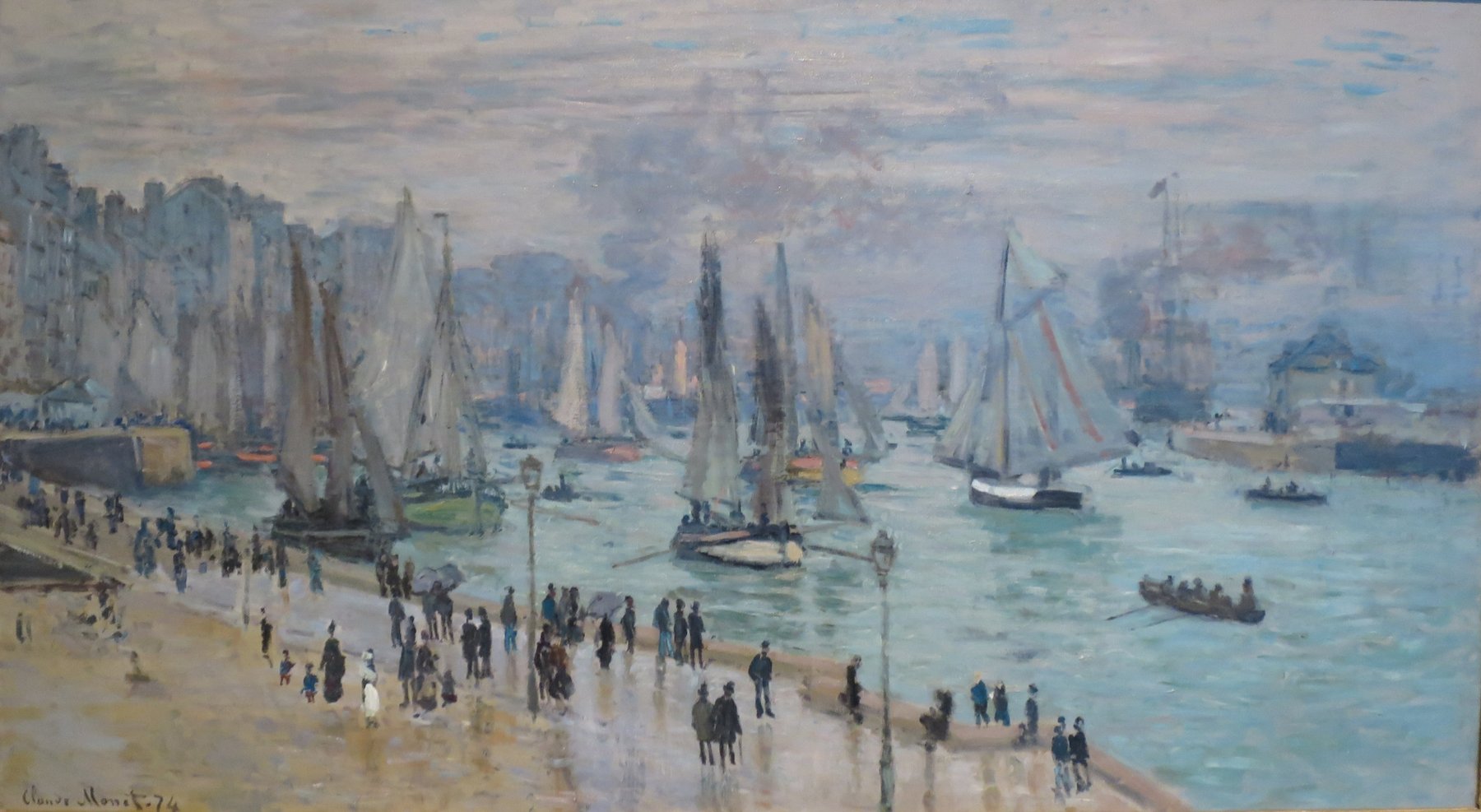
The label spread. Within five years the painters were calling themselves Impressionists in print. By the third group exhibition in 1877, the catalogue used the word in the introduction. By 1880 the term was the standard way to refer to the entire constellation of painters working in this register. The next time you read about impressionism monet, or impressionism movement, or any of the dozens of variations on impressionism in art that get used today, the word ultimately points back to a single morning in November 1872 at Le Havre and a satirical critic in April 1874 trying to make a joke.
How the Marmottan shows it
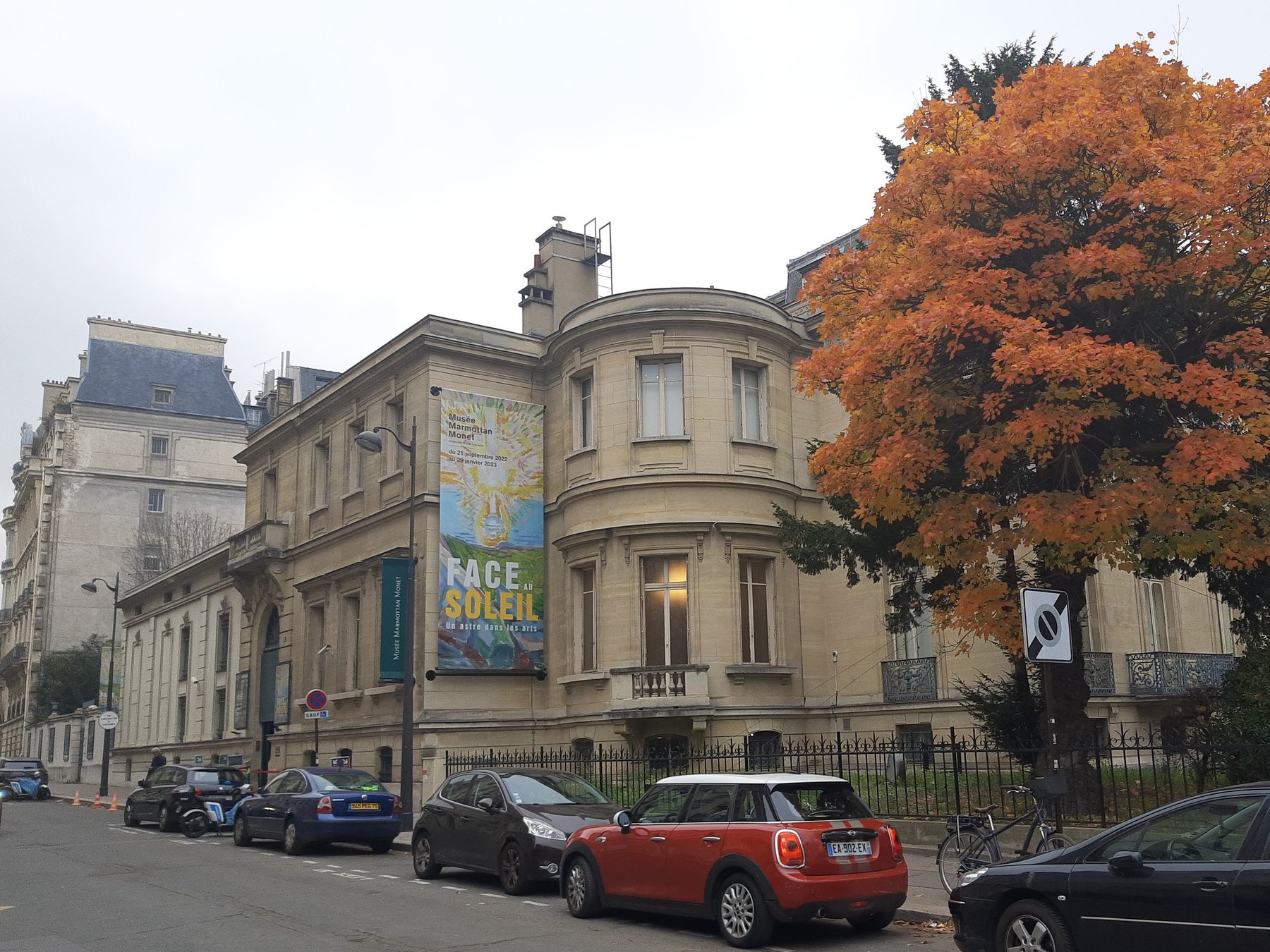
The painting is hung in a low-lit gallery on the third floor, in a room dedicated to the museum’s earliest Monets. The room is small. There are two benches. The lighting is deliberately tuned to the gray-blue palette of the canvas, which means the orange sun reads even more strongly than it does in reproduction.
You should give it ten minutes. Sit on the bench at the far wall first and look at the painting from the back of the room. Then walk up and stand at the standard six-foot viewing distance. Then move to about eighteen inches and look at the brushwork on the water. Then step back to six feet again. The painting changes character at each distance. From far away it is a coherent atmospheric study. Up close it is mostly empty canvas with a few decisive marks. The gap between those two readings is the trick the painting was inventing in real time.
If you have time, walk around the same floor and look at the other ninety-four Monets in the building. The Marmottan owns the largest collection of Monets in the world, donated by Michel Monet in 1966. Most of them are late Giverny works, water lilies and weeping willows and Japanese bridges. The Sunrise sits among them like the seed they all came from. You will not get this density of Monet anywhere else, not at the Orangerie, not at the Orsay, not at Giverny itself.
What to look for
The orange dollop. The seven flicks of red on the water. The pencil grid still visible at the lower edge. The tug’s smoke going right. The two black rowboats. The forty-eight by sixty-three centimeter canvas, smaller than you expect, smaller than most reproductions suggest.
And the title in the corner of the wall label. Impression, soleil levant. The word the critics threw, and the painters caught.
The kicker
A painter looked out a hotel window in Le Havre on a Wednesday morning in November 1872 and worked fast for an hour. Two years later he sent the canvas to Paris because he had nothing else to send. A magazine writer in April 1874 looked at it on a wall and mistook the title for an admission of failure. The word stuck. Impression became a movement, and the movement became a way of looking, and the way of looking became how most of us see paintings of light and weather and water now. All from one fast morning at a working harbor and one bad joke that the painters refused to take as an insult.
Image credits
- Claude Monet, Impression, soleil levant.jpg — Claude Monet (1840-1926). Source, Public Domain.
- Eugène Boudin. Le Havre. Der Außenhafen bei Sonnenuntergang.jpg — Eugène Boudin (1824-1898). Source, Public Domain.
- ‘Le Havre, Bâteaux de Peche Sortant du Port’ by Claude Monet, 1874.JPG — Claude Monet (1840-1926). Source, Public Domain.
- Musée Marmottan Monet, Paris, from street.jpg — via Wikimedia Commons. Source, CC BY-SA.


