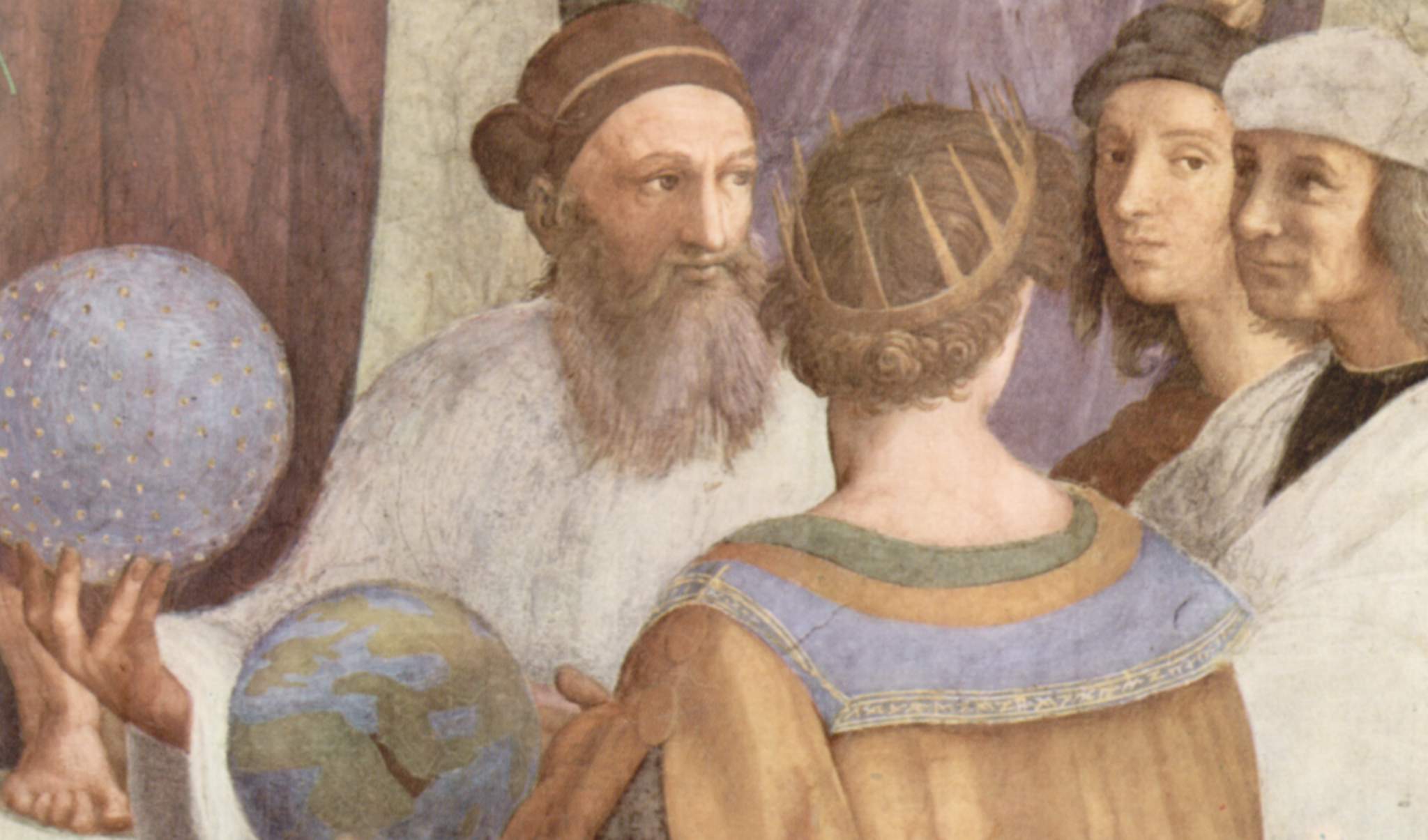
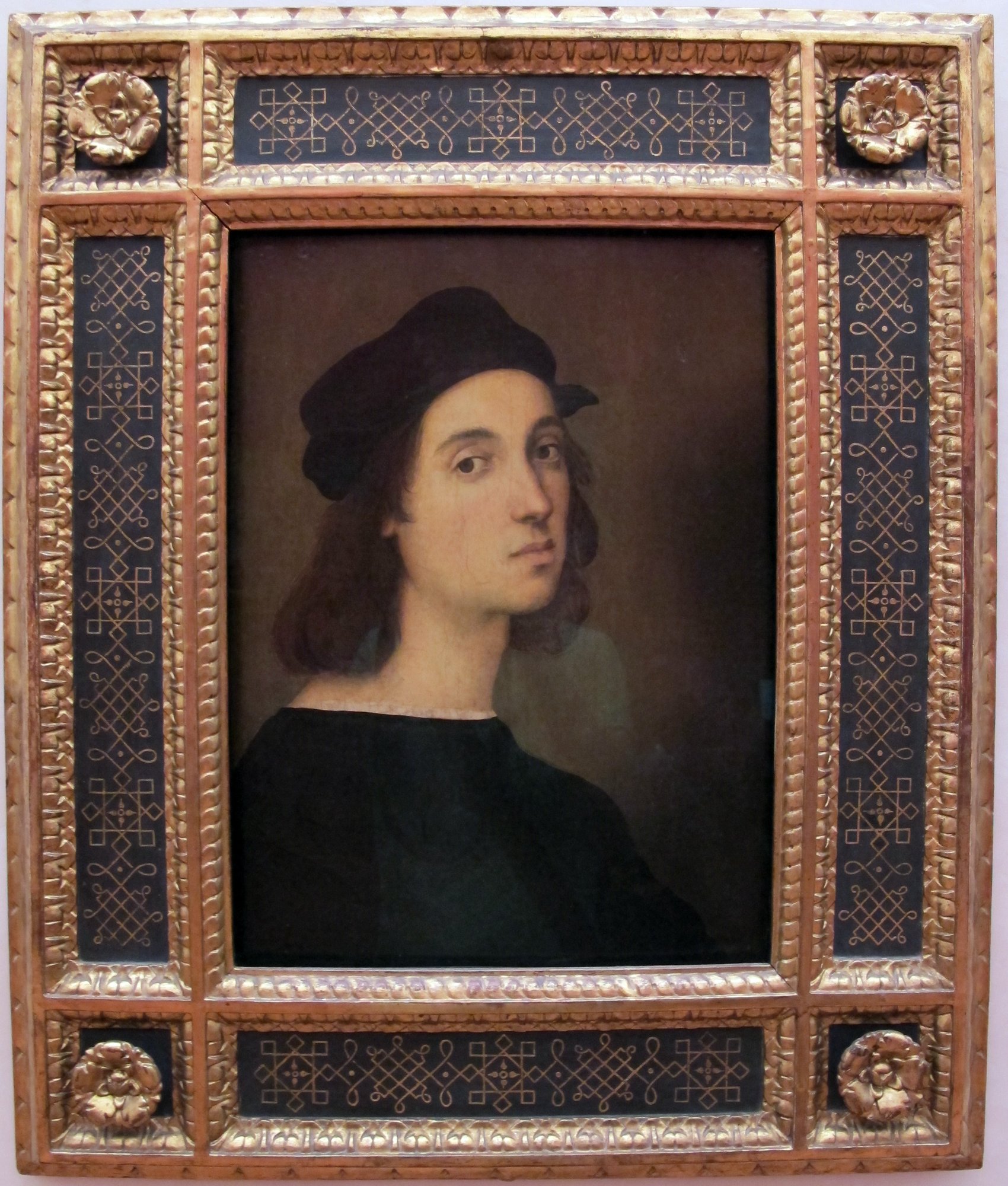
In the far right of the fresco, in the middle of a crowd of fifty philosophers, one figure looks directly at you. He is not gesturing. He is not arguing. He is not holding a book or a slate or a globe. He is wearing a soft dark cap. He is about twenty-seven years old. His eyes are the only eyes in the painting that meet yours.
That is Raphael. He painted himself into the fresco. The Raphael self portrait School of Athens is the quietest loud thing in Renaissance painting.
He is standing behind the Egyptian astronomer Ptolemy, who holds a terrestrial globe. Next to Ptolemy, holding a celestial globe, is Zoroaster. The three of them form a small knot of astronomers and mathematicians in the right foreground. Raphael has given himself a costume — a black beret, dark jacket, no beard yet — that says painter, not philosopher. He is in the scene but not of it. He has slipped in as a witness.
It is not hidden. It is not clever. It is just there, on the right, looking out, waiting for you to notice. Most visitors to the Stanza della Segnatura don’t. The average tourist spends about four minutes in the room. The guide points at Plato and Aristotle, reads the famous gestures, maybe gets to Michelangelo in the tunic, and moves on. The painter in the corner stays in the corner.
But once you see him, you cannot unsee him. And once you understand what he is doing there, the whole painting changes shape.
Why the painter put himself beside Ptolemy
In 1509, when Raphael began painting the Stanza della Segnatura, he was twenty-six years old and almost nobody in Rome knew his name. Pope Julius II had brought him to the Vatican on the recommendation of his fellow Urbino townsman Donato Bramante, the architect who was tearing down old St. Peter’s and building the new one. Bramante had told Julius about a young painter with an unusual gift for composition. Julius gave Raphael a single room to decorate, on trial. If the frescoes failed, Raphael would be sent home.
They did not fail. The School of Athens, finished around 1511, was the room’s centerpiece. When Julius saw it, he fired every other painter he had hired for the apartment and turned the whole floor over to Raphael.
So when Raphael tucked his own face in on the right, he was making a claim that had not yet been made. He was saying: I belong in this room. Not as a laborer, not as a decorator, not as an artisan with his brush. As a peer to Plato and Aristotle. The painter at twenty-seven, still on probation, placed his face inside the greatest gathering of ancient minds ever assembled in one picture, and he placed it at eye level with the viewer.
His left cheek is lit. His right is in shadow. He is looking out as if he just heard his name called. He is recording his presence.
Raphael cameo in his own painting
This was not the first painter cameo in a fresco. It was not even the first in Rome that year. Self-portraits smuggled into crowd scenes are a Renaissance tradition that goes back to Giotto. Botticelli put himself in the Adoration of the Magi, looking over his shoulder at the viewer. Ghirlandaio put his family and his assistants into the wedding scenes in Santa Maria Novella. The Raphael cameo in his own painting is part of a long tradition of painters hiding themselves in the crowds they paint.
What makes his version unusual is not the gesture. It is the company.
Giotto’s painters hid in the margins of biblical scenes. Botticelli hid in a family group of Medici clients. Raphael hid among the philosophers. And not just any philosophers — the greatest philosophers who had ever lived, in the company of Plato and Aristotle, on the walls of the Pope’s private library. That is a different kind of claim. It is not the painter as workman showing up at his own job. It is the painter as thinker.
The argument Raphael was making had a name in his period. It had a Greek name. It was a reference to Apelles.
Apelles renaissance painter lineage
Apelles was the most famous painter of antiquity. He worked for Alexander the Great. He painted portraits that ancient Romans wrote entire chapters about. None of his paintings survive. The ones we know about we know because Pliny the Elder described them in his Natural History, which every educated man in 1509 had read. Apelles was, to Renaissance painters, what Homer was to poets. If you wanted to claim that a painter could be a serious artist — not an artisan, not a decorator, but an artist on the level of poet or philosopher — you claimed the legacy of the apelles renaissance painter.
This is what Raphael invoked by walking into the fresco as himself. Pliny wrote that Apelles had painted Alexander’s court. Raphael painted himself next to Plato’s. It was the same move, fifteen centuries later, in a different scene.
The black beret and what it meant
Look at what Raphael is wearing. A black cap. Not a toga, not a tunic, not the draped robes of the ancient philosophers around him. He is dressed as a sixteenth-century Italian, which is to say he is dressed as himself, in the present tense.
Every other figure in the fresco is in antique costume. Plato’s white robe, Aristotle’s blue, Euclid’s purple — all of them are dressed as Greeks. The only figure besides Raphael wearing contemporary clothing is Michelangelo, propped against a block of marble in the center, in the dusty boots and working smock of a working sculptor. The two contemporaries who got to walk into the ancient world dressed as themselves were the two painters Julius II was then employing in adjacent rooms of the Vatican.
This is the Raphael looking at viewer tradition in its earliest and most confident form. He is not watching Plato. He is not watching Aristotle. He is watching you.
The effect is small. Most people miss it. The figure is pushed to the right, stands partly behind another figure, appears to be listening to something. But his eyes are out. And because his eyes are the only eyes in the fresco turned toward the room, his gaze becomes a kind of hinge. When you finally see it, you realize that Raphael is the only figure who is aware of the viewer. Everyone else is in their own time. He is in yours.
Stanza della Segnatura visitors and the argument
The room Raphael painted was not a chapel or a ceremonial hall. It was the Pope’s private library. The Stanza della Segnatura housed the Pope’s personal books and was used for signing documents. The four walls of the room were decorated according to a single scheme: four faculties of knowledge, one per wall. Theology on one wall. Philosophy on another. Poetry on a third. Law on the fourth. On the ceiling, four tondi above the four walls, personifying each faculty.
So the philosophy fresco was one quarter of an argument. The other three walls made the rest of it. Across from the philosophers sat the theologians, gathered around the Eucharist in the Disputation of the Sacrament. On a side wall, Parnassus, with Apollo and the poets, including a laurel-crowned Dante and a blind Homer. On the fourth wall, the lawgivers.
The point of the room, taken as a whole, was that these four ways of knowing — philosophical reason, religious revelation, poetic inspiration, legal tradition — all converged in the same room, and that room was the Pope’s. The ancients and the moderns shook hands across the ceiling.
Stanza della Segnatura visitors who rush through the room miss the conversation. They look up at the ceiling tondi and then back down at the walls and then out the door toward the Sistine. But the room was designed to be stood in, slowly, with your neck turning, taking in all four walls at once. The argument only works when all four are in your peripheral vision.
Which means Raphael’s face is not just inside the philosophy fresco. It is inside the larger scheme. By placing himself in the philosophy wall, Raphael placed himself inside the wheel of all four faculties. He was, by his own quiet positioning, claiming that painting belonged in the same room as theology, philosophy, poetry, and law. That painting was a form of knowing.
Artist signature in fresco, without a signature
The School of Athens does not carry Raphael’s name in a bold inscription. There is no big “Raphael fecit” on a cartouche. There is one small inscription, four letters, on Euclid’s slate in the right foreground — R.V.S.M., for Raphaello Vrbinas Sva Manu, “Raphael of Urbino, by his own hand.” It is the only written signature in the painting. The letters are small enough that you have to lean in.
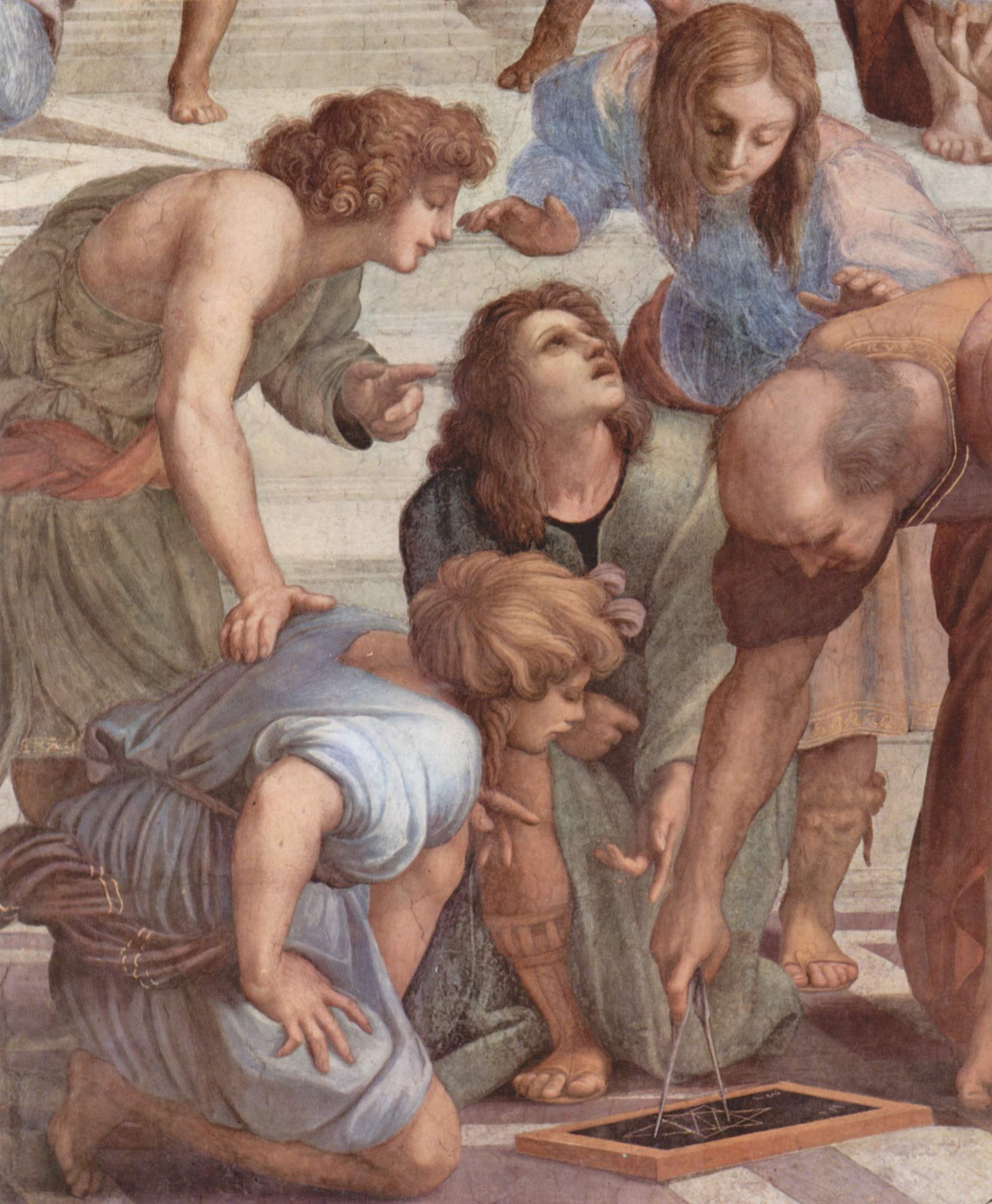
And it sits on the slate Euclid is using to teach his students. Raphael signed the fresco through the mathematician, through the teaching moment, through the figure he had modeled on his sponsor Bramante. (Euclid is Bramante in antique costume. Raphael thanked his patron by turning him into a Greek geometer.)
The artist signature in fresco is doubled: the verbal one on the slate, and the visual one in the self-portrait on the right. The first you have to find with your eyes on the ground. The second you find when someone stares at you. Both of them say the same thing: Raphael was here. A painter made this.
Chiaro walks you through the knot of astronomers on the right — Ptolemy’s globe, Zoroaster’s globe, Raphael’s face — as a single three-figure composition, so the self-portrait stops reading as background and starts reading as the point it quietly is. The cap, the lit cheek, the steady gaze happen in your ear while your eye is already on them.
Renaissance artists hiding themselves
Raphael was not the only painter to walk into his own fresco. The habit of renaissance artists hiding themselves in biblical and historical scenes was widespread, strange, and largely silent. Nobody wrote manuals on it. Nobody commissioned it. The cameo was a private convention that painters honored among themselves and that educated patrons sometimes noticed and sometimes didn’t.
Giotto is said to be one of the mourners in a fresco in Assisi, watching a funeral from the back of the crowd. Fra Angelico may be a small hooded monk in his own Last Judgement. Masaccio painted himself into the Brancacci Chapel as a bystander in Saint Peter’s audience. Botticelli stands on the right of his Adoration of the Magi, looking at the viewer with the same slightly skeptical expression Raphael would later wear in the Segnatura. Leonardo, uniquely, never seems to have done this — or if he did, nobody has ever convincingly identified it.
What the tradition did was different from what we now mean by a signature. The painter did not identify himself. He placed himself inside the scene and let observers find him or not. This was a form of modesty and a form of claim at the same time. Modesty because the face was small, partial, off to the side. Claim because the painter had walked into sacred or ancient space and made himself a resident.
The painter cameo tradition was the working artist’s way of asserting, without writing it down, that he was not just a hired hand.
Raphael Self Portrait School of Athens: finding him
If you stand in the Stanza della Segnatura and look at the fresco from the center of the room, the self-portrait is hard to see at first. The fresco is enormous, about twenty-six feet wide. Your eye goes to the center, where Plato and Aristotle walk toward you. Your eye goes to the bottom center, where Michelangelo sulks on a block of marble. Your eye goes to the bottom right, where Euclid bends over his slate.
Then move your eye up and right, past Euclid, to the group of three men standing together. The one with the crown is Ptolemy. The one with the star-studded globe is Zoroaster. The young man in the dark cap behind them, looking out, is Raphael.
He is easier to find if you know what you are looking for. He is almost at eye level. He is the only one not arguing. His face is softer than the men around him. He is watching the room, which is to say, watching you.
This is the point of the move. The self-portrait is not meant to dominate the scene. It is meant to be the thing you notice last, after you have taken in all the famous figures, and that then rearranges everything. Once you see Raphael, the fresco is no longer a tableau of ancient minds. It becomes a claim by a young painter, standing in a Vatican room, that his work belonged in their company.
That claim was vindicated within five years. By 1513, Raphael was the highest-paid painter in Europe. By 1516, he had been appointed head architect of St. Peter’s after Bramante’s death. By his death at thirty-seven in 1520, he was so famous that his funeral, held in the Pantheon, drew a crowd that overwhelmed the church.
The painter who had quietly walked into the fresco at twenty-seven was, by the end of his short life, buried among the ancients he had joined.
The kicker
Stand at the right side of the fresco. Find the black cap. Find the young face. Wait a second until your eyes meet his. That was the point. Five hundred years ago a twenty-seven-year-old painter arranged for his face to find yours in a papal library, and yours is the face he was painting for.

