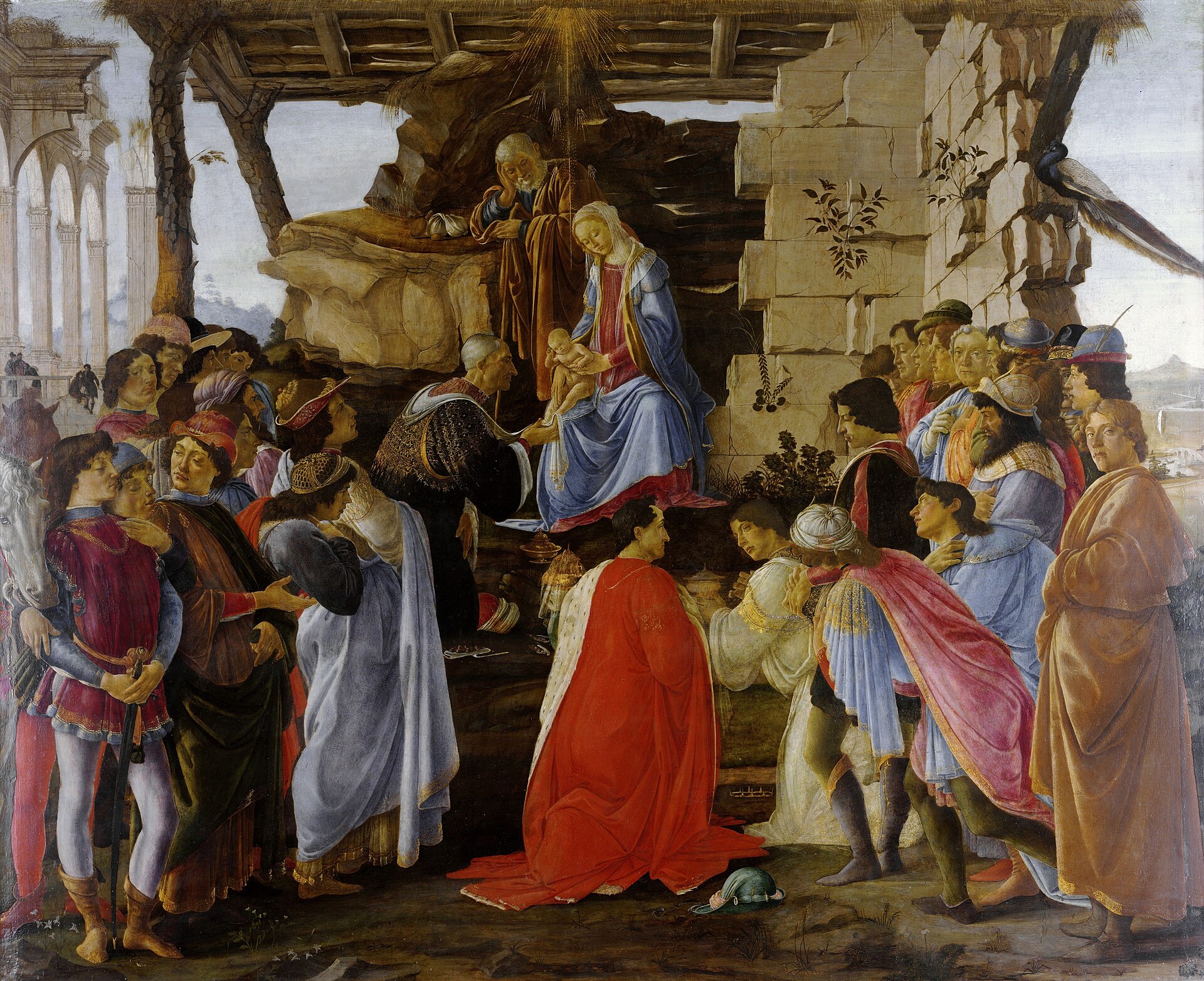
Almost every Renaissance Adoration of the Magi was a vehicle for portraiture. The three kings of the East, in the Bible story, came from far away with gold and frankincense and myrrh. The kings could be painted as anybody. Florentine patrons regularly asked their painters to give the Magi the faces of the patron’s friends, family, and political allies. The bystanders behind the kings could be even more local. The whole painting could be turned into a family portrait disguised as a sacred scene.
Botticelli’s Adoration of the Magi, painted in the mid 1470s and now in the Uffizi, is the single most ambitious version of this maneuver. It is a portrait of the Medici dynasty disguised as the visit of the kings to the manger. It also, very quietly, is one of the earliest painter self-portraits in Italian art. Botticelli put himself on the right edge of the painting, looking straight out at the viewer.
This is the essay on who is who, what the painting is doing, and why the painter ends up at the right.
What you are actually looking at
The setting is a half-ruined classical building, the kind of crumbling triumphal arch a fifteenth-century Italian painter used to gesture toward “the ancient world.” Inside the ruin, on a low rise in the foreground, the Virgin Mary sits with the Christ Child on her knee. Joseph stands or kneels beside her, depending on which restoration you’re looking at.
Three kings have arrived, one on the ground in front of the Christ Child, two slightly behind, all of them in elaborate contemporary Florentine dress that is not pretending very hard to be Eastern royal robes. Around them, a crowd of about two dozen men and a few women, also in Florentine dress, also in mid-1470s fashion. Some of them are looking at the Christ Child. Some of them are looking at each other. Some are pointing. One of them, on the right edge of the canvas, is looking out at you.
The painting is tempera on panel, about 111 by 134 centimeters, originally an altarpiece. It is small enough that, standing close, you can see the faces of every figure clearly. This is important. The faces are the point.
Who commissioned it
The patron was Gaspare di Zanobi del Lama, a Florentine banker and minor Medici functionary. He had no aristocratic pedigree. He had been involved in some financial scandals. He wanted to consolidate his standing in the Medici circle, and he commissioned this altarpiece for his family chapel in the church of Santa Maria Novella, on the south side of the nave, sometime around 1475. (The chapel itself is gone, demolished in 1565.)
The painting was a bid for visibility. By having Botticelli paint the Medici as the kings — and the Medici cousins, allies, and clients as the bystanders — del Lama was aligning himself, permanently and prominently, with the most powerful family in Florence. It worked. Every Florentine who walked into Santa Maria Novella for the next ninety years saw the family portrait disguised as the sacred scene, and saw del Lama’s name attached to it.
Del Lama himself is in the painting. He is the bearded older man in the middle of the second row of figures on the right side, looking out at the viewer and pointing one finger upward, as if introducing the room. Botticelli’s painter-cameo at the far right is in a sense replying to del Lama’s: the patron and the painter, both quietly identified, on the same side of the canvas.
Vasari’s identification
Most of what we know about who is who in this painting comes from a single sentence in Giorgio Vasari’s Lives of the Artists, written about seventy-five years after the painting was finished. Vasari, who had access to Florentine court tradition and could ask people who had known the older generation, identified the three kings explicitly. Modern scholars have confirmed and refined his identifications using comparison with other Medici portraits, especially the medals and bronzes that survive of Cosimo, Piero, and the others.
Here is Vasari’s identification, which is still the scholarly baseline.
Cosimo il Vecchio as the kneeling king
The king kneeling directly in front of the Christ Child, his crown set down on the ground beside him, holding the Child’s small foot in his hand, is Cosimo il Vecchio de’ Medici. Cosimo, born in 1389, had effectively founded the Medici political dynasty. He had been dead for eleven years when Botticelli painted this — he died in 1464 — but Vasari says, and the face confirms, that Botticelli painted him from the surviving medals and bust portraits.
It is the most prominent place in the painting. The most senior Magus, kneeling at the Christ Child’s feet. By placing Cosimo there, the painting performs a small theological argument: the Medici dynasty kneels first to Christ. The family pageant is reverent, not arrogant.
Cosimo is bald, with a slightly hooked nose and the heavy jaw he had in life. He is in profile. The face is recognizable to anyone who knows the bronze medals struck after his death.
Piero il Gottoso as the second king
The middle king, kneeling slightly behind Cosimo, in a red robe lined with ermine, his hands raised in supplication, is Piero il Gottoso de’ Medici, “Piero the Gouty.” Piero was Cosimo’s son and successor. He had ruled the family for only five years, from 1464 to 1469, and had died at fifty-three of the gout that gave him his nickname. Like Cosimo, he was already dead when Botticelli painted this.
Piero is younger-looking than Cosimo, fuller-faced, with a wider mouth. He is dressed more elaborately, more ducally, than the older man. His role in the painting is to be the bridge: the link between the founder and the present generation of the family.
Giovanni de’ Medici as the third king
The third king, the one with his back partly turned to the viewer, also kneeling, is Giovanni de’ Medici, Piero’s younger brother and Cosimo’s second son. Giovanni had died young, in 1463, before either his father or his older brother. Botticelli painted him from family memory and from a posthumous medal.
Three kings, three Medici, two of them dead before the painting was made: this is a dynastic monument. The painting is honoring the dead founders along with the living family.
Lorenzo il Magnifico in the standing crowd
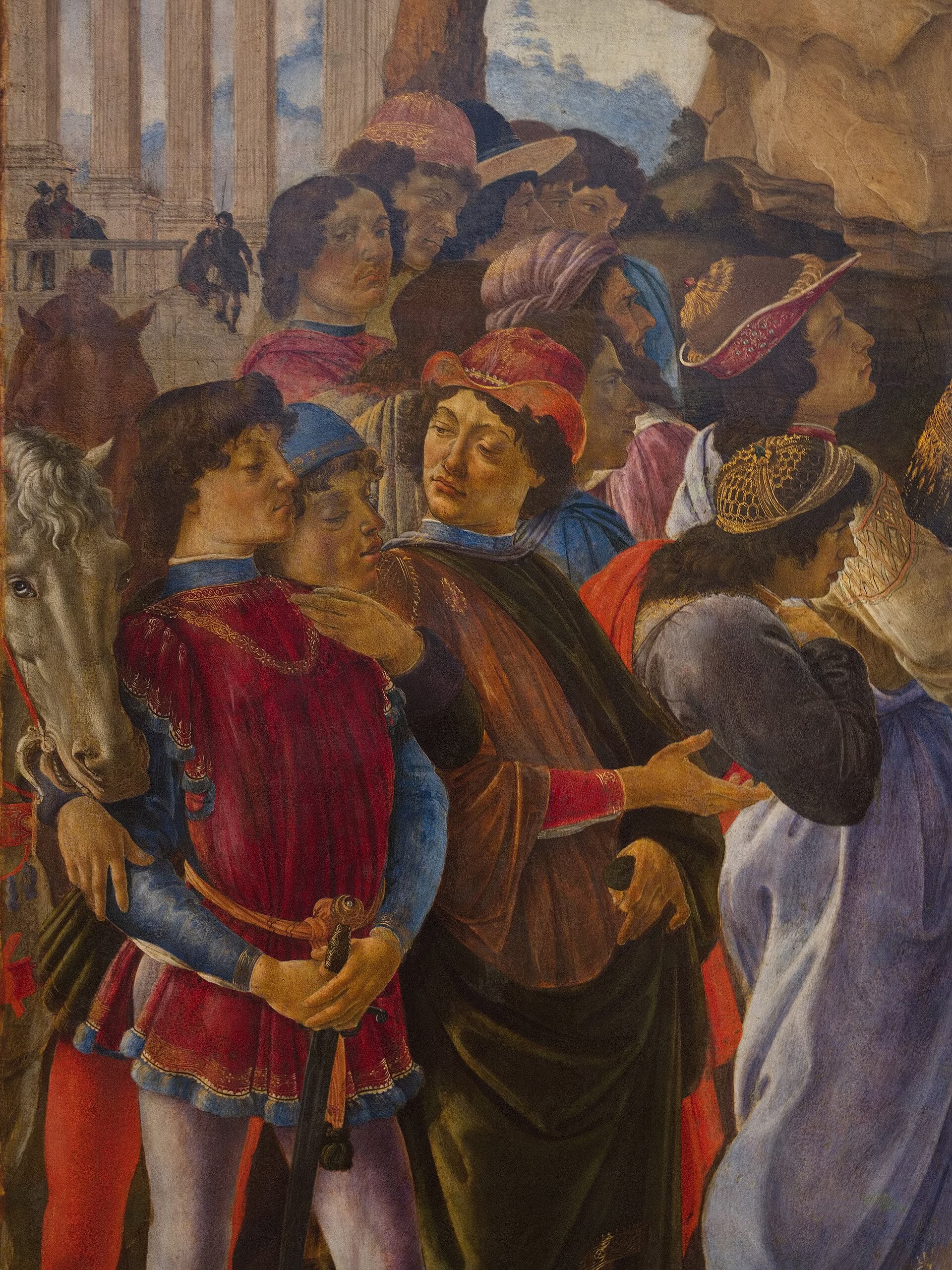
Among the standing figures on the left, slightly elevated, dressed in dark robes with a small black hat, holding a sword that he leans on with one hand, is Lorenzo il Magnifico de’ Medici — “Lorenzo the Magnificent” — the de facto ruler of Florence at the time the painting was made. Lorenzo would have been twenty-six in 1475, freshly in charge of the family fortunes after Piero’s death six years earlier.
Lorenzo’s face is famous. The hawkish profile, the long jaw, the dark eyes. Botticelli was painting from life. (Lorenzo was a daily presence at the Medici palace and at the surrounding villas; Botticelli was a member of the household intellectually and socially, if not as a paid retainer.) The Lorenzo in this painting is the same Lorenzo Botticelli would later put into the Birth of Venus and La Primavera in disguised form. Here, Lorenzo is unmistakably himself.
Giuliano de’ Medici among the standing figures
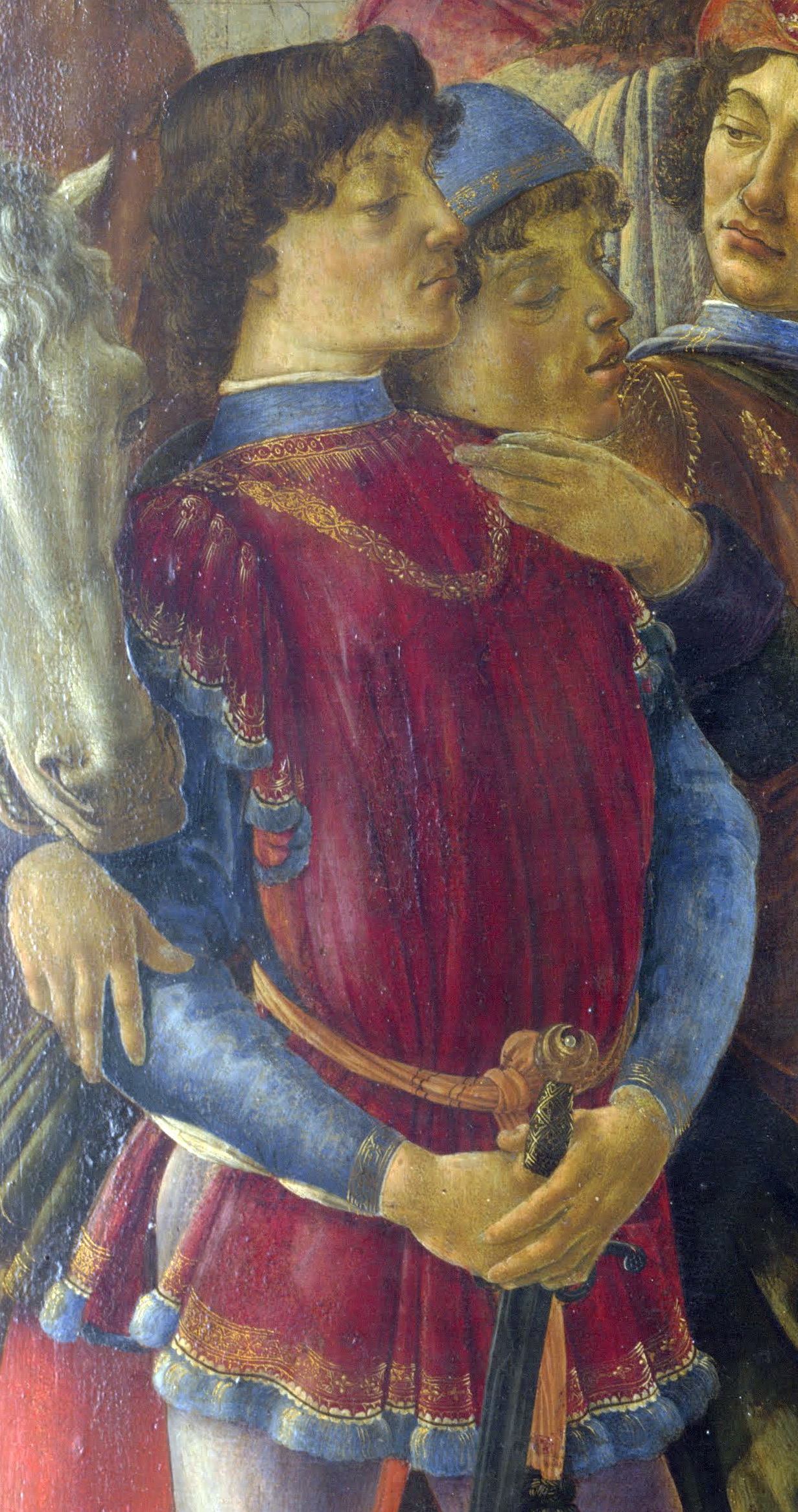
Among the standing figures, in some attributions on the right side of the canvas, in a darker robe, with his head bent slightly, is Giuliano de’ Medici, Lorenzo’s younger brother. Giuliano was four years younger than Lorenzo, twenty-two when this painting was made. He was the family’s heir presumptive after Lorenzo. Three years after this painting was finished, in 1478, Giuliano would be assassinated during the Pazzi Conspiracy in the Florentine cathedral, stabbed nineteen times in the chest while attending Easter Mass. Lorenzo would survive the same attack, with a knife wound in the neck.
So this painting captures the Medici family in the very last years before the Pazzi catastrophe. Giuliano is still alive, still standing, still part of the dynastic group portrait. Three years from now he will be dead in the Duomo. Botticelli, who knew Giuliano well, would later paint a famous posthumous portrait of him in the Berlin Gemäldegalerie.
The Botticelli self-portrait at the right
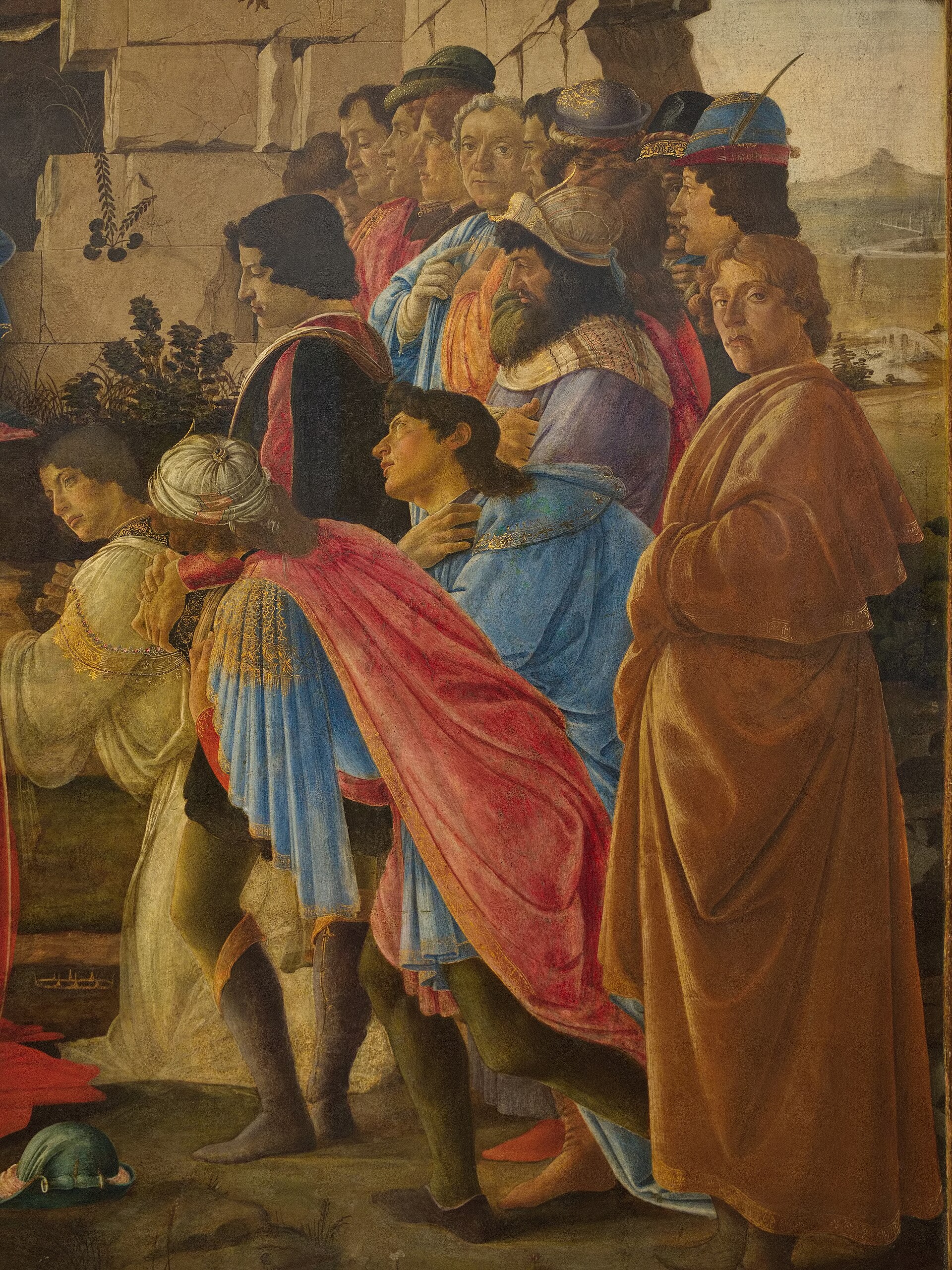
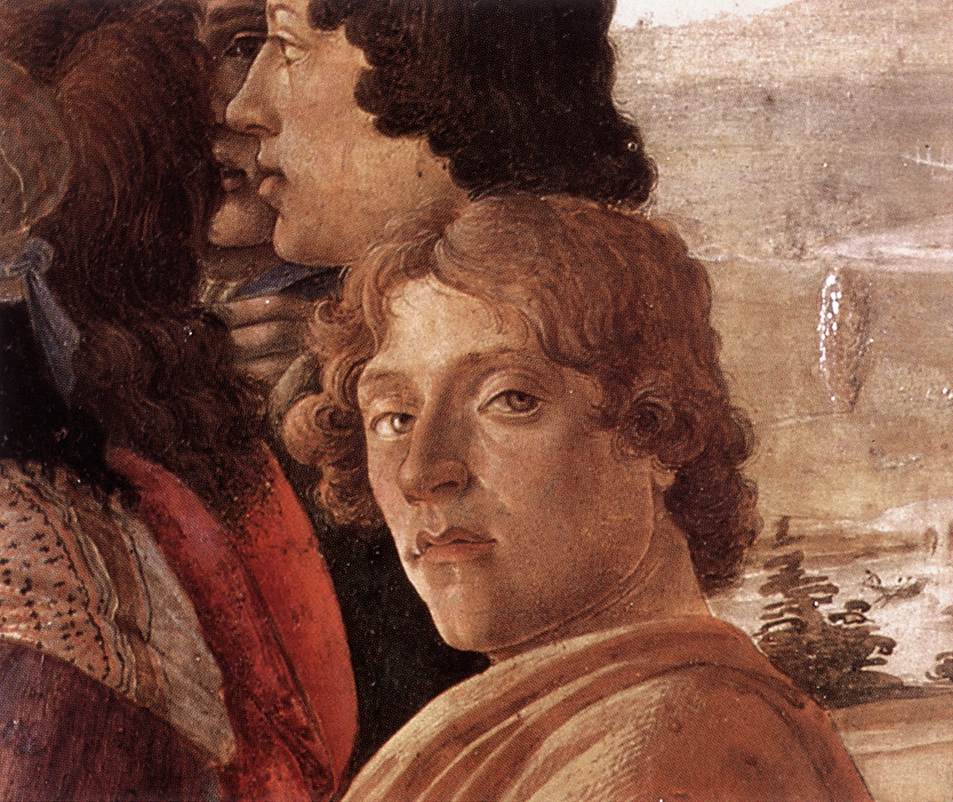
On the far right of the canvas, in the front rank of the standing figures, in a yellow-gold cloak, with a small reddish-blond beard, looking directly out at the viewer, stands Sandro Botticelli himself. Vasari identifies him explicitly: “in the painting is the portrait of Sandro himself, who is the figure on the right who is turning toward the viewer.”
Botticelli would have been about thirty when this painting was made. The face matches. The beard matches. The expression — slightly skeptical, slightly tired, very alert — matches the face he would later paint in other contexts.
The painter cameo at the right edge is not, in 1475, a new tradition. Giotto had hidden himself in fresco crowds. Masaccio had put himself in the Brancacci Chapel. Ghirlandaio would do the same in Santa Maria Novella a decade later. What is unusual about Botticelli’s version is the directness of the look. He is not looking at the holy scene. He is not looking at his patron. He is looking, calmly and steadily, at the viewer.
A century and a half later, Caravaggio would do something similar in his self-portrait as the severed head of Goliath in the Borghese. We have a whole essay on Caravaggio’s late self-presentations in Rome that pairs with the move Botticelli is making here. And we have an essay on Raphael’s self-portrait in The School of Athens, painted thirty-six years after this Adoration, where the same trick — painter looks at viewer from the right edge of a sacred scene — gets used at much larger scale.
The Botticelli at the right of the Adoration of the Magi is the prototype. The Raphael in the Vatican is, on some readings, paying tribute to it.
What the painting is doing politically
The painting is, on every level, a piece of Medici propaganda. The dynasty’s three founders are kneeling at the manger, in the most reverent positions in the scene. The current heads of the family are in the standing crowd, dressed in sober contemporary fashion, present but not preening. The patron, del Lama, is in the second rank, identified by his finger pointing to the heavens. The painter is on the right, looking out.
By 1475, the Medici were already worried about how to manage their increasingly visible power in a city that was, at least nominally, a republic. The traditional Medici strategy was to wield power without flaunting it: dress modestly, decline ceremonial titles, maintain a fiction of being just another Florentine family. Adoration of the Magi, as a piece of public art in Santa Maria Novella, threaded that needle perfectly. The family was not painting itself as kings of Florence. It was painting itself as kings of the East kneeling before Christ. Reverence and visibility, in one gesture.
The trick worked for about a hundred years. The Medici held the city, more or less continuously, until the end of the dynasty in 1737.
Why this painting is in the Uffizi
The Adoration of the Magi hung in del Lama’s chapel at Santa Maria Novella from about 1475 until the chapel was demolished in 1565 during a renovation of the church. The painting was rescued, moved, and eventually entered the Medici collection. It was hung in the Uffizi probably in the late seventeenth century. It has been in the museum, with relatively little movement, ever since.
It now hangs in the Botticelli rooms, alongside La Primavera and The Birth of Venus, in Room 10–14. The room is one of the busiest in the museum. Most visitors stop in front of the two big mythological paintings, take their photographs, and walk past the Adoration to get to Leonardo and Michelangelo in Room 35.
This is a mistake. The Adoration is more biographical, more politically loaded, and arguably more revealing of how Botticelli understood his own role in the city than either of the two more famous paintings. To stand in front of it and identify the faces — Cosimo, Piero, Giovanni, Lorenzo, Giuliano, del Lama, and Botticelli himself — is to see a slice of Florence in 1475 with rare directness.
Chiaro walks through the seven identified portraits — the three Medici kings, the two Medici brothers in the crowd, the patron del Lama, and Botticelli on the right — as one continuous group photograph in early-modern dress, so the painting reads as the family portrait it always was instead of the holy scene it is dressed as.
How Botticelli did it
Vasari says, again, that Botticelli “made beautiful and lively faces” in this painting and that the work brought him “great reputation, as much in Florence as elsewhere.” It is the painting that established Botticelli as the painter the Medici trusted with their most political commissions. After this Adoration, he got the Sistine Chapel frescoes from Sixtus IV (1481), the Primavera commission from Lorenzo di Pierfrancesco (1482), and the second Adoration in Berlin. The Birth of Venus, in the mid-1480s, would not have happened without this.
The technique is clean tempera on panel, the figures arranged in a sophisticated frieze that the eye reads in two directions: from the central Holy Family outward to the wings, and from the front kneelers backward through the standing crowd. The architecture — the half-ruined classical pavilion — is set on a slight oblique, giving the painting depth without losing the friezelike quality of the figures.
The colors are restrained: a lot of dark green, dark red, ochre, gold, with occasional flashes of bright blue and white. This is consistent with what was fashionable in Florentine painting in the mid-1470s, a few years before the brighter palette of Primavera.
The kicker
Walk into the Botticelli rooms. Pass the Birth of Venus. Pass La Primavera. Find the smaller, darker panel on the next wall. Now look at the right edge. The blond man in the gold cloak is not a bystander. He is the painter, looking out at you across five hundred and fifty years. To his left, the family that ran Florence is kneeling at a manger. The whole painting is a held-breath. Sandro Botticelli, age thirty, is letting you in on the joke.
Image credits
- Botticelli - Adoration of the Magi (Zanobi Altar) - Uffizi.jpg — Sandro Botticelli (c. 1445-1510). Source, Public Domain.
- Sandro Botticelli - The Adoration of the Magi (detail) - WGA2705.jpg — Sandro Botticelli. Source, Public Domain.
- Sandro Botticelli - The Adoration of the Magi (detail) - WGA2703.jpg — Sandro Botticelli. Source, Public Domain.
- Botticelli, Adoration of the Magi (Zanobi Altarpiece), 1474-76, Uffizi, detail.jpg — Sandro Botticelli, photo by Sailko. Source, CC BY 3.0.
- Botticelli, Adoration of the Magi (Zanobi Altarpiece), 1474-76, Uffizi, detail with self-portrait.jpg — Sandro Botticelli, photo by Sailko. Source, CC BY 3.0.
_-_Uffizi.jpg)
_-_WGA2705.jpg)
_-_WGA2703.jpg)
,_1474-76,_Uffizi,_detail.jpg)
,_1474-76,_Uffizi,_detail_with_self-portrait.jpg)