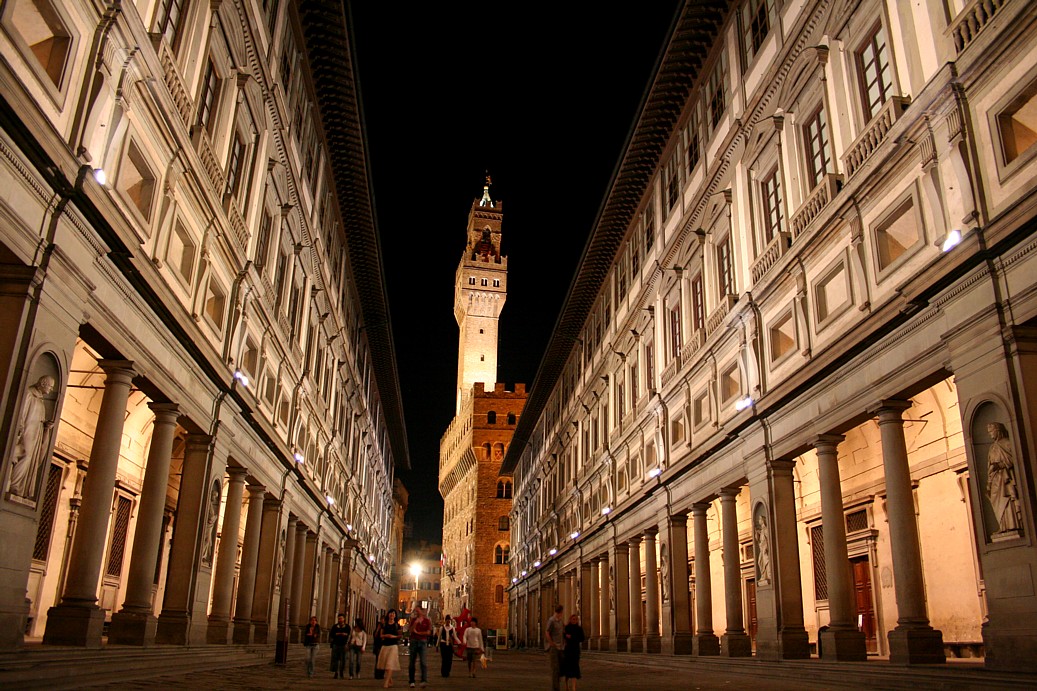
The Uffizi Gallery is the oldest art museum still operating in its original building, the largest collection of Renaissance painting in the world, and — by visitor volume — the second most visited museum in Italy. It sells about four million tickets a year. In high season, it sells those tickets out three to four days in advance. If you arrive in Florence on a summer Tuesday and try to walk in, you will likely be turned away.
Uffizi Gallery reservations, in other words, are not optional. They are the first thing you do, before you book the hotel, before you book the train, before you decide which day you spend in Florence at all. This is the practical guide. How to book on the official site, what to skip, when the free days are, and the small handful of details that will save you between an hour and a half-day in line.
What “reservations” actually means
The Uffizi sells two kinds of admission. The first is a timed-entry ticket, where you book a specific entry slot — a thirty-minute window — and arrive at the door during that window. Once inside, you can stay as long as the museum is open. The second is a walk-up ticket, sold at the door on a first-come basis, with no advance booking.
In practice, walk-up tickets exist but are increasingly rare. From April through October, and during all major holidays, the museum routinely sells through its daily allocation of timed-entry slots before the morning starts, leaving no walk-up tickets at all. From November through March, on weekdays in poor weather, you may be able to walk up. On weekends, even in winter, you usually cannot.
The right move, in every season, is to book ahead. The earliest you can book is sixty days in advance. The latest is, in theory, the morning of your visit, though by that point on a busy day every slot will be sold.
The official site (and why it matters)
The Uffizi has exactly one official ticketing site: uffizi.it. The booking flow is on the Webshop B-Ticket sub-page that the official site links to. (Search for “uffizi tickets official” in any browser and the .it domain is the first result.)
Every other “Uffizi tickets” website you see — and there are dozens, including some that buy Google ads against the official URL — is a third-party reseller. These resellers buy slots from the official allocation, mark them up by 20 to 80 percent, and add their own service fees on top. Some are legitimate operators that include short guided tours. Many are not. None of them give you a faster line than the official site. Some of them do not deliver tickets at all, leaving you to argue with a Florentine ticket office in Italian about a third-party booking they have never heard of.
Use uffizi.it. Pay in euros. Save the QR code to your phone. Done.
The standard adult full ticket as of 2026 is 25 euros (sometimes 27 euros for special exhibition periods, when the regular price already includes whatever exhibition is mounted in the third-floor halls). EU citizens between 18 and 25 pay a reduced rate of around 12 euros. Under-18s and EU disability cardholders are free. There is a small online booking fee on top, around 4 euros, that makes the actual cost about 29 euros for a full adult ticket. There is no way to avoid it.
What time slot to book
The Uffizi opens at 08:15 Tuesday through Sunday and closes at 18:30, with the last admission at 17:30. It is closed on Mondays. (Don’t fly in for a one-day Florence visit on a Monday. The Pitti Palace, the Accademia with the David, and Palazzo Vecchio are all open Mondays and can absorb the day if your itinerary already has Monday locked in.)
The best slots are the very first of the day, 08:15 or 08:30. The reasons are straightforward: the rooms are emptier, the light through the long corridor windows is best in early morning, the temperature is comfortable in summer, and you finish before the lunch crowds arrive. The corridors get noticeably louder around 11:00, peak around 14:00, and start thinning out again after 16:00.
Second-best slots are the last hour and a half, around 16:00 or 16:30. The crowds drop. The corridors empty. You will not have time to do the full collection, but you will have time for the Botticellis, Leonardo and Michelangelo, and Caravaggio.
The slots to avoid: 10:30 to 13:00. Cruise-ship and bus-tour groups arrive in this window. The Botticelli room becomes physically uncomfortable.
Where to actually enter
This is the single most important practical detail and the one most visitors get wrong. The Uffizi has multiple doors. They are not interchangeable.
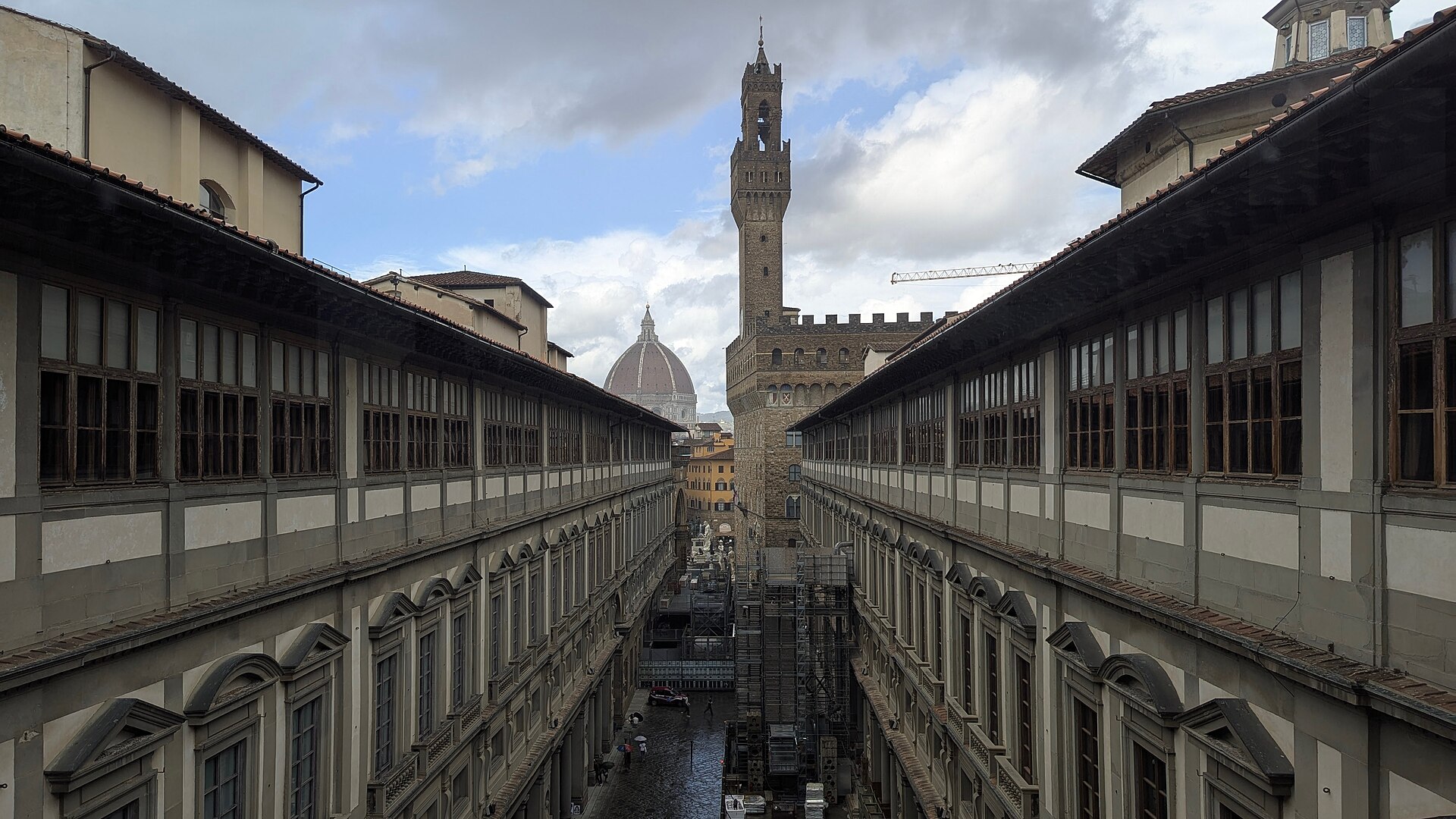
There are four main entrances along the U-shaped courtyard:
- Entrance 1 is the main entry, on the east wing of the courtyard, for visitors without a ticket. This is where the walk-up line forms. It is the longest of the four and the one to avoid.
- Entrance 2 is also on the east wing, immediately next to Entrance 1, but is only for visitors with a confirmed timed-entry ticket. This is where you go if you booked ahead. The line is usually fifteen to thirty minutes regardless of how clear the rest of the courtyard looks, because the Uffizi’s security check is thorough and runs at a fixed speed.
- Entrance 3 is on the west wing of the courtyard, opposite Entrance 2, and is reserved for groups with a guide. If you are a solo visitor with a paper ticket and you accidentally line up at Entrance 3, the guards will redirect you. (This is a common mistake.)
- Entrance 4 is the exit and the gift shop entrance, on the west wing near the Arno end of the courtyard.
If you booked ahead on uffizi.it, look for the small sign over the second door from the west on the east wing — Entrance 2 — and join that line. The guards check your QR code, run your bag through a scanner, and you are in.
What to skip
The Uffizi is large enough that most first-time visitors burn out somewhere on the second floor. The fix is to skip in advance. Here is what most visitors can comfortably skip without losing the museum.
Skip the ground floor. The ground floor is mainly drawings and the print collection — fragile, dimly lit, primarily of interest to specialists. Unless you are specifically there for a special exhibition, head straight up to the second floor.
Skip the long Niobe Room (Sala della Niobe). It contains a set of Roman copies of Greek originals depicting the slaughter of the children of Niobe. They are interesting if you have all day. They are not why you came. Walk through, look around once, keep going.
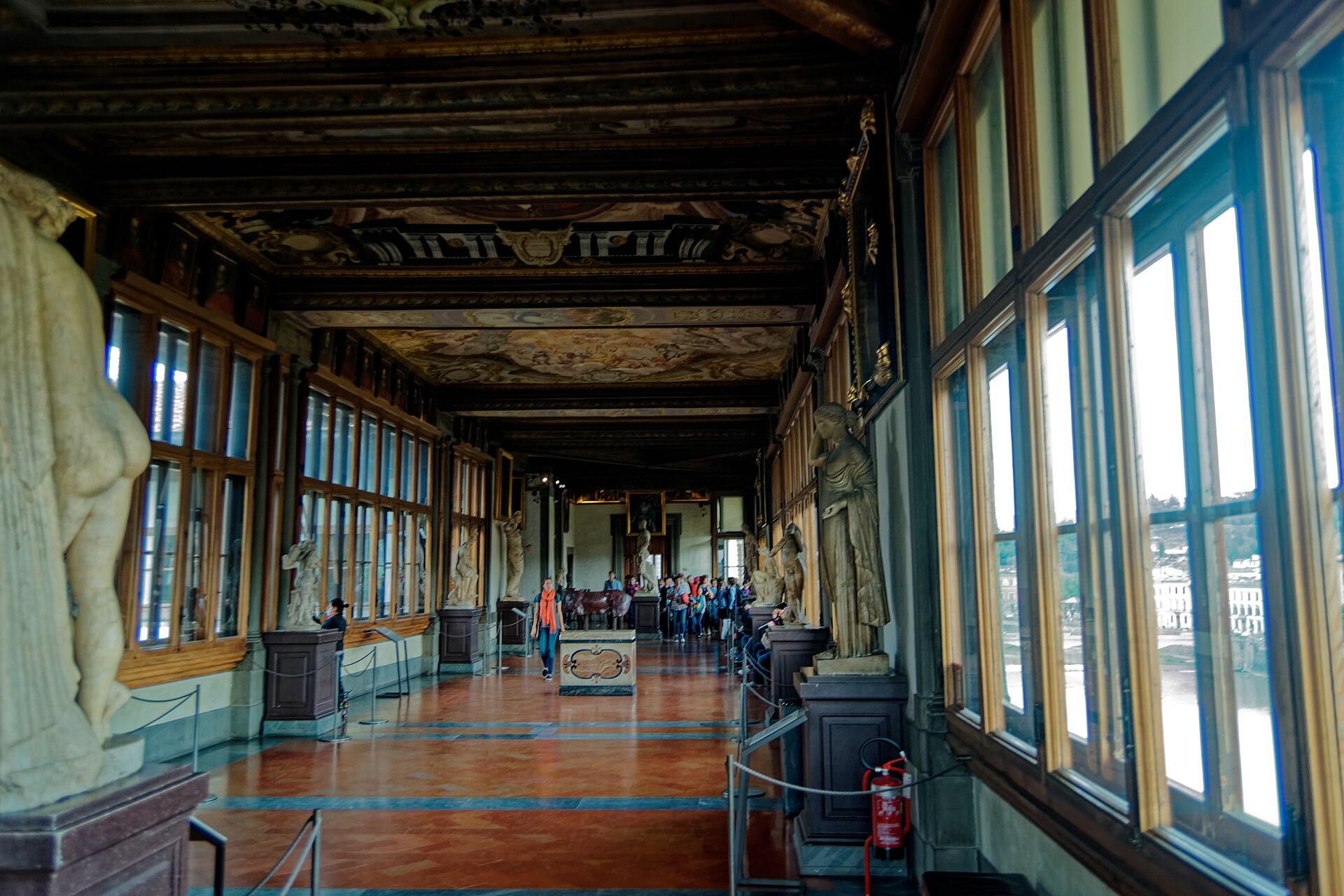
Skip the corridor sculptures on a first visit. The U-shaped corridors are lined with classical and Roman sculptures and the painted ceiling above them is full of grotesques. They are gorgeous. They are also slow to absorb. On a first visit, prioritize the rooms that open off the corridor. Save the corridor itself for a second pass on the way out.
Consider skipping the Vasari Corridor reservation unless you are already a Florence-museum-completionist. The corridor — the famous covered passage that runs from the Uffizi over the Ponte Vecchio to the Pitti Palace — reopened to the public in late 2024 after a decade of restoration. It is now sold as a separate timed-ticket attraction, not as a default part of the Uffizi visit. The walk through is interesting if you are committed to the bit, but it adds an hour to a day that, if you are visiting Florence for the first time, is probably already overstuffed.
What not to skip: Botticelli rooms (Room 10–14), Leonardo and Michelangelo (Room 35), Raphael (Room 41), Titian (Room 83), Caravaggio and Artemisia (Room 90). The overview of the museum walks through what is in each of these in detail, and the first-timer’s walkthrough covers the route.
Free days
The Uffizi participates in the Italian Ministry of Culture’s free-admission program, which means there are free-entry days roughly once a month. The pattern as of 2026:
- First Sunday of every month, October through March. The summer months are excluded. (Too many tourists for the free-day system to handle.)
- Specific national holidays: April 25 (Liberation Day), June 2 (Republic Day), and a small handful of others.
On free days, the museum is open but you cannot book a timed slot in advance. You arrive, you wait in the walk-up line at Entrance 1, and you go in when the line moves. The line on a free Sunday in February starts forming at about 07:30 and the wait at peak is two to three hours. The line disperses by mid-afternoon.
If you are a budget traveler with a flexible schedule, the first Sunday of November, December, January, or February is the right time to do the free day. The line is real but tolerable, the museum is no more crowded than a normal Saturday, and you save 25 euros.
If you are on a tight schedule, do not try to use the free day. Book a timed-entry ticket at the regular price.
What the ticket includes
The standard adult ticket includes:
- Full access to all permanent galleries on the second and third floors of the main Uffizi building
- The current temporary exhibition, if there is one mounted in the special exhibition halls
- Access to the corridor sculptures and the long internal corridors
It does not include:
- The Vasari Corridor, sold separately as a timed-ticket since the 2024 reopening
- The Pitti Palace across the river, which has its own ticket
- The Boboli Gardens behind the Pitti Palace, also separately ticketed
- The Galleria dell’Accademia (the home of Michelangelo’s David), which is separate from the Uffizi entirely
There is a combined “Uffizi + Pitti + Boboli” pass, called the PassePartout, that bundles the three for around 38 euros over five consecutive days. If you are spending three days or more in Florence, the PassePartout is good value. If you are doing one day in Florence, just buy the Uffizi ticket.
What to bring (and what not to)
Bring: an ID — a passport, a national ID card, or a driver’s license — that matches the name on the ticket. The Uffizi sometimes spot-checks. Bring a phone with the QR code easily accessible (or a printed copy as backup). Bring a refillable water bottle; there are water fountains in the corridors.
Don’t bring: large bags. Anything bigger than a small daypack has to be checked at the cloakroom. The cloakroom is free but slow. Tripods, selfie sticks, and large camera lenses (anything over 20 cm or so) have to be checked. Outside food and drinks are not allowed.
Photography: still photography without flash is allowed in most galleries. Video is generally not. Special exhibitions sometimes prohibit photography entirely.
The realistic time budget
If you book ahead, arrive at Entrance 2 fifteen minutes before your slot, breeze through security in twenty minutes, and head straight to the Botticelli room: plan three hours for a focused visit, four to five hours for an unhurried one. The museum is large enough that even an unhurried visit will not show you everything. That is fine. The collection is denser than a single visit can hold.
A focused three-hour Uffizi visit looks like this:
- Hour one: second-floor rooms 2 (Cimabue and Giotto) through 9 (Filippo Lippi). Move quickly through the early Tuscan rooms. Stop at Piero della Francesca’s diptych in Room 8.
- Hour two: Room 10–14 for the Botticellis, Room 35 for Leonardo and Michelangelo, Room 41 for Raphael.
- Hour three: third floor — Titian in Room 83, Caravaggio and Artemisia in Room 90, then exit through the long west corridor.
The overview of the collection walks through the ten works to know in detail. The Florence walkthrough handles the route through the building. For the painting that pulls most of the crowd, the Birth of Venus essay and the Primavera essay cover what you are looking at when you arrive.
Chiaro walks you through the Botticelli room from across the corridor as you approach it, so the ten-second walk from the doorway to The Birth of Venus is already framed before you stand in front of the canvas. It is the kind of audio that is most useful in a crowded museum where you cannot stop and read a full label without holding up the line behind you.
A note on the 2024 third-floor reopening
The Uffizi spent most of 2018 through 2024 in a long, phased restoration of its third-floor galleries — the home of the Renaissance and Baroque collections, including Caravaggio and Titian. The work is now done. The third floor reopened in late 2024 with new room arrangements, new climate-controlled vitrines for the most fragile pieces, and a clearer signage system. The Botticelli rooms (second floor) were unaffected and have been on regular display throughout.
If you are reading older guidebooks, some of the Caravaggio room numbering will have changed. The current numbering is in the Italian Ministry of Culture’s published map of the gallery, available as a PDF on uffizi.it.
The kicker
The Uffizi is a building with one entrance for ticket holders, one entrance for walk-ups, one entrance for groups, and one exit. The four doors look the same from the courtyard. The right door, with a ticket booked through uffizi.it sixty days in advance for an 08:15 slot, is the difference between the morning of your life and a four-hour wait. Book ahead. Show up early. The rest of Florence will be there when you come out.


