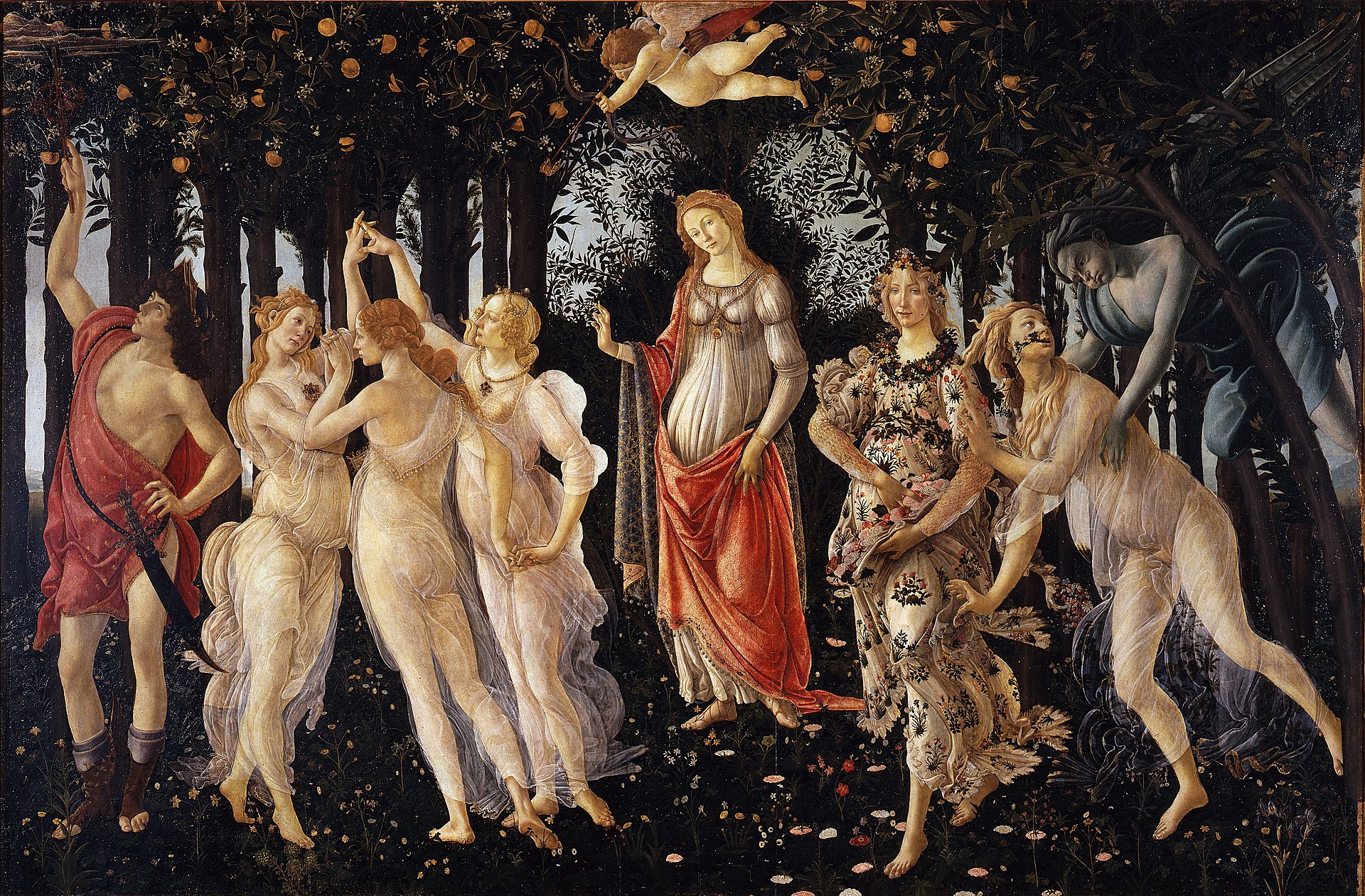
If The Birth of Venus is the painting that puts Botticelli on every tote bag, La Primavera is the one that puts him on every art history syllabus. It is older — painted around 1482, three years before the Birth — larger, denser, and harder. It has nine figures instead of four. It has no obvious narrative. It does not illustrate a single myth. Scholars have been arguing about its meaning since Vasari first described it in 1550, and they have not finished arguing yet.
This is the painting essay. The season the painting is set in. The story it tries to tell. The patron it was painted for. And why, more than half a millennium later, you can still walk into Room 10–14 of the Galleria degli Uffizi and feel the air go quiet in front of it.
What you are actually looking at
A grove of orange trees. Nine figures, lined up loosely across the foreground, in a band of about ten feet. From left to right, in the order most scholars now agree on:
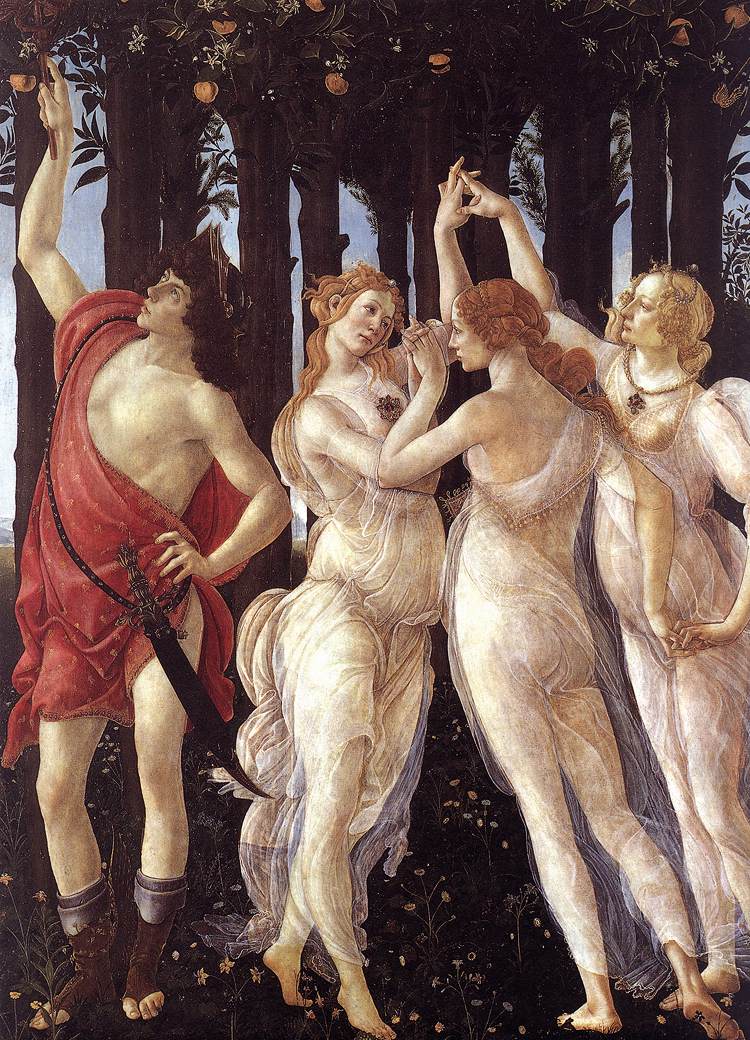
- Mercury, the messenger god, in a red cape with a sword at his hip and his caduceus (the staff with the two intertwined snakes) raised toward the trees, parting clouds that have just appeared above the grove.
- The Three Graces, three young women in nearly transparent white gowns, arranged in a circle, holding each other’s hands as they dance.
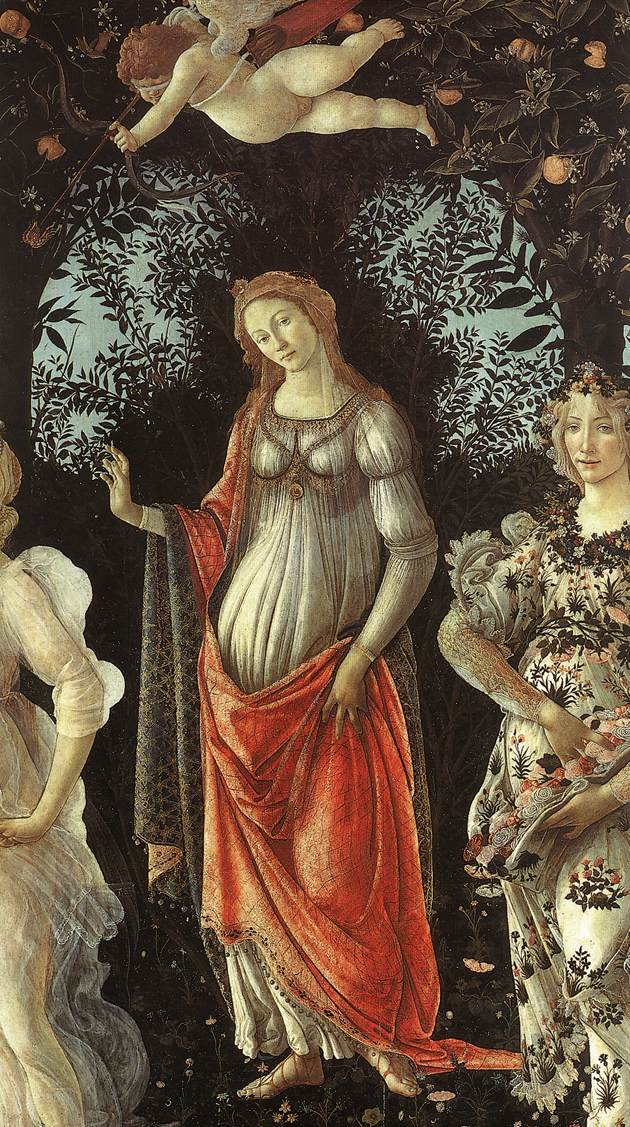
- Venus, slightly elevated above the others in the center, dressed in red, calm-faced, with her right hand raised.
- Above her: a blindfolded Cupid, drawing his bow and aiming an arrow at the central Grace.
- Flora, the goddess of flowering, in a flower-stamped dress, scattering roses from a fold in the cloth that she holds in front of her like an apron.
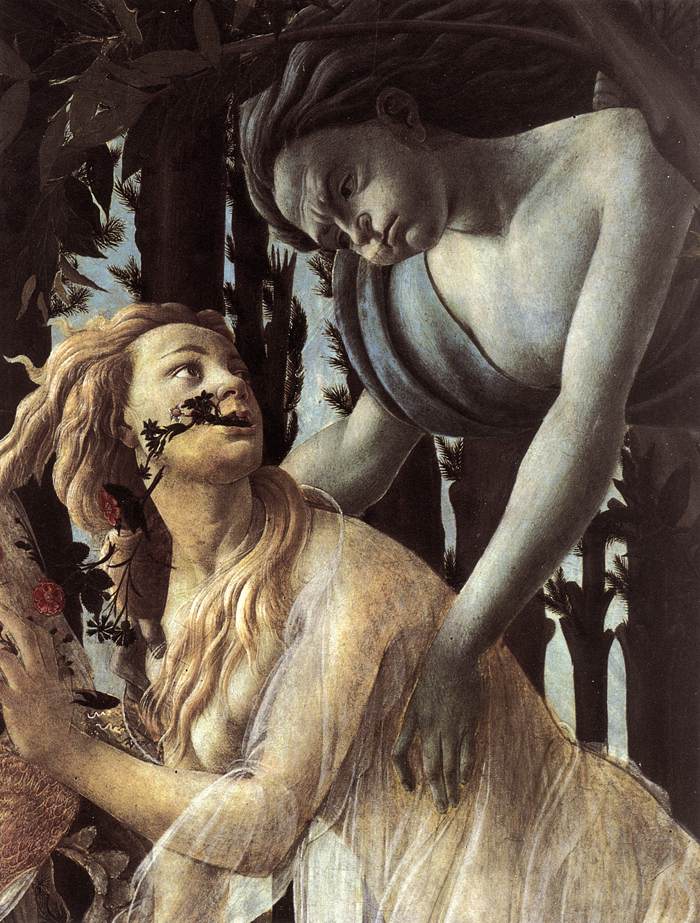
- Chloris, a nymph in a thin white dress, her body twisted away from the figure behind her, tendrils of vegetation already coming out of her mouth as she begins her transformation.
- Zephyr, the west wind, his cheeks distended, his blue body half-emerging from the trees on the far right, gripping Chloris from behind.
Three hundred and ninety different plants have been identified in the painting. Roses, irises, primroses, hyacinths, narcissus, daisies, periwinkles, cornflowers, jasmine, lilies of the valley, and on. The botanical accuracy is so high that the modern scholars who studied the species in the 1980s could date the painting to within a couple of weeks of early spring in Tuscany.
The grove is made of orange trees with golden fruit. The oranges are not random. They are the mala medica, “Medici fruit,” a heraldic emblem of the Medici family. The whole grove is a heraldic message: this grove belongs to the Medici, and the spring it sets is theirs.
The season
The painting’s title — Primavera, “Spring” in Italian — is not Botticelli’s. It comes from Vasari, who saw the painting around 1550 in the Medici villa at Castello and, in his Lives of the Artists, described it as showing “Venus, whom the Graces are adorning with flowers, signifying spring.” The label stuck. By the seventeenth century the painting was known throughout Florence as La Primavera.
The season is unmissable once you know what to look for. The narcissus blooming around Chloris’s feet are early-spring flowers in the Tuscan calendar. The orange trees are in fruit, which means late winter or very early spring. The clouds Mercury is parting are the cold gray clouds of the end of winter. Zephyr, the west wind, was the wind that classical writers said brought the spring. He is bringing it now.
This is not generic spring. It is a specific moment: the hinge between the last of winter and the first of the warm season, when the wind shifts, the orange grove fruits, and the flowers begin to bloom. The painting catches the world in that one second.
The story it tells (roughly)
The cleanest narrative reading of Primavera runs from right to left. This is unusual. Western painting almost always reads left to right, the way we read text. Botticelli reverses it.
On the right, Zephyr, the west wind, has just blown into the grove. He has caught hold of Chloris, a wood nymph, and is about to assault her. Chloris twists away. Vegetation begins to come out of her mouth. According to Ovid’s Fasti, written in the early first century AD, the rape of Chloris by Zephyr ends in her transformation: he marries her, gives her dominion over flowers, and she becomes the goddess Flora. Botticelli has painted both stages of the same figure. Chloris on the right, mid-transformation. Flora a step further left, fully transformed, scattering flowers from her gown.
In the center, Venus stands in her red mantle. She is the ruling presence of the grove. She is dressed in the costume of a contemporary Florentine bride. (The Medici household had several brides in the relevant years.) Above her, Cupid is blindfolded and aiming his arrow. Below the arrow, the Three Graces — Aglaia, Euphrosyne, Thalia, the three daughters of Zeus in Hesiod’s Theogony, though the names matter less than the choreography — dance.
On the far left, Mercury has stepped slightly out of the dance. He has lifted his caduceus to a small bank of dark clouds that has appeared above the orange trees. He is parting them. He is, the scholarly consensus suggests, banishing the last of winter.
So: Zephyr arrives, brings the first warm wind, and the rape and transformation of Chloris into Flora is the first event of the new season. Flora scatters flowers across the grove. Venus presides. The Graces dance. Cupid aims his arrow at the central Grace. Mercury, at the boundary between the grove and the sky, drives away the clouds.
It is a procession, in nine parts, of the arrival of spring.
Who painted it and when
Sandro Botticelli — born Alessandro di Mariano di Vanni Filipepi in Florence around 1445 — painted Primavera sometime between 1480 and 1482. The painting is tempera on wood panel. It is large: 203 by 314 centimeters, a little under seven by ten feet. It is one of the largest pre-1500 secular paintings in Europe.
By 1482, Botticelli was thirty-seven and at the peak of his career. He had just returned from Rome, where he had painted three frescoes in the Sistine Chapel for Pope Sixtus IV. He was the favored painter of the Medici circle, in close correspondence with the Florentine philosophers and poets — Marsilio Ficino, Pico della Mirandola, Angelo Poliziano — who orbited Lorenzo il Magnifico. He had a workshop. He had assistants. He was, by every measure of contemporary Florentine reputation, on top.
Primavera was the painting that proved his command of figure composition at the largest scale. The nine figures are arranged in a sophisticated rhythm, each in a different pose, each dressed differently, each in a different state — and they balance. The eye moves through them. Nothing falls out.
Who commissioned it
For most of the painting’s history, the assumption was that Primavera had been commissioned by Lorenzo il Magnifico, the de facto ruler of Florence. Vasari described it as hanging in the Medici villa at Castello, west of the city, alongside The Birth of Venus. But twentieth-century archival research has identified the actual patron more precisely.
The patron was Lorenzo di Pierfrancesco de’ Medici, a younger cousin of Lorenzo il Magnifico, born in 1463. Lorenzo di Pierfrancesco’s father had died young. He was being raised in the household of his older cousin, who treated him as a kind of intellectual ward. Primavera was probably commissioned around the time of his marriage to Semiramide Appiani in 1482, and may have been intended to hang in the Florentine townhouse of the couple, the Casa Vecchia, where it was first recorded by an inventory in 1499.
The painting was, in other words, a wedding gift, or a wedding-adjacent commission, for a young Medici cousin in his late teens. The Florentine humanist Angelo Poliziano was almost certainly the program designer. Poliziano had read Hesiod, Ovid, Lucretius, and the Neoplatonist commentators. He could have read all of them in the original Greek and Latin. Most modern scholars attribute the program — the choice of figures, the iconography, the right-to-left reading — to him.
A separate scholarly theory, advanced by Charles Dempsey in the 1970s and 1980s, argues that the painting was actually a wedding gift for the marriage of Semiramide’s relative Lorenzo Tornabuoni to Giovanna degli Albizzi in 1486. The Tornabuoni theory is well argued but outside the standard academic consensus, which sticks with the Lorenzo di Pierfrancesco-Appiani wedding. Either way: a Medici-adjacent wedding, in a young man’s house, with Venus presiding over the marriage bed.
The four figure-by-figure decisions
The painting is so full of figure-by-figure detail that an entire essay decoding each figure separately is the only way to do them justice. Here are the four most consequential reading decisions.
Why Venus is dressed as a bride
Venus, in the center, is not dressed as a goddess. She is dressed as a sixteenth-century Florentine bride. The red mantle, the white underdress with red trim, the hairstyle (the trinzale, with a single jewel at the forehead), are all the costume of a Florentine sposa. A viewer in 1482 would have read her as a married woman, not a goddess.
This is the painting’s central pun. The whole canvas is, on one level, a scene of pagan mythology — Venus surrounded by Cupid, Mercury, Flora, Zephyr, the Graces. On another level, it is the marriage allegory the painting was actually commissioned for. The bride’s room had Venus in it, and Venus was the bride.
Why Mercury is turning his back
Mercury, on the left, is the only figure not engaged with the others. The Graces dance in their circle. Venus presides. Flora scatters flowers. Zephyr seizes Chloris. Mercury stands slightly apart, his back angled away from the dance, and he reaches up with his caduceus to part the clouds.
The Neoplatonist reading: Mercury is the psychopomp, the soul-guide, who marks the boundary between the earthly grove and the heavens above. He is leading the soul out of the world of physical love (Venus, Flora, the Graces) into the world of celestial love (the cleared sky above). Lorenzo di Pierfrancesco, who was being trained by Marsilio Ficino in exactly this kind of philosophical exercise, was meant to look at Mercury every day and remember the move from earthly love to divine love.
Why Cupid is blindfolded
The blindfold is a quotation from Petrarch, who in the Trionfi described Cupid as blind, his arrows landing without regard for whom they hit. Cupid is aimed, in Primavera, at the central Grace. Some scholars say he is shooting Castitas (Chastity), the most modest of the three. The arrow about to land in her chest is what will turn her — by the inexorable logic of love — into Pulchritudo (Beauty), the second Grace, who in turn becomes Voluptas (Pleasure), the third. The dance is the cycle of erotic transformation, and Cupid is the random arrow that starts it.
Why the painting reads right to left
Ordinary Western reading is left to right. Primavera moves right to left: Zephyr arrives, Chloris becomes Flora, Flora scatters, the Graces dance, Mercury parts the clouds. The reversal is the painting’s most disorienting design choice. Most viewers experience it as a vague unease before they consciously notice it.
The reading is, again, Neoplatonist. The right side of the painting is the world of physical, animal, even violent love (Zephyr’s assault on Chloris). The left is the world of philosophical, intellectual, ascending love (Mercury parting the clouds). The painting moves from the body to the mind, from earth to sky. To read it correctly, your eye has to learn to move backwards.
The flowers
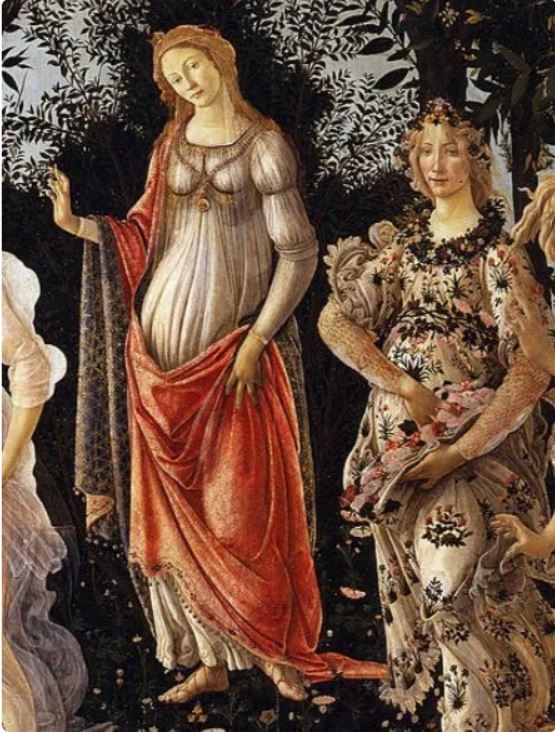
Botanists have been working on the flowers in Primavera for the better part of a hundred years. The most thorough study, by the Tuscan botanist Mirella Levi d’Ancona in the 1980s, identified about 190 species. (Some scholars now go higher.) Flowers are scattered across the entire foreground. They are blooming under the figures’ feet, draped across their gowns, flying in the air around Flora.
The flowers are not random. Most of them are flowers associated with marriage, with Venus, or with springtime in classical literature. The roses are sacred to Venus. The daisies are flowers of Flora. The cornflowers are sometimes associated with Roman bridal customs. The narcissus is the flower of the Greek nymph Echo. The hyacinth is the flower of the youth Hyacinthus, who was loved by Apollo. Each species, in the Neoplatonist iconographic system Poliziano was working in, is a coded reference.
The flowers are also pure beauty. You do not have to read them as code to be stopped by them. They are a riot of color in an otherwise dark, controlled, green and gold canvas. They are why the painting feels alive.
Why it has not stopped being argued about
Most great Renaissance paintings tell a single, identifiable story. The Last Supper. The School of Athens. Venus of Urbino. You can summarize them in a sentence.
Primavera cannot be summarized in a sentence. It is not a single myth. It is not a single allegory. It is, almost certainly, a deliberately layered construction, each figure carrying meanings on multiple registers at once: classical mythology, contemporary marriage symbolism, Neoplatonist philosophical allegory. Poliziano, the program designer, was the kind of scholar who could read the same image as Hesiodic, as Ovidian, as Ficinian, and as wedding allegory all at once, and write a Latin poem about each layer.
This is why scholars are still arguing. The painting is not unsolvable; it is over-solvable. Every reading is partly correct, and none of them exhaust it.
Chiaro walks through the right-to-left motion of the painting — Zephyr seizing Chloris, Chloris transforming into Flora, Flora scattering, the Graces dancing, Mercury parting the clouds — as one continuous flow of springtime moving across the canvas, so the painting reads as a single procession instead of a static line of figures.
Where to find it
La Primavera hangs in the Galleria degli Uffizi in Florence, in Room 10–14, the long Botticelli room. It is on one of the side walls, opposite The Birth of Venus. The room is the most visited in the museum. The two paintings face each other, with seating between them.
The light in the room is calibrated to read tempera on panel: cooler than the daylight you walked in from, more even, with a touch of warm overhead. Stand close. Step back. Stand close again. The painting changes scale based on distance. From three feet away you see the flowers and the gold leaf. From fifteen feet away you see the rhythm of the nine figures.
The Uffizi overview covers the rest of the museum and the first-timer’s walkthrough handles the route. If you only have time for one Botticelli essay, the figure-by-figure decode goes deeper into who each of the nine figures is and what each is doing.
The kicker
Walk in. Find the orange grove. Start on the right, with Zephyr’s blue cheek emerging from the trees. Move your eye left, against the way you read everything else. Watch Chloris become Flora, Flora scatter the flowers, the Graces dance, Mercury reach for the clouds. Six hundred years ago, in a young Medici cousin’s wedding chamber, somebody designed a painting that asked your eye to move backwards through the spring. It still does.
Image credits
- Botticelli-primavera.jpg — Sandro Botticelli (c. 1445-1510). Source, Public Domain.
- Primavera 03.jpg — Sandro Botticelli (Three Graces detail). Source, Public Domain.
- Primavera 02.jpg — Sandro Botticelli (Mercury detail). Source, Public Domain.
- Primavera 05.jpg — Sandro Botticelli (Venus and Cupid detail). Source, Public Domain.
- Botticelli’s Primavera - detail (Flora and Venus).jpg — Sandro Botticelli. Source, Public Domain.


.jpg)