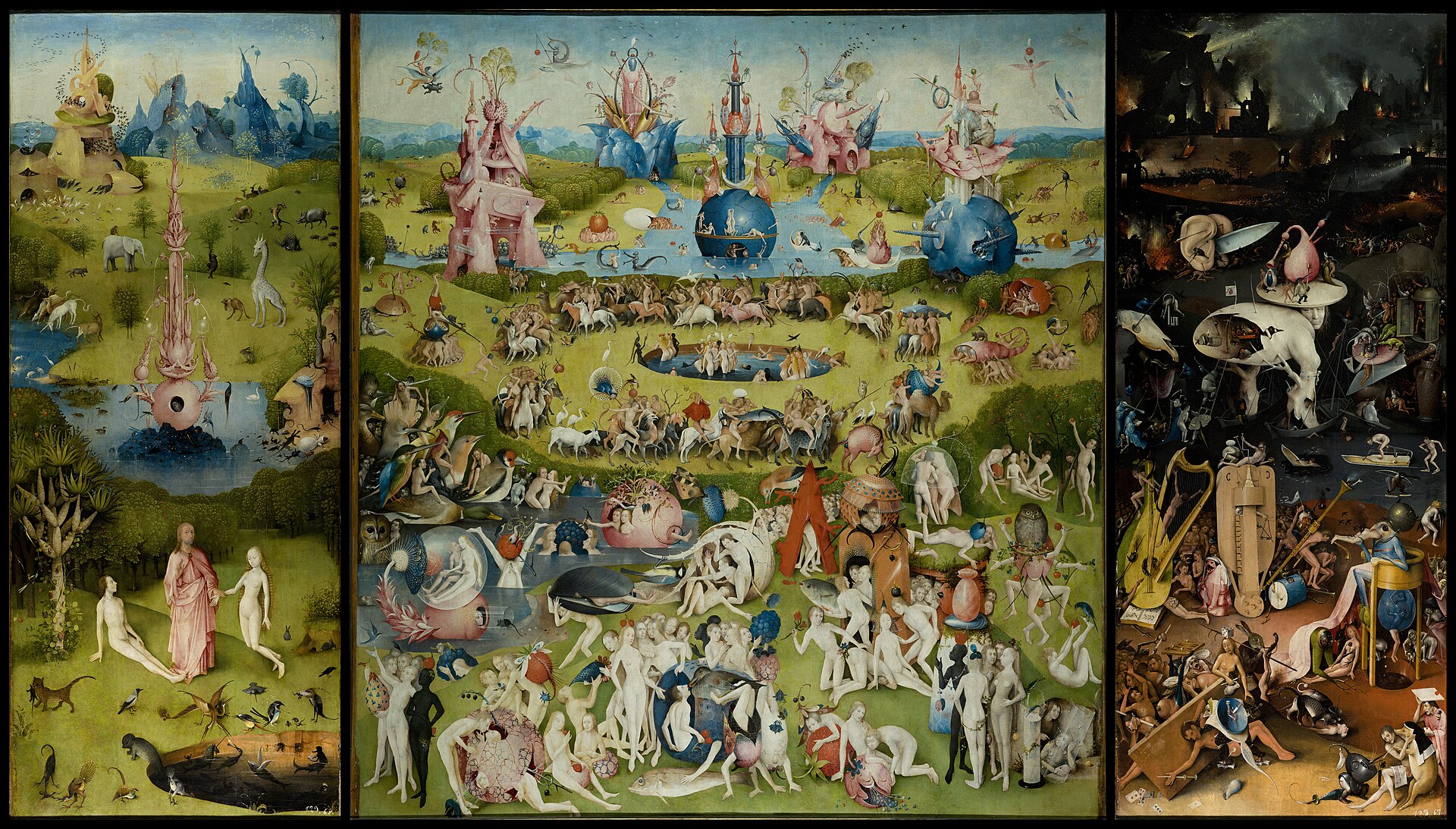
Around the year 1500, a painter in the Dutch town of ‘s-Hertogenbosch made a hinged wooden altarpiece roughly seven feet tall and thirteen feet wide when open, and filled it with hundreds of naked people, giant strawberries, transparent bubbles, a man with a flower stuck in his backside, an owl, a man wearing an eggshell whose torso is a hollow tavern with people drinking inside it, and a pair of ears the size of a house impaled on a knife. It hangs in Room 56A of the Prado in Madrid, behind glass, and it has been baffling everyone who looks at it for five hundred years. What is The Garden of Earthly Delights about? Nobody knows. That is not a figure of speech. There is no surviving document from Bosch’s lifetime explaining it, no contract, no letter, no record of who ordered it, and every interpretation since has been a guess dressed in scholarship.
This is the most famous unsolved painting in the world, and the reason to stand in front of it is not to be told the answer but to watch how much invention one human being packed into a single object. The painter signed his work Jheronimus Bosch, after his town, though he was born Jheronimus van Aken. He almost never dated anything, kept no studio diary that survives, and left a body of work so unlike anything before or after it that he reads, from this distance, like a man who received a transmission no one else got.
A picture that opens
The Garden is a triptych, which means it has a central panel and two hinged wings that fold shut over it like cupboard doors. This was the standard format for an altarpiece, a devotional object that would sit on or behind an altar, opened for feast days and closed the rest of the time. Bosch took the holiest format in Christian painting and filled it with the least holy content imaginable, which is the first of the painting’s many provocations. When you stand before it at the Prado you see it open, all three panels at once, but it was built to be experienced in two states, and the closed state is where the story starts.
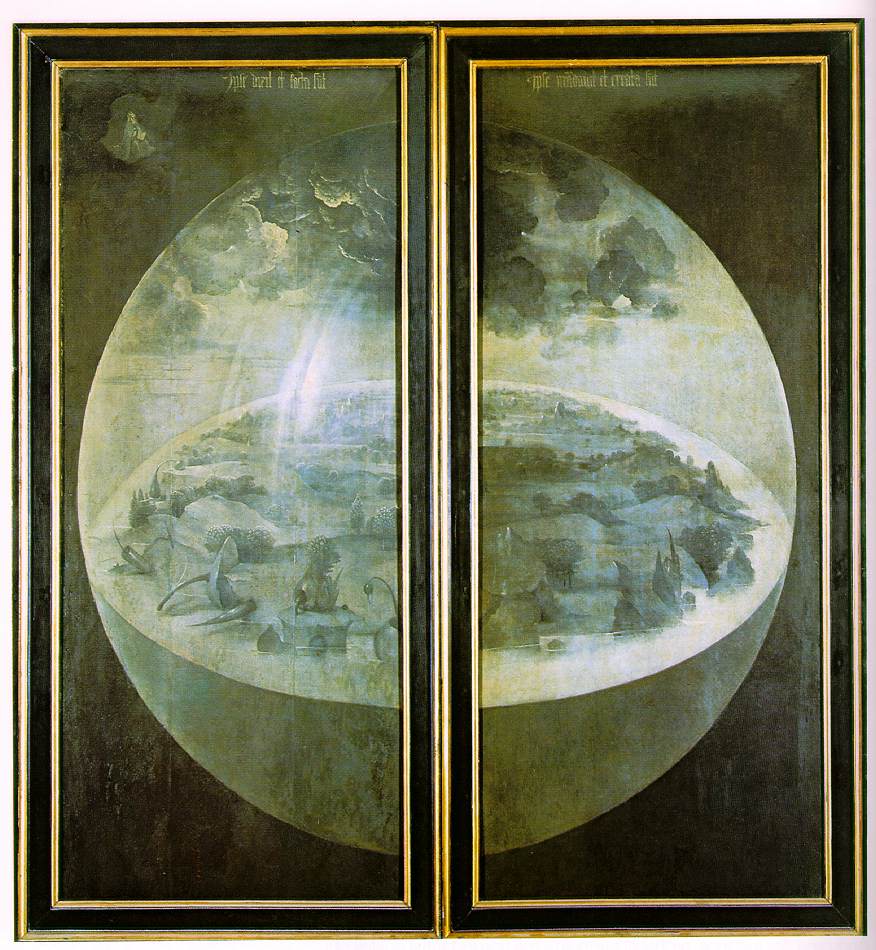
Closed, the outer faces of the two wings combine into a single image: the flat earth on the third day of Creation, before the sun and moon were made, before animals, before people, rendered in grisaille, a near-monochrome gray-green. The whole world floats inside a transparent crystal sphere, like a specimen in glass, and in the upper left corner a tiny figure of God the Father sits with a book, watching. An inscription runs across the top in Latin: “For he spoke, and it was done; he commanded, and it stood fast.” So the painting begins in austerity and silence, the cold gray planet under God’s eye. Then you open the doors, and color and chaos explode out, and the question of how we got from that quiet sphere to this carnival is the whole drama of the object.
Left panel: paradise, with a warning already in it
The left wing is Eden. God, here a young Christ-like figure, presents Eve to a freshly created Adam in a green landscape with a strange pink fountain at the center, the Fountain of Life. At first glance it is paradise. Look closer and it is already going wrong. The pool around the fountain swarms with the early ancestors of the chaos to come, a cat trots off with a dead mouse in its jaws, a lion devours a deer, a three-headed bird wades in the water, and bizarre hybrid creatures crawl out of the dark pond at the bottom. Bosch’s Eden is not a clean before-the-fall paradise. It is a garden in which predation and the grotesque are already present, as if corruption were baked into creation from the start.
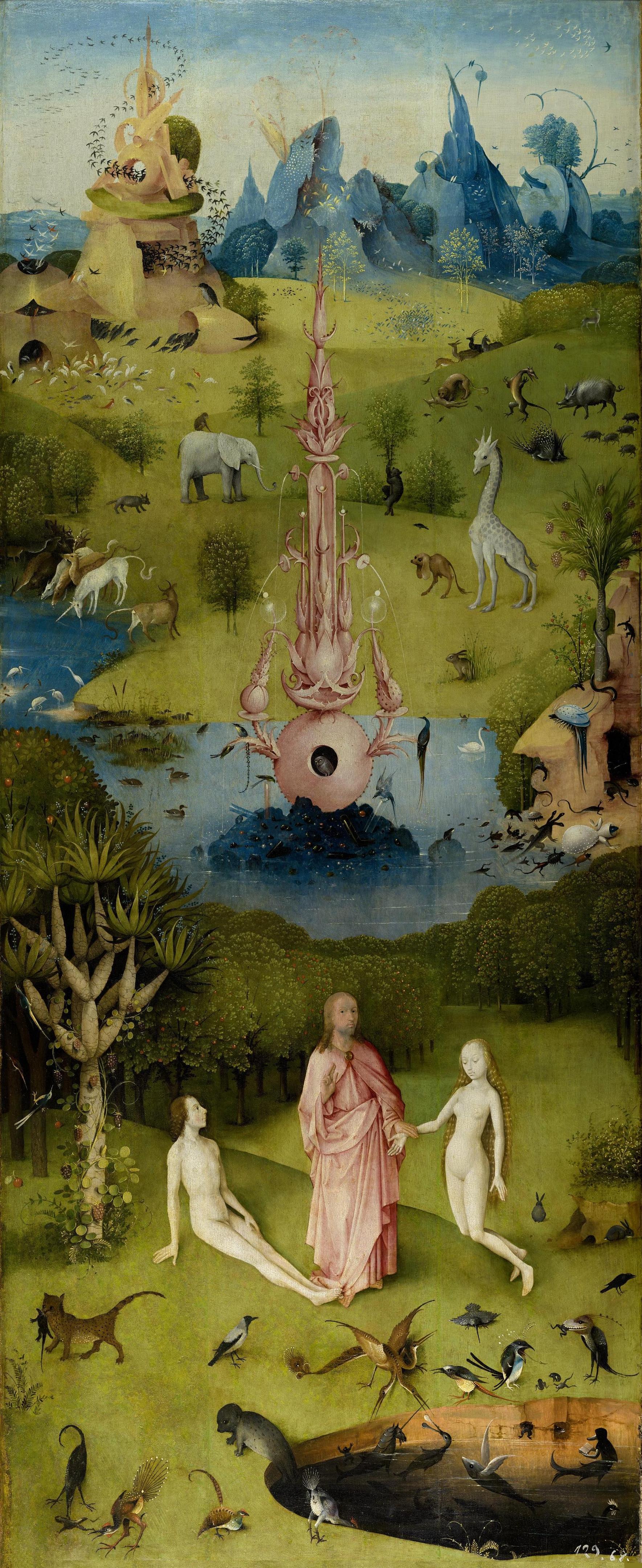
This is the detail that warns you not to trust the obvious reading. If the left panel is innocence, why is it full of killing and monsters? Bosch refuses to give you the clean moral arc, paradise then sin then punishment, that the triptych format promises. The fall is already implied in the garden, which means the central panel is not a departure from Eden so much as Eden’s logical continuation.
Central panel: the part everyone comes for
The middle panel is the largest and the one that gave the painting its name, a wide green park swarming with hundreds of small pale naked figures doing things that are hard to categorize. They ride a circular parade of animals, deer, goats, horses, a unicorn, around a central pool of bathing women. They climb inside and out of giant fruits. They cluster around enormous berries and birds many times human size, a man feeding a strawberry to a companion, couples sealed inside transparent bubbles and the shells of mussels, a person doing a headstand with flowers blooming from the body. There is no violence here and no clothing, and crucially, no children, no old people, no work, no consequence. It is an endless erotic playground populated entirely by young adults, frozen at the peak of pleasure with nothing before and nothing after.
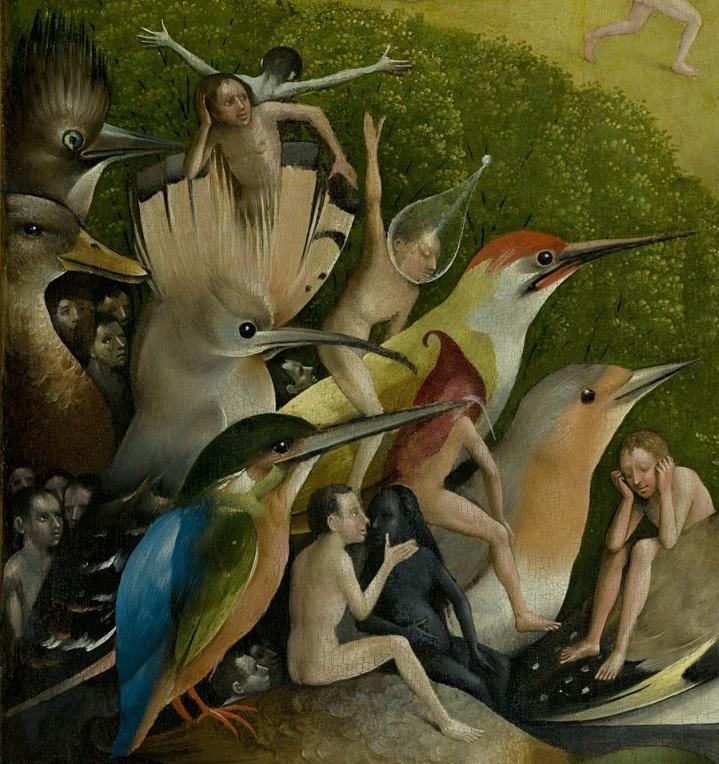
For four centuries the standard reading was that this is a warning, a lurid picture of the sin of lust meant to scare a viewer into virtue, the strawberries and bubbles symbols of how pleasure is sweet, fragile, and gone in a moment. There is a tradition that the strawberry was understood as the fruit of fleeting delight, and Bosch’s contemporaries are recorded calling the work, decades after his death, the painting of the strawberries. But a minority of scholars have argued the opposite, that this is not condemnation at all but a vision of a lost or alternative paradise, an image of innocent sexuality before shame, painted by a man whose religious views may have been less orthodox than the church around him. The honest position is that the painting will not resolve. It hovers between celebration and warning, and Bosch built it to hover.
Right panel: hell, and the man who heard it coming
Then you reach the right wing, and the temperature drops. This is hell, and it is the darkest and most original vision of damnation in Western art, a black nighttime landscape lit by a burning city in the distance, where the sinners of the central panel are now tortured by the instruments of their own pleasures. Gambling becomes torment, a man is crucified on a harp, a choir of the damned sings from a musical score tattooed across a naked backside, ears the size of doors roll forward crushing people, impaled on a long knife. At the center sits the so-called Tree-Man, a broken eggshell body on rotting tree-trunk legs, his hollow torso a tavern, his face turning back to look at the viewer with an expression of weary recognition. Many scholars believe that face is Bosch’s self-portrait, the painter placing himself at the heart of his own hell.
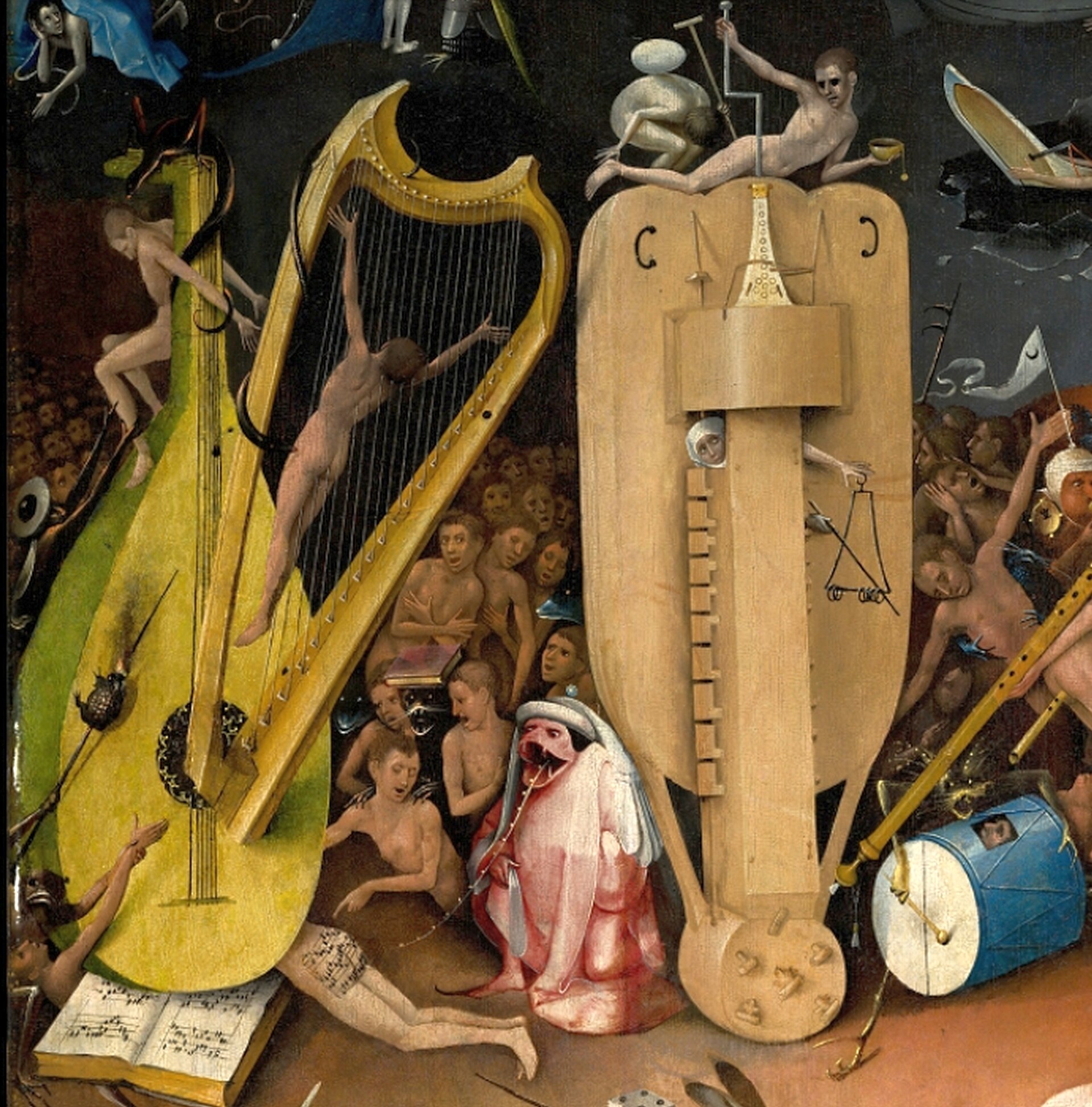
The genius of Bosch’s hell is that it is specific. Generic medieval hells are red and full of generic flames and pitchforks. Bosch’s is cold, dark, and personalized, every torture matched to a sin, every instrument of pleasure turned to pain. This is where the wait-really moments cluster, the harp-crucifixion, the butt-music so precisely notated that musicians have transcribed and recorded it as an actual playable tune, the giant ears. It is the panel that earned Bosch his reputation as the first great painter of the nightmare, the man the Surrealists claimed four hundred years later as their ancestor.
How a Dutch nightmare ended up in Madrid
Bosch worked in the Low Countries and died in 1516, and his strange, sin-obsessed pictures might have stayed regional curiosities if not for one obsessive collector: King Philip II of Spain. Philip, the same austere, devout monarch who built the gloomy palace-monastery of El Escorial, was a fanatical admirer of Bosch, which is one of the great surprises of art history, the most rigid Catholic king in Europe falling for the wildest, most heterodox painter of the previous century. Philip acquired The Garden of Earthly Delights in 1591, after it had passed through the collection of the Spanish nobility in the Netherlands, and installed it among his treasures. Through the Spanish royal collection it eventually came to the Prado in 1939. The reason the world’s strangest painting hangs in Madrid is that a Spanish king could not stop looking at it, the same royal appetite for collecting that filled the museum with Titian, Velazquez, and Goya.
Why nobody can explain it
The deepest problem with the Garden is that the people who should have explained it are silent. Bosch left no writings. The patron is unknown, though scholars have proposed it was made for a noble family rather than an actual church altar, which would explain the un-churchly content. There is no surviving moral program, no accompanying text, no contract specifying the subject. The earliest commentators, writing decades after Bosch’s death, already disagreed about what it meant. Every reading since, lust-warning, lost-paradise, alchemical allegory, heretical sect manifesto, has been built on internal evidence and educated guessing, because the external evidence does not exist. The painting is a sealed message with no key.
This is exactly why it rewards standing in front of. A painting you can fully explain you can leave after reading the wall label. The Garden gives you nothing to settle on, so you keep looking, and the longer you look the more you find, a different small drama in every square foot, a figure you missed, a creature you cannot name. Chiaro reads out the closed-shutter Creation, the strawberry symbolism, the Tree-Man self-portrait, and the music written on the body in hell, right in front of the panel, so the details you need a guide to notice get pointed out while you are standing where you can see them.
What to look for
If you have only ten minutes, look at it in this order. First, imagine the doors closed, the gray world in the glass sphere, and remember that everything you are about to see grew out of that silence. Then read the three panels left to right as time, Eden, the garden of pleasure, hell, and notice that the moral arc never quite holds, that paradise already has monsters and hell is made from the toys of the middle panel. Find the Tree-Man in hell and meet his backward glance, possibly the painter’s own face. Find the music on the body and remember someone has played it aloud. Then step back and accept that you will leave without an explanation, because five hundred years of scholars have too. That is not the painting failing to communicate. That is the painting doing exactly what it was built to do, which is to never let you finish looking.
To see Bosch among the rest of the collection a Spanish king assembled, the highlights tour in what to see at the Prado places the Garden alongside Goya’s nightmares and Titian’s emperors, and the Prado visiting guide tells you how to find Room 56A without getting lost.