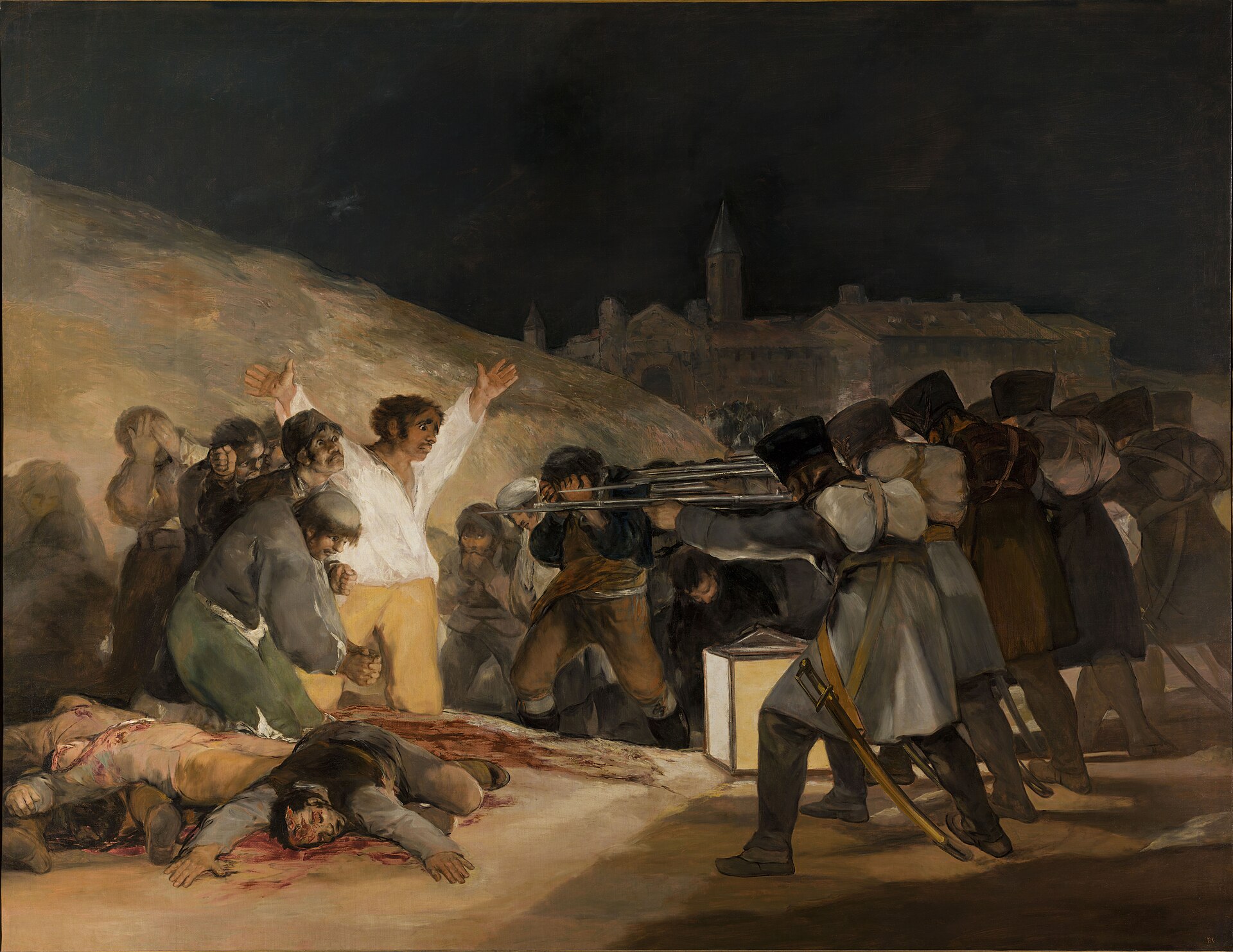
In the dark, a row of soldiers stands with their backs to us, rifles raised in a single horizontal line, faces hidden. In front of them a heap of bodies bleeds into the dirt. And at the center, lit by a square lantern on the ground, a man in a white shirt and yellow trousers kneels with his arms flung wide, staring straight down the gun barrels, his mouth open. He has a wound in his right palm. The whole painting is built to make you look at him and then at the guns and understand that in the next second he will be dead. This is The Third of May 1808, painted by Francisco de Goya in 1814, and it is the picture that taught the rest of art how to paint war as horror instead of glory. It hangs in Room 64 of the Prado in Madrid, beside its companion piece, and it is one of the most influential paintings ever made.
Before Goya, the standard way to paint a battle was to paint a victory: a general on a rearing horse, a flag, a noble death in a heroic pose, the whole thing arranged to make war look like the highest human activity. Goya threw all of that out. He painted the losers. He painted anonymous civilians being shot in the dark by a machine of soldiers with no faces, and he made the victim a nobody in a peasant’s shirt rather than a hero, and he gave that nobody a pose borrowed from the crucified Christ. The Third of May 1808 is the moment European art stopped lying about what war looks like.
What happened on the second and third of May
The painting records two real days in Madrid. In 1808 Napoleon’s army had occupied Spain under the pretense of an alliance, and on May 2 the people of Madrid rose up against the French troops in the streets, a spontaneous popular revolt. The fighting was brutal and brief. The next day, May 3, the French commander Marshal Murat ordered mass reprisals. Through the night and into the morning, French firing squads rounded up hundreds of Spaniards, many of them ordinary citizens caught with weapons or simply suspected, and executed them on the hills outside the city, including the hill of Principe Pio where this scene is set. The uprising and its bloody suppression became the founding trauma of the Spanish War of Independence, the years of guerrilla warfare, the word guerrilla, little war, was coined in this conflict, that eventually drove the French out.
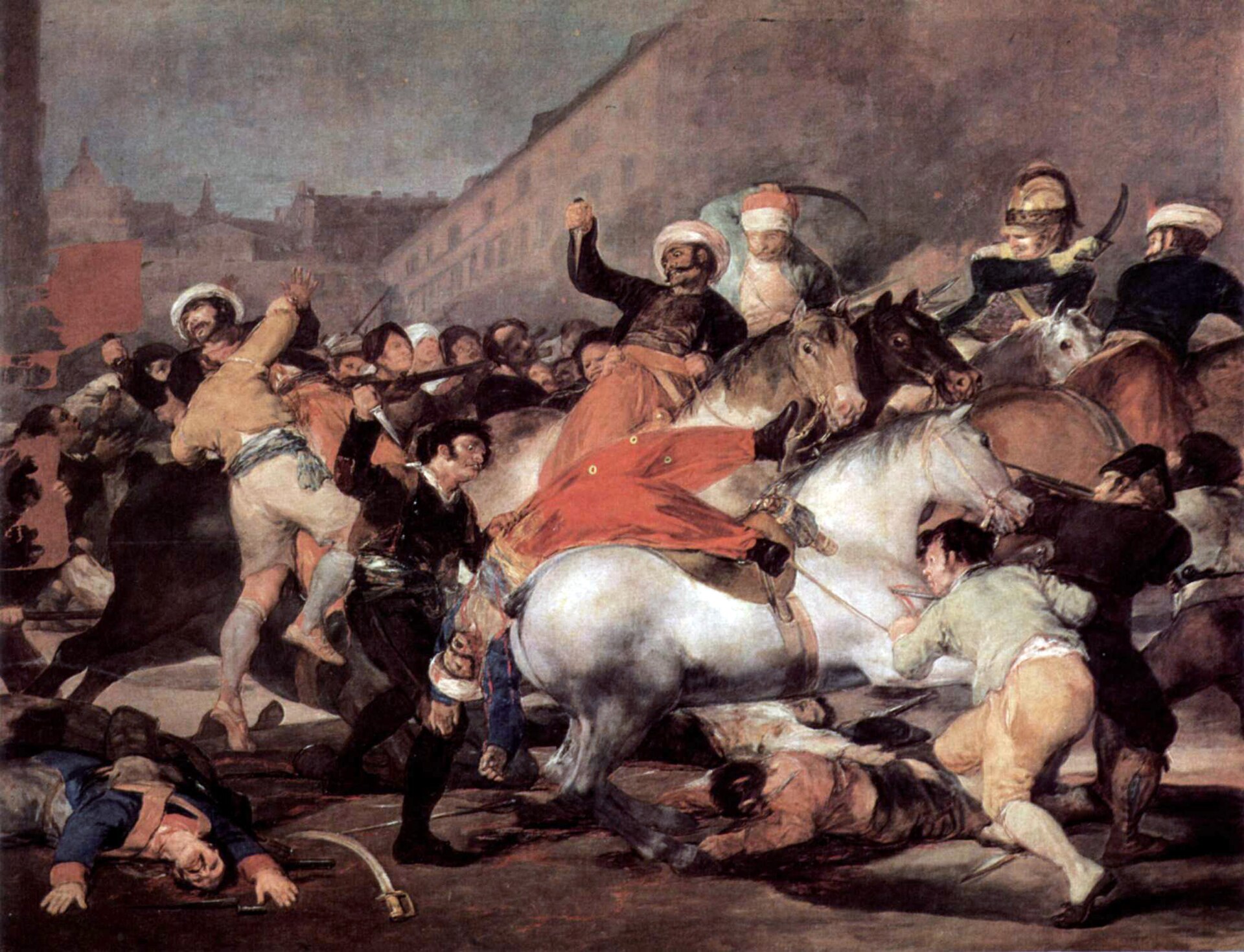
Goya painted both days as a pair. The Second of May 1808 shows the uprising itself, a chaotic swirl of Madrileno civilians dragging Napoleon’s Mamluk cavalry, his Egyptian troops, off their horses in a knot of knives and rearing animals. It is loud, confused, and full of motion. The Third of May is its silent, terrible answer, the morning after, when the chaos has been replaced by the cold machinery of execution. Hung together as they are at the Prado, they read as cause and consequence, the rage of the people and the price the people paid.
Why the man in the white shirt changed everything
Look at the central figure. He kneels with both arms thrown up and out, palms forward, and in the lit right palm there is a dark mark, a wound. This is not an accident. Goya has posed an anonymous Spanish laborer in the attitude of the crucified Christ, complete with a stigmata-like wound, and lit him so brightly with the lantern that he glows against the brown dark like a saint in an altarpiece. By giving a nameless victim the iconography reserved for the most sacred death in Christian art, Goya makes a claim that was genuinely new: that the death of an ordinary, unimportant person, shot in the dark by an occupying army, is as worthy of awe and grief as the death of a god. The victim has no name and no rank. That is the point. He is everyone the firing squads killed, and Goya insists he matters absolutely.
Around him the other victims complete the message. To his left a man clenches his fists and lowers his head. A monk prays. A man covers his face with his hands so he will not have to watch. At the kneeling man’s feet lies a corpse already shot, face down in a spreading pool of blood, arms still flung wide in an echo of the living man’s pose, a preview of the next second. Behind, a line of more prisoners stumbles up the hill toward the same fate, one of them already hiding his eyes. Goya gives the victims individuality, fear, prayer, defiance, despair. He gives the soldiers none.
The faceless machine
The most radical decision in the painting is what Goya does to the firing squad. He paints them from behind, as a single dark mass, identical hats, identical packs, identical raised rifles forming one unbroken horizontal line, their faces entirely hidden. They are not men. They are a mechanism. This was a deliberate inversion of every battle painting that came before, in which the soldiers of the painter’s own side were the heroes with the visible noble faces. Goya makes the killers anonymous and the killed individual, and in doing so he locates all the humanity on one side of the lantern and all the inhumanity on the other. The diagonal of the rifles and the diagonal of the hillside drive your eye straight to the white shirt, so that no matter where you start looking, the composition delivers you to the man about to die.
There is no glory anywhere in the picture. The light source is not heaven but a boxy iron lantern sitting on the ground, a piece of military equipment, throwing a hard practical light on an act of state murder. The city of Madrid is a black silhouette of towers in the far background, asleep, indifferent. The dirt is churned. This is the first painting to look at war and see only its cruelty, with no compensating nobility offered to soften it, and almost every honest war image since, Manet’s executions, Picasso’s Guernica which hangs across town at the Reina Sofia, the photographs of every modern conflict, descends from it.
Painted six years late, and what that cost Goya
Goya did not paint these in 1808. He painted them in 1814, six years after the events, immediately after the French were finally expelled and the Spanish king Ferdinand VII was restored to the throne. Goya, who had been court painter under the previous king and had kept working through the French occupation, petitioned the new government for funds to paint, in his words, the most notable and heroic actions of the glorious insurrection against the tyrant of Europe. The two May paintings were the result. There is some ambiguity about Goya’s own loyalties during the occupation, he was a man who served whichever power held Madrid, and some read the 1814 paintings partly as a public proof of patriotism by a painter who needed to demonstrate it. None of that diminishes the work. Whatever mix of conviction and self-protection drove him, what he produced was the opposite of propaganda, because propaganda glorifies and this only mourns.
What happened to the paintings afterward is telling. For most of the nineteenth century The Third of May was barely shown, considered too raw, too ugly, too disturbing for public display, and it spent years in storage and was reportedly damaged, possibly during transport in the Spanish Civil War, which is why close inspection reveals areas of loss. It took decades for the art world to understand that Goya had not painted a failed history picture but a new kind of picture entirely.
The dark room next door
The Third of May is the gateway to the most disturbing part of the Prado, the Black Paintings. In his old age, deaf, ill, and bitter, Goya covered the interior walls of his own farmhouse outside Madrid with fourteen private murals in black, brown, and blood tones, images he never exhibited and apparently painted only for himself. They were later transferred to canvas and given to the Prado, where they hang in Room 67. The most famous is Saturn Devouring His Son, the god of time cramming the bloody body of his own child into his mouth with wild, terrified eyes, a vision of pure horror with no narrative comfort at all.
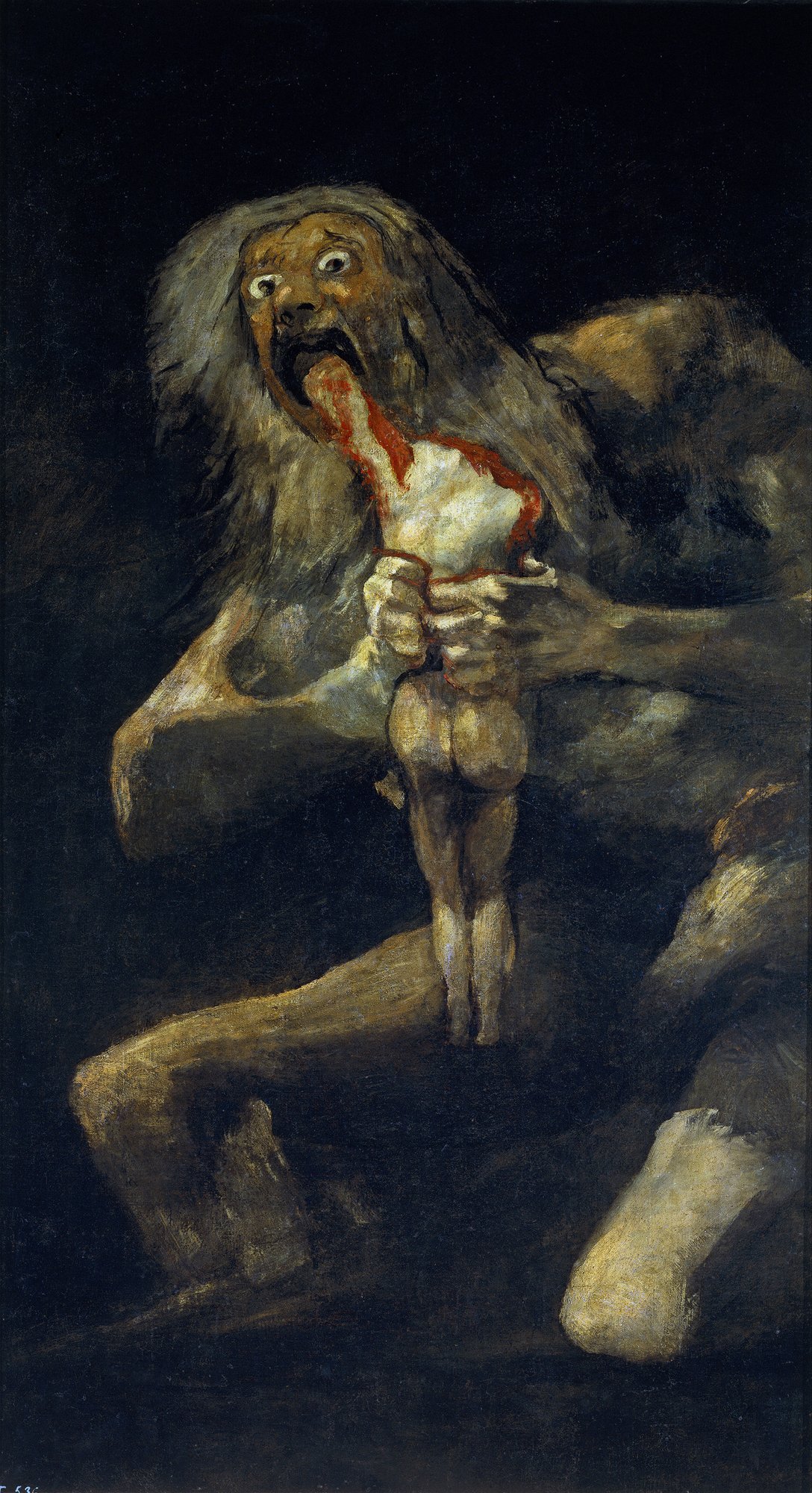
The line from The Third of May to Saturn is direct. Both come from a man who had watched his country tear itself apart, who had documented the atrocities of the war in a private series of etchings called The Disasters of War, and who had concluded that human violence had no bottom. The firing squad and the child-eating god are the same vision in two registers, public and private. Standing in front of both at the Prado, in adjacent rooms, is the closest you can come to the inside of Goya’s mind in his last decade.
What to look for
Start with the lantern, because it is the engine of the whole picture, and notice that the only light in this scene comes from a piece of military hardware on the ground, not from any sky. Follow the light to the white shirt and find the wound in the right palm, then recognize the pose. Look at the corpse at his feet and see your own future in it, arms already thrown wide, face already in the dirt. Then turn to the soldiers and try to find a single face. You cannot. Last, look at the line of prisoners climbing the hill behind, each one a man who will stand where the white shirt stands within minutes, and understand that Goya has painted not a moment but an assembly line. Chiaro reads out the Christ pose, the stigmata, the faceless squad, and the lantern in front of the canvas itself, so the details that make this the first modern war painting get pointed out while you are standing where you can see them.
To place Goya among the painters a line of Spanish kings collected, the highlights tour in what to see at the Prado sets The Third of May beside Bosch’s hell and Titian’s emperor, and the Prado visiting guide explains how to find the Goya rooms and the Black Paintings without missing them.