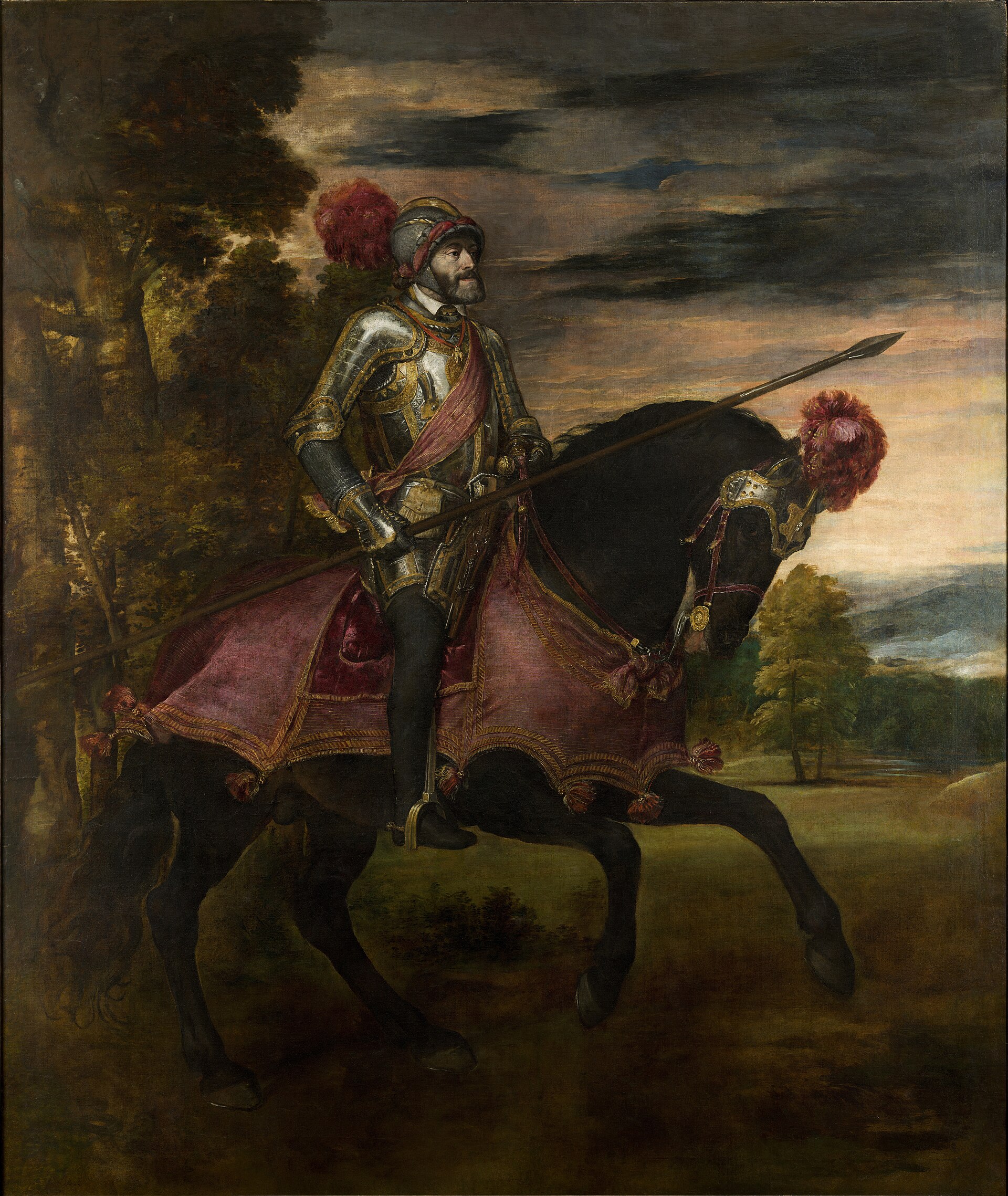
A man in black-and-gold armor rides a dark horse out of a wood at dawn, alone, holding a lance, against a sky streaked with the red of either sunrise or recent fire. There is no army around him, no battle behind him, no enemy in sight. There is just the rider, the horse, the long red sash of a commander, and the light. The man is Charles V, Holy Roman Emperor, King of Spain, ruler of the Netherlands, of Naples, of an empire in the Americas so large that it was said the sun never set on it, the single most powerful human being in the world in 1548. The painter is Titian, the greatest portraitist alive. The painting is the Equestrian Portrait of Charles V at Muhlberg, it hangs in Room 27 of the Prado in Madrid, and it is the picture that invented the image of the ruler on horseback as the symbol of command itself.
Every later painting of a king or general triumphant on a rearing horse, every bronze equestrian statue in every European capital, every propaganda image of a leader astride a mount, descends from this one canvas. Titian did not invent the equestrian portrait from nothing, the Roman emperors had themselves cast in bronze on horseback, and Renaissance artists had drawn riders, but Titian fused the imperial Roman tradition with the new psychological depth of oil painting and produced the template that the next four centuries copied. To stand in front of it at the Prado is to stand at the source of a visual cliche so total that it is hard to remember someone had to make it first.
The battle that was barely a battle
The painting commemorates a real event, the Battle of Muhlberg, fought on April 24, 1547, on the river Elbe in Germany. Charles V, a devout Catholic, was at war with the Schmalkaldic League, an alliance of German Protestant princes who had broken with Rome in the wake of Luther’s Reformation. At Muhlberg his imperial army crossed the river and crushed the Protestant forces decisively, capturing their leader. It was the high point of Charles’s long struggle to hold his sprawling, religiously fracturing empire together, the moment the Catholic emperor appeared to have won.
The catch is that Charles, who suffered terribly from gout, was so ill at the time that he could barely sit a horse and may have been carried to parts of the field in a litter. The lone heroic warrior of the painting is, historically, a sick fifty-seven-year-old man in pain. Titian knew this, and the painting is all the more interesting for it, because what he produced is not a record of how Charles actually appeared at the battle but an idealized image of imperial authority, the emperor as he wished to be seen, eternal, solitary, in control. The gap between the gouty reality and the dawn-lit myth is the whole genius of the commission. Titian was not painting a battle report. He was painting power.
What Titian leaves out
The most sophisticated thing about the painting is its emptiness. There is no battle. Look as hard as you like and you will find no clash of armies, no fallen enemies, no fortress, no flags of the defeated. Other artists would have crammed the canvas with the spectacle of victory. Titian removes all of it and gives you only the rider, alone, emerging from the trees in the cold early light. The solitude is the message. Charles does not need an army in the frame, because he is the empire. The single armored figure against the wide sky carries more authority than any crowd of soldiers could, precisely because nothing competes with him for your attention.
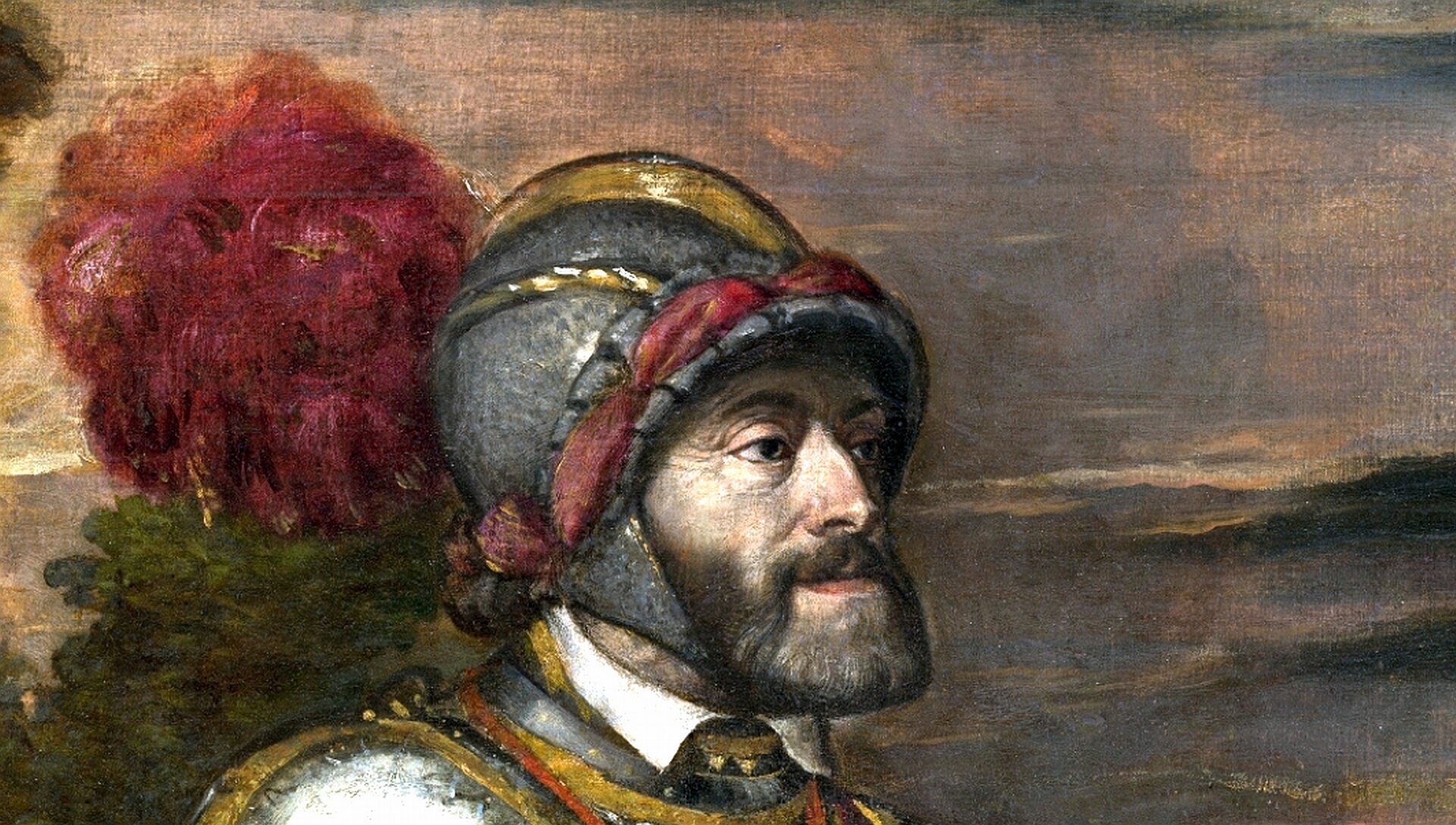
Then look at the face, because Titian does not idealize it the way he idealizes the situation. The emperor’s famous Habsburg jaw, the protruding lower lip and lengthened chin produced by generations of dynastic intermarriage, is clearly there. So is the weariness. This is not a young hero’s face. It is a tired, aging man’s face under the gleaming helmet, and Titian, who had painted Charles many times and was trusted by him as no other artist was, did not flatter it into youth. The combination is what makes the picture great: the body and the setting are mythic, timeless, godlike, while the face is a real, specific, exhausted human being. Titian gives you the institution and the man at once.
The armor, the light, and the red
Charles wears the actual parade armor he owned, black steel chased with gold, and it still survives in the Royal Armoury in Madrid, a few minutes from where the painting hangs, so you can see the real object Titian painted. Across it runs a wide crimson sash, the sash of a Catholic commander, and the same red bleeds into the sky behind him. That sky is the painting’s quiet masterstroke. Is it dawn, the light of a new day breaking over a victorious empire? Or is it the red of the fires of war, the smoke of the battle just fought? Titian leaves it deliberately unresolved, so the emperor rides forever between sunrise and conflagration, between hope and violence, the ambiguity holding the whole religious meaning of the war in suspension.
The horse matters too. It is not rearing, not galloping, not theatrical. It walks forward at a steady, controlled pace, head slightly bowed, completely under the rider’s command, an image of power that does not need to perform itself. A lesser painter would have made the horse rear to show drama. Titian makes it walk, because a man who can move at his own pace through the world is more powerful than a man whose horse is out of control. Every detail is calibrated to say the same thing in a different register: this man is in command of everything, including the moment.
Why the most powerful man in Europe is in a museum in Madrid
Charles V was King of Spain, and the painting passed down through the Spanish royal collection, which is the foundation of the Prado. Charles abdicated in 1556, exhausted by decades of trying to govern an empire too large to govern, split his realms between his brother and his son, and retired to a monastery in Spain to die. His son, Philip II, inherited Spain, the Netherlands, the Americas, and his father’s art collection, including this portrait and a whole series of works Titian made for the Habsburgs over decades. The Spanish Habsburgs were Titian’s greatest patrons, and the Prado holds the finest collection of his work anywhere because the family that ruled Spain spent a century buying him. When the royal collection became a public museum in 1819, the emperor on his horse came with it. The same dynastic appetite for collecting brought Bosch’s hell and Durer’s self-portrait into the same building.
The template that ate the world
The proof of the painting’s power is how completely it was copied. When Velazquez became court painter to Charles’s great-grandson a century later, he painted his own equestrian portraits of the Spanish royal family in conscious dialogue with Titian’s model, and they hang nearby in the Prado. Rubens copied the Muhlberg portrait. So did Van Dyck when he painted Charles I of England on horseback. Rembrandt, David painting Napoleon crossing the Alps, the bronze generals on plinths in a hundred city squares, all of it traces back to the lone armored rider in the dawn light. Titian created the grammar of how to make a ruler look like destiny, and rulers have been ordering pictures of themselves in that grammar ever since.
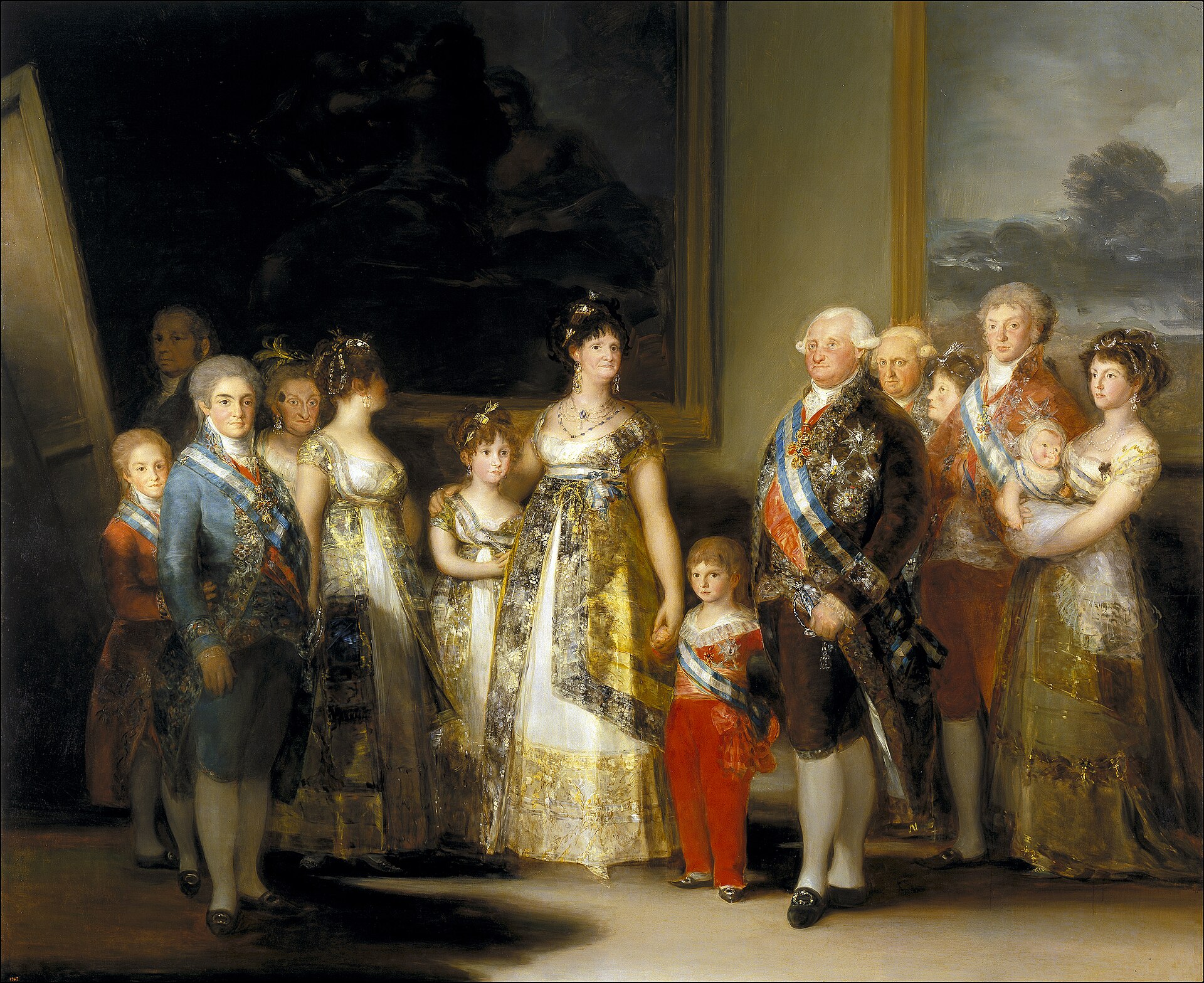
It is worth seeing Titian’s emperor next to a later Spanish royal portrait to feel the difference. Goya’s Family of Charles IV, painted two and a half centuries later and also in the Prado, shows the Spanish royal family of 1800 lined up in finery, and Goya, famously, did not flatter them, the king looks vacant, the queen hard and vain. Where Titian built a myth around a tired man and made him eternal, Goya stripped the myth off his monarchs and showed them as ordinary, even unimpressive, people. The two paintings bracket the history of the royal portrait: Titian inventing the heroic image of the ruler, and Goya, at the end of the line, quietly taking it apart.
What to look for
Begin with what is missing, the army, the enemy, the battle, and feel how the emptiness concentrates everything onto the single rider. Then look at the sky and decide for yourself whether it is dawn or fire, knowing Titian wanted you unable to settle it. Move to the face and find the Habsburg jaw and the exhaustion, the real man inside the myth. Watch the horse and notice it is walking, not rearing, command without theater. Last, remember that the armor is a real object you can go see down the street, and that the sick, gouty man who wore it ruled more of the earth than anyone alive. Chiaro reads out the missing battle, the dawn-or-fire sky, the Habsburg face, and the controlled horse in front of the canvas itself, so the choices Titian made get pointed out while you are standing where you can see them.
To set Titian among the works a line of Spanish kings assembled, the highlights tour in what to see at the Prado places the emperor beside Goya’s executions and Velazquez’s Las Meninas, and the Prado visiting guide shows you how to find the Titian rooms.