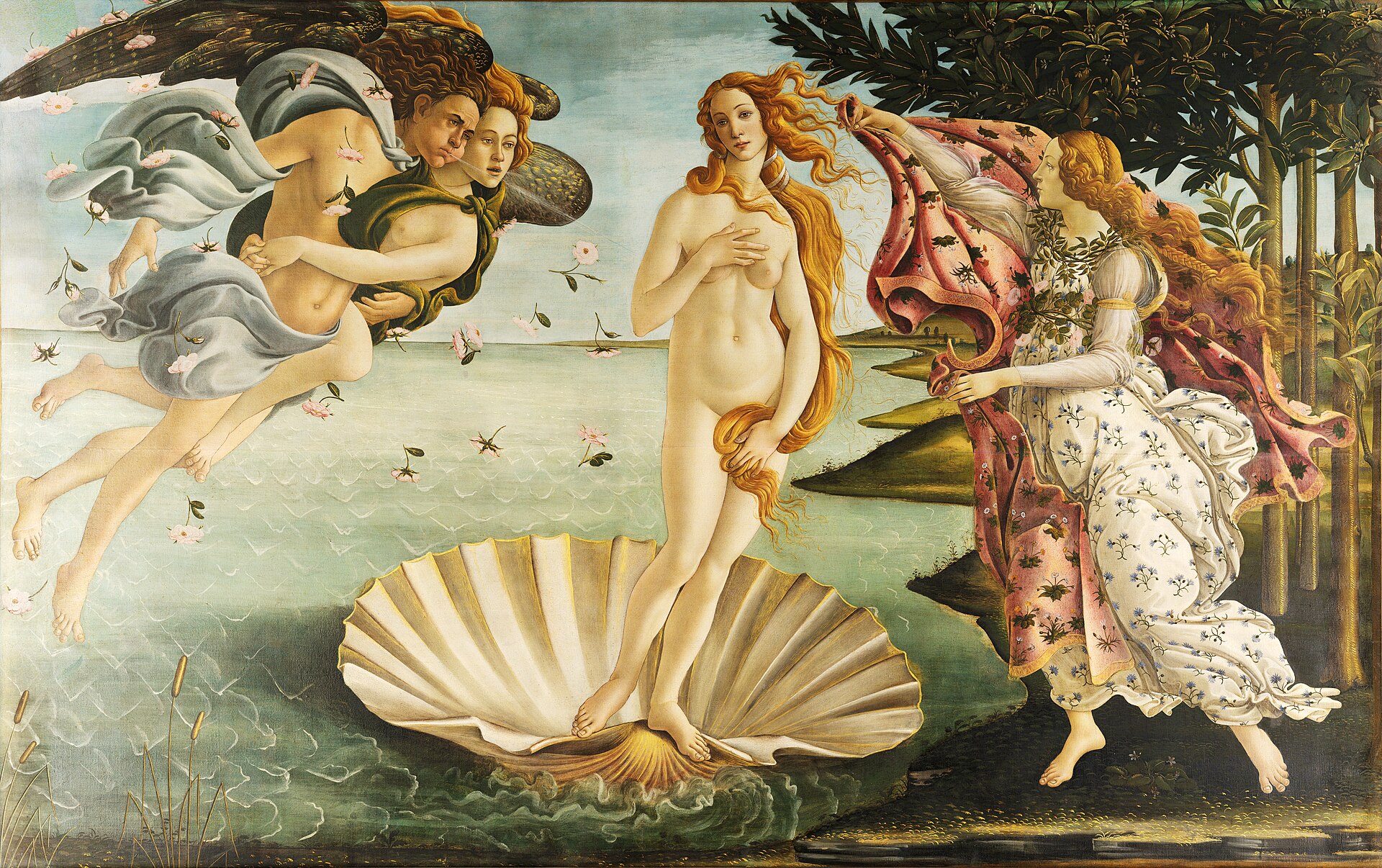
Most people who walk into Room 10–14 of the Galleria degli Uffizi think they already know this painting. They have seen it on tote bags and posters and shower curtains and Renaissance survey textbooks. They walk in expecting a reproduction the size of a magazine cover. What stops them is the size. The Birth of Venus is nine feet wide. Venus herself, standing on her shell at the center of the canvas, is roughly life-size. She is the first life-size female nude painted in Western Europe since the fall of the Roman Empire, more than a thousand years before. And she is looking, very calmly, just past your right shoulder.
That is the thing the gift shop posters never prepare you for. The Birth of Venus by Sandro Botticelli is not a small precious object. It is a wall. A wall on which a young goddess has just arrived, on a shell, on a wind, naked, dignified, and entirely unbothered.
This is the painting essay. What you are looking at, what it means, why it has been doing this to people for five hundred and forty years.
What you are actually looking at
A goddess, just born from the sea, drifts toward shore on a giant scallop shell. Her name is Venus, in Latin, or Aphrodite, in Greek. The myth is older than Homer. Hesiod’s Theogony, written sometime around 700 BC, tells how the sky god Uranus was castrated by his son Cronus and the severed parts were thrown into the sea. From the foam that rose around them, a goddess emerged. The Greeks called her Aphrogeneia, foam-born. The Romans called her Venus. She was the goddess of love, of beauty, of generation, and in some versions, of springtime itself.
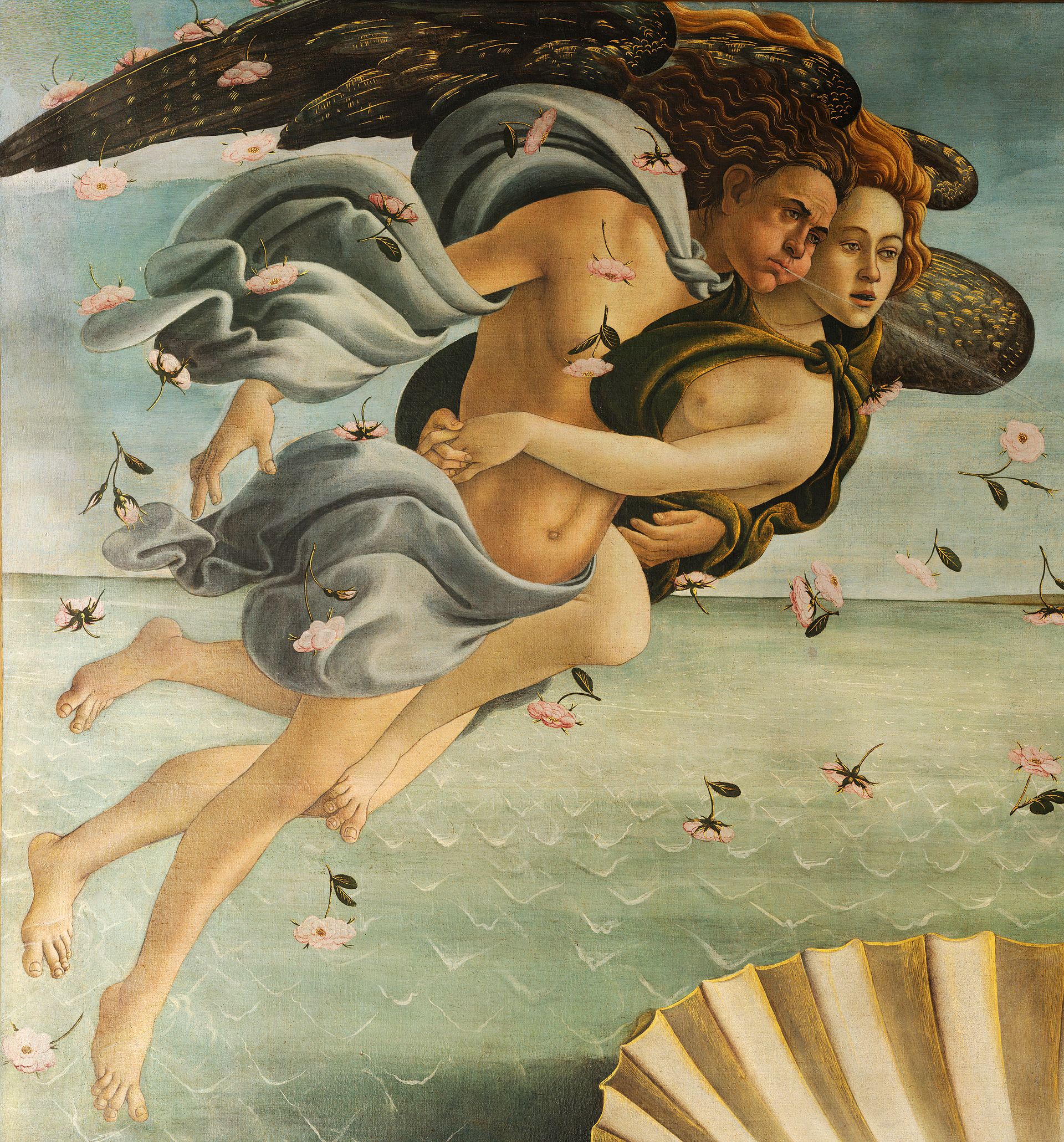
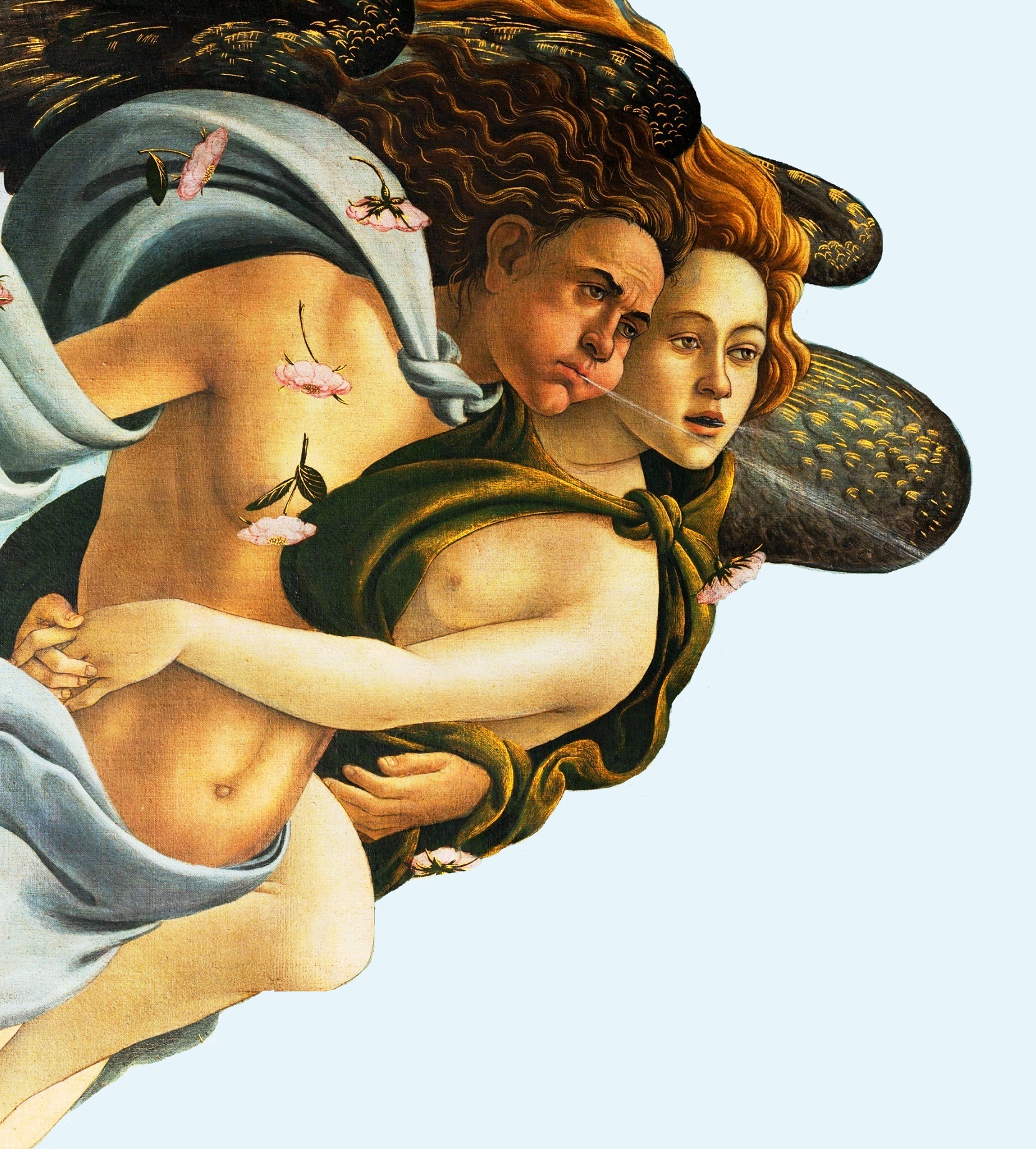
In Botticelli’s painting, she has just arrived. On the left, two figures, the wind god Zephyr and a smaller female figure usually identified as the nymph Chloris, blow her toward shore on gusts of breath. The wind is visible. You can see it in the streaks of gold flying across the air. On the right, a young woman waits on the shore in a flower-stamped dress, holding out a pink mantle to wrap the new goddess in. She is one of the Horae, the seasons. Some scholars say specifically the Hora of Spring.
The shell Venus stands on is a scallop, Pecten jacobaeus, a Mediterranean species that since antiquity had been a symbol of female sex and fertility. The roses scattered through the air, according to the Roman poet Lactantius, were born at the same moment Venus was. Each detail is a quotation. Each quotation a thousand years old.
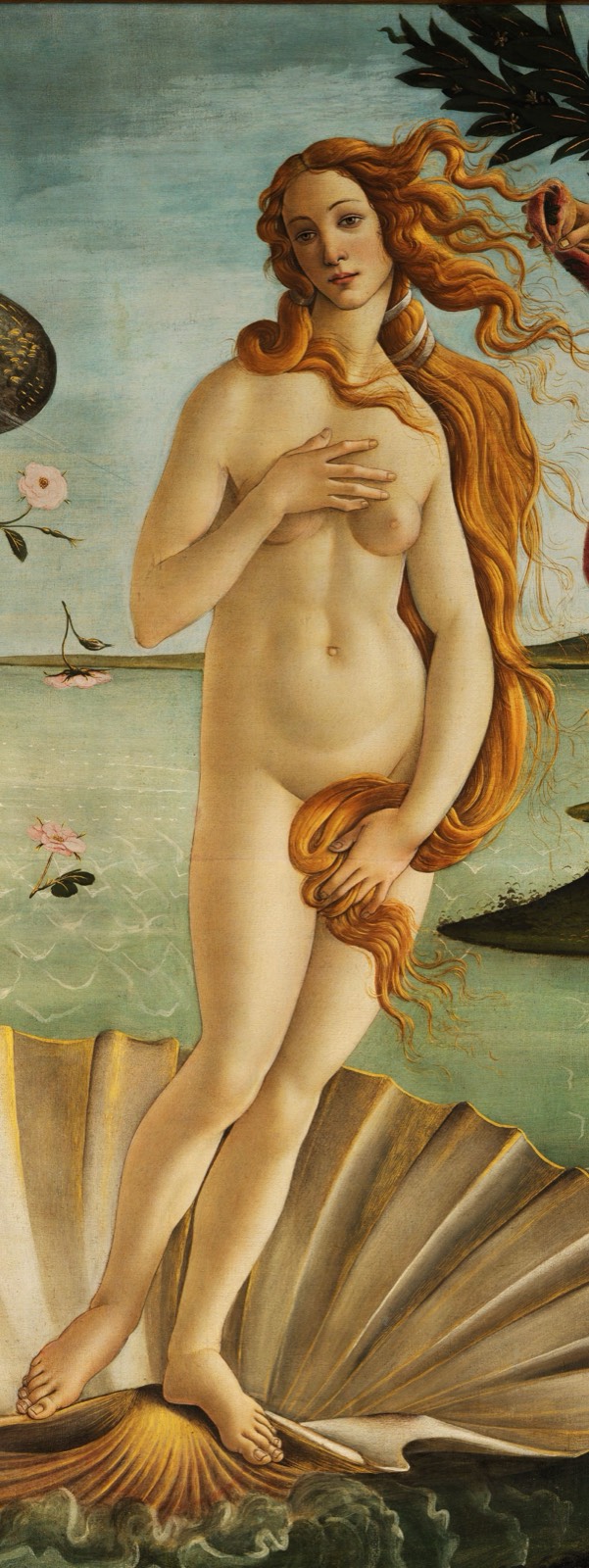
What is unusual is the calm of it. Venus has just been born. She has been blown across the open sea on the breath of the wind. She is about to be clothed by a season. She should be startled. She is not. Her face is tilted slightly. Her eyes are directed nowhere in particular, somewhere past the viewer’s right shoulder. Her mouth is closed. She is balanced on one leg, weight on the right, the contrapposto pose that classical Greek sculpture had perfected fifteen centuries earlier and that Renaissance painters were rediscovering one figure at a time.
She is not Eve. There is no shame in her body. There is no fall. She is a goddess.
Who painted it and when
Sandro Botticelli — born Alessandro di Mariano di Vanni Filipepi in Florence around 1445 — painted The Birth of Venus sometime between 1484 and 1486. By that point he was already the painter of Lorenzo de’ Medici’s circle. He had finished his Sistine Chapel frescoes for Pope Sixtus IV in Rome. He had painted La Primavera a few years earlier, almost certainly for the same patron Birth of Venus would end up with. He was forty years old, established, and at the height of what art historians now call his sweet linear style.
The painting is tempera on canvas, not on wood panel like most large works of the period. That choice is unusual and probably practical: the canvas was lighter and could be hung on a country-villa wall, where the panel would have warped in damp air. The dimensions are about 172 by 278 centimeters, or roughly five-and-a-half feet by nine feet.
It is one of the few paintings of its century to survive on canvas instead of panel. It has been restored many times. The most recent campaign, in the early 1980s, removed a thick layer of yellowed varnish and brought back the cooler, paler palette Botticelli had used: silvers in the water, a sage-green sea, the soft pinks of Venus’s mantle, the gold leaf still glittering on individual highlights of her hair.
Who commissioned it
For most of the painting’s life, scholars assumed it was commissioned by Lorenzo de’ Medici, “Lorenzo il Magnifico,” the de facto ruler of Florence and Botticelli’s most famous patron. That is partly right. The painting ended up in the Medici villa at Castello, west of Florence, where Vasari saw it in the mid sixteenth century and described it as one of two great Venuses in the house. (The other was La Primavera.)
But Lorenzo il Magnifico was not the actual patron. The patron was almost certainly his cousin, Lorenzo di Pierfrancesco de’ Medici, a younger relative who inherited the villa at Castello and who was being raised by Lorenzo il Magnifico as a kind of intellectual ward. Lorenzo di Pierfrancesco was probably about seventeen or eighteen when Primavera was painted and around twenty when Birth of Venus was finished. The painting was probably hung in his bedchamber.
This matters for how to read it. The Birth of Venus was not a public altarpiece. It was a private painting in a young nobleman’s private room. The Neoplatonist scholars in the Medici circle — Marsilio Ficino, Pico della Mirandola, Angelo Poliziano — believed Venus could be read on two levels: as the goddess of earthly love, but also as the goddess of celestial love, the soul’s longing for the divine. A young Medici being trained to govern Florence might be expected to keep a Venus in his bedchamber to remind him, daily, of the harder kind of love: love of beauty, love of wisdom, love of the good. The painting is a philosophical instrument. The nudity is the argument.
Why she is naked
The nudity is the move that has kept this painting in conversation for five centuries. By 1485, when Botticelli finished it, no Western painter had shown a life-size, fully nude female body in more than a thousand years. The medieval Church had treated the female nude as a symbol of either Eve, that is, sin, or martyred saint, that is, suffering. A confidently nude Venus was a category that did not exist.
Botticelli’s solution was to dress the painting in classical authority. He copied Venus’s pose from a specific ancient sculpture: the Venus Pudica, the so-called “modest Venus” type, which the Romans had copied from a fourth-century BC Greek original by Praxiteles. The pose, one hand covering the breast, the other a hank of hair across the lap, was a thousand-year-old quotation. Anyone in the Medici circle would have recognized it. The argument was: this is not a nude woman. This is the ancient goddess of love, and the body is what the ancients made of her.
The argument worked, more or less, for five hundred years. It almost did not survive Botticelli’s own old age. After Lorenzo il Magnifico died in 1492, Florence fell briefly into the hands of the Dominican preacher Girolamo Savonarola, who denounced the city’s secular paintings as vanities. Some accounts say Botticelli, who became a follower of Savonarola, burned some of his own pagan paintings in a public bonfire. The Birth of Venus survived because it was already at the Medici villa at Castello, outside the city. The Medici family kept it there, mostly out of public view, for another two and a half centuries.
What the swirl of hair is doing
Look at Venus’s hair. It is impossibly long. It runs down past her thighs. It is moving in the wind, lifted up off her shoulders in a coil that frames her body and ends in a hank that crosses her lap. The hair is doing two things at once. It is decorative — gold leaf still survives on individual strands, glittering when the gallery light catches it the right way. And it is doing the modesty work the Venus Pudica pose can only half do: covering the body, just barely, so that the viewer can see the form without seeing more than the period would tolerate.
The same logic governs the Hora’s pink mantle, which is about to be wrapped around Venus’s body. The mantle has not yet covered her. It is hovering. Botticelli has caught the goddess in the one second between the open sea and the social world, between mythology and decorum.
The hair is also a quotation. Botticelli’s nearly contemporary friend the poet Angelo Poliziano had written, in his Stanze per la Giostra of 1475, a long verse about the birth of Venus. In Poliziano’s poem, Venus rises from the foam, con le man tenendosi il crin biondo, “holding her blonde hair with her hands.” Botticelli is illustrating the line.
The Hora and the pink mantle
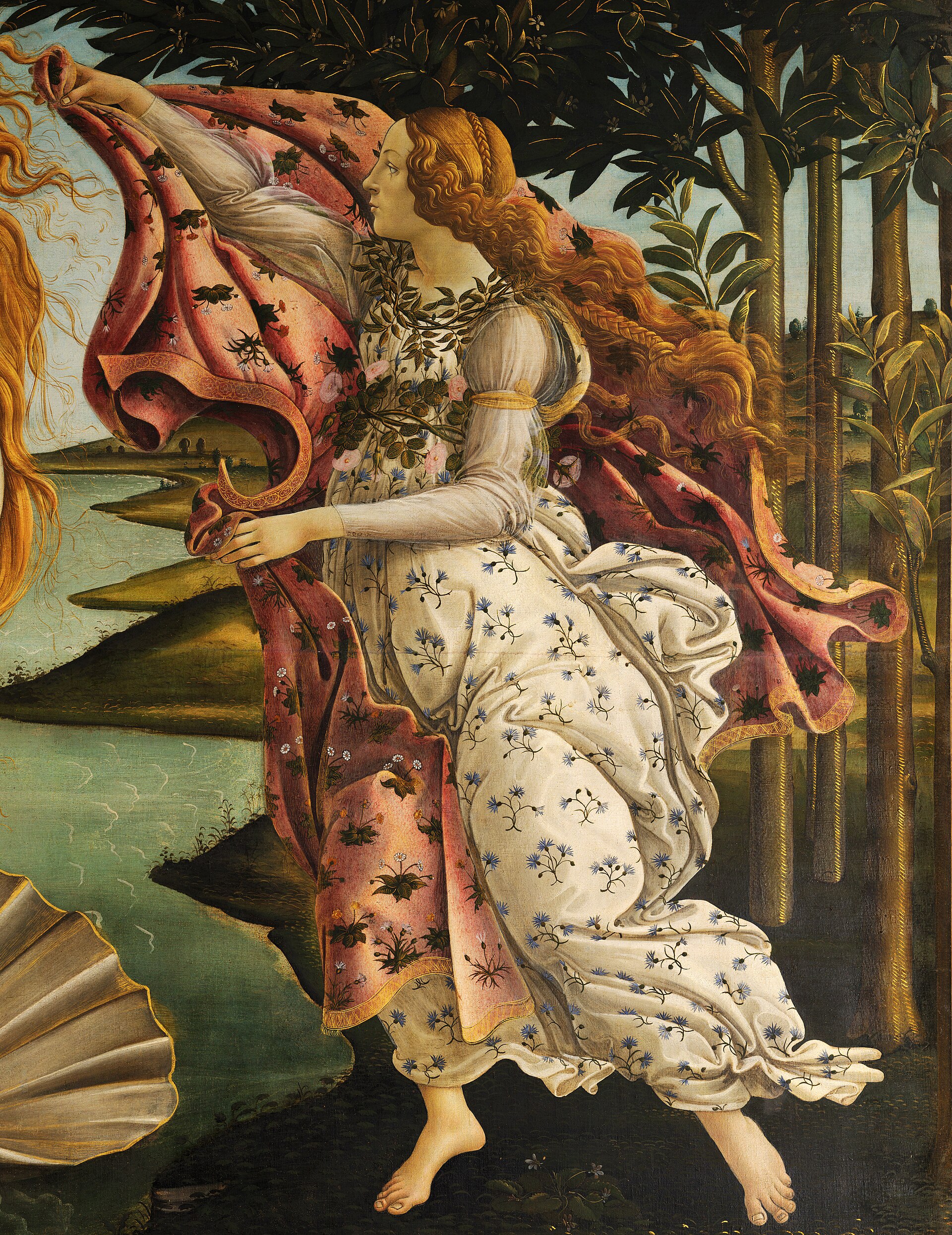
The Hora on the right is one of the painting’s most quoted figures. She is dressed in a white gown stamped with cornflowers. She is barefoot. She is leaning forward, slightly off balance, into the wind that has just brought Venus to shore. She holds out a pink mantle stamped with daisies, marigolds, and primroses. The wind catches the mantle. Her own dress lifts and ripples around her ankles.
The Horae were the daughters of Zeus and Themis in Greek mythology, the personifications of the seasons. There were three of them, sometimes four. The Greek lyric poet Pindar wrote that the Horae attended Aphrodite’s birth and clothed her in the first robe she ever wore. Hesiod said the same thing. Botticelli is again illustrating a literary source.
If the Hora is specifically the Hora of Spring — which is what most modern scholars argue, because of the cornflowers and the rose-patterned mantle — then the painting is, among other things, a calendar. Venus is being clothed by the season she rules. The painting is set in early spring. The flowers are spring flowers. The wind is the west wind, Zephyr, that ancient writers said brought the spring.
This makes Birth of Venus a sister piece to Botticelli’s La Primavera. Both were painted for the same Medici cousin, both ended up in the same villa. Both are, on one reading, about the arrival of spring as a moment of cosmic transformation. The two paintings, when they were hung together at Castello, would have been read as a pair. The longer essay on La Primavera walks through how the second painting works.
Why the figures float
If you look closely at Venus’s feet, you will notice something strange. They are not quite resting on the shell. The shell is not quite resting on the water. The Hora’s feet are not quite touching the ground. Zephyr is in the air, but so is everyone, slightly. Botticelli has painted the whole scene as if gravity has been suspended.
This is not a mistake. It is the painting’s signature. Botticelli was working at the moment when Italian painting had just rediscovered, through the fifteenth-century mathematicians, single-vanishing-point linear perspective. He could draw weight on a body when he wanted to. (Look at his Adoration of the Magi.) But for Birth of Venus, he chose to ignore it. The figures are weightless. They are arranged in a flat, decorative band across the canvas, like a frieze. The water below Venus’s shell is patterned in V-shaped chevrons, almost like a textile.
What he is doing is referencing a different tradition: not Roman wall painting, but late Gothic French and Flemish manuscript illumination, which his teacher Filippo Lippi had also borrowed from. The flatness, the gold accents, the linear hair, the small, doll-like quality of the bodies, are all part of a deliberate stylistic choice. Botticelli is painting a goddess. A goddess does not have to obey the laws of weight. She arrives on the breath of the wind, and the painting makes you feel it.
This stylistic decision is what got Botticelli partly forgotten in the High Renaissance, when Leonardo and Michelangelo and Raphael moved painting toward fully realized three-dimensional bodies and natural light. Botticelli’s flat, frieze-like compositions looked old-fashioned by 1510. They stopped looking old-fashioned around 1860, when the Pre-Raphaelites in England and the early Symbolists in France rediscovered him and made his linear style fashionable again. The Birth of Venus has been famous, more or less continuously, ever since.
What the painting represents
For the Neoplatonists in the Medici circle, The Birth of Venus was an allegory of the descent of beauty into the world. Marsilio Ficino, the philosopher who had translated Plato’s complete works for Cosimo de’ Medici a generation earlier, taught that Venus was the embodiment of humanitas, the harmonious human ideal. There were two Venuses in his system: the celestial Venus, who represented divine love, and the earthly Venus, who represented natural love. The two were not opposed. They were the same goddess seen from different angles.
The painting on Lorenzo di Pierfrancesco’s wall was probably meant to be read as the celestial Venus — Venus arriving for the first time, before she has been clothed, before she has joined the social world. She is, in Ficino’s language, Humanitas itself: the principle of beauty and harmony, descending from heaven into matter. The young man in whose bedroom the painting hung was meant to look at her every day and remember the beauty he was supposed to be cultivating.
This sounds very philosophical. It is also, more straightforwardly, a beautiful picture of a beautiful woman, which is what fifteen-year-olds in the Medici household and twenty-year-olds in the Uffizi gift shop have always also seen. Both readings are correct. Botticelli’s painting was designed to hold both at once. The Neoplatonist could see the soul descending. The teenager could see Venus.
Chiaro walks you through the four-figure composition — Zephyr, Chloris, Venus, the Hora — as one continuous gust of wind moving from left to right across the canvas, so that the whole painting reads as a single moment instead of a static tableau. The roses, the cornflowers, the gold-leaf hair, all happen in your ear while your eye is already on them.
Why she is the first
The thing that makes The Birth of Venus matter, beyond its sheer beauty, is what it did for the next four centuries of Western painting. Before 1485, a life-size female nude was almost unthinkable in a Christian context. The image of the female body in late medieval and early Renaissance painting was reserved for two roles: Eve, in scenes of the Fall, where the nudity was a sign of sin, or martyred saints, where it was a sign of suffering. There was no image, in living memory, of a woman simply standing, naked, calmly, in her own body, as a positive subject.
Botticelli broke that. He used classical authority to do it — the Venus Pudica pose, the Hesiodic myth, the Poliziano poem — but the result was a category that had not existed since antiquity: the female nude as a serious subject of painting, neither sinful nor suffering. After 1485, the door was open. Giorgione’s Sleeping Venus, around 1510. Titian’s Venus of Urbino, 1538, painted for the Duke of Urbino and now hanging in the same Uffizi as Botticelli’s. Cabanel’s Birth of Venus, 1863, in the Musée d’Orsay. Bouguereau’s, 1879. Manet’s Olympia, 1863, which set the tradition on its head by painting Venus as a contemporary courtesan.
Every nude on every museum wall after 1485 owes something to the Medici cousin’s bedroom in the villa at Castello. The painting was the door.
Why she is so famous
Some part of the answer is the painting itself: the size, the color, the linear elegance, the Hora’s cornflowers and the gold-leaf hair. Some part is the Neoplatonist context — the philosophical depth that has made the painting a magnet for art historians for one hundred fifty years. Some part is the way the female nude as a subject has carried the painting forward through every successive period of Western art.
But part of it is also the calmness of Venus’s face. She is not posing. She is not seductive, in any obvious way. She is not embarrassed. She is not even, really, looking at us. Her face is tilted just slightly past the viewer, her eyes focused on something a little past your right ear. She has just been born, and she is looking, very steadily, at whatever it is she is now going to have to do.
That look, more than anything else in the painting, is why people stop in front of it. They were expecting a poster. They get a goddess who is not paying attention to them. The painting refuses to perform. It just stands there, nine feet wide, on its tempera canvas, in Room 10–14 of the Uffizi, and waits.
Where to find it
The Birth of Venus hangs in the Galleria degli Uffizi in Florence, in the same room as La Primavera. The room is on the second floor of the museum, in the Botticelli galleries — formally Rooms 10 through 14, which together make a long sequence dedicated to the painter and his workshop. The painting is in the middle of the largest room, on the long wall, with seating opposite for visitors who want to sit. The room is usually crowded around peak hours; it thins out in the early morning and the last hour before close.
If you have not been to the Uffizi before, the practical guide to the museum walks through everything else worth seeing on the same visit, and the reservations guide covers how to book.
The kicker
Stand nine feet back. Look at the goddess at the center of the canvas. Look at where her eyes are pointing — past you, somewhere just over your shoulder. She is not interested in the room. She is not interested in the camera phone. She is just there, calmly, on her shell, in the wind, the way she has been since 1485. And the calm she has, you do not. That is what the painting was made to do, and it is still doing it.
Image credits
- Sandro Botticelli - La nascita di Venere - Google Art Project - edited.jpg — Sandro Botticelli (c. 1445-1510). Source, Public Domain.
- The Birth of Venus detail - Venus.jpg — Sandro Botticelli. Source, Public Domain.
- The Birth of Venus detail - Zephyr and Chloris.jpg — Sandro Botticelli. Source, Public Domain.
- The Birth of Venus detail - Hora.jpg — Sandro Botticelli. Source, Public Domain.
- Sandro Botticelli. The Birth of Venus. Zephyrus.jpg — Sandro Botticelli. Source, Public Domain.


