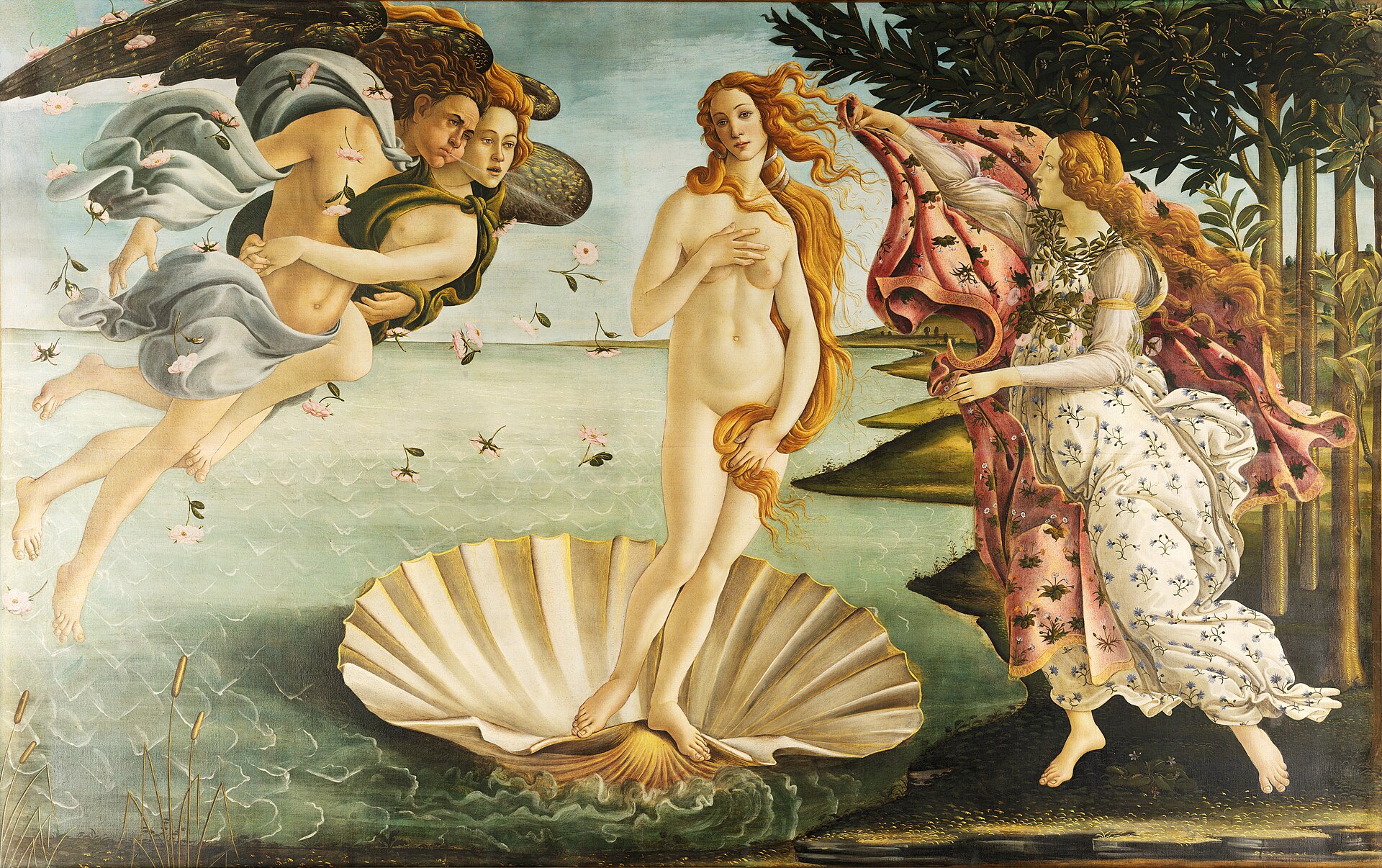
If you walk into the Galleria degli Uffizi from the east-wing entrance and turn right, you will be in the Botticelli room within four minutes. The Birth of Venus is on the long wall, life-size, nine feet wide, in the middle of the row. La Primavera is on a perpendicular wall to your right. The Botticelli Adoration of the Magi is around the corner. There will be roughly forty other people in the room. The light will be soft. The painting will be larger than you expected.
This is the visitor’s guide to standing in front of it. Where it is, exactly, what is in the same room, when the room is empty, the photograph everyone tries to take, and the small things people miss.
For the painting itself — what it means, who painted it, why she is naked — see the longer essay on The Birth of Venus. This is the practical companion to that essay: how to actually see the painting in the museum.
The room
The painting hangs in the Botticelli rooms, formally Rooms 10 through 14, but they all open into one another and most visitors experience them as a single connected gallery. The official Uffizi room number for the wall The Birth of Venus hangs on is Room 12, sometimes written as Sala 12 — “Botticelli, La Venere”.
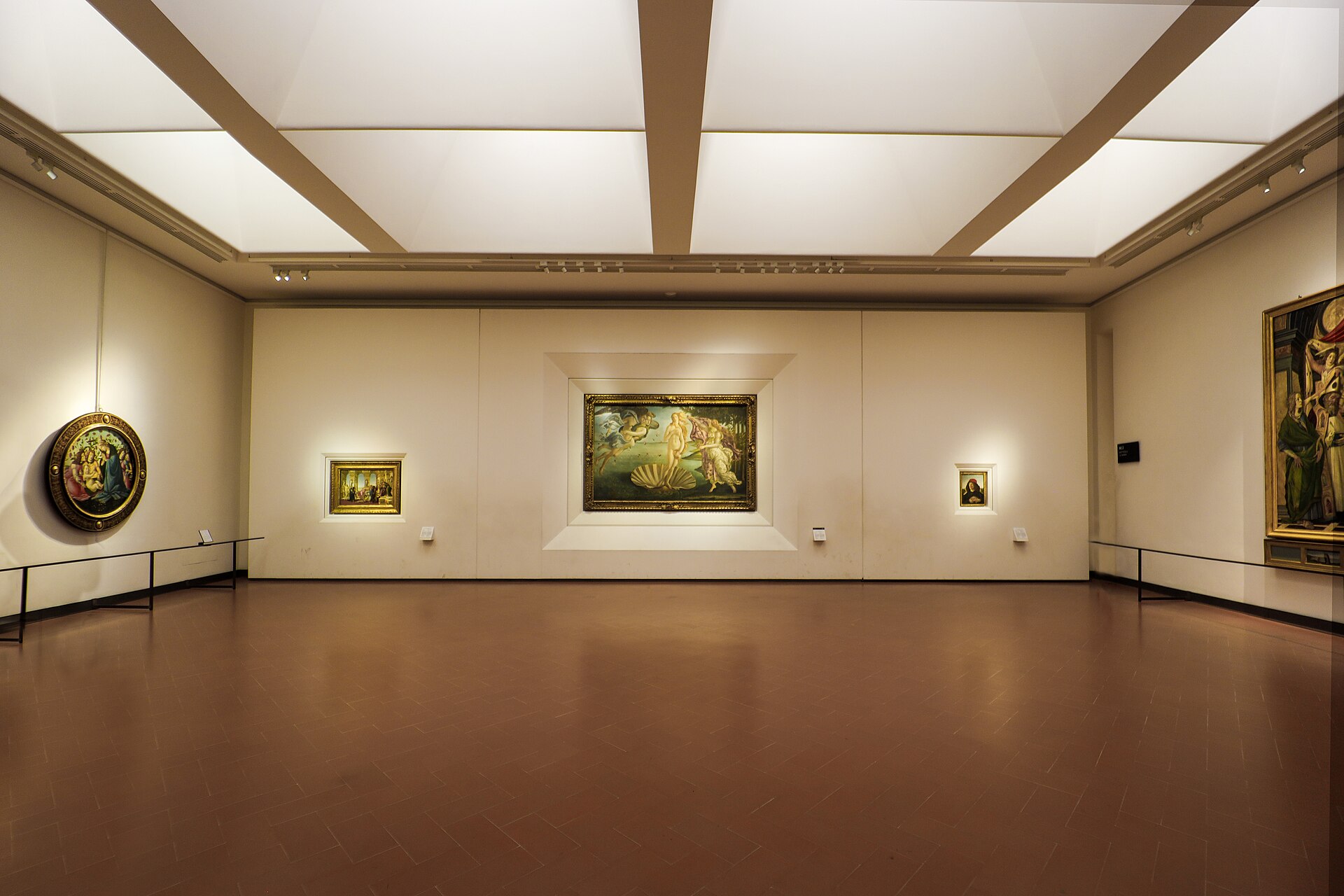
The room itself is the largest single gallery on the second floor. The walls are a soft gray-green, the floor is a polished terra cotta, the ceiling is white plaster with simple cornices. The lighting is overhead and even, calibrated for tempera on canvas, which means slightly cool — slightly less warm than ordinary museum daylight — to bring out the silvers and the sea-green of Venus’s water without yellowing the gold leaf in her hair.
There are benches in the middle of the room, oriented so you can sit and look at The Birth of Venus head-on. There is a similar set of benches oriented toward La Primavera on the opposite wall. The two long benches are usually fully occupied during peak hours. They free up between 16:30 and closing.
How to walk to it
From Entrance 2 — the entrance for visitors with timed-entry tickets — the route to the Botticelli room is short. Through security, up the staircase, into the East Corridor on the second floor, and right at the first long block of side rooms. The Botticelli galleries are signposted from the staircase landing.
The walking route inside the museum, if you are heading directly: enter the second floor, walk past Rooms 2 through 9 (Cimabue, Giotto, Filippo Lippi, Piero della Francesca), and turn right into the long block of Botticelli galleries. You will pass La Primavera first, on your left as you enter the long room. The Birth of Venus is on the perpendicular wall, slightly further in. The Adoration of the Magi and several smaller Botticellis are in the connected Room 10–11, before you reach the main Primavera / Birth of Venus wall.
If you are walking the museum’s natural counter-clockwise loop and want to do it in chronological order, you will reach the Botticelli room about thirty to forty minutes into the visit, after the early Tuscan rooms. If you want to do The Birth of Venus first, before the room fills up, walk through the early rooms quickly — five minutes — and head straight to Room 12.
What is on the walls around it
The Botticelli room is one of the densest in the museum. The Birth of Venus is on the long wall, but it is not alone. The same room, in the connected sequence of rooms 10–14, also holds:
- La Primavera (c. 1482), the second great Botticelli mythological painting, on the perpendicular wall
- Adoration of the Magi (c. 1475), the Medici family portrait disguised as a Bible scene, in the connected Room 10
- Madonna of the Magnificat (c. 1483), a circular painting of Mary writing the Magnificat in a book held by the Christ Child
- Madonna of the Pomegranate (c. 1487), another circular Madonna, with the Christ Child holding a partly-open pomegranate
- Pallas and the Centaur (c. 1482), a slightly smaller mythological allegory probably also painted for Lorenzo di Pierfrancesco de’ Medici
- Several smaller religious panels by Botticelli’s workshop, hung along the lower walls
The room is, in other words, one of the great single-painter concentrations in any museum. There are more Botticellis here than there are Vermeers in the entire Mauritshuis, and most of them are first-rate.
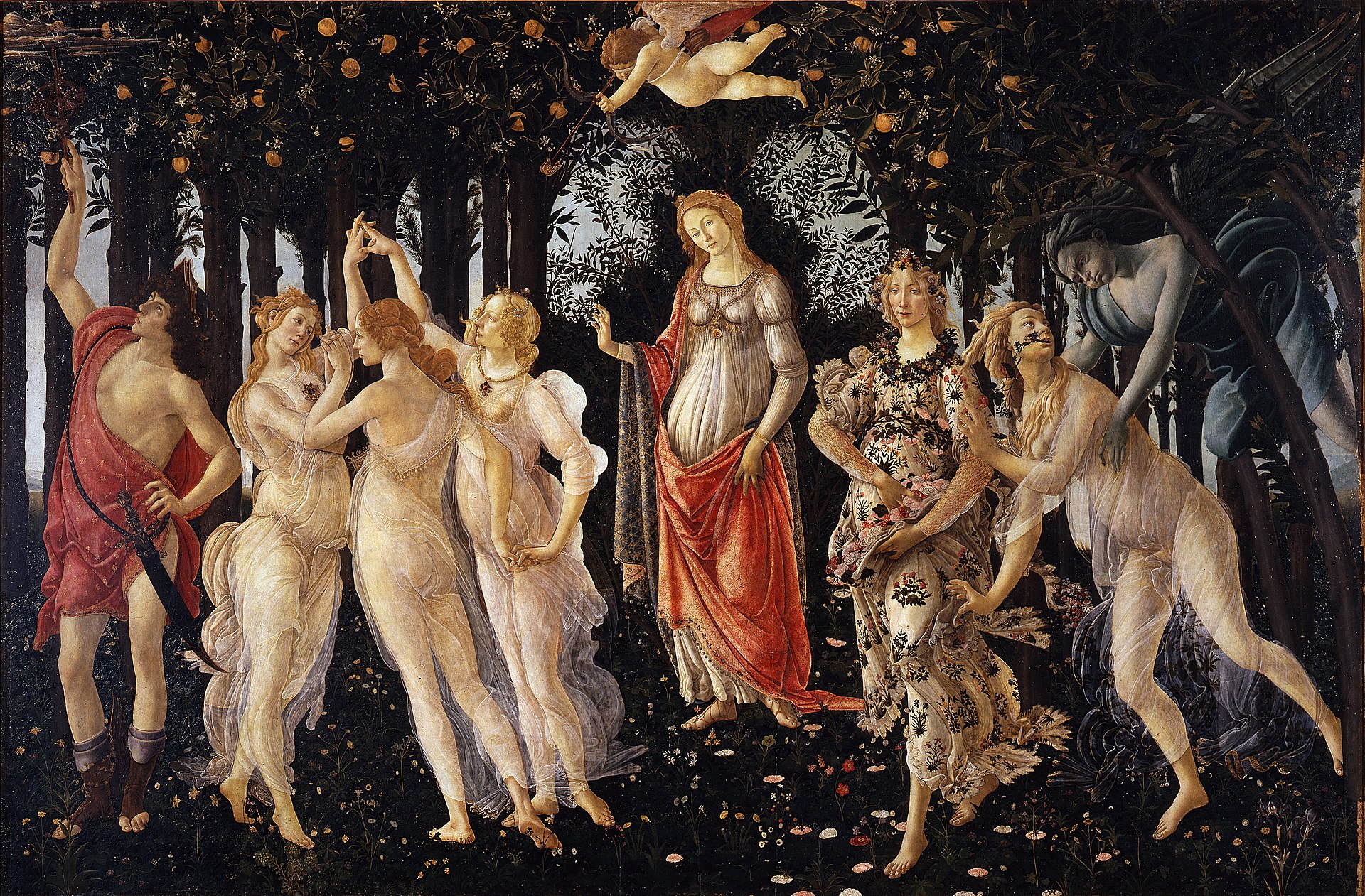
For the whole essay on La Primavera and the figure-by-figure decode, and the whole essay on the Adoration of the Magi, separate posts cover each of the three big Botticellis the room holds.
When the room is empty
The room fills up fast and stays full for most of the day. There are three windows when it thins out enough that you can stand directly in front of The Birth of Venus without anyone in your way:
- 08:15 to 08:45. The first thirty minutes after opening. If you have an 08:15 timed-entry ticket and walk straight to the Botticelli room, you will have about ten minutes alone before the rest of the morning’s visitors filter in. This is the best window. It is also when the morning light through the windows is softest.
- 12:30 to 13:15. Most groups break for lunch. The lunchtime emptiness is real but short.
- 17:00 to 17:30. The last half-hour before last admission. The crowd thins out in advance of closing. The light has gone slightly warmer by this time, which is also good for tempera.
The peak hours are 10:30 to 12:00 and 14:00 to 15:30. In peak hours, the Botticelli room becomes physically uncomfortable. Stand against the back wall, give it ten minutes, and come back at 12:30.
The photograph everyone tries to take
The Birth of Venus is one of the most photographed paintings in any museum, and most of the photographs are bad. The reasons:
- The painting is wide. Nine feet across. Most phone cameras can’t fit the whole canvas in a frame from a comfortable viewing distance, and stepping back further means crowds in the way.
- The light is calibrated for the painting, not for cameras. The cool, even, overhead lighting reads slightly cyan on most phone sensors.
- The crowd in front of the painting. People photograph the painting and end up with the back of someone’s head in the foreground.
If you want a usable photograph: shoot from the corner of the room, at about a 30-degree angle to the painting, framing only the central two-thirds of the canvas (Venus and the Hora). Avoid trying to capture the full nine-foot width. Step back to about ten feet from the painting. Don’t use flash — flash photography is prohibited and the guards will stop you. The painting’s surface is matte, but it has been varnished often enough over the centuries that the highlights catch.
The other photograph: from across the room, with the long bench and the gallery floor in the foreground and the painting in the middle distance. This composition reads as a museum photograph rather than a reproduction of the painting itself, and it is what most professionals shoot.
The small things people miss
Three small details that most visitors walk past:
-
The water. Look at the surface of the sea around Venus’s shell. The waves are stylized — V-shaped chevrons that almost read as a textile pattern. Botticelli did not paint a realistic ocean. He painted a decorative band of cool sage-green that functions like a backdrop. This is one of the painting’s deliberate stylistic choices, and it tells you that Botticelli is not aiming for the optical realism his contemporaries Leonardo and Verrocchio were after. He is making something flatter, more Gothic, more linear.
-
The gold leaf. Walk close to the painting — as close as the museum velvet rope allows. Look at Venus’s hair. Most of it is painted in tempera, but individual strands are highlighted with actual gold leaf, applied in thin lines and catching the room light when you step from side to side. The gold also appears on the swirling air of the wind on the left side of the canvas. Step laterally as you stand in front of the painting and watch the gold flicker.
-
The Hora’s feet. The young woman on the right of the painting, holding out the pink mantle, is barefoot. Look at her feet. They are not quite touching the ground. The whole painting has a slightly weightless, hovering quality that Botticelli used deliberately to communicate that he is painting a divine moment, not a realistic scene. Once you notice the feet, you start to see the same effect across the whole painting — Zephyr in the air, Venus barely on her shell, the shell barely on the water.
Why this room and not another room
The Birth of Venus has been in the Uffizi since the late eighteenth century, when the Medici art collection was consolidated into the museum’s permanent display. Before that, the painting hung at the Medici villa at Castello, west of Florence, where Vasari had seen it in the mid-1500s. The painting was probably painted for Lorenzo di Pierfrancesco de’ Medici, the cousin of Lorenzo il Magnifico, around 1485, and lived in his villa for about two and a half centuries before being moved into the city.
The room has been the Botticelli room — in its current configuration as Sala 12, the long room that holds both Birth of Venus and La Primavera on perpendicular walls — since the most recent major reinstallation, in the 2010s. The decision to hang the two paintings in the same room is curatorial: the two were almost certainly conceived as a pair, were painted for the same patron, and lived in the same villa for centuries. Putting them in the same gallery lets visitors see them in the relationship they were intended to have.
A separate, smaller decision: the Birth of Venus is hung at a height where the goddess’s eyes are roughly at the height of the average viewer’s eyes when standing about eight feet back. This is intentional. Botticelli painted Venus with her eyes pointed slightly past the viewer’s right shoulder — not directly at the viewer, but adjacent. The hanging height makes the angle of her gaze legible at the natural standing distance.
What is in the museum nearby
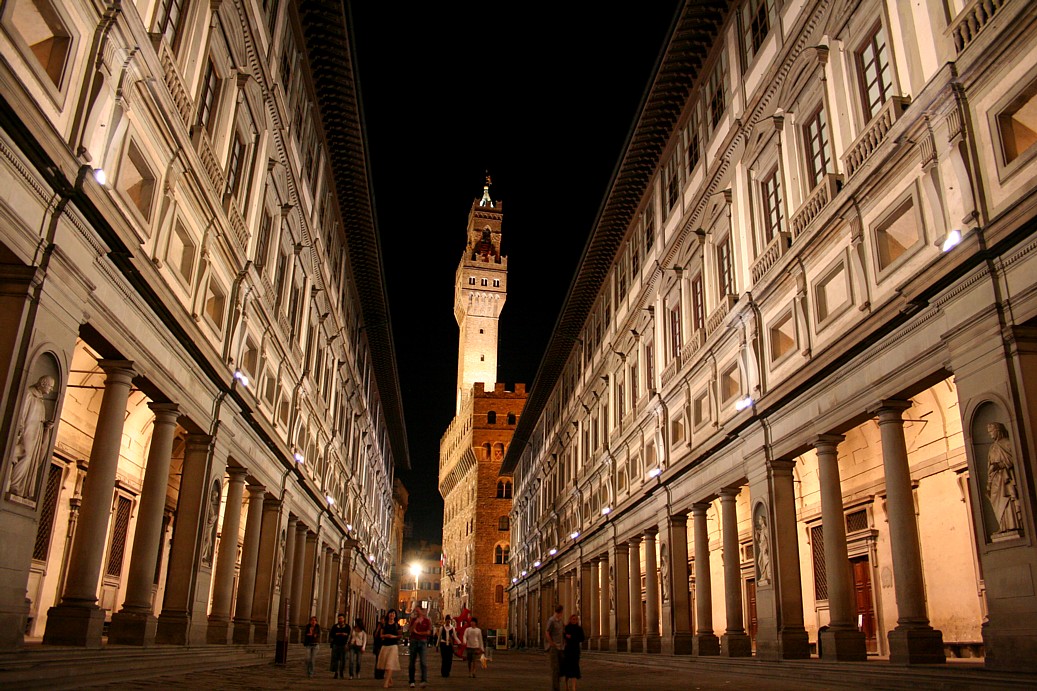
The Botticelli room is roughly a third of the way through the second floor. From here, the natural route continues counter-clockwise through the rest of the museum:
- Room 35 (Leonardo and Michelangelo): five minutes’ walk further along the East Corridor
- Room 41 (Raphael): two more rooms past Leonardo
- Room 83 (Titian): on the third floor, reached via the staircase at the south end of the East Wing
- Room 90 (Caravaggio and Artemisia): also third floor, near the West Wing exit
The overview of what is in the Uffizi covers the ten works to know in detail, and the first-timer’s walkthrough covers the route through the building. For the practical reservation step, the reservations guide covers booking and entrance choice.
Chiaro walks you through the Botticelli room from the doorway, so the four-minute approach from the East Corridor — past La Primavera on the left, the Madonna of the Magnificat on the right — is already framed by the time you stand in front of The Birth of Venus on the long wall.
A note on photographs (and the painting on tote bags)
You will, by the time you get to Florence, have seen The Birth of Venus on roughly forty different reproductions. Posters, totes, mugs, postcards, the t-shirt your roommate bought freshman year, the print on the wall of your high-school art teacher’s classroom. The reproductions are usually about 18 inches wide. You walk into the room expecting something approximately that size.
The painting is nine feet wide. The first thing every visitor experiences is the size shock. The reproductions had cropped most of what you cared about. The Hora on the right, the wave of Zephyr’s hair on the left, the actual scale of Venus standing on her shell — all of these are larger and more present than the reproductions had suggested.
The shock is part of the experience. Stand back ten feet, take in the full canvas, and let the size do its work for the first thirty seconds. Then walk closer for the gold leaf, the cornflowers on the Hora’s dress, and the chevrons on the water.
The kicker
Walk in. Turn right at the first long block of galleries. Pass La Primavera, which deserves a stop later. Find the long wall. The painting on the long wall is nine feet wide and Venus is looking past your right shoulder. She has been doing that since 1485. The Hora is still about to wrap her in the pink mantle. Zephyr is still blowing her ashore. Five hundred and forty years later, the room is still arranged so the goddess’s eyes meet a point slightly past your ear, and not your face. That is exactly what Botticelli intended. Step back, sit on the bench, and let her do it.
Image credits
- Sandro Botticelli - La nascita di Venere - Google Art Project - edited.jpg — Sandro Botticelli (c. 1445-1510). Source, Public Domain.
- Galleria degli Uffizi, sala 12 ‘Botticelli La Venere’ a feb 2024 -FG1.jpg — Sailko. Source, CC BY 3.0.
- Botticelli-primavera.jpg — Sandro Botticelli. Source, Public Domain.
- Uffizi Gallery, Florence.jpg — Diliff. Source, CC BY-SA 3.0.


