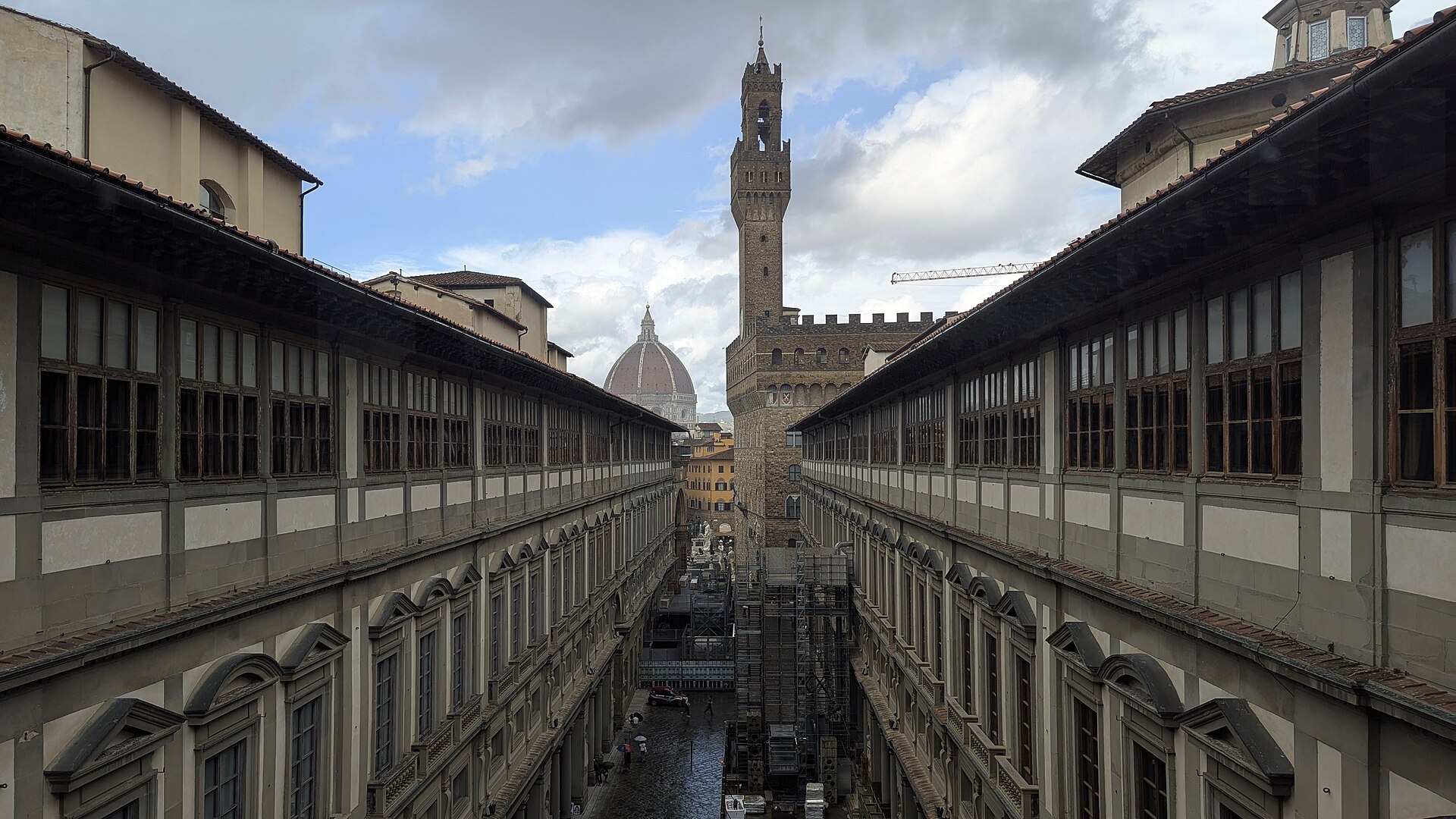
The Uffizi Gallery in Italy is, by most measures that matter, the single most important Renaissance collection in the world. It has more Botticellis than any other museum, anywhere. It has the only finished Leonardo on canvas in Italy. It has the Michelangelo painting that all his frescoes after 1506 are arguments with. It has the Caravaggio that turned modern art-historical scholarship around. It has the Titian that taught every reclining nude that came after it how to lie down. It has the Raphael that defined the Renaissance Madonna for three centuries. It has Botticelli’s The Birth of Venus and La Primavera in the same room.
It is also, by reputation, the museum that visitors most consistently underestimate. They come for Botticelli, see Botticelli, and leave. They miss the rest. This is a guide to what is actually inside, the ten works to know before you walk in, and why the building, which started life as a Medici government office complex, ended up holding all of this.
What the Uffizi is, in one paragraph
The Galleria degli Uffizi — uffizi is the Italian word for “offices” — is housed in a U-shaped sixteenth-century building between the Piazza della Signoria and the Arno river in Florence. The building was commissioned in 1560 by Cosimo I de’ Medici, the first Grand Duke of Tuscany, and designed by his court artist Giorgio Vasari (yes, that Vasari, the one who wrote Lives of the Artists) to consolidate the city’s thirteen administrative magistracies into a single building. By 1581 the upper floor of the eastern wing was already being used to display the Medici art collection. The collection grew, the offices moved out, and by 1769 the entire building had been turned into a public picture gallery. The Uffizi is, in other words, the oldest art museum in the world that is still operating in its original building.
It holds about 4,800 paintings and roughly 13,000 drawings and prints, with around 1,500 works on permanent display in any given year. The chronological arc runs from late medieval Tuscan altarpieces, on the second floor, through the High Renaissance and Mannerist galleries, to the seventeenth-century rooms with Caravaggio and Artemisia Gentileschi at the end. A single floor of the building is bigger than the whole Frick. A full visit takes between three and five hours. A focused one, sticking to the ten works below, can be done in two.
1. Botticelli, The Birth of Venus (1485)
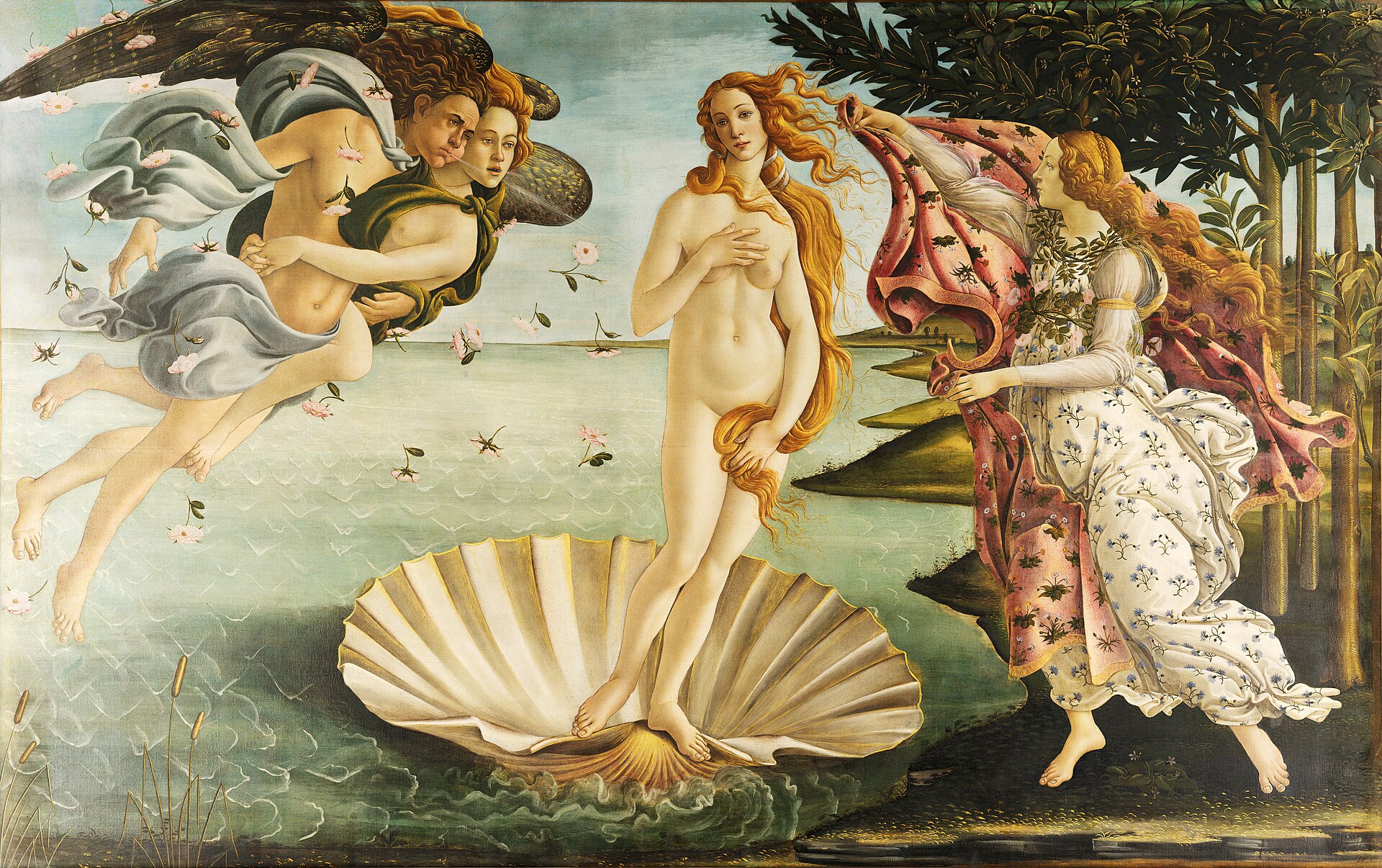
The painting most visitors arrive for, and the only reason most people will ever know what tempera on canvas is. The Birth of Venus is in Room 10–14, on the long wall, life-size, surprising. We have a longer essay on what the painting means and why it works and a shorter visitor’s guide to finding it in the museum.
The thing to know before you stand in front of it: it is the first life-size female nude painted in Western Europe in over a thousand years. The argument Botticelli made to get away with it was that this was not a contemporary nude but a goddess, in a pose copied from a famous ancient Greek sculpture, illustrating a myth told by Hesiod. The argument worked. The door it opened — the female nude as a serious subject for painting — has been open for five hundred and forty years.
Same room, same painter: La Primavera. Different painting, different scale, different reading. Both were painted for the same Medici cousin. The Primavera essay walks through the second one figure by figure.
2. Leonardo da Vinci, Annunciation (c. 1472)
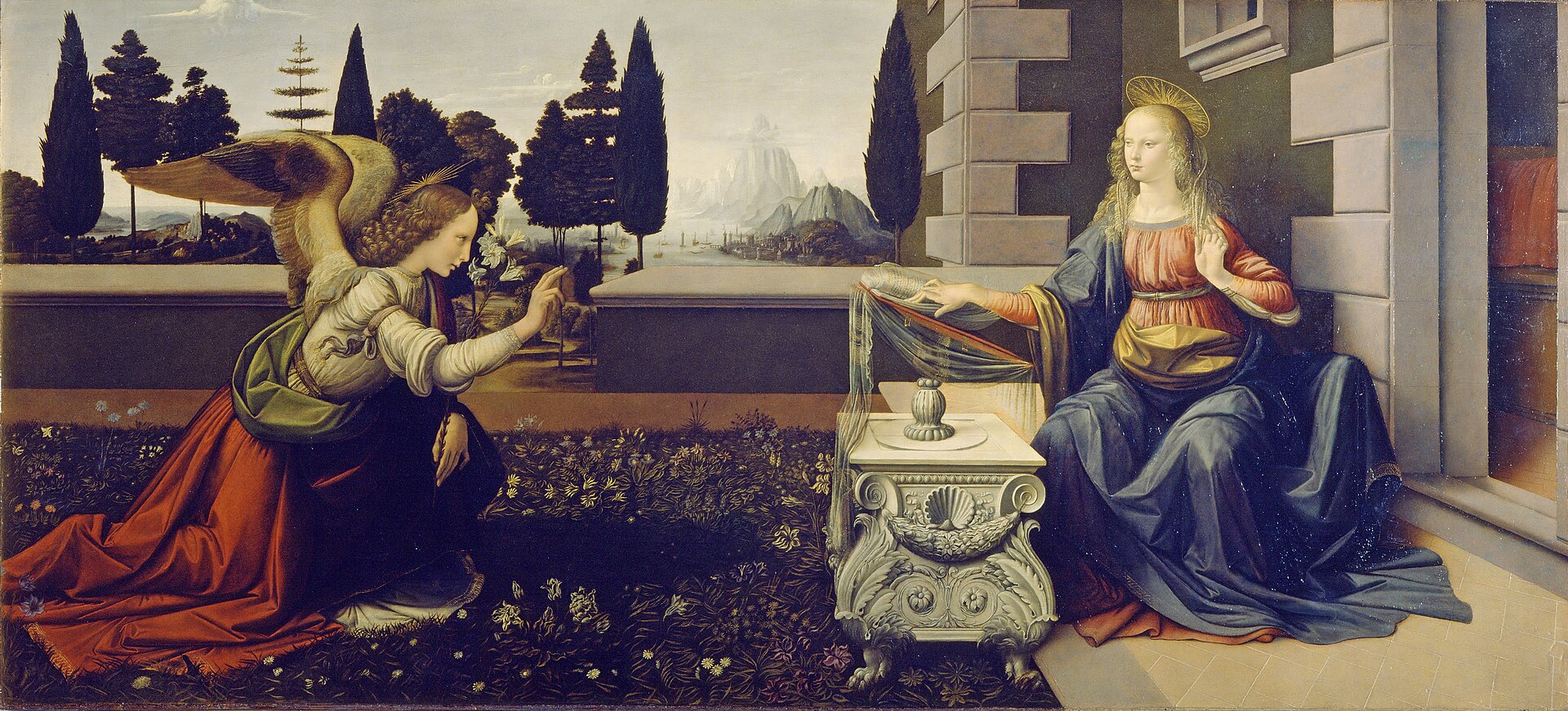
Painted when Leonardo was about twenty years old, in the workshop of his master Andrea del Verrocchio. It is the earliest finished work universally attributed to him. The angel kneels in a Florentine garden, the Virgin Mary sits at a marble lectern, and the perspective grid running away to the cypress-dotted Tuscan hills in the background is the perspective grid that all early Leonardo is built on.
Look at the angel’s wings. Leonardo, even at twenty, was sketching real birds. The wings are anatomically accurate. He was already the painter who would later dissect bodies and design flying machines, and you can see it.
The Annunciation is in Room 35, alongside Leonardo’s Adoration of the Magi, the unfinished masterpiece he abandoned in 1481 when he moved to Milan and that the Uffizi has been arguing about ever since.
3. Michelangelo, Doni Tondo (c. 1506)
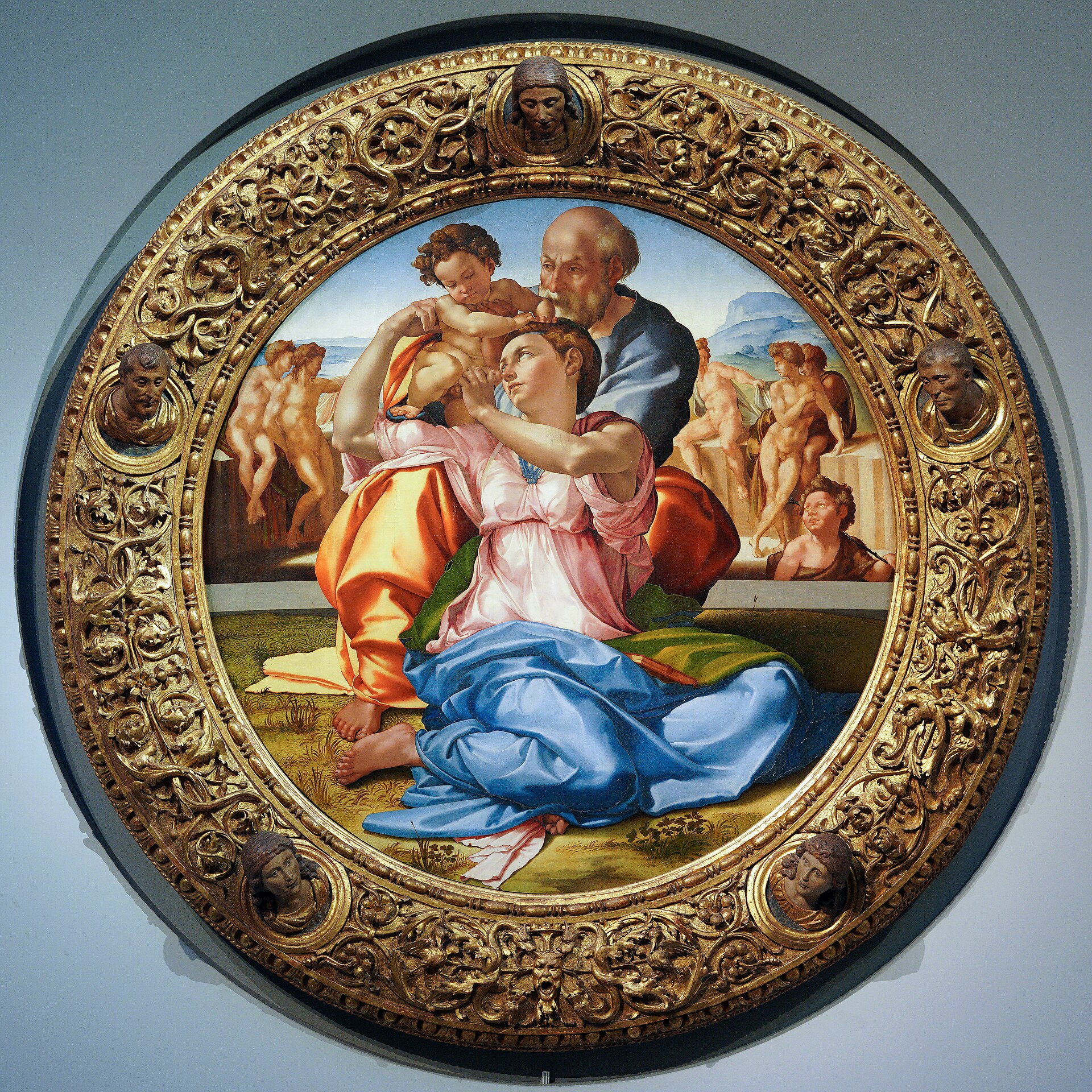
The only finished panel painting Michelangelo ever made. He did not enjoy the format. He preferred sculpture, and after this he preferred frescoes. But around 1506, before he started the Sistine Chapel ceiling, he produced this circular tempera-on-panel painting for the Florentine merchant Agnolo Doni and his wife Maddalena Strozzi, probably as a wedding or pregnancy gift.
The Holy Family is in the foreground. The Virgin twists impossibly to receive the Christ Child from Joseph behind her. Five nude male figures lounge in the middle distance, draped on a low wall, their function in the painting fiercely debated for five hundred years. (Pagans before the coming of Christ? Athletes from antiquity? An exercise in twisted male anatomy?)
The painting is small — about 120 cm in diameter — but every figure in every Michelangelo fresco painted afterward is, on some level, a footnote to it. The Sistine ceiling figures, the Last Judgement, the Medici tombs in San Lorenzo: they all started in this tondo. We have a whole essay on Michelangelo’s signature — the only sculpture he ever signed — that pairs well with this room.
The Doni Tondo is in Room 35, the same Leonardo room. The two great rivals of the early sixteenth century, painted at the same age, hung in the same gallery.
4. Raphael, Madonna of the Goldfinch (c. 1506)
Raphael was twenty-three when he painted this. He had recently arrived in Florence from Urbino. He was studying both Leonardo and Michelangelo. The painting shows it: the soft sfumato of the faces is Leonardo, the muscular structure of the Christ Child is Michelangelo. The composition — Mary, Christ, the young John the Baptist, arranged in a triangle around a goldfinch (a Christian symbol of the Passion) — is Raphael’s own.
The painting was nearly destroyed in 1547 when the house of its owner, Lorenzo Nasi, collapsed in an earthquake. It was reassembled from seventeen fragments. A 2008 restoration found and removed the worst of the patches. What you see now is what Raphael painted, with cleaner color than the painting has had for centuries.
The Madonna of the Goldfinch is in Room 41, the Raphael room. We have an essay on Raphael’s self-portrait in The School of Athens — a different painting, in a different city — that pairs with what this Madonna does for Raphael’s early career.
5. Titian, Venus of Urbino (1538)
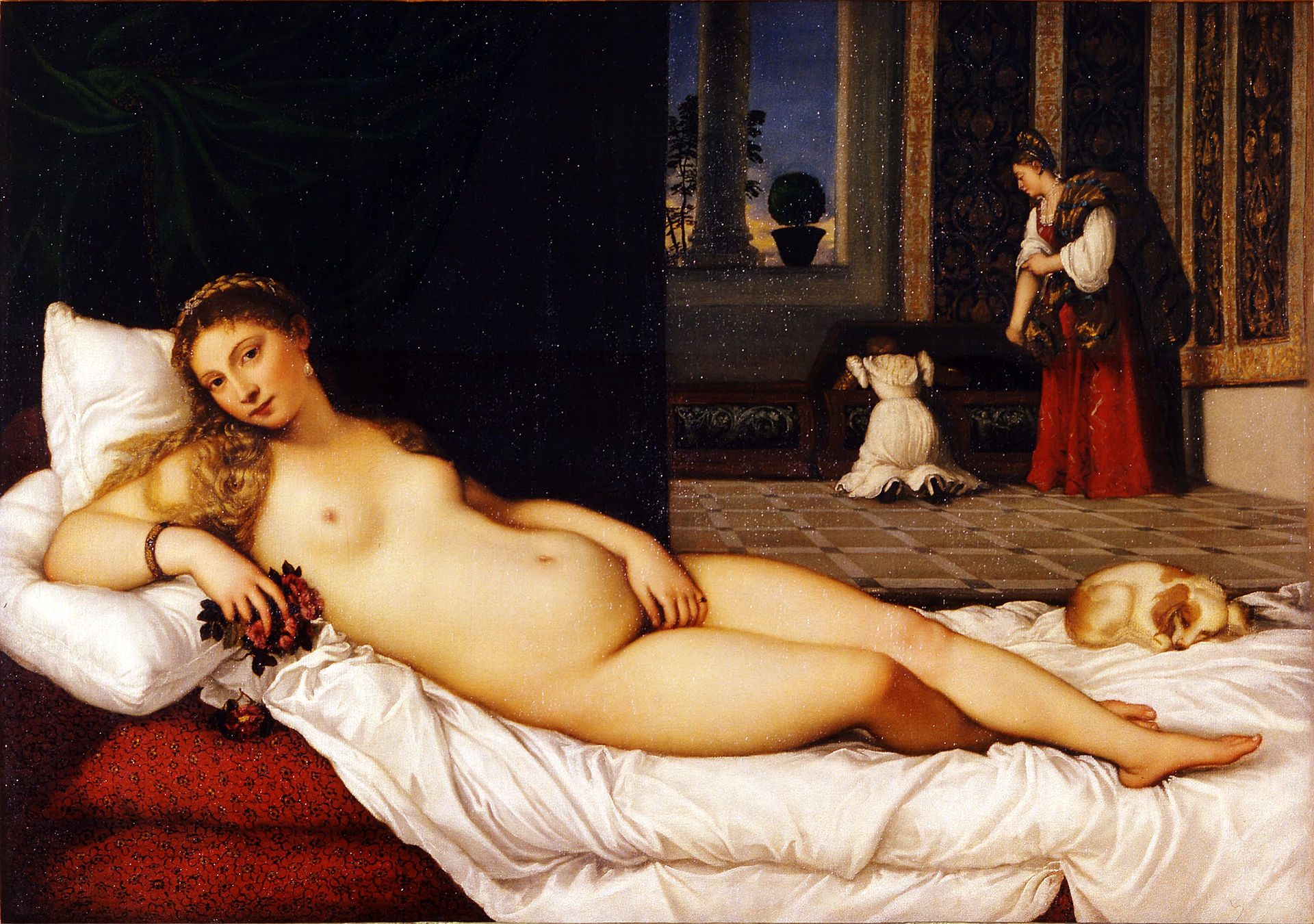
If Botticelli’s Birth of Venus opened the door for the female nude, Titian’s Venus of Urbino walked through it. Painted in 1538 for Guidobaldo della Rovere, then heir to the Duchy of Urbino, the painting shows a young woman reclining on her bed in a Venetian palace, looking calmly out at the viewer, while two servants in the background search through a chest for her clothes.
The painting is technically a Venus — there is a small bouquet of roses in her right hand, a sleeping spaniel at her feet (faithfulness, marital love), a myrtle plant on the windowsill behind (sacred to Venus). But it is also unmistakably a portrait of a real Venetian woman. The bedroom is real. The dog is real. The light coming in from the window is real.
This is the painting that taught every later reclining nude — Goya’s Maja, Manet’s Olympia, Modigliani — how to lie. It is in Room 83.
6. Caravaggio, Medusa (c. 1597)
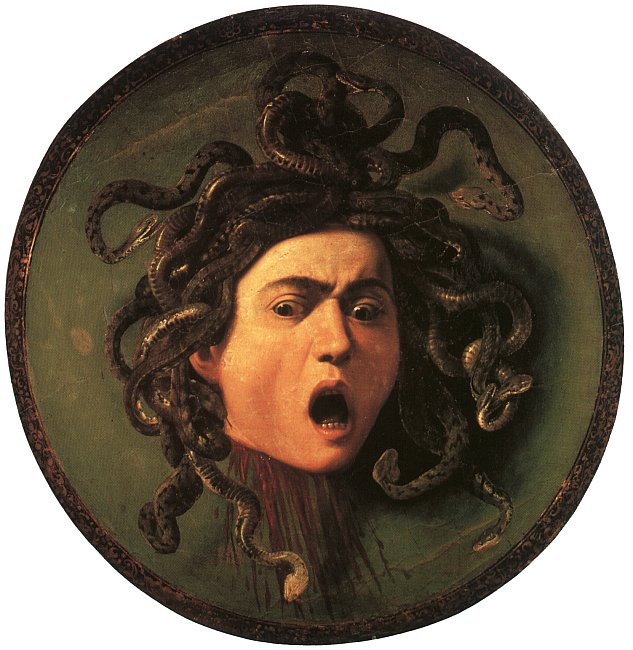
Caravaggio painted Medusa on a round, leather-covered wooden shield around 1597, as a gift to Cardinal Francesco Maria del Monte to be presented to Ferdinando I de’ Medici, Grand Duke of Tuscany. It is, technically, a parade shield — a ceremonial object, not a battle weapon — but it functions as a painting because Caravaggio used the convex surface to make the screaming head look as if it is bulging out toward the viewer.
The Medusa myth: a Gorgon with snakes for hair whose gaze turned men to stone, killed by Perseus, who used a polished shield to see her reflection without looking at her directly. Caravaggio painted the head in the moment after Perseus has cut it off. The eyes are still alive. The mouth is still open. The blood is still spurting. The scream, which most painters had treated as horrified, Caravaggio painted as bewildered.
The face under the snakes is Caravaggio’s own. He used himself as the model. It is one of the strangest, most disturbing self-portraits in Renaissance painting. We have a longer essay on Caravaggio’s other paintings in Rome, if the Medusa is your introduction to him.
7. Botticelli, Adoration of the Magi (c. 1475)
The Medici family group portrait disguised as a Bible scene. Botticelli painted himself, his patrons, and most of the Medici dynasty into this one panel painting, which probably hung in the church of Santa Maria Novella and which now sits in the Botticelli rooms. The figure of the kneeling king, traditionally identified as Cosimo il Vecchio, is actually a portrait of him. The figure on the right looking out at the viewer is Botticelli himself, age about thirty.
We have a whole essay on this painting — who is who, how the family portrait works, why the painter put himself into it. It is one of the most quietly autobiographical paintings of the fifteenth century, and one of the easiest to walk past.
8. Piero della Francesca, Diptych of the Duke and Duchess of Urbino (c. 1473–75)
A small two-panel double portrait of Federico da Montefeltro, the Duke of Urbino, and his wife Battista Sforza. They face each other, hers to his left, against a luminous Tuscan landscape that runs continuously across both panels. The duke is in profile, in red, with his famously broken nose (he had lost his right eye in a tournament and was always painted from the unbroken side). The duchess is also in profile, in pale skin and elaborate hair, but probably from a death mask: she had died in 1472, and Piero painted the diptych after.
Look at the landscape. It is the same view, in two halves. The light is consistent. The little river bends. The hills recede. This is one of the earliest atmospheric perspectives in Italian painting — not the geometric perspective of Leonardo, but the perspective of haze and color.
The diptych is in Room 8.
9. Artemisia Gentileschi, Judith Slaying Holofernes (c. 1620)
The painting that, more than any other, has made Artemisia Gentileschi a name people now recognize. She painted it in Florence around 1620, a few years after she had been raped at seventeen by her father’s colleague Agostino Tassi and had testified against him in the Roman court that convicted him. The biographical reading is that the painting is a revenge fantasy: Artemisia paints Judith, the biblical heroine who beheaded the invading general Holofernes, as a strong-armed woman doing the work calmly, with her maidservant pinning the general’s body for her.
The painting is huge, dark, Caravaggesque. The blood is realistic. The arms are powerful. Artemisia knew exactly what she was doing.
She is in Room 90, in the Caravaggio rooms.
10. Cimabue, Maestà di Santa Trinita (c. 1283), and Giotto, Ognissanti Madonna (c. 1310)
The two altarpieces with which the Uffizi opens the second floor, side by side, in Room 2. Cimabue’s gilded Maestà — Mary on her throne, surrounded by saints and angels — is one of the great late-Byzantine icons. Giotto’s Ognissanti Madonna, painted thirty years later, is the painting where Italian art turns. Mary’s body has weight. Her knees show under the cloth. The throne is a real wooden chair, in three dimensions, with shadow. Western painting changes in the gap between these two altarpieces. To stand between them is to stand at the hinge.
Most visitors blow past this room on their way upstairs to Botticelli. Don’t.
How the museum is organized
The U-shaped building has two long parallel wings — the East Corridor and the West Corridor — connected at the south end by a short third corridor that overlooks the Arno. The visitor route runs counter-clockwise: up to the second floor on the East side, across the south corridor with its view of the river, back down the West side. The corridors themselves are hung with classical sculptures and the painted ceiling is decorated with sixteenth-century grotesques copied from Roman antiquity.
The galleries open off the corridors. Second floor: the Tuscan medieval and early Renaissance work. Third floor (recently reopened after a multi-year renovation): the High Renaissance, Mannerism, Caravaggio, Artemisia, and the Flemish and German paintings. The Vasari Corridor — the famous covered passage that runs from the Uffizi over Ponte Vecchio to the Pitti Palace — has reopened in 2024 after a decade-long closure, but as a separate timed-ticket attraction, not a default part of the visit.
The first-timer’s walkthrough covers the route in detail, and the reservations guide handles tickets.
Why the museum exists at all
The story is a very good one and worth knowing.
In 1737, the last Medici, Anna Maria Luisa, signed the Patto di Famiglia — the Family Pact — with the incoming Lorraine dynasty that was about to inherit Tuscany. The pact had one critical condition: the entire Medici art collection had to remain in Florence forever. It could not be sold off, could not be moved to Vienna, could not be broken up. Anna Maria Luisa, who had no heirs and was watching her family’s three-hundred-year rule end, made the most consequential cultural-policy decision in European history. She tied the collection to the city.
This is why the Uffizi exists. It is why Florence, a town of 360,000 people, has the largest concentration of Renaissance painting in the world. It is why, in 1769, when the offices in the building were finally moved out and the upper floors were opened to the public, the new Lorraine grand dukes had no choice but to keep the Medici collection on display. The pact stuck. It is still legally in force today.
Anna Maria Luisa is buried in the Medici Chapels at San Lorenzo, a ten-minute walk from the Uffizi. The other Renaissance painting collections that scattered into private hands — Mantua’s, Urbino’s, Modena’s — got broken up by sale, war, and inheritance over the next two centuries. Florence’s didn’t.
Chiaro walks through the chronological arc of the museum — from Cimabue’s gilded Maestà in Room 2 to Caravaggio’s Medusa and Artemisia’s Judith in Room 90 — as one continuous unfolding of Italian painting, so the rooms read as a story instead of a list.
What to skip if you have only two hours
If you only have two hours, do these in this order: Cimabue and Giotto in Room 2, Piero della Francesca’s diptych in Room 8, Botticelli’s Primavera and Birth of Venus in Room 10–14, Leonardo and Michelangelo in Room 35, Raphael in Room 41, Titian in Room 83, Caravaggio in Room 90.
That is ten rooms. Two hours is enough. Skip the ground floor (drawings and prints), skip the long Niobe Room with the Roman copies, skip the Botticelli workshop pieces that are not the two big ones. Save those for the second visit.
For broader context on how to think about Italian museum itineraries, the parallel piece on the Borghese is the best comparison: smaller museum, denser collection, similarly Medici-adjacent.
The kicker
The Uffizi is not a museum that was built to hold art. It is an office building that started decorating its upstairs hall, kept decorating, and could not stop. By the time the offices moved out, the art had taken over. Anna Maria Luisa de’ Medici tied the collection to the building forever in 1737. The building has been a museum ever since. Walk in expecting Botticelli. Stay for the way Western painting got organized. The whole story, more or less, is on these two floors.
Image credits
- Piazzale degli Uffizi perspective view, Florence, Italy, August 2025.jpg — Camunesco, Source, CC BY-SA 4.0.
- Sandro Botticelli - La nascita di Venere - Google Art Project - edited.jpg — Sandro Botticelli (c. 1445-1510), Source, Public Domain.
- Medusa by Caravaggio 2.jpg — Caravaggio (1571-1610), Source, Public Domain.
- Leonardo da Vinci - Annunciazione - Google Art Project.jpg — Leonardo da Vinci (1452-1519), Source, Public Domain.
- Tondo Doni 2021.jpg — Michelangelo Buonarroti (1475-1564), Source, Public Domain.
- Tiziano - Venere di Urbino - Google Art Project.jpg — Titian (c. 1488-1576), Source, Public Domain.


