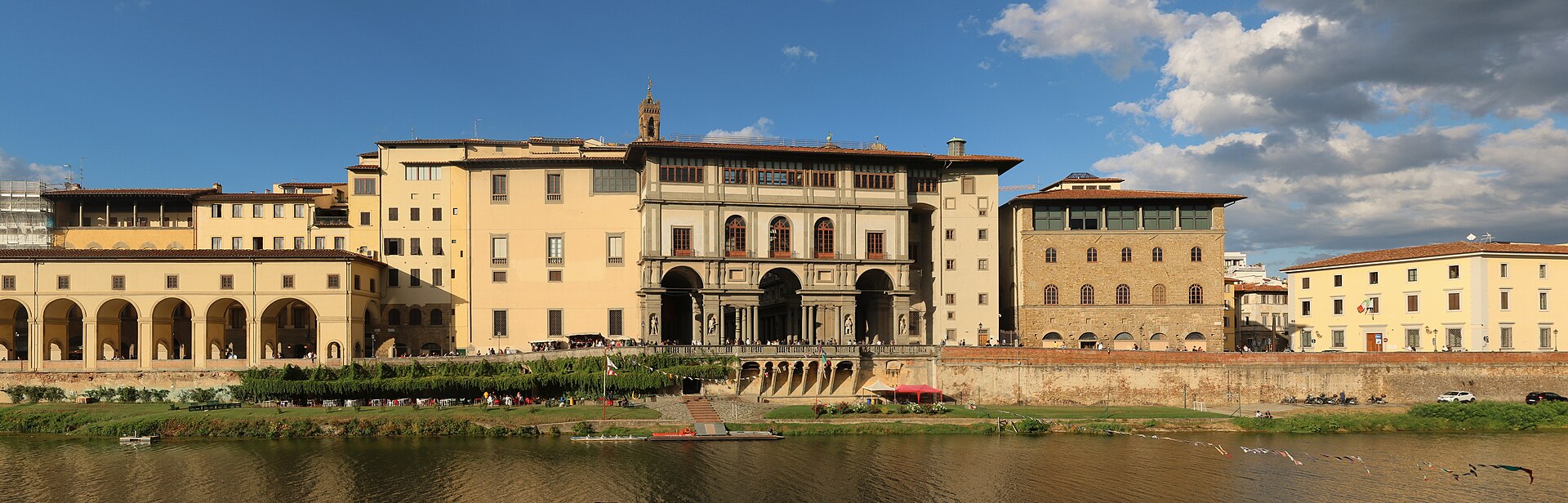
The Uffizi Gallery Florence is one of the strangest museum buildings in Europe, and the strangeness is most of the experience. It is not a freestanding palace, not a converted church, not a purpose-built museum. It is a sixteenth-century government office complex, U-shaped, with the open end of the U facing the river. You walk into the courtyard between the two long arms, you go up to the second floor of the eastern arm, you walk the entire length of the eastern wing, you cross the short southern corridor that hangs over the Arno, you walk back the entire length of the western wing, and you exit. The route is, in itself, a kind of map of how the Medici thought about administering Florence in 1560.
This is the first-timer’s walkthrough. Where the building sits in the city. The route through it. Where to enter and where to exit. The view from the southern corridor. The Vasari Corridor that connects it to the Pitti Palace. The five things to do before and after on the same day.
Where it sits in Florence
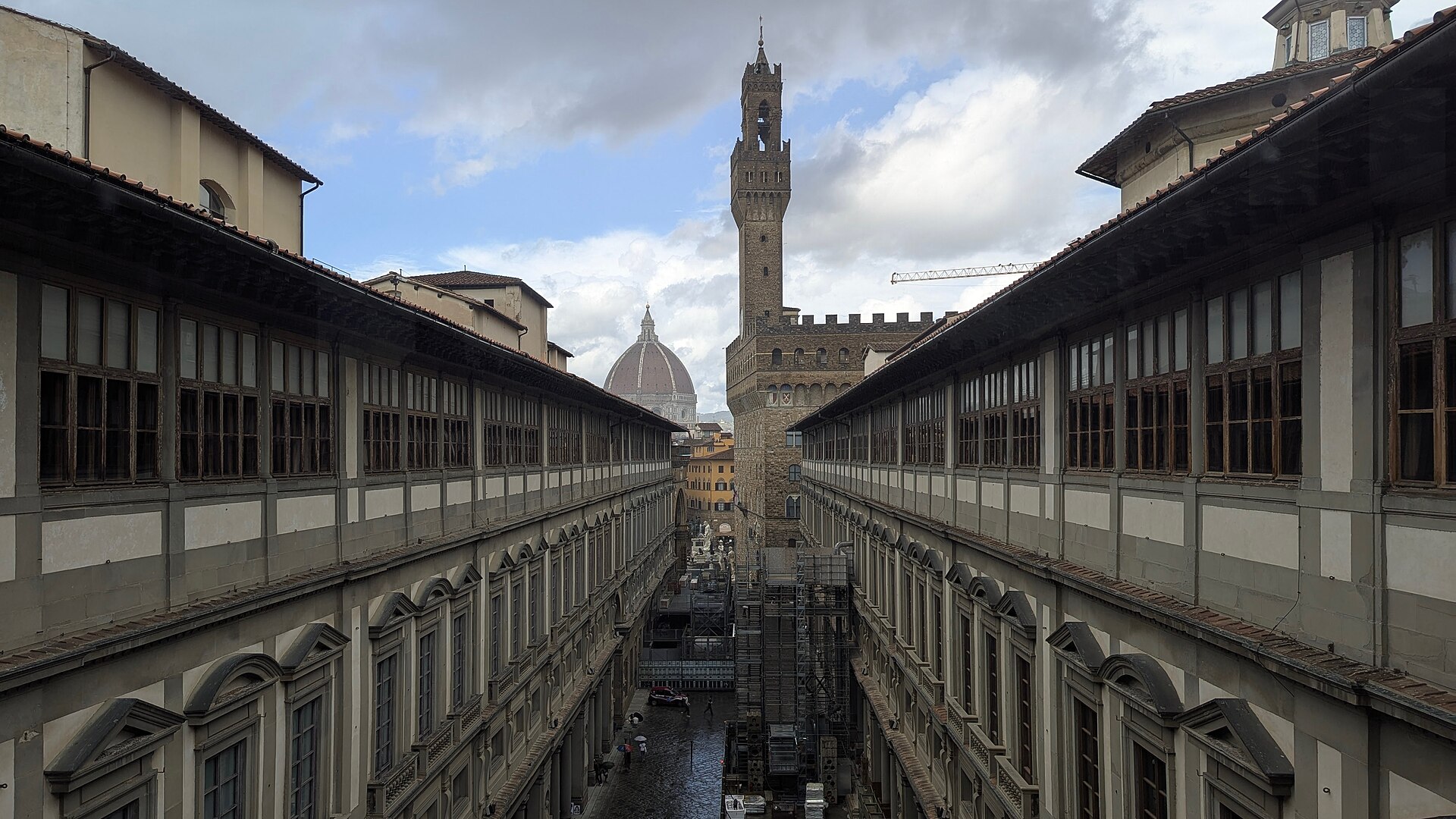
The Uffizi is in the very center of Florence, between the Piazza della Signoria and the Arno river. Stand in front of Palazzo Vecchio, the medieval town hall with its tall crenellated tower. The Uffizi’s open courtyard runs back, perpendicular to the Palazzo, all the way to the river. From the river end, you can see the Ponte Vecchio about two hundred meters to your west, the bridge with the gold-and-jewelry shops along its sides.
So the Uffizi is wedged into the narrow strip of land between the Piazza della Signoria and the Arno. The building’s design takes advantage of the geometry. The two long parallel wings run north-south. The short southern corridor closes the U with a covered passage that overhangs the river itself. The building was designed in 1560 by Giorgio Vasari for Cosimo I de’ Medici, the first Grand Duke of Tuscany, to house the thirteen Florentine magistracies — the uffizi, “offices” — in one architectural complex. The art collection moved into the upper floors a generation later. The offices moved out, slowly, over the next two centuries.
The closest landmarks: Palazzo Vecchio is at the north end of the Piazza degli Uffizi, the courtyard between the wings. The Loggia dei Lanzi, with its open-air sculpture gallery, is on the corner where the courtyard meets the Piazza della Signoria. Ponte Vecchio is two hundred meters west along the Lungarno. The Duomo — Florence’s striped marble cathedral with Brunelleschi’s dome — is a five-minute walk north.
Walking distance from any of these means everything is close. Florence’s historic center is small. From the Duomo to Ponte Vecchio is fifteen minutes on foot.
How to get to the entrance
The address is Piazzale degli Uffizi 6, 50122 Firenze. There is no metro stop. Florence does not have a metro. (There is a tram system, but it does not serve the historic center.) The closest train station is Santa Maria Novella, the main Florence station, about a fifteen-minute walk away. Most visitors come from Santa Maria Novella on foot.
If you are staying in central Florence — within a thirty-minute walk of the Duomo — walk to the Uffizi. There is no faster way. Taxis exist but are not allowed into the pedestrian zone, which extends most of the way to the museum. Buses are similarly indirect.
The route from Santa Maria Novella station: out the front doors of the station onto Piazza della Stazione, south on Via dei Banchi to the Duomo (about eight minutes), then south again on Via dei Calzaiuoli to Piazza della Signoria (about five minutes), then through the piazza to the Uffizi courtyard. The whole walk is about fifteen minutes and takes you past most of the city’s most famous landmarks.
Where to enter
The Uffizi has four doors along the long courtyard between the two wings. They look almost identical from the street. They are not interchangeable.
- Entrance 1: the door for visitors without a ticket — the walk-up line. Long, slow, often hours. Avoid.
- Entrance 2: the door for visitors with a confirmed timed-entry reservation. This is the one to use. The line is shorter, fifteen to thirty minutes, and moves at a steady pace through the security check.
- Entrance 3: the door for groups with a guide. If you accidentally line up here as a solo visitor, the guards will redirect you. (This is a common mistake.)
- Entrance 4: the exit, on the west wing near the river end. You cannot enter through this door.
The reservations guide covers booking on uffizi.it in detail. The single most important practical decision is to use Entrance 2, with a pre-booked ticket from the official site.
The route, in five segments
The visit is organized as a counter-clockwise loop through the U-shaped building. Up the East Wing, across the South Corridor, back down the West Wing, exit. Five segments, in order:
1. The East Wing, second floor: medieval to early Renaissance
You enter on the ground floor, ride or walk up the staircase to the second floor, and emerge into the East Corridor. This is the long, frescoed-ceiling, sculpture-lined gallery that runs the entire length of the building’s east wing. The corridor itself is the spine of the museum. Most of the painting galleries open off it as side rooms.
The first segment of rooms — Rooms 2 through 9 — is the early Italian section: Cimabue, Giotto, Simone Martini, Gentile da Fabriano, Filippo Lippi, Piero della Francesca, Paolo Uccello. This is where Italian painting becomes Italian painting. Don’t blow past it. Cimabue’s Maestà and Giotto’s Ognissanti Madonna in Room 2 are the painting in the museum where the Western tradition turns from icon to image. Stand between them.
2. Room 10–14: Botticelli
The next side gallery is the long Botticelli room — formally Rooms 10 through 14, but they all open into one another as a single connected space. La Primavera is on one wall. The Birth of Venus is on another. The Adoration of the Magi is nearby. The room is the most visited in the museum. The crowd is real. The light is calibrated for tempera on panel and the paintings glow under it.
We have separate essays on the Birth of Venus, the Primavera, the Adoration of the Magi, and a visitor’s guide to finding the Birth of Venus in this specific room. On a first visit, give the Botticelli room twenty minutes.
3. Rooms 35–41: Leonardo, Michelangelo, Raphael
Past Botticelli, the corridor continues into the High Renaissance rooms. Leonardo’s Annunciation and the unfinished Adoration of the Magi are in Room 35. Michelangelo’s Doni Tondo — the only finished panel painting Michelangelo ever made — is in the same room. Raphael’s Madonna of the Goldfinch is two rooms down, in Room 41.
This is the room sequence where most first-time visitors realize how dense the museum is. The three biggest names of the early sixteenth century are within fifty feet of each other. Spend twenty minutes here.
4. The South Corridor
At the south end of the East Wing, the corridor turns ninety degrees and runs along the river end of the building. This is the South Corridor, the short connecting passage that closes the U.
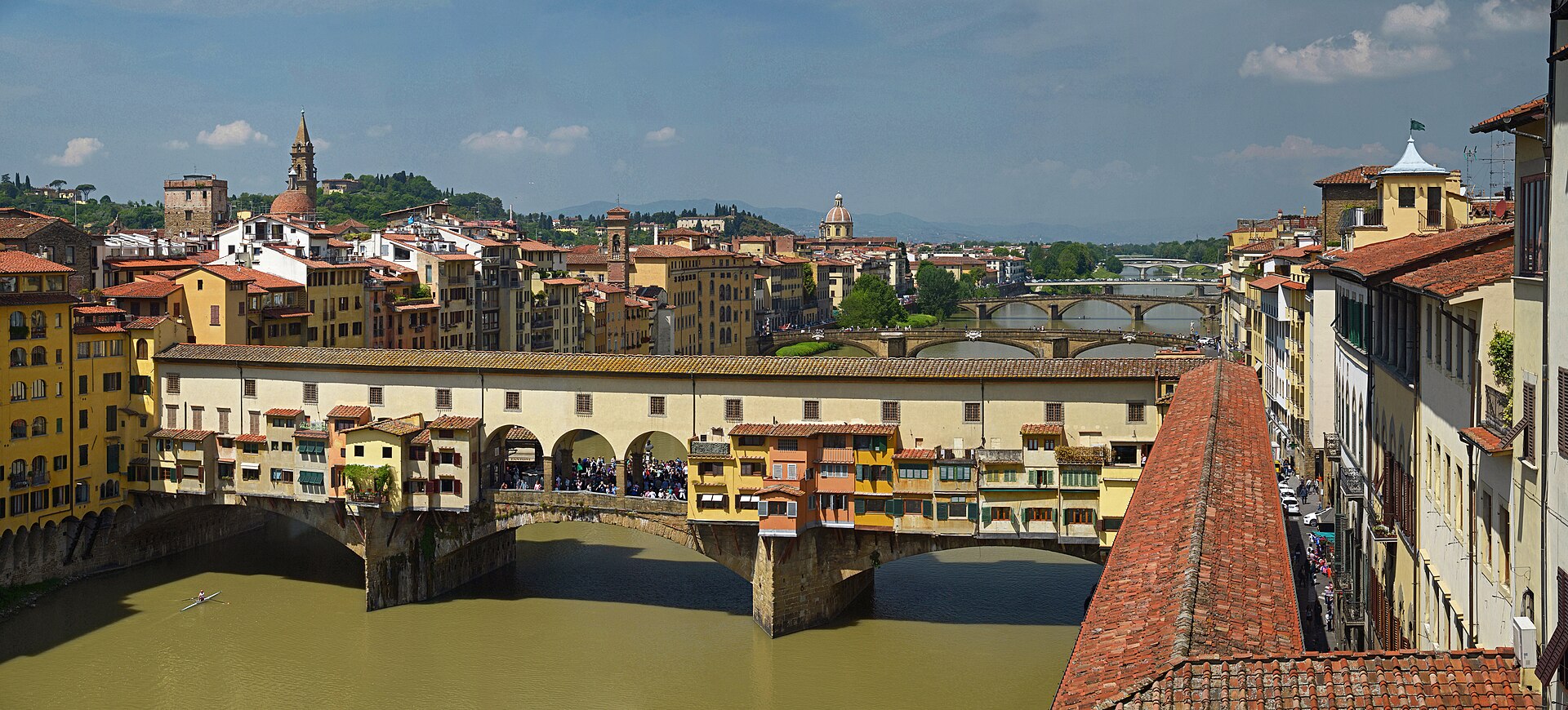
Stop at the windows. The Arno runs underneath. Ponte Vecchio is to your right. The Vasari Corridor — the covered passage — runs across the top of the bridge. This is the view nobody mentions in standard guidebooks but everybody who has been to the Uffizi remembers. It is also the easiest place in the building to feel the Medici scale of operations: the family connected its town hall to its private palace by a kilometer of covered walkway, so they could move through the city without setting foot on the street. The corridor was finished in 1565. It is still there.
5. The West Wing, third floor: Titian, Caravaggio, Artemisia
The West Wing has been completely restructured by the long restoration that ended in late 2024. The third-floor galleries now hold the high-Renaissance Venetian, Baroque, and Caravaggesque collections. Titian’s Venus of Urbino is in Room 83. Caravaggio’s Medusa and Bacchus and Sacrifice of Isaac are in Room 90. Artemisia Gentileschi’s Judith Slaying Holofernes is in the same Caravaggio room.
The third-floor rooms are quieter than the second-floor Botticellis. The light is different — cooler, sharper — and the seventeenth-century paintings reward it. Spend forty-five minutes here. We have a longer essay on Caravaggio’s other paintings in Rome that pairs with the Caravaggios in this room.
The exit is at the river end of the West Wing, through the gift shop, back out into the courtyard.
The interior
The interior is part of the visit. The corridors are not just transit. They are themselves frescoed and sculpted, in continuous bands of late-Renaissance grotesques along the ceiling and Roman busts and statues lining the walls. The ceiling is the work of a team of late-sixteenth-century painters who copied the wall paintings from Nero’s Golden House in Rome. The grotesques are full of small jokes — winged satyrs, animals dressed as humans, painted-on architecture — that reward looking up.
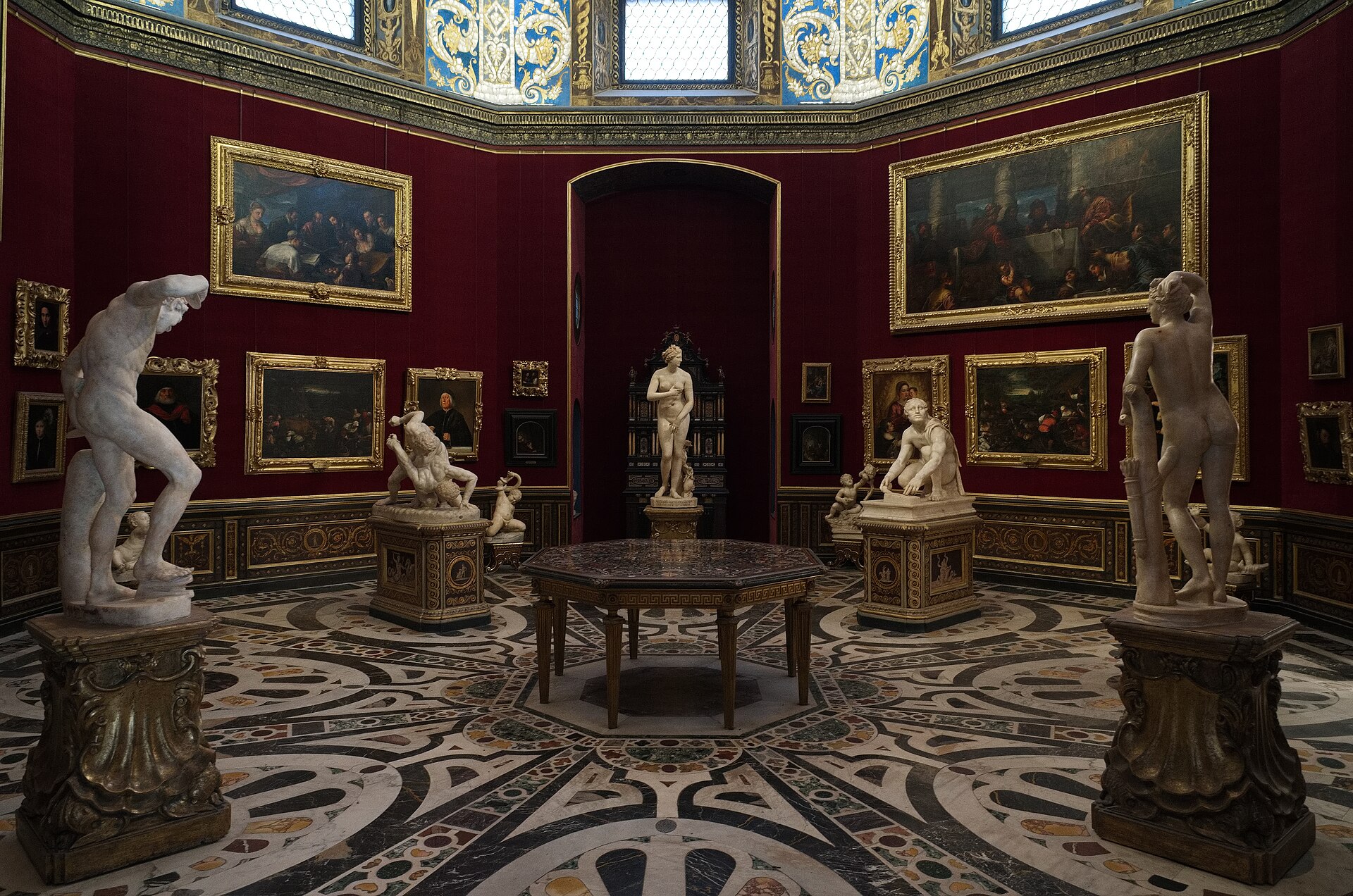
The most architecturally distinctive room is the Tribuna, the octagonal red-walled room near the middle of the East Wing. It was built in 1581 by Bernardo Buontalenti to house the most precious objects in the Medici collection — gemstones, ivories, the so-called “Medici Venus” sculpture, and the small panel paintings the family valued most. The Tribuna is a self-contained little museum within the museum. The original cabinet-of-curiosities arrangement has been partly preserved. You can look in but not enter (a glass barrier holds visitors at the doorway), which has been the rule since the room was structurally restored in the 2010s.
The Vasari Corridor
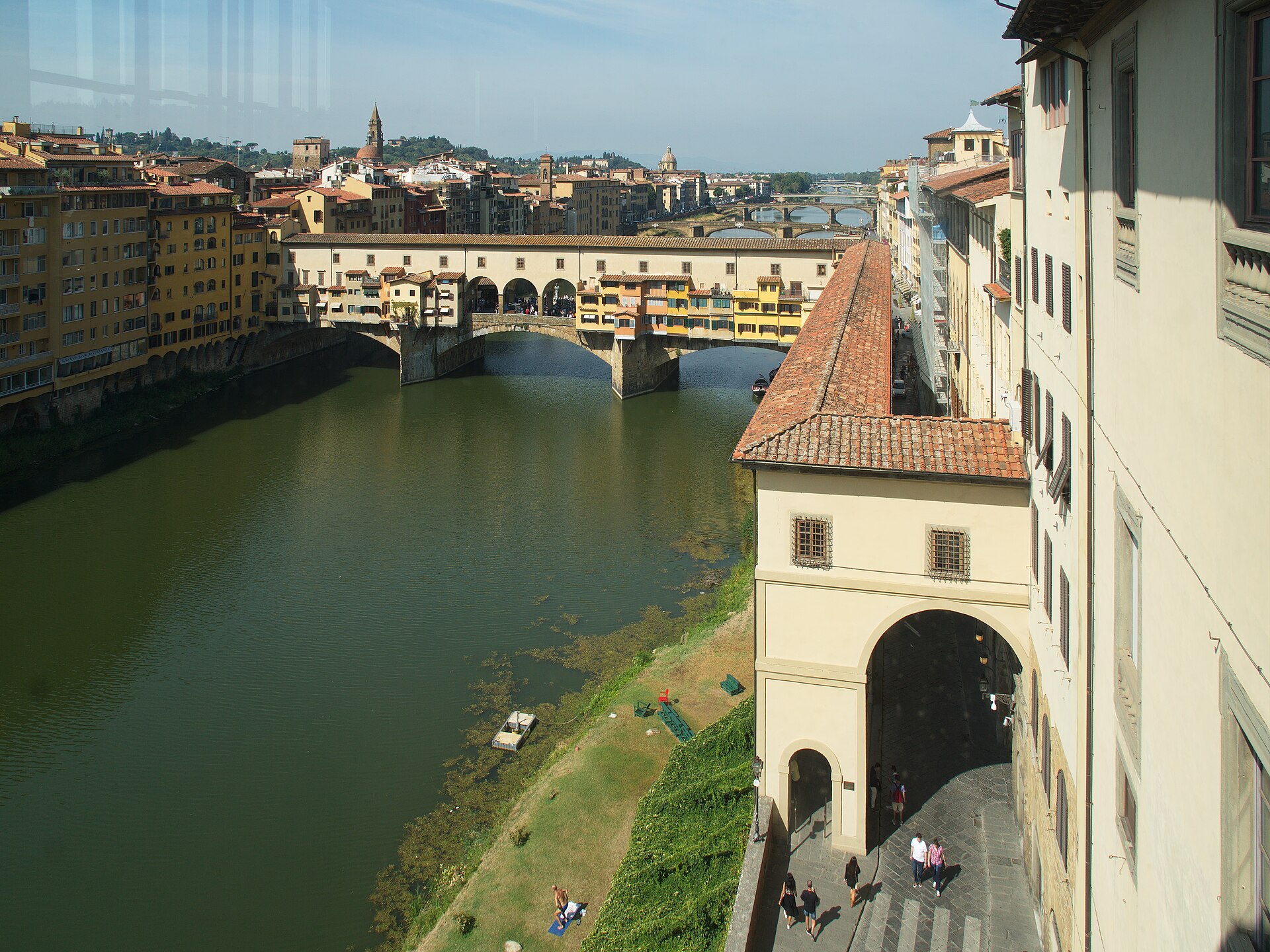
The Vasari Corridor is the kilometer-long covered passage that runs from the Uffizi, across the Ponte Vecchio, and over to the Pitti Palace on the south bank of the Arno. It was designed by Vasari in 1565 for Cosimo I, finished in five months, and was originally a strictly private passage for the Medici family and their guests. The corridor allowed the Grand Duke to move between the seat of government (Palazzo Vecchio, connected to the Uffizi by an internal passage), and the family’s private residence (Pitti Palace), without ever having to walk through the public street.
For decades the corridor was hung with the Medici self-portrait collection — about 1,000 portraits, mostly self-portraits by famous painters — which made it one of the strangest museum spaces in Italy: a kilometer-long art gallery that you walked through, single file, with a guide.
The corridor closed for restoration in 2016 and reopened in late 2024 as a separate timed-ticket attraction. The self-portrait collection has mostly been redistributed to the main galleries. The corridor itself is now an architectural and historical experience: you walk the length of it, look out the small windows over the Ponte Vecchio, see the small chapel built into the corridor opposite the Mannelli tower, and exit at the Pitti Palace end.
The Vasari Corridor reservation is sold separately, around 45 euros, and adds an hour to the day. On a first visit to Florence, it is worth doing only if you are committed to the museum side of Florence. Most first-time visitors should skip it and use the time elsewhere.
What to do before
If you have an 08:15 slot, you will not have time to do anything before the museum. You will be in the breakfast queue at 07:30. That is fine. The Uffizi rewards going first.
If your slot is later — say, 11:00 or 14:00 — the natural pre-Uffizi stop is Piazza della Signoria, the wide square right next to the museum. The square is itself an open-air sculpture museum: a copy of Michelangelo’s David stands where the original used to (the original is in the Accademia, ten minutes north), and the Loggia dei Lanzi on the south side of the square has half a dozen monumental Renaissance and Roman sculptures including Cellini’s Perseus. Walk through, spend twenty minutes, then enter the Uffizi.
If you have a full morning before a 14:00 slot, walk five minutes to the Duomo and climb Brunelleschi’s dome (separate ticket, separate booking, also book ahead). The view from the top is the iconic Florence skyline. Allow an hour for the climb — 463 steps, no elevator, narrow stairs.
What to do after
The Uffizi exit drops you at the river end of the courtyard. From there, three natural moves:
- West along the Arno to Ponte Vecchio. The bridge is two hundred meters away. Cross it. The shops on the bridge have been jewelry shops since the late sixteenth century, when Ferdinando I de’ Medici banned the butchers and tanners who had originally occupied the bridge in the fourteenth century, because the smell offended the Vasari Corridor he had built directly above them.
- Across to the Pitti Palace and the Boboli Gardens. From Ponte Vecchio, ten minutes’ walk south to the Pitti, the family’s main residential palace from 1549 onward and now home to the Galleria Palatina (one of Italy’s great Baroque collections) and several smaller museums. The Boboli Gardens behind the Pitti are one of the great Italian Renaissance gardens. Allow two to three hours.
- North to the Accademia. A fifteen-minute walk north of the Uffizi is the Galleria dell’Accademia, home to Michelangelo’s original David. The Accademia is a small, focused museum — the David is the destination, with a few rooms of late-Gothic panel paintings around it — and absorbs about an hour. It is closed Mondays. Book ahead.
The neighborhoods south of the Arno — the Oltrarno — are quieter than the north bank, with smaller restaurants, artisan workshops, and the Brancacci Chapel in Santa Maria del Carmine, where Masaccio’s frescoes from 1427 are sometimes called the cradle of Italian Renaissance painting. We have written about how museum routes in northern Italian cities compare; the Borghese Gallery essay in Rome is the best parallel for thinking about a tightly-scheduled, timed-entry Italian art museum.
The interior view down the corridors
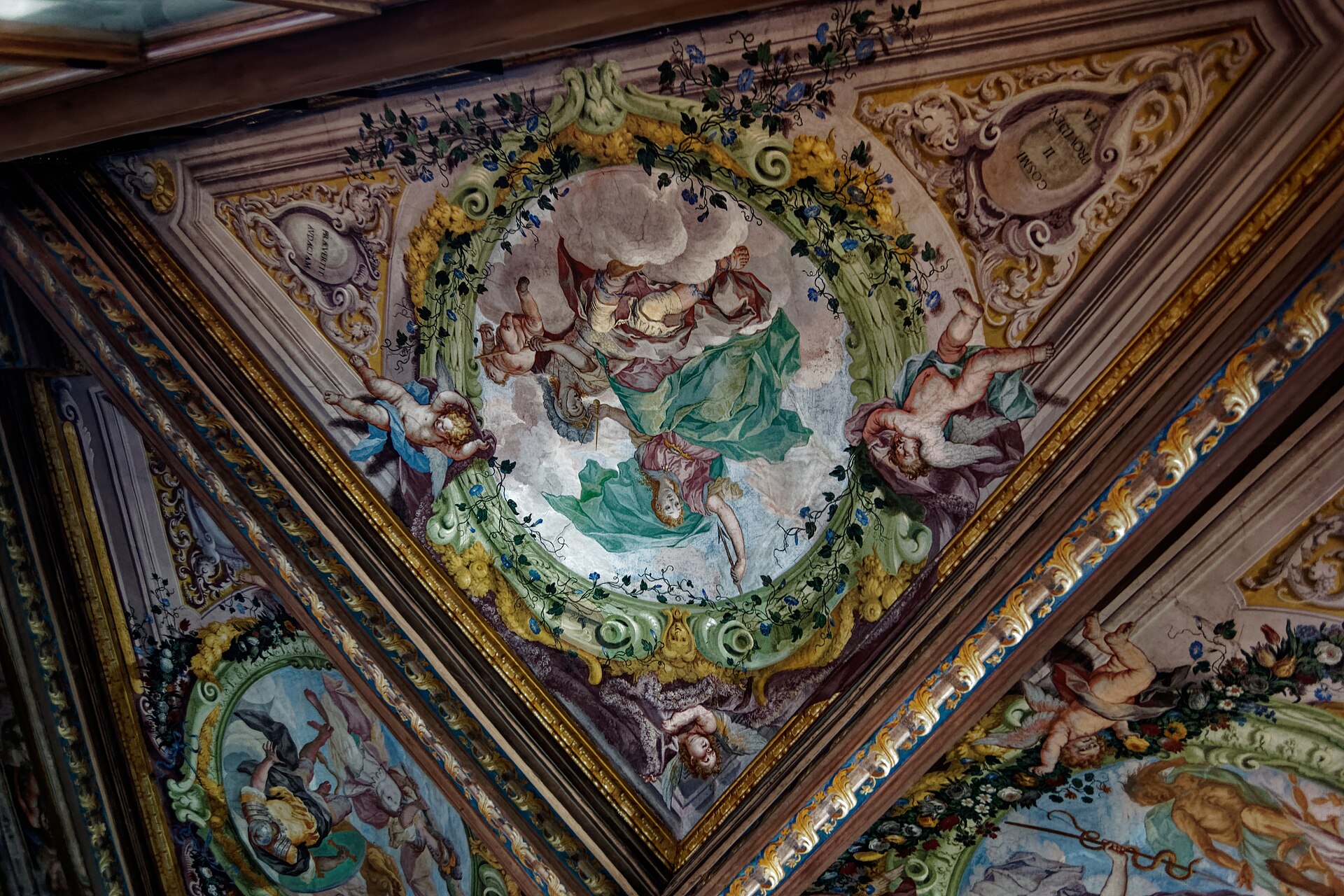
If you have any spare time on the way out of the museum, look up. The corridor ceilings are five hundred years of decorative invention. Whole landscapes are painted on them. The Romans buried in the floor of Nero’s Golden House inspired everything — the painted vines, the trompe l’oeil architecture, the tiny mythological figures tucked into the corners. The ceilings are the part of the museum visitors most consistently miss.
Chiaro walks through the route — east corridor up, south corridor across, west corridor down — as one continuous architectural experience, so the building itself reads as a single Medici instrument for moving the eye through five hundred years of painting.
The realistic time budget
A reasonable first-time Uffizi visit is three to four hours, plus thirty minutes for security and entrance, plus thirty minutes to exit through the gift shop and back into the city. So allocate about four to five hours total, from leaving your hotel to standing back on the Lungarno after the visit.
If you are doing a single day in Florence, the Uffizi takes the morning. The afternoon is for Ponte Vecchio, the Pitti, and the Accademia. The evening is for dinner and a walk back through the lit-up Piazza della Signoria. That is a complete one-day Florence itinerary, and it is exactly what most visitors do.
The kicker
Walk into the courtyard. Look up at the long parallel wings. Behind every window on the second floor is a painting older than your country. The route is counter-clockwise: east up, south across, west down. The whole building is one continuous loop through the way the Medici thought about art, government, and the Arno river. Three hours later, when you walk out the gift shop end, you will have seen the largest concentrated stretch of Renaissance painting on Earth, and you will have done it inside a building that was, originally, just an office.
Image credits
- Florence - Uffizi from Arno.jpg — Diego Delso. Source, CC BY-SA 4.0.
- Piazzale degli Uffizi perspective view, Florence, Italy, August 2025.jpg — Camunesco. Source, CC BY-SA 4.0.
- Vasari corridor and Ponte Vecchio seen from the Uffizi.jpg — Diliff. Source, CC BY-SA 3.0.
- Florence, Uffizi, Tribuna-2.jpg — Sailko. Source, CC BY-SA 3.0.
- Firenze - Florence - Galleria degli Uffizi - Vasari Corridor 1566 - Decorated Ceiling.jpg — Txllxt TxllxT. Source, CC BY-SA 4.0.
- View of the Ponte Vecchio and Arno river from the Uffizi Gallery. Florence, Italy.jpg — Vyacheslav Argenberg. Source, CC BY 4.0.


