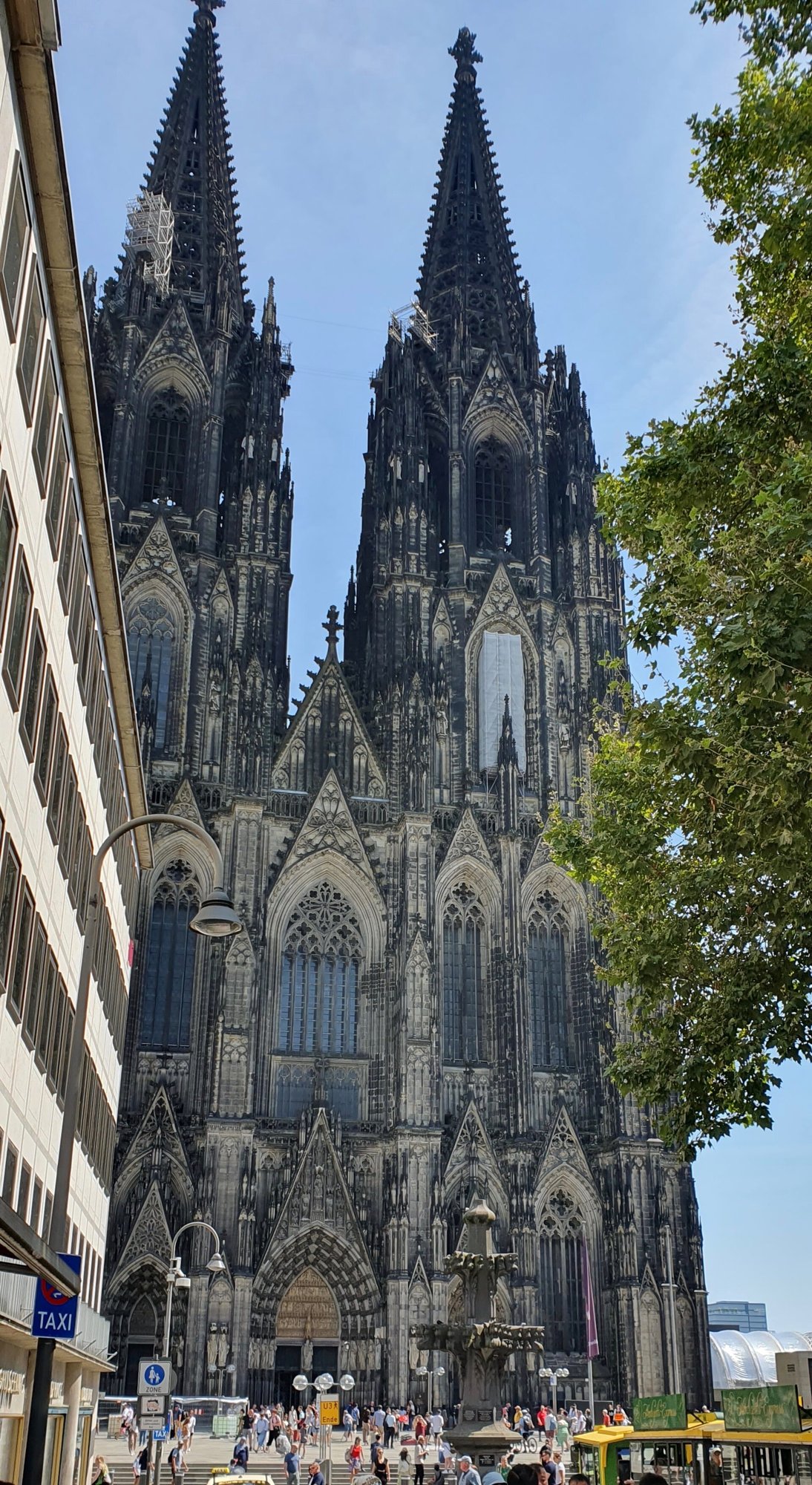
In most European cities you can’t walk ten minutes without passing a church. Some are famous. Most aren’t, and they’re often the more interesting ones: a plain door in a side street that opens on a gilded ceiling, a Romanesque front older than anything else on the square, a saint over the portal holding something you can’t quite make out.
Every church answers four questions if you know how to ask them: what kind of church it is, who it’s dedicated to, roughly when it was built, and what’s worth seeing inside. This post walks through each one. For the general question of identifying any building, start with how to find out what building you’re looking at. This one is about churches only.
Church, cathedral, basilica, chapel: what’s the difference?
The name on the map already tells you something.
A church is the general word: a building for Christian worship. A parish church serves the people who live around it.
A cathedral isn’t defined by size or beauty. It’s the church that holds a bishop’s throne, the cathedra, which is where the name comes from. A city usually has one. That’s why a modest building can be a cathedral and a huge one can be “just” a church.
A basilica means two things. In architecture, it’s a plan borrowed from Roman public halls: a long central nave with lower aisles on either side. In the Catholic Church, it’s also an honorary title granted by the pope to churches of special importance. Rome has four major basilicas, including St Peter’s. Hundreds of other churches around the world carry the lesser title of minor basilica.
A chapel is a smaller place of worship, often inside or attached to something else: a palace, a college, a hospital, or a side space within a bigger church. The Sainte-Chapelle in Paris was the chapel of the royal palace. The Sistine Chapel is the pope’s chapel, which is why the conclave meets there. We covered its restoration controversy in an earlier post.
An abbey was, or still is, the church of a monastery. Westminster Abbey kept the name long after the monks left.
Who is it dedicated to?
Almost every church is dedicated to someone: Christ, the Virgin Mary, a saint or a group of saints. The dedication is the church’s name, and it’s usually written on the building if you look.
Read the inscription. Over the main door or across the top of the facade, there is often a line in Latin. Italian Baroque churches often begin with D.O.M., short for Deo Optimo Maximo, “to God, the best and greatest”, followed by the saint’s name.
Look at who’s standing over the door. The figure in the place of honour, in the centre of the portal or at the top of the front, is usually the dedication saint. Saints are recognizable by what they carry, their attributes:
- Keys: St Peter, who was given the keys of heaven.
- A sword: St Paul, who was beheaded.
- An X-shaped cross: St Andrew.
- A wheel: St Catherine of Alexandria.
- A gridiron: St Lawrence, who was martyred on one.
- Arrows: St Sebastian.
- A scallop shell and a pilgrim’s staff: St James, patron of the pilgrims to Santiago.
- A lamb, and clothes of camel hair: St John the Baptist.
- A winged lion, ox, eagle or man: the four evangelists Mark, Luke, John and Matthew.
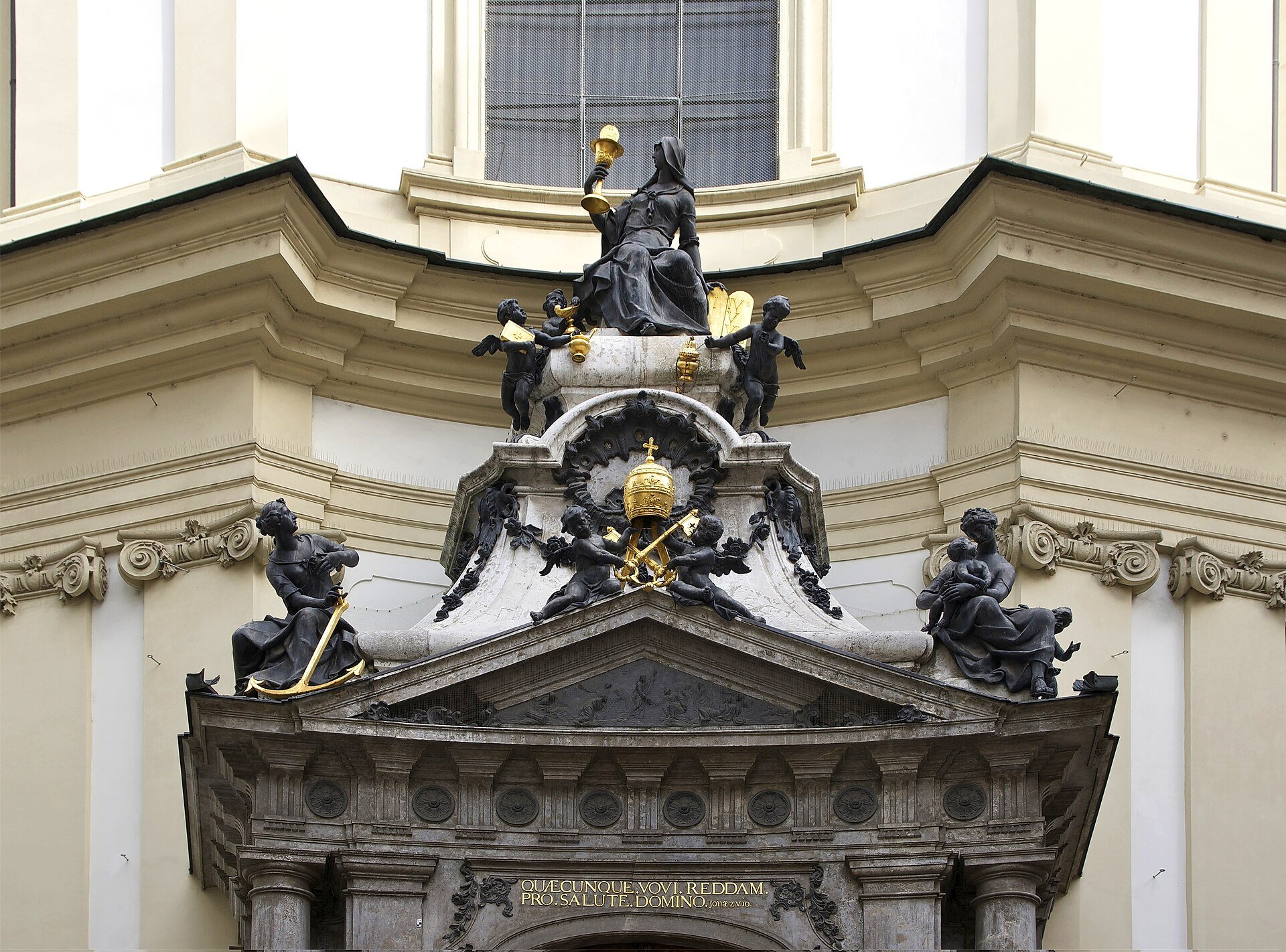
Once you know the attributes, you can name the saints on almost any portal in Europe. Three Gothic portals, like those at Notre-Dame de Paris, are a whole sculpted book: the Last Judgement in the centre, the Virgin on one side, St Anne on the other. Our Notre-Dame post reads them one by one.
Which way is it facing?
Traditionally, a church is built with its altar at the east end, facing Jerusalem and the rising sun, and the main door at the west. That’s why the front of a Gothic cathedral is called the west front.
It’s a tradition, not a rule. Where a site or a street made it impossible, builders turned the church round. St Peter’s in Rome is the most famous exception: its front faces east and its apse points west. But if you’re lost in an old town, the curved end of a church is still a reasonable guess for east.
How old is it? Reading the style from the outside
You don’t need to be an architect to put a church in the right century. Four styles cover most of what you’ll see in Europe.
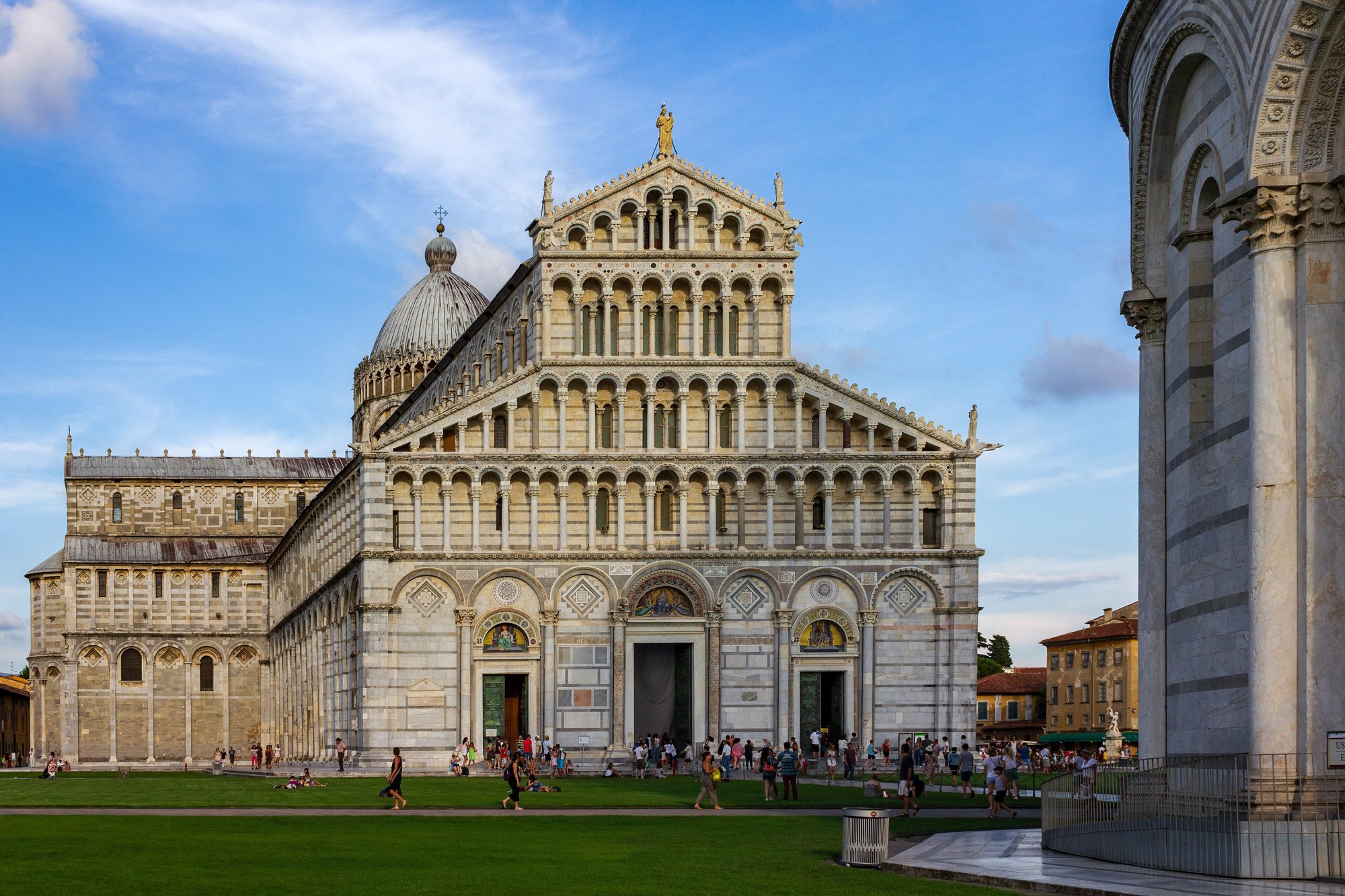
Romanesque (roughly 1000-1200). Thick walls, round arches, small windows, a heavy and solid feel. Decoration comes in bands and rows of small arcades. Pisa Cathedral, begun in the 11th century, is a famous example, and so is its leaning bell tower.
Gothic (roughly 1150-1500). Pointed arches, tall windows full of stained glass, a big round rose window over the door, spires, and flying buttresses holding the walls up from outside. Everything pulls upward. Cologne Cathedral is the extreme case: begun in 1248 and only finished in 1880, to the medieval plans.
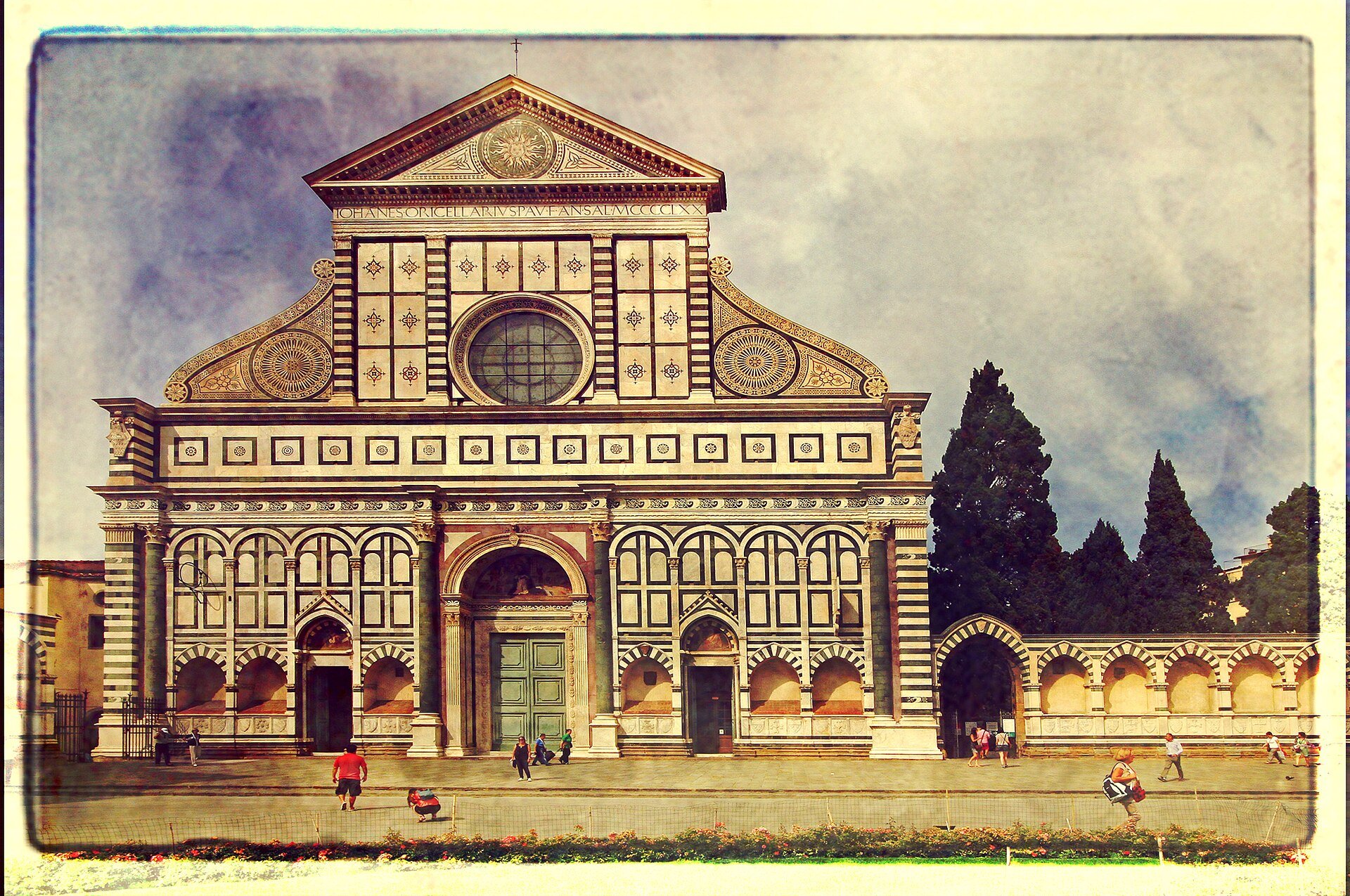
Renaissance (roughly 1400-1600). Back to Rome: columns, pilasters, triangular pediments, symmetry, and simple geometry of squares and circles. And domes. Brunelleschi’s dome over Florence Cathedral is where it starts. Santa Maria Novella, across town, has a Renaissance front designed by Leon Battista Alberti set on top of an older Gothic church.
Baroque (roughly 1600-1750). The same classical pieces, but in motion. Facades curve in and out, pediments break open, there’s gold, marble in several colours, and light pouring in from windows you can’t see. It was designed to move you before you’d worked out why.
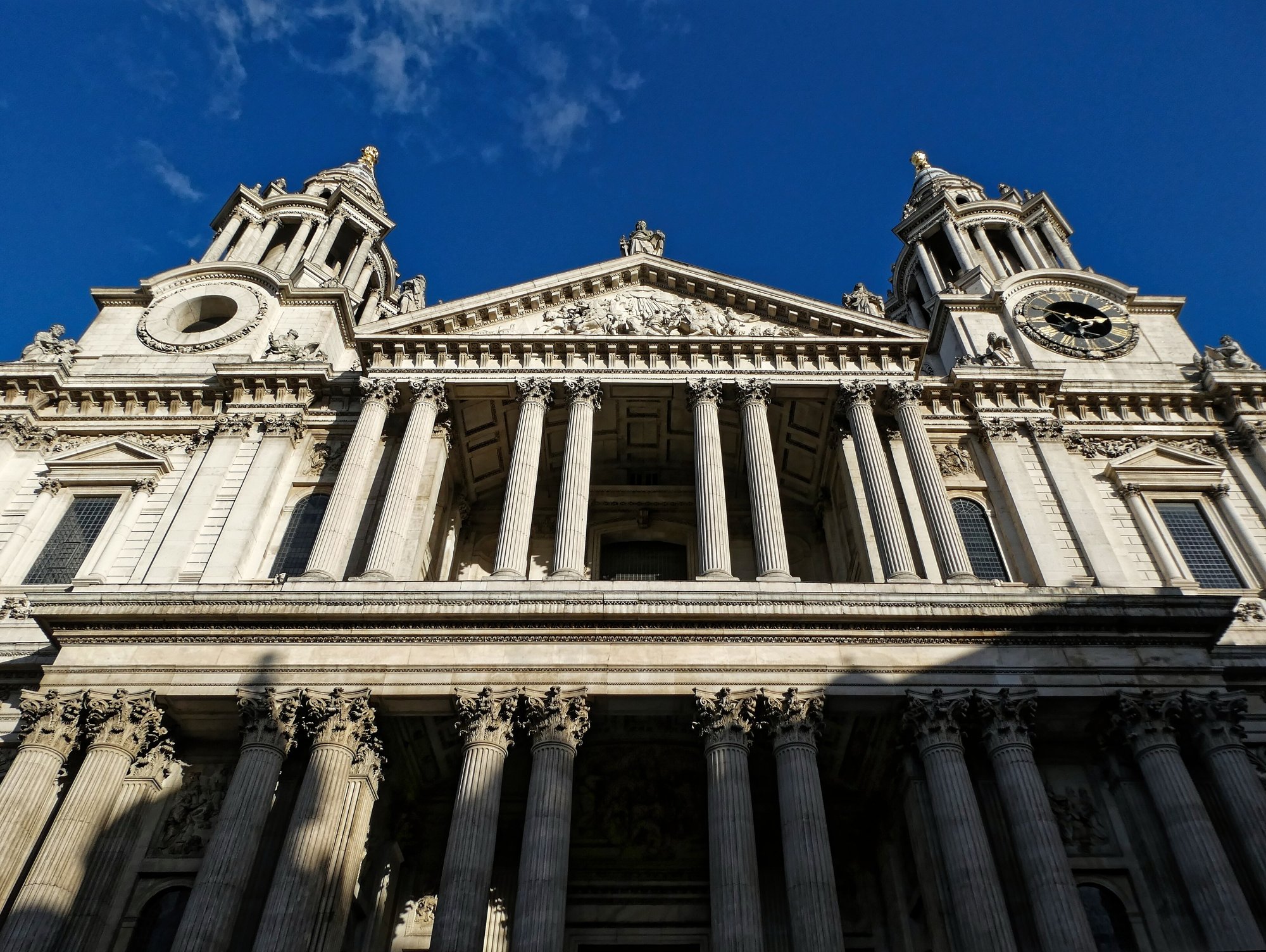
Then there are the churches that borrowed. A lot of what looks medieval was built in the 19th century, in the Gothic Revival. Sacré-Cœur on Montmartre took its white domes from Romanesque and Byzantine churches and was built between 1875 and 1914. And some churches change faith entirely: Hagia Sophia was built as a church in 537, became a mosque in 1453, a museum in 1934 and a mosque again in 2020. And Seville Cathedral still uses the minaret of the mosque it replaced as its bell tower.
Many churches are a mix, built over centuries, so the facade and the nave may disagree. That’s not a mistake. It’s the building’s history showing.
What to look for inside
Once you’re through the door:
- The high altar and the painting above it. The altarpiece usually shows the saint the church is dedicated to, or the event it celebrates.
- The side chapels. These were often paid for by rich families, and that’s where the best paintings hide. A Caravaggio in a Roman side chapel is a cliché for a reason.
- The floor. Tomb slabs with names, dates and coats of arms. People have been buried under church floors for centuries.
- The ceiling. Most visitors never look up. Frescoes, painted vaults and domes are often the best thing in the building.
- The light. Where it comes from, and what it falls on at this time of day, is usually not an accident.
How Chiaro does it
All of the above takes a while, and it’s easy to get one clue wrong. Chiaro does the whole thing from one photo.
One photo in, a story out. Point your camera at the church, the portal, the altarpiece or the saint over the door. Chiaro recognizes it and starts talking: what it is, who built it and why it matters. Audio starts within seconds, so you can keep your eyes on the building, not the screen.
Works almost anywhere you point it. The famous cathedrals and the side-street church that isn’t in any guidebook. If it has a story, Chiaro finds it. There are no city packs to download.
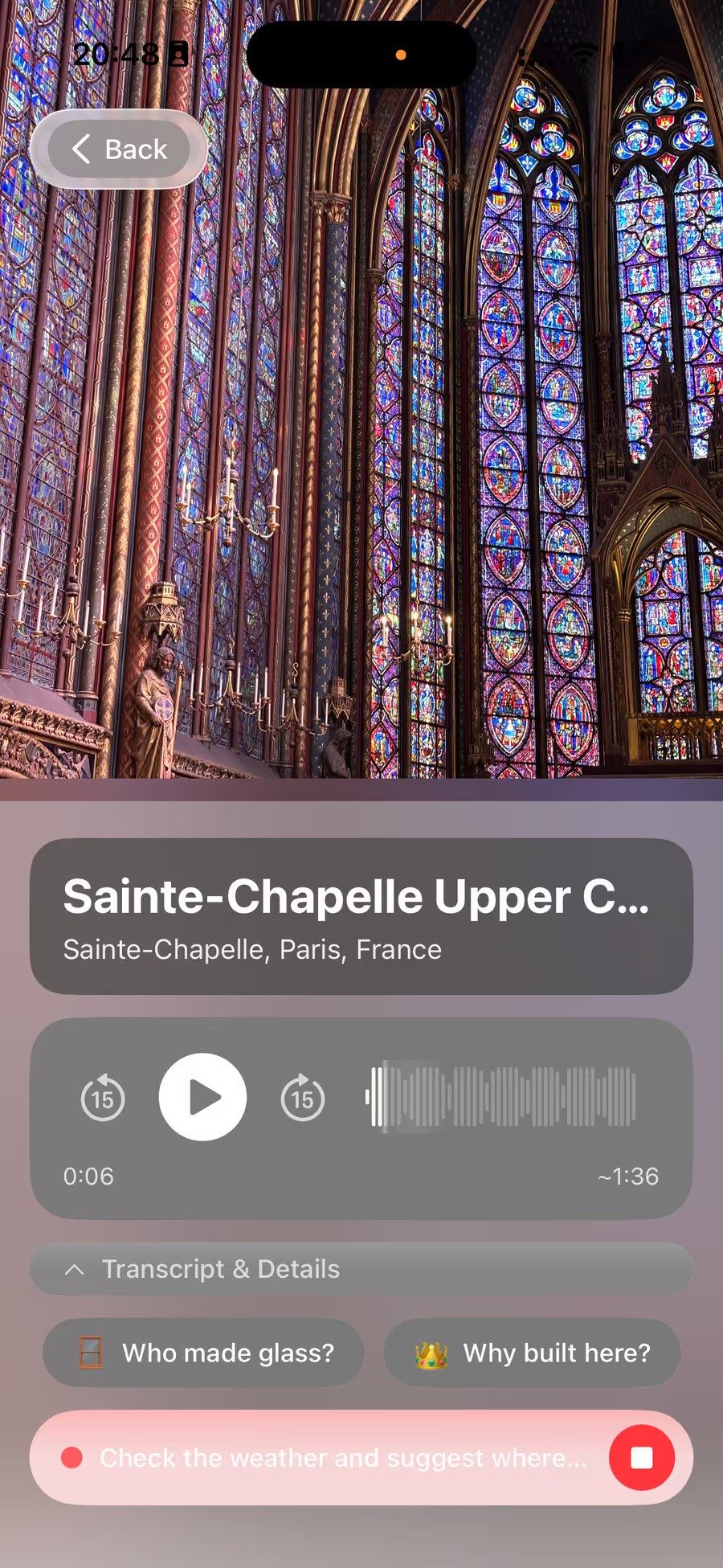
Curious? Just ask. “Who’s the saint with the wheel?” “Why is the bell tower separate?” “Is there a mass on now?” Type or say any question and Chiaro answers out loud. When the answer depends on today, like opening times or a service, it checks the web and brings back today’s answer.
In your language, and the local one. Chiaro speaks 18 languages, in a woman’s or a man’s voice. Place names appear in your language and the local one side by side, so the Stephansdom on the tram map and St Stephen’s Cathedral in your headphones are clearly the same building.
It connects the dots. The Map shows Chiaro’s picks around you, so you can find the next church worth the walk. Every evening, Chiaro turns what you saw into a Filo, a short story of your day that links the churches, the saints and the people who paid for them.
See how recognition works
The landmark pages on the Chiaro website are a demo of what the app does once it recognizes a building: five stops at each place, the kind of guide Chiaro builds from your photo, playing in your browser with no account. Churches among them include Notre-Dame, Sainte-Chapelle, Cologne Cathedral, St Paul’s, St Stephen’s in Vienna, the Sagrada Família and Seville Cathedral. In the app, any church you point it at gets the same treatment, including the one on your own street.
FAQ
How do I find out the name of a church?
Look for an inscription over the main door, the saint standing in the centre of the portal, or a plaque by the entrance, and check the labels near you on a map. Or point Chiaro at it and it will tell you.
What’s the difference between a cathedral and a church?
A cathedral is the church that holds a bishop’s throne, the cathedra. It’s about status, not size.
What makes a church a basilica?
In Catholic usage, basilica is an honorary title the pope grants to important churches. The word also describes a building plan with a tall central nave and lower side aisles.
How can I tell how old a church is?
Look at the arches and windows. Round arches and small windows suggest Romanesque. Pointed arches, big stained glass and spires suggest Gothic. Columns, pediments and a dome suggest Renaissance. Curves, gold and drama suggest Baroque. Many churches mix several.
Go inside
Most people photograph the front of a church and walk on. The front tells you what kind of church it is, who it belongs to and when it was built. The inside is where it tells you why.
Chiaro means “clear” in Italian. Get it on the App Store, point it at the next church you pass, and listen.
Snap. Listen. Explore.