On November 12, 1918, the day after the guns stopped on the Western Front, a seventy-seven-year-old painter with failing eyes wrote to his friend Georges Clemenceau, the prime minister. Claude Monet wanted to give the nation two paintings to mark the victory. Clemenceau came to Giverny, looked at what was leaning against the studio walls, and talked him into giving a great deal more. Eight years later, Monet was dead, and the French state was still building the rooms to hold his gift.
Yet the water lilies Monet grew and painted for thirty years are not one painting but a scattered archipelago. There are roughly 250 of them. A few are the size of a kitchen window. Some are the size of a city bus. They hang in Paris, New York, London, Chicago, Zurich, Kansas City and Tokyo, and one of the most famous of them no longer exists, because it was destroyed in a fire in Midtown Manhattan in 1958.
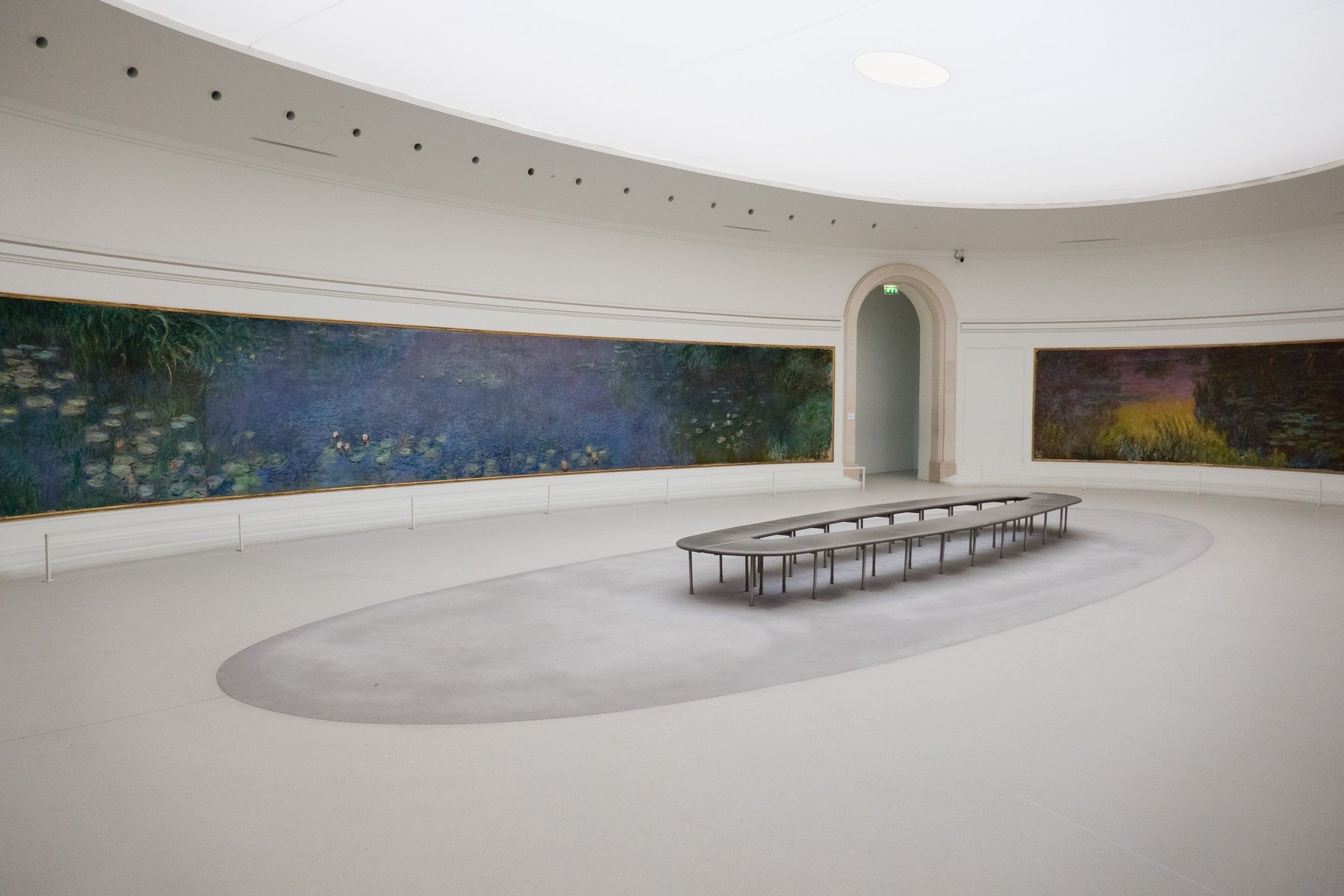
Here is the short answer. The essential set is the eight wall-sized compositions at the Musée de l’Orangerie in Paris, installed in two oval rooms that Monet designed the experience of himself. The second stop is the Musée Marmottan Monet, which holds the studio canvases his family kept. The best set outside France is the nearly forty-two-foot triptych at MoMA in New York.
A pond he dug so he could paint it
The paintings start with a piece of swampy land. Monet rented a farmhouse in the Normandy village of Giverny in 1883 and bought it in 1890, once his paintings had finally started to sell. In 1893 he bought another plot across the road and the railway line at the bottom of his garden. There was a small pond on it. He asked permission to divert water from a local stream, and the neighbors objected, because they were afraid his exotic plants would poison their water. He got his way.
He filled the pond with new hybrid water lilies from the Latour-Marliac nursery in the south of France, the same nursery that had shown its colored lilies at the Paris World’s Fair of 1889. In 1895 he built the humpbacked wooden footbridge in the Japanese style, painted green, copied from the prints he collected. He hired a gardener whose job, the story goes, included rowing out every morning to wash the road dust off the lily pads.
Monet did not stumble on a beautiful pond. He engineered one, staffed it, and then spent three decades painting it. The garden was the first artwork. The canvases were the record.
From footbridge to no horizon at all
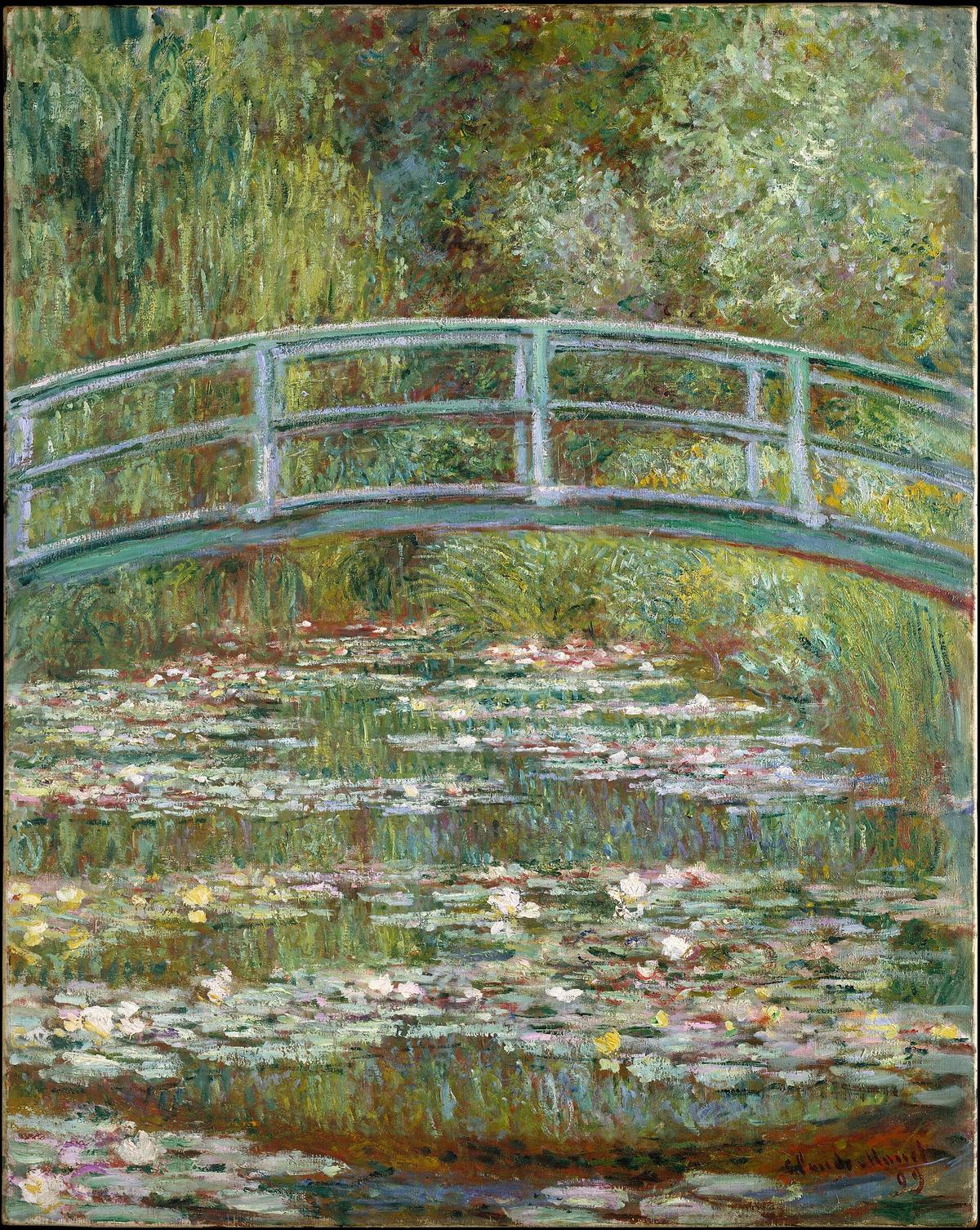
The first water lily paintings, from the late 1890s, look like normal landscapes. There is the bridge, a bank, a sense of where you are standing. The Met’s Bridge over a Pond of Water Lilies, from 1899, is one of more than a dozen views of the bridge Monet painted that year and the next.
Then, around 1903, he started cutting things out. First the bridge went. Then the bank. Then the sky, which survives only as a reflection on the water. By the time Monet showed forty-eight water lily canvases at the Durand-Ruel gallery in Paris in May 1909, the pictures were almost all surface. No horizon, no ground, no fixed point. You are looking straight down into a pond that has swallowed the world above it.
The next five years were brutal. The Seine flooded in 1910 and drowned the garden. His second wife, Alice, died in 1911. In 1912 a doctor told him he had cataracts. His son Jean died in 1914, and then the war came. Monet stayed in Giverny anyway and, in 1915, built a huge new studio with a glass roof, an ugly industrial shed that he complained spoiled the property. Inside it he began the grandes décorations, canvases about two meters tall and up to six wide. He made more than forty of them and destroyed some along the way.
Water Lilies: Monet’s gift to France, and the rooms he never saw
The gift to the nation grew from two panels into twenty-two panels forming eight compositions. Monet signed the contract with the state in April 1922. He set conditions. The paintings had to be shown together, in natural light, in a space he approved, and he chose the Orangerie, the old greenhouse for orange trees at the western end of the Tuileries garden, beside the Place de la Concorde. The architect Camille Lefèvre built two oval rooms laid end to end along the east-west axis of the city.
Then Monet stalled. He kept repainting. He was still reworking the panels after a cataract operation in 1923, which left him seeing colors strangely for months. Clemenceau, who had made promises on his behalf, sent letters that ranged from coaxing to furious. Monet died at Giverny on December 5, 1926. The panels were installed the following spring, and the rooms opened to the public in May 1927. He never saw them hung.
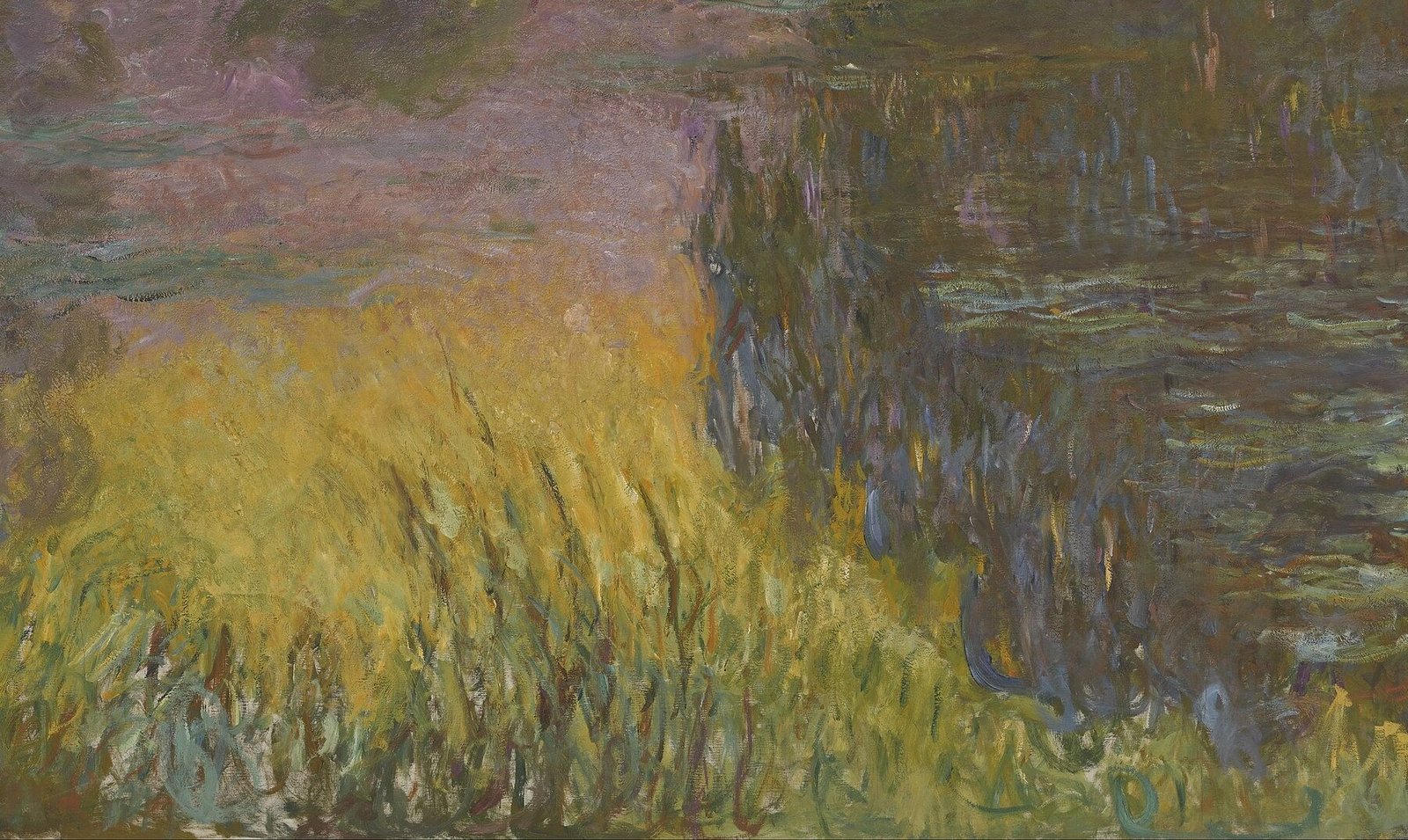
What he wanted the visitor to feel, in his own words as the museum quotes them, was “the illusion of an endless whole, of a wave without horizon and without shore.” The four compositions in each room curve around you with no corners to rest your eyes on. There is no beginning and no end. There is only the pond, at every hour of the day, all at once.

The Sistine Chapel that nobody visited
Here is the part the gift shop leaves out. For about twenty years, almost nobody cared. By 1927 Monet’s late style looked like a sick old man’s mess to the younger generation, and the critics blamed his eyes. The rooms were cold and badly lit. Water leaked through the dirty skylights onto the canvases. At least once, another exhibition was hung right in front of the panels. During the Second World War, shrapnel from the bombing of Paris lodged in the canvases.
The turn came after the war. A renovation was finished in 1952, and the painter André Masson called the rooms “the Sistine Chapel of Impressionism.” American painters walked in, saw canvases with no edges and no center, and recognized something they were trying to do themselves. Suddenly Monet’s leftovers in the Giverny studio were the most wanted paintings in the world.
One more indignity was coming. A 1960s renovation stacked two floors of galleries over the oval rooms for the Walter-Guillaume collection, and the daylight Monet had demanded was replaced by electric light. A restoration from 2000 to 2006 tore those floors out and brought the sky back. Today a cloud passing over the Tuileries passes over the pond.
How to see the Monet water lilies at the Orangerie
The Musée de l’Orangerie is open from 9 a.m. to 6 p.m. every day except Tuesday, with last entry at 5:15 p.m. On Fridays during exhibitions it stays open until 9 p.m., at a reduced price after 6. A full ticket is 12.50 euros online, and a combined ticket with the Musée d’Orsay costs 20 euros, which makes sense if you are doing both. Entry is free on the first Sunday of the month, but you have to book a time slot. Closest Métro: Concorde, lines 1, 8 and 12.
Timing matters here. Book the 9 a.m. slot or come after 4 p.m.; late morning, when the tour groups arrive, is the worst time of day. On a gray winter afternoon the panels go cool and blue. On a bright day in June the whites flare. They are different paintings.
Do not walk the walls like a corridor. Sit on the central bench of the first room for five minutes before you move. From the center, the panels read as one surface. From close up, they break into strokes as thick as rope. Then walk to the second room, where the willow trunks come down like the bars of a cage.
If you are visiting this winter, you are in luck. 2026 is the centenary of Monet’s death, and the Orangerie is running an exhibition called “Monet, painting time” from September 30, 2026, to January 25, 2027, with almost forty of his paintings leading up to the Water Lilies. The Walter-Guillaume collection on the lower level, with its Renoirs and Cézannes, comes with the same ticket. Our Paris Impressionism itinerary shows how to fit the Orangerie into a day with the Orsay across the river.
The Marmottan has what the family kept
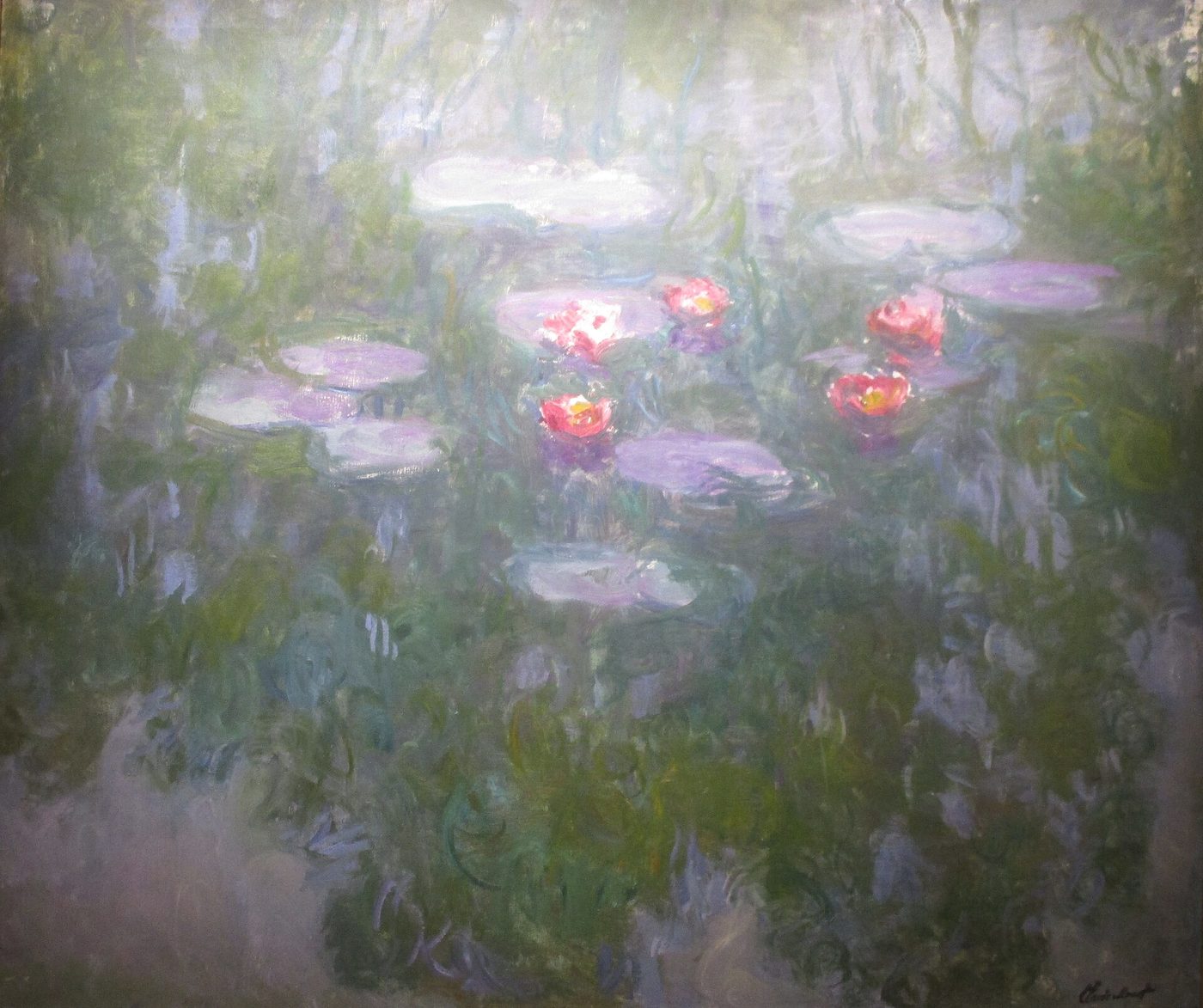
The Musée Marmottan Monet is a nineteenth-century hunting lodge turned mansion on the edge of the Bois de Boulogne, in the sixteenth arrondissement. In 1966 Monet’s son Michel left the museum everything the family still owned: the Giverny house and more than a hundred canvases. Many of them were the late garden and pond paintings that had never been shown in Monet’s lifetime.
They hang in a large room downstairs devoted to Monet, a low, dim space where the Water Lilies, the wisteria and the last Japanese bridges sit side by side. These are not the polished panels of the Orangerie. Some are ferocious. The final bridges, painted in the early 1920s when his eyes were failing, are tangles of red and orange in which the bridge almost dissolves. Upstairs, in the same building, is the small harbor scene that started it all, Impression, Sunrise. Fifty years separate the two rooms.
The Marmottan is open Tuesday to Sunday from 10 a.m. to 6 p.m., until 9 p.m. on Thursdays, and you do not need to book. Take Métro line 9 to La Muette and walk through the Ranelagh garden. For the centenary it is showing “Histories of Landscape: From Monet to Hockney” until January 31, 2027. Thursday evenings are the quietest.
MoMA’s water lilies, and the fire
In 1955 the Museum of Modern Art in New York bought one of the big late Water Lilies from Michel Monet, a panel about eighteen feet wide, for four million francs, then about 11,500 dollars. It added a smaller one the next year. Alfred Barr, the museum’s founding director, saw them as ancestors of the abstract painting coming out of New York, and hung the big one between floor-to-ceiling drapes like an altarpiece.
On April 15, 1958, a fire broke out on MoMA’s second floor, where workmen were repairing the air conditioning. A drop cloth caught, then the open cans of paint. An electrician died. Staff passed paintings out hand over hand, and nearly all of the museum’s two thousand were saved. The two Monets were too big to move. The smaller one burned in a stairwell. The big one was crushed under debris when firefighters broke through the windows behind it.
Barr went shopping again within ten days. Prices had exploded. The triptych MoMA agreed to buy at the end of 1958, with money from the Mrs. Simon Guggenheim Fund, cost about 150,000 dollars. It is the set you see today: three panels, about two meters tall and nearly forty-two feet long together, pink and violet clouds reflected in turquoise water. A single panel almost twenty feet wide came with it.

The triptych hangs in Gallery 515 on MoMA’s fifth floor, among the collection rooms for 1880 to 1950, but rooms rotate, so check before you go. If you are standing in front of it, Chiaro tells the story of the 1958 fire while you look at the panels that replaced the lost ones, and the cloud reflections in the center read differently once you know they are a second chance.
Where to see the water lilies Monet left everywhere else
After the big three, the series scatters. These are the holdings worth planning around. Museums rehang and lend, so confirm a painting is on view before you travel for it.
| Where | What | Why go |
|---|---|---|
| Musée de l’Orangerie, Paris | Eight compositions in twenty-two panels, 1914-1926 | The complete environment Monet planned. Nothing else comes close. |
| Musée Marmottan Monet, Paris | The family’s late Water Lilies, wisteria and Japanese bridges | The rawest late work, plus Impression, Sunrise upstairs |
| Musée d’Orsay, Paris | Water Lily Pond, Green Harmony, 1899, and Blue Water Lilies | The early bridge and the middle years; the bridge picture is lent to the Orangerie show this winter |
| MoMA, New York | The triptych, a single panel and Agapanthus | The best large set outside France |
| Metropolitan Museum, New York | Bridge over a Pond of Water Lilies, 1899 | The early series at its most conventional |
| National Gallery, London | Water-Lilies, after 1916, and The Water-Lily Pond, 1899 | A big late panel, about four meters wide, bought in 1963 |
| Art Institute of Chicago | Water Lilies, 1906 | A squarish middle-period canvas with no shore at all |
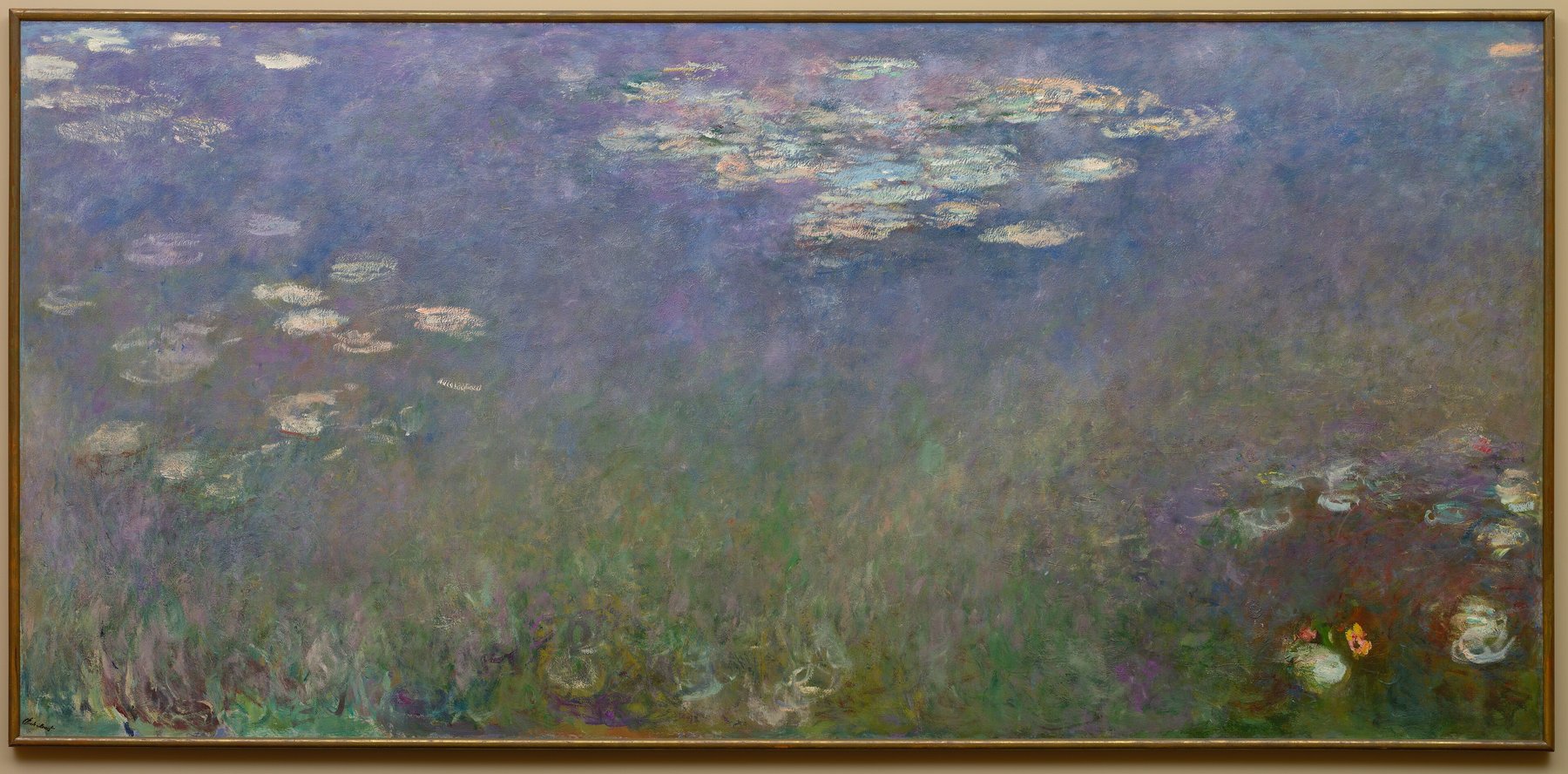
| Cleveland, Saint Louis and Kansas City | The Agapanthus triptych, split three ways | The left panel is in Cleveland, the center in Saint Louis, the right at the Nelson-Atkins |
| Kunsthaus Zurich | Large late panels bought after its 1952 show | One of the first museums to buy the big panels, when few wanted them |
| National Museum of Western Art, Tokyo | Water Lilies, 1916, and a damaged late panel | See below |
The Tokyo story deserves its own paragraph. The Japanese collector Kojiro Matsukata bought a huge Water Lilies, Reflection of Willows, in the early 1920s and left it in France, where it vanished during the Second World War. In 2016 a French researcher found it rolled up in a Louvre storage room, roughly half of it destroyed. It went back to Tokyo, was stabilized, and is shown as what it is: a ruin of a Monet, still shimmering.
The split Agapanthus triptych is the other one people chase. Its three panels were sold separately around 1960 and ended up in three Midwestern cities. They have occasionally been reunited for exhibitions.
Giverny has the pond, not the paintings
The house and garden at Giverny, run by the Fondation Claude Monet, hold no original Water Lilies. The paintings in the house are reproductions. What Giverny has is the pond itself, restored and replanted since the site opened to the public in 1980, with the green bridge, the willows and the lilies.
The garden opens for the season from early April to early November. In 2026 it ran from April 1 to November 1, so it is closed now until spring. Go early on a weekday in late May or June, when the lilies are open and the wisteria on the bridge is in flower. The water is much smaller than you expect. That is the point. Monet turned a pond you can walk around in a few minutes into a world with no edges.
Giverny works best as the last step. See the paintings in Paris first, then stand at the edge of the water and watch a cloud slide across it. You will see what he was looking at, and how far he went past it, the way the Woman with a Parasol is not quite the hill at Argenteuil.
Monet’s Water Lilies FAQ
How many Water Lilies paintings did Monet make?
Roughly 250 oil paintings of the lily pond, made from the late 1890s until his death in 1926, from small easel pictures to the huge decorative panels.
Where are Monet’s Water Lilies?
The main set is in two oval rooms at the Musée de l’Orangerie in Paris. The Musée Marmottan Monet has the largest group of late studio canvases. Outside France, the key one is the triptych at MoMA in New York, with others in London, Chicago, Cleveland, Saint Louis, Kansas City, Zurich and Tokyo.
How big are the Water Lilies at the Orangerie?
Each panel is about two meters, or six and a half feet, tall. End to end, the eight compositions run to roughly ninety meters, close to three hundred feet.
Why did Monet give the Water Lilies to France?
He offered them on November 12, 1918, the day after the Armistice, as a monument to peace. His friend Georges Clemenceau persuaded him to make the gift much larger than the two panels he first proposed.
Is it worth seeing the Water Lilies at the Orangerie?
Yes, and it takes less time than you think. Forty-five minutes covers the two rooms, an hour and a half the whole museum. Go at opening or late in the day.
Can you see Water Lilies at Giverny?
You can see the pond, the bridge and the real lilies from April to early November, but no original paintings. For the canvases, go to the Orangerie and the Marmottan in Paris.
What to look for in the oval rooms
Start in the middle of the first room at the Orangerie and turn slowly. Find the panel where the light is coolest and the one where it is warmest; you are looking at morning and sunset on the same pond. Then walk up close. The paint is thick, scrubbed and overlaid. Look for the vertical strokes that are not lilies at all but reflections of willow trunks on a bank you never see. Find the clouds. They are always upside down.
In New York, the same exercise works in front of the MoMA triptych: the dark sides first, then the pink center, where the sky has fallen into the water. And with one more afternoon in Paris, the late bridges at the Marmottan show you the same man, in the same years, painting almost blind.
Monet spent the last thirty years of his life looking down. The Orangerie asks you to do the opposite: sit still in a white room, look straight ahead, and let a pond in Normandy close around you on every side.